The ladies of "The View" had a hard time not laughing at Republican presidential candidate Donald Trump on Monday morning. The candidate suggested this weekend that his Democratic opponent Hillary Clinton was on debate performance-enhancing drugs, though he did not reveal what those drugs would be. He's demanded that Clinton take a drug test before the next debate, which the internet soundly mocked him for.
"Wait a minute," co-host Joy Behar said. "He was the one who was stalking and -- he was the one who was walking all around her and hovering and acting like he was pumped up. In the first debate, he was the one who was sniffing and sleeping. He's on downers and then uppers apparently of some sort. I don't know."
Co-host Jedediah Bila agreed, saying that the move makes Trump look desperate. "If you have to resort to this -- he's trying to put a message out there that -- he talked about her stamina repeatedly, she can't handle the job, she can't do this but honestly, go after her policy," she said. "Because if you're not going after her policy that means you're incapable. If I were going against Hillary Clinton I would have plenty to say and it wouldn't have to do with whether or not she was on drugs or her stamina. Her stamina is just fine. She was Secretary of State, she is a strong, intelligent woman, who you disagree with. Have the guts to take her on there or be quiet."
Sara Haines noted that there are so many things Trump could be talking about, but Whoopi Goldberg explained that doing so would require Trump to do his homework and learn about issues. "As opposed to having his team do stuff so they can go out and talk about it as opposed to him doing it. And, you know, I bet, she might be on, what did you say, Lipitor?" she asked Behar.
"Maybe she's on Lipitor," Behar said.
"Maybe she has a heart issue, that's what you're going to find. But are you going to do the drug test, too, Donald?" Goldberg challenged.
"He's on Viagra, you know it," Behar said, laughing. "You know it. Come on. Got to be either Levitra, Cialis or Viagra, the Holy Trinity of the pharmaceutical industry."
"Well, maybe that's the problem," Goldberg suggested. "Maybe he's uncomfortable because it lasted more than 15 hours. I'm just saying, you know, maybe that's why he was stalking her like that. He was just trying to get comfortable. I don't know. I just think, you know, there are things that we should be looking at, I guess."
Politics in America and Europe may be increasingly isolationist, but deadly pathogens aren’t. Votes for Brexit and Donald Trump may in fact be votes for worsening pandemics and fewer doctors and researchers to fight them.
This summer Brits chose to leave the EU and Americans nominated Trump as the Republican Party candidate. On both sides of the Atlantic, Brexiters and Trump supporters voted to go it alone. Their leaders preach keeping out immigrants and shunning multilateral organizations like the EU and NATO. But economic downturn and international criticism may not be the worst fallout.
As a global health researcher, I think the potential impact on our health could be even scarier. Here’s why.
The isolationism championed by Brexit architects and Trump alike endanger the coordinated efforts required to keep pandemicsunder control. The xenophobia that has been their rallying cry threatens health care delivery and critical health research at home.
Less cooperation, more disease
The Brexiters have parodied the EU as hamstrung and woefully inefficient. Trump has threatened to renege on NATO commitments due to unequal financial contributions of member states.
These critiques are not without basis: Multilateral organizations can be slow and at any given time, the costs and benefits may not be evenly shared. Some were even criticized for delays in responding to the exceedingly urgent Ebola crisis. But there are also intrinsic advantages to large-scale, multicountry cooperation, particularly when it comes to global health.
Pooling funds from more than 50 donor nations, The Global Fund for AIDS, TB and Malaria has supported low- and middle-income countries in saving an estimated 17 million lives since 2002.
Why is this approach better than each country providing its own unilateral assistance?
First, the Global Fund has streamlined the funding process; instead of applying to four dozen different funding sources, the government of Rwanda can expect to receive US$148 million to fight AIDS from a Global Fund grant over 18 months starting July 2015, according to the organization’s website.
Second, the Global Fund, in turn, pools country requests for lifesaving HIV and malaria treatments and buys drugs in bulk at cheaper prices. Their pooled procurement process is essentially the Costco of the global pharmaceutical market. Purchasing in huge quantities allows economies of scale and wholesale pricing that have helped bring the cost of first-line HIV treatment down from as much as $10,000 per person per year in 2000 to as little as $100 in 2016, according to a recent MSF report.
Growing isolationism
Yet, whatever the potential benefits for recipient countries, some may say treating HIV and malaria in Africa and Asia is simply not a priority in hard economic times at home. “Let’s fund our NHS instead,” the Brexit campaign plastered on its infamous bus wrap. “America First” pledges Trump.
On both sides of the Atlantic, the current political trend is not just unilateral; it is also inward-facing and isolationist. This is a losing strategy in the face of global epidemics like Ebola and Zika.
In fact, Ebola was brought under control only by a coordinated cross-border response, international collaboration throughout the regions most affected and worldwide contact tracing. Fragmented, uncoordinated responses allowed the epidemic to get out of control in the first place.
With more than half a million people now returned home from Zika-affected Brazil after this summer’s Olympics, we need to share information across borders and collaborate financially, strategically and operationally on control measures.
Turning away doctors and scientists
Ultimately, the political trend of isolationism isn’t just bad for controlling emerging epidemics. It threatens the day-to-day health of Brexit and Trump supporters alike. Migration has allowed medical systems in Europe and the U.S. to attract top global talent.
As Dr. Sarah Wollaston, a member of the British Parliament, said, “If you see a migrant in the NHS, they’re more likely to be treating you than standing in line in front of you.” A former GP and onetime Euro-skeptic, she campaigned to stay in the EU out of concern for the national health system.
Beyond direct medical care, isolationism risks crippling scientific research leading to new vaccines and medicines by restricting the flow of scientists and students to universities and research centers. Brexit could threaten funding for cancer and mental health research as well as the U.K.‘s ability to attract and retain scientific talent. Likewise in the U.S., xenophobic policies and sentiments could have a dire effect on advances in science; all six of the U.S.-based scientists who won Nobel Prizes this week are immigrants. Even with visa exceptions for certain professions, a nativist ethos makes any country a far less appealing destination for migrants with in-demand scientific and technical skills.
This summer, both Britain and America saw elites in populist clothing whipping up a frenzy by chanting “Vote Leave, Take Control” and “Make America Great Again.” The public health threat posed by these xenophobic, isolationist movements is just another indication of how ill they serve the public interest.
The Brexit referendum has already steered Britain down a dangerous path. But with global epidemics and domestic health care at stake, the U.S. still has time for cooler heads to prevail this fall before Trump is in the White House and his policies literally make us sick.
Republican nominee Donald Trump has been framing his failed campaign as one that was sunk by the media and a rigged election system. He has even called on his supporters to monitor polling places for alleged voter fraud on Election Day.
As Trump continues to make such irresponsible and baseless claims in an effort to refocus the cause of his sinking campaign, Ohio Secretary of State Jon Husted expressed his concern over Trump's narrative. He told the New York Times on Monday that Trump's allegations are "wrong and engaging in irresponsible rhetoric."
During a segment with CNN, Husted also said, "I can reassure Donald Trump that I am in charge of elections in Ohio and they’re not going to be rigged." He added, "We should not be questioning [the election process] or the legitimacy of it."
Husted has played an active role as a "voter fraud crusader" since he took office in 2011 as the Ohio Secretary of State.
In 2013, he launched an investigation into alleged voter fraud in Ohio, which found that most of the state's seemingly suspicious election activity was more likely due to confusion than fraud.
At the time, Ohio State Rep. Kathleen Clyde said in a statement, "I would like to see the Secretary of State focus on the real problems in our elections instead of playing to his base with these distractions." It appears that Trump's latest focus on voter fraud and rigged elections has shifted Husted's perspective.
In recent weeks, Trump has been ramping up his war on the media after the Washington Post released audio of the presidential candidate bragging about sexually assaulting women.
At least 17 women have come forward since the tape was released, and they have accused Trump of sexual harassment and assault.
The GOP nominee is now suggesting that these accusations are part of a media and Clinton campaign conspiracy against him in an effort to take down his campaign.
Husted told CNN he was "remorseful or regretful that [Trump is] saying things like this, which really undermine the potential he has as a candidate."
According to the latest RealClearPolitics polling average, Trump is down by 1.6 points in the battleground state of Ohio, with 42.4 percent voter support behind Clinton's 44 percent.
Texas Democrats have long sought salvation from an electoral drought, looking for champions who can fight back the Republicans who win all of the time.
Maybe they just need the right Republican. They’re hoping Donald Trump is their guy.
Recent polling and a lot of recent headlines about Trump and Hillary Clinton have Republicans in Texas worrying about the results at the top of the ticket in November.
They know they’re in a red state. A fair number are sticking with their candidate, and many think he’ll weather the current storm. But they’ve had a rotten run for the past couple of weeks — a ride rough enough to bring a little hope to the Democrats and a little fear to conservatives.
Recent history is with the Republicans.
xEMILY ALBRACHT
Without third-party candidates putting up big numbers, it would take a monumental collapse on the Republican side to turn Texas blue, or even purple.
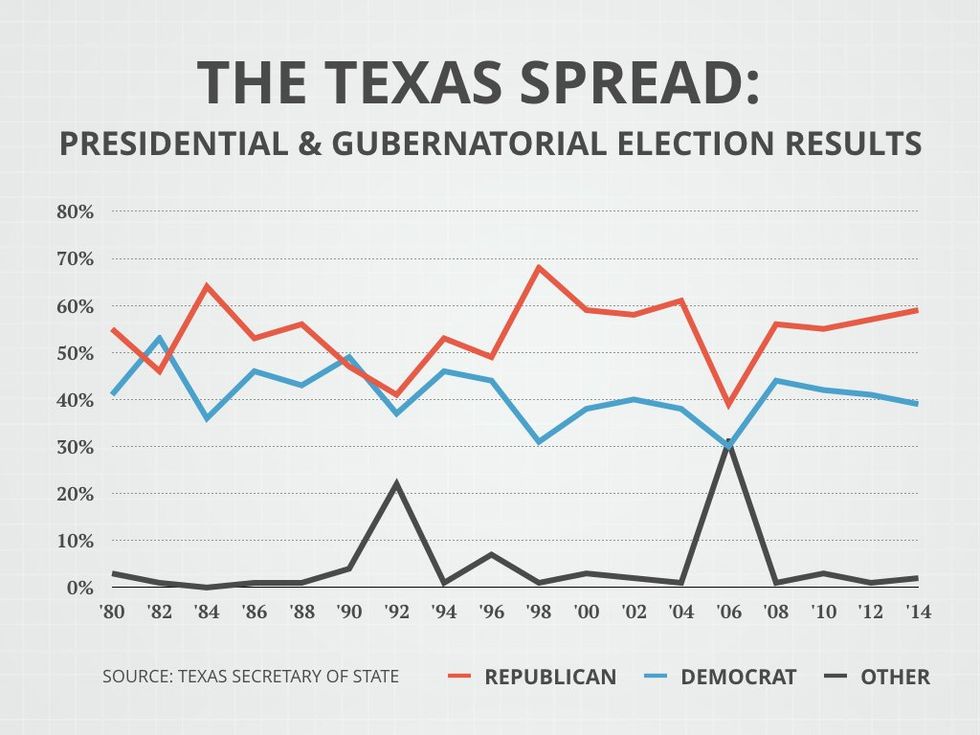
This is a double-digit Republican state in presidential elections. Only one Democrat — Jimmy Carter in 1976 — has been able to break the Republican streak that began in 1972.
Only one Democrat — Bill Clinton in 1992 and 1996, with an assist from data services billionaire Ross Perot of Dallas — has been able to hold the Republican margin under 10 percentage points during that four-decade period.
Races for governor — the marquee state contests in non-presidential years — don’t offer much hope. Democrats have won just two of those elections since 1978. That’s the year Bill Clements broke a historic drought for Republicans, surprising Democrat John Hill and taking up residence in the Governor’s Mansion.
The Democrats won it back in 1982, lost it, won it again in 1990 and have not elected a governor since. Most of those were, like the presidential races, double-digit wins for the Republicans.
Since Gov. Ann Richards lost to George W. Bush in 1994, only one Democrat lost by less than 10 points. Chris Bell lost to Rick Perry by nine percentage points, with an assist from third-party candidates Carole Keeton Strayhorn (now Keeton) and Richard “Kinky” Friedman.
Some presidential election watchers had high hopes for the Libertarian Party’s Gary Johnson and the Green Party’s Jill Stein, thinking the two would scoop up conservative and liberal voters who didn’t like the main contenders. Neither has made the kind of dent in the polls that Perot did, or that former Alabama Gov. George Wallace did before that.
Last week, a WFAA/SurveyUSA poll found Trump ahead of Clinton by only four points — a virtual tie in a survey with a four-percentage-point margin of error — with Johnson and Stein together getting just 4 percent of the votes.
To be sure, that poll was in the field as voters were coming out of the second presidential debate and watching a wave of revelations about recorded Trump comments about sexually assaulting women and a growing list of women who say he assaulted them.
It was, arguably, the worst possible time to take the candidate’s political temperature, and it might be transitory. Maybe Trump’s Texas voters will rally to his side before early voting starts on Oct. 24.
The predecessors set the marks. On the Republican side, Mitt Romney got 59.3 percent of the Texas vote in 2012; John McCain got 55.5 percent in 2008; former Gov. Bush got 59.3 percent in 2000 and 61.1 percent in his re-election bid four years later.
The Democratic numbers, as you might expect, are grim. No candidate has broken 45 percent since Carter. Bill Clinton got 43.8 percent in 1996; President Barack Obama got 43.7 percent in 2008.
The blue votes have fallen short of the red votes for years, which is why it seems so unlikely that Hillary Clinton might beat Trump in Texas in 2016. Losing Republican presidential candidates usually win here even when they can’t sell their ideas everywhere else.
If this year’s nominee has another week or two like his last week or two, he’ll put that recent Texas election history to a real test.
Some of Donald Trump's chief advisors appear to be more interested in damaging their longtime nemesis, Hillary Clinton, than getting the Republican presidential nominee elected.
In his latest video posted on GQ, Keith Olbermann demonstrated the links between Trump's presidential campaign and the so-called right-wing conspiracy that tried -- and failed -- to bring down Bill and Hillary Clinton in the 1990s.
"While certainly they want to defeat Hillary, relitigating the Bill Clinton legacy for the 4,000th time and beating her up and beating him up is almost as satisfying," Olbermann said.
Olbermann recalled conservative commentator Laura Ingraham, who he was dating at the time, explaining what he needed to know in 1998 about the "vast right-wing conspiracy" working to bring down President Bill Clinton.
Ingraham showed him a fax machine, where rumors and allegations were disseminated and then injected into the media conversation by Matt Drudge.
She explained there were only about a dozen conspirators involved, including pollster and opposition researcher Kellyanne Fitzpatrick and disgraced political investigator David Bossie.
Fitzpatrick went on to marry attorney George Conway, who had represented Paula Jones in her lawsuit against Bill Clinton, and Bossie became the director of the conservative Citizens United activist group.
They now serve as Trump's campaign manager and deputy campaign manager -- and Olbermann suspects the real estate developer and former reality TV star might be something of a victim in their ongoing efforts to destroy the Clintons.
"There are two things to understand," Olbermann said. "When Hillary Clinton said there was a vast right-wing conspiracy to undermine her husband, she was wrong. It wasn't vast, but it sure had stamina, even as its public faces like Newt Gingrich committed career suicide trying to lay the Clintons low. It stayed alive, often underground, until the opportunity arose for a comeback -- you know, like Dracula."
"That's the second thing to understand," Olbermann continued. "That opportunity was Donald Trump. He probably doesn't even realize it, but now you do, and in this part of this nightmare journey Trump is actually something of a victim. Sure, Ingram and Conway and Bossie and Drudge and the others would like to see him elected, but if he crashes and burns and ruins his businesses and has to leave the country in disgrace and goes into the history books as the man who tried to replace the government of the United States with a dictatorship with a bad combover -- hey, at least they scuffed Hillary up again. And a President Hillary means they can get the band back together and spend the next four years conspiring against her. They got what they wanted."
Ten of America's best teachers say they can no longer remain on the sidelines of the 2016 election.
Per Daily Kos, ten winners of assorted state "Teacher of the Year" awards have written a joint letter opposing Donald Trump's candidacy, while saying that they could no longer be neutral about an election this dangerous.
Specifically, the teachers said that Trump's behavior has made it harder for them to teach children how to properly treat one another.
"We teach children that girls are just as smart, capable, and worthy of respect as boys," they write. "Donald Trump has mocked women in myriad ways, including his post-debate tirades against Alicia Machado, his off-color innuendo about FOX host Megyn Kelly, and his predatory boasts about groping."
The teachers then go on to discuss the toll that the election has taken on their students, many of whom fear for their safety if Trump becomes president.
"The fear felt by people of color, including young children and their families, is real," they write. "An eight-year old Mexican-American girl came up to her teacher, her eyes wide and her expression solemn. She asked: 'Mr. Minkel, are you scared of Donald Trump? I am very afraid of him.' An Indian-American woman told her former teacher: “Mr. O, my 9 year-old came home upset and asked me if we will have to live on the other side of the wall—because that’s where brown people will have to live—and whether I will still be her mom if Trump wins."
A link tweeted by Sen. Ted Cruz (R-TX) that has since been deleted suggested that there would be "mandated sex change operations" if Hillary Clinton wins the presidency.
The column makes the case for conservatives creating a new party to oppose Clinton instead of aligning with GOP leaders who "are already planning to greet her with tailwinds instead of headwinds."
But while advocating for the new party, the column also veers into fringe conspiracies.
"[Texas Sen. John Cornyn's] biggest agenda item for a Hillary presidency is to grant her George Soros’s top policy agenda — jailbreak — which will help create a permanent Democrat majority," Horowitz writes, referring to criminal justice reform.
He goes on to predict "mandated sex change operations" by 2020 if conservatives are not able to stop Clinton.
"By that point, we will have mandated sex change operations," Horowitz warns. "Heck, our own military during a time of war and internal morale crisis has already published a handbook on sex changes. We simply don’t have the time to continue down this failed path. We’ve already been in the wilderness for 27 years."
They’ve all broken from their tradition of endorsing Republican nominees and have endorsed Hillary Clinton for president.
On the same note, The Chicago Tribune, USA Today and The Atlantic have also done something new this cycle: The Tribune endorsed the Libertarian candidate, Gary Johnson (the paper usually endorses the Republican nominee, except for Barack Obama in 2008). The latter two usually don’t make endorsements but have written editorials urging voters to either not vote for Republican candidate Donald Trump (USA Today) or vote for Hillary Clinton (The Atlantic).
This avalanche of surprise endorsements has raised an important question: Do newspapers endorsements even matter? And, if so, do some matter more than others?
Going to the betting markets
In 2008, we were living in Chicago when The Chicago Tribune decided to endorse, for the first time in its history, a Democratic presidential candidate, Barack Obama. It was big news.
As economists born outside of the United States, we were curious about this phenomenon. Around the world, newspaper endorsements for political candidates aren’t the norm; they certainly don’t take place in our home countries (Argentina, France and Portugal). So we decided to investigate the impact of newspaper endorsements.
We’re not the first to do so; in an influential paper, economists Chun-Fang Chiang and Brian Knight found that newspapers endorsements are likely to influence readers’ decisions, especially those of more moderate voters.
Building upon this research, we wanted to address a different issue: To what extent can newspaper endorsements influence the daily odds of each candidate winning?
Winning candidates will often receive a good chunk of endorsements. But it’s difficult to tell whether the endorsements helped get him or her the votes, or whether they earned votes simply due to the fact that they were good candidates. It’s the common dilemma of “causation or correlation.”
Therefore, our main challenge was creating a situation in which the quality of the candidate could remain constant, but the vote share could move.
To do this, we used data from online prediction markets – specifically, INTRADE, a now-defunct online platform that included a prediction exchange that would allow people to take positions (called “contracts”) on the probability of practically any event taking place. Contracts might include “England to win the 2010 Soccer World Cup,” “Jennifer Lawrence to win the Oscar for Best Actress” or, in our case, “Obama to win US Presidential Election” in 2008 and 2012. The price of a contract depends on the probability of the event taking place. For example, after England tied with the United States 1-1 in its first World Cup soccer match against South Africa, the corresponding contract for England winning the World Cup saw its price dramatically go down.
As such, the contract price reflects the average probability of a candidate winning the election, as estimated by market participants. For example, say the price of an “Obama winning the election” contract was US$5.25 on a given day. This meant that Obama had a 52.5 percent probability of winning at the time of purchase. If you bought a contract on that day – and if Obama ended up winning – you’d earn $10, for a net gain of $4.75. If he lost, the owner would lose his initial bet. Some researchers prefer these measures to polls because, rather than asking for a voter’s preferences, prediction markets make people “put their money where their mouth is.”
Following this tradition, we collected the data of the 2008 and 2012 elections, and used the price on the Obama contract to show his daily probability of winning. We then looked at how a day with a number of endorsements supporting one or the other candidate influenced this probability (measured at the end of the day).
But not every newspaper endorsement is equal, and it’s important to factor this into the analysis as well. Some have more readers than others. Some tend to support Republican candidates, while others tend to support Democratic candidates.
For this reason, we classified newspapers according to their political leaning along two dimensions already measured in the literature: (1) the media slant (a measure created in the influential work of economists Matthew Gentzkow and Jesse Shapiro) and (2) their propensity to endorse the Democratic candidate, data that come from the work of political scientists Stephen Ansolabehere, Rebecca Lessem and James M. Snyder.
The media slant measure – which examines the ideology of the newspaper and the language used in covering polarizing matters such as abortion, illegal immigrants and stem-cell research – is used to determine whether or not an endorsement is a surprise.
We then estimated the impact of such endorsements on Obama’s probability of winning.
The results, and what they mean in 2016
Our first findings built nicely upon previous research. We found, perhaps not surprisingly, that endorsements from high-circulation newspapers have a larger effect on the probability of winning.
More interestingly, our results suggested that endorsements that were a surprise (given the editorial board choices in previous elections) – but were still consistent with the traditional style and rhetoric of the newspaper – seemed to matter the most. For instance, The Chicago Tribune’s endorsement for Obama in 2008 seemed to have a significant effect. The paper had never endorsed a Democrat candidate before, but it also maintained its traditional center-right style and tone.
Overall, we found that on days with at least one endorsement, the endorsed candidate experiences higher odds of winning. There’s some evidence that this effect increases the more endorsements a candidate receives on a given day. However, this should be taken with a grain of salt; with each additional endorsement, the marginal effect decreases.
Among the many strange events of this election cycle are the huge share of surprise endorsements. Because one candidate, Donald Trump, has distanced himself from the traditional ideology of his party, he’s also distanced himself from the traditional ideology of some editorial boards. The combination of these two anomalies have brought newspaper endorsements into the spotlight more than ever before.
A chart compares newspaper endorsements from 2012 and 2016.
Extrapolating our results to the current election, this means that USA Today’s mandate to not elect Trump could have a significant effect, since it’s one of the top U.S. newspapers in terms of circulation.
And what about Hillary’s endorsements from right-leaning publications that endorsed Romney in 2012, like The Cincinnati Enquirer? Using our data from previous election cycles, if Clinton had a 50 percent chance of winning on the day of the endorsement, it would have likely increased her odds of winning the election by a couple of percentage points.
Putting our economists’ hats on, we know our results should be interpreted with caution, as they speak to short-run effects on the perceived probability of a candidate winning the elections. Those effects may fade as we get closer to election date or as long as other events take place during the campaign. Naturally, new information could emerge about a candidate that influences the final outcome. The most conservative interpretation of our results is that newspaper endorsements can help to create momentum that the receiving candidate can build upon.
In our paper, we explain in detail why the interpretation of our results should be taken as causal, and not casual. (That is, our identification strategy implies that the probability of winning increases due to the endorsements and not other events that may have taken place the same day.)
In sum, do endorsements matter? Definitely. They can help create momentum for the candidate and slightly shift the odds. But will they define the outcome on Election Day? Unlikely.
When Thomas More wrote his genre-defining book Utopia in 1515, he tapped into a stream of thought that ran from the world of Plato. The strong current of utopian thinking that influenced the politics, religion and art of the modern world continues to flow today, in both its hopeful and dismal tributaries.
More’s version of the popular traveller’s tale captures the ambivalence that accompanies ideas of utopia: is it a fantasy to be dismissed or a hope to be enacted?
The text is slippery, moving between satire and sincerity in ways that are difficult to distinguish. The name of More’s main “informant”, Raphael Hythloday, for example, can be translated from the Greek, as “knowing in trifles” or “nonsense”. And, of course, “Utopia” itself means “no place”.
But within the playful tone of Utopia is a detailed account of a cohesive and contented society that contemporary Europeans would have recognised as a direct inversion of their own precarious real world.
16th-century Europe can be seen, in contrast, as the other side of the Utopian coin; what we would call dystopia.
Doomsday discourse
The world is witnessing another iteration of this well-established twinned trope in Donald Trump’s campaign to be America’s next president.
Both the utopian and the dystopian are deployed in Trump’s speeches. His acceptance speech at the Republican National Convention lacked More’s subtle irony, instead offering a powerful blend of hope and horror.
Trump’s convention speech has been described as dark and apocalyptic. He talked of a “crisis” framed as an existential threat to “our way of life”.
Since then, at an August rally in Willmington, North Carolina (infamous for the suggestion that the “second-amendment people” could do something about Hillary Clinton choosing liberal-minded judges), Trump warned that a Clinton presidency would “destroy the country”.
He repeated this imagery of violent domestic chaos in the first of the presidential debates with Clinton, lamenting with the African-American demographic his perception of their reality:
You walk down the street, you get shot.
Trump extended this vision to the international scene in the second debate, mentioning:
… carnage all over the world.
Trump invokes the language of salvation
This current and anticipated cataclysm, however, is framed by the sloganised promise that, as president, Trump would “Make America Great Again”.
Ordinary electioneering is also boosted to the level of millenarian prophesy in statements like:
I have a message for all of you: the crime and violence that today afflicts our nation will soon – and I mean very soon - come to an end. Beginning on January 20, 2017, safety will be restored.
Like Karl Marx, Trump exhorts us to radical change but remains vague on the details of his achieved utopia.
In The German Ideology, Marx envisaged communism as a kind of paradise for enlightened gentleman farmers. Freed from the confines of subsistence, one could:
… hunt in the morning, fish in the afternoon, rear cattle in the evening, criticise after dinner.
Trump’s utopia, however, is construed more along the lines of negative freedom. Specifically, not being shot when one walks down the street or the absence of illegal immigrants.
It seems a critique of the dystopian present, rather than a promise of a utopian future, is the cultural force that has propelled Trump so far.
Competing visions
Two writers who have not been reticent to set out the details of 21st-century utopias are Paul Mason and Rutger Bregman.
Paul Mason’s Postcapitalism: A Guide to Our Future argues that the global finance system will be exhausted. Accordingly, proliferation of information technology will propel us beyond market-driven production. The resultant utopia will be, like More’s imagining, broadly socialist in conception.
While money is abolished in More’s Utopia, Mason sees it radically reduced in an economy of “free stuff” (enabled by thorough automation and knowledge circulating freely). One important and ongoing use of money in Mason’s postcapitalist utopia, however, will be the universal basic income.
This is a utopian notion that seems to appeal to even those outside the circle of re-constructed Marxism. Libertarians like this idea because it would remove the perceived ethical paternalism of the welfare system. Instead, the state would be merely a provider or guarantor.
The individual is then free to spend this guaranteed income in a way s/he sees fit. This could be a life of hunting, herding, fishing and critiquing - or not.
‘Free money’ is a notion already proposed by some of history’s leading thinkers.
The universal basic income is also central to the vision Rutger Bregman presents in his book, Utopia for Realists. While there are two key dystopian figures in Mason’s narrative – neoliberalism and climate change – Bregman’s utopia is more upbeat in its account of the present.
He notes that we are living in the world of neoliberalism’s triumph. But rather than despair, this leads Bregman to the conclusion that if ideas have changed the world before, they can again. Neoliberalism is simply a set of ideas, not a force of nature. The task is therefore a political one: change the ideas that organise our reality.
Bregman draws explicitly from the stream of utopian thinking and culture. Referring to the medieval dream of “Cockaigne” – where “rivers ran with wine, roast geese flew overhead and pancakes grew on trees” – he points out that in the context of the long history of human suffering and deprivation, we have already arrived in this land of plenty.
Repurposing a quote from William Gibson (a novelist familiar with the utopia-dystopia dyad), Bregman might say: Utopia is already here, it’s just not evenly distributed.
To the universal basic income Bregman adds two other requirements in order to achieve a global utopia now: open borders and a 15-hour workweek. The shorter working week would directly reduce CO2 emissions and distribute work and benefits more widely when the free movement of people is allowed.
His arguments for these three policy shifts are moderate rather than revolutionary. Indeed, in his account of the history of the universal basic income, Bregman tells how then-president Richard Nixon almost instituted the policy in 1968.
This might be of interest to Trump, given his law-and-order narrative is modelled on Nixon’s 1968 presidential campaign.
It is a sign of desperate times that such divergent stories, Trump’s apocalypse and Bregman’s global Cockaigne, can speak so compellingly to the present through the ancient language of utopia.
Donald Trump and his running mate, Mike Pence, are questioning the integrity of the American democratic process without any real evidence -- even as early votes are already being cast.
Jackie Kucinich, a CNN political analyst and the Washington bureau chief for The Daily Beast, said Monday morning on "New Day" that multiple studies had found fewer than three dozen instances of in-person voter fraud out of billions of ballots cast.
"This isn't a thing, but that's not stopping Donald Trump and Mike Pence, frankly, from spreading this," Kucinich said. "(Sunday) on 'Meet the Press' Mike Pence was asked whether they would accept the election results. He said, yes, but almost on the next breath he went back to the fact that this election is being rigged."
The Republican candidates' rhetoric threatened the peaceful transfer of power, said "New Day" host Chris Cuomo, although they produced no evidence of fraud.
"They haven't really offered any evidence, and so people are filling in the blanks themselves," Kucinich said. "That's why you see people quoted in various states that there might be violence. They're going to make sure that people who don't look like them are vetted or that they're going to watch them. It's troubling rhetoric coming out of the Trump campaign, and coming from down on the ground going into election day -- and let's not forget people are actually voting right now. So, it's not that there might be some fracas at the polls, but this is already happening."
Trump's rhetoric appears to be working.
A new poll found 41 percent of voters believe the Nov. 8 election could be "stolen" from Trump, who has encouraged his supporters to monitor polling stations in largely minority voting districts.
"It's called racial profiling," said Steve Webb, a carpenter and Trump supporter from Fairfield, Ohio. "Mexicans, Syrians -- people who can't speak American. I'm going to go right up behind them. I'm going to do everything legally. I want to see if they are accountable. I'm not going to do anything illegal. I'm going to make them a little bit nervous."
CNN's Alisyn Camerota said an exhaustive study by News 21, a group of top journalism students from universities all over the U.S., found 2,068 alleged instances of voter fraud, including 10 cases of voter impersonation, out of 146 million total registered voters.
"They drilled down on Arizona, Ohio, Georgia, Texas, Kansas -- that's where attorney generals actually prosecuted cases," Camerota said. "So beyond allegations, they prosecuted 38 cases of voter fraud -- 38 out of millions. In Arizona there were 13 cases of people prosecuted for double voting -- 13 -- and this is over 10 years, by the way. This isn't one year, over 10 years. Then the Republican National Lawyers Association also looked at it themselves and they found 200 allegations of election fraud, again, over 10 years."
Those isolated instances simply weren't enough to affect the outcome of a national election, and at least some of those cases were unintentional, said Alex Burns, a political correspondent for the New York Times and a CNN political analyst.
"It's usually not the kind of voter fraud that people imagine when they think of what happens when somebody steals an election," Burns said. "It's not people in a county courthouse stuffing ballots in a box or even showing up and me saying, 'Hi, I'm Chris Cuomo. I'm here to vote.' It's people voting in a jurisdiction where they're no longer technically registered or they haven't updated their registration, or they're in a primary where they're not supposed to be voting in a primary."
"Each of those infractions is something authorities, of course, ought to look at, but there is simply no indication that there is any kind of systemic problem with voting in this country," Burns said. "I spoke to the Ohio secretary of state yesterday, who is a Republican, who says we're trying hard to run a fair election here, and this kind of talk just it takes time away from doing our actual and difficult jobs."
Mexican craft brewery Cerveza Cucapá launched a hilarious campaign — not for a wall but for beer — and "Donald Trump is going to pay for our beers," they say.
A Spanish-language video was published during the first presidential debate, showing a man who traveled to Los Angeles and sold Trump T-shirts to unsuspecting Trump supporters. While the shirt read “Donald el que lo lea,” and showed the Republican nominee in a clown nose, no one noticed it was mocking Trump. The phrase is a variation of a well-known Mexican saying that only Mexicans and Mexican-Americans would understand.
Cucapá founder Mario García explained to Vice that the campaign came from Trump himself, who has claimed that Mexico will pay for the wall on the U.S. border. "Well, Donald Trump is gonna pay for our beers, even though he doesn’t know it yet," García said.
While getting Trump himself to cough up the cash proved more difficult, their T-shirt trick worked wonders on the Venice Beach boardwalk, along Hollywood Boulevard and Huntington Beach.
The first sale on video shows García sitting next to an old white man at a bus stop. He asks who the man, "Are you a Donald supporter?" The man says that he is, and snags a T-shirt.
The plan worked, except with the police, who seemed to have problems with T-shirt stand and further that García was filming interactions.
“Two police officers wanted to take away our merchandise and another moved us on,” she said. “There were a lot of people that insulted us, threw our merchandise on the floor, and shouted at us for supporting Trump, but there were also a lot of people who wanted to buy the shirts.”
The border issue has always been something that the brewery has talked about. Founded in 2002, their first location was in Mexicali and gets their name from the indigenous Cocopah tribe, that settled on both sides of the U.S. and Mexican borders.
“At Cucapá we’ve always carried the theme of the border in our DNA, so it was very natural for us as a brand to want to do something about Trump,” García said.
Check out the video showing the T-shirt sales below:
Donald Trump surrogate Scottie Nell Hughes suggested on Monday that 1.8 million voters were committing "some sort of fraud" because of outdated voter registrations.
Hughes told CNN host Chris Cuomo that the 2016 election is being fixed in two ways: The media is biased for Hillary Clinton and it is "rigged [by] the voters on election day."
"Pew research in 2012 came back and said one in eight voter registrations are inaccurate," she said. "There is significantly [SIC] that they're no longer valuable. That's 146 million voters in the United States today, 1.8 million has some sort of fraud or has something wrong with their voter registration."
"The solution?" Hughes added. "Voter ID laws! That's why the Republicans are pushing so hard for it."
While the Pew Center on the States did publish a paper on the voter registration system in 2012, Hughes grossly misstated its findings.
The research found that 24 million registrations were "significantly inaccurate," and that 1.8 million deceased voters were listed on the rolls. Pew did not, however, find that incorrect registration information amounted to "voter fraud."
Hughes also noted that the purpose of ginning up fears of a rigged election "was all about who's going to turn their people out to the polls."
"The Clinton camp has one way of doing it, on strategy," she opined. "The Trump camp is saying, you have to turn out, there's no way you can just stay home this year if you want to see a Republican take over the White House."
In 2014, Loyola Law School professor Justin Levitt examined voting data and found just 31 legitimate cases of fraud in over 1 billion votes cast.
Watch the video below from CNN's New Day, broadcast Oct. 17, 2016.
Even as US presidential candidate Donald Trump aggressively condemned Beijing, his hotel firm pursued a lucrative business deal with a giant state-owned Chinese firm headed by a top Communist official, sources say.
Trump has long declared Beijing to be America's "enemy", but his Trump Hotel Collection (THC) negotiated with the State Grid Corporation of China -- an electricity company that is the country's largest state-owned enterprise -- to brand and manage a major development in the capital, according to sources with direct knowledge of the talks.
The process resulted in a memorandum of understanding for a deal potentially worth between $100 million and $150 million over 15 years, Robby Qiu, the former director of Trump's Greater China office told AFP.
The discussions were confirmed by a source who asked for anonymity to discuss sensitive business information.
Trump has repeatedly been accused of double standards during the election campaign, and questions have been raised about possible conflicts of interest due to his overseas deals.
China's state-owned enterprises (SOEs) are a key element of the Communist party's control over the world's second-largest economy, and seen as important tools for pursuing its policy and geopolitical objectives.
Unlike private firms, their top executives are directly appointed by the ruling party, and often hold senior party positions.
During his White House bid, Trump has frequently excoriated China, claiming it has stolen millions of American jobs through distorted trade policies and currency manipulation.
In his 2011 book "Time (Frankfurt: A11312 - news) to Get Tough" -- released as he pondered a presidential campaign -- he called China's leaders ?our enemy".
?What else do you call the people who are destroying your children and grandchildren's future... who are ruining our way of life?? he wrote.
"We shouldn't entertain Communists and beg for a few tiny contracts."
The negotiations with State Grid -- whose then chairman Liu Zhenya had been an alternate member of the Communist Party's Central Committee -- began a little over two years later.
Derek Scissors, an expert on US-China business relations at the American Enterprise Institute, told AFP: ?It does make him look considerably worse, in my view, to be working with branches of the Chinese state after so sharply criticising the policies of the Chinese state.?
State Grid is listed as the world?s second largest company by revenues in the Forbes Global 500 and provides electricity around 1.1 billion people across China.
Earlier this year Australia rejected a bid by it to purchase a regional electricity utility over concerns the deal would be "contrary to the national interest".
Several attempts by Chinese SOEs to invest in US firms and infrastructure have previously been blocked by Washington on security grounds.
- 'A great future in China' ?
THC, since renamed Trump Hotels, manages Trump?s portfolio of luxury accommodations and has struck licensing and management deals for Trump-branded hotels, residences and golf courses in countries from Panama to Azerbaijan and Indonesia.
Trump has said he has 121 projects abroad, telling Vanity Fair they include ?numerous deals? in China.
His companies' current activities in the Asian country remain unclear.
Negotiations with other SOEs and at least one Chinese city government continued at least through the opening months of Trump's presidential campaign, according to Qiu, who moved to a different employer late last year.
In July 2015, a month after Trump declared his candidacy, the company's office in Shanghai began recruiting for two employees with experience working with "large state-owned corporations", according to a job posting seen by AFP.
Last October THC chief executive Eric Danziger told the state-owned China Daily newspaper that it was "actively" pursuing deals in major Chinese metropolises including Beijing, Shanghai and Shenzhen.
Trump has sought business in China since at least 2006, when documents filed with the Chinese government show he began trademarking his name in Hong Kong and on the mainland.
In 2008 he agreed with Chinese property developer Evergrande and Hong Kong-based Orient Property Group to try to build a development in Guangzhou, according to filings to the Hong Kong stock exchange. But nothing ever came of the collaboration.