Donald Trump may not only hire the best people, but he does seem to have a lock on hiring people who make up wild conspiracy theories on the Clintons.
The Daily Beast on Thursday took a look back at a book written by Trump deputy campaign manager David Bossie, in which he said that Bill Clinton was to blame for the 9/11 terror attacks.
The reason that Clinton was to blame, Bossie insisted, was because he hated our military and intelligence services, and tried to undermine their strength and operational capabilities at every step.
In particular, Bossie says that one of Clinton's top methods for undermining our national security infrastructure was support for letting gay people serve in the military and at the CIA.
For instance, Bossie asserted that Clinton severely depressed military morale with his policy of letting gay people serve as long as they didn't reveal themselves publicly as homosexuals.
"That Clinton continued to loathe the military was revealed as soon as he took office and attempted to overhaul military policies, such as allowing homosexuals to serve with the new ‘don’t ask, don’t tell’ policy," he wrote.
Bossie also slammed Clinton for purportedly recruiting gay people to work in our intelligence agencies.
"Historically, there had been serious security-clearance issues and concerns about homosexuals in the intelligence community, concerns based on legitimate rationales,” Bossie wrote in his book. “Unfortunately, in the Clinton administration, we didn’t see any serious study of the issue. Rather, Clinton’s ideology, and his need to pay back the homosexual community, forced the CIA to change, regardless of the effect on national security. Where will this end? It is hard to say."
Bossie's tirade against gay people working in the intelligence community is particularly rich since J. Edgar Hoover -- who was the first-ever director of the FBI and a longtime right-wing hero -- is widely believed to have been gay.
U.S. Democratic presidential candidate Hillary Clinton chastised Republican rival Donald Trump on Thursday for hinting about things he learned in classified intelligence briefings he has received as the nominee.
Speaking to reporters the morning after a New York forum on security featuring separate appearances by the two candidates, Clinton said the businessman was "inappropriate and undisciplined" in discussing his briefings from U.S. officials.
"I would never comment on any aspect of an intelligence briefing I received," said Clinton, a former secretary of state, before boarding her campaign plane.
At the televised forum on Wednesday night, Trump said he was "shocked" by information he got during the briefing. "What I did learn is that our leadership, (President) Barack Obama, did not follow what our experts ... said to do," he said.
Obama hit back at Trump on Thursday for criticizing his foreign policy record, saying the Republican nominee for the Nov. 8 election was unfit to follow him into the Oval Office and the public should press him on his "outright wacky ideas."
(Writing by John Whitesides; Editing by Frances Kerry)
A simple interview with MSNBC's "Morning Joe" turned into a Sarah Palin moment, when Libertarian candidate for president Gary Johnson was asked about Aleppo while talking about Syria and ISIS.
"And what do you do about Aleppo?" Mike Barnicle asked Johnson.
"And what is Aleppo?" Johnson asked. Barnicle asked if he was kidding.
Aleppo, of course, is the part of Syria we see splashed across the news for chlorine attacks and refugee camps. It's a major part of the conversation about how we handle the war against ISIS.
It didn't take long before Twitter was lighting up with #WhatIsAleppo and calling the statement career ending or disqualifying for a presidential candidate. "Morning Joe" panelist Mark Halperin remarked that Johnson and other third party candidates pitch that they should be taken seriously, but how can they be when they don't know basic information about foreign policy.
Check out the Twitter backlash below (and a video of the face-plant):
The CNN "New Day" morning panel joined the chorus of heckling against candidate forum moderator Matt Lauer on Thursday, but it was CNN senior media and politics reporter Dylan Byers who crushed him.
"Political interviews, forums, town halls, debates, these are really big, significant deals. They're especially big, significant deals given all that's at stake in the 2016 election. You don't send Matt Lauer to do a political reporter's job. Look, in a debate, it might be fair to argue that you can let the two candidates fact-check each other. But when it comes to these one-on-one interviews, these forums, you have to step up and play that role. That onus is on you, and Matt Lauer didn't do that. He certainly didn't do that with Donald Trump. He didn't do it on the Iraq War. He didn't do it on a number of other issues and frankly, this criticism that he went a lot harder on Hillary Clinton than Donald Trump, I think, is well founded."
Fellow reporter Brian Stelter agreed, saying political reporters have an ethical duty to hold both candidates to the same standards. "I saw the journalistic challenge of this decade. Interviewing Donald Trump and challenging him when he is wrong is the unique challenge of our time. Hillary Clinton is a challenge as well, but Trump is a unique challenge and Lauer did not step up to that challenge last night."
During last night's Commander-in-Chief Forum, Donald Trump doubled down on an old tweet where he claimed that widespread sexual assaults in the military were an inevitable consequence of putting men and women together in the armed forces.
Rep. Mark Takano (D-CA) appeared on CNN Thursday morning and tore into Trump for not taking the opportunity to repudiate his old views on women in the military.
"The idea that sexual assault and rape are a natural, inevitable consequence of putting men and women together in a working context is simply absurd," said Takano, who is the ranking member of the United States House Committee on Veterans' Affairs. "Donald Trump should have rejected and repudiated what he said instead of doubling down on it."
Takano also trashed Trump's purportedly novel proposal to create a court system in the military, as he noted that we've had a military justice system in place for years to handle sexual assault claims.
How does a belief in American exceptionalism shape foreign policy?
The views of the presidential candidates will likely be on display during a national security and military affairs forum hosted by the Iraq and Afghanistan Veterans of America and NBC News this week. What may be most surprising is not what the candidates say, but the way in which they say it. Donald Trumpdislikes the term “American exceptionalism” and refuses to use it. Hillary Clinton said in August, “If there’s one core belief that has guided and inspired me every step of the way, it is this: The United States is an exceptional nation.”
She is not the only Democrat making this profession of faith. Two years earlier, Obama declared, “I believe in American exceptionalism with every fiber of my being.”
This sort of language has historically been associated with Republicans, who added a belief in American exceptionalism to their 2012 party platform. Now, Ronald Reagan’s “shining city on a hill” is moving across the aisle. In adopting such rhetoric, however, Democrats are also trying to reframe it.
American exceptionalism – defined as “the conviction that our country holds a unique place and role in human history” – has long celebrated a singular people specially called to spread liberty and democracy to the world. The exceptionalism touted by Obama and Clinton celebrates a diverse country that sees other nations as essential partners for global good. Theirs is an American exceptionalism with a cosmopolitan twist.
In a course I teach on the history of American exceptionalism, my students and I look at how this rhetoric has evolved into a story of a nation with a grand and global mission. Politicians, standing in the middle of the story, often choose a beginning that will define America and direct the country to its proper end. Knowing how that story has traditionally been told, we can see how Obama and Clinton are adapting it to redefine the nation’s identity and purpose in the world.
Cosmopolitan exceptionalism
In her embrace of American exceptionalism, Clinton stated, “We celebrate diversity as a source of national strength.”
Consider the contrast between this statement and the ideas of Josiah Strong, a 19th-century Protestant clergyman whose unexpectedly popular book “Our Country: Its Possible Future and Its Present Crisis” spelled out what many of that time believed about America. Strong contended that the Anglo-Saxon race was “the representative of two great ideas”: civil liberty and a pure, spiritual Christianity. These “two great needs of mankind” flourished best in America, Strong contended. And as America increasingly embraced them, they would spread to all the world.
Strong’s hope for a transformed world reveals how theology and politics became intertwined in the history of American exceptionalism. During the 19th century, the story of America settled on a narrative of God-given liberty – a tale of self-government spreading from the Puritans through the Founders to a future world saved by the grace of America. As the influential preacher Washington Gladden asked in 1909, “Is there not work to do in the salvation of the world which can only be done on the scale of the nation?”
The idea was that God works his purposes primarily through nations, not churches – and specifically through one nation, the United States. That idea appealed to many at a time when the United States was rapidly expanding its influence around the world. It gave American power a religious purpose of redemption.
Such was the Cold War ideology that fueled Ronald Reagan’s “shining city on a hill.” Reagan loved to tell a story of America that began with John Winthrop, the first governor of Massachusetts Bay. Shortly before arriving, Winthrop declared to fellow Puritans: “we shall be as a city upon a hill.” Borrowing this phrase from Matthew 5:14, Winthrop hoped New England would model godliness, along with all other true Christian communities across the world. According to Reagan, however, the Puritans came primarily in search of freedom. And ever since, Reagan claimed, Americans had remained true to that noble ideal, serving as a beacon of liberty in a world threatened by communism.
When Mario Cuomo challenged Reagan, arguing that America was really a “tale of two cities" – a story of success for the few and constraints for the rest – Democrats became known as the opponents of American exceptionalism. This is the view Obama tried to flip when he set Trump against Reagan: “Ronald Reagan called America ‘a shining city on a hill.’ Donald Trump calls it ‘a divided crime scene’ that only he can fix.”
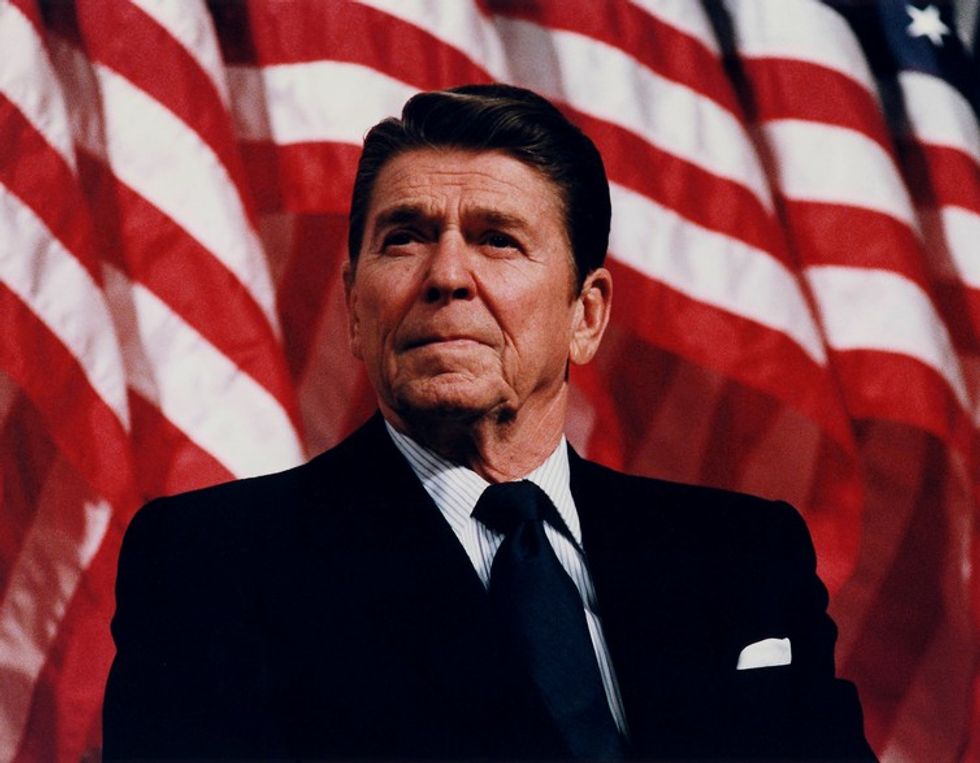
President Ronald Reagan speaking at a rally in Minnesota.
For many years, Obama, like Reagan, has sketched a story of America that begins with the Puritans, our “earliest settlers,” and carries forward by remaining “true to our founding documents.” Yet, the national narrative he offers has attempted to alter Americans' understanding of what Strong called our country’s “present crisis” and “possible future.” For both him and Clinton, the military exemplifies American exceptionalism – not because of its might, but because of its diversity. Obama said, it represents “every shade of humanity, forged into common service.”
That celebration of diversity includes affirming other nations' contributions to global good. According to Clinton, “American leadership means standing with our allies because our network of allies is part of what makes us exceptional.“ In this newer exceptionalism, America fights not only for others, but with others. As Obama explained, “what makes us exceptional is not our ability to flout international norms and the rule of law; it is our willingness to affirm them through our actions.” In the language of American exceptionalism, Obama has tried to claim that America is exceptionally good at following norms set by international coalitions.
A new exceptionalism, an old problem
While it may seem radically new in some ways, this rhetoric of Obama and Clinton reveals a longstanding tension in the language of American exceptionalism: How should a nation that sees itself as a savior shape its foreign policy? When it comes time to act, after all, the nation must decide whether it is acting primarily in its own interest or in the interest of others.
In his book, Strong proclaimed, “Our plea is not America for America’s sake; our plea is America for the world’s sake.” What is good for the nation, he was saying, is good for the world. In fact, Strong’s entire book is based on the premise that the savior, America, must be preserved from several evils, including Mormons, Catholics and immigrants, in order to save the world.
Over a century later, Clinton much more subtly made the same kind of claim, that serving American interests ultimately serves the world. Clinton declared: “American leadership means leading with our values in pursuance of our interests, in protection of our security.” The entire sentence centers on the values, interests and security of the United States. But Clinton continued: “At our best, the United States is the global force for freedom, justice and human dignity.”
Together, these back-to-back lines eliminate any difference between national goals and global good. In the rhetoric of American exceptionalism there is no distinction between self-interest and world service.
While Obama and Clinton have endorsed a newer, more diverse and cosmopolitan exceptionalism, its primary narrative nonetheless remains intact. America is “the indispensable nation,” as Clinton reiterated. She offers a vision of the world as a round table where America, paradoxically, remains seated at the head.
How have we gotten to the point where it's normal for a presidential candidate heap praise on Vladimir Putin, not understand that the military has a court system, and talk openly about purging a large chunk of senior officers from the military?
President Obama on Thursday said that a lot of it has to do with how our media has covered Trump as though he's a regular presidential candidate, rather than a dangerous outlier who has broken democratic norms during every step of his campaign.
"There is this process that seems to take place over this electoral season where somehow behavior that in normal times we would consider completely outrageous and unacceptable becomes normalized," Obama said during a news conference while on his trip to Asia. "And people start thinking we should be grading on a curve."
Obama also challenged the media to treat Trump as though he were a real presidential candidate and not just some joke candidate who deserved less scrutiny.
"I think it's important for the public, and the press, to just listen to what he says and to follow up, and ask questions about what appear to be contradictory, or uninformed, or outright wacky ideas," he said.
Moderator Matt Lauer has come under heavy fire for his performance on Wednesday night at the Commander in Chief Forum, in which he let Trump get away with falsely claiming that he had always been against the invasion in Iraq, among other things.
From the New Republic to the Washington Post, editorials are beginning to write about the Donald Trump scandals that cable news seems to be ignoring. Perhaps, that's why "Late Night" host Seth Meyers did his own comparison of the candidates.
Questions have plagued the Hillary Clinton for the use of a private email server while serving as Secretary of State. Last week, the FBI released notes from the interview with Clinton revealing that she didn't know that the letter "C," when embedded somewhere in the email meant "confidential." It seems Trump didn't know it meant that either since he tweeted, "Lyin' Hillary told the FBI that she did not know the 'C' markings on documents stood for CLASSIFIED. How can this be happening?"
"Ya know," Meyers began his hilarious smackdown. "It's so great that when Trump is wrong he does us the favor of highlighting it by putting it in all caps. It's only a matter of time before he tweets, 'Our best president was our first president ABRAHAM LINCOLN.'"
Meyers concluded that only Trump could take an issue that has dogged Clinton in the polls and "turn it into a bizarre conspiracy theory fever dream." At a rally in North Carolina Tuesday, Trump implied that the "IT aide who pleaded the 5th and who is still very much alive may actually be dead." After playing the clip of Trump asking where the IT guy went, Meyers explained that pleading the 5th doesn't mean someone then dies. "It just means, he's the IT guy," he said.
"One reason you probably heard less about it is because it's not exactly clear what the Trump Foundation does," Meyers said. "The Clinton Foundation provides life-saving care to AIDS patients while the Trump Foundation once gave $250 to the Special Olympics and $100 to the March of Dimes. Did he think the name meant you could only give dimes?"
"The irony is that Trump University offers a class called 'Looking the Other Way,'" Meyers joked.
Trump swore he never even spoke to Bondi and that the whole incident is merely a coincidence. However, it wasn't just the Trump Foundation that donated to Bondi while she was considering fraud charges. Trump and his daughter Ivanka, separately gave $500 to Bondi's re-election campaign.
"Everyone knows there's three things Ivanka Trump cares about: the real estate business, high-end fashion, and down-ballot Florida politics," Meyers joked.
The problem Trump has is that he spent the entire primary season openly bragging about buying influence with both Democrats and Republicans.
"Think about how sad that is," Meyers said about giving Clinton a donation and her attending his wedding later. "He is bragging that he had to pay people to come to his wedding. And I'm pretty sure Hillary wasn't the only one who was there for the money," Meyers said, flashing a photo of Melania Trump on the screen.
"And yet, after months of accusing Hillary of pay-to-play at the Clinton Foundation and calling for her to be in prison Trump supporters including former federal prosecutors Chris Christie (R-NJ) and Rudy Giuliani are brushing off these allegations against Trump as completely innocuous. I guess they'll just defend anything Trump does, or as Trump himself put it," Meyers said, before playing a clip of Trump saying, "they kiss my ass."
When it comes to Donald Trump and his supporters predicting their victory in November, they've begun using cloud formations to match their prophecy.
Wednesday night on Stephen Colbert's "Late Show," the host revealed a tweet from Trump's lawyer, Michael Cohen, that depicted a cloud formation similar to Trump's profile. Cohen captioned the photo, "In case anyone is unsure as to who will be our next #POTUS, the Lord has chosen the people's messenger."
Cohen later retweeted himself saying, "Yep, even the Lord, himself, is a fan of the #TrumpTrain."
"Yes!" Colbert exclaimed. "God made a Trump-shaped cloud. Though the cloud actually holds a position longer than the real Donald Trump can."
Colbert, a devout Catholic, admitted that God works in mysterious ways, "because, later that day, He also endorsed a sea horse, a ducky and your mother making love to the mailman," he said showing cloud photos.
This week, Trump also insulted Democratic rival Hillary Clinton by saying that she didn't have "the presidential look." Trump never clarified what "presidential look" entailed, but many online interpreted it to be a sexist attack because she is female and all presidents have been male.
Colbert agreed it sounded a bit sketchy. "Is it something in this area," he said, waving his hand over his face and then down to his genital region. "How can I put this? I think Trump is pointing out that you can't spell 'presidential' without 'penis' or, if you want to use all the letters, 'idle rat penis.' Which might be another sign."
He further admitted that Trump's remark made him ponder Clinton's "look," which she could easily borrow from past presidents. He then showed photoshopped pictures of Clinton with George Washington's hair, Abe Lincoln's beard, FDR's glasses and cigarette holder and William Howard Taft's morbid obesity.
Donald Trump declared on Wednesday that Russia's Vladimir Putin had been a better leader than U.S. President Barack Obama, as the Republican presidential nominee used a televised forum to argue he was best equipped to reassert America's global leadership.
Trump suggested at the event in which he and Democratic rival Hillary Clinton made back-to-back appearances that U.S. generals had been stymied by the policies of Obama and Clinton, who served as the Democratic president's first secretary of state.
"I think under the leadership of Barack Obama and Hillary Clinton the generals have been reduced to rubble. They have been reduced to a point that’s embarrassing for our country," Trump said at NBC's "Commander-in-Chief" forum in New York attended by military veterans.
It was the first time Trump and Clinton had squared off on the same stage since accepting their parties' presidential nominations in July for the Nov. 8 election.
Clinton was grilled over her handling of classified information while using a private email server during her tenure at the State Department. FBI Director James Comey had declared her "extremely careless" in her handling of sensitive material but did not recommend charges against her.
"I did exactly what I should have done and I take it very seriously, always have, always will," she said.Trump's praise of Putin and his suggestion that the United States and Russia form an alliance to defeat Islamic State militants could raise eyebrows among foreign policy experts who feel Moscow is interfering with efforts to stem the Syrian civil war.
"If he says great things about me, I’m going to say great things about him," Trump said of the Russian president. "Certainly in that system, he’s been a leader, far more than our president has been."
Trump had called Obama "the founder of ISIS," an acronym for Islamic State, in stump speeches several weeks ago. The statement drew broad criticism, prompting him to take a more disciplined approach to campaigning. He has since picked up ground on Clinton in national opinion polls.
Trump also flirted with revealing what he had been learning in classified intelligence briefings given to him by U.S. officials because he is the Republican nominee.
"There was one thing that shocked me," Trump said. "What I did learn is that our leadership, Barack Obama, did not follow what our experts ... said to do, and I was very, very surprised. ...Our leaders were not following what they recommended."
Earlier on Wednesday, Trump pledged to launch a new U.S. military buildup, saying America was under threat like never before from foes like Islamist extremists, North Korea and China.
DEBATE PREVIEW?
The event offered a prelude to how Clinton and Trump will deal with questions on national security issues in their three upcoming presidential debates later in September and in October.
Clinton began the forum saying her long experience in government as a U.S. senator and secretary of state made her uniquely qualified to serve as president.
She said she had "an absolute rock steadiness" to be able to make tough decisions, a not so subtle dig at Trump, who Democrats say is temperamentally unfit for the White House.
Moderator Matt Lauer doggedly pressed her about her handling of emails from a private server while secretary of state from 2009 to 2013. The issue has raised questions about whether she can be trusted to serve as president.
Clinton said none of the emails she sent or received were marked top secret, secret or classified, the usual way such material is identified.
Appearing in the second half of the hour-long show, Trump faced questions about his fitness for office. Asked if he would be prepared on Day One to be commander in chief, Trump said: "One hundred percent."
Trump quickly abandoned Lauer's entreaties to avoid attacking his opponent and focus on what he would do if elected president in November.
"She's been there for 30 years," Trump said. "We need change, and we need it fast."
The event brought together the meticulously prepared Clinton, 68, the wife of former President Bill Clinton, and Trump, 70, a New York businessman whose brash, freewheeling style has allowed him to dominate the headlines during his campaign.
Clinton said she regretted her decision as a U.S. senator from New York to vote in favor of the much-criticized 2003 Iraq war and that Trump had been in favor of it as well. Trump has condemned the war during his campaign and said he would avoid lengthy conflicts in the Middle East.
On the U.S. intervention in Libya in 2011, Clinton rejected Trump's criticism of her support for the effort as secretary of state.
"Permitting there to be an ongoing civil war in Libya would be as threatening and as dangerous as what we are seeing in Syria," she said.
Trump said Clinton's handling of Libya proved disastrous. Republicans have made much of the fact that the U.S. ambassador to Libya, Chris Stevens, was killed in an Islamist attack in Benghazi, Libya, in 2012.
"She made a terrible mistake in Libya," said Trump.
Clinton said U.S. policies under her leadership at the State Department had helped promote security.
"We made the world safer," she said.
(Reporting by Steve Holland and Jeff Mason; Additional reporting by Amanda Becker and Alana Wise in Washington and Gina Cherelus and Jonathan Allen in New York; Editing by Alistair Bell and Peter Cooney)
While her colleague Matt Lauer was asking Donald Trump easy questions and getting ripped online for hectoring Hillary Clinton,MSNBC host Rachel Maddow's contribution to the "Commander-in-Chief forum" on Wednesday actually accomplished the event's goal -- putting veterans' concerns in this year's presidential election front-and-center.
"The reality is that we need to drill deeper. We need follow-up questions, right?" said Paul Rieckhoff, CEO of the Iraq and Afghanistan Veterans of America. "This is exactly the kind of follow-up question we needed."
Rieckhoff's group hosted the forum, and Maddow's telecast veered away from typical election fare to feature veterans like one he identified as Kristen, who said she was concerned about Trump's failure to address equality within the US military.
Kristen, who served three tours of duty in Afghanistan, said that a key part of US operations in that country depended on troops who could connect with local communities -- several of whom are women or transgender service members, or who come from diverse religious backgrounds.
"I wasn't assured that he would put policies in place to ensure a level playing field for all troops who can meet the standards and serve our nation in the roles that we need them to," she said of Trump.
"By specifying Trump there, do you feel like you are hearing things that you like more from Clinton on that?" Maddow asked. "Or are you not hearing anything from either of them on that?"
Kristen explained that Trump "was not referencing any policy that I have heard," and mentioned the Military Justice Improvement Act, which was introduced by Sen. Kirsten Gillibrand (D-NY) three years ago as a measure to address sexual assaults within the military by shifting them to the purview of independent investigators.
"I didn't hear anything that has been part of the conversation over the last several years," Kristen said to Maddow.
Watch the discussion, as aired on Wednesday, below.
Ret. Lt. General Mark Hertling explained on Wednesday that Donald Trump's plan to take possession of Iraq's oil was unworkable because the United States no longer practiced warfare techniques like stealing land and raping women.
During the Commander-in-Chief forum on MSNBC, Trump told host Matt Lauer that the U.S. should have taken Iraq's oil because "to the victor go the spoils."
"I cannot wrap my mind around the concept," CNN host Anderson Cooper later noted. "Just from a military standpoint, all I see is you're taking the oil of a sovereign nation, which is our ally, under this antiquated notion of to the victor go the spoils. They're supposedly our ally."
"Wouldn't that turn everybody else against the United States if we are stealing Iraq's oil?" Cooper wondered.
"Not if we were in the 16th Century," Hertling replied. "But unfortunately we're not, we're in the 21st."
Ret. Col. Cedric Leighton noted that Trump's words were "something you might expect a Chinese military leader to say."
"But it is not workable for our particular time and the particular region that we're dealing with here," Leighton said. "You want to raise the oil revenue for the countries that are effected by these conflicts and you want to give them a way in which to live their lives."
"The idea of to the victor go the spoils, it implies that Iraq itself is the enemy," Cooper observed. "And we have crushed them and now we're taking their oil."
"It implies that the U.S. military that's there is a mercenary force," Hertling pointed out. "It is not the American way of war to go and occupy land, steal its resources, rape its women and do the kind of things that Mr. Trump is saying."
"It is a simplistic approach that is appealing to a certain percentage of Americans."
Watch the video below from CNN, broadcast Sept. 7, 2016.
After being criticized for asking Hillary Clinton about her emails during an NBC presidential candidate forum on Wednesday, NBC's Matt Lauer concluded his interview with Donald Trump with a rather rote question.
"You said in a speech today, 'History shows that when America is not prepared, is when danger is the greatest,'" Lauer said before asking, "Will you be prepared on day one if you're elected president of the United States to tackle these complex national security issues?"
"One hundred percent," Trump insisted, before arguing that Clinton "made a huge mistake" regarding foreign policy toward Libya.
"We have great management talents, great management skills," Trump said.
"You are prepared," Lauer repeated before being cut off.
"Totally prepared," Trump said. "But remember this: I found this subject and these subjects of interest all of my life, Matt. This hasn't been over the last 14 months. I found these subjects of tremendous interest. That's why they were asking me about Iraq 14 years ago. They were asking me these questions."