Scientists have unearthed a spectacularly preserved, nearly complete fossil in northeastern China of a feathered dinosaur with wings like those of a bird, although they doubt the strange creature could fly.
The researchers on Thursday said the fast-running meat-eater was about 6 feet (1.8 meters) long and covered with simple hair-like feathers over much of its body, with large, quill-like feathers on its wings and long tail.
The largest-known dinosaur with wings, it lived about 125 million years ago during the Cretaceous Period. Considering its mouth full of sharp teeth and its overall oddness, University of Edinburgh paleontologist Steve Brusatte dubbed the dinosaur, named Zhenyuanlong suni, a "fluffy feathered poodle from hell."
A member of a group of dinosaurs called raptors closely related to birds, it was a cousin of Velociraptor, although that dinosaur, featured inaccurately in the "Jurassic Park" films as much bigger than it was, lived about 40-50 million years later.
"Zhenyuanlong was a dinosaur that really looked like a bird," said Brusatte, who collaborated with Chinese paleontologist Junchang Lü. "You wouldn't think of it differently than a turkey or an emu or a big chicken."
In their form and shape, its wings looked like those of a modern bird like an eagle or vulture.
"If you saw this wing on its own, you would probably think that Zhenyuanlong could fly. But it's a fairly big raptor, and its arms are so short in proportion to its body, that I have a hard time believing that it could fly or glide or do anything in the air," Brusatte said.
More likely, Brusatte said, Zhenyuanlong used its wings for display the way a peacock uses its tail feathers to attract mates and intimidate rivals. Another possibility is using the wings to brood eggs in the nest, Brusatte said.
Brusatte said finding a dinosaur with traits like Zhenyuanlong's raises questions about why wings evolved in the first place.
"Did they evolve specifically for flight? In that case, Zhenyuanlong perhaps descended from a flying ancestor and that's why it still has wings. Or, alternatively, did wings first evolve for display or egg brooding or some other type of function, and then only in some dinosaurs were they later co-opted into airfoils for gliding and flying?"
Birds evolved from small feathered dinosaurs. The oldest-known bird, crow-sized Archaeopteryx, lived about 150 million years ago.
The research was published in the journal Scientific Reports.
(Reporting by Will Dunham; Editing by Sandra Maler)
The Satanists have gotten conservatives to rise to the bait again. Recently, Megyn Kelly of Fox News brought Lucien Greaves of the Satanic Temple onto her program to discuss his decision to withdraw a request to put a statue of Baphomet at the Oklahoma state capitol. As Greaves explained, the Satanic Temple had only requested the statue as a response to the state putting up a statue of the Ten Commandments. Now that the Oklahoma Supreme Court has ordered the state to take down the Ten Commandments statue, the Satanists are, according to Greaves, satisfied that the state will not “allow a single viewpoint to co-opt the power and authority of government institutions.”
Obviously, Kelly’s purpose in having Greaves on was not to give a secularist viewpoint a fair hearing, but to drive up Fox News ratings by whipping her conservative audience into a what-is-this-world-coming-to outrage at hearing not only that Satanists exist, but they think they have rights and stuff, just like Christians. She probably accomplished that goal, but at the expense of making herself look like a fool. She was visibly angry at Greaves, spitting out words like “Satanist” and “pagan” and condescendingly sneering at “your devil figure.”
But to the discerning viewer, Greaves kept the upper hand throughout the segment. As Kelly worked herself up, he calmly made the case for a government that truly respects freedom of religion and does not try to impose a specific belief on citizens. Once again, Satanists show they are the absolute masters at trolling conservatives. Here's why.
1. Satanists play off the conservative victim complex.
If conservatives were smart, they would ignore Satanists as much as they could. But, as this Fox segment shows, the right just can’t avoid engaging. So much of conservatism is built on this silly notion that the world is out to oppress conservative Christians. The idea that real Satanists are out there just feeds that narrative that the world is out to get them, meaning they can hardly help but freaking out and calling even more attention to Satanists.
Satanists turn conservative disingenuousness over on itself. As the court found, the original decision to put the Ten Commandments statue up at the capitol was a direct attempt by conservative Christians to suggest state endorsement of Christianity, which directly contradicts the state constitution’s ban on using public money to push religion. But Kelly kept using the defeated and clearly disingenuous argument that the Ten Commandments isn’t about religion, but “historical meaning.” Greaves calmly put that down, pointing out that Baphomet also has historical meaning, and the image of the demon god has been important occult imagery since the 19th century.
This argument irritated Kelly, and it’s no wonder. Conservatives love to trot out this “historical meaning” argument, but tend to be vague about what specific meaning this kind of gesture had in history. That’s because the history being honored is a lengthy and dishonorable history of previous attacks on religious freedom from their conservative Christian forebears. It’s an attempt to rewrite history to make it seem like the theocrats of our past were more relevant than the secularists. In reality, it’s the opposite: This country has been secular from the beginning, with separation of church and state written into our Constitution. Greaves’ comment about the 19th century was funny, sure, but it was also an important reminder that secularism and plurality are hardly new ideas.
2. Satanists force conservatives to be more blunt about their theocratic intentions.
Obviously, the right does not want to let Satanists put up their own competing monuments for every Christian monument conservatives sneak onto government grounds. But, as Greaves’ appearance on Fox News shows, it’s very difficult to explain why Christian monuments are okay but Satanist ones are not if you’re sticking to the vague “historical meaning” arguments. By pressing their point, Satanists force the hands of defenders of the Christian monuments.
Case in point: On this segment of Fox News, Kelly turned from Greaves to Randy Brogdon, the former Oklahoma state senator who got the Ten Commandments monument in the first place. Unable to answer any of Greaves’ arguments, Brogdon resorted to basically admitting that the purpose of the monument was to endorse Christianity above all other religions, by arguing that Oklahoma has “different values.” In other words, since Oklahomans have elected a bunch of Christian fundamentalists to state government, it should be okay to have that government tell religious minorities that they aren’t quite as good as the religious majority. Doubtful that Brogdon would have been this blunt if Greaves hadn’t forced his hand.
3. Satanists tweak the literalism of right wingers.
Anyone who has watched even five minutes of conservative “comedy” can tell you that right-wing ideology does not mesh well with a sense of irony, or humor generally. That’s one of the biggest reasons Satanist pranks work so well on them. Let’s be clear: most Satanists do not actually worship Satan. The entire "religion" is very tongue-in-cheek, a way to espouse humanist values while also poking fun at religion. But that’s clearly not evident to many conservatives. In this segment, Kelly can barely contain how angry Satanists make her. Brogdon tries to laugh the whole thing off, but you can also tell he thinks a Baphomet statue is only happening over his dead body.
It’s strikingly clear to outsiders that the Satanists are tweaking the noses of the conservatives. This also serves a larger purpose in exposing the self-seriousness underlying the efforts to put up Christian monuments everywhere. Conservatives really do see themselves on a mission from God to rebuild this country in their grim Bible-thumping image. The monuments are just one piece of an overall puritanical attempt to take over the culture and ruin it for everyone else. They are deadly serious about this, which means it’s a serious threat. A little Satanic humor can help show the rest of us exactly what we’re up against.
Icy mountain ranges can be seen rising from Pluto's surface, according to the first close-up images released Wednesday from NASA's New Horizon's spacecraft after its historic of flyby of the dwarf planet.
The mountains' elevation reaches 11,000 feet (3,400 meters), the US space agency said, or about as high as the Rocky Mountains.
Scientists were also stunned to see a close-up section of Pluto that showed no sign of craters, despite its home in the Kuiper Belt, the region beyond Neptune where cosmic debris is constantly pelting Pluto and its five moons.
NASA said the findings suggest that Pluto is geologically active, and contains parts that are youthful in astronomical terms, perhaps less than 100 million years old, a small fraction of the 4.5 billion year age of the solar system.
"It might be active right now," said project scientist John Spencer.
Scientists first saw hints of a geologically active phenomenon on Triton, a moon of Neptune that was glimpsed by the Voyager 2 space mission in the 1980s. It also had virtually no impact craters.
"Now we have settled the fact that these very small planets can be very active after a long time and I think it is going to send a lot of geophysicists back to the drawing boards to try and understand how exactly you do that," said principal investigator Alan Stern.
"The bedrock that makes those mountains must be made of H20, of water-ice," said Stern.
Other kinds of ice that are abundant on the surface of Pluto are made of nitrogen, methane and carbon monoxide.
"You can't make mountains out of that stuff. It is just too soft," Spencer told reporters.
- Historic flyby -
New Horizons, a $700 million nuclear-powered spacecraft, spent much of Tuesday snapping pictures and collecting data as it zoomed by Pluto.
The piano-sized spacecraft passed 7,750 miles -- or about the distance from New York to Mumbai, India -- from Pluto's surface.
Those images, including color data on Pluto and some of its five moons, offer 10 times more detail than ever before seen.
But the information the spacecraft has gathered is only beginning to reach Earth, after a journey of nearly 10 years and three billion miles (4.8 billion kilometers).
And the data is going to keep coming in for the next 16 months, according to Stern.
Other images released Wednesday showed Charon, the largest moon of Pluto -- measuring about the size of Texas -- as having its own belt of troughs and cliffs that extend about 600 miles (960 kilometers) across the surface, as well as a canyon that is four to six miles deep.
"Charon just blew our socks off when we had the new image today," said deputy project scientist Cathy Olkin.
"It is a small world with deep canyons, roughs, cliffs, dark regions that are still slightly mysterious to us," she added.
"There is so much interesting science in this image alone."
Not since NASA's Voyager 2 mission, which flew by Neptune in 1989, has a spacecraft visited a planetary system.
And Pluto, long considered the farthest planet from the Sun before it was reclassified as a dwarf planet in 2006, has never before been explored.
So far, a series of pictures from the spacecraft have revealed curious surface features, from a dark shadowy whale figure to a bright heart shape.
But just what these shapes are, or what kind of terrain they represent, remains unclear.
The images released Wednesday have a resolution of about 100 meters (yards) per pixel.
The unprecedented degradation of Earth's natural resources coupled with climate change could reverse major gains in human health over the last 150 years, according to a sweeping scientific review published Thursday.
"We have been mortgaging the health of future generations to realise economic and development gains in the present," said the report, written by 15 leading academics and published in the peer-reviewed medical journal The Lancet.
"By unsustainably exploiting nature's resources, human civilisation has flourished but now risks substantial health effects from the degradation of nature's life support systems in the future."
Climate change, ocean acidification, depleted water sources, polluted land, over-fishing, biodiversity loss all unintended by-products of humanity's drive to develop and prosper "pose serious challenges to the global health gains of the past several decades", especially in poorer nations, the 60-page report concludes.
The likely impacts on global health of climate change, ranging from expanded disease vectors to malnourishment, have been examined by the UN's panel of top climate scientists. But the new report, entitled Safeguarding Human Health in the Anthropocene Epoch, takes an even broader view.
The "Anthropocene" is the name given by many scientists to the period ?- starting with mass industrialisation -? in which human activity has arguably reshaped Earth?s bio-chemical make-up.
"This is the first time that the global health community has come out in a concerted way to report that we are in real danger of undermining the core ecological systems that support human health," said Samuel Myers, a scientist at Harvard University and one the authors.
- Danger of bee decline -
A companion study on the worldwide decline of bees and other pollinators, led by Myers and also published in The Lancet, illustrates one way this might happen.
Come September, Lake Erie might face a toxic algae bloom that could rival the record-setting spread of scum that happened in 2011. And such blooms could become more common as the warming climate fuels more downpours that wash bloom-fueling fertilizers into the lake.
The forecasts for a severe bloom this year, made in early July by scientists with the National Oceanic and Atmospheric Administration and regional partners, was based on the considerable rains that fell in June and washed a large load of the fertilizers into the lake’s watershed.
While this particular event can’t be blamed on climate change, said NOAA scientist Tim Davis, it is what could happen more often without efforts to address fertilizer use, some of which are underway. These blooms can have major impacts on local tourism, fishing, wildlife and, in the case of last year’s bloom, can sometimes cause issues for city water supplies.
‘Giant Incubator’
Erie has had an up and down history with algae blooms, which are conglomerations of life forms called cyanobacteria that operate like plants (though they are not true plants), requiring sunlight, water, nutrients and the right temperatures to flourish.
It happens that western Lake Erie provides a perfect environment, as it is shallow, warm and has high nutrient concentrations.
Back in the 1960s, algae blooms were a common occurrence, thanks to nutrients dumped into the lake by industrial pollution.
“It was considered a dead lake,” Davis said, until the Clean Water Act helped turn the tide in the late 1970s and made Erie a poster child for waterway restoration.
Then came the invasion of the zebra mussels. The non-native species was brought in by ship ballast water and changed the ecology of the lake. That shift in species, combined with an uptick of nutrient loading, in particular, phosphorous, from increased farming and fertilizer use brought the blooms back starting in the 1990s.
The blooms that happen in western Lake Erie today are a different type of cyanobacteria than in the ‘60s, and in addition to the fertilizers supplying phosphorous that helps the blooms grow bigger, they also supply nitrogen, which is suspected to make the blooms more toxic.
More Downpours, More Blooms
Another factor in the equation that leads to more and bigger blooms is rainfall. When big rains fall in the region, more fertilizers and therefore more nutrients get washed into the waterways that feed into the lake. After a relatively dry April and May, major rains in June have led to significant nutrient loading in the Erie watershed, which prompted scientists to issue their forecast for a severe bloom that could rival 2011. That major bloom was also linked to extremely heavy rains. This year’s bloom should start this month and peak in September, they said.
Climate change looks to provide a boost to this factor, as a warmer atmosphere holds more moisture, which means that when storms form, they have more fuel and lead to more heavy downpours. (Warming lake temperatures are also a factor.)
Click image to enlarge.
Already such heavy rainfall events have increased by 37 percent across the Midwest since the late 1950s and could become four to five times as common by 2100 in the area that feeds into the lake if greenhouse gas emissions aren’t reduced, according to the 2014 National Climate Assessment. So if all else stays the same, warming would mean more and potentially more toxic blooms.
It could also tilt the odds in favor of disruptions to local water supplies, as happened with last year’s bloom, which led to a two-day ban on drinking water in Toledo. While these events are typically rare because they require certain weather patterns that mix the algae down from the surface to where water intake pipes are, the shift to more blooms would mean more opportunities for these events to happen.
Even if efforts are made in the next few years to begin curtailing the greenhouse gas emissions that are fueling climate change, there’s already a certain amount of warming locked in, which means that to address the issue of Erie’s algae blooms, the nutrient part of the equation has to be reduced.
Davis said that he and other scientists are working with farmers to reduce over-fertilization and fertilizing at the wrong times (such as before an expected storm), to reduce the amount of nutrients heading into Erie.
“We’re never going to eradicate the blooms,” he said, but they can try to ensure that future blooms are smaller and less toxic so they have less impact on the health of the lake and the local economy.
Tiny fossil eggs long thought to harbour the embryos of dinosaurs or primitive birds, in fact contained unhatched baby lizards -- the oldest ever found, scientists said Wednesday.
The eggs, roughly the size of a one-euro coin or sparrow egg, are about 125 million years old, and were discovered in Thailand in 2003.
They have hard shells, unusual for lizards, and initial examinations concluded they must have been laid by a small carnivorous dinosaur or early type of bird.
Not satisfied, an international team of scientists decided to look inside the fossil eggs using the powerful European Synchrotron Radiation Facility (ESRF) in Grenoble, France.
High-resolution, ultra-bright X-rays allowed them to observe the finest details of the minute bones inside the six knob-covered shells, and recreate the skeletons in 3D.
They found features of a "hitherto unknown lizard", including a long and slender skull ending in a pointed snout, and a "quadrate" -- a jaw articulation bone found in the lizard family.
"These embryos were neither dinosaurs, nor birds, but lizards from a group called anguimorph," the ESRF said in a statement.
The group includes komodo dragons and mosasaurs, a type of extinct marine reptile.
"The discovery of anguimorphs in hard-shelled eggs comes as a considerable surprise," said the statement -- and recast the evolution of lizard reproduction.
"So far, only geckos were known to lay hard-shell eggs."
I stumbled across mindfulness, the meditation practice now favored by titans of tech, sensitive C-suiters, new media gurus and celebrities, without even really knowing it.
A couple of years ago, I was deeply mired in an insane schedule that involved almost everything (compulsive list-making at 4am, vacations mostly spent working, lots of being “on”) except for one desperately missed item (sleep; pretty much just sleep). A friend suggested I download Headspace, a meditation app he swore would calm the thoughts buzzing incessantly in my head, relax my anxious energy and help me be more present. I took his advice, noting the app’s first 10 trial sessions — to be done at the same time over 10 consecutive days — were free. When I found the time to do it, it was, at best, incredibly relaxing; at worst, it barely made a dent in my frazzled synapses. When I didn’t find the time (because again, schedule), the effort to somehow make time became its own source of stress. In the end, I got an equally hectic yet far more satisfying career, took up running and forgot Headspace existed.
That is, until the term “mindfulness” reached a tipping point of near ubiquity. As it turned out, what I’d regarded as just a digitized form of guided meditation was actually a “mindfulness technique,” part of a bigger, buzzy, Buddhism-derived movement toward some version of corporate enlightenment. As long ago as 2012, Forbes reported that Google, Apple, Deutsche Bank and several other corporate behemoths already had mindfulness programs in place for employees. Phil Jackson, the basketball coach with a record-setting 11 NBA titles, tacitly praised mindfulness for his wins, telling Oprah he’d incorporated the technique into player practice regiments. Arianna Huffington, empress of media, not only sings the praises of mindfulness in speeches around the country, but she and Morning Joe co-host Mika Brzezinski just hosted an entire conference dedicated to it this past April. And perhaps least surprising of all, Gwyneth Paltrow is a proselytizing adherent, giving mindfulness in general, and Headspace in particular, a shout-out on her lifestyles-of-the-rich-and-beautiful website, Goop.
You can tell a lot about trendy new concepts by who embraces them, and why. In the case of mindfulness, business leaders cite a number of reasons why they’ve adopted the concept so wholeheartedly. Studies have found that mindfulness meditation reduces stress, thereby making it a safeguard against employee burnout. Research finds that mindfulness bolsters memory retention and reading comprehension, which means employees can be more accurate in processing information. One Dutch study found that mindfulness makes practitioners more creative, helping ensure workers remain a fount of ideas. And some schools for children as young as first grade have begun teaching mindfulness meditation, based on studies that suggest it helps maintain focus, a resource in constant threat of short supply for those multitasking their way through so many mundane, workaday obligations.
The idea is that mindfulness helps cleanse cerebral clutter and hush neural distractions so we can redirect that brain power into being our most in-the-moment selves.
But really, we already knew this. Long before mindfulness became the path toward corporate good vibes — back when Westerners were getting into what was then simply called Zen meditation — millions were already offering unsolicited testaments to the restorative powers of the technique. (To modify an old joke about vegans, Q: How do you know someone’s into meditation? A: Oh, don’t worry, they’ll tellyou.) The pesky problem with meditation, now dubbed “mindfulness,” was its connection with Buddhism. Jon Kabat-Zinn, widely credited with introducing the concept of mindfulness to America in the 1970s, reportedly recognized the spread of the concept might be helped by loosening its religious ties. As a New York Times article on the practice explains, Kabat-Zinn redefined the technique, giving it a secular makeover and describing it as “[t]he awareness that arises through paying attention on purpose in the present moment, and non-judgmentally.” Without all that dogma attached, the opportunities for use were suddenly endless.
And there’s nothing business loves better than a good opportunity. Silicon Valley, which sits in the shadow of San Francisco and its countercultural influence, was first to recognize the benefits of mindfulness. In a New Yorker piece that explores the history of the phenomenon, Lizzie Widdicombe cites Steve Jobs — who traveled India as a teen and was an avid practitioner of meditation — as the first tech industry icon to weave mindfulness with business practices. His heir apparent in this arena is Chade-Meng Tan, whose title at Google is, no kidding, Jolly Good Fellow, or alternately, the slightly more formal Head of Personal Growth. Originally hired in 1999 as an engineer, in 2007 Tan headed up the company’s first "Search Inside Yourself” course, a two-day mindfulness-focused program. Since then, the corporate adopters of mindfulness, which also include Procter & Gamble, General Mills and Aetna, have grown to include companies in every area of business, stretching far beyond tech to banking, law, advertising, and even the United States military. (Although, it should be noted, deep meditation may actually be damaging for some PTSD sufferers, exacerbating the condition.)
Strip away all the fuzzy wuzzy, and one glaring fact stands out about mindfulness’s proliferation across the corporate world: At the end of the day, the name of the game is increased productivity. In other words, the practice has become a capitalist tool for squeezing even more work out of an already overworked workforce. Buddhism’s anti-materialist ethos seems in direct odds with this application of one of its key practices, even if it has been divorced from its Zen roots. In an article about “McMindfulness,” the pejorative term indicting the commodified, secularized, corporatized version of the meditative practice, David Loy states “[m]indfulness training has wide appeal because it has become a trendy method for subduing employee unrest, promoting a tacit acceptance of the status quo, and as an instrumental tool for keeping attention focused on institutional goals.”
A 2013 piece from the Economist titled “The Mindfulness Business” compares mindfulness to the culture of self-help, previously held as the cure-all for a business culture looking to maximize worker usefulness. The piece points out that this recontextualized version of meditation seems, cynically, to miss the point of the practice’s original intent:
“Gurus talk about 'the competitive advantage of meditation.' Pupils come to see it as a way to get ahead in life. And the point of the whole exercise is lost. What has parading around in pricey Lululemon outfits got to do with the Buddhist ethic of non-attachment to material goods? And what has staring at a computer-generated dot got to do with the ancient art of meditation? Western capitalism seems to be doing rather more to change eastern religion than eastern religion is doing to change Western capitalism.”
It’s a valid point that drives home the schism between the roots of the practice and the warped interpretation of it.
For now, there seems no end to the spread of mindfulness — which isn’t such a bad idea. The notion of self-care in an era of constant digital distractions, as well as midnight and weekend work email exchanges, is a welcome one. But what of the halfhearted appropriation of a noble, anti-capitalist practice to thicken the bottom line? As Loy notes in his Huffington Post piece, American Buddhist monk Bhikkhu Bodhi warns that "absent a sharp social critique, Buddhist practices could easily be used to justify and stabilize the status quo, becoming a reinforcement of consumer capitalism." That’s a pretty good summation of what’s already happening. Until corporate America discovers its next trendy panacea, the practice will continue to spread, its miraculous effects touted — and often overstated— as a booster of profits and more. It’s a bit like oms for making better worker drones; or rather, Zen done the American way.
New Horizons' fly-by of Pluto and its moons is the latest in a historic string of missions to objects in the solar system. But given that a fly-by lasts for just a short time, how much can we really get out of it? There’s no doubt that the mission will yield a great deal of interesting data, but surely more would be gained if the spacecraft could go into orbit for a number of days or actually land on the surface and take physical samples.
New Horizons is hugely important because it is giving us a first glimpse into the unseen world of a third class of objects in the Kuiper belt – the building blocks of the outer solar system, located beyond the terrestrial and gas-giant planets. Fly-bys such as this are very exciting as they provide just one chance for unique measurements at the target.
While we are only at the very first stage of exploring Pluto and its moons, the fly-by will provide the foundations for future missions. Indeed, a fly-by is the first in the classical four stages of solar-system exploration and is followed – in this order – by an orbiter, a lander and the return of a sample from a body (marked 1-4 in the table below).
Lessons from the past
The first fly-by was of our Moon, made in 1959 by the Russian Luna-1 spacecraft. And 50 years ago, nearly to the day (July 15), the US Mariner 4 made the first fly-by of Mars.
My generation was captivated by the historic fly-bys of the outer planets and some of their moons, and I’ve been lucky enough in my own career to have been involved in instrument teams for several historic fly-bys. These were the Giotto mission to comets Halley (1986) and Grigg-Skjellerup (1992), as well as several close “fly-by firsts” in the Saturn system with the Cassini mission (such as moons Titan, Enceladus, Rhea, Dione, Hyperion).
Flyby firsts.
Author provided
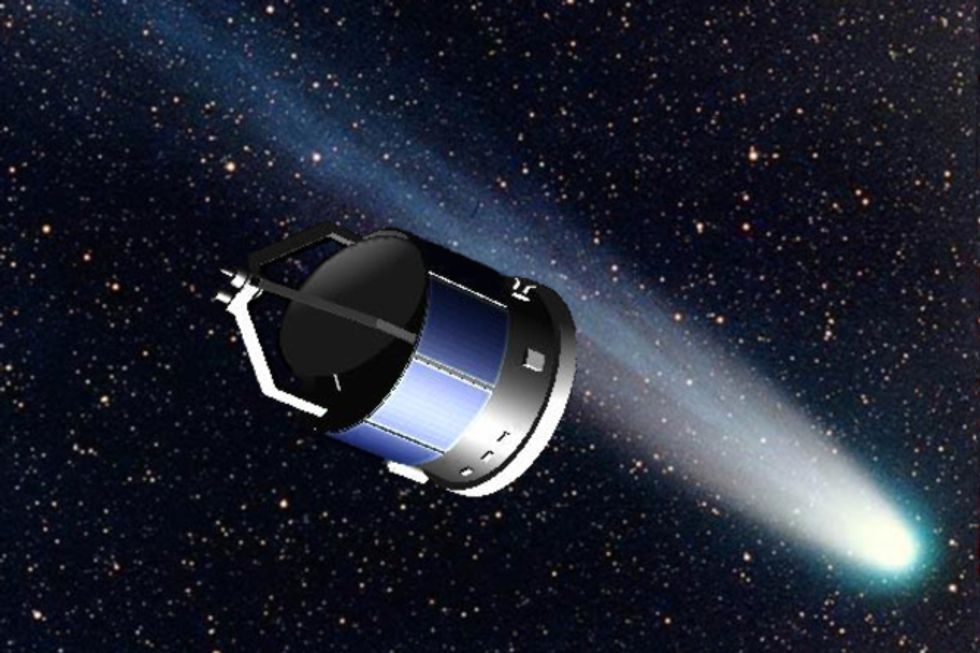
The Giotto fly-by of comet Halley only lasted a few days, but our knowledge of comets was revolutionised by this encounter. One of several probes to explore Halley in the mid-1980s, Giotto had the widest and most capable set of instruments and passed closer to its target than any of its companions.
It found cometary jet activity, a surprisingly dark surface, hydrocarbons in a crust and a complex bow shock and tail formation mechanism. These discoveries are now being followed up by the Rosetta mission and Philae lander at comet 67P.
Artist’s impression of Giotto approaching a comet.
But the fact that fly-bys happen so quickly can also make them very stressful and difficult to manage. When we were monitoring the Giotto spacecraft, flying past Halley at 68.4 km/s, it suddenly started spinning off its axis after encountering a dust particle near its closest approach. Fortunately it was possible to stop the wobble.
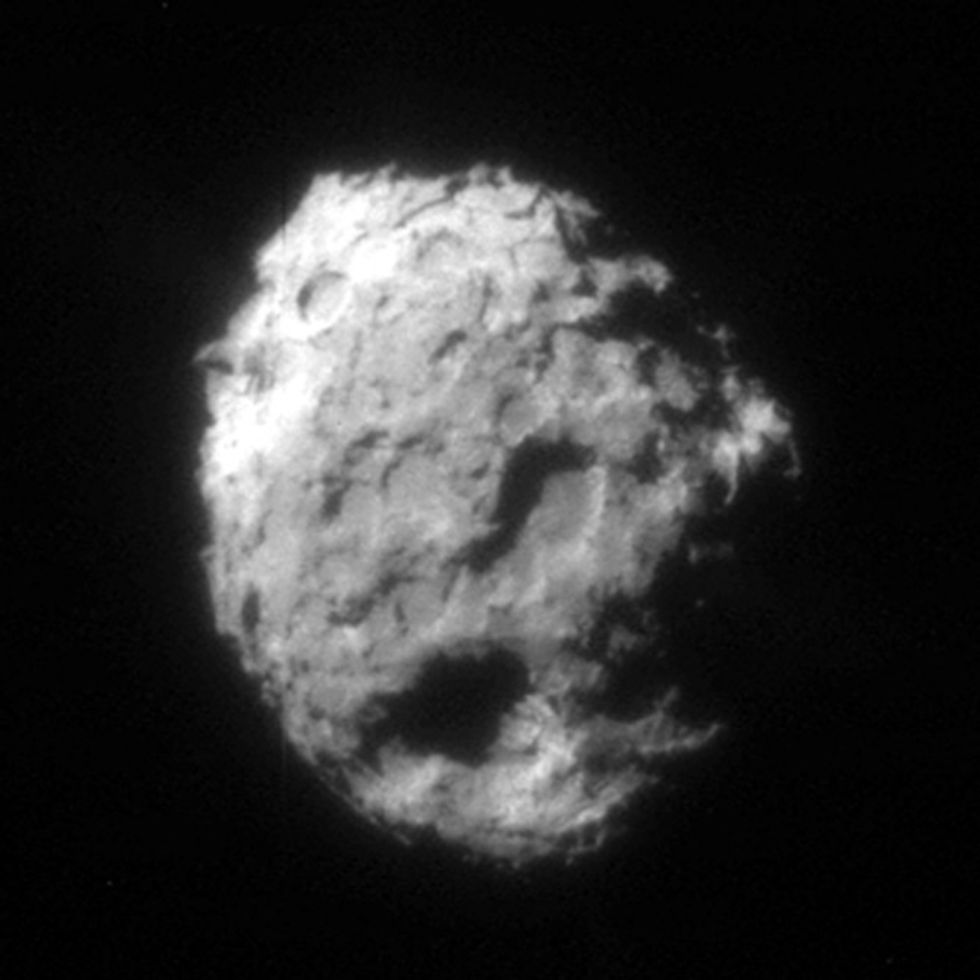
Comet Wild 2 as seen from Stardust on January 2, 2004
There are many other examples where data have been rescued – including with New Horizons during its worrying glitch (now fixed) on July 4.
New Horizons and beyond
After launch on an Atlas V in 2006, the 478kg spacecraft passed Jupiter only 13 months later, which was an express route. The main reason for the hurry was to reach Pluto before its tenuous atmosphere collapses by freezing as the planet moves further away from the Sun. The mission design of New Horizons gives a very fast fly-by at over 14 km/s (50,000 km/hour), with only a few hours and days for the highest resolution measurements.
Measured in “astronomical units” (one AU is about 149.6m kilometres), Pluto’s orbit takes it from its closest point to the Sun (29.7 AU, 1989), inside Neptune’s orbit (30.1 AU), through its current distance (nearly 33 AU) out to its furthest distance from the Sun (48.9 AU, 2113). Receding from the Sun, the surface temperature reduces from its current 40 Kelvin, leading to freezing of the atmosphere.
But why fly past, rather than going into orbit? The most simple answer is that a lot of energy, meaning a lot of fuel, would be needed to slow New Horizons enough to capture it into orbit. Instead, NASA opted to get to the Pluto-Charon system quickly with a relatively capable 30 kg payload, rather than taking a large amount of extra fuel using a different fly-by scheme, to get there before the atmosphere collapses.
New Horizons is already expanding the thin textbooks on the Pluto-Charon system with early images, and the data to be returned over the next 16 months from visible, infrared and ultraviolet spectrometers as well as plasma, dust and radio science instruments will broaden and rewrite them again.
Image of Pluto and Charon, taken with New Horizons.
But new questions will almost certainly arise, which can only be answered by a more detailed orbiter mission, following the usual exploration sequence. When that would happen is hard to say. The relative priority will need to be compared with missions to other objects, particularly those where the exploration stage is low, before possible implementation.
In the future, we can look forward to more detailed fly-by missions of objects where our knowledge is limited and later-stage missions such as Rosetta. Also we will visit new dimensions, such as ExoMars drilling underneath the Mars surface by up to 2 metres for the first time. The JUICE fly-bys of Jupiter’s moons Europa, Ganymede, and Callisto, before entering Ganymede orbit, will allow comparison of subsurface oceans, and Europa Clipper will fly past Europa 45 times to complete a detailed reconnaissance there.
These missions, and their follow-ons, will help us discover more about the humankind’s place in the universe – and whether we are alone. But it is clear that, while we have achieved a lot in solar-system exploration so far, there is still a large amount left to do.
Andrew Coates is Professor of Physics, Head of Planetary Science at the Mullard Space Science Laboratory at UCL.
Is the field of social psychology biased against political conservatives? There has been intense debate about this question since an informal poll of over 1,000 attendees at a social psychology meeting in 2011 revealed the group to be overwhelmingly liberal.
Formal surveys have produced similar results, showing the ratio of liberals to conservatives in the broader field of psychology is 14-to-1.
Since then, social psychologists have tried to figure out why this imbalance exists.
The primary explanation offered is that the field has an anticonservative bias. I have no doubt that this bias exists, but it’s not strong enough to push people who lean conservative out of the field at the rate they appear to be leaving.
I believe that a less prominent explanation is more compelling: learning about social psychology can make you more liberal. I know about this possibility because it is exactly what happened to me.
‘Homo libertus’ becomes a social psychologist
I used to be a libertarian. I believed that protecting individual liberties was the highest purpose of law, and that the government should have no role in shaping people’s behavior. These views tended to align with Republican positions more than Democratic ones on issues such as gun control, environmental policy and treatment for addiction.
I believed that people should have every opportunity to make their own choices, and should bear the full responsibility of the consequences of those choices.
The libertarian worldview assumes that each of us is a homo libertus, a creature that acts with its full mental capacity all the time, reasoning through every decision in terms of its complete implications for the individual’s values and well-being.
A perfect libertarian society wouldn’t need laws to protect the environment, for example, because each homo libertus would consider the impact on the environment of every decision that he or she makes. Society’s care for the environment would be reflected automatically in the choices of its citizens.
One of social psychology’s most powerful insights is that humans are not homo liberti. Thinking about ourselves in this way is alluring, but also mistaken. We are not radical individuals; we are social creatures. We do not think logically at all times; we take shortcuts. We do not always consider the future. And even when we do, we are biased by the present context.
Learning about social psychology, about how people actually make important choices, made me aware of the critical role that society plays, through laws and other means, in enabling us to fulfill our values and ideals. This realization pushed me to be decidedly more liberal than I was before.
It’s not that studying psychology made me a bleeding heart, but that studying psychology gave me a better understanding of why people do what they do. Three topics in particular that shaped the evolution of my political views from libertarian to liberal: gun control, charity and self-control.
There are many others, but these three most vividly illustrate the flaws in the homo libertus assumption.
Self-defense is not always defined in a rational way.
Andrew Innerarity/Reuters
Case study #1: gun control
Learning about social psychology first changed my views about gun control. Homo libertus would follow first principles when deciding to use force: only out of self-defense, and only when there is a real threat of harm.
But we now know that people’s perceptions of threat are a blend of objective reality and subjective interpretation. The experience of threat is informed by our snap judgments of the situation and our preconceptions about the potential attacker.
Implicit biases, including ones that go against our overt beliefs, can sneak into life-and-death decisions. This knowledge convinced me that giving even the most well-intentioned people total liberty with guns leads to outcomes that violate equality and justice.
A consignment of US Agency for International Development (USAID) medical equipment toward the fight against Ebola is offloaded in Liberia on August 24 2014.
James Giahyue/Reuters
Case study #2: Charity
Decisions about charitable giving are another example. Government aid to foreign countries is unnecessary, I used to think, because if people care about what happens outside the US, then they’ll give money directly to those in need.
It turns out that we humans often have noble, charitable intentions, but we behave in strange and irrational ways when it comes to actual giving.
For example, people give more money to save the life of one person who is vividly portrayed than to save hundreds of people who are depicted as statistics, a phenomenon known as the identifiable victim effect.
Even when victims are equally identifiable, we tend to give less money when there are more of them. If a homo libertus cared enough to donate $X to one person, then he would donate at least that much to two people. The fact that real humans act in the opposite way made me realize that formalizing our support for those in need through foreign aid and similar policies is a logical way for people in our society to ensure that we act on our charitable intentions.
Homo libertus might have perfect self-control. The rest of us, not so much.
The libertarian view places the responsibility for choices and their consequences entirely on the individual. We have the right to engage in unhealthy behaviors such as cigarette-smoking or excessive eating, and the downstream problems arising from those behaviors are ours alone.
However, unlike homo libertus, many factors outside of our control interfere with our ability to quit smoking or eat healthfully. Simply being poor reduces self-control. Being abused or neglected as a child reduces self-control and increases the risk of substance use as an adult. In a perfect world, we would all have sufficient self-control to align our intentions neatly with our actions.
But in this world, where we do not, the fact that some people are saddled with deficits whose seeds were sown before birth undermines the libertarian assumption that people are capable, autonomous decision-makers.
These are just three examples, but I think they illustrate well the ways that the idealized folk psychology that underpinned my libertarian politics collapsed in the face of social psychological evidence.
You might think this means I think people aren’t responsible for their behavior, but actually I just think that we have a different kind of responsibility. The fact that we’re not always in total control of our immediate actions means that we have even greater responsibility to construct our situations and our institutions in alignment with our deep values.
As I continue to study social psychology, I increasingly believe in the importance of policies that recognize and accommodate the realities of human psychology, which necessarily insert certain roles for government in our everyday lives. And I bet I’m not the only one.
Scientists at Nasa’s New Horizons mission control centre are celebrating the spacecraft’s dramatic flyby of Pluto, the last unexplored world in the solar system.
The US probe shot past Pluto at more than 45,000 km/h (28,00mph) at 12.49pm UK time on a trajectory that brought the spacecraft within 12,500km of the body’s surface.
The moment marks a historic achievement for the US, which can now claim to be the only nation in the world to have visited every planet in the classical solar system.
“It should be a day of incredible pride,” said Charlie Bolden, Nasa’s chief administrator.
In 2006, seven months after New Horizons blasted off on its mission, astronomers at the International Astronomical Union changed the definition of planet, a move that downgraded Pluto to a dwarf planet.
In a live interview on Nasa TV on Tuesday, Bolden said he hoped that the scientists would reconsider the name. “I call it a planet, but i’m not the rule-maker,” he said.
Bristling with cameras and other instrumentation, the New Horizons probe was programmed to gather a wealth of images and data as it sped past Pluto and its five small moons, Charon, Styx, Nix, Hydra and Kerberos.
Mission scientists at Johns Hopkins University in Baltimore were out of contact with the spacecraft as it hurtled past the icy body 4.8bn km from Earth. Instead the probe captured images and took measurements automatically and stored them on board to send back later.
At such a great distance, direct control from the ground is impossible, because radio signals take more than nine hours to travel to the spacecraft and back again.
Scientists now face an agonising wait for news from the spacecraft, which is due to call home at 2am UK time on Wednesday morning. Only when that signal is received will Nasa officials know whether New Horizons survived the flyby.
The greatest hazard posed to the spacecraft is dust that may form a hazy cloud around Pluto after being knocked off its moons by meteorite strikes. Hal Weaver, a scientist on the mission, said that colliding with a dust particle the size of a grain of rice could potentially destroy the mission. But the risk of such a catasrophic failure is low, at less than one in 10,000.
Images beamed back from New Horizons have shown Pluto in shades of red, with valleys, mountains and craters. Fresh measurements from the probe found that Pluto was larger than previously thought, at 2,370km across.
Data from the Large Hadron Collider (LHC) outside Geneva appears to have proved the existence of particles made of five quarks, solving a 50-year-old puzzle about the building blocks of matter, scientists said on Tuesday.
Quarks are the tiny ingredients of sub-atomic particles such as protons and neutrons, which are made of three quarks. The less common and more unstable mesons, particles found in cosmic rays, have four.
A five-quark version, or "pentaquark," has been sought, but never found, ever since Murray Gell-Mann and George Zweig theorized the existence of such sub-atomic particles in 1964.
Guy Wilkinson, spokesman for the LHCb experiment based at CERN, the physics research center that houses the LHC, said a telltale "bump" seen in a graph of billions of particle collisions could only be explained by a five-quark particle.
"From the point of view of our experiment, we think it has fulfilled all criteria of discovery. We have no other way of explaining what we have seen. But the scientific method is such that we have submitted a paper to a journal, the journal will consider it, then the community will judge," he told Reuters.
The LHC, a circular 27 km (17 mile) underground particle accelerator, has provided reams of data since it started smashing protons together at close to the speed of light in 2010.
Analysis of the collisions has already proved the existence of the Higgs boson, a particle that gives mass to matter, and scientists are now looking for a "dark universe" that they believe exists beyond the visible one.
The pentaquark discovery has opened even more new avenues.
"What we want to do now is to look for other five-quark particles and try and understand more about their nature, and this may tell us something about how even the matter inside our bodies is bound together," Wilkinson said. "It may also have cosmic consequences for ... understanding what happens to stars at the end of their life."
He said it was still a mystery why it had taken 50 years to find pentaquarks.
"There must be many, many pentaquarks out there. In fact in our analysis we found two. One is very evident, the other is a little harder to see. There should be many out there."
(Reporting by Tom Miles; Editing by Mark Trevelyan)
As cannabis bans are relaxed in more U.S. states, the race is on to develop an instant roadside breathalyzer for police to test drivers who may be taking the "high" road.
Vancouver-based Cannabix Technologies Inc, founded by a retired Royal Canadian Mounted Police officer, expects to be first out of the gate with a "pot breathalyzer" - a handheld device similar to those used to detect alcohol.
Cannabix won't give an estimate of when its product might go on sale, but has a prototype undergoing in-house testing.
Other hopefuls, such as Colorado-based Lifeloc Technologies Inc and a chemistry professor-PhD student duo at Washington State University, are still busy in the lab.
The devices aim to accurately detect the presence of THC, the psychoactive component in cannabis, but can't provide enough evidence of impairment by themselves.
"I think the first breathalyzer on the market will be a simple 'yes' or 'no' for the presence of THC at the time of the test, and in that sense it won't provide a quantitative evidential measure," said Barry Knott, the chief executive of Lifeloc, which already makes alcohol breathalyzers.
The size of the potential market is unclear, owing to widely varying estimates of cannabis use, and unreliable data on those driving under its influence.
But developers say they will be able to sell pot devices for a lot more than the ubiquitous alcohol breathalyzers.
Lifeloc sells alcohol breathalyzers for $300-$400 but expects to charge $2,500-$3,500 for its cannabis version.
Marijuana is illegal under U.S. federal law but is allowed for medical use in about half the country's states. Others, including Oregon and Colorado, have gone further, allowing recreational use.
Lifeloc shares, traded over the counter, have risen about 21 percent to $14.50 this year, while Cannabix's have risen about 21 percent to 17 Canadian cents on the small-cap Canadian Securities Exchange.
A roadside breathalyzer would replace a complicated assortment of costly blood and urine tests that can take days to get a result. But even these tests are a long way from showing impairment, as the science on how cannabis affects driving is far from settled.
HOW MUCH IS TOO MUCH?
The National Highway Traffic Safety Administration, in a paper this year, said cannabis impairs psychomotor skills, attention, lane tracking and cognitive function, but not enough is known about how much is needed to affect driving performance.
This is primarily because of the vastly different ways in which alcohol and cannabis affect the human body.
Whether marijuana is smoked or ingested also dramatically changes how the body processes it. It's also difficult to isolate the affects of cannabis in crashes if drivers have also consumed alcohol and/or other drugs.
But some states are not waiting to reach a consensus on how much THC is too much to drive.
Washington and Montana have set a limit of 5 nanograms/milliliter (ng/mL), while Pennsylvania has a 1 ng/mL limit.
Other states prohibit drivers from having any measurable amount of cannabis in their system.
These limits are more political than based on science, said Nicholas Lovrich, a political scientist at Washington State University who is researching the accuracy of drug-recognition experts - police officers trained to detect drug impairment in drivers.
Cannabix founder Kal Malhi initially aims to cater to Canada and the U.S. states that have zero tolerance for THC, hoping his device - designed to confirm police observations - will be able to accurately detect THC up to two hours after consumption.
The company won't talk about its technology, other than to say a patent is pending. Aside from law enforcement, Malhi sees employers and educational institutions as potential customers.
Lifeloc's research has been boosted by a $250,000 grant from the Colorado Office of Economic Development and International Trade.
The company has undertaken laboratory tests of its technology, but creating a real-time device that can collect enough sample for reasonable analysis is proving a challenge.
A few blows are typically sufficient to determine alcohol levels, Knott said. "... With a marijuana breathalyzer we'd have somebody blowing like 20 times - that's just not going to fly."
Washington State University is also still in the research stage, as part of a project applying existing technology - ion mobility spectrometry - to drug testing, including cannabis.
"(This) is the same technology used for explosive detection at airports, the same technology used across the world for chemical warfare detection," said Dr. Herbert Hill, who is working on the research with student Jessica Tufariello.
However, the likely inability of these devices to accurately detect levels of THC - at least initially - raises the question of whether law enforcement agencies will clamor to buy them.
"If this is just a matter of showing how many people have THC in their systems, then it's essentially useless," said Steve Sarich, who runs a cannabis advocacy group and serves as an expert witness for cases involving THC-related impairment.
What would we do without Gwynnie? Not only has she taught the world to cook an egg but she has now explained how to yawn properly
From suncream to bed-making , the internet is full of advice on mundane endeavours which you have apparently been “doing wrong” your whole life.
And you’ve been doing yawning wrong too, according to Gwyneth Paltrow.
Why is Gwyneth Paltrow telling me how to yawn?
Any self-respecting wellness devotee seeking advice on any dilemma, from how to cook an egg , to where to buy a gold-plated juicer , turns to Gwyneth Paltrow’s lifestyle website Goop.
With so much of this fascinating content, it’s unlikely you’ll ever be bored. But if you do feel a yawn coming on, you should embrace it and indulge in it, says Paltrow.
The Hollywood star has published a multiple-step guide to yawning , featuring advice from Michael Lear, who is described as a yogi and “quarterback for mindfulness”, on how to “really lean into the yawn reflex”.
Yawning is contagious, as Paltrow says, so within minutes of Lear telling his dinner table guests that they should feel welcome to yawn, the room was full of gaping mouths.
“There’s a perception that it’s rude or that it means that you’re bored, but the reality is that it’s a very important mechanism for releasing stress,” Lear says in Paltrow’s piece. “It feels good for a reason: Trust that your body knows how to calibrate itself.”
Is that really why we yawn?
Hippocrates had a theory that yawning would rid the body of toxic air and replenish a supply of clean air for the body.
But the theory doesn’t completely stand up – if yawning is a method for increasing the supply of oxygen to the brain, we would yawn while exercising, for example, and we don’t.
Theories differ, but one of the most commonly accepted reasons is that yawns are the body’s “thermostat”. A 2007 study by Dr Andrew Gallup , of the State University of New York, found temperature made a difference to whether people yawned when they watched videos of others – with those holding a heat pack to their foreheads far more likely to yawn.
Gallup theorises that yawning is less about stretching or relieving stress, but more about cooling the brain, as the big inhale changes the temperature of blood flow.
“Not only do predicted brain and localised body temperature fluctuations surround yawning events, but yawns are also triggered or inhibited by environmental factors such as ambient temperature manipulation and medical conditions,” Gallup wrote.
Is the rise in brain temperature potentially caused by boredom or tiredness?
“Yawning is a symptom of one of several factors influencing brain temperature, including insufficient blood flow, time of day, and high rates of metabolic heat production,” Gallup writes. “It is therefore predicted that similar to the experience of feeling tired, boredom would also be accompanied by rises in brain temperature.”
Dr Olivier Walusinski, who organised a 2010 international yawning conference in Paris, strongly disagrees with the “brain cooling” theory however, saying foetuses have been observed yawning in the womb, despite their body temperature being controlled by the mother.
However, Dr Nadja Reissland, of Durham University, observed yawning in the womb in 13 foetuses she studied, and said that was likely explained by “the maturing of the brain early in gestation.”
Is yawning actually contagious?
Yawning after someone else does is likely to be because of the mimicry that humans demonstrate when they feel empathy, according to Matthew Campbell, a researcher at the Yerkes National Primate Research Center at Emory University. Chimpanzees also exhibit similar behaviour.
Saying the word “yawn” in English is similar to the act of yawning, and likely to “trip a switch” in the brain and make us yawn even if we don’t mean to. “If you get enough stimulation to trip the switch, so to speak, you yawn,” Campbell said. “It doesn’t happen every time, but it builds up and at some point, you get enough activation in the brain and you yawn.”
Lear calls yawning “the body’s primary way to release and stretch the jaw and neck muscles after a long day of work and conversation”.
You might not have realised that there’s a correct way to yawn. But there is, apparently. And it’s surprising detailed.
In short (Gwyneth has more specific details):
Tilt your head back and allow your mouth to hang open widely.
Contract the back of the throat and breathe deeply through your mouth.
Inhale and exhale completely while relaxing the shoulders.
When the yawn comes “reach and extend into it” to stretch the jaw muscles.
Repeat 8-10 times until tearing.
You can also try bringing the lips together as you yawn, with teeth apart.
Robert Provine, a neuroscientist at the University of Maryland, Baltimore County, has studied both yawning and laughing reflexes. His research seems to cast doubt on the notion that this kind of performed yawning is really yawning at all. You cannot truly “yawn on command”, he writes in American Scientist.
“Yawns occur either spontaneously or as a contagious response to an observed yawn. Intense self-awareness, as when you are being observed or even suspect that you may be observed, inhibits yawning.
‘Tearing’? That sounds painful...
Paltrow seems to mean “tearing up”, rather than tearing your mouth with a super-sized yawn.
“As you yawn the lacrimal glands around the eye are squeezed and tearing is induced,” she says. The piece ends with “Note: Tearing is not necessary for this exercise to be beneficial.”
Don’t yawn until you tear the corners of your mouth. Honestly, ow.