Astronomers using the Hubble orbital telescope found a "supermassive" black hole lurking at the heart of the only dwarf galaxy ever observed to host one, they reported Wednesday.
The surprise was discovered at the core of a tiny but incredibly dense galaxy, M60-UCD1, about 50 million light years from Earth, the team reported in the journal Nature.
M60-UCD1 is packed with some 140 million stars but is only 300 light years across -- 1/500th of the diameter of our Milky Way.
Black holes are enigmatic phenomena whose gravitational force is so extreme that not even light can escape their clutch.
Supermassive versions of these beasts have until now only been seen at the centre of large galaxies, including our own, but never one so small.
The astronomers were especially taken aback when they calculated that the hole accounts for a whopping 15 percent of the galactic mass.
The hole has the mass of 20 million Suns, making it five times heavier than the black hole at the centre of the Milky Way.
One explanation could be that M60-UCD1 was once part of a much larger galaxy, which split and left one section with the black hole.
If this theory is wrong and further sky-gazing shows that ultra-compact dwarf galaxies do typically harbour a supermassive black hole, the time could be nigh for a rethink.
It would mean there could be twice as many black holes in our region of the Universe than previously estimated, the journal said.
Boeing Co's proposal to develop a so-called space taxi for NASA astronauts includes a seat for paying tourists to fly to the International Space Station, the company's program manager said on Wednesday, a first for a U.S. space program.
The $4.2 billion, five-year contract allows Boeing to sell rides to tourists, Boeing Commercial Crew Program Manager John Mulholland told Reuters, adding that the price would be competitive with what the Russian space agency now charges to fly tourists to the orbital outpost.
"Part of our proposal into NASA would be flying a Space Adventures spaceflight participant up to the ISS," Mulholland said, referring to a Virginia-based space tourism company that brokers travel aboard Russian Soyuz capsules.
Now that Boeing has won a share of NASA's space taxi contract, "we hope ... to start working with the ISS program to make it happen," he said. "We think it would be important to help spur this industry."
Space Adventures is scheduled in January to begin training British singer Sarah Brightman for a 10-day visit to the station, a trip costing $52 million, according to Tom Shelley, president of Space Adventures.
Brightman is slated to become the eighth paying passenger to travel to the station, a $100 billion research complex that flies about 260 miles (418 km) above Earth.
Boeing's first test launch of the taxi is not expected until 2017.
BOTTOM LINE
Commercial flights may also help Boeing's bottom line on a rare, fixed-price, government-backed development program.
Under the contract, Boeing is responsible for cost overruns and the cost of delays. The aerospace company appears to be confident it can produce the taxi without lowering the operating margin in its networks and space business, which was 7.8 percent last quarter.
But Boeing faces competition from rival Space Exploration Technologies, or SpaceX, which also won a NASA contract and says it can develop the taxi for nearly 40 percent less than Boeing.
SpaceX already plans to offer trips to tourists, but did not immediately respond to questions about whether it would fly tourists on its NASA missions.
The NASA contracts awarded on Tuesday to Boeing and SpaceX cover design, building, testing their spaceship and up to six missions to fly astronauts to the station, a pace of roughly two per year. California-based SpaceX, owned and operated by technology entrepreneur Elon Musk, says it can create and fly the taxi for $2.6 billion, compared to Boeing's $4.2 billion bid.
"I think it's a vital next step in SpaceX's progress," Musk said in an interview on FOX Business Network.
Most of the price difference appears to be the rocket.
SpaceX's Dragon capsule will fly on the company's Falcon 9 boosters, which cost about $61 million for satellite-delivery missions. Boeing’s CST-100 capsules will fly aboard Atlas 5 rockets, which are manufactured and flown by United Launch Alliance, a partnership of Lockheed Martin Corp and Boeing. The rockets, which are powered by a Russian RD-180 engine, cost about $150 million apiece.
ON TARGET
The taxi project appears to be well within Boeing's core space capabilities, which suggests it will not have trouble meeting its cost and schedule targets, analysts said.
"They're not pushing the envelope in terms of technology the way SpaceX is" in developing a new rocket, said Ken Herbert, an analyst at Canaccord Genuity in San Francisco. The contract revenue would hit Boeing's income statement mostly in 2017 and 2018, he added.
Separately, Boeing and Lockheed announced on Wednesday that United Launch Alliance would invest heavily in a new rocket engine being developed by Amazon.com Inc founder Jeff Bezos and his private company space company Blue Origin. The agreement is aimed at freeing the United States from its dependency on Russian-made engines for rockets for launches and is expected to have little effect on the space taxi.
Meanwhile, SpaceX has been aggressively exploiting the price advantage of its American-made rocket to try to break ULA's monopoly on launching the U.S. military's satellites. A lawsuit contesting the Air Force's last contract with ULA is pending in a U.S. court.
The company also has been successfully wooing commercial satellite launches, a business estimated to be worth $2.4 billion a year, a 2014 Satellite Industry Association study shows.
So far, the company's Falcon 9 rockets have flown 12 times, all successfully. ULA's Atlas 5, which is mostly used by the U.S. military, made its 49th successful flight late on Tuesday.
(Reporting by Irene Klotz; editing by Alwyn Scott and G Crosse)
Parasites are fascinating. They are uniquely adapted to survive, in some cases through very complex life cycles. There’s also research to suggest that some may even change the behaviour of hosts to assist them in their quest to reproduce. But you wouldn’t want to get one. Here are six of the most gruesome.
Giardia
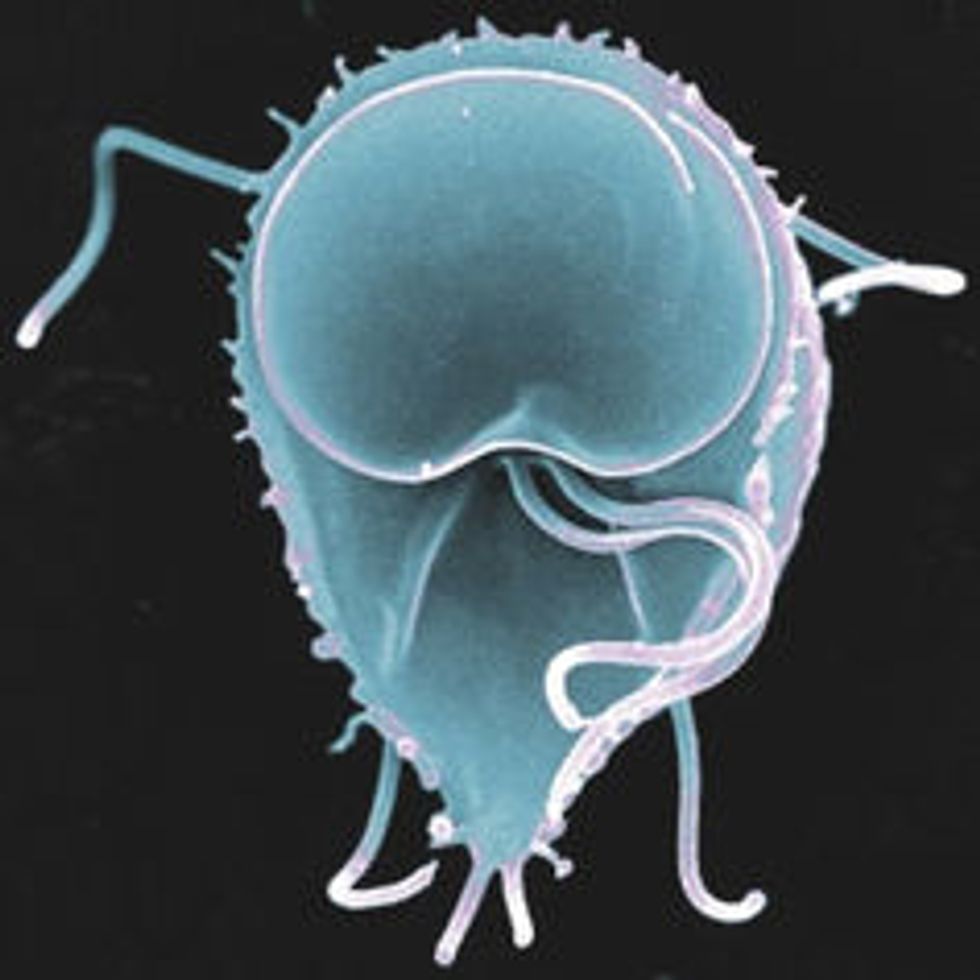
Giardia duodenalis (or Giardia intestinalis, Giardia lamblia) is one of the most common protozoan parasites of humans and mammals.
Giardia intestinalis
AJC1
You’re usually infected by ingesting the cyst stage of the parasite from water or food contaminated with infected faeces. Direct person-to-person spread can also occur from poor hygiene.
Once inside the body, the microscopic cysts develop into feeding stages (trophozoites) which multiply and colonise the small intestine. After passing through the intestines, they form new cysts that are shed in faeces, ready to infect new hosts.
Some infected people go on to develop giardiasis, an intestinal illness characterised by profuse pale diarrhoea, abdominal cramps, flatulence, fatigue and weight loss.
Giardiasis is found worldwide. Most cases are among travellers to areas where it’s common, children in day-care, or in people who drink untreated water. Giardiasis commonly resolves in a few weeks without treatment but in some people it persists and can cause malnutrition.
Guinea worm
Guinea worm (GW), Dracunculiasis medinensis, is a parasitic roundworm that causes Guinea Worm Disease (GWD) among people in poor rural areas with little access to clean water or health care.
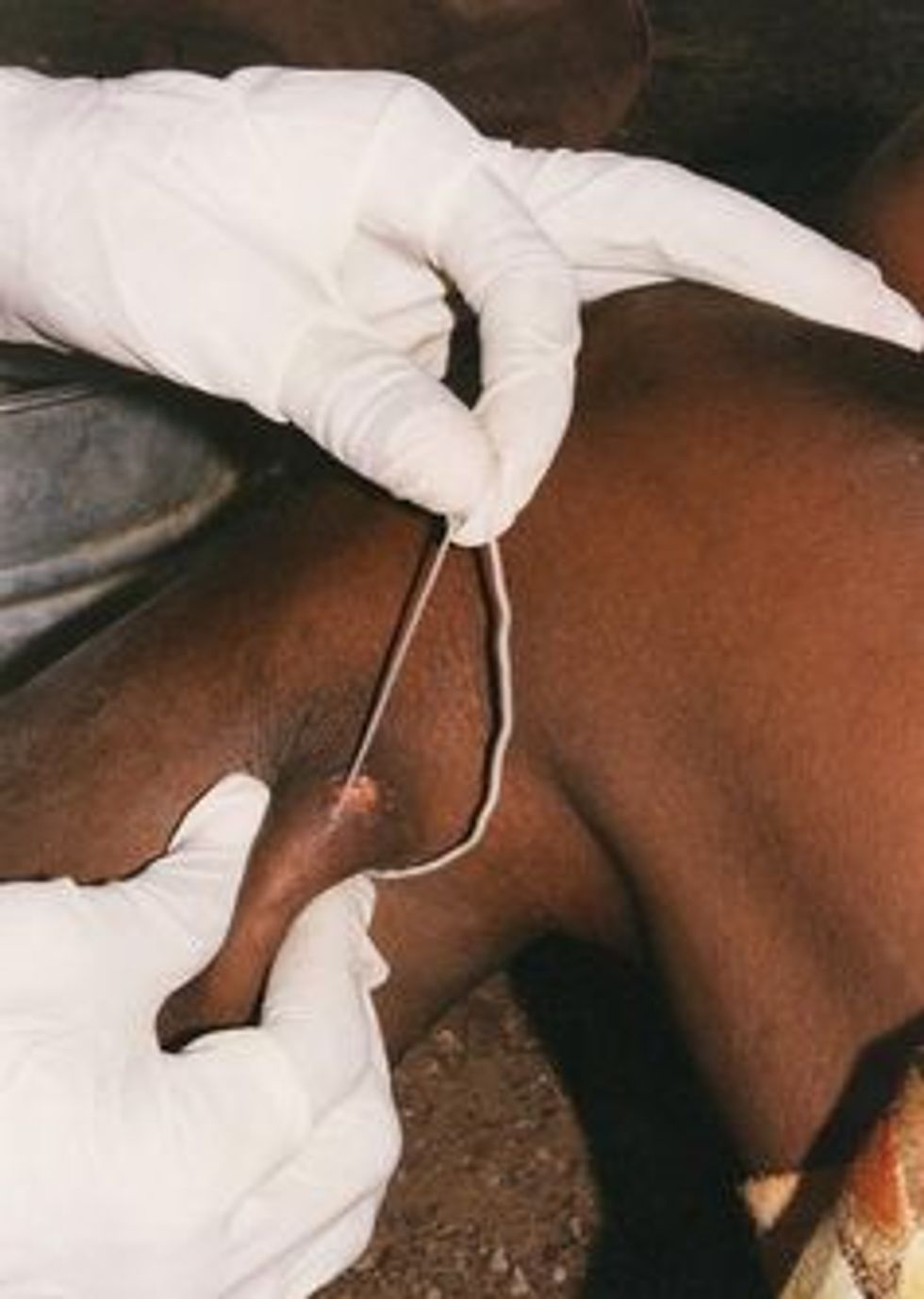
Guinea worm has a complicated life cycle involving minute Cyclops water fleas. You pick up GW by drinking untreated water containing Cyclops infected with GW larvae. Cyclops die in the stomach, releasing the larvae which penetrate the stomach and intestinal wall, before moving into body tissues to mature into adults. After mating, the males die and females (up to 1m long x 1-2mm thick – think Angel hair pasta) migrate through the tissues to the surface of the skin, often in the feet/lower legs.
Guinea worm. Now on the retreat.
CDC
Infected people don’t usually have symptoms initially. But, about a year later, a painful blister forms which ruptures, often after immersion in cool water. The female worm emerges from the ulcer releasing millions of larvae which are then eaten by other Cyclops.
People may have more than one worm. There is no available treatment or vaccine. Instead, the worm is removed slowly by winding it around a small stick after it emerges: this may take weeks.
GWD isn’t fatal but the ulcer is intensely painful and debilitating and secondary bacterial infections can lead to blood poisoning. Livelihoods are affected if people are unable to stand or walk.
Thankfully, eradication programmes have left GWD relatively uncommon. Just 25 years ago, more than 3.5m people in 20 countries in Africa and Asia had GW. In 2012 there were fewer than 600 reported cases.
Dermatobia hominis (human botfly)
Dermatobia hominis, or human botfly, is found in tropical areas of Central/South America and the Caribbean and is one of several flies which can cause myiasis - ie tissue infection by a fly larva (maggot).
Adult botflies capture blood feeding insects (like mosquitoes or ticks) and lay eggs on their bodies in which larvae develop. When the mosquito bites for a blood meal, the larvae hatch and penetrate the tissue. Larvae feed on tissue just beneath the skin for up to 10 weeks, breathing through an airhole in the host’s skin.
If not removed, the larvae mature and erupt, dropping to the ground where they pupate for about a month.
Signs of infection include boil-like swellings where someone’s been bitten. Larvae might also move inside the lesion which can be felt.
Treatment involves surgical removal of the maggot or using petroleum jelly to block the airhole, which causes the maggot to pop out.
Filarial worm
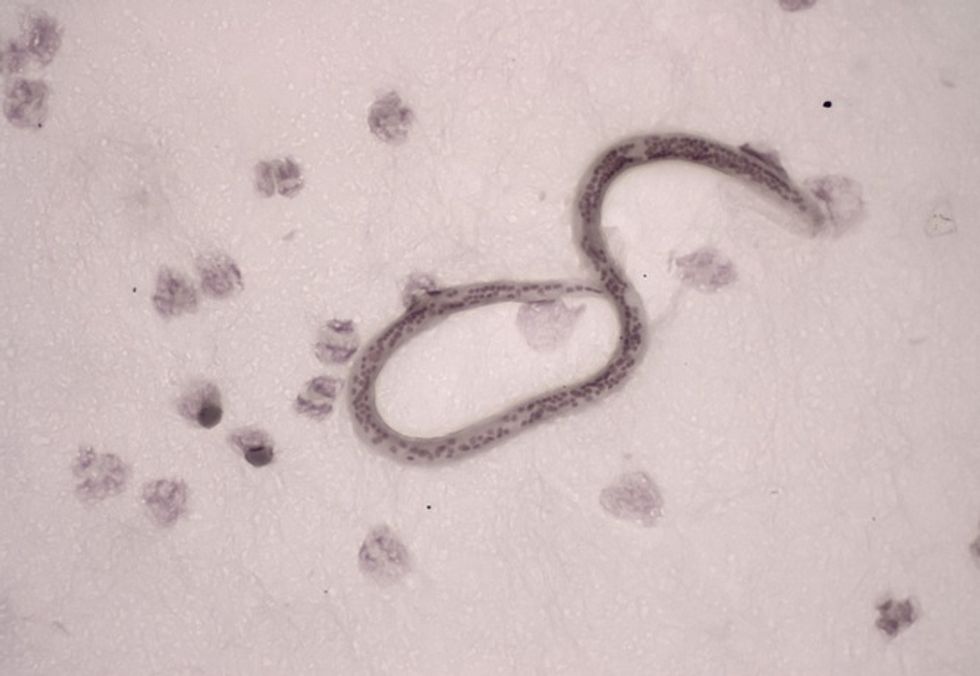
Filarial worms are tiny roundworms that live in lymphatic and subcutaneous tissue, just below the skin.
Filarial worm
Marc Perkins OCC Biology Department
Several species (for example Wuchereria bancrofti and Brugia malayi) cause lymphatic filariasis (LF), a disease seen in the tropics/sub-tropics of Africa, Asia, Western Pacific regions, South America and parts of the Caribbean, and commonly known as elephantiasis in its severest form.
In LF, microscopic larvae called microfilariae (MF) circulate in the blood. These are sucked up by feeding mosquitoes and, after further maturation, can transmit to another person when the mosquito feeds again. MF travel from the skin to the lymphatic system to develop into adults that can live for over five years. After mating, millions of MF are released back into the blood.
The lymphatic system maintains bodily fluid levels and helps to fight infections. In LF, adult worms living in lymphatic vessels and nodes cause damage resulting in fluid retention and swelling.
Most infected people don’t show symptoms but some develop significant swelling, usually in the legs, after repeated exposure. Secondary skin infections that cause skin thickening and hardening are common.
Elephantiasis
CDC
Men can also suffer a huge swelling of the scrotum. Severe LF is disfiguring and disabling, and carries social stigma.
Other species of filarial worm include Onchocerca volvulus, which causes “river blindness” and occurs mostly in Africa.
Vandellia Cirrhosa
Vandellia cirrhosa or “candiru” is a member of the cat-fish family found in the Amazon. It’s small (up to 5cm) and attaches to larger fish to feed on their blood using spines on its gill operculum.
Candiru is infamous for reportedly swimming into urethral openings of unprotected bathers. The majority of reports are based on unverifiable historical accounts and one recent but unsubstantiated case from Brazil where a man claimed that a candiru jumped out of the water following the stream of his urine and into his penis.
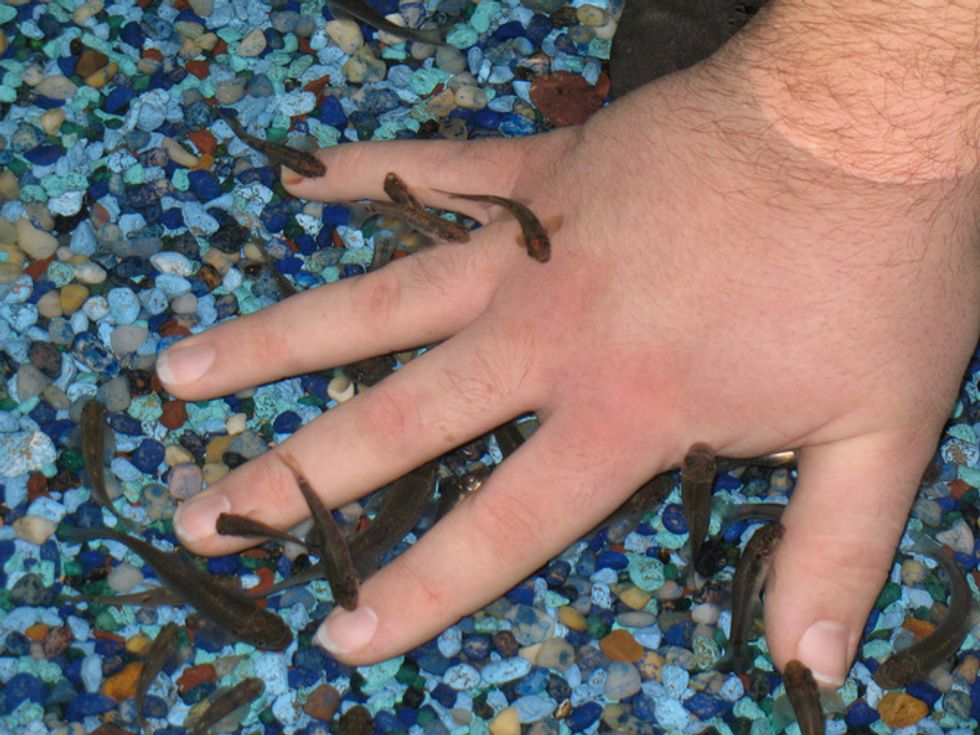
Better near your hands - where you can see them.
Hollyking
Candiru attack is now largely considered an urban legend, however it may still be wise to wear a bathing costume!
Chigoe flea/Jiggers
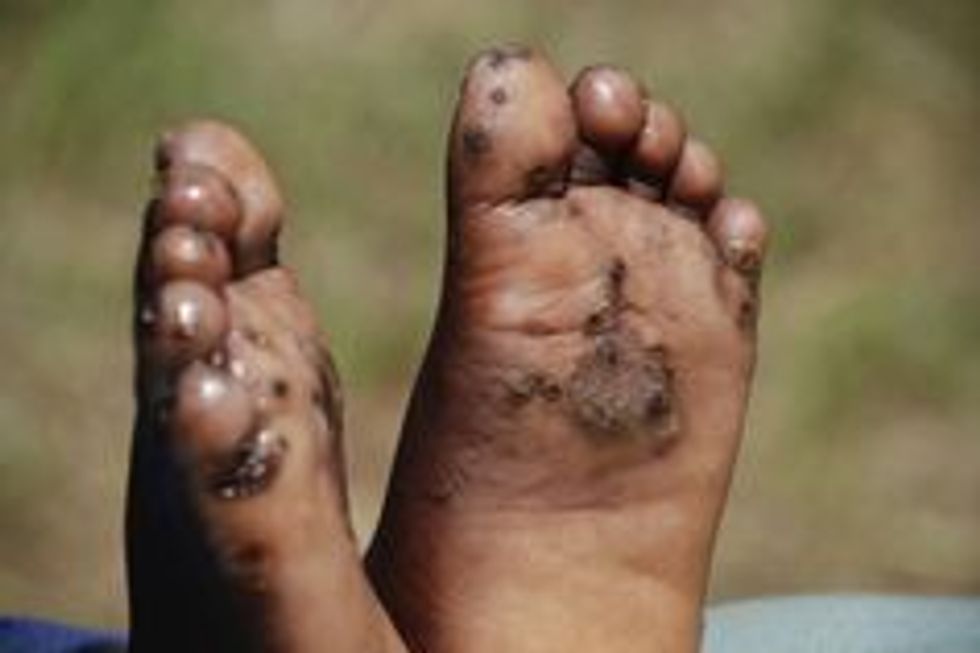
Chigoe or sand fleas (Tunga penetrans) - or “jiggers” - are small ectoparasites (they live on the surface of the host). The fertilised females burrow into exposed skin, commonly on the toes/feet, to feed on blood and tissue fluid and lay their eggs.
Jiggers live in warm dry sand (ie beaches) and soil (paths, parks etc) in tropical and subtropical regions of the Americas, Africa and the Far East.
Jigger lesions
Boyznberry
The embedded flea swells dramatically (up to the size of a pea!). This infestation resembles a blister with a black dot which is actually the legs, breathing apparatus and reproductive organs of the flea. After several weeks, eggs (there may be several hundred) begin to be laid and fall to the ground, hatching about three days later and emerging as adults 2-3 weeks later.
Pain and swelling are common even in single infestation and complications include secondary infections that can cause tetanus and gangrene and loss of nails and toes.
By Debbie Nolder, London School of Hygiene & Tropical Medicine
Debbie Nolder receives funding from Public Health England.
A woman in Oxford has become the first British volunteer to be injected with an experimental Ebola vaccine, which, if it works, will be fast-tracked for use in west Africa.
In an unprecedented move, the untested vaccine has already gone into mass production. Some 10,000 doses are being manufactured by the British drug company GlaxoSmithKline, funded by the Wellcome Trust and the UK government, which are also supporting the Oxford trial.
If the vaccine is found to be effective, there will be supplies available to protect thousands of health workers in west Africa, who will be the first to get it. Nobody wants a repeat of the ZMapp experience – only a dozen doses were available worldwide of the experimental drug and, controversially, they went mostly to foreign medical and aid workers.
The first British volunteer is Ruth Atkins, 48, a communications and engagement manager in the NHS from Marcham in Oxfordshire and a former nurse. She heard on the radio as she was driving home from work that volunteers were needed for a vaccine trial run by Oxford University researchers.
"I volunteered because the situation in west Africa is so tragic and I thought being part of this vaccination process was something small I could do to hopefully make a huge impact," she said.
One hour after the vaccination, she said: "I feel absolutely fine, it felt no different to being vaccinated before going on holiday."
Atkins is the first of 60 healthy people who will be vaccinated to find out whether the potential vaccine has any troublesome side effects. Studies involving animals have shown no ill effects so far.
The vaccine was already under development by GSK – it was in the portfolio of Okairos, a smaller company bought by GSK last year – before the Ebola outbreak occurred, but it could have taken a decade to get it through the trials and into production.
Instead, four trials will be taking place at the same time to gather enough safety data and early information on the immune response, which is some indication of whether it really will protect against the disease.
Ten volunteers have already been injected in the US, where the National Institutes of Health has been funding the development of this vaccine against the Ebola Zaire strain and another against Ebola Sudan. If all goes well, there will also be trials in the Gambia and Mali in healthy volunteers.
It is hoped that results from the trials will be available before the end of this year. If the vaccine performs well, it will be given to health workers in Ebola-stricken regions. This, too, is effectively a trial – the only way to find out whether the vaccine really can protect against the disease.
Prof Adrian Hill, director of the Jenner Institute at the University of Oxford which is running the trial, said: "Witnessing the events in Africa makes it clear that developing new drugs and vaccines against Ebola should now be an urgent priority. It is tremendous that so many people have worked hard to make this trial happen in a short time, and I am enormously grateful to those volunteers who have come forward to take part and to the funders including the Wellcome Trust, DFID, MRC and MHRA for supporting this trial so quickly.
"These are initial safety trials of the vaccine and it will be some time before we know whether the vaccine could protect people against Ebola. But we are optimistic that the candidate vaccine may prove useful against the disease in the future."
Dr Ian Hudson, the Medicines and Healthcare Products Regulatory Agency's chief executive, said the trial proposal was approved with extraordinary speed: "Our priority is to protect public health. Given the importance of Ebola as a risk to public health in some countries in Africa, we fast-tracked the review of the clinical trial application for this vaccine so that it was assessed and authorised by the MHRA's experts in just four working days."
A simple urine test for the virus that causes cervical cancer could offer a less invasive and more acceptable alternative to the conventional cervical smear test, researchers said on Tuesday.
In a study comparing the accuracy of urine sample testing with smear testing conducted by a doctor, scientists from Britain and Spain found the results were good and said using the urine test to detect human papillomavirus (HPV) could lead to more women agreeing to be screened.
"The detection of HPV in urine is non-invasive, easily accessible and acceptable to women, and a test with these qualities could considerably increase uptake," the researchers said on Tuesday in thebmj.com, the online version of the British Medical Journal.
The study, which analyzed 14 studies involving 1,443 sexually active women, was led by Neha Pathak of the women's health research unit at Queen Mary University of London.
Compared with cervical smear samples, urine HPV testing had an overall sensitivity -- the proportion of positives correctly identified -- of 87 percent, and a specificity -- the proportion of negatives correctly identified -- of 94 percent.
Urine testing for the particularly high risk strains of HPV that cause the majority of cervical cancer cases, had an overall sensitivity of 73 percent and a specificity of 98 percent compared with cervical samples.
HPV is one of the most common sexually transmitted infections, with up to 80 percent of sexually active women infected at some point in their lives.
Infection with specific high risk strains of HPV can cause cervical cancer, which kills around 266,000 women a year globally, according to the World Health Organization.
By the far the vast majority of cervical cancer deaths are in poorer countries where access to screening and prevention methods is less widely available.
In a smear test, an instrument called a speculum is inserted into the vagina to allow access to the cervix and a brush is used to collect cells from the surface of the cervix.
In wealthier developed countries, cervical screening for HPV has been in place for many years and have been able to catch many potential cancer cases before they develop.
More recently, national immunization programs using vaccines from drugmakers Merck and GlaxoSmithKline have been launched to protect girls from HPV.
Yet in developing nations, where some 445,000 cases were diagnosed and 230,000 women died of cervical cancer in 2012, infrastructures have not yet been established to run national screening programs and HPV vaccination is still rare.
In a commentary on Pathak's study, Henry Kitchener, professor and chair of gynecological oncology at Manchester University noted that even in developed countries such as Britain, for example, cervical screening coverage has fallen below 80 percent in recent years.
This is partly due to some complacency about cervical cancer as it starts to be come less common, he said, but also partly due to emotional factors such as embarrassment or fear of an invasive speculum examination.
Using a urine test instead of a smear could persuade those reluctant women to come for regular screening, Kitchener said, while in lower income countries that lack infrastructure "self sampling (urine testing) might even be beneficial and cost effective for all women who are eligible for screening".
(Reporting by by Kate Kelland. Editing by Jeremy Gaunt)
Scientists in Britain have given blow-by-blow details of King Richard III's death at the Battle of Bosworth more than 500 years ago and say two of many blows to his bare head could have killed him very swiftly.
Their analysis of the remains of the last English monarch to die in battle suggest he was attacked by one or more people, and that nine of 11 blows, clearly inflicted in battle, were to his skull and another possibly fatal blow was to his pelvis. The findings also support previous opinion that he had no helmet on.
The head injuries are consistent with some near-contemporary accounts of the battle, the researchers said in findings published in The Lancet medical journal on Wednesday.
"The wounds to the skull suggest that he was not wearing a helmet, and the absence of defensive wounds on his arms and hands indicate that he was otherwise still armored at the time of his death," said Sarah Hainsworth, a professor of materials engineering at Leicester University, who co-led the study.
The remains of King Richard III were found by archaeologists under a municipal car park in the central English city of Leicester in 2012 and subsequently identified by experts from the city's university.
A court ruled in May this year that the king should be reburied near to where he was slain in battle, dashing the hopes of descendants who had wanted his remains to be taken back to his northern English stronghold of York.
According to historical record, the monarch was killed in battle on Bosworth Field, near Leicester, on Aug. 22, 1485, and those accounts suggest Richard was forced to abandon his horse after it became stuck in a mire and was then killed fighting.
His death was the culmination of the Wars of the Roses, a bloody 30-year power struggle between Richard's House of York and the rival House of Lancaster.
Hainsworth's team used whole body computerized tomography (CT) scans and micro-CT imaging to analyze trauma to the bones and determine which of Richard's wounds might have proved fatal.
They also analyzed tool marks on bone to identify the medieval weapons potentially responsible for his injuries.
According to Guy Rutty, a pathologist on the research team, "the most likely injuries to have caused the king's death are the two to the inferior aspect of the skull -- a large sharp force trauma possibly from a sword or staff weapon, such as a halberd or bill, and a penetrating injury from the tip of an edged weapon."
(Reporting by Kate Kelland. Editing by Louise Ireland)
NASA will partner with Boeing and SpaceX to build commercially owned and operated "space taxis" to fly astronauts to the International Space Station, ending U.S. dependence on Russia for rides, U.S. Senator Bill Nelson said on Tuesday.
The U.S. space agency also considered a bid by privately owned Sierra Nevada Corp., but opted to award long-time aerospace contractor Boeing and California's SpaceX with contracts potentially worth billions of dollars, to develop, certify and fly their seven-passenger capsules.
SpaceX is run by technology entrepreneur Elon Musk, also the CEO of electric car manufacturer Tesla Motors.
Nelson spoke on CNN ahead of a planned NASA news conference scheduled for later on Tuesday at the Kennedy Space Center in Florida.
The contract has taken on new urgency in recent months, given escalating tensions with Russia over its annexation of the Crimea region of Ukraine.
Boeing's CST-100 spaceship would launch aboard Atlas 5 rockets, built by United Launch Alliance, a partnership of Lockheed Martin and Boeing. SpaceX, which already has a $1.3 billion NASA contract to fly cargo to the space station, intends to upgrade its Dragon freighter to carry astronauts.
Terms were not immediately disclosed. NASA has said that in addition to test flights, the awards would include options for between two and six operational missions.
Before the end of 2017, NASA wants to be flying astronauts commercially from the United States, ending Russia's monopoly on space station crew transport. The agency currently pays $70 million per person for rides on Russian Soyuz capsules, the only flights available for astronauts since the retirement of the U.S. space shuttles in 2011.
China, the only other country to fly people in orbit besides the United States and Russia, is not a member of the 15-nation space station partnership.
NASA has spent about $1.5 billion since 2010 investing in partner companies under its Commercial Crew program. Boeing and SpaceX have won most of NASA's development funds.
The Commercial Crew program is based on a successful predecessor public-private partnership that created two cargo lines to the station, a research laboratory that flies about 260 miles (418 km) above Earth. In addition to SpaceX, NASA has a $1.9 billion contract with Orbital Sciences Corp for resupply missions.
(Reporting by Irene Klotz in Cape Canaveral and Andrea Shalal in Washington; Editing by Ros Krasny, Jim Loney and Sandra Maler)
Scientists said Tuesday a female colossal squid weighing an estimated 350 kilograms (770 lbs) and thought to be only the second intact specimen ever found was carrying eggs when discovered in the Antarctic.
The squid had been kept in optimum freezing conditions at the Te Papa museum in Wellington ever since it was brought back to New Zealand from the seas off the frozen continent during the southern hemisphere's summer.
The colossal squid is thought to extend up to 4-5 metres (13-16 feet) from tip to tentacle and weigh up to 500 kilograms. Its relation, the giant squid, can grow a lot longer but is much more spindly.
This specimen, like other octopus and squid species, has three hearts -- one to pump blood around the body and two for its gills (lungs) -- and is estimated to be about 3.5 metres in length.
"This one had two perfect eyes," scientist Kat Bolstad from Auckland University of Technology who led the examination told AFP.
"They have very large and very delicate eyes because they live in the deep sea. It's very rare to see an eye in good condition at all."
Measurements revealed the animal's eye was 35 centimetres (14 inches) in diameter, and confirmed that the specimen was a female.
"We were excited to find that out... as it turns out this one is a female, and it has got some eggs," Bolstad told reporters.
"This was by far the most perfect colossal squid that I have seen."
The only other time scientists anywhere have had the chance to examine an intact colossal squid was in 2008, also at Te Papa, the museum said. That specimen was also female.
Bolstad said the latest specimen was so well preserved the scientists were able to examine it with an unusual level of detail, including the lens on the eyes.
"The fact that we have a specimen in good shape, but that we can get so much information from and still have in good shape, is a win-win," Bolstad said
The squid was found by a fishing vessel in Antarctica last southern hemisphere summer when the boat's captain, recognising what had come to the surface, carefully netted it and brought it onboard.
The number of colossal squid in the ocean is unknown but Bolstad said sperm whales in the Antarctic ate a lot of the animals.
After samples were taken from the squid examined on Tuesday, it would be preserved for further research and display, she added.
An Indian spacecraft is on course to reach Mars, an official said Monday, following a 666-million-kilometre voyage that could see New Delhi's low-cost space programme win Asia's race to the Red Planet.
The 350-tonne rocket carrying an unmanned probe is set to enter Mars's orbit next week after 10 months in space.
It is India's first mission to the planet to search for evidence of life.
Indian Space Research Organisation official Koteswara Rao said the rocket has travelled almost 666 million kilometres (413 million miles) since its launch from the southern spaceport of Sriharikota last November.
" India will be the first country in the world to insert a spacecraft into the Martian orbit in a maiden attempt if the operation succeeds," ISRO scientific secretary V. Koteswara Rao told reporters.
"And also the first Asian country to reach the Red Planet's sphere," Rao said.
Rao said the rocket's engines will be "woken up" to allow for a "course correction" on Sunday before its arrival on September 24.
ISRO scientists will also slow down the craft now travelling at 22.2 kilometres per second to 2.14 metres per second to allow for a smoother entry into the planet's orbit.
The cost of the project, at 4.5 billion rupees ($70 million), is a fraction of the $671 million NASA spacecraft that also launched last year and is expected to arrive within days of the Indian craft.
India has never before attempted inter-planetary travel. More than half of all missions to Mars have ended in failure, including China's in 2011 and Japan's in 2003.
Only the United States, Russia and the European Space Agency have been successful.
The Mars Orbiter Mission was revealed only 15 months ago by the previous prime minister.
The timing and place of the announcement -- in an Independence Day speech -- led to speculation India was seeking to make a point to China, despite denials from ISRO.
The gold-coloured probe, the size of a small car, will aim to detect methane in the Martian atmosphere, which could provide evidence of some sort of life form on the fourth planet from the sun.
Prime Minister Narendra Modi has hailed the country's low-cost technology, saying a domestically-made rocket that launched four foreign satellites into orbit in June had cost less to make than the Hollywood film "Gravity".
But the programme has also faced critics who say a country that struggles to feed its people adequately should not be splurging on space travel.
Researchers in Canada found that a patient who has been unresponsive for nearly 20 years still showed awareness of his surroundings in a test involving a short film by director Alfred Hitchcock, The Verge reported on Monday.
The team from the University of Western Ontario showed the male patient, who has been in a vegetative state since suffering cardiac arrest when he was 16 — though with his eyes open — an eight-minute clip from the film Bang! You're Dead and found that his brain activity was similar to that of a group of 12 healthy people who watched the same footage.
"What we saw is that his brain changed at all of those key moments in the movie in exactly the same way as a healthy volunteer," Adrian Owen, who wrote the study, told the CBC. "Essentially we were getting at consciousness. We were measuring or detecting the fact that this patient was able to follow the plot."
The study was published on Monday in Proceedings of the National Academy of Sciences. Owen's team also found that the patient's brain also responded similar to that of a different group of volunteers when watching a "scrambled" version of the film with scenes out of order, with no emphasis on a plot.
"This was a big result for us," team member Lorena Naci told The Verge. "The activity wasn't just [the result] of some automatic triggering."
Naci said the patient's father had already been taking him to the movies on a weekly basis for years.
"It was reassuring to him that habit was indeed something that his son was understanding — something that he was benefiting from — and that he should keep doing," she said.
Owen told the CBC that thus far, the study has measured brain activity in 15 patients. At least one of them, a 20-year-old woman who suffered a brain injury 10 years ago, did not show a response to the film. Overall, the team estimates that as many as one in five patients in similar states might still be conscious on some level.
"Our next step is to look at that in a number of brain-injured patients, and to figure out how frequently they show this type of activity," Naci said.
NASA won't meet a congressionally ordered goal to find 90 percent of nearby and potentially dangerous asteroids larger than 460 feet (140 meters) in diameter, the agency’s Inspector General said on Monday.
The shortfall comes despite a 10-fold increase in NASA’s annual budget over the past five years – from $4 million in 2009 to $40 million in 2014 - to track and assess potentially dangerous asteroids and comets. So-called “Near-Earth Objects,” or NEOs, fly within about 28 million miles (45 million km) of Earth.
The agency’s efforts are poorly coordinated, ill-managed and under-staffed, according to a 32-page report titled “NASA’s Efforts to Identify Near-Earth Objects and Mitigate Hazards,” by NASA Inspector General Paul Martin.
“NASA estimates that it has identified only about 10 percent of all asteroids 140 meters and larger,” Martin wrote. “Given its current pace and resources, (NASA) has stated that it will not meet the goal of identifying 90 percent of such objects by 2020.”
A one-person office manages a “loosely structured conglomerate of research activities that are not well integrated and (which) lack overarching program oversight, objectives and established milestones to track progress,” the report said.
NASA has found about 95 percent of the largest and potentially most destructive asteroids, those measuring about 0.62 mile (1 km) or larger in diameter.
About 66 million years ago, a 6.2-mile (10-km) -wide object hit what is now Mexico’s Yucatan peninsula, triggering global climate changes that are believed to have led to the demise of the dinosaurs and most other species alive at that time.
More recently, a fragment of an asteroid estimated to be just 59 feet (18 meters) in diameter exploded over Chelyabinsk, Russia. The force of the Feb. 15, 2013, explosion matched the energy released in 30 atomic bombs, blowing out windows and destroying buildings. More than 1,000 people were injured by flying debris.
“Recent research suggests that Chelyabinsk-type events occur every 30 to 40 years,” the Office of Inspector General report said, adding that most impacts would occur in the ocean rather than in populated areas.
Since 1998, NASA has spent about $100 million on programs to find, assess and mitigate potentially threatening space neighbors.
As of July 2014, the agency has discovered about 11,230 NEOs, including 862 of the largest asteroids. That figure includes only about 10 percent of the smaller nearby asteroids that are about 460 feet (140 meters) wide, far short of the agency’s goal to find 90 percent by 2020, the report said.
The report made five recommendations for beefing up NASA’s asteroid detection efforts, including adding at least four to six employees to help manage the program and coordinating projects with other U.S. and international agencies and with privately funded initiatives.
NASA’s Associate Administrator for Science John Grunsfeld said in a letter to Martin he expects a new NEO program to be in place by Sept. 1, 2015.
Usually ‘X’ marks the spot, but for the ESA’s Rosetta orbiter, Site ‘J’ has been selected as the place where its Philae lander will touch-down on Comet 67P/Churyumov–Gerasimenko (67P/C-G), officials at the agency announced on Monday. Rosetta, which is the first mission to ever rendezvous with a comet, will accompany 67P/C-G on its journey throughout the…
Although it's far from the sort of brain transplant beloved by science fiction enthusiasts, scientists have taken one step in that direction: they have spliced a key human brain gene into mice.
In the first study designed to assess how partially 'humanizing' brains of a different species affects key cognitive functions, scientists reported on Monday that mice carrying a human gene associated with language learned new ways to find food in mazes faster than normal mice.
By isolating the effects of one gene, the work sheds light on its function and hints at the evolutionary changes that led to the unique capabilities of the human brain.
For the study, scientists used hundreds of mice genetically engineered to carry the human version of Foxp2, a gene linked to speech and language. In a 2009 study, mice carrying human Foxp2 developed more-complex neurons and more-efficient brain circuits.
Building on that, neuroscientists led by Christiane Schreiweis and Ann Graybiel of the Massachusetts Institute of Technology trained mice to find chocolate in a maze. The animals had two options: use landmarks like lab equipment and furniture visible from the maze ("at the T-intersection, turn toward the chair") or by the feel of the floor ("smooth, turn right;" "nubby, turn left").
Mice with the human gene learned the route as well by seven days as regular mice did by 11, scientists reported in Proceedings of the National Academy of Sciences.
Surprisingly, however, when the scientists removed all the landmarks in the room, so mice could only learn by the feel-of-the-floor rule, the regular rodents did as well as the humanized ones. They also did just as well when the landmarks were present but the floor textiles were removed.
It was only when mice could use both learning techniques that those with the human brain gene excelled.
That suggested, Graybiel said, that what the human gene does is increase cognitive flexibility: it lets the brain segue from remembering consciously in what's called declarative learning ("turn left at the gas station") to remembering unconsciously (take a right once the floor turns from tile to carpet).
Unconscious, or procedural, learning is the kind the feel-of-the-floor cue produced: the mice didn't have to consciously think about the meaning of rough or smooth. They felt, they turned - much as people stop consciously thinking about directions on a regular route and navigate automatically.
"No one knows how the brain makes transitions from thinking about something consciously to doing it unconsciously," Graybiel said. "But mice with the human form of Foxp2 did much better."
If Foxp2 produces the cognitive flexibility to switch between forms of learning, that may help explain its role in speech and language.
When children learn to speak, they transition from consciously mimicking words they hear to speaking automatically. That suggests that switching from declarative to procedural memory, as the humanized mice did so well thanks to Foxp2, "is a crucial part of the process," Graybiel said.
(Reporting by Sharon Begley; editing by Andrew Hay)