Virginia state Sen. Amanda Chase is facing criticism for claiming on Facebook that women who are raped are "naive and unprepared" because they weren't armed.
During a social media debate on gun ownership, Chase told one constituent, "It's those who are naive and unprepared that end of [sic] raped. Sorry but I’m not going to be a statistic."
Chase ultimately doubled down on her comments in a public statement, saying the constituent was "scoffing at my rights and the rights of everyone else who protect themselves ... I'm a champion for women, their right to protect themselves and their right to their opinion, even if I may not agree, but will not tolerate the bullying or chastising the rights of the Second Amendment."
In reality, there is no evidence whatsoever that carrying guns deters rapes. Higher gun ownership is in fact linked to higher violent crime — and in fact most sexual violence against women is committed by familiar people, not random strangers who prey on people while jogging.
For all Chase's claims that she is a "champion for women," she opposes ratification of the Equal Rights Amendment in Virginia, calling it "a plot by the left to eliminate gender altogether" — although she has said that her revolver is "my little Equal Rights Amendment."
Chase's Democratic opponent in Virginia's 11th Senate District, social worker Amanda Pohl, sharply condemned Chase's rape remarks. "As someone who works in advocacy, I know we can prevent sexual assault by funding primary prevention and ending rape culture," said Pohl. "Victim-blaming and shaming contribute to rape culture and harm survivors. Virginians deserve better."
The Virginia Senate elections will take place this November. Republicans control the chamber by one vote, and are struggling to defend their turf after their racial gerrymander was struck down in court.
In a deep-dive "Reality Check" on CNN Tuesday morning, analyst John Avlon delved into the chaos engulfing the National Rifle Association that has led to the ouster of multiple top executives and the gun rights organization pulling the plug on their inflammatory NRA TV network.
Avlon began, "America's biggest gun lobby, the National Rifle Association shut down live programming last week and its online television channel, NRA-TV. And that because NRA CEO Wayne LaPierre said it had moved too far from its core mission."
The CNN contributor then shared clips of controversial former NRA spokesperson Dana Loesch ranting at liberals by saying, "They use their media to assassinate real news. They use their schools to teach children that their president is another Hitler, all to make them march and scream about xenophobia and homophobia,"
"Since its founding by two Union officers after the Civil War, the NRA went work from its early mission to help teach marksmanship to being a political powerhouse dedicated to inflaming culture wars and fundraising off fears of gun control," Avlon asserted before adding that one big reason for the end of NRA-TV was that no one was buying what they were selling.
"According to Comscore, the NRA website clocked a stunningly bad 49,000 unique visitors in January alone," the analyst explained. "By comparison, CNN saw an average of 120 million unique visitors a month in 2018."
Describing the NRA's overall problems, Avlon advised, "As always, if you want to find the truth -- follow the money. Audits of the NRA by accountants showed that after spending $420 million in 2016, including $54 million to support Donald Trump and Republicans and a nearly $15 million deficit -- and double that the following year, while donations fell."
A man who claimed he was a substitute teacher at Santa Fe High during the 2018 shooting told a harrowing story of survival. But the school district says he never worked there.
In the immediate aftermath of the May 2018 shooting at Santa Fe High School, a man who said he witnessed the carnage seemed to turn up everywhere.
The man calling himself David Briscoe appeared in Time as a substitute teacher seemingly in the wrong place at the wrong time; CNN described his heroism as he ordered his students to “get down” and kept them protected until police came; The Wall Street Journal relayed the blood-curdling screams he heard from students in the hallway.
In April, nearly a year after the shooting, he told a strikingly similar story to The Texas Tribune. But after investigating some of his claims, the Tribune did not publish his account of the shooting — because it appears his entire story was an elaborate hoax.
In a roughly 31-minute interview with the Tribune, David Briscoe told his tale: When the first shots rang out — “it was very, very loud” — he said he directed his classroom of nearly a dozen students in the remedial English course he was teaching to muffle their screams with their hands.
He barricaded the doors. Turned off the lights.
He said he could never return to the Houston-area school where 10 died and another 13 were injured last spring. “Just knowing that there’s blood on the walls where you walk at ... I don’t think I could go back,” he said, so after he and his students were rescued by law enforcement, he said he quit teaching altogether and moved to Florida, three months after he took the job at Santa Fe High.
But according to the school district, he was never there.
Lindsey Campbell, a spokeswoman for Santa Fe Independent School District, said it had no record of anyone named David Briscoe being employed by the district in any capacity and that the district is confident no one by that name was on campus the day of the shooting last year.
“We are extremely disappointed that an individual that has never been a part of our school community would represent themselves as a survivor of the mass violence tragedy that our community endured,” said Santa Fe ISD Superintendent Leigh Wall. “This situation illustrates how easily misinformation can be created and circulated, especially when the amount of detailed information available is limited due to the still ongoing investigation.”
James Roy, a lieutenant for the Galveston County Sheriff’s Office — which helped investigate the massacre — said the shooting was contained to the art rooms and there were no English classes on that side of the school.
“The best I can tell, we have no record of [Briscoe],” Roy said. He added that the man’s claim that the shots were “very, very loud,” didn’t sound right.
“If he was anywhere other than that hallway [where the shooting the place], I don't think he could’ve heard anything but the fire alarm,” he said, referring to the alarm a teacher pulled as a warning to get people out of the school.
Public records show that Briscoe had a home address in Florida at the time of the shooting; there’s no record of him living in Texas at any time.
All four news organizations that quoted him removed any reference of David Briscoe from their stories after being contacted by the Tribune.
“I don’t know what motivates people to try to take advantage of a tragedy like this,” said John Bridges, the managing editor for the Austin American-Statesman, which also quoted Briscoe in an article shortly after the shooting. “It’s sick and it’s sad.
“Reporters can face significant reporting hurdles in the immediate aftermath of a tragedy,” he said, “and some people unfortunately attempt to take advantage of those situations and try to dupe reporters.”
It’s not uncommon for people to emerge after a high-profile disaster pretending to be a victim — often for financial gain, but sometimes simply for attention. Years after the 9/11 terrorist attacks, it was revealed that a Spanish woman who claimed to be a survivor of the attack was never there.
“Social media makes it easier for everybody to be fooled by people — regular people, journalists and politicians,” said Gina Chen, an assistant professor at the University of Texas at Austin’s School of Journalism. “People pretend to be other people for various reasons, sometimes nefarious and sometimes not.”
The man calling himself David Briscoe used social media to initiate contact with some reporters, including a Tribune reporter. When the Tribune asked to interview him again in early May, he initially claimed a rogue former employee for the social media company he said he started — whom he refused to name — had stolen his identity.
Then he stopped responding to requests for comment.
“I have never lived in Texas”
The man using Twitter handle @daviddbriscoe reached out to the Tribune in April, hoping to discuss his role as a survivor of the Texas tragedy as news reports circulated of survivors of a school shooting at Marjory Stoneman Douglas High School in Parkland, Fla. taking their own lives.
After the shooting at Santa Fe High, the man told the Tribune by phone, he became isolated and depressed and began drinking heavily. He said he never tried to contact any of the other survivors. At one point, he said, he contemplated suicide, and he told a reporter he was still struggling with depression. He said he spent a couple of months at his parents’ home in New Orleans immediately after the tragedy, then returned to the Houston area for a while to live with a friend before moving to Orlando, Florida — where he said he founded his social media company.
Twitter DM screenshot
He said he recently gave a speech at Colonial High School in Orlando, where the principal honored him and he talked to students and faculty about what he thought lawmakers could do to prevent another tragedy.
A spokeswoman for Colonial High School said no one named David Briscoe came to the school to speak.
Half a dozen Santa Fe survivors contacted by the Tribune also said they had never heard of someone named David Briscoe, and many wondered how he managed to snooker the media and grief-stricken survivors into believing his tale.
“Who knows how many other tragedies he’s put himself in around the country?” said Flo Rice, a former Santa Fe High substitute teacher who was shot in both legs last May. “No one wants to have been there, and no one wants to have been in this club that we’re all in now.”
After the initial April 25 phone interview with the Tribune, the man calling himself David Briscoe went quiet until mid-May, when he responded to a direct message on Twitter.
He claimed he had never talked to the Tribune.
When he was shown the email account and phone number of the person who first contacted the Tribune, as well as screenshots of the initial direct messages, he claimed one of his employees impersonated him and had likely been the person who gave interviews with other media outlets. He added that someone — likely that same employee — stole his identity nearly a year before. He wouldn’t disclose the name of the employee in question “due to company policy” but said the person had been arrested.
Twitter DM screenshot
During a subsequent exchange through Twitter in early June, he would only say that he was hesitant about giving a statement for this story.
“We do not want [to] be in the middle of all of this. Again, my identity was already stolen, I do not want to be potentially targeted again,” he said.
“I have never lived in Texas,” he said. “I have only lived in Florida. I’ve been living here practically my whole life.”
After that conversation, his direct messages were disabled and phone calls went to voicemail.
The media response
Some of the publications that quoted him say they are taking steps to avoid a similar incident.
“We have removed him from the piece, and we apologize to our readers for the misinformation,” said Steve Severinghaus, a spokesman for The Wall Street Journal. “We are reviewing how this error was made and will take steps to safeguard against this in the future.”
Bridges, the Statesman managing editor, said that a reporter from his publication first initiated contact with David Briscoe last year after seeing his social media posts — made from the same account through which he first made contact with the Tribune — about the shooting. Those posts have since been deleted, Bridges said.
“The school obviously was in no position to verify employment in those moments immediately after the shooting,” Bridges said.
“Reporters in breaking news situations attempt to verify sources and information as much as they can — and we made reasonable attempts as we were reporting in the minutes after the shooting,” Bridges said.
In recent days, Bridges added, a reporter from the Statesman attempted to initiate contact with David Briscoe to verify his initial claims.
But the man had blocked the reporter from his account and denied that he ever portrayed himself as a shooting witness.
Disclosure: The University of Texas at Austin has been a financial supporter of The Texas Tribune, a nonprofit, nonpartisan news organization that is funded in part by donations from members, foundations and corporate sponsors. Financial supporters play no role in the Tribune's journalism. Find a complete list of them here.
On the surface, the gun debate almost appears on the surface to be a debate between men and women, as Moms Against Gun Violence dominates the anti-NRA conversation. It's given the pro-gun argument a twinge of masculinity at the heart of gun culture, but it's taken out of the debate about gun violence.
"American masculinity is closely tied to gun culture and violence, but is rarely discussed," The Post wrote in its teaser about the documentary. "As traditional masculine expectations are being challenged in Hollywood, politics, advertising and beyond, some gun policy experts are asking, is it time for this examination to reach gun culture?"
Whether it's violence against men, rural or urban, homicide or suicide, men are disproportionately represented. Men as a whole are five times more likely to own a gun than women, the documentary cites. While both men and women include "protection" as a reason to own a gun, most women list it as the sole reason for having one.
[caption id="attachment_1514597" align="aligncenter" width="646"] (Photo: Screen capture from Washington Post documentary)[/caption]
Scott Melzer, Professor of sociology at Albion College remarked in the documentary that when mass shootings occur Americans seek easy fixes like fixing mental healthcare or fixing the gun show loophole, but fixing the way we view boys and men with guns is never part of the conversation.
Josh Cast is one of the founders of FourGuysGuns, a YouTube show that gives tips, tricks, product reviews and more to men about guns. He noted in an interview that masculinity is not the focal point, but it's certainly where other men get their knowledge and experience from when entering the gun culture.
He explained that a lot of people assume he and other men in the pro-gun movement are viewed as, "right-wing, anti-everything" and "I don't have a large penis if I don't have a gun."
However, he also admitted that guns also play into his identity "with, kind of, my gender role," he said. Noting that "genetically" there are "caregivers and worriers." He hates the label the NRA ascribes to its members and to gun owners. He was just as horrified by the school shootings as others and wants to see action to stop school shootings.
Melzer explained that for men, guns are a symbol of protection and providing. He said that the idea of masculinity surrounds men being in control, powerful, independent, tough and strong. His research partner, Jennifer Carlson, professor of sociology at the University of Arizona, agreed, saying it all adds together for a "recipe about how to be a good man."
He said that when society expects men to be "dominant, powerful, in control, in charge, to not give in," we're setting them up for acts of violence when they feel like they are not in control. The vast majority of mass shooters seek some form of fame, which they feel will prove they are masculine and strong. They tend to be white, heterosexual men who have experienced "downward mobility" in their lives, the documentary states. They then often find someone to blame for their problems and lash out.
Rob Pincus, executive vice president of Second Amendment Organization explained that many men grew up with an image of manliness being associated with guns.
While Pincus is an avid gun owner and teaches defense, he's also a radical opponent of the NRA. In the 2019 convention, he criticized the group for their lack of transparency and for only representing "certain types" of gun owners. He said that they pander to one particular demographic. He went on to say that the NRA helps perpetuate the stigma of gun ownership by associating gun ownership with "a scared, angry, fearful person."
Melzer described the NRA position as being about both victims and heroes, who believe that if they are regulated in any way then they will lose all of their rights and freedoms.
Laurinda Bellinger, Chapter President of Well Armed Women, said that most women she teaches are coming out of domestic violence situations or are fearful for one reason or another. She said that guns aren't even made to accommodate women's hands, so they often need extra training to help with learning to use them.
Professor Carlson explained that it's a lot easier to blame the object and fight the war against it rather than to deal with the psychology and vulnerability which is actually at the source of gun culture. Until we do, however, America will never fully resolve the gun problems.
The National Rifle Association has a hefty bill that remains unpaid, despite making a huge haul in fundraising for the 2016 election.
According to Betsy Woodruff at the Daily Beast, the NRA owes $1.6 million to their vendor, Ackerman McQueen, they've used for advertising for years. The company is the one responsible for doing the media for NRATV, the group's streaming service for pro-gun television.
The two have had a long relationship and err on the side of quiet privacy, which Woodruff said on MSNBC, shows just how acrimonious the battle has become.
The unpaid bills are part of a lawsuit that could end not only the business partnership but also the entire existence of NRATV.
“AMc requests that the Court issue an injunctive order requiring the NRA to post the $3,000,000 letter of credit mandated by the parties' contract,” the court documents outline. “The alternative is that AMc will be compelled to discontinue all services to the NRA and lose the employees who perform those services forever, incurring costs for severance the NRA is unlikely to pay without litigation.”
The documents go on to allege that a "shut down of those services will give the NRA an opening to claim a breach by AMc — a situation orchestrated by the NRA."
NRATV is cited extensively throughout the filing, with claims that NRATV had problems and AMc is being "scapegoated" for problems that are "related to the NRA's own self-governance, AMc has always operated at the direction of the NRA CEO.”
The organization has been dealing with serious legal bills as well. Not only were the overwhelming donations for Trump a problem, but they also face a hefty fine as a result of the move. Meanwhile, New York Gov. Andrew Cuomo threatened to use the state to punish companies that do business with the NRA, prompting another lawsuit the group must fund. Wednesday it was also revealed that the NRA's CFO has a history of embezzlement.
New Zealand opened a gun buyback scheme Thursday aimed at ridding the country of semi-automatic weapons similar to those used in the Christchurch mosque attacks that killed 51 Muslim worshippers.
Prime Minister Jacinda Ardern vowed in the hours after the March 15 killings that New Zealand's gun laws would be tightened and her government has expedited the change in just three months.
"The buyback and amnesty has one objective -- to remove the most dangerous weapons from circulation following the loss of life at Al Noor and Linwood mosques," Police Minister Stuart Nash said.
The Australian man accused of the killings, Brenton Tarrant, is alleged to have used an arsenal of five weapons, including two military style semi-automatic rifles (MSSAs), in the attacks on two Christchurch mosques.
Lawmakers voted to outlaw MSSAs, which allow the rapid fire of high-calibre bullets, by a margin of 119-1 in the wake of the worst massacre in modern New Zealand history.
Licensed firearms owners will have six months to surrender weapons that have now been deemed illegal under the scheme, with an amnesty ensuring they will not face prosecution during that period.
After the amnesty expires, possession of a prohibited firearms is punishable by up to five years in jail.
Compensation will be based on the model and condition of the firearm, with the total cost of the scheme estimated at NZ$218 million ($143 million).
That includes NZ$18 million towards administration costs for what Nash said was "a huge logistical exercise".
He said police knew of 14,300 registered MSSA rifles and there were an estimated 1.2 million firearms in the community, with the vast majority still legal under the new rules.
Police said they were organizing "collection events" around the country where firearms owners could submit their weapons.
Tarrant last week pleaded not guilty to terrorism charges, as well as 51 counts of murder and 40 of attempted murder.
Wilson "Woody" Phillips, Jr. once worked at an employee-benefits consulting firm that was supposed to pay $45,000 to a Texas company. Yet, somehow, the money was rerouted.
According to a report from The New Yorker, when the companies were going back and forth about where the missing $45,000 went, they realized it had been routed to an account in Maryland, under the name of Hughes.
“They gave me records saying who the account belonged to,” accounts-payable manager Mary Hughes recalled in an interview. “And, sure enough, it was Woody’s.”
Hughes then walked through all of the payments that Wyatt made the previous years and found several cases where checks were deposited into his account instead of the firm. It totaled at least one million dollars in embezzled funds. At least three of Hughes' former colleagues corroborate her story.
He was ultimately fired but charges weren't brought against him. The fear the company had was that they would lose customers if it was broadcast.
“Wyatt’s doors would have closed if the company prosecuted him,” Hughes told the New Yorker. “I mean, we were dealing with people’s money, and our C.F.O. was stealing.”
Hughes said that it always bothered her that Phillips got away with stealing the money, particularly since he went off to work for the NRA in wake of his job. And in that capacity, he manages all of the funds for the organization. That's when Hughes decided to speak out.
“Enough is enough,” she said.
“The NRA has no knowledge of the matters in question and, naturally, is not at liberty to comment on any issues that do not involve the NRA,” the organization said in a statement. “With respect to his relationship with the NRA, Mr. Phillips was a longtime employee, and he continues to provide value to the Association and its members.”
Hughes said that she confronted Phillips after learning of the embezzlement.
"And he said, ‘Mary, who else knows about this?’” she recalled. She walked back to her office and after he left she made copies of the invoices that had been paid. She saw they were all "cleverly crafted fakes" the report revealed. The problem is that none of the payments had ever happened.
“It was a down payment on this, or the escrow on that,” she said after following the money. “I saw that he started the scheme almost as soon as he walked into the door."
Immediately after all of it was uncovered, Phillips was meeting with lawyers. He ultimately paid $500,000, but she said he owed over $1 million.
A student was convicted on Wednesday of manufacturing a firearm using a 3D printer, in what London's police said they believed was the first such successful prosecution in Britain.
Tendai Muswere, 26, pleaded guilty to making the 3D printed gun, in a hearing at Southwark Crown Court in the British capital.
Police searched Muswere's central London home on drugs grounds in October 2017. They found evidence of cannabis cultivation -- and also components of a 3D printed gun, capable of firing a lethal shot.
Zimbabwean national Muswere, who does not hold a firearms licence, said he was printing the firearm for a university film project and claimed he did not know that the components were capable of firing.
"He later refused to comment on what his film project was about," London's Metropolitan Police said in a statement.
Officers went through his internet search history and found he had viewed videos demonstrating how to use a 3D printer to manufacture firearms which fired live ammunition.
A second raid in February 2018 resulted in the discovery of further components of a 3D printed gun.
"Muswere claimed that he was printing the firearms for a 'dystopian' university film project but he has not explained why he included the component parts necessary to make a lethal barrelled weapon," said Acting Detective Sergeant Jonathan Roberts, who led the investigation.
"Muswere was planning to line the printed firearms with steel tubes in order to make a barrel capable of firing.
"This conviction, which I believe is the first of its kind relating to the use of a 3D printer to produce a firearm, has prevented a viable gun from getting into the hands of criminals."
Federal law already makes it illegal for most people to possess a weapon on secure parts of an airport tarmac. The bill was aimed at also allowing local law enforcement, especially at smaller airports, to take action in the face of an emergency.
A state representative says action is still needed after Gov. Greg Abbott vetoed his bill that would have allowed local authorities to bring charges against people who carry a gun in a secure area of a Texas airport.
Federal law already makes it illegal for a person or airport employee to possess a weapon on secure parts of the airport tarmac. State Rep. Rafael Anchía, a Democrat from Dallas, wanted to give state officials the same jurisdiction as federal agents in such a case, partially so that smaller commercial airports wouldn’t have to wait for a federal agent to arrive on site in order to take action in the face of an emergency.
“When you’re talking about a security threat on a tarmac, with a passenger aircraft and fuel and everything like that, every second counts,” Anchía said.
But Abbott vetoed the bill Saturday, writing in a statement that it would “impose an unacceptable restraint on the Second Amendment rights of law-abiding travelers.”
“The Legislature may have intended simply to keep firearms off the tarmac, but the bill as drafted would newly prohibit carrying in any part of the airport terminal building, even ahead of the TSA inspection checkpoint,” Abbott wrote.
Still, Abbott left the door open to a future bill that might accomplish similar goals.
“By vetoing this bill, I am ensuring that Texans can travel without leaving their firearms at home,” he wrote. “I look forward to working with the next Legislature on the good idea behind this bill.”
Anchía said Monday that the bill already takes Abbott’s concerns into account — by excluding private parts of the tarmac that could be used, for example, by a gun owner using a private plane to go on a hunting trip.
“The fact that the governor is suggesting somehow the language picked up the nonsecure area of the terminal is really not credible,” Anchía said.
Anchía said over the weekend that police at Dallas/Fort Worth International Airport “asked for this bill.” Representatives from the city of Dallas, the Houston Police Department and the Combined Law Enforcement Associations of Texas registered their support. But members of the gun rights groups Open Carry Texas and Gun Owners of America opposed the bill at hearings.
It passed with a 140-8 vote in the House and 25-6 in the Senate, Anchía noted.
Earlier this year, data from the Transportation Security Administration reported a surge in the number of guns found at airport security checkpoints, where guns are still banned.
Out of the top 10 airports where TSA found the most guns, four are in Texas.
“The threat's not going to go away, so we need to deal with it in the legislation,” Anchía said. “I just worry that the threat still exists.”
According to an extensive report, the National Rifle Association was using money from their donors to fund the lavish lifestyles of their board members and vendors.
For example, a former pro-football player was on the national board and paid $400,000 to do "public outreach" and "firearms training." A writer in New Mexico was given $28,000 for writing articles for an NRA publication. Another board member sold ammunition to the NRA for an "undisclosed sum."
The organization has been dealing with an internal battle for several months, as two factions are fighting about the future of the group. The recent president was dethroned, and CEO Wayne Lapierre is back to steering the direction of their work.
The NRA has drawn a lot of attention for their considerable donations that were outside of the norm in 2016. Progressive activists and political analysts have wondered if the money was coming from a foreign entity so that the funds could be spent to support Donald Trump. At least 20 Russian donors were uncovered for donating to the group.
The Wall Street Journal reported last year week that LaPierre racked up hefty expenses totaling $275,000 in "personal charges" at a single store in Beverly Hills. He spent approximately $253,000 in luxury travel to Italy, Budapest, and the Bahamas. He also paid $13,800 to rent an apartment for a summer intern.
The NRA has 76 members of its board of directors who are not paid for their service. However, previous reports speculated at least 17 of those managed to score cash from the group over the last three years, the Post reported. However, payments were received by about one-quarter of the members.
CEO Wayne LaPierre was one of the primary beneficiaries to the funds, scoring hundreds of thousands in charges from a Beverly Hills clothing boutique as well as foreign travel.
"NRA officials said LaPierre's wardrobe allowance began 15 years ago and that he was urged by Ackerman to make the purchases for his public appearances, a practice that they said has since been discontinued," reported the Post. "They said his travel was necessary for fundraising. The apartment was secured for a three-month summer internship when university housing typically used was unavailable."
"I will be the first person to get in your face about defending the Second Amendment, but I will not defend corruption and cronyism and fearmongering," said lifetime NRA member Vanessa Ross.
Previous leader, Oliver North, was ousted for trying to stage a coup against LaPierre. He was set to make millions off of a public relations agency contract between the NRA and an Ackerman McQueen, LaPierre alleged. According to North, however, the organization's lawyer was scoring "extraordinary" payments for legal fees that totaled in the millions.
Board members don't earn a salary for their service and have no financial responsibilities to raise funds. There are no term limits on their positions.
The Post spoke to a tax expert who said that these payments could be a conflict of interest for those tasked with monitoring the finances of the group.
"In 25 years of working in this field, I have never seen a pattern like this," said Washington attorney Douglas Varley, who specializes in tax-exempt organizations. "The volume of transactions with insiders and affiliates of insiders is really astonishing."
"But the pattern raises a threshold question of who the organization is serving," he continued. "Is it being run for the benefit of the gun owners in the country and the public? Or is it being run as a business generating enterprise for officers and employees of the organization?"
The Los Angeles Police Department is investigating an incident at a downtown 7/11 when a rapper pulled a gun -- all of it caught on video.
"Lil Xan whipped out a handgun and pointed it at a man who demanded to know why the rapper once called Tupac "boring" ... and now LAPD is investigating," TMZ reported.
The incident allegedly began with a difference of opinion as to the excitement of listening to the music of legendary rapper and civil rights activist Tupac Shakur.
"TMZ obtained this video of the altercation which went down shortly before 10 PM Friday in a 7/11 parking lot near downtown L.A. The person shooting the video says he asked Xan why he 'talked sh*t' about Tupac last year in an interview," the site noted.
Xan used the N-word in his outburst.
"What the f*ck you want, bruh?? Get the f*ck out, n***a!" he shouted.
The rapper is best known for the 2017 song "Betrayed," which reached number 64 on the Billboard Hot 100.
Xan, for his part, lashed out at fans of Tupac in a statement.
"F*ck all you old head ass b*tches still talking bout that 2pac shit," Xan said.
This trope – “the good guy with a gun” – has become commonplace among gun rights activists.
Where did it come from?
On Dec. 21, 2012 – one week after Adam Lanza shot and killed 26 people at Sandy Hook Elementary School in Newtown, Connecticut – National Rifle Association Executive Vice President Wayne LaPierre announced during a press conference that “the only way to stop a bad guy with a gun is a good guy with a gun.”
Ever since then, in response to each mass shooting, pro-gun pundits, politicians and social media users parrot some version of the slogan, followed by calls to arm the teachers, arm the churchgoers or arm the office workers. And whenever an armed citizen takes out a criminal, conservative media outlets pounce on the story.
But “the good guy with the gun” archetype dates to long before LaPierre’s 2012 press conference.
Other cultures have their detective fiction. But it was specifically in America that the “good guy with a gun” became a heroic figure and a cultural fantasy.
‘When I fire, there ain’t no guessing’
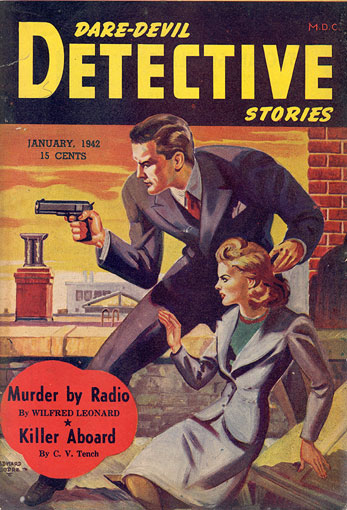
Beginning in the 1920s, a certain type of protagonist started appearing in American crime fiction. He often wore a trench coat and smoked cigarettes. He didn’t talk much. He was honorable, individualistic – and armed.
These characters were dubbed “hard-boiled,” a term that originated in the late 19th century to describe “hard, shrewd, keen men who neither asked nor expected sympathy nor gave any, who could not be imposed upon.” The word didn’t describe someone who was simply tough; it communicated a persona, an attitude, an entire way of being.
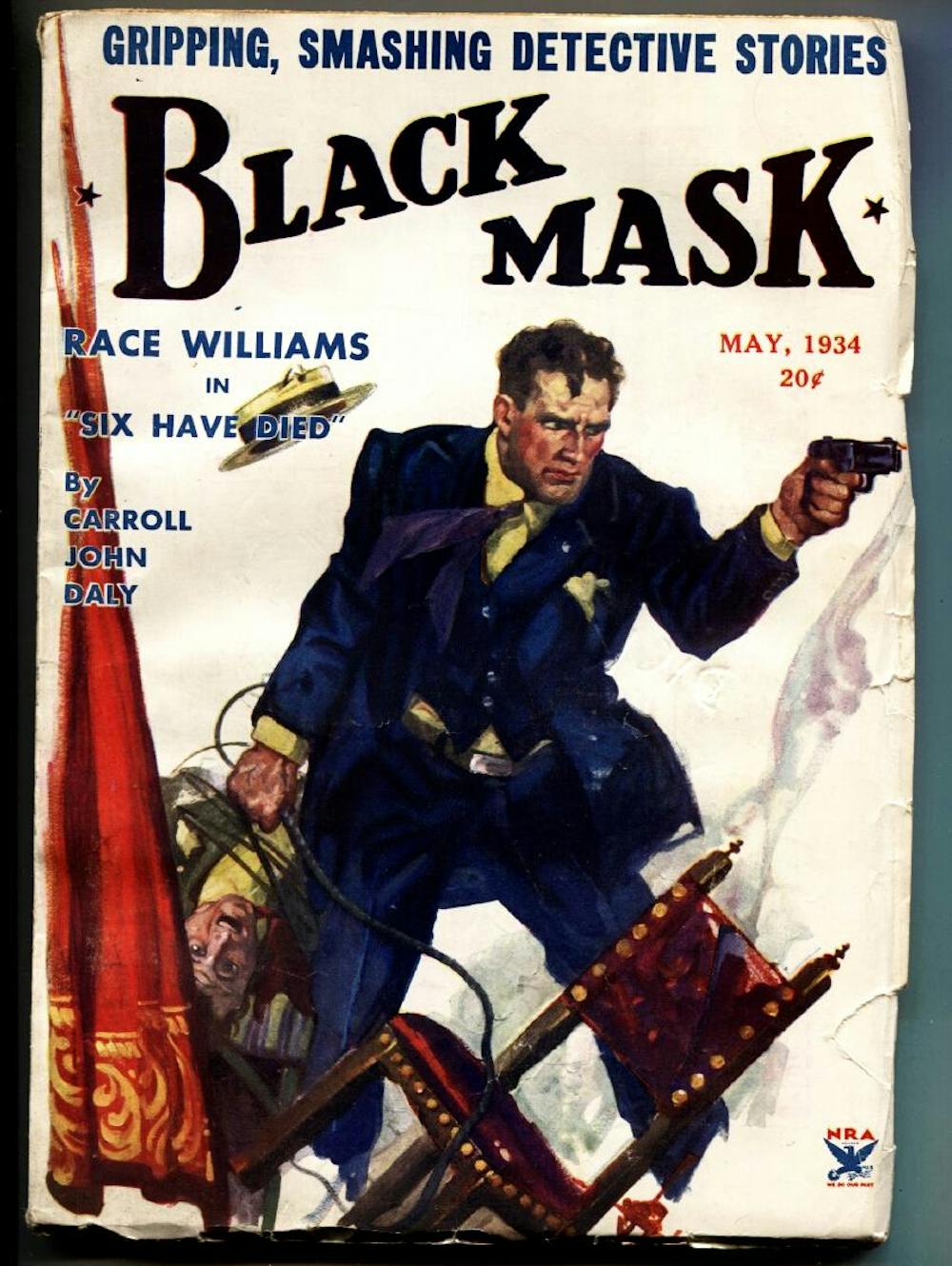
Most scholars credit Carroll John Daly with writing the first hard-boiled detective story. Titled “Three Gun Terry,” it was published in Black Mask magazine in May 1923.
The May 1934 issue of Black Mask features Carroll John Daly’s character Race Williams on the cover.
“Show me the man,” the protagonist, Terry Mack, announces, “and if he’s drawing on me and is a man what really needs a good killing, why, I’m the boy to do it.”
Terry also lets the reader know that he’s a sure shot: “When I fire, there ain’t no guessing contest as to where the bullet is going.”
From the start, the gun was a crucial accessory. Since the detective only shot at bad guys and because he never missed, there was nothing to fear.
Part of the popularity of this character type had to do with the times. In an era of Prohibition, organized crime, government corruption and rising populism, the public was drawn to the idea of a well-armed, well-meaning maverick – someone who could heroically come to the defense of regular people. Throughout the 1920s and 1930s, stories that featured these characters became wildly popular.
Their stories’ plots differed, but their protagonists were mostly the same: tough-talking, straight-shooting private detectives.
In an early Hammett story, the detective shoots a gun out of a man’s hand and then quips he’s a “fair shot – no more, no less.”
In a 1945 article, Raymond Chandler attempted to define this type of protagonist:
“Down these mean streets a man must go who is not himself mean, who is neither tarnished nor afraid. … He must be, to use a rather weathered phrase, a man of honor, by instinct, by inevitability, without thought of it, and certainly without saying it.”
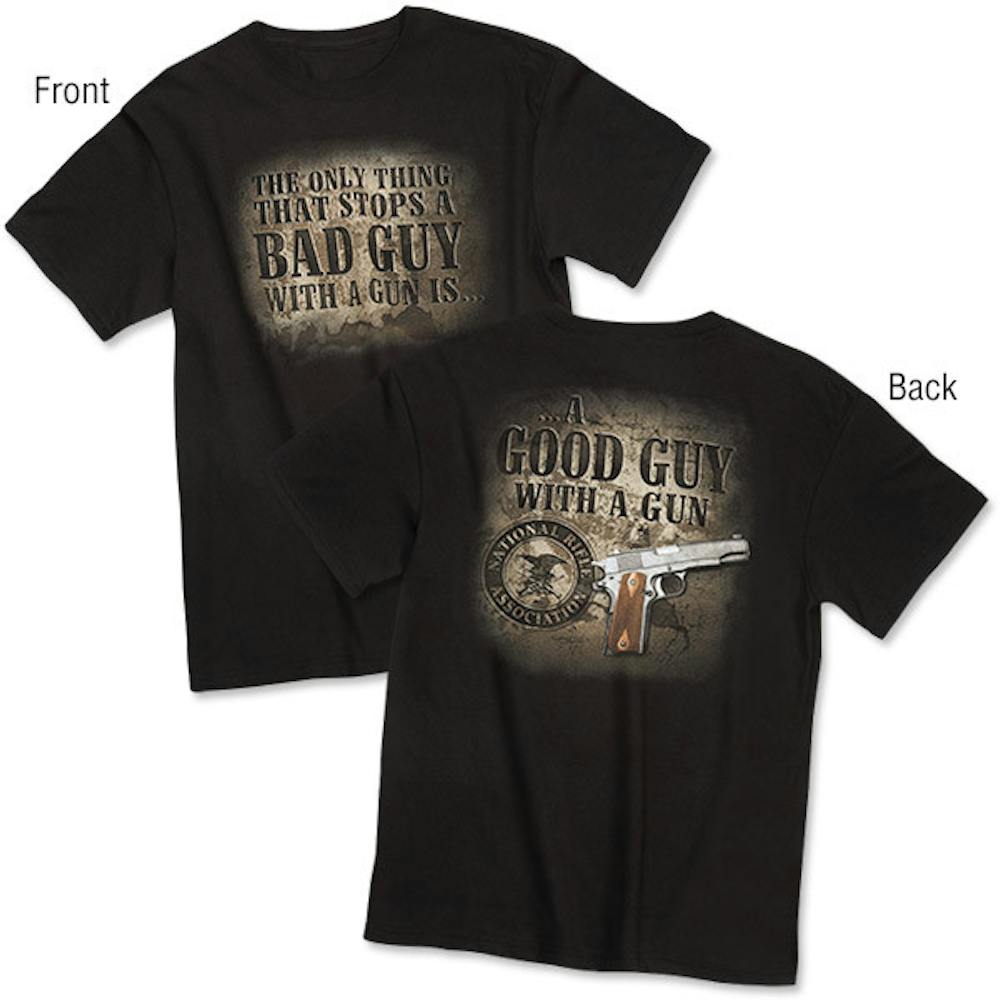
Gun rights enthusiasts have embraced the idea of the “good guy” as a model to emulate – a character role that just needed real people to step in and play it. The NRA store even sells T-shirts with LaPierre’s slogan, and encourages buyers to “show everyone that you’re the ‘good guy’” by buying the T-shirt.
The problem with this archetype is that it’s just that: an archetype. A fictional fantasy.
In pulp fiction, the detectives never miss. Their timing is precise and their motives are irreproachable. They never accidentally shoot themselves or an innocent bystander. Rarely are they mentally unstable or blinded by rage. When they clash with the police, it’s often because they’re doing the police’s job better than the police can.
Another aspect of the fantasy involves looking the part. The “good guy with a gun” isn’t just any guy – it’s a white one.
In “Three Gun Terry,” the detective apprehends the villain, Manual Sparo, with some tough words: “‘Speak English,’ I says. I’m none too gentle because it won’t do him any good now.”
Could this explain why, in 2018, when a black man with a gun tried to stop a shooting in a mall in Alabama – and the police shot and killed him – the NRA, usually eager to champion good guys with guns, didn’t comment?
A reality check
Most gun enthusiasts don’t measure up to the fictional ideal of the steady, righteous and sure shot.
After a huge breakup between two different sects in the National Rifle Association (NRA), former president Oliver North is being subpoenaed.
According to Daily Beast reporter Betsy Woodruff, court documents show the group served North last month along with Lance Olson and Daniel Boren, all of whom are on the NRA's board.
The subpoena demands documents such as emails sent from April 10 through May 22 about people working for the NRA's ad firm, anything sent about the NRA's Indiana convention about Wayne LaPierre, anything about the group's expenditures, North's expenses and any communications about leaks.
Interestingly, the subpoena dropped about one month after President Donald Trump told the organization to "get its act together quickly."
It's part of a months-long public battle between two groups in the organization battling for the future of the NRA.




/https://static.texastribune.org/media/files/b6234ddd9190cf6f69bc81e82c8fe948/Screen%20Shot%202019-05-17%20at%202.25.18%20PM.png)
/https://static.texastribune.org/media/files/87118431b60e480e802bb14ac5c934b1/Screen%20Shot%202019-05-17%20at%202.25.36%20PM.png)
 (Photo: Screen capture from Washington Post documentary)[/caption]