The U.S. Air Force missed four chances to block the shooter in 2017’s deadly church attack in Texas from buying guns after he was accused of violent crimes while in the military, a report by the Department of Defense’s inspector general said on Friday.
Because the Air Force failed to submit Devin Kelley’s fingerprints to the Federal Bureau of Investigation, the former airman was able to clear background checks to buy the guns he used to kill 26 people at the First Baptist Church in Sutherland Springs.
A Reuters investigation last year found that the Air Force missed multiple chances to submit Kelly’s fingerprints into the FBI’s criminal databases after the November 2017 attack.
Kelley, who was 26, was shot by a bystander as he fled and was found dead soon after, having shot himself in the head.
According to the inspector general’s report, the first missed chance came in June 2011, after the Air Force Office of Special Investigations began investigating a report of Kelley beating his stepson while Kelley served at a base in New Mexico.
The second chance came in February 2012, after the Air Force learned of allegations that Kelley was also beating his wife, the report said.
The third was in June 2012, when Kelley confessed on video to injuring his stepson, the report said.
The fourth was after Kelley’s court-martial conviction for the assaults in November 2013.
“If Kelley’s fingerprints were submitted to the FBI, he would have been prohibited from purchasing a firearm from a licensed firearms dealer,” the inspector general’s report said.
Each missed instance was a breach of Department of Defense policy, the report said. Multiple Air Force officials involved in Kelley’s case did not understand these policies or were unable to explain why they were not followed in interviews with the inspector general’s office.
The inspector general recommended that the Air Force improve its training of staff on submitting fingerprints and examine whether officials involved in Kelley’s case should face discipline.
Previous inspector general reports have found widespread lapses in the military’s reporting of criminal histories to the FBI going back years.
The Air Force agreed with the inspector general’s findings and said they matched the conclusions of its own investigation last year, a spokeswoman said. The Air Force said it has been correcting other instances where it failed to submit fingerprints to the FBI going back to 1998.
Reporting by Jonathan Allen; Editing by David Gregorio
Guns caused the life expectancy of black Americans to drop by more than four years from 2000 to 2016, twice as much as the decline in life expectancy of white Americans during the same period, according to an academic study published on Tuesday.
Assault with firearms accounted for more than three years of the drop among black Americans, while the rest reflected suicides by gun, according to the report in BMJ Evidence-Based Medicine.
The life expectancy for white Americans dropped about two years and nearly three months due to firearms, with assault contributing less than a year.
The study used data gathered from the Centers For Disease Control and Prevention to examine race-specific life expectancy loss in the United States related to firearms.
Bindu Kalesan, an author of the study and a professor at the Boston University School of Medicine, said in a statement that understanding how gun violence affects people of races may help with the development of more effective prevention programs.
Suicides by gun occurred mainly among older white Americans, researchers found, limiting its negative impact to one year and more than seven months. For black Americans, life expectancy decreased by about seven months because of suicides by gun.
A sharp drop in life expectancy occurred around age 20 among both black Americans and white Americans, the study showed. For black people under the age of 20, assaults with firearms were to blame. For white Americans above the age of 20, the drop was driven by suicides by gun.
Reporting by Gina Cherelus in New York; editing by Frank McGurty and Leslie Adler
Authorities in Ohio arrested a National Rifle Association instructor for allegedly forging carrying a concealed weapon (CCW) training certificates.
The Portage County Sheriff's Office charged Anthony P. Drago, 47, with 12 felony charges.
The allegations include four counts of tampering with records, four counts of falsification to obtain a CCW permit and four counts of forgery, WKYC reports.
Drago was arraigned Monday morning and released on $20,000 bond.
Two toddlers in a car were hit by gunfire from another vehicle in front of a hospital in Jackson, Mississippi, on Thursday and were in stable condition at the medical facility, police said.
The incident, in front of University of Mississippi Medical Center, was first reported to police as a possible mass shooting in progress, Jackson Police Chief James Davis told reporters.
A 1-year-old child in the car was struck in the leg and a 3-year-old sibling was hit in the torso, Davis said.
Their mother grabbed the children after the shooting and rushed them into the hospital for treatment, he said.
Police were searching for the suspect, who was driving a dark-colored sedan when he drove up to the woman and her two children and opened fire, police said.
A representative from the hospital could not immediately be reached for further details.
Reporting by Alex Dobuzinskis in Los Angeles; Editing by Sonya Hepinstall and Peter Cooney
The father of Emantic Fitzgerald "E.J." Bradford Jr. in a Friday appearance on CNN slammed the Hoover, Alabama police department for failing to reach out or apologize to the family after mistakenly killing him at this past Thursday's mass shooting at a shopping mall.
"Nobody has responded," said Bradford Sr. "We haven't got no calls and no apology. Nothing has been told to us what happened, what transpired to led up to this point."
Bradford Sr, who who worked as a correctional officer for 25 years, told anchor Alisyn Camerota that he felt the Hoover police department had already disrespected his grieving family by lying about what had happened and for refusing to release video evidence.
"My thing is you showed me a lack of respect, his mother a lack of respect, and my son a lack of respect because you allowed him to lay there in the mall bleeding out," Bradford said angrily. "you never covered him up, and you have people putting stuff on facebook, social media, my son's brains blown out and his grandmother couldn't take it. She almost passed out yesterday."
"It hurts me as a father, and it hurts me as a person that worked so long for law enforcement," he added."Just to get that disrespect, that is disrespect totally across the board."
TOMS Shoes company announced on Monday an ambitious effort to end gun violence in America.
Founder Blake Mycoskie made the announcement during an appearance on "The Tonight Show with Jimmy Fallon."
"We going to start by giving $5million to the most amazing organizations working hard, on-the-ground, every day to end gun violence," Mycowskie announced.
"This will be the single largest corporate gift to end gun violence in the history of the United States," he added.
The crowd cheered wildly as Mycowskie began to cry.
Fallon reached across this desk to comfort him with a hand on his arm, repeatedly saying, "it's awesome" as the applause continued.
Mycoskie also announced that people who visit www.Toms.com, type in their name, and the company will send a postcard to the relevant congressional representatives demanding universal background checks.
Police have not yet identified the weapon used in the shooting, but people were already assuming it was an assault rifle and lashing out at the National Rifle Association.
In a strange and gruesome incident, Greg Griggers, the district attorney for Alabama’s 17th Judicial Circuit, was shot in the face by a former Alabama state trooper early Thursday afternoon, reports AL.com.
The former state trooper, identified as Steve Smith, was shot to death by law enforcement at the scene.
“Griggers got shot in the face and they killed the ex-state trooper who shot him,” Michael Jackson, another DA, told AL.com Thursday afternoon.
“They say he’s going to recover,” Jackson said. “I got an investigator going down there [to Demopolis] right now, and they’re going to give me updates.”
WVUA 23 in Tuscaloosa reported that Griggers had been ambushed waiting in his car. Smith fired several rounds from a shotgun just after 12:45 p.m. on the main street of downtown Demopolis, Marengo County’s largest city.
Griggers was hospitalized after the attack but was released Thursday afternoon.
The motive for the shooting is unclear. Griggers, a Democrat, has served as district attorney since January 2003.
“It’s very, very shocking,” said Capt. Jason Roberts with Alabama Law Enforcement Agency’s State Bureau of Investigation told Tuscaloosa News.
“We’re very early in this investigation,” he said. “All we know at this point is that the district attorney was fired upon in an ambush-style shooting and we will be investigating it as an independent investigation.”
"The whole building was freaking out,” one former employee told The Trace.
The report notes:
Perhaps the most vivid evidence of belt-tightening at the NRA was its drastically reduced spending on the 2018 midterm elections. The group shelled out just under $10 million on House and Senate candidates this cycle — less than half of what it spent on congressional races in 2014 and 2016.
According to one former staffer, the NRA is "draining money from general operations to push over to [lobbying operations]" because "[t]hey want the money to be able to push the agenda."
The NRA is also said to be losing money due to litigation over its Carry Guard insurance program in New York, where stiff regulations have caused the advocacy group to lose millions.
A part-time Texas firefighter has lost multiple jobs as a civil servant after proposing setting up feeders at the border and allowing hunters to shoot and kill desperate immigrants.
According to ABC7, Westfield Fire Department firefighter Chris Bush wrote on Facebook: "We should buy deer feeders fill them with pinto beans put them on the border and make a new hunting season. I wonder how many Texans will buy that hunting licenses and how many tags we would be allowed..."
After the post went viral, his employers got wind of it and took immediate action by firing him.
According to Bush's Facebook page, he was employed by the Westfield Fire Department, Bellaire Fire department and Harris County EMS.
The report states Bush lost his job at all three places of his employment.
In a statement, the city of Bellaire said: "Wednesday morning we became aware of an inappropriate and offensive social media post by a part-time firefighter. Upon learning of that post, we took immediate and appropriate action, and the individual is no longer employed with the City of Bellaire."
Mass shootings seem to have become a sad new normal in the American life. They happen too often, and in very unexpected places. Concerts, movie theaters, places of worship, schools, bars and restaurants are no longer secure from gun violence.
Often, and especially when a person who is not a minority or Muslim perpetrates a mass shooting, mental health is raised as a real concern or, critics say, a diversion from the real issue easy access to firearms.
Less is discussed, however, about the stress of such events on the rest of the society. That includes those who survived the shooting, those who were in the vicinity, including the first responders, those who lost someone in the shooting, and those who hear about it via the media.
I am a trauma and anxiety researcher and clinician psychiatrist, and I know that the effects of such violence are far-reaching. While the immediate survivors are most affected, the rest of society suffers, too.
First, the immediate survivors
Like other animals, we humans get stressed or terrified via direct exposure to a dangerous event. The extent of that stress or fear could vary. For example, survivors may want to avoid the neighborhood where a shooting occurred or the context related to shooting, such as outdoor concerts if the shooting happened there. In the worst case, a person may develop post-traumatic stress disorder, or PTSD.
PTSD is a debilitating condition which develops after exposure to serious traumatic experiences such as war, natural disasters, rape, assault, robbery, car accidents, and of course gun violence. Nearly 8 percent of the U.S. population deals with PTSD. Symptoms include high anxiety, avoiding reminders of the trauma, emotional numbness, hyper-vigilance, frequent intrusive memories of trauma, nightmares and flashbacks [https://www.ptsd.va.gov/professional/treat/essentials/dsm5_ptsd.asp]. The brain switches to fight and flight mode, or survival mode, and the person is always waiting for something terrible to happen.
When the trauma is man-made, the impact can be profound: the rate of PTSD in mass shootings may be as high as 36 percent among survivors . Depression, another debilitating psychiatric condition, occurs in as many as 80 percent of people with PTSD.
Survivors of shootings may also experience survivor’s guilt, the feeling that they failed others who died, did not do enough to help them survive, or just because they survived. PTSD can improve by itself, but many need treatment. We have effective treatments available in form of psychotherapy, and medications. The more chronic it gets, the more negative the impact on the brain, and the harder to treat.
The effect on those close by, or who arrive later
PTSD not only can develop through personal exposure to trauma, but also via exposure to others’ severe trauma. Humans are evolved to be very sensitive to social cues and have survived as a species particularly because of the ability to fear as a group. We therefore learn fear and experience terror via exposure to trauma and fear of others. Even seeing a black and white scared face on a computer, will make our amygdala, the fear area of our brain, light up in brain imaging studies.
People in the vicinity of mass shooting may see exposed, disfigured or burned dead bodies, injured people in agony, terror of others, extremely loud noises, chaos and terror of post shooting, and the unknown. The unknown – a sense of lack of control over the situation – has a very important role in making people feel insecure, terrified, and traumatized.
I, sadly, see this form of trauma often times in asylum seekers exposed to torture of their loved ones, refugees exposed to casualties of war, combat veterans who lost their comrades, and people who lost a loved one in car accidents, natural disasters, or shootings.
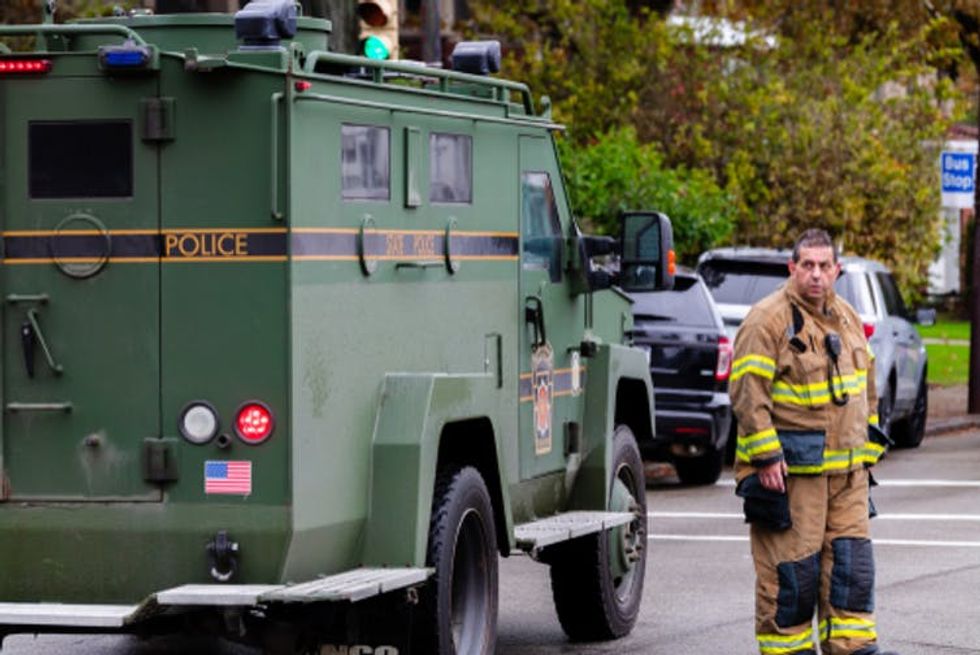
A first responder after the shooting at Tree of Life synagogue in Pittsburgh Oct. 27, 2018.
Another group whose trauma is usually overlooked is the first responders. When we all run away, the police, the firefighters, and the paramedics rush into the danger zone, and frequently face uncertainty, threats to themselves, their colleagues, and others, as well as terrible bloody scenes of post shooting. This exposure happens to them too frequently. PTSD has been reported in up to 20 percent of first responders to man-made mass violence.
How does it affect those who were not even near the shooting?
There is evidence of distress, anxiety, or even PTSD symptoms among people who were not directly exposed to a disaster, but were exposed to the news, including post-9/11 . Fear, the coming unknown (is there another shooting, are other co-conspirators involved?) and reduced faith in our perceived safety may all play a role in this.
Every time there is a mass shooting in a new place, we learn that kind of place is now on the not-very-safe list. When at the temple or church, the club or in the class, someone may walk in and open fire. People not only worry about themselves but also the safety of their children and other loved ones.
Media: the good, bad, and the sometimes ugly
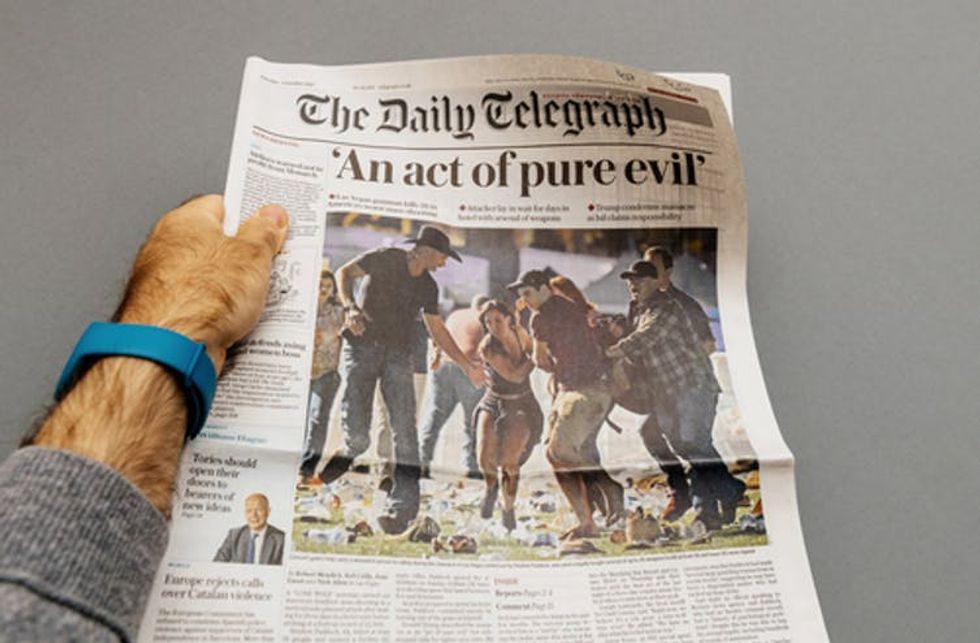
The Daily Telegraph front page of the shootings in Las Vegas on Oct 1, 2017.
I always say American cable news are “disaster pornographers.” When there is a mass shooting or a terrorist attack, they make sure to add enough dramatic tone to it to get all the attention for the duration of the time they desire. If there is one shooting in a corner of a city of millions, the cable news will make sure that you feel like the whole city is under seige.
Besides informing the public and logically analyzing the events, one job of the media is to get viewers and readers, and viewers are better glued to the TV when their positive or negative emotions are stirred, with fear being one. Thus, the media, along with the politicians, can also play a role in stirring fear, anger, or paranoia about one or another group of people.
When we are scared, we are vulnerable to regress to more tribal, and stereotyping attitudes. We can get trapped in fear of perceiving all members of another tribe a threat, if a member of that group acted violently. In general, people may become less open, and more cautious around others when they perceive a high risk of exposure to danger.
Is there a good side to it?
As we are used to happy endings, I will try to also address potentially positive outcomes: we may consider making our gun laws safer and open constructive discussions, including informing the public about the risks. As a group species, we are able to consolidate group dynamics and integrity when pressured and stressed, so we may raise a more positive sense of community. One beautiful outcome of the recent tragic shooting in the Tree of Life was the solidarity of Muslim community with the Jewish . This is especially productive in the current political environment where fear and division are common.
The bottom line is that we get angry, we get scared and we get confused. When united, we can do much better. And, do not spend too much time watching cable TV; turn it off when it stresses you too much.
In an interview KCAL, a former high school coach claimed that Thousand Oaks shooter Ian David Long attacked and sexually groped her 10 years ago, but that she never reported it, instead just kicking him off the track team.
Long is reportedly responsible for a mass shooting at Thousand Oaks bar that left 12 dead, and then turned the gun on himself.
Speaking with local reporters, Dominique Colell recalled the incident that began with a dispute over a cell phone and ended with Long groping her as he grappled with her over the phone.
“He attacked me. He attacked his high school track coach,” said Colell. “Who does that?”
According to Colell, she found the phone and was attempting to see who owned it, when Long blew up at her.
“Ian came up and started screaming at me that was his phone,” Colelle explained. “He just started grabbing me. He groped my stomach. He groped my butt. I pushed him off me and said after that — ‘you’re off the team.’ “
But Colell says she was encouraged by other coaches and officials at Newbury Park High School to accept his apology and not do anything that would ruin his future in the Marine Corps.
Jason Coffman, father of 22-year old victim Cody Coffman, memorialized his son and said “guns are in the wrong hands” at a Thursday press conference following Wednesday night’s mass shooting in Thousand Oaks, California.
"I cannot believe it happened to my family. I don't know what to tell other people," Coffman said, his head hanging. "I am speechless and heartbroken. I have been talking to you for a little while, I am pooped out, I'm spent."
"Ever since my son was 3 years old, I coached him all the way up til when he played high school baseball. I was the coach," Coffman said. "He was my fishing buddy. I fished all the time and that poor boy would come with me whether he liked it or not. Fishing on the boat. That's the kind of stuff that I am truly going to miss."
Coffman said he felt sorry for the parents of the killer, and slammed America's lax gun laws.
"Everybody has their rights. We all live in a free world here," he said. "The United States of America is for everybody. Guns are in the wrong hands."