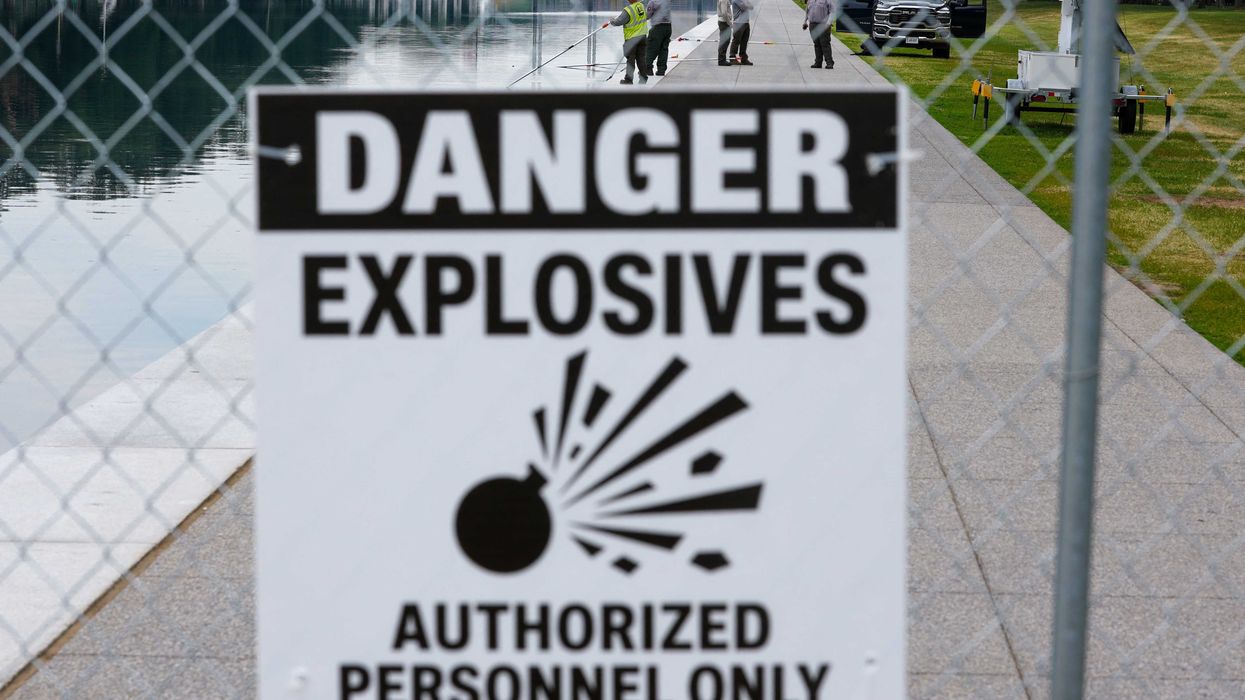
A sign reads "Danger Explosives" as workers clean algae from the Lincoln Memorial Reflecting Pool following the completion of recent renovations in Washington, D.C., U.S., June 26, 2026. REUTERS/Ken Cedeno

The White House's claim that vandals sabotaged its Reflecting Pool renovation has proved as flimsy as the pool's controversial new lining, according to a report released Thursday.
A comprehensive Washington Post investigation revealed the deterioration plaguing the $14 million renovation stems from construction failures—in particular coating seams -- not sabotage.
The Lincoln Memorial's Reflecting Pool exhibits peeling damage in at least seven distinct locations, all positioned along seams created when waterproof coating was applied in separate rectangular sections, the report noted. The failure pattern strongly indicates installation errors rather than intentional destruction, according to the Post.
Trump has repeatedly blamed vandals for the damage, which emerged just two weeks after the project's completion in early June. "The slashes were 300 yards long, and the floor of the pool was cut and then pulled upward, with great force, by these thugs," he posted on Truth Social, offering no evidence.
However, satellite imagery, construction photos, and video documentation revealed a critical pattern: every single failure occurred at seams—the junction lines between sections painted at different times.
Post reporters conducted on-site inspections and identified seven sites where the protective membrane had partially or completely separated from the concrete basin. The deterioration appeared in "irregularly shaped patches" stretching along the pool's edges.
"In five of the spots, the dark blue Pipeliner 5000 coating had peeled off to reveal more of the same material," the Post reported. "Experts said this appears consistent with an adhesion failure caused by an overlap of the dark blue over a dried layer of the same material at the seams. For any overlapping Pipeliner 5000 to adhere, the underlying layer would need to still be wet or, if not, steps would need to be taken to prepare the surface."
Four independent waterproofing experts with decades of experience unanimously concluded that the failure pattern indicated "application errors." While they stopped short of identifying a definitive cause without laboratory analysis, they identified seams as inherently vulnerable areas requiring meticulous attention.
"Anytime you have a stop and go, you're going to open yourself up to a problem that might occur," Vito Mariano, president of waterproofing company Basecrete Technologies explained to the Post, pointing out that the coating must be applied "as monolithic as possible" with minimal interruptions.
Rudy Stankowitz, a pool operations expert agreed and added, "They have a window [of time] … to get the next layer down. Otherwise, it’s not going to adhere properly unless additional prep is done."
Report typos and corrections to corrections@rawstory.com.
For customer support contact support@rawstory.com.