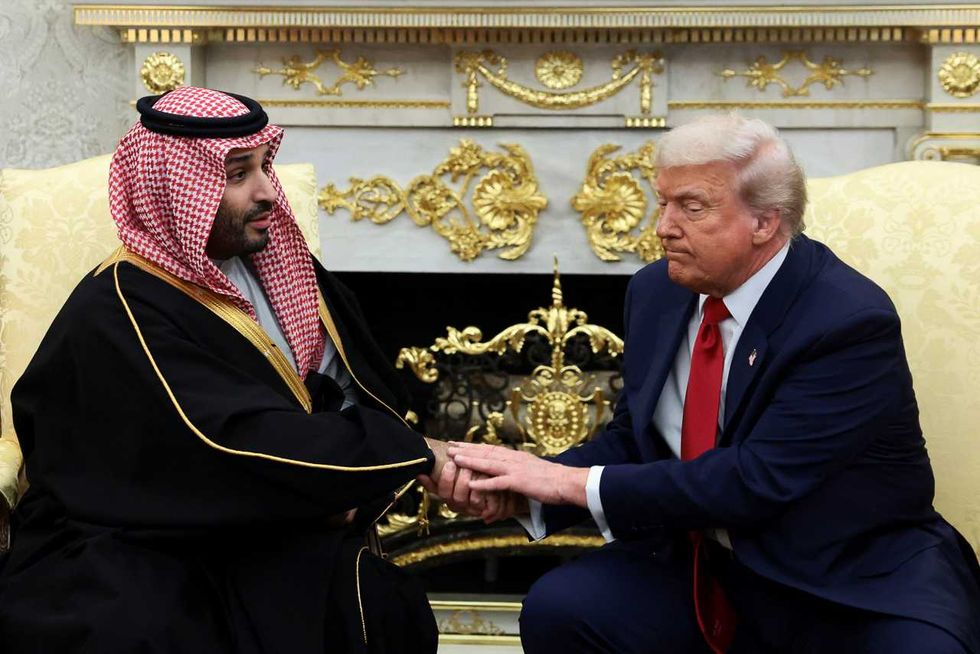
U.S. President Donald Trump and Saudi Crown Prince and Prime Minister Mohammed bin Salman shake hands during a meeting in the Oval Office at the White House in Washington, D.C., U.S., November 18, 2025. REUTERS/Evelyn Hockstein

President Donald Trump spurred terror and outrage Wednesday when reports surfaced that he formally approved a sweeping 30-year nuclear agreement with Saudi Arabia, worth tens of billions of dollars, that could pave the way for uranium enrichment in the Middle East.
The accord, expected to be signed Wednesday by Energy Secretary Chris Wright and Saudi Prince Abdulaziz bin Salman, gives American companies a central role in building Saudi Arabia's civilian nuclear infrastructure while locking out foreign competitors like Russia and China, but nonproliferation experts warn the deal could trigger a cascade of nuclear ambitions across the Middle East, reported the Wall Street Journal.
"Whither goes Saudi Arabia, so goes the United Arab Emirates, Turkey and Egypt," said Henry Sokolski, executive director of the Nonproliferation Policy Education Center. "The idea that this will have a happy ending is delusional."
A key provision would allow U.S. companies to construct a uranium-enrichment facility in Saudi Arabia if a joint two-year study determines the step is warranted, though the facility would operate under a "black box" arrangement designed to keep sensitive enrichment technology out of Saudi hands.
Sokolski and other critics say that framework doesn't go far enough, warning that Saudi Arabia's refusal to accept the so-called "gold standard" — a binding commitment never to enrich uranium or reprocess spent fuel domestically — sets a dangerous precedent.
Robert Einhorn, a former senior State Department nonproliferation official, echoed those concerns, saying that without adequate constraints on enrichment, the deal "could increase nuclear proliferation risks in the Middle East and beyond."
Adding to the alarm is Saudi Arabia's rejection of the International Atomic Energy Agency's "Additional Protocol," which would have subjected the kingdom to more rigorous inspections. Critics argue the alternative monitoring arrangement negotiated by the Trump administration will be insufficient to catch suspected nuclear activity at sites not directly built by the U.S.
Congressional critics have also raised objections. Rep. Brad Sherman (D-CA) said lawmakers should withhold approval unless Saudi Arabia agrees to forgo enrichment and reprocessing entirely, arguing the administration shouldn't enable proliferation risks "just because U.S. companies stand to make a profit."
The deal also arrives as the White House presses Iran, Saudi Arabia's regional rival, to sharply limit its own nuclear program — a juxtaposition critics call contradictory, even as Trump officials insist the Saudi program will be safeguarded.
Blocking the agreement will be difficult because doing so requires a joint congressional resolution capable of overriding a presidential veto, a two-thirds majority threshold rarely cleared on foreign policy disputes. The deal is expected to reach Congress for review in the coming days.
Presidents from both parties have long objected to efforts by Middle Eastern countries to enrich uranium, and some lawmakers have argued that a nuclear deal with Saudi Arabia, in particular, was such a sensitive topic that it should face an even tougher congressional standard.
A bipartisan group of lawmakers – including now-Secretary of State Marco Rubio – in 2018 sponsored an act that would block nuclear cooperation with the kingdom unless Congress affirmatively voted to approve such a deal, but that measure was never brought to a vote.
Report typos and corrections to corrections@rawstory.com.
For customer support contact support@rawstory.com.