Top Stories Daily Listen Now
RawStory

World

Putin says Russia has nothing to do with the mercenaries in Mali

French President Emmanuel Macron (R) speaks with Russian President Vladimir Putin during their meeting. -/Kremlin/dpa

There is no connection between Moscow and Wagner group mercenaries active in Mali, said Russian President Vladimir Putin on Tuesday, addressing a cause of concern among European governments involved in training missions in the West African country.

"As far as Wagner is concerned, I have already said that the Russian state has nothing to do with it," Putin said after meeting French President Emmanuel Macron in Moscow.

Keep reading... Show less

Retired US general anticipates anti-Putin Russian official will 'disappear shortly'

Retired Gen. Barry McCaffrey told MSNBC on Monday evening that the latest statements from a top Russian general will likely end his life. Former Russian Ambassador Michael McFaul tweeted Monday about the Russian general's opposition to President Vladimir Putin, calling it "a big deal."

"General Leonid Ivasho was a respectful and hawkish leader in the Russian Ministry of Defense," explained Chris Jansing. He "played a major role in the Pristina standoff with NATO in 1999. Do you agree, speaking as a general yourself, is that a big deal?"

Keep reading... Show less

Why were two luxury cruise ships seized last week in the Bahamas?

By Michael Tedder The ships are operated by Crystal Cruises, a Miami-based company that is owned by Genting Hong Kong. The luxury cruise ships the Crystal Symphony and Crystal Serenity were arrested on Friday in Freeport in the Bahamas, according to Cruise Law News. The ships are operated by Crystal Cruises, a Miami-based company that is owned by Genting Hong Kong. Why Were The Ships Seized? Last week a federal district court judge in Miami issued an arrest warrant for the Crystal Symphony, after fuel supplier Peninsula Petroleum Far East filed a lawsuit against Crystal Cruises “and sought the ...

Cookies: I looked at 50 well-known websites and most are gathering our data illegally

The owners of Google and Facebook were both heavily fined for using cookies illegally at the tail end of 2021 by the French data protection authority, Commission Nationale de l’Informatique et des Liberté (CNIL). On the French versions of Google, its sister platform YouTube, and Facebook, users were being asked to consent to cookies in such a way that it was much easier for them to accept than reject the request. They could accept cookies with just one click but there was a more laborious process for refusing.

Google owner Alphabet was fined €150 million (£125 million) and Facebook owner Meta €60 million. Alphabet was fined more because its breaches affected more people and it had been in trouble for violations in the past. Both companies were also given three months to change their systems to make it as easy for users to reject cookie requests.

Meta and Alphabet have yet to comply, though they have until April to do so. The law in the UK and the rest of the EU is also the same as in France, so it is going to be interesting to see what they do in these jurisdictions too.

In the meantime, I looked at what many other companies were doing and found that many are still collecting data using cookies in similar ways. So what’s going on?

Cookie laws and workarounds

Cookies are small text files stored by websites on our internet browsers, which allow the website to gather information about us. Some cookies are necessary for us to be able to browse the site in question – for example, to add items to a shopping cart.

More contentious cookies track a user’s browsing behaviour. There are first-person cookies, where the site in question tracks users’ behaviour to offer them relevant products; and third-party cookies, where this is done by another company to allow others to advertise to the user instead – the classic example is Google Ads.

Cookies gather so much information that it is usually more than enough to identify the person behind the device. Besides visits to particular web pages, they can also record a person’s search queries, goods or services purchased, IP address and exact location.

From this, it is possible to infer a person’s name, nationality, language, religion, sexual orientation and other intimate details – most of which are special categories of personal data that cannot be processed without the explicit consent of the individual under EU ePrivacy Directive and the EU and UK’s General Data Protection Regulation (GDPR).

The GDPR requires such consent to be specific, informed, unambiguous and given freely – requiring affirmative action by the user. Unfortunately, this is not giving us a great deal of protection.

Artist's representation of the GDPR attached to various padlock symbols

Worth the paper it’s written on?

Olivier le Moal

Websites have used various methods to get around the requirements. Most cookie consent requests used to be presented with pre-selected tick boxes that, by default, made individuals accept cookies on their devices. In 2019 the Court of Justice of the European Union (CJEU) decided websites could no longer do this, since it avoided the GDPR’s affirmative action requirement. But such is the value of the data that can be gathered using cookies that websites merely switched to different workarounds instead.

The popular option is the one that saw Facebook and Google sanctioned by the CNIL in France. The CNIL essentially said that when it comes to refusing cookie consent, two clicks are too many: it meant that people are being pressured into consenting, and was therefore contrary to the GDPR’s free consent requirement. This presumably explains why, from a 2020 experimental study of users who had lived in the EU, 93% accepted cookies regardless of having a second window option for managing them.

The wider issue

The French interpretation of the GDPR is not binding on the British courts, the CJEU or other regulators in Europe. So, once the CNIL’s three-month deadline runs out, websites with similar imbalanced cookie consent in other GDPR countries might claim there is an ambiguity in the law around what counts as consent. But really the law is quite clear and the French interpretation should be a strong signal that other privacy authorities will reach a similar conclusion.

And yet, when I looked at 50 randomly chosen well-known websites, only 15 (30%) appear to comply with the EU/UK data privacy laws. Some of those sites which are compliant, such as ebay.co.uk, provide “Accept” and “Decline” buttons in the same banner. Others such as bbc.co.uk make it more difficult to reject cookies but allow users to browse without consenting to them.

As many as 32 (64%) of the sites did not appear to comply with EU and UK cookies laws. These include Google, Facebook and Twitter, as well as other major businesses such as Ryanair and the website of the Daily Mirror.

Twitter, for example, merely notifies the user of consent in a banner that states: “By using Twitter’s services, you agree to our cookies use”. Other companies, including Google and Facebook, hide the refuse/decline button in a second window. Still others, such as Ryanair, create a cookies wall where visitors may use the site only if they choose “Yes, I agree” or go to the “View cookies setting” to select their preferences.

Screenshot of Ryanair cookie request window

Ryanair

There were a further three websites where it was either unclear or borderline as to whether they were within the rules. Spotify, like the BBC, has a typical cookies banner but lets users browse without accepting the cookies. But its cookies banner covers half of the device screen. This reduces the quality of the user’s browsing experience and could potentially be regarded as a coercive practice.

The fact that big tech companies are not complying with cookies laws suggests that millions of citizens are likely having their personal data gathered unlawfully. It is hard not to wonder if some companies are knowingly breaching the rules because they generate so much revenue from their cookies that it’s worth risking a sanction for a privacy breach.

They may also be betting that the relevant authorities are too underfunded or understaffed to enforce the rules. For example, a recent report by the Dutch ombudsman highlighted that the relevant authority in that country had 9,800 unresolved privacy complaints at the end of 2020. And according to the Irish Council for Civil Liberties, “almost all (98%) major GDPR cases referred to Ireland remain unresolved” – in part due to lack of budget and sufficient specialist staff. The situation is unlikely to be radically different in other EU countries.

If the UK and EU are serious about protecting citizens’ privacy, they need to amend the rules to be more specific about what a consent window should look like, and run information campaigns to make it clear to citizens that withholding consent cannot in any way limit their browsing experience. They should also allocate the required resources to enforce the rules. Only then will the laws around these little-understood tools for harvesting our data be fit for purpose.

Keep reading... Show less

British man gets 22 months in prison over global movie piracy

By Jonathan Stempel NEW YORK (Reuters) - A British man was sentenced on Monday to a 22-month prison term after admitting involvement in a global piracy ring that caused major losses for movie and TV production studios by distributing unreleased content online. George Bridi, a 52-year-old former disk jockey, had already spent 17-1/2 months in jail since his arrest in Cyprus over his work for the Sparks Group, which prosecutors called an international online piracy group. Bridi pleaded guilty in November to a copyright infringement conspiracy charge. "Infringement of U.S. copyrights is a big pro...

Angelina Jolie shares letter from Afghan woman who details rights being ‘taken away’ under Taliban control

A letter sent to Angelina Jolie detailed the rights that are being taken away from women in Afghanistan after the Taliban seized control of the country. Jolie shared the letter on Instagram, saying she received it from a young Afghan woman who hasn’t been able to go back to school since the Taliban took over last year. “I feel like women don’t have any right to speak or put their word forward,” the letter reads, according to Jolie’s post. “The rights of the woman are taken away from them and they are not allowed to do anything in the country,” the letter continued. “Few weeks back when the Tal...

What you missed at the Olympics while you were sleeping

By Dan Gartland Plus, inside the NFL and Hollywood's long, strange relationship. Good morning! I’m Dan Gartland and this is the first edition of SI:AM. Thanks for coming on this journey with me. If you're reading this on SI.com, you can sign up to get this free newsletter in your inbox each weekday at SI.com/newsletters. It Was a Busy Day in BeijingPeople may just be starting their days here in North America, but it was an eventful start to the week in Beijing, where Olympic action has kicked into high gear. We’ll start with the Americans, because the Olympics are an exercise in blind patrioti...

Platinum jubilee: The British monarchy has been in and out of public favor for 200 years

As Queen Elizabeth II approaches her platinum jubilee, the first British monarch to do so, the royal family is also facing a difficult time. Headlines on the upcoming trial of the Duke of York are competing with plans for the jubilee.

Meanwhile, news coverage suggests that the queen and other royals, notably the Duke and Duchess of Cambridge, remain popular and much loved.

The history of the British monarchy shows that ebbs and flows of popularity were not unusual, especially in the last 200 years – an era when the royal family began to be presented to the public via the mass media.

Keep reading... Show less

No clear winner in Costa Rica election, run-off looming

Carlos Alvarado, President of Costa Rica, casts his ballot for the presidential and parliamentary elections into a ballot box. A run-off is looming for the Costa Rican presidential election as no clear winner emerged in the vote count late Sunday. -/La Nacion via ZUMA Press/dpa

A run-off is looming for the Costa Rican presidential election as no clear winner emerged in the vote count late Sunday.

According to figures released by the electoral authority from counting at more than 75 per cent of polling stations, ex-president Jose Maria Figueres had a clear lead and was followed by ex-finance minister Rodrigo Chaves.

Keep reading... Show less

North Korea grows nuclear, missiles programs, profits from cyberattacks -U.N. report

By Michelle Nichols

UNITED NATIONS (Reuters) - North Korea continued to develop its nuclear and ballistic missile programs during the past year and cyberattacks on cryptocurrency exchanges were an important revenue source for Pyongyang, according to an excerpt of a confidential United Nations report seen on Saturday by Reuters.

Keep reading... Show less

Mexico breaks up migrant camp near US border

Migrants are seen next to riot police as authorities dismantle an improvised camp outside El Chaparral crossing port in Tijuana, Baja California state, Mexico, near the border with the US. After almost a year, authorities dismantle the camp and...

Tijuana (Mexico) (AFP) - Authorities on Sunday broke up a camp of about 380 migrants, mostly from Mexico and Central America, in Tijuana, near the US border. 

Mexican migration officials announced that they were trying to relocate the people in the area just south of San Diego, California.

Keep reading... Show less

Dumping plastic in waterways is 'criminal', pope says in TV interview

By Philip Pullella and Giulia Segreti VATICAN CITY (Reuters) - Dumping plastic in waterways is "criminal" and must end if humanity wants to save the planet for future generations, Pope Francis said in a television interview on Sunday. In the hour-long interview on state broadcaster RAI's Channel 3, Francis also reiterated some of the key themes of his papacy, condemning excessive spending on armaments, defending the rights of migrants, and condemning ideological rigidity by conservatives in the Church. Francis, who has made defending the environment a cornerstone of his pontificate, recounted ...

France's Macron flies to Moscow in high-risk diplomatic mission

By Michel Rose

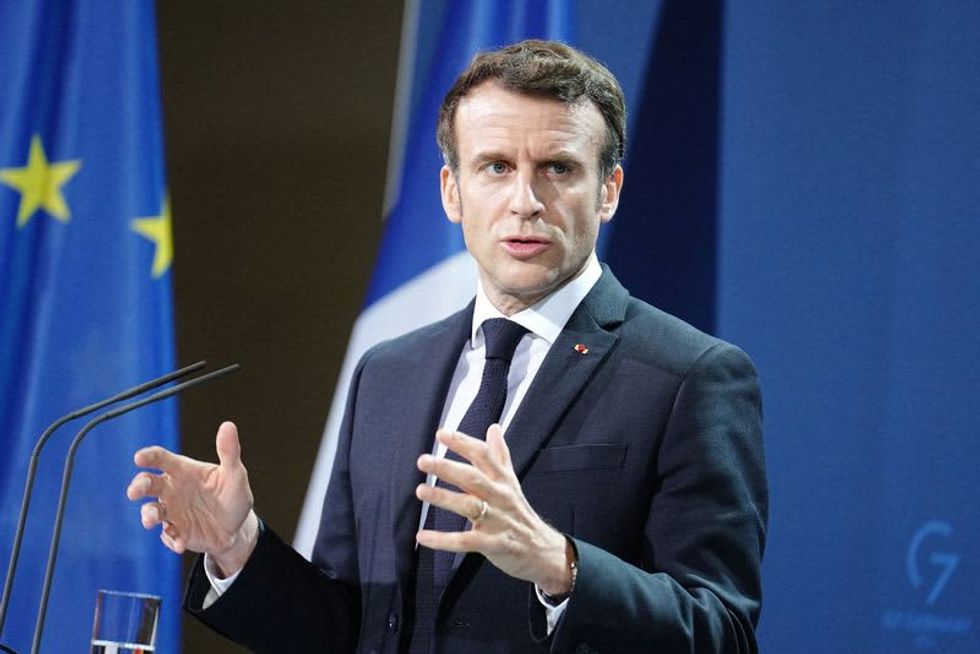
MOSCOW (Reuters) - French President Emmanuel Macron flies to Moscow on Monday in a risky diplomatic move, seeking commitments from Russian President Vladimir Putin to dial down tensions with Ukraine, where Western leaders fear the Kremlin plans an invasion.

Keep reading... Show less