Lawyer L. Lin Wood is one of two of President Donald Trump's legal pals working to stage lawsuits to take the 2020 election results from President-elect Joe Biden. But in a new Sunday tweet, his allegations of conspiracy are now including America's neighbor to the north, Canada.
"CCP & 1000’s of US citizens worked together to try to steal 2020 election at top of ticket & selected down ballot (sic) races," Wood tweeted. "Serbia, Canada, Venezuela, Cuba, CIA, George Soros, Bill Gates, Biden, Clinton Foundation & many national state & local officials from both parties involved."
CCP presumably means the Chinese Communist Party. It's unclear how Venezuela managed to overthrow the American election since it can't even feed its own people. It's also unclear how Canada, Serbia, Venezuela, and Cuba became part of the Chinese Communist Party or "US citizens" who "worked together to try to steal the 2020 election."
Science fiction is shifting into reality. With humanity’s plans to return to the moon this decade and further ambitions to travel to Mars in the next, we need to figure out how to keep astronauts healthy for these years-long missions. One solution long championed by science fiction is suspended animation, or putting humans in a hibernation-like sleep for the duration of travel time.
We can turn to nature for guidance and a potential solution to this challenge.
Primates have been used in space research for decades. Space pioneer Miss Baker, a squirrel monkey, rode a Jupiter IRBM into space in 1959 and returned safely.
Space is unforgiving. In this freezing void of darkness there is no oxygen, no gravity and no protection against the constant shower of cosmic radiation. Humans have evolved under a constant gravitational pull — so when you put people into space, strange and dangerous things happen to their bodies.
However, scientists and engineers working with astronauts on the International Space Station have innovated and continue to address these problems. For example, we know that spaceflight leads to loss of muscle and bone density, since our bones and muscles do not need to work against the pull of gravity to move us around.
These physiological challenges are combined with the technological difficulties of sending multiple humans on these long missions where they face logistical complications of packing and allocating enough provisions and supplies, as well as social issues of coping with extreme isolation in deep space.
Putting the body on pause
Suspended animation and biostasis may elicit science fiction images of humans in cryosleep pods. If we could put humans in a state of suspended animation by greatly slowing or even fully halting metabolic activity, we could alleviate issues surrounding space travel: time, health concerns, spacecraft size and supply allocation.
WIRED takes a look at the science behind suspended animation.
But how can we safely ease humans into hibernation and then bring them back when the time is right, without risking muscle and bone wasting, to name a few challenges? These are questions that the United States Department of Defense and other space agencies are actively exploring.
Animals who spend the winter in states of suspended animation — hibernation — don’t experience significant muscle and bone wasting. Their existence and ability to reversibly turn off biological processes seemingly necessary for life may well hold the key to creating the conditions required for the human hibernation strategy that could pave our way to surviving long interstellar voyages to distant stars.
In fact, the use of biostasis has already been proposed for the transport of large numbers of travellers to Mars, where crew members will be sustained with specially formulated total nutrition liquids while they “sleep.”
Model animals?
How do we translate hibernation in animals to hibernation in humans? Recent work has uncovered such an ability in animals that are evolutionarily similar to humans: hibernating primates. What is unique about these primates is that they can enter a state of hibernation when resources are scarce and temperatures become cold, and do so without seriously dropping their body temperature.
One of the driving forces behind this extreme ability is microRNAs — short pieces of RNA that act as molecular gene silencers. MicroRNAs can regulate gene expression without altering the genetic code itself. By studying the microRNA strategy these animals use, we can exploit this genetic on/off switch for rapid, reversible changes that could aid hibernation in humans.
Our work on gray mouse lemurs (Microcebus murinus) shows how microRNAs control which biological processes remain on to protect the animal and which ones are switched off to save energy. Some of these microRNAs were found to combat muscle wasting during hibernation. Other roles seem to involve preventing cell death, slowing down or stopping unnecessary cell growth, and switching fuel stores from quickly consumed sugars to slower-burned fats.
Mouse lemurs are more closely related to humans than mice, which are more typically used for research.
Our lab also looks at how microRNAs are helping animals survive other extreme environmental stresses including freezing, oxygen-deprivation and hot, dry climates. There is no stress more extreme than the vacuum of space, and we hope our research will contribute to the new RNA-based interventions that are gaining attention and emerging as viable human therapeutics.
Space is within our reach, and studying what’s already on Earth will help get us there.
The threat of far-right terrorism has loomed large in Australia this week. An 18-year-old from NSW has been arrested on charges of advocating terrorism and inciting others to violence. According to police, he had not only been sharing white supremacist and neo-Nazi views online, but had expressed support for being involved in a “mass casualty” event.
The arrest coincided with the launch of an inquiry into extremist movements in Australia by the parliamentary joint committee on intelligence and security. Headed by Liberal MP Andrew Hastie, the inquiry will consider both right-wing and left-wing extremism.
The teenager from Albury arrested this week by the NSW Joint Counter Terrorism Team.
AUSTRALIAN FEDERAL POLICE
Also this week, the royal commission report into the Christchurch terrorist attack reported that New Zealand security and intelligence services had mistakenly ignored the potential of far-right groups to commit acts of terrorism due to an overwhelming focus on Islamist threats.
The commissioners confirmed the convicted terrorist behind the attack that killed 51 people had been active in Australian extremist groups before moving to New Zealand.
The far right becoming more visible during pandemic
Far-right extremism is not a new phenomenon in Australia, but it has certainly been on the rise in the past year in response to federal and state governments’ handling of the coronavirus pandemic.
In September, ASIO revealed that up to 40% of its counterterrorism efforts were now directed at far-right extremist activities, an increase from 10-15% before 2016.
ASIO has also warned that far-right groups were exploiting the pandemic to expand their operations. New groups have emerged and existing groups have become more radicalised and increased their memberships.
One such right-wing group is the Proud Boys. They received what seemed like an endorsement this year from US President Donald Trump when, after being asked to condemn white supremacist and militia groups during the first presidential election debate in September, he said they should “stand back and stand by”.
The group has also been growing in Australia this year. Its vetting channel on the encrypted app Telegram has been increasingly active, with a steady stream of new applicants. And members have participated in protests throughout the year.
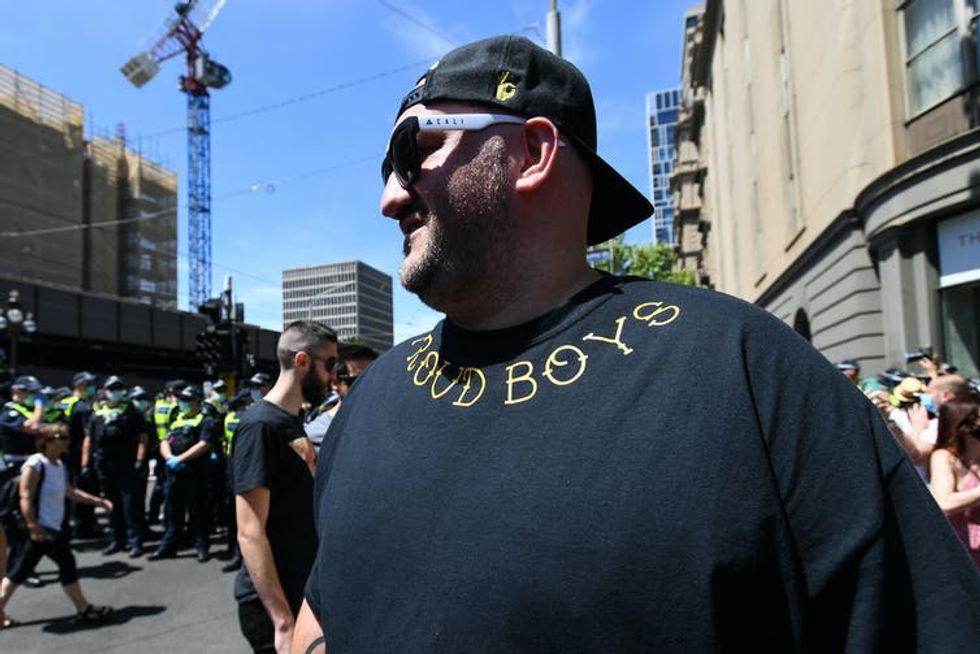
At the Melbourne Invasion Day rally, a group of Proud Boys posed at Flinders Street Station wearing T-shirts that said “Governor Arthur Phillip did nothing wrong”. They dispersed before the rally commenced.
By November, however, they were bolder and appeared wearing their signature Fred Perry polo shirts at an anti-lockdown protest at Victoria’s Parliament House. They scuffled with police before being pepper-sprayed, arrested and fined.
The Proud Boys became more of a visible presence at a November protest in Melbourne.
Erik Anderson/AAP
The Proud Boys are a self-described “Western chauvinist” street-fighting gang for men. They claim to be non-racist, but members must take an oath upholding Western civilisation as supreme. Their process for becoming a member also involves violence against each other and against antifascists or “antifa”.
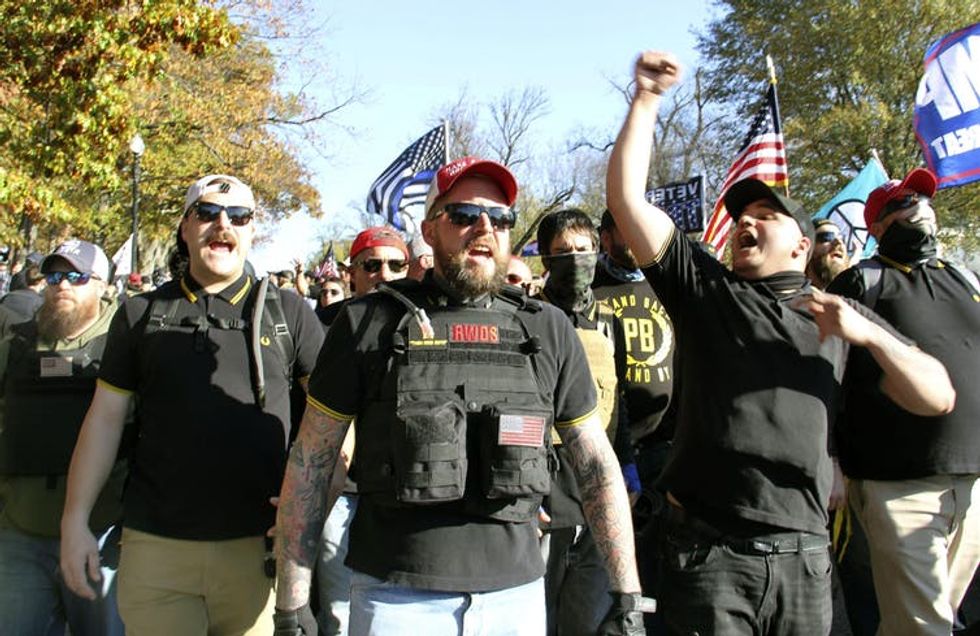
This year, Proud Boys members in America have been arrested for assault, street brawls and weapons offences. They are an increasingly visible presence on the streets there, frequently wearing military body armour and carrying high-powered weapons.
The increased visibility of Proud Boys at demonstrations is concerning if it signals a new strategy by the group to engage in street violence either with police or left-wing protesters.
Proud Boys members protesting the presidential election outcome in Washington. Note right Wing Death Squad badge.
KYDPL KYODO/AP
Other far-right groups emerging
Other right-wing groups in Australia have benefited from public anger to the government’s coronavirus responses, as well.
Relatively new groups such as the Townsville Free Corps and the National Socialist Network, an offshoot of the Lads Society and incorporating ex-Antipodean Resistance members, have stepped up their recruitment and propaganda activities in Melbourne, Sydney and Queensland over the past year.
The Southern Poverty Law Centre in the US, which tracks far-right extremist groups, revealed in August that the white supremacist terror group The Base had also interviewed potential Australian members using its Perth-based recruiter to set up cells. By late 2019, at least a dozen Australian men had applied to join The Base.
One potential member had been a former political candidate for One Nation, the SPLC reported.
Many of these far-right groups are adherents to the same “great replacement theory” that motivated the Christchurch killer. According to this theory, white Europeans are threatened by increasing non-white immigration and are therefore facing “white genocide”.
Tyler Jakovac, the 18-year-old man arrested in Albury this week, fits this description. According to NSW police assistant commissioner Mark Walton, he hated anyone who did not look like him and was specifically opposed to Jews, Muslims and immigrants.
The National Socialist Network issued a statement via an encrypted app claiming that Jakovac applied to join six months ago, but didn’t pass the vetting process. The group claims that after being rejected, Jakovac abused it as being “too moderate”.
The Christchurch killer, meanwhile, had been invited to join an earlier version of Sewell’s group. He declined and went on to act alone.
This raises a problem: extremist groups with a public propaganda strategy are easier to identify, but as the inquiry into the Christchurch attack noted, lone actors can be almost invisible to authorities.
There are communities on gaming platforms, message boards and in encrypted apps that share racist, anti-semitic and hateful material every day. By “"weaponising” irony, users can hide behind plausible deniability (“it’s just a joke”) when challenged about the violence stated in their posts. But to outsiders, the language used can be confronting.
It is often insiders who have a more finely tuned sense of when someone is crossing over from sharing memes to something more sinister. We need to educate and support internet users to follow their hunches by identifying and reporting other users who are edging toward violent action.
The Christchurch murderer was reported to police in 2016 for threatening someone with retribution on the “day of the rope”, according to the inquiry report. This is neo-Nazi shorthand for the mass murder of race traitors. Unfortunately, no police action was taken.
There are thousands of references to the “day of the rope” in online groups — knowing when to step in is the challenge. And, as the events of this week show, disruptive preemptive action is essential to reduce the risk of another mass murder.
The United Arab Emirates is getting top-of-the-line fighter jets. Morocco is winning recognition for decades-old territorial claims. And Sudan is coming off the US terrorism blacklist.
The Arab nations are suddenly achieving long-sought goals after agreeing to normalize ties with Israel, in a last-minute triumph for the unorthodox diplomacy of outgoing President Donald Trump's son-in-law, Jared Kushner.
Widely mocked for more than three years as a boyish lightweight, who was best known for his famous wife, troubled property deals and his father's stint in prison, Kushner is scoring historic breakthroughs lauded by Trump's base with four Arab nations since September joining the so-called Abraham Accords with Israel.
"President Trump took a contrarian approach," Kushner told reporters Thursday as he announced the latest deal, with Morocco, saying that the Arab-Israeli conflict "has been held back for so long by old thinking and by stalled process."
Veterans of Middle East diplomacy agree that Kushner moved nimbly after the United Arab Emirates first signalled its willingness to recognize Israel.
"He had the authority; he was smart enough to develop personalized relations. I think he clearly deserves some credit for taking advantage of what the landscape showed was possible," said Dennis Ross, who served as Bill Clinton's Middle East envoy.
Kushner, a family friend of Israeli Prime Minister Benjamin Netanyahu, broke decades of US norms on Middle East peacemaking by barely making a pretense of being evenhanded with the Palestinians.
Trump recognized Jerusalem as Israel's capital and, in a long-delayed Middle East plan unveiled in January 2020, gave the US blessing if Netanyahu wanted to annex much of the West Bank.
Speaking to CNN at the time, Kushner warned the Palestinians, who were offered a limited state, not to "screw up another opportunity like they've screwed up every other opportunity that they've ever had in their existence."
Personal bonds
Soft-spoken, thin and always sporting neatly coiffed hair and crisp suits, Kushner contrasts in style, if not goals, from his father-in-law.
Trump gave comedians fodder for jokes by putting Kushner in charge of everything from the Middle East to painkiller addiction, but in the Arab world, such familial arrangements showed he spoke for the president.
"In the Middle East, what negotiators or mediators need is unmistakable authority," Ross said.
Kushner, who turns 40 days before Trump leaves office, worked quietly and largely bypassed the State Department, whose top Middle East diplomat, asked at a late 2019 congressional hearing about his contribution to the Trump plan, replied, "Um, none."
Kushner traveled to Morocco for a Ramadan fast-breaking dinner with the king and swapped messages on WhatsApp with Saudi Arabia's powerful crown prince despite widespread concerns about his human rights record.
In Bahrain, another of the four Arab nations to move to recognize Israel, Kushner last year gathered Gulf executives for dinners and cocktails at a luxury hotel as they waxed about economic opportunities for the Palestinians, whose leadership boycotted the event.
-- UAE starts new dynamic -
Kushner had initially seen Gulf Arab promises of money as a way to pressure the Palestinians -- unsuccessfully -- to accept peace on Israel's terms.
But in mid-2020, UAE strongman Sheikh Mohamed bin Zayed Al-Nahyan -- described by former president Barack Obama in his new memoir as the Gulf's savviest leader -- reached out to turn the dynamic on its head.
Netanyahu would drop his plan for annexation. The UAE, in turn, would become the first Arab nation in more than 25 years to recognize Israel -- and win the right to buy stealth-capable US F-35s.
"It was an initiative that was really driven by the Emiratis but the administration, to its credit, was quick to pick up on it and has used that template these last several months," said David Makovsky, who studies Arab-Israeli relations at the Washington Institute for Near East Policy.
The new concept was "to put bilateral things that have traditionally had some importance to the United States and make those part of the deal."
Makovsky said there were key factors besides Trump and Kushner. Gulf Arabs feared US retrenchment as well as the growing influence of Iran and were aware of Israel's technological superiority.
Trump's unstated quid pro quos have raised alarm in some quarters, with Democrats opposing the F-35 sale and even some prominent Republicans upset over recognition of Morocco's claim to Western Sahara.
But Israel, which alone in the region had F-35s, did not object to the sale as it saw the dawn of a new era.
Makovsky believed that at least the Gulf Arabs' recognition of Israel stood on firm ground.
"If I could build on it," he said of Kushner's diplomacy, "I would hope that a new administration would do it with a twist and see if there is also something on the Palestinian issue."
Prime Minister Boris Johnson has said he is not going to walk away from Brexit talks - but Britain should prepare for World Trade Organization (WTO) rules, which would mean no trade deal with the European Union. The British prime minister warned that while Britain was keen to continue talks and believe a deal could be arranged with the European Union, Britons should prepare for no post-Brexit deal on January 1. Speaking to Sky News in Downing Street after his phone call with European Commission President Ursula von der Leyen and a meeting with his cabinet on Sunday, he said: "As things stand, ...
Germany is to close all but essential shops in the coming days under a weeks-long lockdown covering the Christmas holiday period, Chancellor Angela Merkel and the country's 16 state premiers agreed at a meeting on Sunday. The measures are to come into effect from Wednesday and last until January 10. These also include considerable restrictions imposed on schools and kindergartens, with most facilities to be closed or only operate to a limited extent. A partial lockdown in Germany that closed bars, restaurants and leisure facilities from early November while keeping shops and schools open was "...
The Pfizer-BioNTech Covid-19 vaccine was set to begin leaving the company's Michigan factory on Sunday, ready to be injected into the arms of millions of the most vulnerable Americans as the global death toll approached 1.6 million.
Doses will be shipped out in boxes containing dry ice that are capable of staying at -70 degrees Celsius (-94 degrees Fahrenheit), the frigid temperature needed to preserve the drug.
General Gus Perna, who is overseeing the massive logistical operation as part of the government's Operation Warp Speed, likened the moment to D-Day, a turning point of World War II.
- ADVERTISEMENT -
"I am absolutely 100 percent confident that we are going to distribute safely, this precious commodity, this vaccine, needed to defeat the enemy Covid," he told reporters.
The imminent start of the mass vaccination campaign in the world's hardest-hit country came as Italy overtook Britain as the European nation with the highest coronavirus death toll.
"I am worried about the two weeks of Christmas holidays. We are up against a dramatic pandemic which is ongoing -- the battle still has not been won," Italian Health Minister Roberto Speranza told a symposium as the country recorded 64,036 deaths, surpassing Britain's 64,026.
Regional affairs minister Francesco Boccia told Italian television that unless people adopted a careful approach, "the risk of a third wave is almost certain."
As the world was shortly expected to reach 1.6 million deaths, infections in the United States were soaring, with 1.1 million new cases confirmed in the past five days and the death toll nearing 300,000.
Over the past two weeks, the US has repeatedly exceeded 2,000 Covid-related deaths per day, rivaling tolls from the early days of the pandemic.
Perna said hundreds of sites, including hospitals and other distribution centers, would receive the vaccines from Monday to Wednesday, which would cover the first wave of about three million people to be vaccinated.
Federal health authorities have recommended that healthcare workers and nursing home residents be at the front of the line, but the final decisions have been left to states.
The US is seeking to inoculate 20 million people this month alone.
Elsewhere, South Korea on Sunday reported 1,030 new coronavirus cases, a record high for a second day in a row as the country struggled to tackle a third wave of infections.
The country had previously been held up as a model of how to combat the pandemic, but the resurgence prompted President Moon Jae-in to apologize for his administration's failure to contain the virus.
- Regulatory approval -
The US became the sixth country to green-light the Pfizer vaccine on Friday night, after Britain, Bahrain, Canada, Saudi Arabia and Mexico.
It was a triumphant moment for the American giant and its German partner BioNTech, who began work on their product, based on experimental mRNA (messenger ribonucleic acid) technology, just 11 months ago.
The vaccine has been shown in a clinical trial of 44,000 people to be 95 percent effective, and no serious safety concerns have been identified.
But after two healthcare workers in Britain suffered severe allergic reactions, the US regulator has advised people who have known allergies to the vaccine's ingredients to avoid getting it.
Food and Drug Administration scientist Peter Marks voiced support for Pfizer's plan to allow people involved in the clinical trial to find out whether they had received the vaccine or placebo.
Under this proposal, if they received the placebo, they can request the vaccine when their demographic group's turn comes up.
Some scientists have opposed this plan because if trial participants become "unblinded" and find out what they received, they may change their behavior and this would corrupt the trial's data.
But Marks said: "We have to balance the amount of blinded data that we receive with the need to protect people from a pandemic that's taking thousands of lives daily."
Two other vaccine candidates stumbled Friday.
France's Sanofi and Britain's GSK said their vaccine would not be ready until the end of 2021.
And in Australia the development of a vaccine at the University of Queensland was abandoned after clinical trials produced a false positive HIV result among subjects involved in early testing.
Britain is to end government funding for fossil fuel projects overseas, Prime Minister Boris Johnson said Friday, on the eve of an international climate change summit.
Johnson announced a halt to funding of new crude oil, gas and coal projects before opening the Climate Ambition Summit co-hosted by Britain, the United Nations and France on Saturday.
"I'm pleased to say today that the UK will end taxpayer support for fossil fuel projects overseas as soon as possible," Johnson said in a statement released by his office.
Britain has been criticised for sending billions of pounds abroad to help extract and refine fossil fuels and build power stations.
It has promised to end this soon, while saying there will be "very limited exceptions".
"Calling time on financing overseas fossil fuel projects really is a welcome move," said the policy director at Greenpeace UK, Doug Parr.
Christian Aid's head of campaigns and UK advocacy Pete Moorey said to tackle the climate crisis, 80 percent of known fossil fuels needed to be left in the ground.
"The UK government is right to heed this warning and end support for fossil fuels overseas," he added.
"Developing countries need investment to leapfrog the dirty energy that has led us into this crisis and access the clean renewable that can both accelerate their development and tackle the climate emergency."
Downing Street said it intends to implement the policy by November next year, when Britain will host the UN summit on climate change COP26, in Glasgow.
- 'Unacceptably high' -
Over the last four years, the British government "supported £21 billion ($28 billion, 23 billion euros) of UK oil and gas exports through trade promotion and export finance", it added.
Britain has been criticised by watchdogs and activists including Swedish campaigner Greta Thunberg for financing dirty energy projects abroad.
UK Export Finance (UKEF), a government department, provides British companies with export credit guarantees to help them trade overseas.
In 2019, an Environmental Audit Committee (EAC) report concluded that UKEF's support for fossil fuel energy projects was "unacceptably high" in developing countries.
It said Britain had supported projects worth £2.6 billion between 2013 and 2018, most in "low and middle-income countries".
By contrast, just £104 million went on renewable energy projects, it said, recommending an end of support for new fossil fuel projects by the end of next year.
The prime minister in January announced an immediate end to support of coal mining and coal-powered power stations abroad in developing countries.
Britain is not alone among wealthy nations in backing such projects abroad under the radar.
A study released in January by the market monitor Oil Change International and Friends of the Earth America found that export credit agencies of G20 countries provide more than 10 times as much state-backed financing to oil, gas and coal projects abroad as they do to renewable energy schemes.
A Brexit trade deal between Britain and the European Union looked to be hanging in the balance on Saturday after gloomy assessments from leaders on both sides of the Channel, with just hours left before last-gasp talks conclude.
Prime Minister Boris Johnson and European Commission chief Ursula von der Leyen have given their negotiators until Sunday before a decision is made on whether to keep talking or give up.
The mood worsened after von der Leyen told EU leaders at a marathon Brussels summit there were "low expectations" and the "probability of a no-deal is higher than of a deal".
Ireland and Germany tried to raise spirits, agreeing that a pact was "difficult but still possible".
But Johnson said it was looking "very, very likely" that Britain would end up dealing with its biggest single trading partner on World Trade Organization (WTO) terms from the New Year.
"If there's a big offer, a big change in what they (the EU) are saying then I must say that I've yet to see it," he told reporters.
The comments did nothing to inspire confidence in the British pound, which extended its losses on currency markets, dropping more than one percent against the dollar.
"Traders are turning their back on the pound as the language being used now is more serious," CMC Markets analyst David Madden told AFP.
UK chief negotiator David Frost and his EU counterpart Michel Barnier are trying to carve out a deal by Sunday, with just three weeks left until the end of a transition period following Britain's departure from the bloc in January.
- Last-minute turnaround? -
Whatever happens, Britain will leave the EU single market and customs union, leading to the re-introduction of border checks for the first time in decades.
That has already raised the prospect of heavy traffic clogging roads leading to seaports in southern and southeast England, as bureaucracy lengthens waiting times for imports and exports.
Transport companies have also warned that Ireland could see import volumes shrink in the event of new customs for goods routed through Britain.
"As an industry we're looking to plan ahead but there's so many unknowns it becomes difficult," Road Haulage Association director Martin Reid told the Press Association.
Logjams at the Felixstowe container port in eastern England and elsewhere have already raised fears of more to come, and delays in deliveries to shops, businesses and industry.
But Johnson's spokesman said they were mainly caused by a "global spike" in demand for consumer goods and the effect of the coronavirus outbreak on shipping patterns and container capacity.
Brexit trade talks have been deadlocked over the extent of EU access to British fishing grounds and rules governing fair competition.
An EU official refused to rule out a last-minute "turnaround" for a deal, even after the bloc published "no-deal" contingency planning in what was seen as a warning shot to Britain.
Johnson again said fishing and the so-called level playing field were key issues, in particular a "ratchet clause" that would bind Britain to match any future EU legislation.
Von der Leyen told a post-summit news conference the proposed "equivalence" rules would not be compulsory and Britain could act as it sees fit.
"We would simply adapt the conditions for access to our market accordingly," she added.
Johnson's spokesman said that would still leave Britain tied to decisions made in Brussels.
In the event of no-deal Brexit, the Royal Navy is ready to deploy four armed patrol ships as a "last resort" to protect Britain's fishing waters, the defence ministry confirmed to local media.
- 'Australia terms' -
Johnson won a snap election a year ago on Saturday with the promise of an "oven-ready" Brexit deal that would break years of political deadlock since Britain voted in 2016 to exit the EU.
But he has been under pressure to make good on his promise.
Johnson's assessment that Britain would "prosper mightily" on WTO rules with the EU -- what he calls "Australia terms" -- has not been universally welcomed.
Tariffs and quotas would drive up the cost of business that would be passed on to consumers in the form of higher prices in an economy already reeling from the coronavirus pandemic.
As a whole, the EU is Britain's biggest trading partner. Australia in comparison is the EU's 19th-largest trading partner.
Australia's former prime minister Malcolm Turnbull warned Johnson on Thursday: "Be careful what you wish for."
"Australia's relationship with the EU is not one from a trade point of view that I think Britain would want, frankly," he said.
The longest international border in the world, between Canada and the United States, will remain closed until January 21 due to the Covid-19 pandemic, Prime Minister Justin Trudeau announced Friday.
"Canada and the United States agreed today to keep our shared border closed until January 21," Trudeau told a news conference.
The border was initially closed in March to slow the spread of the novel coronavirus.
The closure has been renewed monthly since then. Only trade in goods and merchandise and essential travel are allowed.
A second wave of Covid-19 infections in Canada -- with a total of nearly 450,000 cases reported as of Friday -- has forced several regions to reintroduce pandemic measures.
The United States is the worst-affected country in the world, with almost 300,000 deaths from 15.7 million cases.
Sen. Jim Inhofe (R-OK), a longtime ally of President Donald Trump, pointedly broke with the president this week after Trump formally recognized Moroccan sovereignty in the Western Sahara Desert.
Inhofe, who has long had ties with the West Sahara's Polisario Front liberation movement, was furious that the president gave Morocco formal recognition over its claim to the territory.
"The Sahrawi people have the right to decide their own future," Inhofe wrote. "The president has been poorly advised by his team; he could have made this deal without trading the rights of a voiceless people."
As Axios reports, Trump decided to pull the trigger on the Morocco deal when Inhofe failed to deliver on two of his top priorities: Repealing Section 230 of the Communications Decency Act and blocking the renaming of military bases named after Confederate generals.
"Inhofe rejected both demands and... the two had a difficult phone call in which Inhofe leveled with Trump and said: 'This is the only chance to get our bill passed,'" the publication writes. "An angry Trump went to his Twitter account to hit back at Inhofe, claiming his position would harm U.S. national security and election integrity and reiterating his threat to veto the bill."
Trump aides in favor of the Morocco deal, including son-in-law Jared Kushner and chief of staff Mark Meadows, saw this rift as an opening to get the president to sign on after years of lobbying.
According to a report from the Daily Beast's Anna Nemtsova, the Russian Communist Party is taking a page out of the White House's playbook to disguise from the public the devastation caused by the coronavirus pandemic while at the same time creating doubts about the need for vaccinations.
The report notes that the Communist Party in Russia is leading the charge to downplay concerns, while at the same time making the case that an overreaction to the deadly pandemic could cripple an already struggling economy.
If that sounds familiar, Nemtsova writes, it is because the actions are mirroring the effort by the Trump administration that tried to downplay concerns over fears it would impact the ultimately doomed president's re-election efforts.
"Though its top leaders have mostly stayed clear of the issue, the rank-and-file in Russia’s Communist Party, the direct successor of the once giant Soviet party, have become the most visible coronavirus deniers and anti-vaxx agitators in Russia," she wrote. "Rising leaders in Russia’s largest opposition party have taken up the issue refusing to wear masks, downplaying social distancing, dismissing quarantine plans and even insisting they will not take Russia’s own vaccine."
According to the report mass vaccination efforts were launched last weekend using Russia's own vaccine called Sputnik V, but turnout has not been what is needed to stem the tide of COVID-19 infections with 59 percent of Russians stating they don’t trust the vaccine.
Part of that mistrust can be attributed to the Communist Party officials.
In an interview with the Beast, Valery Rashkin -- head of the Communist Party in Moscow -- dismissed the need for the vaccine, saying in an interview, "I have had a Soviet ideological vaccine against thieves and liars, it keeps me healthy,” before adding that concerns about the pandemic are hurting poor people the most.
"Much like President Trump and the Republican Party in the U.S., Rashkin says the impact of the pandemic is exaggerated and restrictions must be lifted to save businesses, he claims nearly 1,000 small and medium businesses have gone bankrupt during the pandemic," the report states with Rashkin adding, "Don’t believe Moscow is rich, it is a city with an immense number of poor people and the largest number of oligarchs; people are left without help to survive on pennies, while authorities spread gloom and fear."
"Communist leaders claim the party’s popularity has been growing during the pandemic, which concerns the Kremlin’s administration. In local elections in September, 32 percent of the capital’s residents voted for Communists," Nemtsova wrote, adding, "Just like Soviet communists, modern Russian Leninists inspire confrontations between poor and rich, although the modern party accepts the market economy and international trade, and has taken to recruiting small business owners."
The report goes on to note that Russia saw a record 613 deaths from COVID-19 on Friday alone, with the overall death toll passing 45,000.
The Swedish climate activist Greta Thunberg has condemned the "empty words" of world leaders in a video message released ahead of the fifth anniversary of the Paris climate accord on Saturday.
Since world leaders pledged to limit global temperature rises to 2 degrees Celsius in 2015, "a lot has happened, but the action needed is still nowhere in sight," the 17-year-old said in a video posted to social media.
Thunberg warned "we are still speeding in the wrong direction," and she accused global decision-makers of wasting time "creating new loopholes with empty words and creative accounting."
Although the accord signed in the French capital five years ago committed governments to capping global warming at 2 degrees -- and if possible 1.5 degrees -- compared to the pre-industrial era, the UN warned on Wednesday that the world is currently on course for a temperature rise of 3 degrees, despite the fall in emissions caused by the pandemic.
In its annual assessment of emissions levels, the UN's Environment Programme found that 2020's 7-percent fall in carbon pollution would have "negligible impact" on warming without a broad and rapid shift away from fossil fuels.
On Friday the 27 member states of the EU agreed to raise their greenhouse gas reduction target for 2030 to at least 55 percent of 1990 levels, against the current 40 percent.
Thunberg, the figurehead of the Fridays for Future climate protest movement, regularly calls on governments to set annual emissions targets for now, and not the 2030 or 2050 horizons which are used in most international greenhouse gas agreements.
However, in her latest three-minute video Thunberg said that "the hope comes from the people" and she called on people to act, ahead of a day of 2,500 planned demonstrations worldwide, many online, by her movement to mark the anniversary of the Paris accord.
The movement claims the objective of 1.5 degrees is now "non negotiable" and the only hope of safeguarding the planet for future generations.