The Trump Organization is planning a massive real estate development, according to a new report by Martyn McLaughlin in The Scotsman.
"In what would be one of the most ambitious and expensive foreign projects undertaken by Donald Trump’s family business since he assumed the presidency, his company has commissioned a detailed masterplan to develop as many as 225 properties, as well as leisure facilities and shops, on an expanse of rolling farmland adjacent to Turnberry’s lauded Ailsa course, a four-time host of golf’s Open Championship," the Scottish newspaper reported.
"Given the Trump Organisation has yet to formally submit a planning application, it has not announced the project or publicised its intentions. But Scotland on Sunday has obtained a series of documents prepared on its behalf by an architectural practice and one of the nation’s leading planning lawyers. Together, they spell out the company’s grand ambitions for the 114 year old resort, arguably the most prestigious of all Trump’s properties," The Scotsman reported. "A key selling point put forward by the Trump Organisation’s architects is the creation of 'high-end private residential homes for retirement living,' which it says would offer 'permanent tranquility and respite' and help address a 'social need' amongst an ageing population."
McLaughlin laid out a thread on Twitter laying out his reporting:
A major global update based on data from more than 36,000 weather stations around the world confirms that, as the planet continues to warm, extreme weather events such as heatwaves and heavy rainfall are now more frequent, more intense, and longer.
The research is based on a dataset known as HadEX and analyses 29 indices of weather extremes, including the number of days above 25℃ or below 0℃, and consecutive dry days with less than 1mm of rain. This latest update compares the three decades between 1981 and 2010 to the 30 years prior, between 1951 and 1980.
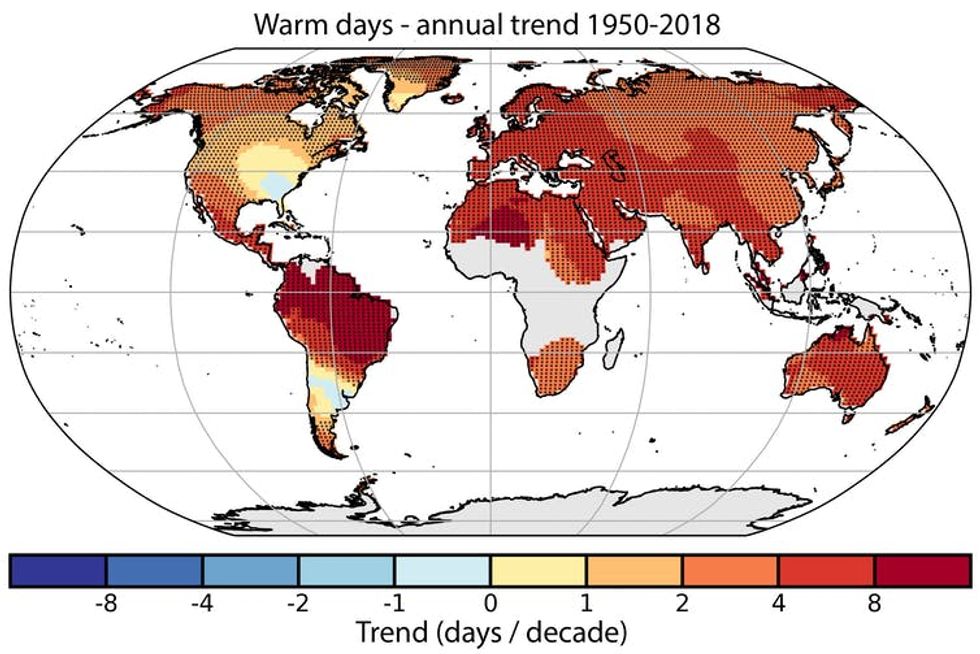
Globally, the clearest index shows an increase in the number of above-average warm days.
Author provided
For Australia, the team found a country-wide increase in warm temperature extremes and heatwaves and a decrease in most areas in cold temperature extremes such as the coldest nights. Broadly speaking, rainfall extremes have increased in the west and decreased in the east, but trends vary by season.
In New Zealand, temperate regions experience significantly more summer days and northern parts of the country are now frost-free.
Unusually warm days are becoming more common throughout Australia. When we compare 1981-2010 with 1951-80, the increase is substantial: more than 20 days per year in the far north of Australia, and at least 10 days per year in most areas apart from the south coast. The increase occurs in all seasons but is largest in spring.
New Zealanders are also experiencing more days with temperatures of 25℃ or more. The climate stations show the frequency of unusually warm days has increased from 8% to 12% from 1950 to 2018, with an average of 19 to 24 days a year above 25℃ across the country. Unusually warm days, defined as days in the top 10% of historic records for the time of year, are also becoming more common in both countries.
During the summers of 2017-18 and 2018-19, marine heatwaves delivered 32 and 26 (respectively) days above 25℃ nationwide in New Zealand, well above the average of 20 days. This led to accelerated glacial melting in the Southern Alps and major disruption to marine ecosystems, with die-offs of bull kelp around the South Island coast and salmon in aquaculture farms in the Marlborough Sounds.
In many parts of New Zealand, cold extremes are changing faster than warm extremes.
Between 1950 and 2018, frost days (days below 0℃) have declined across New Zealand, particularly in northern parts of the country which has now become frost-free, enabling farmers to grow subtropical pasture grasses. At the same time, crops that require winter frosts to set fruit are no longer successful, or can only be grown with chemical treatments (currently under review) that simulate winter chilling.
Across New Zealand, the heat available for crop growth during the growing season is increasing, which means wine growers have to shift varieties further south.
In Australia, the situation is more complicated. In many parts of northern and eastern Australia, there has also been a large decrease in the number of cold nights. But in parts of southeast and southwest Australia, frost frequency has stabilised, or even increased in places, since the 1980s.
These areas have seen a large decrease in winter rainfall in recent decades. The higher number of dry, clear nights in winter, favourable for frost formation, has cancelled out the broader warming trend.
In Australia, extreme rainfall has become more frequent in many parts of northern and western Australia, especially the northwest, which has become wetter since the 1960s. In eastern and southern Australia the picture is more mixed, with little change in the number of days with 10mm or more of rain, even in those regions where total rainfall has declined.
In New Zealand, more extremely wet days contribute towards the annual rainfall total in the east of the North Island, with a smaller increase in the west and south of the South Island. For Australia, there are significant drying trends in parts of the southwest and northeast, but little change elsewhere.
Extremes of temperature and precipitation can have dramatic effects, as seen during two marine heatwaves in New Zealand and the hottest, driest year in Australia during 2019.
Jim Salinger, Honorary Associate, Tasmanian Institute for Agriculture, University of Tasmania and Lisa Alexander, Chief Investigator ARC Centre of Excellence for Climate System Science and Associate Professor Climate Change Research Centre, UNSW
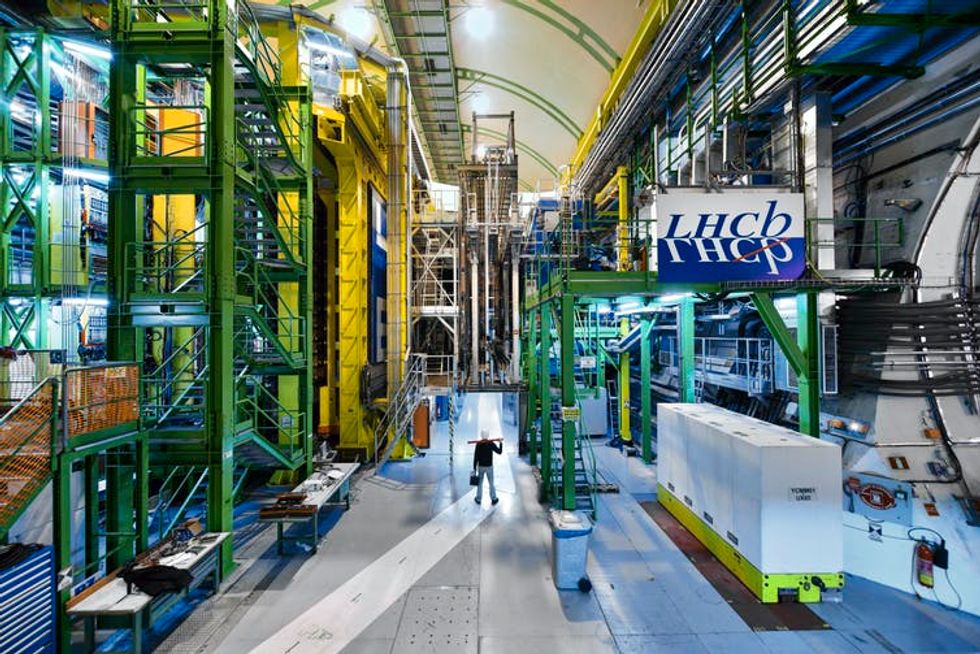
The LHCb collaboration at CERN has announced the discovery of a new exotic particle: a so-called “tetraquark”. The paper by more than 800 authors is yet to be evaluated by other scientists in a process called “peer review”, but has been presented at a seminar. It also meets the usual statistical threshold for claiming the discovery of a new particle.
The finding marks a major breakthrough in a search of almost 20 years, carried out in particle physics labs all over the world.
To understand what a tetraquark is and why the discovery is important, we need to step back in time to 1964, when particle physics was in the midst of a revolution. Beatlemania had just exploded, the Vietnam war was raging and two young radio astronomers in New Jersey had just discovered the strongest evidence ever for the Big Bang theory.
On the other side of the US, at the California Institute of Technology, and on the other side of the Atlantic, at CERN in Switzerland, two particle physicists were publishing two independent papers on the same subject. Both were about how to make sense of the enormous number of new particles that had been discovered over the past two decades.
Many physicists struggled to accept that so many elementary particles could exist in the universe, in what had become known as the “particle zoo”. George Zweig from Caltech and Murray Gell-Mann from CERN had struck upon the same solution. What if all these different particles were really made of smaller, unknown building blocks, in the same way that the hundred-odd elements in the periodic table are made of protons, neutrons and electrons? Zweig called these building blocks “aces”, while Gell-Mann chose the term that we still use today: “quarks”.
We now know that there are six different kinds of quarks – up, down, charm, strange, top, bottom. These particles also have respective antimatter companions with opposite charge, which can bind together according to simple rules based on symmetries. A particle made of a quark and an antiquark is called a “meson”; while three quarks bound together form “baryons”. The familiar protons and neutrons that make up the atomic nucleus are examples of baryons.
This classification scheme beautifully described the particle zoo of the 1960s. However, even in his original paper, Gell-Mann realised that other combinations of quarks might be possible. For example, two quarks and two antiquarks might stick together to form a “tetraquark”, while four quarks and an antiquark would make a “pentaquark”.
In the following years, several new exotic particles were discovered, and physicists started to realise that most of these particles could only be explained successfully if they were tetraquarks made of four quarks instead of two. Then, in 2015, the LHCb experiment at CERN discovered the first pentaquark particles made of five quarks.
All tetraquarks and pentaquarks that have been discovered so far contain two charm quarks, which are relatively heavy, and two or three light quarks – up, down or strange. This particular configuration is indeed the easiest to discover in experiments.
But the latest tetraquark discovered by LHCb, which has been dubbed X(6900), is composed of four charm quarks. Produced in high-energy proton collisions at the Large Hadron Collider, the new tetraquark was observed via its decay into pairs of well-known particles called J/psi mesons, each made of a charm quark and a charm antiquark. This makes it particularly interesting as it is not only composed entirely of heavy quarks, but also four quarks of the same kind – making it a unique specimen to test our understanding on how quarks bind together.
For now, there are two different models that could explain how quarks bind together: it could be that they are strongly bound, creating what we refer to as a compact tetraquark. Or it could be that the quarks are arranged to form two mesons, which are stuck together loosely in a “molecule”.
Ordinary molecules are made from atoms bound together by the electromagnetic force, which acts between positively charged nuclei and negatively charged electrons. But the quarks in a meson or baryon are connected via a different force, the “strong force”. It is really fascinating that atoms and quarks, following very different rules, can both form very similar complex objects.
The new particle appears to be most consistent with being a compact tetraquark rather than a two-meson molecule, which was the best explanation for previous discoveries. This makes it unusual, as it will allow physicists to study this new binding mechanism in detail. It also implies the existence of other heavy compact tetraquarks.
Window into micro-cosmos
The strong force operating between quarks obeys very complicated rules - so complicated, in fact, that usually the only way to calculate its effects is to use approximations and supercomputers.
The unique nature of the X(6900) will help understand how to improve the accuracy of these approximations, so that in the future we will be able to describe other, more complex mechanisms in physics that are not within our reach today.
Since the discovery of the X(3872), the study of exotic particles has thrived, with hundreds of theoretical and experimental physicists working together to shed some light on this exciting new field. The discovery of the new tetraquark is a huge leap forward, and is an indication that there are still many new exotic particles out there, waiting for someone to unveil them.
Istanbul (AFP) - President Recep Tayyip Erdogan on Saturday rejected worldwide condemnation over Turkey's decision to convert the Byzantine-era monument Hagia Sophia back into a mosque, saying it represented his country's will to use its "sovereign rights".Erdogan, who critics say is chipping away at the Muslim-majority country's secular pillars, announced Friday that Muslim prayers would begin on July 24 at the UNESCO World Heritage site.In the past, he has repeatedly called for the stunning building to be renamed as a mosque and in 2018, he recited a verse from the Koran at Hagia Sophia. "T...
Paris (AFP) - Forget Beluga caviar, foie gras, smoked salmon or ortolan, the tiny bird that French gourmets put a napkin over their heads to eat so they can savour every last second of their unique aroma.No, the food that goes best with the finest champagne is the humble radish.The discovery was made by the celebrated French chemist and wine expert Jacques Puisais, now 93, who has spent the last half century unsparingly researching which food goes best with different wines.Didier Depond, the head of the venerable Delamotte champagne house, is so convinced of the validity of Puisais' science he...
London (AFP) - Hong Kong expatriates living in Britain have welcomed London's pledge of "a pathway to future citizenship" for millions of the territory's residents after China imposed a controversial security law there.But they warned this "message of hope" would not help many, including those born after Hong Kong's 1997 return to Chinese rule and now aged over 18 -- people at the forefront of protests against Beijing. "It is helpful -- it sends a strong message of hope to Hong Kongers, many of whom are waiting to be rescued from their city," a 35-year-old financial analyst living in London si...
Sofia (AFP) - Bulgarian President Rumen Radev called on Saturday for a resignation of the "mafia-type" conservative government, which he blamed for ordering police raids on his offices this week.The president's legal affairs and anti-corruption secretary and his security and defence advisor were detained for questioning on Thursday and their offices searched as part of two separate probes into influence-peddling and disclosure of state secrets.The searches sparked public anger and brought thousands of demonstrators onto the streets of Sofia to condemn the raids as an attack by the government...
The World Health Organization has urged countries grappling with coronavirus to step up control measures, saying it is still possible to rein it in, as some nations clamp fresh restrictions on citizens.
With case numbers worldwide more than doubling in the past six weeks, Uzbekistan on Friday returned to lockdown and Hong Kong said schools would close from Monday after the city recorded "exponential growth" in locally transmitted infections.
WHO chief Tedros Adhanom Ghebreyesus called on countries to adopt an aggressive approach, highlighting Italy, Spain, South Korea and India's biggest slum to show it was possible to stop the spread, no matter how bad the outbreak.
The health agency's comments came as US President Donald Trump was forced to cancel an election rally in New Hampshire, citing an approaching storm.
Trump has pushed to hold large gatherings against health advice as epidemiologists warn of the dangers posed by the virus moving through the air in crowded and confined spaces.
On a visit to Florida on Friday, Trump hit out at Beijing over the pandemic.
"(The) relationship with China has been severely damaged. They could have stopped the plague.... They didn't stop it," he told reporters.
The virus has killed at least 556,140 people worldwide since it emerged in China last December.
More than 12.3 million cases have been registered in 196 countries and territories, triggering massive economic damage.
The United States, the country worst hit by the illness, reported almost 64,000 new cases Friday and the death toll now stands at just under 134,000, according to Johns Hopkins University.
Brazil, the second-hardest hit, surpassed 70,000 deaths and reported 45,000 new infections, the health ministry said.
In Uzbekistan, citizens were from Friday facing lockdown restrictions again that were originally imposed in March but lifted gradually over the past two months.
The Central Asian country's return to confinement followed a decision by Australia to lock down its second-biggest city Melbourne from Thursday.
A police officer manning a checkpoint on the outskirts of the former Soviet republic's capital said only drivers with "a good reason" to enter Tashkent -- such as delivering food or other vital supplies -- could pass.
Restaurants, gyms, swimming pools and non-food markets have all shut their doors until at least August 1.
Private transport within cities will be limited to morning and early evening journeys and essential purposes such as travelling to work and purchasing food or medicine.
In Hong Kong, the spike marks a setback for the city after daily life had largely returned to normal with restaurants and bars resuming regular business and cultural attractions reopening.
Despite being right next to mainland China where the virus first emerged, the city had managed to quash local transmission in recent months.
But new clusters have started to emerge since Tuesday, including at an elderly care home that reported at least 32 cases and a housing estate with 11.
- 'Turn this pandemic around' -
"Across all walks of life, we are all being tested to the limit," the WHO's Tedros told a virtual news conference in Geneva.
"From countries where there is exponential growth, to places that are loosening restrictions and now starting to see cases rise.
"Only aggressive action combined with national unity and global solidarity can turn this pandemic around," he said.
Elsewhere, French officials warned of rising cases in metropolitan France as the death toll topped 30,000.
In Israel, Prime Minister Benjamin Netanyahu admitted a decision to allow businesses, including bars and event spaces, to reopen may have been made "too soon".
The Middle Eastern country recorded its highest number of infections over a 24-hour period, at nearly 1,500.
In Australia, meanwhile, authorities said they would slash by half the number of people allowed to return from overseas.
From Monday, only 4,000 Australian citizens or permanent residents will be permitted to enter each day.
Chanting “Impunity is Over!” or dancing against sexual violence, women’s rights activists protested Friday in multiple cities in France and abroad against President Emmanuel Macron’s appointment of a new interior minister who is accused of rape and a justice minister who has minimized the #MeToo movement.
The actions started Friday morning in Dijon, where new Interior Minister Gerald Darmanin and Prime Minister Jean Castex were meeting with police. A dozen feminists held out banners and signs condemning Darmanin and rape culture.
Later Friday, in front of Paris City Hall, women staged a flash mob and performed the song and dance “ A Rapist in Your Path " started by feminists in Chile, which has become an international rallying cry against sexual violence and victim shaming.
The young, diverse crowd - most in masks - demanded Darmanin’s resignation and exuded anger at Macron, who had promised to make fighting sexual violence a grand cause of his term. Signs read “Darmanin named, Victims disdained” or “Victims, We See You”.
One of the speakers, who identified herself only as Margaux, said: “Without questioning the fundamental right to the presumption of innocence, the nomination of a man accused of rape reminds us how sexual and sexist violence is normalized and minimized, including at the highest levels of the state.”
“The message sent is very clear: Aggressors, don’t be afraid,” she told the crowd of about 1,000 people.
Feminist group Nous Toutes and others announced other actions Friday in other French cities as well as at French embassies or consulates in London, Sydney, Montreal, Berlin, Brussels, Barcelona and Tel Aviv.
The French government said it remains committed to gender equality and defended the new ministers, stressing the presumption of innocence.
Darmanin firmly denies the rape accusation, and an investigation is underway. New Justice Minister Éric Dupond-Moretti is a lawyer who has defended a government member accused of rape and sexual assault, and has ridiculed women speaking out as a result of the #MeToo movement.
Activists also expressed concern about LGBTQ rights with Darmanin in charge of French police, because he opposed gay marriage before France legalized it in 2013.
“We have the impression we’re being treated like idiots,” said Paris protester Alix Joly, a 25-year-old graduate student. When she heard about the latest government nominations, she said, “I laughed, but bitterly.”
The protest came amid a growing investigation into accusations by at least 26 women that a Paris street artist well known in the historic Montmartre neighborhood raped or sexually assaulted them. The artist-photographer says he never raped anyone. Lawyers for the accusers say he systematically preyed upon teen girls or young women, plied them with alcohol or drugs and took compromising photos so they would be too ashamed to report what happened.
Ghislaine Maxwell's lawyers asked a New York court Friday to release her on bail of $5 million, insisting she will stay in America to fight sex abuse charges related to Jeffrey Epstein.
The British socialite has been charged with sex trafficking minors for Epstein, her former boyfriend and convicted sex offender who killed himself in prison last summer while awaiting trial.
In documents filed with the Southern District of New York, her attorneys said the daughter of late newspaper baron Robert Maxwell "vigorously" denies the charges and "intends to fight them."
They argued that "she is not a flight risk" and asked Judge Alison Nathan to release her from custody on $5 million bail, signed by six of her associates and secured by a $3.75 million property in Britain.
Maxwell's defense team said she would surrender her passports from the United States, Britain and France and would confine herself to a property in New York with electronic GPS monitoring.
They added that the COVID-19 crisis would put Maxwell's health at "serious risk" if she continues to be incarcerated.
The bail hearing is scheduled for Tuesday at 1:00 pm (1700 GMT). Prosecutors will argue for Maxwell, 58, to remain behind bars.
The charges against her include conspiracy to entice minors as young as 14 years old to travel in order to engage in illegal sex acts and perjury.
Maxwell is also accused of taking part in some of the sexual abuse.
Sudan's highest governing body Friday ratified a law criminalizing female genital mutilation, a widespread ritual in the African country, the justice ministry announced.
The sovereign council, comprising military and civilian figures, approved a series of laws including criminalization of the age-old practice known as FGM or genital cutting that "undermines the dignity of women", the ministry said in a statement.
The reform comes a year after longtime president Omar al-Bashir was toppled following months of mass pro-reform protests on the streets in which women played a key role.
Sudan's cabinet in April approved amendments to the criminal code that would punish those who perform FGM.
"The mutilation of a woman's genital organs is now considered a crime," the justice ministry said, punishable by up to three years in prison.
It said doctors or health workers who carry out genital cutting would be penalized, and hospitals, clinics or other places where the operation was carried out would be shut.
Prime Minister Abdalla Hamdok hailed Friday's decision.
"It is an important step on the way to judicial reform and in order to achieve the slogan of the revolution -- freedom, peace and justice," he tweeted.
The premier vowed that Sudan's new authorities would "forge ahead and review laws and make amendments to rectify flaws in the legal system".
- Long decried as barbaric -
Nearly nine out of 10 girls in Sudan fall victim to FGM, according to the United Nations.
In its most brutal form, it involves the removal of the labia and clitoris, often in unsanitary conditions and without anaesthesia.
The wound is then sewn shut, often causing cysts and infections and leaving women to suffer severe pain during sex and childbirth complications later in life.
Rights groups have for years decried as barbaric the practice, which can lead to myriad physical, psychological and sexual complications and, in the most tragic cases, death.
The watershed move is part of reforms that have come since Bashir's ouster.
"It is a very important step for Sudanese women and shows that we have come a long way," women's rights activist Zeinab Badreddin said in May.
The United Nations Children's Fund has also welcomed the move.
"This practice is not only a violation of every girl child's rights, it is harmful and has serious consequences for a girl's physical and mental health," said Abdullah Fadil, the UNICEF Representative in Khartoum.
The UN says FGM is widespread in many countries across Africa, the Middle East and Asia, affecting the lives of millions of girls and women.
In Sudan, rights campaigners say the custom has over the past three decades spread to remote regions where it was previously not practiced, including Sudan's Nuba mountains.
In neighboring Egypt, as in several other countries, genital cutting is now prohibited. A 2008 law punishes it with up to seven years in prison.
Sudan's anti-FGM advocates came close to a ban in 2015 when a bill was discussed in parliament but then shot down by Bashir who caved in to pressure from some Islamic clerics.
Yet many religious leaders have spoken out against genital cutting over the years.
Venice's long awaited flood defense system designed to protect the lagoon city from damaging waters during high tides on Friday survived a first test of its 78 barriers.
The massive infrastructure project known as MOSE, which relies on sluice gates that can be raised to protect the city's lagoon during high tides, has been underway since 2003, but has been plagued by cost overruns, corruption scandals and delays.
The complex engineering system uses a network of water-filled caissons, designed to be raised within 30 minutes to create a barrier capable of resisting a water rise of three meters (10 feet) above normal.
"This is the first test of movement of all four barriers at the same time," a statement said announcing the successful completion of the test.
Each barrier is made up of around 20 individual gates.
The project has thus far cost about 7 billion euros ($8 billion), versus an original estimate of 2 billion.
Venice regularly experiences "acqua alta", abnormally high tides that flood shops and hotels as well as the famous St. Mark's Square.
In November, the high waters peaked at 1.87 meters (six feet), a record not seen since 1966, causing extensive damage to the tourist city.
The project's head, Elisabetta Spitz, said MOSE will be operational from autumn 2021, although there remains a lot of work and forthcoming tests.
Prime Minister Giuseppe Conte, who came to Venice to assist in the test, said the project had arrived at its "last mile".
"We must ensure this safeguard will be available for next autumn-winter," Conte said.
A test in October on part of the barrier caused worrying vibrations and engineers discovered parts had rusted.
The Serenissima, as the floating city is called, is home to 50,000 residents but receives 36 million visitors each year.
The world’s first ever commercial high-speed internet service to use balloons to connect people to the web was launched in a remote region of Kenya’s Rift Valley this week.
Operated by Loon, part of Google parent company Alphabet, the service aims to bring affordable 4G internet to people in rural locations.
The balloons connect with internet ground stations and then communicate with each other to form a network of transmitters in the sky and initially will cover a region of 50,000 sq km, providing internet to 35,000 customers.
“Loon is finally in Kenya. Kenya being the first country in the world to commercialize the technology. This is basically base stations up even beyond where the planes are,” Joe Mucheru, Kenyan information minister, told Reuters as he launched the service on Wednesday.
Loon’s technology has been in development for a while and was first made public in 2013, but it has not been used commercially until now.
The helium-filled balloons carry a solar panel and battery, and float in the upper atmosphere, high above airplanes and weather.
They are launched from bases in California and Puerto Rico and then flown remotely to their destination
A total of 35 balloons will be used for the Kenya network, which is being run in partnership with Telkom Kenya.
“This will help me reach out to people even in the diaspora, because it has really been hard due to poor network around here,” honey vendor Dorcas Kipteroi told Reuters.
“We are sometimes left behind when it comes to communication, and you want to send some honey to people but the mode of communication becomes a challenge.”