"If the basics aren't followed, there is only one way this pandemic is going to go. It's going to get worse and worse and worse."
The head of the World Health Organization warned Monday that a "return to the 'old normal'" was not in "the foreseeable future" and urged global leaders to act cooperatively to control the coronavirus pandemic.
"Let me blunt, too many countries are headed in the wrong direction," WHO Director-General Dr. Tedros Adhanom Ghebreyesus said at a media briefing.
Tedros's remarks came as the total number of total coronavirus cases continued ticking upward, nearing 13 million globally. More than 570,000 Covid-19 deaths have been recorded worldwide, over 134,000 of which were in the United States.
The U.S.—which has the highest number of cases in the world—recorded over 3.2 million cases as of Monday, an increase of over 60,000 Sunday. Infections continue to rise in dozens of U.S. states including Florida, which on Sunday broke the national record for the largest single-day increase in coronavirus cases with over 15,000.
The WHO chief didn't single out the U.S. in his comments but noted, "The epicentre of the virus remains in the Americas, where more than 50% of the world's cases have been recorded."
The trajectory of the pandemic if governments fail to "roll out a comprehensive strategy focused on suppressing transmission and saving lives" and individuals don't take public health measures like wearing masks is clear, said Tedros.
"If the basics aren't followed, there is only one way this pandemic is going to go," Tedros said. "It's going to get worse and worse and worse."
"I want to be straight with you," he continued, "there will be no return to the 'old normal' for the foreseeable future."
But, he stressed, "it is never too late to take decisive action."
Tedros said governments must take out "all the tools we have to bring this pandemic under control" and act to "accelerate the science as quickly as possible."
The White House, meanwhile, continues to downplay the threat of the pandemic and discredit statements made by the nation's top infectious disease expert, Anthony Fauci.
President Donald Trump has repeatedly bashed the WHO throughout the pandemic and announced last week that the U.S. is formally withdrawing from the global health body.
Dubai (AFP) - The United Arab Emirates said it plans to launch its "Hope" Mars probe on Friday local time from Japan's Tanegashima Space Center after a two-day delay due to poor weather there. A rocket is due to blast off at 5:43 am local time (2043 GMT Thursday) carrying the unmanned spacecraft that is bound to orbit the Red Planet in the Arab world's first interplanetary mission. The launch was postponed from 2051 GMT Tuesday because of inclement weather at the remote Japanese launch site, but remains well within the launch window which runs until August 13. The Emirati project is one of three...
Moscow (AFP) - Russian mining giant Norilsk Nickel faced pressure from a key shareholder on Tuesday to overhaul management after disasters including a massive Arctic fuel spill that sparked a state of emergency. Aluminum producer Rusal, which owns 28 percent in Norilsk Nickel, said it was "seriously concerned" over recent environmental accidents in the Russian Arctic and called for a shakeup in management. "What is currently happening at Nornickel invites to seriously question the competence of the company's management as well as their suitability to be in charge of running the business," Rusal...
Hong Kong (AFP) - China has accused Hong Kong democracy activists of trying to start a revolution as it warned some campaigning for recent primaries may have breached a tough new security law it imposed on the city.The bellicose comments by the Liaison Office, which represents China's government in the semi-autonomous city, dramatically heighten the risk of prosecution for opposition parties and leading figures.More than 600,000 Hong Kongers turned out over the weekend to choose candidates for upcoming legislative elections despite warnings from government officials that the exercise could bre...
Tokyo (AFP) - It might be the unlikeliest instructional video ever, but footage of two Japanese amusement park executives demonstrating how to "scream inside your heart" to avoid spreading COVID-19 while on a rollercoaster has been a roaring success."Now our customers stay silent while riding on rollercoasters," a spokeswoman for amusement park operator Fujikyuko told AFP, after the video on riding etiquette for the coronavirus era went viral.The video features the executives, one in a full suit and tie, the other in a shirt and bowtie, sitting stiffbacked and straightfaced in silence, with on...
Sydney (AFP) - Queen Elizabeth II was not informed in advance about the 1975 dismissal of Australia's prime minister by her representative in country, letters kept secret for decades and released Tuesday revealed.The British monarch's representative in Australia, governor-general John Kerr, sparked a constitutional crisis when he abruptly fired Gough Whitlam, the democratically elected leader of the centre-left Labor party.In May the High Court ruled more than 200 letters between the queen's private secretary and Kerr -- including many addressing the controversial affair -- should be made publ...
"Infections are rapidly spreading among U.S. personnel when we Okinawans are doing our utmost to contain the infections."
Okinawa Gov. Denny Tamaki slammed the U.S. military over the weekend for not taking sufficient action to prevent the spread of Covid-19 after dozens of Marines stationed on the Japanese island tested positive, threatening to spark a large outbreak in a community where the virus has otherwise been well-contained.
Tamaki said during a press conference Saturday that "Okinawans are shocked" by the surge in cases among American Marines on the island. The Associated Pressreported that the U.S. military only disclosed the number of cases among U.S. Marines after Okinawan officials repeatedly demanded transparency.
"We now have strong doubts that the U.S. military has taken adequate disease prevention measures."
"It is extremely regrettable that the infections are rapidly spreading among U.S. personnel when we Okinawans are doing our utmost to contain the infections," said Tamaki. "We now have strong doubts that the U.S. military has taken adequate disease prevention measures."
Around 20,000 U.S. troops are stationed at more than 30 locations on Okinawa. While it is not known how the U.S. personnel were infected, Japanese newspaper Asahi Shimbun reported Saturday that local officials were concerned "about a sudden spike of infections because he saw many U.S. military service members wandering around outside the bases on the Fourth of July."
"We have raised the level of warning because we believe that infections are already spreading within our community," said Mayor Masaharu Noguni of Chatan, Okinawa.
As the New York Timesreported Monday, the new Covid-19 cases in Okinawa "are a new strain on relations between the military and the local government, where the presence of American bases, dating to the end of World War II, has been an ongoing source of friction."
"Citizens have long complained of noise, crime, and aircraft accidents, and have repeatedly questioned why nearly half of the 55,000 American troops in Japan—which include personnel from all of the military branches—are stationed on Okinawa," the Times noted.
Tomonari Kiyuna, a worker at a noodle shop in Chatan, told the Times that he is "scared" by the surge in coronavirus infections among U.S. troops.
"We're very careful, wearing masks, washing hands, and sanitizing," Kiyuna said. "I want them to disclose the information. They are Americans but they are staying in Okinawa, Japan. Okinawans or the Japanese people have the right to know."
We have all seen the alarming headlines: Coronavirus cases are surging in 40 states, with new cases and hospitalization rates climbing at an alarming rate. Health officials have warned that the U.S. must act quickly to halt the spread – or we risk losing control over the pandemic.
I’ve researched the history of the 1918 pandemic extensively. At that time, with no effective vaccine or drug therapies, communities across the country instituted a host of public health measures to slow the spread of a deadly influenza epidemic: They closed schools and businesses, banned public gatherings and isolated and quarantined those who were infected. Many communities recommended or required that citizens wear face masks in public – and this, not the onerous lockdowns, drew the most ire.
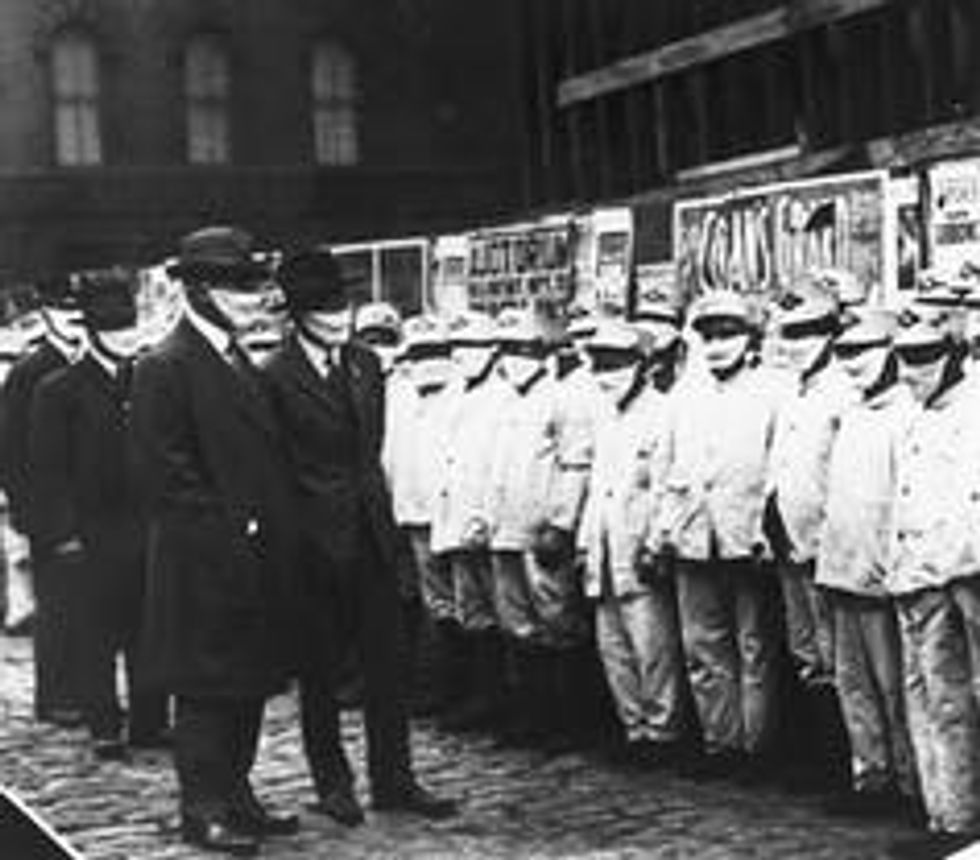
Officials wearing gauze masks inspect Chicago street cleaners for the flu, 1918.
In mid-October of 1918, amidst a raging epidemic in the Northeast and rapidly growing outbreaks nationwide, the United States Public Health Service circulated leaflets recommending that all citizens wear a mask. The Red Cross took out newspaper ads encouraging their use and offered instructions on how to construct masks at home using gauze and cotton string. Some state health departments launched their own initiatives, most notably California, Utah and Washington.
Nationwide, posters presented mask-wearing as a civic duty – social responsibility had been embedded into the social fabric by a massive wartime federal propaganda campaign launched in early 1917 when the U.S. entered the Great War. San Francisco Mayor James Rolph announced that “conscience, patriotism and self-protection demand immediate and rigid compliance” with mask wearing. In nearby Oakland, Mayor John Davie stated that “it is sensible and patriotic, no matter what our personal beliefs may be, to safeguard our fellow citizens by joining in this practice” of wearing a mask.
Health officials understood that radically changing public behavior was a difficult undertaking, especially since many found masks uncomfortable to wear. Appeals to patriotism could go only so far. As one Sacramento official noted, people “must be forced to do the things that are for their best interests.” The Red Cross bluntly stated that “the man or woman or child who will not wear a mask now is a dangerous slacker.” Numerous communities, particularly across the West, imposed mandatory ordinances. Some sentenced scofflaws to short jail terms, and fines ranged from US$5 to $200.
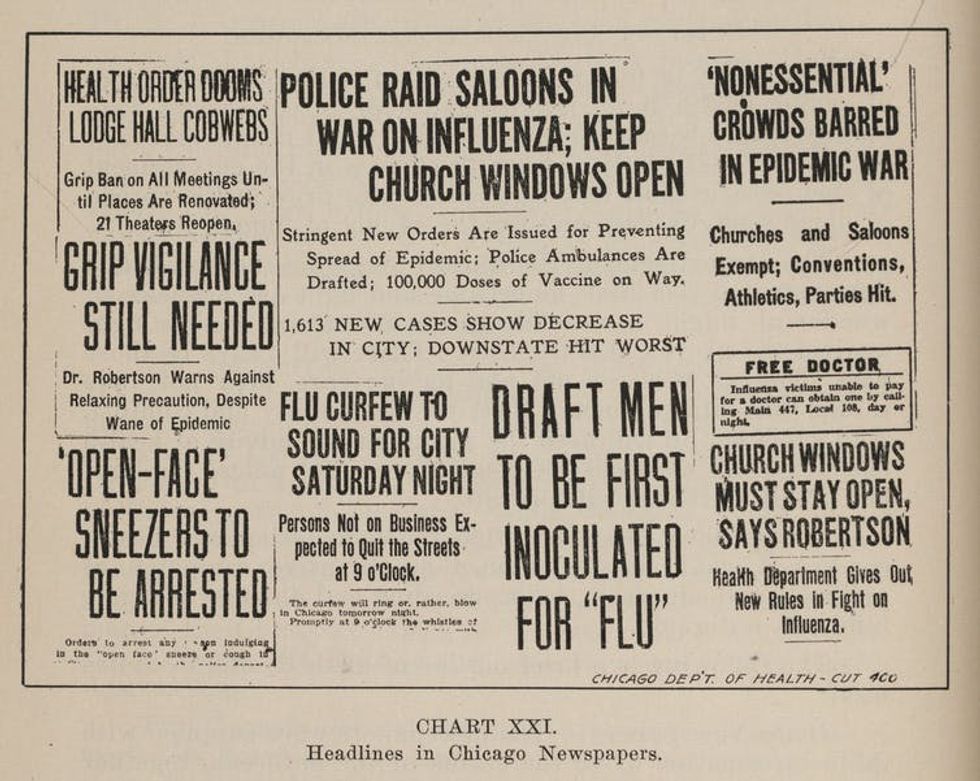
Collage of newspaper headlines related to the previous year’s influenza pandemic, Chicago, Illinois, 1919. Headlines include ‘Police Raid Saloons in War on Influenza,’ ‘Flu Curfew to Sound for City Saturday Night’ and ‘Open-Face Sneezers to Be Arrested.’
Passing these ordinances was frequently a contentious affair. For example, it took several attempts for Sacramento’s health officer to convince city officials to enact the order. In Los Angeles, it was scuttled. A draft resolution in Portland, Oregon led to heated city council debate, with one official declaring the measure “autocratic and unconstitutional,” adding that “under no circumstances will I be muzzled like a hydrophobic dog.” It was voted down.
Utah’s board of health considered issuing a mandatory statewide mask order but decided against it, arguing that citizens would take false security in the effectiveness of masks and relax their vigilance. As the epidemic resurged, Oakland tabled its debate over a second mask order after the mayor angrily recounted his arrest in Sacramento for not wearing a mask. A prominent physician in attendance commented that “if a cave man should appear…he would think the masked citizens all lunatics.”
In places where mask orders were successfully implemented, noncompliance and outright defiance quickly became a problem. Many businesses, unwilling to turn away shoppers, wouldn’t bar unmasked customers from their stores. Workers complained that masks were too uncomfortable to wear all day. One Denver salesperson refused because she said her “nose went to sleep” every time she put one on. Another said she believed that “an authority higher than the Denver Department of Health was looking after her well-being.” As one local newspaper put it, the order to wear masks “was almost totally ignored by the people; in fact, the order was cause of mirth.” The rule was amended to apply only to streetcar conductors – who then threatened to strike. A walkout was averted when the city watered down the order yet again. Denver endured the remainder of the epidemic without any measures protecting public health.
Precautions taken during the 1918 flu pandemic would not allow anyone to ride street cars without a mask. Here, a conductor bars an unmasked passenger from boarding.
In Seattle, streetcar conductors refused to turn away unmasked passengers. Noncompliance was so widespread in Oakland that officials deputized 300 War Service civilian volunteers to secure the names and addresses of violators so they could be charged. When a mask order went into effect in Sacramento, the police chief instructed officers to “Go out on the streets, and whenever you see a man without a mask, bring him in or send for the wagon.” Within 20 minutes, police stations were flooded with offenders. In San Francisco, there were so many arrests that the police chief warned city officials he was running out of jail cells. Judges and officers were forced to work late nights and weekends to clear the backlog of cases.
Many who were caught without masks thought they might get away with running an errand or commuting to work without being nabbed. In San Francisco, however, initial noncompliance turned to large-scale defiance when the city enacted a second mask ordinance in January 1919 as the epidemic spiked anew. Many decried what they viewed as an unconstitutional infringement of their civil liberties. On January 25, 1919, approximately 2,000 members of the “Anti-Mask League” packed the city’s old Dreamland Rink for a rally denouncing the mask ordinance and proposing ways to defeat it. Attendees included several prominent physicians and a member of the San Francisco Board of Supervisors.
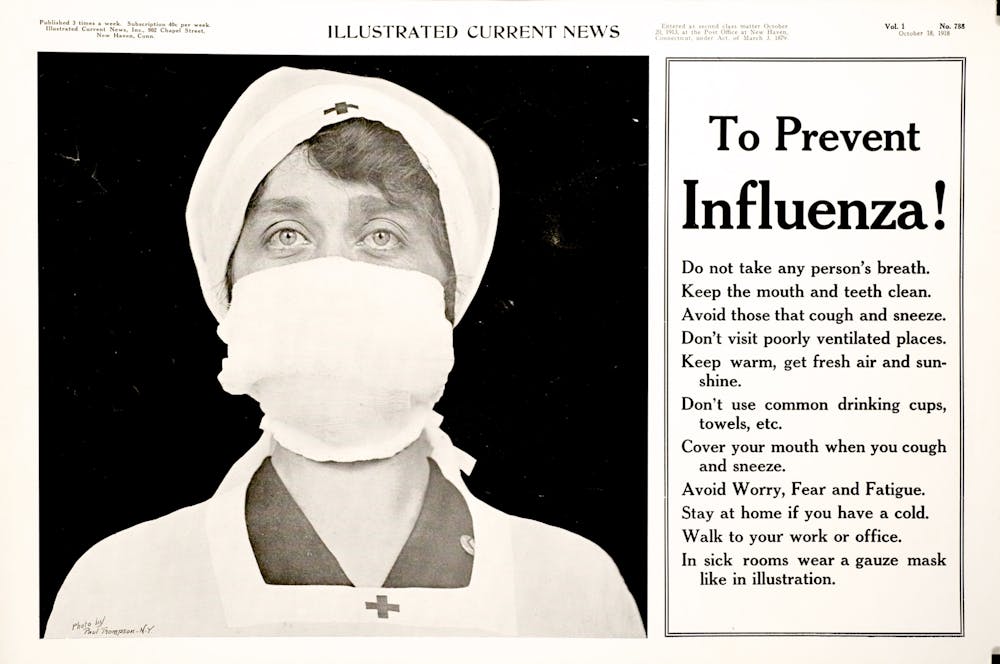
Poster of a Red Cross nurse wearing a gauze mask over her nose and mouth – with tips to prevent the influenza pandemic.
It is difficult to ascertain the effectiveness of the masks used in 1918. Today, we have a growing body of evidence that well-constructed cloth face coverings are an effective tool in slowing the spread of COVID-19. It remains to be seen, however, whether Americans will maintain the widespread use of face masks as our current pandemic continues to unfold. Deeply entrenched ideals of individual freedom, the lack of cohesive messaging and leadership on mask wearing, and pervasive misinformation have proven to be major hindrances thus far, precisely when the crisis demands consensus and widespread compliance. This was certainly the case in many communities during the fall of 1918. That pandemic ultimately killed about 675,000 people in the U.S. Hopefully, history is not in the process of repeating itself today.
On July 14, a new Mars-bound spacecraft will launch from Japan. While several Mars missions are planned to launch over the next month, what makes this different is who’s launching it: the United Arab Emirates.
Though new to space exploration, the UAE has set high goals for the probe, named Hope. The mission aims to further study the climate of Mars, but Omran Sharaf, mission lead, also says, “It’s a means for a bigger goal: to expedite the development in our educational sector, academic sector.”
With space exploration usually pursued by actors like the United States, Russia, China, the European Space Agency and more recently, India, Hope will be the first mission to the red planet from a Middle Eastern country. As a space policy expert, I believe Hope is also significant in two other ways: It shows how international collaboration, through which Hope was designed and built, enables a new generation of space exploration and demonstrates the expansion of this sector can further economic development.
Growing international collaboration
While tense relations in space between major countries seem to dominate the headlines, the UAE’s mission shows how cooperation is just as important. Despite being the third-richest country in the world, the UAE’s scientific and engineering community is still small. As such, the Emiratis turned to other experts for help. To build Hope and its scientific instrumentation, the UAE worked with the University of Colorado Boulder and then sent it to Japan to be launched on a Japanese H-2A rocket.
International cooperation in space is not new. Typically, such collaboration is used by states to either advance the interest of a particular state – usually, the U.S. or Russia – or to reduce the costs of space exploration. For example, early in the space race, the United States assisted European countries with launching satellites to demonstrate the power of the U.S. in space. The International Space Station, on the other hand, has been a work in progress since the mid-1990s. It was built through a partnership established to reduce the costs of building and operating such a large project in low Earth orbit.
While international prestige plays a role for Hope (its arrival at Mars is timed to the UAE’s 50th anniversary), the cooperation involved is different. Instead of relying on countries for direct assistance, the UAE contracted with an American university and a commercial Japanese launcher. By doing so, they have taken advantage of significant changes in the accessibility and affordability of space technology to produce a fairly low-cost mission. For just US$200 million in costs, they believe Hope will stimulate and grow their economic base.
Though resource-rich, the UAE remains an economically fragile state. They have historically produced few Ph.D.‘s in the basic sciences and lack a robust knowledge economy. Sharaf, Hope’s mission lead, has frankly acknowledged that the mission “is about the future of the UAE and our survival.” The idea is for Hope to inspire a new generation of Emiratis to pursue education in STEM fields to diversify and strengthen the country’s economy. This approach seems to be working, with the UAE already seeing a 12% annual increase in STEM enrollment for the past several years.
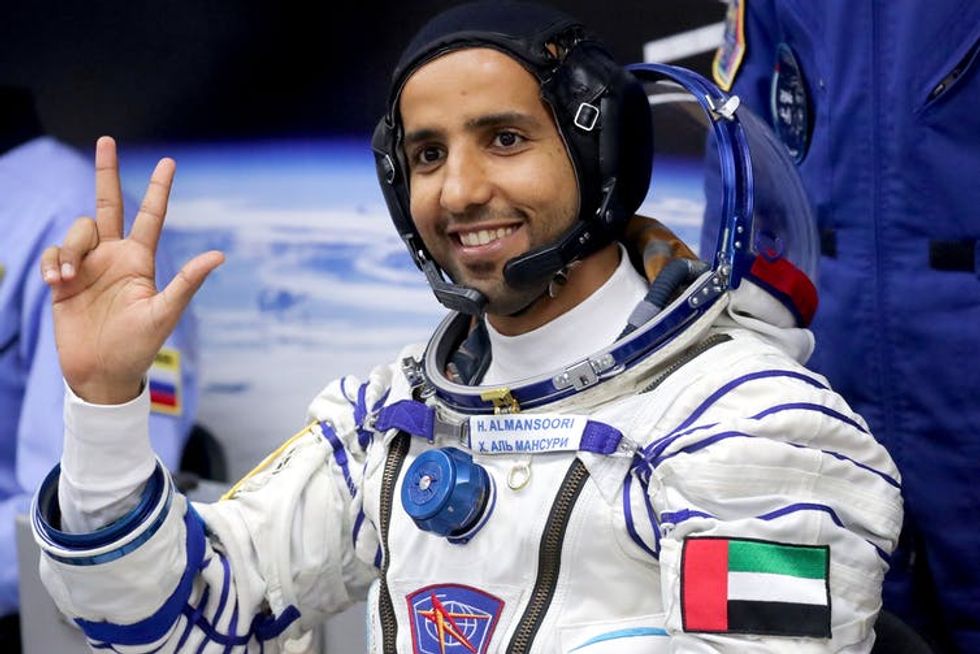
The United Arab Emirates’ first astronaut, Hazza Al Mansouri, gives an OK sign during a spacesuit check before a launch to the International Space Station.
While international achievement remains important, economic concerns like the UAE’s are increasingly driving space exploration.
In addition to the UAE and other Middle Eastern countries, African states are also looking to take advantage of space. To date, 11 African countries have launched satellites and Africa’s space economy is currently worth around $7 billion. As a sign of how serious the continent is, the African Union is planning to establish an African space agency that will be headquartered in Egypt.
Unlike Hope, whose goal is to indirectly stimulate the Emirati economy, African countries are seeking direct economic impact through the use of satellites. In South Africa, remote imaging satellites are being used to catch illegal fishing off its coast. Ethiopia is using its first Earth-observing satellite to improve weather monitoring in the Horn of Africa. Nigeria has used its three Earth satellites to aid in resource and even electoral mapping.
Given a lack of homegrown capabilities, South Africa, Ethiopia, Nigeria and the UAE have all had to take advantage of international collaboration. This is especially true when it comes to launching the satellites. As such, the use of space exploration to support economic development can only continue through the type of cooperation that led to Hope.
Sydney residents were warned Monday to put the brakes on partying as a new coronavirus cluster emerged at a city pub on the heels of a major outbreak in Melbourne.
Three pubs in Sydney and its surrounds were closed after being linked to outbreaks or failing to comply with social distancing requirements, while other events were under investigation with Australia on edge over a resurgence of the virus.
The new cluster emerged after Melbourne entered a six-week lockdown on Thursday, and surrounding Victoria state was sealed off from the rest of the country in an effort to contain the virus.
Authorities reported 177 new infections in and around Melbourne Monday, marking a week of triple-digit increases.
New South Wales police assistant commissioner Tony Cooke on Monday slammed the "moronic behavior of people at dance parties", after local media published footage of large private get-togethers in Sydney's wealthy eastern suburbs.
City residents are allowed a maximum of 20 visitors to their homes under restrictions which have been gradually eased in recent weeks as the number of infections dwindled.
At least 21 infections have now been linked to a growing cluster at Sydney's Crossroads Hotel -- a popular drinking spot on a major traffic route -- raising concern the virus could be spreading in the state.
- Stepped-up penalties -
A dozen military personnel who visited the pub while poised to deploy on an anti-virus mission were on Monday in isolation at an army base in rural New South Wales.
The state's police minister David Elliott warned that if the situation was not brought under control, pubs could be closed again.
"If we have to close hotels and clubs again, the patrons will have to take some of the ownership of that," he told a press conference Monday.
"I will, however, work to my dying breath to make sure that that doesn't happen."
Police have stepped up penalties for breaching coronavirus restrictions in recent days, with almost Aus$220,000 ($153,000) in fines handed out across Melbourne in the past 24 hours.
On Friday, a group whose house party was exposed by their large KFC order was fined Aus$26,000 while six people from Victoria who tried to cross Queensland's border illegally were each fined Aus$4,000 the following night.
Australia has recorded just under 10,000 coronavirus cases and 108 fatalities.
Most states and regions have reported few or no new daily cases of the disease in recent weeks, allowing much of the country to ease restrictions on movement and gatherings.
The gunman behind New Zealand's Christchurch mosque shootings sacked his lawyers Monday and opted to represent himself, raising fears he would use a sentencing hearing next month to promote his white-supremacist views.
Australian national Brenton Tarrant will be sentenced on August 24 on 51 murder convictions, 40 of attempted murder and one of terrorism arising from last year's massacre, the worst mass shooting in New Zealand's modern history.
He has pleaded guilty to the charges.
At a pre-sentencing hearing on Monday, High Court judge Cameron Mander allowed Tarrant's lawyers, Shane Tait and Jonathan Hudson, to withdraw from proceedings at the request of their client.
However, the judge ordered "standby counsel" to be available next month in case Tarrant -- who appeared in the Christchurch court via video link from an Auckland prison -- changes his mind.
New Zealand Muslim Association president Ikhlaq Kashkari questioned Tarrant's motives, saying victims could be re-traumatised if the gunman were allowed to spout far-right rhetoric from the dock.
"My first concern when I read this was 'Oh my God, what's this guy up to, is he going to use this as a platform to promote his views and thoughts?'," he told AFP.
"A lot of people are still going through trauma and this was seen as one of those events that would give them closure. I hope it's not going to be something that will trigger more pain instead."
- 'He wants attention' -
In March 2019, Tarrant gunned down Muslim worshippers during Friday prayers at two Christchurch mosques, live-streaming the killings as he went.
His victims included children, women and the elderly.
The former gym instructor unexpectedly reversed his not-guilty plea in March this year, removing the need for a lengthy trial.
The terror and murder charges all carry life sentences, setting a minimum non-parole period of 17 years while also giving the judge power to imprison without the possibility of release. New Zealand does not have the death penalty.
Survivors and the families of victims will be present during the three-day sentencing hearing and Islamic Women's Council of New Zealand spokeswoman Anjum Rahman said many would not want to hear from Tarrant.
While she did not want to speculate on Tarrant's motive for representing himself, she said: "He has shown in the past that he likes to get attention and he wants attention.
China on Monday slapped retaliatory sanctions on three senior Republican lawmakers and a US envoy in a deepening row over Beijing's treatment of Uighurs in the western Xinjiang region.
Some of the most outspoken critics of China -- Senators Marco Rubio and Ted Cruz along with Congressman Chris Smith -- were targeted by the action, as well as the US ambassador-at-large for international religious freedom, Sam Brownback.
The unspecified "corresponding sanctions" were announced days after the US imposed visa bans and asset freezes on several Chinese officials, including the Communist Party chief in Xinjiang, Chen Quanguo, over rights abuses in the region.
The move was "in response to the US's wrong actions", foreign ministry spokeswoman Hua Chunying said at a regular briefing.
"We urge the US to immediately withdraw its wrong decision, and stop any words and actions that interfere in China's internal affairs and harm China's interests," she said.
"China will make a further response depending on the development of the situation."
Sanctions will also be applied on the US Congressional-Executive Commission on China, an agency that monitors human rights in the Asian country.
The two countries have traded barbs and sanctions on a slew of issues since President Donald Trump took office, from trade to more recent spats over the coronavirus pandemic, a security law in Hong Kong, and Chinese policies in the far west regions of Tibet and Xinjiang.
- 'Horrific' abuses -
Witnesses and human rights groups say that China has rounded up more than one million Uighurs and other Turkic Muslims in Xinjiang in a vast brainwashing campaign aimed at forcibly homogenising minorities into the country's Han majority.
Secretary of State Mike Pompeo said last week the United States was acting against "horrific and systematic abuses" in the western region including forced labour, mass detention and involuntary population control.
China rejects the accusations, but it has acknowledged sending Uighurs to "vocational education centres" to learn Mandarin and job skills in a bid to steer them away from terrorism and separatism following a spate of deadly violence in the fractious region.
"I have to point out that Xinjiang affairs are purely China's internal affairs. The US has no right or basis to interfere," Hua said on Monday.
China is "unwavering in its determination to fight against forces of violence and terrorism, forces of separatism, and that of religious extremism," Hua said.
"Its determination to oppose any external forces' interference in Xinjiang affairs and China's internal affairs is unwavering as well."
The coronavirus pandemic has caused an "unprecedented education emergency" with up to 9.7 million children affected by school closures at risk of never going back to class, Save the Children warned Monday.
The British charity cited UNESCO data showing that in April, 1.6 billion young people were shut out of school and university due to measures to contain COVID-19 -- about 90 percent of the world's entire student population.
"For the first time in human history, an entire generation of children globally have had their education disrupted," it said in a new report, Save our Education.
It said the economic fall-out of the crisis could force an extra 90 to 117 million children into poverty, with a knock-on effect on school admissions.
With many young people required to work or girls forced into early marriage to support their families, this could see between seven and 9.7 million children dropping out of school permanently.
At the same time, the charity warned the crisis could leave a shortfall of $77 billion in education budgets in low and middle income countries by the end of 2021.
"Around 10 million children may never return to school -- this is an unprecedented education emergency and governments must urgently invest in learning," Save the Children chief executive Inger Ashing said.
"Instead we are at risk of unparalleled budget cuts which will see existing inequality explode between the rich and the poor, and between boys and girls."
The charity urged governments and donors to invest more funds behind a new global education plan to help children back into school when it is safe and until then support distance learning.
"We know the poorest, most marginalized children who were already the furthest behind have suffered the greatest loss, with no access to distance learning -- or any kind of education -- for half an academic year," Ashing said.
Save the Children also urged commercial creditors to suspend debt repayments for low-income countries -- a move it said could free up $14 billion for education programs.
"If we allow this education crisis to unfold, the impact on children's futures will be long lasting," Ashing said.
"The promise the world has made to ensure all children have access to a quality education by 2030, will be set back by years, " she said, citing the United Nations goal.
The report listed 12 countries where children are most at risk of falling behind: Niger, Mali, Chad, Liberia, Afghanistan, Guinea, Mauritania, Yemen, Nigeria, Pakistan, Senegal and Ivory Coast.
Before the crisis, an estimated 258 million children and adolescents were already missing out on school, the charity said.