Amsterdam’s red-light district re-opened on Wednesday, July 1 after being closed for more than three months during the Covid-19 lockdown, though sex workers have been advised to avoid kissing and follow strict hygiene measures to reduce the risk of spreading the virus.
Industry bodies have compiled a list of recommendations to help keep workers and clients safe, including sexual positions and practices to avoid.
“We advise to avoid being too close to each other’s face, feeling each other’s breath. The intention is to not breathe out into each other’s face,” Debbie Mensink, a public health advisor in Amsterdam, told Reuters.
“In addition, we advise not to kiss, because this implies saliva exchange. The virus can be in the saliva and thus transmitted."
But while other workers such as hairdressers and masseurs are required to wear masks they will not be obligatory for sex workers.
“After the customer leaves the room, we’re going to disinfect everything he might have touched, bed, sink, the toilet if he used the toilet, the doorknobs, everything,” sex worker Felicia Anna told AFP.
The Netherlands ordered all brothels closed in mid-March. For most sex workers it meant the loss of their main source of income, with many having little access to state support during lockdown.
The government had planned to keep brothels closed until September, but brought the date forward after Covid-19 cases dropped.
“During the lockdown, a lot of sex workers ran into financial trouble so we’re very happy that we can finally start our job again,” said Felicia Anna.
“A lot of customers are also tourists and at the moment we don’t have a lot of tourists because there are a lot of countries that still have a travel ban. Hopefully it’s still going to be good for everybody, for every worker. I did ask some of my colleagues and so far they said that the work is quite ok.”
House Speaker Nancy Pelosi (D-CA) revealed in her weekly press briefing that the Russian sanctions bill had sanctions that specifically targeted Russian intelligence, known as the GRU. But those sanctions were stripped out of the bill.
"We passed in a bipartisan way, sanctions on Russia. The administration told us to take out the sanctions against the GRU, the intelligence as well as the defense sectors of Russia. Those should definitely be -- those were there in a bipartisan way. The administration wanted them out. I don't know why," Pelosi said, throwing her arms in the air.
She went on to say that the investigation into the Russian bounty on Americans shouldn't distract from the fact that Russia is trying to interfere with U.S. elections, or that "all roads through this president lead to Putin."
It was reported by the New York Times this week that the money sent to the Taliban for the heads of American soldiers went from GRU accounts to the Afghan militants.
Tehran on Thursday reported an "accident" at Natanz nuclear complex in central Iran, saying there were no casualties or radioactive pollution, and warned foes -- especially Israel -- against hostile actions.
There was "no nuclear material (at the damaged warehouse) and no potential of pollution," the spokesman for Iran's Atomic Energy Organisation Behrouz Kamalvandi told state television.
Kamalvandi said no radioactive material or personnel were present at the warehouse within the Natanz site in central Iran, one of the country's main uranium enrichment plants.
He noted that the cause was being investigated, and said it had caused "some structural damage" without specifying the nature of the accident.
There was "no interruption to the work of the enrichment site itself", which "is working at the pace it used to," Kamalvandi said.
Hours after the announcement, Iran's state news agency IRNA published an editorial warning that "if there are signs of hostile countries crossing Iran's red lines in any way, especially the Zionist regime (Israel) and the United States, Iran's strategy to confront the new situation must be fundamentally reconsidered."
The Iranian Atomic Energy Organisation released a photo purportedly from the site, showing a one-storey building with a damaged roof, walls apparently blackened by fire and doors hanging off their hinges as if blown out from the inside.
State TV later showed a different angle of the building with minor damage to its walls and some of its fans still working.
According to a statement released by the nuclear body, the warehouse was under construction and the accident caused no casualties.
Natanz governor Ramezan-Ali Ferdowsi told the Tasnim news agency that a fire had broken out at the warehouse.
- Cause unknown -
IRNA reported that unnamed Israeli social media accounts had claimed the Jewish state was responsible for the "sabotage attempts".
It stressed that Iran had tried "to prevent escalations and unpredictable situations while defending its position and national interests".
The BBC's Persian service, which Iranian authorities consider hostile, said it received a statement "hours before" the accident from a group called the "Homeland Cheetahs" who claimed responsibility for the accident.
They claimed to be "dissidents present in Iran's security apparatuses" and said the location was targeted as it was not "underground" and therefore the alleged attack could not be denied.
Iran's nuclear body has yet to provide an explanation for the cause of the accident.
Tehran-based analyst Mohammad Marandi ridiculed claims of responsibility for the accident on Twitter.
"If there's a fire anywhere, Iran's foes claim a military strike," said Marandi, who heads the American studies department at Tehran University.
"BBC Persian claims sabotage by a secret organization, while their brethren in Israeli propaganda claim a drone strike! Poor coordination."
The accident comes six days after an explosion near a military complex rocked the Iranian capital.
The blast in the Parchin area in the southeast of Tehran was due to "leaking gas tanks", Iran's defense ministry said on Friday.
Parchin is suspected of having hosted conventional explosion tests with nuclear applications, which the Islamic republic denies.
Tehran announced in May last year it would progressively suspend certain commitments under a 2015 nuclear deal with major powers, unilaterally abandoned by the United States in 2018.
Iran restarted enriching uranium at Natanz last September after having agreed under the accord to put such activities there on hold.
The UN nuclear watchdog said last month that Tehran was continuing to produce enriched uranium in Natanz using "no more than 5,060 (so called first-generation) centrifuges installed in 30 cascades".
Tehran has always denied its nuclear program has any military dimension.
The 2015 deal promised Iran sanctions relief in exchange for limiting its atomic activities.
US President Donald Trump's withdrawal from the deal was followed by Washington reimposing biting unilateral sanctions.
Novak Djokovic and his wife Jelena, who last week both tested positive for coronavirus following his exhibition tournament in the Balkans, have now tested negative, his press service said Thursday.
Neither the 33-year-old player or his partner felt any symptoms, the statement said.
The couple had been self isolating since returning to Belgrade from Zadar in Croatia, the town which hosted the second leg of Djokovic's ill-fated Adria Tour.
Four players -- Djokovic, Grigor Dimitrov, Borna Coric and Viktor Troicki -- tested positive for the virus after the event which saw little social distancing and packed stands.
The world number one's coach Goran Ivanisevic also contracted COVID-19.
Players had embraced across the net, played basketball and even danced in a nightclub during the week of the first leg played in Belgrade.
Djokovic was widely criticised for hosting the tournament.
The Serbian star issued an apology, saying he was "so deeply sorry" that the tournament "caused harm".
On Wednesday, the player donated more than 40,000 euros ($45,000) to Serbian town Novi Pazar which has been badly affected by the pandemic.
Serbia, with a population of about seven million people, has registered nearly 15,000 coronavirus infections and 281 deaths.
On a midsummer day in 1438, a young man from the north shore of Lake Geneva presented himself to the local church inquisitor. He had a confession to make. Five years earlier, his father had forced him to join a satanic cult of witches. They had flown at night on a small black horse to join more than a hundred people gathered in a meadow. The devil was there too, in the form of a black cat. The witches knelt before him, worshiped him and kissed his posterior.
The young man’s father had already been executed as a witch. It’s likely he was trying to secure a lighter punishment by voluntarily telling inquisitors what they wanted to hear.
The Middle Ages, A.D. 500-1500, have a reputation for both heartless cruelty and hopeless credulity. People commonly believed in all kinds of magic, monsters and fairies. But it wasn’t until the 15th century that the idea of organized satanic witchcraft took hold. As a historian who studies medieval magic, I’m fascinated by how a coterie of church and state authorities conspired to develop and promote this new concept of witchcraft for their own purposes.
Early medieval attitudes about witchcraft
Belief in witches, in the sense of wicked people performing harmful magic, had existed in Europe since before the Greeks and Romans. In the early part of the Middle Ages, authorities were largely unconcerned about it.
A church document from the early 10th century proclaimed that “sorcery and witchcraft” might be real, but the idea that groups of witches flew together with demons through the night was a delusion.
Things began to change in the 12th and 13th centuries, ironically because educated elites in Europe were becoming more sophisticated.
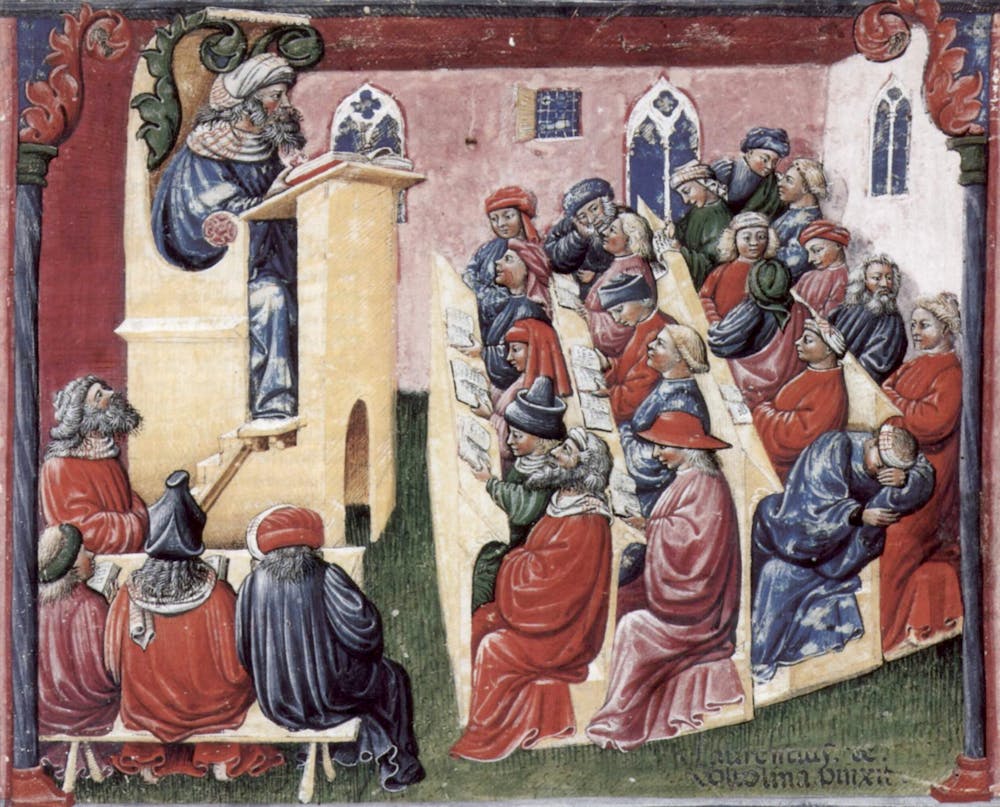
Henricus de Alemannia lecturing students at the University of Bologna in the second half of the 14th century – one of the earliest illustrations of a medieval university classroom.
Universities were being founded, and scholars in Western Europe began to pore over ancient texts as well as learned writings from the Muslim world. Some of these presented complex systems of magic that claimed to draw on astral forces or conjure powerful spirits. Gradually, these ideas began to gain intellectual clout.
Ordinary people – the kind who eventually got accused of being witches – didn’t perform elaborate rites from books. They gathered herbs, brewed potions, maybe said a short spell, as they had for generations. And they did so for all sorts of reasons – perhaps to harm someone they disliked, but more often to heal or protect others. Such practices were important in a world with only rudimentary forms of medical care.
Christian authorities had previously dismissed this kind of magic as empty superstition. Now they took all magic much more seriously. They began to believe simple spells worked by summoning demons, which meant anyone who performed them secretly worshiped demons.
Inventing satanic witchcraft
In the 1430s, a small group of writers in Central Europe – church inquisitors, theologians, lay magistrates and even one historian – began to describe horrific assemblies where witches gathered and worshiped demons, had orgies, ate murdered babies and performed other abominable acts. Whether any of these authors ever met each other is unclear, but they all described groups of witches supposedly active in a zone around the western Alps.
The reason for this development may have been purely practical. Church inquisitors, active against religious heretics since the 13th century, and some secular courts were looking to expand their jurisdictions. Having a new and particularly horrible crime to prosecute might have struck them as useful.
I just translated a number of these early texts for a forthcoming book and was struck by how worried the authors were about readers not believing them. One fretted that his accounts would be “disparaged” by those who “think themselves learned.” Another feared that “simple folk” would refuse to believe the “fragile sex” would engage in such terrible practices.
Trial records show it was a hard sell. Most people remained concerned with harmful magic – witches causing illness or withering crops. They didn’t much care about secret satanic gatherings.
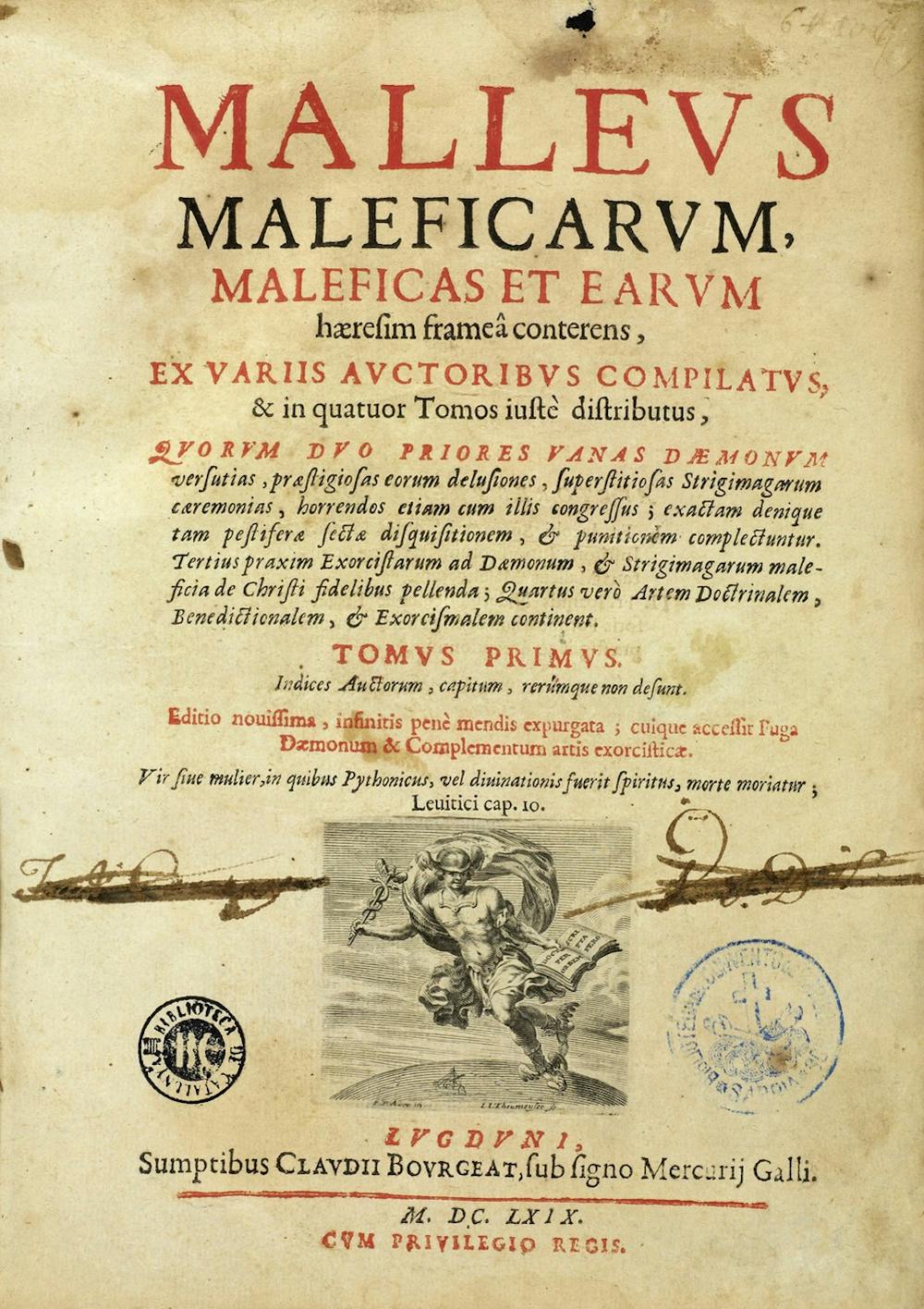
The handbook for detecting and persecuting witches in the Middle Ages, ‘Malleus Maleficarum’ or ‘Hammer of Witches.’
In 1486, clergyman Heinrich Kramer published the most widely circulated medieval text about organized witchcraft, Malleus Maleficarum (Hammer of Witches). But many people didn’t believe him. When he tried to start a witch hunt in Innsbruck, Austria, he was kicked out by the local bishop, who accused him of being senile.
Witch hunts
Unfortunately, the fear of satanic witchcraft grew. The 15th century seems to have provided ideal soil for this new idea to take root.
Europe was recovering from several crises: plague, wars and a split in the church between two, and then three, competing popes. Beginning in the 1450s, the printing press made it easier for new ideas to spread. Even prior to the Protestant Reformation, religious reform was in the air. As I explored in an earlier book, reformers used the idea of a diabolical conspiracy bent on corrupting Christianity as a boogeyman in their call for spiritual renewal.
Over time, more people came to accept this new idea. Church and state authorities kept telling them it was real. Still, many also kept relying on local “witches” for magical healing and protection.
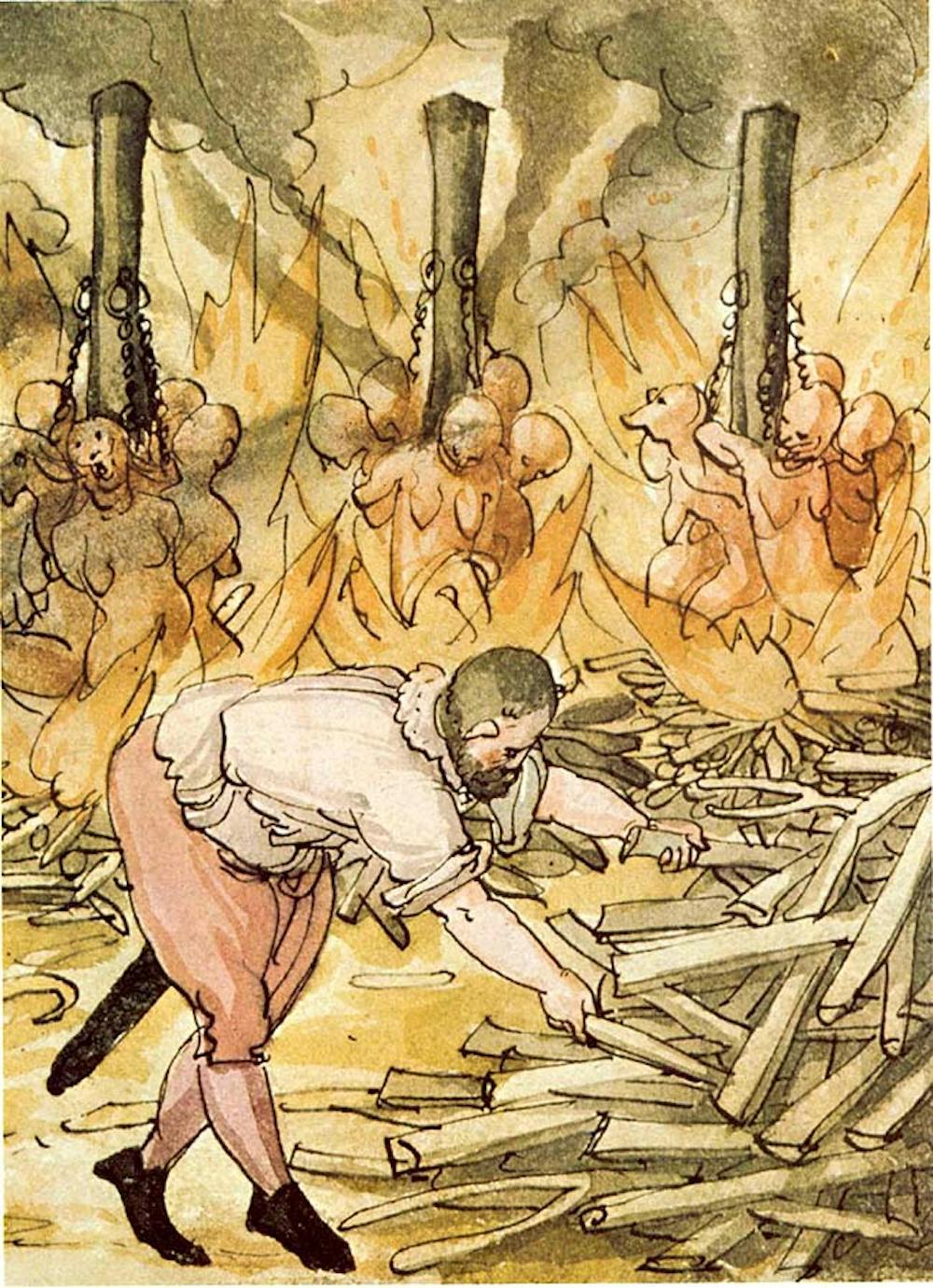
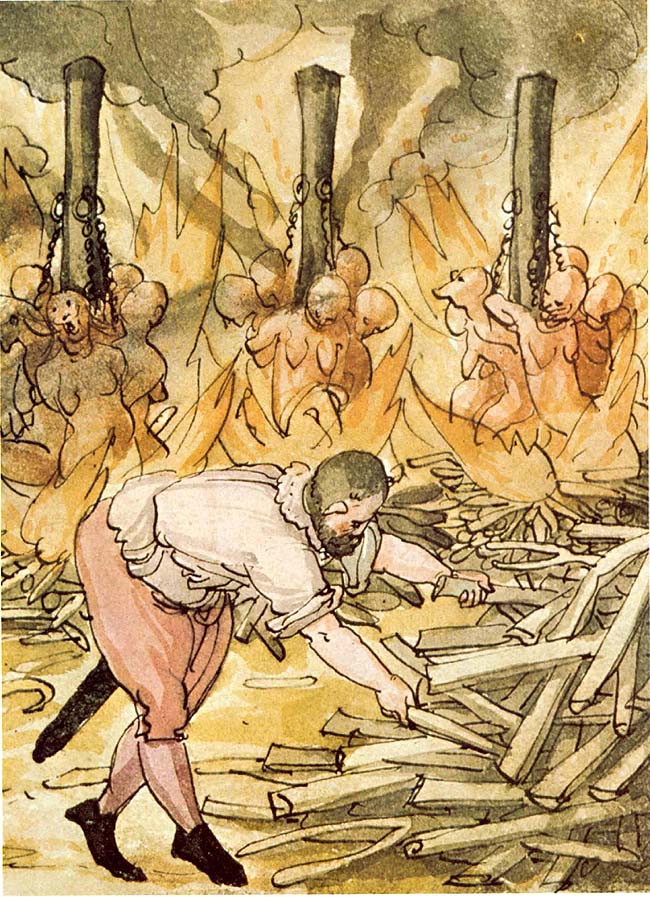
The execution of alleged witches in Central Europe, 1587.
The history of witchcraft can be quite grim. From the 1400s through the 1700s, authorities in Western Europe executed around 50,000 people, mostly women, for witchcraft. The worst witch hunts could claim hundreds of victims at a time. With 20 dead, colonial America’s largest hunt at Salem was moderate by comparison.
Salem, in 1692, marked the end of witch hunts in New England. In Europe, too, skepticism would eventually prevail. It’s worth remembering, though, that at the beginning, authorities had to work hard to convince others such malevolence was real.
It’s excellent this virus has been found early, and raising the alarm quickly allows virologists to swing into action developing new specific tests for this particular flu virus.
But it’s important to understand that, as yet, there is no evidence of human-to-human transmission of this particular virus. And while antibody tests found swine workers in China have had it in the past, there’s no evidence yet that it’s particularly deadly.
China has a wonderful influenza surveillance system across all its provinces. They keep track of bird, human and swine flus because, as the researchers note in their paper, “systematic surveillance of influenza viruses in pigs is essential for early warning and preparedness for the next potential pandemic.”
In their influenza virus surveillance of pigs from 2011 to 2018, the researchers found what they called “a recently emerged genotype 4 (G4) reassortant Eurasian avian-like (EA) H1N1 virus.” In their paper, they call the virus G4 EA H1N1. It has been ticking over since 2013 and became the majority swine H1N1 virus in China in 2018.
In plain English, they discovered a new flu that’s a mix of our human H1N1 flu and an avian-based flu.
What’s interesting is antibody tests picked up that workers handling swine in these areas have been infected. Among those workers they tested, about 10% (35 people out of 338 tested) showed signs of having had the new G4 EA H1N1 virus in the past. People aged between 18 to 35 years old seemed more likely to have had it.
Of note, though, was that a small percentage of general household blood samples from people who were expected to have had little pig contact were also antibody positive (meaning they had the virus in the past).
Importantly, the researchers found no evidence yet of human-to-human transmission. They did find “efficient infectivity and aerosol transmission in ferrets” - meaning there’s evidence the new virus can spread by aerosol droplets from ferret to ferret (which we often use as surrogates for humans in flu studies). G4-infected ferrets became sick, lost weight and acquired lung damage, just like those infected with one of our seasonal human H1N1 flu strains.
They also found the virus can infect human airway cells. Most humans don’t already have antibodies to the G4 viruses meaning most people’s immune systems don’t have the necessary tools to prevent disease if they get infected by a G4 virus.
In summary, this virus has been around a few years, we know it can jump from pigs to humans and it ticks all the boxes to be what infectious disease scholars call a PPP — a potential pandemic pathogen.
If a human does get this new G4 EA H1N1 virus, how severe is it?
We don’t have much evidence to work with yet but it’s likely people who got these infections in the past didn’t find it too memorable. There’s not a huge amount of detail in the new paper but of the people the researchers sampled, none died from this virus.
There’s no sign this new virus has taken off or spread in the regions of China where it was found. China has excellent virus surveillance systems and right now we don’t need to panic.
The World Health Organisation has said it is keeping a close eye on these developments and “it also highlights that we cannot let down our guard on influenza”.
People in my field — infectious disease research — are alert but not alarmed. New strains of flu do pop up from time to time and we need to be ready to respond when they do, watching carefully for signs of human-to-human transmission.
As far as I can tell, the specific tests we use for influenza in humans won’t identify this new G4 EA H1N1 virus, so we should design new tests and have them ready. Our general flu A screening test should work though.
In other words, we can tell if someone has what’s called “Influenza A” (one kind of flu virus we usually see in flu season) but that’s a catch-all term, and there are many strains of flu within that category. We don’t yet have a customised test to detect this new particular strain of flu identified in China. But we can make one quickly.
Being prepared at the laboratory level if we see strange upticks in influenza is essential and underscores the importance of pandemic planning, ongoing virus surveillance and comprehensive public health policies.
And as with all flus, our best defences are meticulous hand washing and keeping physical distance from others if you, or they, are at all unwell.
Hopes for a summertime reprieve from COVID-19 have been dashed as cases surged in June. As infections rise, so does the need for testing.
Dr. Anthony Fauci, director of the National Institute of Allergy and Infectious Diseases, recently announced that health officials are considering pooled testing for COVID-19 in response to the recent surge.
So what is pooled testing, and why does the U.S. need it?
Test groups, not individuals
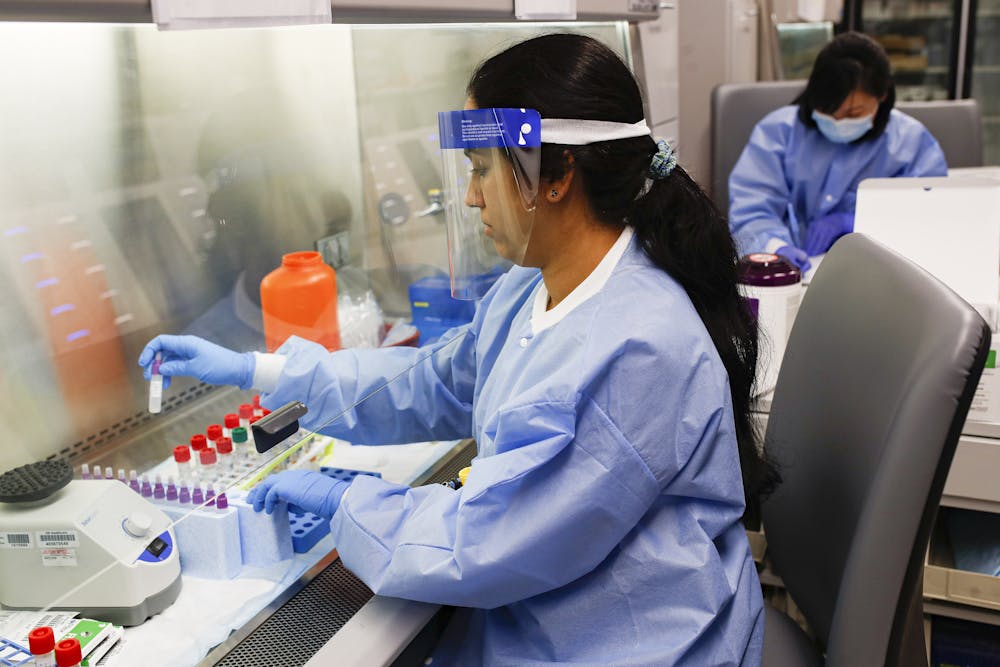
The basic idea of pooled testing is that it allows public health officials to test small groups – called pools – of people using only one test. This means you can test more people faster, using fewer tests and for less money.
Instead of testing one person at a time, samples from multiple individuals would be mixed together and tested as one. If the test comes back negative, everyone in the pool is clear. If positive, each member of the pool is then tested individually.
For example, imagine a workplace with 20 people, one of whom is infected. Pooled testing divides the 20 people into four groups of five. Samples are taken from each person and mixed with the samples from other people in their group. Each grouped sample is then tested – four tests in all.
One of the pools will turn up positive because it contains the single infected person. All five people in this pool are then retested individually, and the one sick person is identified.
In all, nine tests are used and all 20 workers have been screened. If everyone had been screened individually, it would have taken 20 tests.
In practice, the number of tests saved by pooling varies depends on the fraction of people infected. Higher infection rates mean that more pools come back positive, more people need to be retested, and savings from pooling are lower.
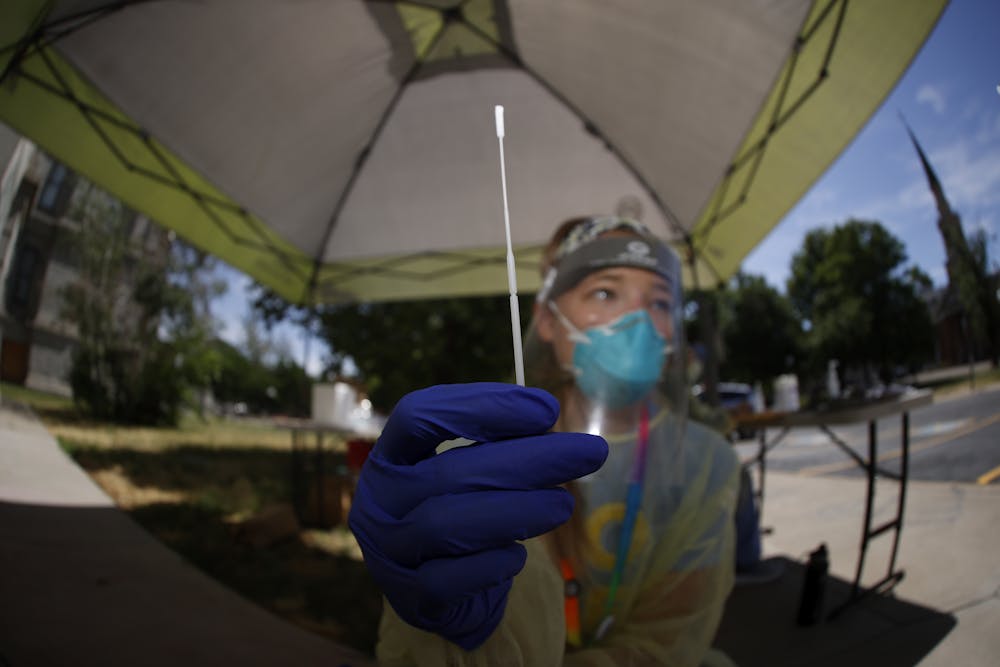
For pooled testing, individual samples are collected, then multiple samples are mixed together and screened using a PCR test that looks for bits of viral RNA.
Pooled testing has long been used to test large asymptomatic populations for disease. State labs have used it to screen for chlamydia and gonorrhea and the Red Cross has used it to test donated blood for Hepatitis B and C, Zika virus and HIV.
And some places have already begun using pooled testing to screen for active coronavirus infections.
[The Conversation’s newsletter explains what’s going on with the coronavirus pandemic. Subscribe now.]
Some people have expressed concern that the dilution of samples from pooling could reduce the accuracy of the PCR tests that look for viral RNA in samples. Fortunately, researchers have already shown that pooled testing is about as accurate as individual testing in pools as large as eight people.
Another concern is infection prevalence. When infection rates climb higher than 15%, too many pools come back positive and pooling is no longer more efficient. Fortunately, on a nationwide basis only about 5% of tests on suspected cases are coming back positive. Even in extreme hot spots like Texas, where 10% or more of suspected cases are testing positive, pooled testing could still be useful.
But the real strength of pooled testing would be seen if health officials start implementing large-scale testing of the general population.
In the general population, the prevalence of new infections is estimated to be less than 2%, even in the hardest-hit states. At these rates, pooled testing could reduce test costs by 80% or more.
Research has shown pooled testing to be accurate for pools up to eight samples, but labs need to get certified to do pooled testing before this approach could be widely adopted.
Considering that American labs are already short of testing reagents, it seems doubtful companies could soon produce enough material to run this many individual tests – assuming companies or governments could even pay for them all. Widespread use of pooled testing can help screen more people using fewer laboratory tests.
Another potential obstacle is cost. If labs charge much more for testing a pooled sample than they do for an individual one, any cost savings will dissipate.
Cheaper, faster testing methods enable screening that is more widespread and more frequent. Frequency is critical for monitoring a disease that spreads rapidly. Moreover, repeat testing helps pick up cases that might have been missed previously. Retesting helps, because research suggests that PCR tests miss about 20% of infected cases, no matter whether they are pooled or not.
Pooling could get the U.S. one step closer to the goal of universal and repeated testing – and play a crucial role in containing the spread of this relentless disease.
Police said Thursday they had shut down an encrypted phone network used as a key tool by organized crime groups across Europe to plot assassination attempts and major drug deals.
French and Dutch police said they hacked the EncroChat network so they could read millions of messages "over the shoulders" of criminal suspects as they communicated, leading to more than 100 arrests.
EncroChat -- which sells custom encrypted phones -- sent a message to users in June warning them to throw away the devices as its servers had been "seized illegally by government entities".
The hack allowed police to "look into the heart" of organized crime groups, Wil van Gemert, Deputy Executive Director of the EU police agency Europol, told a press conference in The Hague.
The hacking of the phones allowed the "disruption of criminal activities including violent attacks, corruption, attempted murders and large-scale drug transports," Europol and the EU judicial agency added in a joint statement.
"Certain messages indicated plans to commit imminent violent crimes and triggered immediate action."
French authorities launched the investigation in 2017 after finding that EncroChat phones were "regularly" found in operations against criminal groups and that the company was operating from servers in France.
"Eventually, it was possible to put a technical device in place to go beyond the encryption technique and have access to the users' correspondence," Europol and the EU judicial agency Eurojust said in a joint statement.
Between 90 and 100 percent of EncroChat clients were linked to organized crime, according judicial sources, with around 50,000 of the phones in circulation.
- 'Power off immediately' -
Dutch police then became involved based on information shared by French police.
The statement said the investigation "made it possible to intercept, share and analyze millions of messages that were exchanged between criminals to plan serious crimes.
"For an important part, these messages were read by law enforcement in real time, over the shoulder of the unsuspecting senders."
Dutch police had busted 19 meth labs, seized thousands of kilos of crystal meth and cocaine, and arrested more than 100 people as a result of the hack, Andy Kraag, head of the police central investigations division, told the press conference.
Dutch media said two of the country's most wanted meth smugglers had been arrested as a result of the investigation.
The French and Dutch authorities defended the decision to hack into the encrypted phone network, saying it was justified by evidence that it was mainly being used for criminal ends.
"The platform targeted in this operation catered specifically to the needs of criminals," said van Gemert.
"The abuse of encryption technology is a key facilitator of criminal activity."
Encrochat, which sold its phones for around 1,000 euros each, sent what it called an "emergency" text to its users on June 13 saying it had been compromised.
"Today we had our domain seized by government entities," said the message, a picture of which was included in the statement but has also been shown on news media in recent weeks.
"You are advised to power off and physically dispose your device immediately."
The Duchess of Sussex has claimed she was left "unprotected" by the royal family from "false and damaging" media articles when she was pregnant, according to leaked documents published on Thursday.
The claims were made in submissions as part of her high-profile case against the Mail on Sunday, website Mail Online and its owner Associated Newspapers.
The duchess, former American actress Meghan Markle, is claiming breach of privacy, data protection rights and copyright over the publication of extracts of correspondence to her estranged father, Thomas, after her wedding to Prince Harry.
In the papers, she submitted she had become "the subject of a large number of false and damaging articles by the UK tabloid media, specifically by the defendant, which caused tremendous emotional distress and damage to her mental health".
The "institution" of the monarchy failed to protect her from the accusations and she was "prohibited from defending herself", they added.
The documents also refer to an article published in People, a US magazine, where five unnamed friends claim they were "rightly concerned for her welfare" following the reports.
The papers, widely cited in the British media on Thursday, add that Markle was not involved with the interview.
They also claim that her May 2018 wedding to Harry, grandson of Queen Elizabeth II, helped generate £1 billion $1.3 billion, 1.1 billion euros) in tourism revenue.
The couple quit frontline royal duties earlier this year and have waged an increasingly bitter war with the media, particularly the tabloid press.
Harry has likened what he said was a "ruthless campaign" against his wife to the treatment of his mother, Diana, princess of Wales.
She was killed in a high-speed car crash in Paris in August 1997, while being pursued by paparazzi photographers.
The couple now live with their young son, Archie, in California and have set up a non-profit organization focusing on the promotion of mental health, education and well-being.
A judge in the case has already struck out parts of the duchess' claims, including that Associated Newspapers acted "dishonestly and in bad faith" and "deliberately dug up or stirred conflict" between her and her father.
The news group denies wrongdoing, and maintains publication was in the public interest and on freedom of expression grounds.
Hundreds of elephants have died mysteriously in Botswana's famed Okavango Delta, the head of the wildlife department said Thursday, ruling out poaching as the tusks were found intact.
The landlocked southern African country has the world's largest elephant population, estimated to be around 130,000.
"We have had a report of 356 dead elephants in the area north of the Okavango Delta and we have confirmed 275 so far," Cyril Taolo, the acting director of the department of Wildlife and National Parks, told AFP in a text message.
He said the cause of the deaths was yet to be established with anthrax having been ruled out.
"We do not suspect poaching since (the) animals were found with tusks," he said.
Samples have been collected and sent to South Africa, Zimbabwe and Canada for testing.
Similar deaths were first reported in May when authorities found 12 carcasses in just a week in two villages in the northwest of the country.
The latest discoveries were flagged by a wildlife conservation charity, Elephants Without Borders (EWB), whose confidential report referring to the 356 dead elephants, was leaked to the media on Wednesday.
EWB suspects the elephants have been dying in the area for about three months.
According to the report dated June 19, 2020, "70 percent of elephant carcasses were considered recent, having died about a month ago, and 30 percent of the carcasses appeared fresh, ranging from one day to two weeks old".
"There was good evidence to show elephants of all ages and sex appear to be dying," said the report penned by EWB director Mike Chase.
Several live elephants appeared to have been weak, lethargic and emaciated, with some showing signs of disorientation, difficulty in walking or limping, EWB said.
"One elephant was observed walking in circles, unable to change direction although being encouraged by other herd members," said the report.
New Zealand froze payments to America's Cup organizers Thursday as officials investigate fraud claims in the lead-up to next year's prestigious yachting regatta in Auckland.
Government officials said they had suspended payments to America's Cup Events Limited, the private company organizing the race, following allegations of spying and misuse of public money.
"We are not intending to make further payments to ACE. This will be revisited pending the outcome of the process," the Ministry of Business, Innovation and Employment said in a statement.
The ministry has previously said it was investigating "structural and financial matters" surrounding the organization of the race but provided no further details.
ACE is a subsidiary of Team New Zealand (TNZ), the racing syndicate who won hosting rights for the 2021 America's Cup when it triumphed in Bermuda in 2017.
TNZ managing director Grant Dalton has repeatedly denied any wrongdoing and complained this week about his organization being infiltrated by spies.
After the government's announcement, TNZ said it had no problem with funds being suspended.
"ACE and Emirates Team New Zealand in fact support the government in holding funds until the process is complete and we have closed out all issues," it tweeted.
The New Zealand Herald said late Thursday that TNZ's lawyers had obtained a gag order from the High Court preventing it from publishing the findings of an interim report into event finances.
- 'Regrettable' situation -
The MBIE statement revealed that the government was withholding NZ$11 million ($7.2 million), part of a NZ$40 million ($26 million) "hosting fee" paid to ACE.
The government and Auckland Council have poured a combined total of around NZ$250 million ($163 million) into the America's Cup, which dates back to 1851.
A letter from government officials leaked to the Herald this week said concerns included a NZ$3 million ($1.95 million) loan to TNZ that was "reclassified" for other purposes and the fraudulent transfer of funds to a Hungarian bank account.
Other issues cited in the letter included an unwillingness to provide information and "poor governance, including suggestions that records should be retrospectively amended".
Dalton has downplayed the claims, dismissing the loan classification as an accounting issue and saying the Hungarian transfer occurred after TNZ fell victim to online scammers.
He said the transfer did not involve public money and police were immediately called in, subsequently recovering some of the funds.
The issues emerged this week when Dalton revealed he had fired a number of employees for leaking confidential information, although he refused to say how many were involved, or speculate on their motives.
Media outlet Newshub said it was told by the sacked employees that they were local contractors who regarded themselves as whistleblowers, not spies.
Auckland mayor Phil Goff said Thursday he was confident the controversy would not derail preparations for the regatta.
"While I regret this situation has arisen, when it did arise you have no option but to deal with it with integrity and transparency. That's what's being done," he told Radio New Zealand.
Seoul (AFP) - The ex-boyfriend of late K-pop star Goo Hara was jailed by an appeal court Thursday for blackmailing her over sex videos that played a part in her apparent suicide.In 2018, Goo -- a member of former girl group Kara -- told local media that her ex had threatened "to end her entertainment career" by leaking their sex videos.A CCTV clip of the couple showed the singer kneeling before him seemingly begging him not to.Goo was found dead at her home in November, and is widely believed to have taken her own life after being targeted by abusive online comments following the reports about...
New Delhi (AFP) - Millions of Indians have joined homegrown social media platforms since New Delhi banned a slew of Chinese apps, including TikTok, amid growing tensions between the giant neighbours, industry officials said Thursday.The ban comes as India steps up economic pressure on China following a border battle last month in which 20 Indian soldiers died.The 59 banned apps include video-sharing giant TikTok, Helo and Likee, with authorities accusing them of activities "prejudicial" to the "sovereignty and integrity of India".Prime Minister Narendra Modi, who has a huge social media profil...