Bolivia's interim president says her government is expelling the top Mexican diplomat in the country over an alleged attempt by members of Bolivia's former government to leave their refuge in the Mexican embassy with Spanish help and flee the country.
Bolivia has also declared two Spanish diplomats persona non grata and asked a group of Spanish security agents to leave as a result of the incident, and Spain expelled three Bolivian officials Monday in response.
Interim President Jeanine Áñez said Ambassador María Teresa Mercado had been given 72 hours to leave the country.
The incident centers around a group of nine former officials in the government of deposed Bolivian President Evo Morales who sought refuge in the Mexican embassy after Morales stepped down under pressure last month.
The acting Bolivian government has charged the former officials with sedition, terrorism and electoral fraud and has refused to allow them safe passage out of the country.
The Bolivian government has accused Spanish diplomats of trying to help the nine officials leave the Mexican embassy on Friday and says the Spaniards arrived at the embassy accompanied by a group of hooded Spanish security agents. Spain has denied the charges.
“A serious violation has been committed against Bolivian sovereignty and democracy, which must be respected,” Áñez said.
Bolivia declared two high-ranking Spanish diplomats persona non grata and six Spanish security officials departed Bolivia on Sunday after the Bolivian government asked them to leave.
Spain’s interim government said Monday that it was expelling three Bolivian diplomats accredited in Spain in response to Bolivia’s “hostile gesture.”
It said that Spain “categorically rejects any hint about the alleged willingness to interfere in the internal political affairs of Bolivia,” and called the allegations “conspiracy theories.”
A police union in Spain said that the agents from the national police force's Special Operations Group, which provides diplomatic security, were partially masked Friday to protest their identities for their own security, a routine precaution.
The Mexican government said its diplomats in Bolivia had followed the principles of Mexican foreign policy and international law.
“We consider this to be a political decision," the government said in a written statement.
"Be an active democratic citizen...because democracy is not only on election day, it's happening all the time."
Climate leader Greta Thunberg offered advice to young people wanting to take action to help solve the climate crisis and met for the first time with natural historian Sir David Attenborough as she took over editor's duties on Monday's episode of the BBC's "Today" radio program.
The 16-year-old activist—who's helped lead millions of people in worldwide climate strikes—guest-edited the show, using the hour-long program to discuss her entry into climate activism and the challenges of fighting against a system that prioritizes fossil fuel companies' profits over the health of the planet.
Thunberg spoke with Attenborough, the longtime BBC broadcaster whose documentaries about the environment and ecosystems Thunberg credited with inspiring her to speak out about protecting the planet.
The young climate activist, Attenborough said, has in just 15 months "achieved what many of us who have been working on it for 20-odd years have failed to achieve."
"You have aroused the world," he said of her work leading climate strikes. "We don't want to spend our time marching through the streets, but we have to, and you've shown very great bravery in doing that."
Thunberg also offered advice to people of all ages who may not know how to fight the climate crisis in a meaningful way, considering that grassroots movements are up against powerful oil, gas, and coal corporations which have received government subsidies for centuries as they have pumped tens of billions of tons of climate-warming carbon into the atmosphere.
As millions of young people did as they prepared to march in the Global Climate Strike in September, people Thunberg's age must help convince the adults in their lives to fight alongside them.
"Speak to your parents," she said. "Put pressure on your parents and the other adults around you."
However, Thunberg said in an interview with the BBC's Mishal Hussein that climate-denying leaders like U.S. President Donald Trump, who pulled the U.S. out of the 2015 Paris climate agreement aimed at limiting global warming to 1.5 degrees Celsius, may not be worth trying to sway.
When asked what she might have said to Trump if she'd spoken to him when both were at the U.N. in September, she replied, "Honestly, I don't think I would have said anything because obviously he's not listening to scientists and experts, so why would he listen to me?"
"So I probably wouldn't have said anything, I wouldn't have wasted my time," Thunberg added.
In addition to Attenborough's work, Thunberg said, she was driven to take climate action after spending several years coping with depression.
"I think it was a medicine in a way to become active," she told the BBC. "I felt like I'm doing everything I can...so there's no reason to be sad and feeling depressed."
Above all, Thunberg said, convincing politicians to make the policy changes necessary to protect the Earth for future generations—instead of remaining beholden to fossil fuel corporations—will take an engaged global citizenry.
"Read up. Inform yourself about the actual science and situation," she said. "Be an active democratic citizen. Of course to vote, but also to be active, because democracy is not only on election day, it's happening all the time."
On Christmas Day, 1119, the king of Jerusalem, Baldwin II persuaded a group of French knights led by Hugh de Payne II to save their souls by protecting pilgrims travelling the Holy Land. And so the Order of the Knights Templar was formed.
This revolutionary order of knights lived as monks and took vows of poverty and chastity, but these were monks with a difference – they would take up arms as knights to protect the civilians using the dangerous roads of the newly conquered Kingdom of Jerusalem. From these humble beginnings, the order would grow to become one of the premier Christian military forces of the Crusades.
Over the next 900 years, these warrior monks would become associated with the Holy Grail, the Freemasons and the occult. But are any of these associations true, or are they just baseless myth?
The Crusades ended in 1291 after the Christian capital of Acre fell to the Mameluke forces of Egypt and the Templars found themselves redundant. Despite their wealth and European holdings, their reason for existence had been to wage war in defence of the Holy Land.
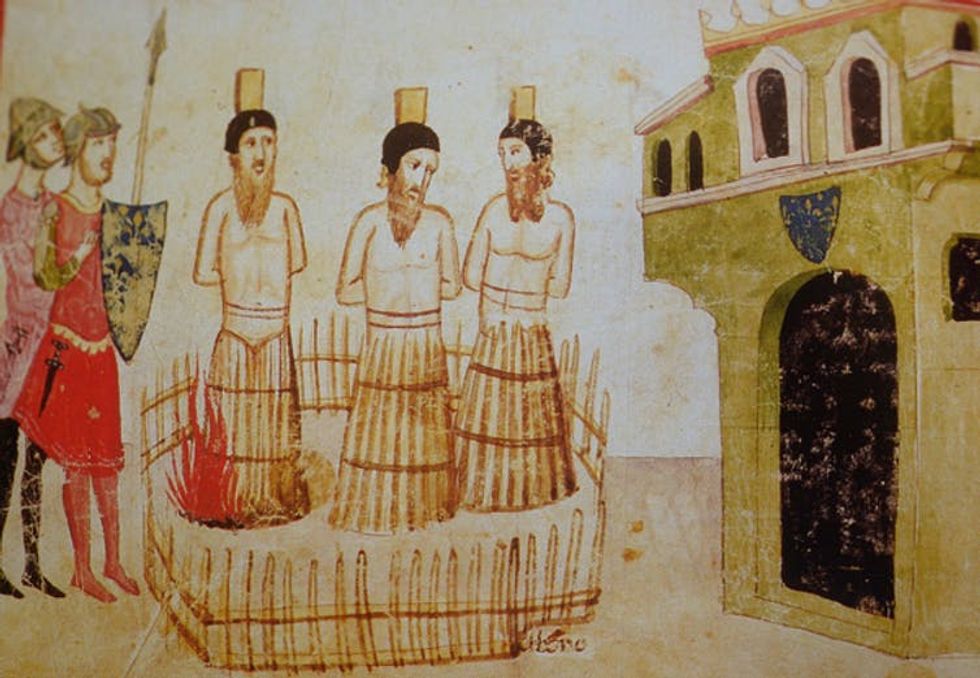
But the French king Philip IV was in debt to the Templar order and, with the Holy land lost, he capitalised on their vulnerability and had the Templars arrested in France on Friday October 13, 1307 in a dawn raid on their Paris Temple and residences. In 1312, the order was abolished by papal decree and in 1314 the last grand-master, Jacque de Molay, was burned at the stake in Paris with three other Templars. With the order destroyed, any surviving former members joined other orders or monasteries.
Execution of Jacques de Molay in Paris, March 1314.
Giovanni Villani, Nuova Cronica - ms. Chigiano L VIII 296 - Biblioteca Vaticana
Despite the arrests and charges of heresy being laid against the order, a document known as the Chinon Parchment was found in 2001 in the Vatican’s archives which documents that the Templars were, in fact, exonerated by the Catholic Church in 1312. But, despite clearing them of heresy, Pope Clement ordered that they be disbanded.
Appropriation of a legend
The suppression of the Templars meant that there was nobody to safeguard their legacy. Since then, the order has been appropriated by other organisations – most notably as ancestors to the Masonic order in the 18th century and, more recently, by right-wing extremist groups such as the Knights Templar-UK and mass-murdering terrorist Anders Behring Breivik.
The Knights Templar’s association with Freemasonry is not so much a myth as it was a marketing campaign by 18th-century Freemasons to appeal to the aristocracy. Historian Frank Sanello explained in his 2003 book, The Knights Templars: God’s Warriors, the Devil’s Bankers, that initially it was Andrew Ramsey, a senior French Freemason of the era, who first made the link between the Freemasons and the Crusader knights.
But he originally claimed the Freemasons were descended from the crusading Order of the Knight Hospitaller. Of course, the Hospitallers were still operational, unlike the Knight Templar, so Ramsey quickly changed his claim to the Templars being the Freemasons’ crusading ancestry.
The Knights Templar had actually been mythologised in popular culture as early as the 13th century in the Grail epic Parzival by German knight and poet Wolfram von Eschenbach. In this Grail epic, the Knights Templar were included in the story as the guardians of the Grail. After the order’s sudden fall, these warrior monks became associated with conspiracies and the occult.
For some, a mystery still surrounds the fate of the Templar fortune (which was in reality seized by Phillip IV, with the majority of their property redistributed to the Hospitallers) and the Templar confessions (extracted under torture) to worshipping an idol dubbed Baphomet. The link between the Templars and the occult would resurface again in the 16th century in Henry Agrippa’s book De Occulta Philosophia.
Modern-day myth
Modern fiction continues to draw upon the widespread mysteries and fanciful theories. These mythical associations are key themes for many popular works of fiction, such as Dan Brown’s The Da Vinci Code in which the Templars guard the Grail. The Templar myth has also found its way into the digital gaming format in the globally successful Assassin’s Creed franchise, in which the player must assassinate a villainous Templar.
Nine centuries after they were formed, the Templars remain the most iconic and infamous order of knights from the Crusades. The Templar legacy has grown beyond their medieval military role and the name has become synonymous with the occult, conspiracies, the Holy Grail and the Freemasons. But these are all false narratives – fantastical, but misleading.
The real legacy of the Templars remains with the Portuguese Order of Knights, Ordem dos Cavaleiros de Nosso Senhor Jesus Cristo(Order of the Knights of Jesus Christ). This order was created by King Diniz in 1319 with Papal permission due to the prominent role the Templars played in establishing the kingdom of Portugal. The new knighthood even moved into the Templars’ former headquarters at Tomar.
For historian Micheal Haag, this new order “was the Templars under another name” – but it pledged obedience to the king of Portugal and not the Pope like their Templar predecessors.
And so the essence of the Templar’s successors still exists today as a Portuguese order of merit for outstanding service – and the Templar myth continues to provide a rich source of inspiration for artistic endeavours.
Fictional vampires tend to reflect the politics of the times that produce them: “Because they are always changing, their appeal is dramatically generational,” says the late American scholar Nina Auerbach in her classic work of criticism Our Vampires, Ourselves. The figure of the vampire, she suggests, always tells us as much about ourselves as it does about vampires per se.
With this in mind, the first episode of the new adaptation of Dracula for the BBC and Netflix by Steven Moffat and Mark Gatiss is at first perplexing. Unlike Moffat’s previous, modernizing adaptations of 19th-century fiction – Jekyll (2007) and Sherlock (2010-17) – the series returns to 1897, the year in which Bram Stoker published his novel.
The setting is high Gothic, featuring a crumbling, eastern European castle (Orava Castle in Slovakia) and a convent full of crucifix-toting nuns. Eschewing the sentimental romance of Francis Ford Coppola’s 1992 adaptation or the wildly successful Twilight franchise, Moffat and Gatiss appear – initially at least – to take us back to the horror of the original text.
But as the episode progresses the European setting becomes more than just spooky window dressing. One of the most famous arguments about the novel, first made by Stephen D. Arata, is that Dracula enacts “reverse colonisation” – Stoker’s vampire expresses the threat that imperialism might not be a one-way operation. From his home in eastern Europe, the count travels to Britain to buy up its real estate and add its women to his harem, bypassing the need for a passport or immigration documents and threatening British manhood in the process.
‘Brexit Gothic’
Seen in this light, Dracula offers a clear application to our times. In an article for The Guardian on “Brexit Gothic”, Neil McRobert points out:
When Nigel Farage expresses concern about Romanian men moving in next door, it makes one wonder if he has read Dracula – the story of a Romanian man who literally moves in beside some stuffy British people.
Moffat and Gatiss are too canny to give us a straightforward metaphor for Brexit – and yet there are clear nods to contemporary anxieties in the first episode. Dracula quizzes Jonathan Harker on English language and culture out of a desire to “pass among your countrymen as one of their own”. He will be the good immigrant who assimilates, who blends invisibly with the host culture. There is a moment of discomfort, however, as he promises to “absorb” Harker – this immigrant is a parasite who feeds off its host.
There is no direct correlation with itinerant agricultural workers, however, as Dracula seeks to infiltrate the highest echelons of society. In a warped version of late 19th-century eugenics, we discover that Dracula’s choosiness about his victims is the secret to his vampiric success – consuming only the blood of the best enables him to retain his human qualities. Hence his appetite for the British Empire. “Vampires go where power is,” says Auerbach. “You are what you eat,” quips Claes Bang’s Dracula.
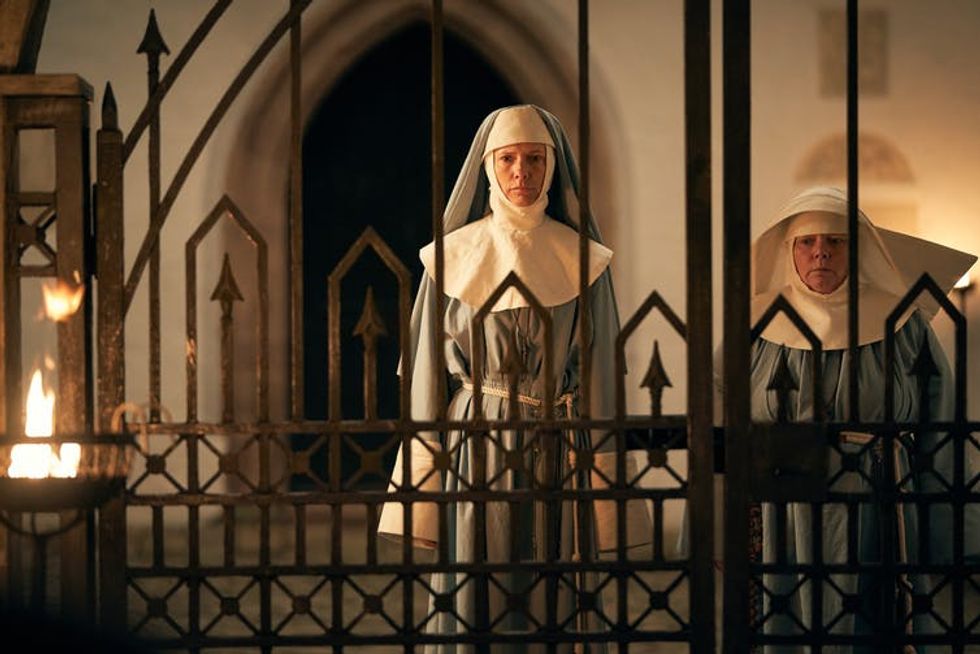
Dolly Wells as Sister Agatha with Joanna Scanlan as Mother Superior.
BBC/Hartswood Films/Netflix/Robert Viglasky
Moreover, this is a tale of two Europeans. Sister Agatha, the Dutch nun who questions Harker after his escape from Dracula’s castle (a significantly expanded role from the book, played with exquisite exasperation by Dolly Wells), scoffs at Jonathan’s English masculinity when he fails to realise the incongruity of a secret message written to him in English in a Transylvanian castle: “Of course not! You are an English man! A combination of presumptions beyond compare.” British exceptionalism looks set to take a tumble as Dracula reaches England in the second instalment.
Dark humour
The episode displays the acute self-aware characteristic of vampire films, which are what Ken Gelder calls “citational”, constantly referring to previous examples of the genre. There are multiple moments when viewers anticipating romance have their expectations rudely shattered. Twilight in particular comes in for some sharp debunking, with Mina playing the role of Twilight’s heroine Bella, appealing to her lover’s higher moral fibre and coming in for a shock as she discovers that true love does not trump bloodlust after all. Instead of Twilight’s lingering shots of gleaming male torsos we get intimate body horror in excruciating close up – a fly crawling across an eyeball, a blackened nail flaking off a finger.
One of the most striking features of Moffat and Gatiss’s adaptation is its humour. Comedy has always been a crucial element of Gothic literature, which continually teeters between terror and laughter. “King Laugh,” a metaphorical figure invented by Professor Van Helsing in Bram Stoker’s novel to explain his own hysterics, is a version of death, leading the characters in a kind of danse macabre. The novel exhibits black humour in the character of the lunatic Renfield, in particular, who calculates how many lives he can consume, starting by eating flies and trading up the food chain.
As I argued in my recent book, Post-Millennial Gothic, a distinguishing characteristic of contemporary vampires is their increasing comic agency. The first self-conscious vampire joke is the iconic one-liner first spoken by Bela Lugosi in Tod Browning’s classic 1931 film: “I never drink … wine.” Moffat and Gatiss get this out of the way in the first few minutes – and even add a callback later in the episode.
There are more zingers to come as Bang quips his way across Europe like an infernal James Bond. When Harker spots him with a glass and queries that he never drinks, I almost expected him to clarify: “Shaken, not stirred.”
The comparison between Dracula and Bond is not a casual one. Bond props up a crumbling British Empire – Dracula aims to infiltrate it and use it to his own ends. They emerge from the same social and historical concerns, two sides of the same coin. Both reflect us back in multiple ways, and neither offers a flattering picture.
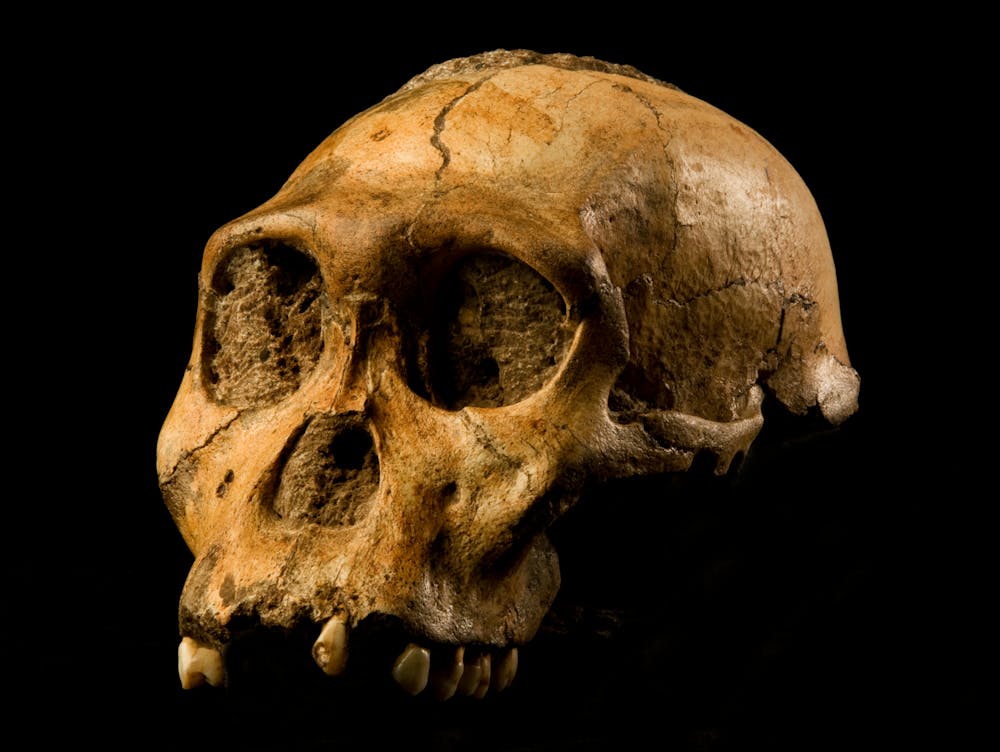
In 1924, a 3-year-old child’s skull found in South Africa forever changed how people think about human origins.
The Taung Child, our first encounter with an ancient group of proto-humans or hominins called australopithecines, was a turning point in the study of human evolution. This discovery shifted the focus of human origins research from Europe and Asia onto Africa, setting the stage for the last century of research on the continent and into its “Cradles of Humankind.”
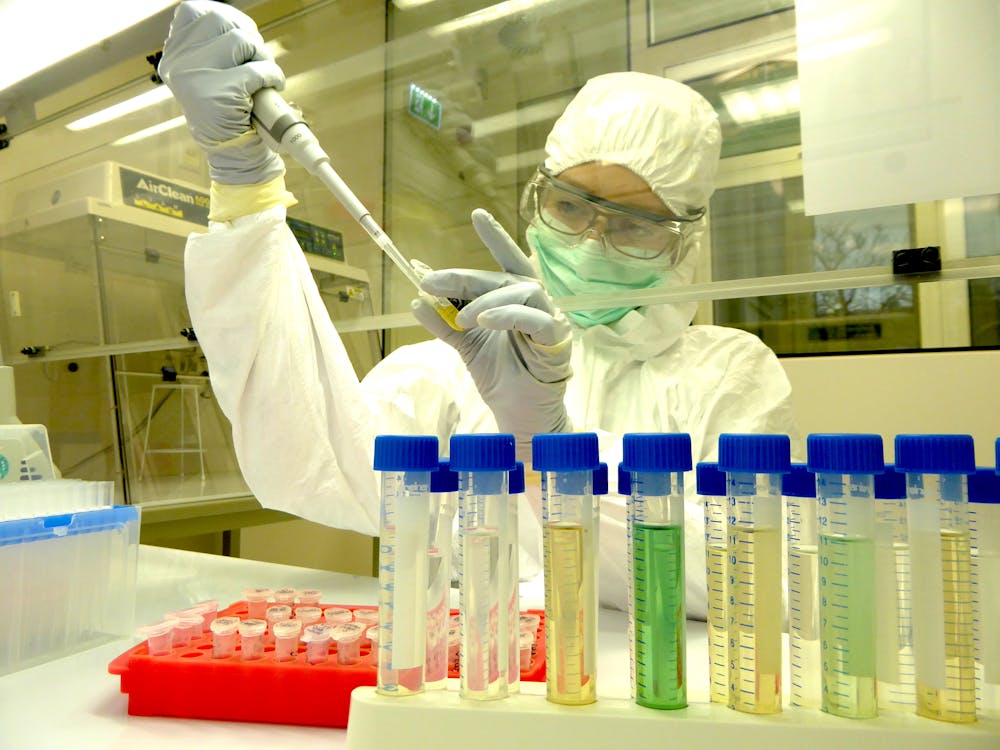
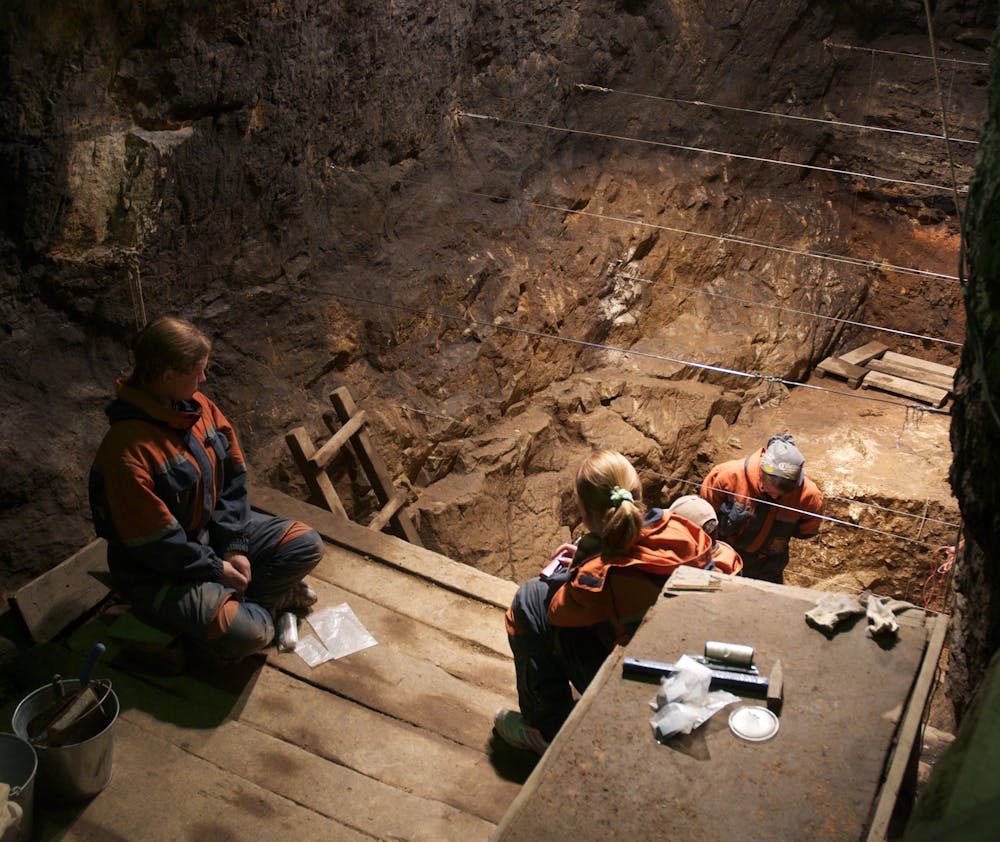
Few people back then would’ve been able to predict what scientists know about evolution today, and now the pace of discovery is faster than ever. Even since the turn of the 21st century, human origins textbooks have been rewritten over and over again. Just 20 years ago, no one could have imagined what scientists know two decades later about humanity’s deep past, let alone how much knowledge could be extracted from a thimble of dirt, a scrape of dental plaque or satellites in space.
The applications go far beyond humans. Paleogenomics is yielding surprising discoveries about plants and animals from ancient seeds and skeletons hidden in the backrooms of museums.
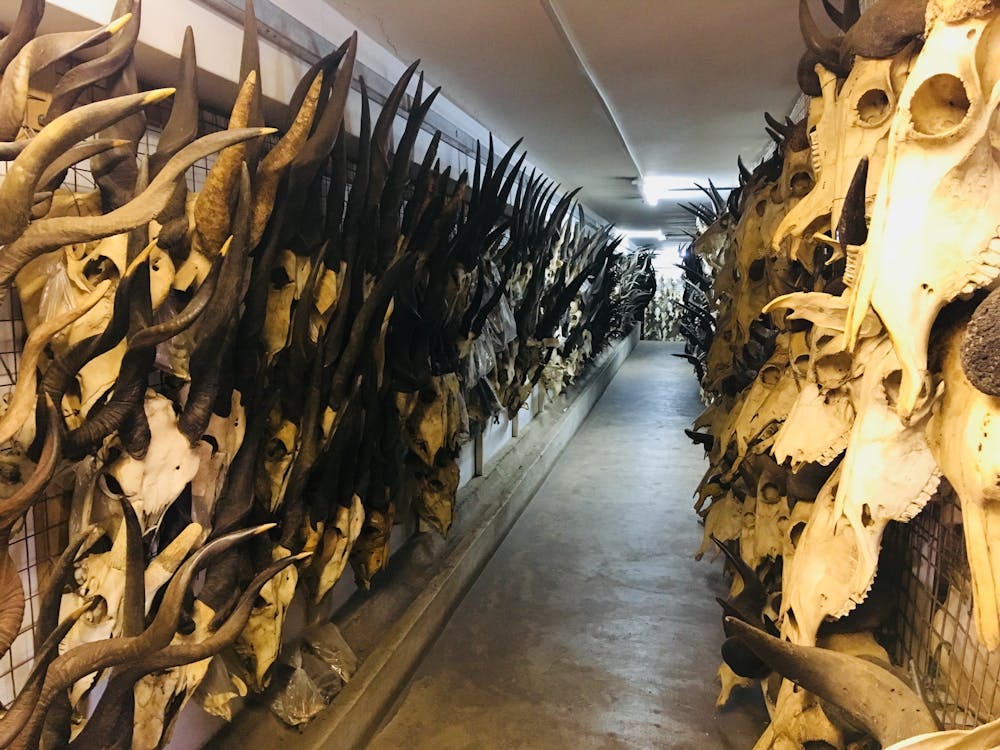
Natural history museums hold a wealth of information, some of which can only be tapped through new biomolecular methods. Scientists analyze modern and fossil animal skeletons to ask questions about the past using ancient proteins.
Mary Prendergast at National Museums of Kenya, CC BY-ND
Biomolecules are making the invisible visible
DNA is not the only molecule revolutionizing studies of the past.
Scientists unexpectedly found lazurite pigment in calcified plaque clinging to a 11th- to 12th-century woman’s tooth, challenging the assumption that male monks were the primary makers of medieval manuscripts.
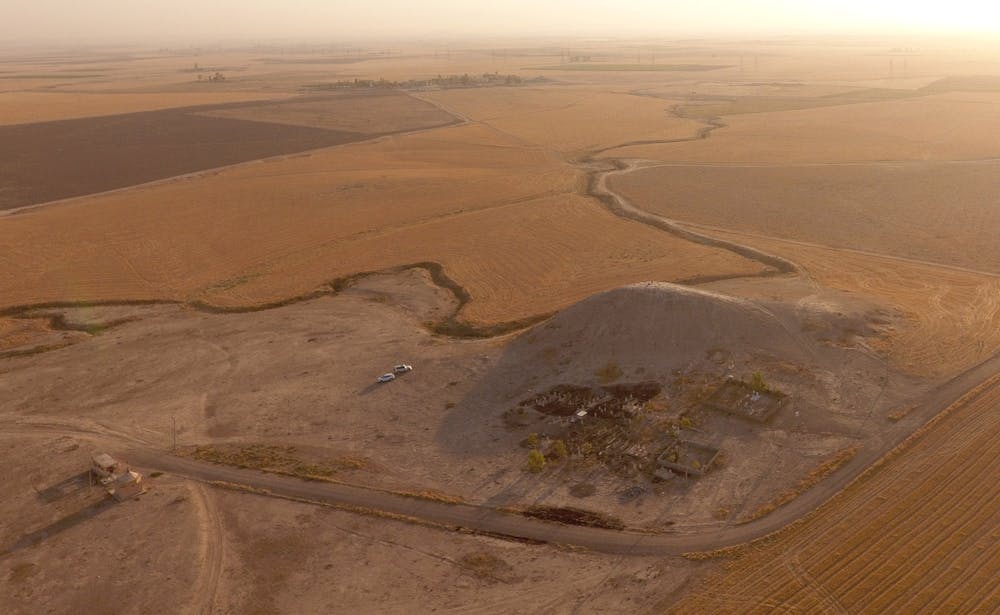
Archaeologists increasingly use technology to understand how sites fit into their environment and to document sites at risk. Here, a drone captured a tell (a mound indicating build-up of ancient settlements) in the Kurdistan Region of Iraq.
Originally developed for space applications, scientists now use LIDAR – a remote sensing technique that uses lasers to measure distance – to map 3D surfaces and visualize landscapes here on Earth. As a result, ancient cities are emerging from dense vegetation in places like Mexico, Cambodia and South Africa.
Geophysical survey methods enable archaeologists to detect buried features without digging large holes, maximizing knowledge while minimizing destruction.
These advances bring researchers together in exciting new ways. Over 140 new Nazca Lines, ancient images carved into a Peruvian desert, were discovered using artificial intelligence to sift through drone and satellite imagery. With the wealth of high-resolution satellite imagery online, teams are also turning to crowdsourcing to find new archaeological sites.
Although new partnerships among archaeologists and scientific specialists are not always tension-free, there is growing consensus that studying the past means reaching across fields.
As new methods enable profound insight into humanity’s shared history, a challenge is to ensure that these insights are relevant and beneficial in the present and future.
Yet in so doing, archaeologists are providing empirical support for climate change and revealing how ancient peoples coped with challenging environments.
Archaeologists today are contributing their methods, data and perspectives toward a vision for a less damaged, more just planet. While it’s difficult to predict exactly what the next century holds in terms of archaeological discoveries, a new focus on “usable pasts” points in a positive direction.
In the most extreme regions of the universe, galaxies are being killed. Their star formation is being shut down and astronomers want to know why.
The first ever Canadian-led large project on one of the world’s leading telescopes is hoping to do just that. The new program, called the Virgo Environment Traced in Carbon Monoxide survey (VERTICO), is investigating, in brilliant detail, how galaxies are killed by their environment.
Commissioned in 2013 at a cost of US$1.4 billion, ALMA is an array of connected radio dishes at an altitude of 5,000 metres in the Atacama Desert of northern Chile. It is an international partnership between Europe, the United States, Canada, Japan, South Korea, Taiwan and Chile. The largest ground-based astronomical project in existence, ALMA is the most advanced millimetre wavelength telescope ever built and ideal for studying the clouds of dense cold gas from which new stars form, which cannot be seen using visible light.
Large ALMA research programs such as VERTICO are designed to address strategic scientific issues that will lead to a major advance or breakthrough in the field.
Galaxy clusters
Where galaxies live in the universe and how they interact with their surroundings (the intergalactic medium that surrounds them) and each other are major influences on their ability to form stars. But precisely how this so-called environment dictates the life and death of galaxies remains a mystery.
Galaxy clusters are the most massive and most extreme environments in the universe, containing many hundreds or even thousands of galaxies. Where you have mass, you also have gravity and the huge gravitational forces present in clusters accelerates galaxies to great speeds, often thousands of kilometres-per-second, and superheats the plasma in between galaxies to temperatures so high that it glows with X-ray light.
In the dense, inhospitable interiors of these clusters, galaxies interact strongly with their surroundings and with each other. It is these interactions that can kill off — or quench — their star formation.
Understanding which quenching mechanisms shut off star formation and how they do it is main the focus of the VERTICO collaboration’s research.
The life cycle of galaxies
As galaxies fall through clusters, the intergalactic plasma can rapidly remove their gas in a violent process called ram pressure stripping. When you remove the fuel for star formation, you effectively kill the galaxy, turning it into a dead object in which no new stars are formed.
In addition, the high temperature of clusters can stop hot gas cooling and condensing onto galaxies. In this case, the gas in the galaxy isn’t actively removed by the environment but is consumed as it forms stars. This process leads to a slow, inexorable shut down in star formation known, somewhat morbidly, as starvation or strangulation.
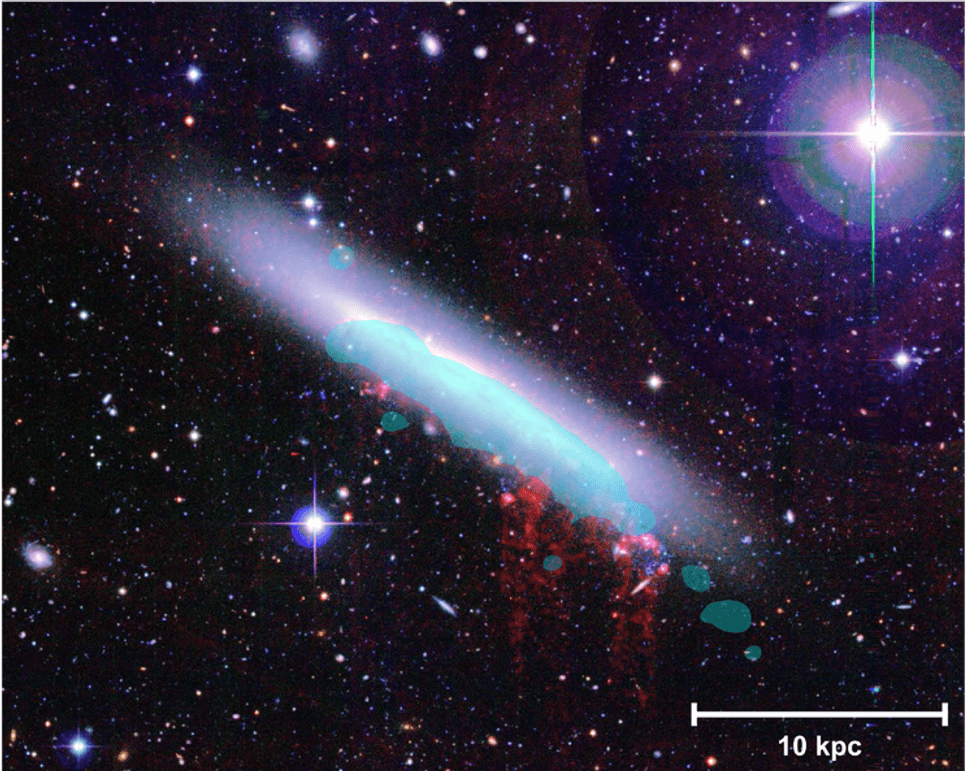
An image of spiral galaxy NGC 4330 in the Virgo Cluster. Ram pressure stripped hot gas is shown in red and a blue overlay shows star-forming gas.
While these processes vary considerably, each leaves a unique, identifiable imprint on the galaxy’s star-forming gas. Piecing these imprints together to form a picture of how clusters drive changes in galaxies is a major focus of the VERTICO collaboration. Building on decades of work to provide insight into how environment drives galaxy evolution, we aim to add a critical new piece of the puzzle.
An ideal case study
The Virgo Cluster is an ideal location for such a detailed study of environment. It is our nearest massive galaxy cluster and is in the process of forming, which means that we can get a snapshot of galaxies in different stages of their life cycles. This allows us to build up a detailed picture of how star formation is shut off in cluster galaxies.
Galaxies in the Virgo cluster have been observed at almost every wavelength in the electromagnetic spectrum (for example, radio, optical and ultra-violet light), but observations of star-forming gas (made at millimetre wavelengths) with the required sensitivity and resolution do not exist yet. As one of the largest galaxy surveys on ALMA to date, VERTICO will provide high resolution maps of molecular hydrogen gas — the raw fuel for star formation — for 51 galaxies.
With ALMA data for this large sample of galaxies, it will be possible to reveal exactly which quenching mechanisms, ram pressure stripping or starvation, are killing galaxies in extreme environments and how.
By mapping the star-forming gas in galaxies that are the smoking gun examples of environment-driven quenching, VERTICO will advance our current understanding of how galaxies evolve in the densest regions of the Universe.
The first two decades of the 21st century saw the return of mass movements to streets around the world. Partly a product of sinking confidence in mainstream politics, mass mobilisation has had a huge impact on both official politics and wider society, and protest has become the form of political expression to which millions of people turn.
2019 has ended with protests on a global scale, most notably in Latin America, the Middle East and North Africa, Hong Kong and across India, which has recently flared up against Prime Minister Narendra Modi’s Citizenship Amendment Act. In some cases protests are explicitly against neoliberal reforms, or against legal changes that threaten civil liberties. In others they are against inaction over the climate crisis, now driven by a generation of young people new to politics in dozens of countries.
As we end a turbulent two decades of protest – the subject of much of my own teaching and ongoing research – what will be the shape of protest in the 2020s?
Following moments of open class warfare in the late 1960s and early 1970s, battles against the political and economic order became fragmented, trade unions were attacked, the legacy of the anti-colonial struggles was eroded and the history of the period was recast by the establishment to undermine its potency. In the post-Cold War era, a new phase of protest finally began to overcome these defeats.
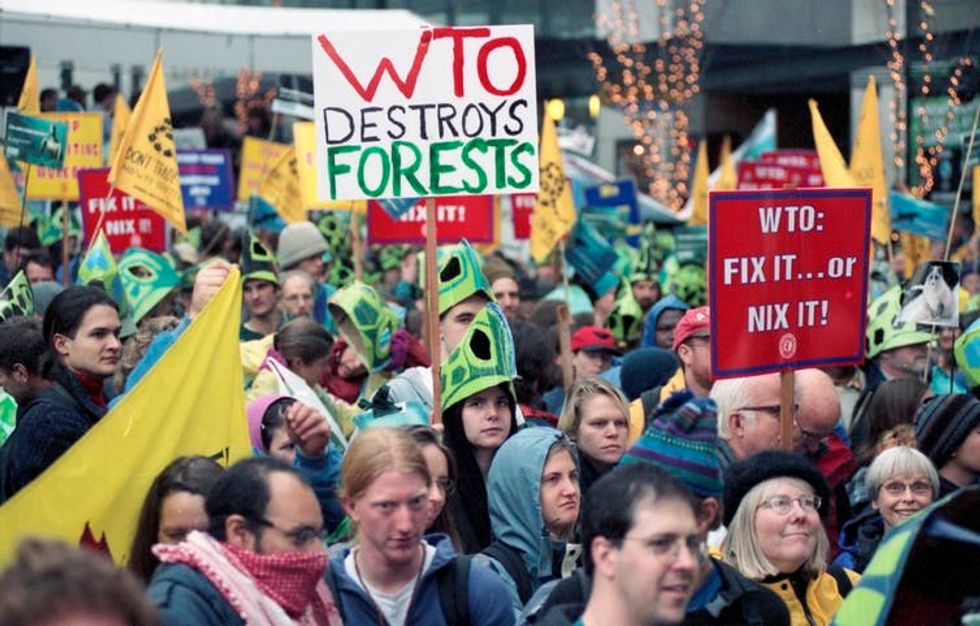
This revival of protest exploded onto the political scene most visibly in Seattle outside the World Trade Organization summit in 1999. If 1968 was one of the high points of radical struggle in the 20th century, protest in the early 2000s once again began to reflect a general critique of the capitalist system, with solidarity forged across different sections of society.
The birth of the anti-globalisation movement in Seattle was followed by extraordinary mobilisations outside gatherings of the global economic elite. Alternative spaces were also created for the global justice movement to connect, most notably the World Social Forums (WSFs), starting with Porto Alegre, Brazil in 2001. It was here that questions over what position the anti-globalisation movement should take over the Iraq War, for example, were discussed and debated. Though the WSFs provided an important rallying point for a time, they ultimately evaded politics.
The global anti-war movement led to the biggest co-ordinated demonstrations in the history of protest on February 15 2003, in which millions of people demonstrated in over 800 cities, creating a crisis of democracy around the US and UK-led intervention in Iraq.
In the years leading up to and following the banking crisis of 2008, food riots and anti-austerity protests escalated around the world. In parts of the Middle East and North Africa, protests achieved insurrectionary proportions, with the overthrow of one dictator after another. After the Arab Spring was thwarted by counter-revolution, the Occupy movement and then Black Lives Matter gained global attention. While the public, urban square became a central focus for protest, social media became an important – but by no means exclusive – organising tool.
To varying degrees, these movements sharply raised the question of political transformation but didn’t find new ways of institutionalising popular power. The result was that in a number of situations, protest movements fell back on widely distrusted parliamentary processes to try and pursue their political aims. The results of this parliamentary turn have not been impressive.
Crisis of representation
On the one hand, the first two decades of the 21st century have seen soaring inequality, accompanied by debt and the neglect of working people. On the other, there have been poor results from purely parliamentary attempts to challenge it. There is, in other words, a deep crisis of representation.
The inability of modern capitalism to deliver more than survival for many has combined with a general critique of neoliberal capitalism to create a situation in which wider and wider sections of society are being drawn into protest. More than a million people have poured onto the streets of Lebanon since mid-October and protests continue despite a violent crackdown by security forces.
At the same time, people are less and less willing to accept unrepresentative politicians – and this is likely to continue in the future. From Lebanon and Iraq to Chile and Hong Kong, mass mobilisations continue despite resignations and concessions.
In Britain, the Labour Party’s defeat in the recent general election is attributed largely to its failure to accept the 2016 referendum result over EU membership. Decades of loyalty to the Labour Party for many and a socialist leader in Jeremy Corbyn calling for an end to austerity couldn’t cut through to enough of the millions who voted for Brexit.
In France, a general strike in December 2019 over President Emmanuel Macron’s proposed pension reforms has revealed the extent of opposition that people feel towards his government. This comes barely a year after the start of the Yellow Vest movement, in which people have protested against fuel price hikes and the precariousness of their lives.
The tendency towards street protest will be encouraged too by the climate crisis, whose effects mean that the most heavily exploited, including along race and gender lines, have the most to lose. When the protests in Lebanon broke out, they were taking place alongside rampant wildfires.
Thinking strategically
As protesters gain experience, they consciously bring to the fore questions of leadership and organisation. In Lebanon and Iraq there has already been a conscious effort to overcome traditional sectarian divides. Debates are also raging in protest movements from Algeria to Chile about how to fuse economic and political demands in a more strategic manner. The goal is to make political and economic demands inseparable, such that it’s impossible for a government to make political concessions without making economic ones too.
There has also been a resurgence of the far right in many countries, emboldened most visibly by parties and politicians in the US, Brazil, India and many parts of Europe. This resurgence, however, has not gone unchallenged.
The convergence of crisis on these multiple fronts will reach breaking point, creating conditions that will become intolerable for most people. This will galvanise more protest and more polarisation. As governments respond with reforms, such measures on their own will be unlikely to meet the combination of political and economic demands. The question of how to create new vehicles of representation to assert popular control over the economy will keep emerging. The fortunes of popular protest may well depend on whether the collective leadership of the movements can provide answers to it.
America has been plagued with rapidly worsening income inequality over the last decade, and the trend has also appeared worldwide. According to Axios, the amount of wealth controlled by all the world's billionaires jumped from $2.4 trillion in 2009 to $8.7 trillion today, with the global top 1 percent capturing 27 percent of all the world's newly created wealth.
But there is a silver lining, according to the Brookings Institute study Axios cites. While the mega-rich saw their wealth rise the most this decade, the second-greatest increase in wealth went to the mega-poor.
As of 2018, the report found, more than half of the world's population is now in the middle class, with the rate of extreme poverty — those living on less than $1.25 per day — falling from 15.7 percent in 2010 to 7.7 percent now. Extreme poverty has been virtually eliminated from China, where it was once commonplace. All told, the average income of the bottom 50 percent of the world has doubled between 1980 and 2016.
Global infant and maternal mortality rates, meanwhile, have been cut in half since 1990, and the child literacy rate has reached 91 percent.
Significant challenges remain. Sub-Saharan Africa continues to lag in many of these metrics. Moreover, rising global income inequality creates other problems even if lower income groups rise as well, from the distortion of health care and housing costs in the developed world, to a degradation of democracy as the ultra-wealthy use their resources and influence to lobby politicians to cater to their political priorities at the expense of the majority.
Nonetheless, standard of living has improved substantially for the most impoverished populations of the world — and that is cause for hope.
The Taliban Monday denied agreeing to any ceasefire in Afghanistan after rumours swirled of a potential deal that would see a reduction in fighting after more than 18 years of war.
The statement from the insurgents comes as local and international forces brace for another bloody winter amid renewed US-Taliban talks, after President Donald Trump called off the negotiations earlier this year over insurgent attacks.
"In the past few days, some media have been releasing untrue reports about a ceasefire... The fact is that, the Islamic Emirate of Afghanistan has no ceasefire plans," the Taliban said.
The US and the Afghan government in Kabul have long called for a ceasefire with the Taliban, including during the year of negotiations between Washington and the Taliban that were abruptly called off by Trump in September.
However, the militants have repeatedly stated that any potential truce will only be ironed out after American troops withdraw from the country.
The US-Taliban talks, held mainly in Doha, were aimed at allowing Washington to begin withdrawing troops in return for various security guarantees.
They were on the brink of a deal when Trump abandoned the effort in September, citing Taliban violence. Negotiations have since restarted in Doha, but were earlier this month put on a "pause".
Trump is looking to slash the troop presence in Afghanistan, potentially even before a deal between Washington and the Taliban is cemented.
Meanwhile deadly bouts of fighting continue, with tens of thousands of Afghan security forces killed since they inherited combat operations from NATO at the end of 2014.
Every day Afghans also continue to bear the brunt of the bloody conflict.
Last week the UN said the country had passed a grim milestone this year, with more than 100,000 Afghan civilians killed or wounded over the past decade.
A UN tally found that last year was the deadliest on record, with at least 3,804 civilian deaths caused by the war -- including 927 children.
Afghanistan is also struggling with an ongoing political dispute after officials announced preliminary results in the latest presidential elections that put President Ashraf Ghani on track to secure a second term.
Elections authorities have yet to declare the results as final after receiving more than 16,000 complaints about the polls, with the ultimate tally expected in the coming weeks.
The Taliban have long viewed Ghani as an American stooge and have refused to negotiate with his government, leading many to fear that fighting against Afghan forces will continue even if the US secures an eventual deal with the militants to withdraw.
Svante Thunberg, father of eco-warrior Greta Thunberg, thinks his daughter is happier being an activist but admitted in an interview he had reservations about her taking up the struggle.
Speaking to the BBC, the 50-year-old actor-turned-producer said he and Greta's mother -- opera singer Malena Ernman -- originally objected to their daughter's decision to become a climate activist.
"Obviously we thought it was a bad idea, putting herself out there with all the hate on social media," he said.
Greta, described as a shy 16-year-old, has found herself in the role of spokesperson for a generation haunted by climate change after she started sitting outside the Swedish parliament in August 2018 with her "School Strike for the Climate" sign.
Instantly recognisable with her long braids and impish looks, she has become the face of youth concerns over climate change, inspiring millions and being invited to address the United Nations climate summit.
Greta's family realised just how much the existential threat of climate change weighed on her when she became depressed at age 11.
She stopped eating, started missing school and even stopped talking.
Despite his initial apprehension Svante Thunberg also said he thought it was clear his daughter was much happier since taking up activism.
Greta has also faced severe criticism and been subjected to a swarm of online conspiracy theory.
Some have claimed she is a puppet of doomsayers, or paid by the "green lobby".
But her father said she was prepared for the "hate" she would receive even before she started her protest.
"She knew exactly what she was doing and I think quite frankly she's very surprised that she has been so well received," Svante Thunberg told the BBC.
"We consider it as a violation of Iraqi sovereignty."
Iraqi Prime Minister Adel Abdul-Mahdi on Sunday accused the Trump administration of violating his nation's sovereignty and further heightening tensions in the region after the U.S. bombed several targets in Iraq and Syria, killing at least 25 fighters and injuring dozens more.
"We have previously confirmed our rejection of any unilateral action by the coalition forces or any other forces inside Iraq, and we consider it as a violation of Iraqi sovereignty and a dangerous escalation that threatens the security of Iraq and the region," Abdul-Mahdi said of the U.S. strikes.
"The dangerous escalation in Iraq occurs in the context of the Trump administration's reckless and needless 'maximum pressure' campaign that threatens to make Iraq an all-out battlefield between the U.S. and Iran."
—Sina Toossi, National Iranian American Council
The Pentagon claimed the airstrikes, which U.S. President Donald Trump approved late Saturday, were a "defensive" response to a rocket attack on an Iraqi military base last week that killed an American contractor.
The U.S. blamed the Kataib Hezbollah militia for the attack and pointed fingers at Iran, which the Trump administration said is funding and arming the group.
"We will not stand for the Islamic Republic of Iran to take actions that put American men and women in jeopardy," U.S. Secretary of State Mike Pompeo, a long-time supporter of regime change in Iran, said in a statement following the strikes on Sunday.
Kataib Hezbollah quickly vowed retaliatory action, saying the Trump administration's actions have left it with "no choice but confrontation."
"Trump should know that he will pay a heavy price in Iraq and the countries where his criminal forces are present," the group said.
Asa'ib Ahl al-Haq, an Iraqi militia group allied with Kataib Hezbollah, said "it is our duty to put an end to the U.S. military presence in Iraq through every legitimate method" and called on "political forces to stand against this cowardly aggression."
The latest U.S. bombing campaign in the Middle East prompted urgent calls for deescalation and warnings that the intensifying conflict could spark a full-blown regional war.
Sina Toossi, senior research analyst with the National Iranian American Council, said the U.S. strikes are linked to Trump's longstanding aggressive posture toward Iran and his decision last year to violate the 2015 nuclear accord.
"The dangerous escalation in Iraq occurs in the context of the Trump administration's reckless and needless 'maximum pressure' campaign that threatens to make Iraq an all-out battlefield between the U.S. and Iran," Toossi said in a statement. "Avoiding this scenario requires a broader rethinking of the maximum pressure policy away from mindless saber-rattling to one that opens channels of dialogue with Tehran."
"By reneging on the Iran nuclear deal and pursuing a maximalist goal of denying Iran influence in Iraq and elsewhere, President Trump has set the stage for chaos to overtake large parts of the region," Toossi added. "In its misplaced aim to sanction and isolate Iran, the administration risks yet again plunging Iraq into total chaos."
A Chinese court on Monday sentenced the doctor who claimed to be behind the world's first gene-edited babies to three years in prison for illegal medical practice, state media reported.
He Jiankui, who shocked the scientific community last year by announcing the birth of twins whose genes had allegedly been altered to confer immunity to HIV, was also fined three million yuan ($430,000), Xinhua news agency said.
He was sentenced by a court in Shenzhen for "illegally carrying out the human embryo gene-editing intended for reproduction", Xinhua said.
Two of his fellow researchers were also sentenced. Zhang Renli was handed a two-year jail term and fined one million yuan while Qin Jinzhou was given 18 months, suspended for two years, and fined 500,000 yuan.
The trio had not obtained qualifications to work as doctors and had knowingly violated China's regulations and ethical principles, according to the court verdict, Xinhua said.
They had acted "in the pursuit of personal fame and gain" and seriously "disrupted medical order", it said.
Xinhua said a third gene-edited baby was born as a result of He's experiments, which had not previously been confirmed.
He announced in November last year that the world's first gene-edited babies -- twin girls -- had been born that same month after he altered their DNA to prevent them from contracting HIV by deleting a certain gene under a technique known as CRISPR.
The claim shocked scientists worldwide, raising questions about bioethics and putting a spotlight on China's lax oversight of scientific research.
Amid the outcry, He was placed under police investigation, the government ordered a halt to his research work and he was fired by his Chinese university.
Gene-editing for reproductive purposes is illegal in most countries. China's health ministry issued regulations in 2003 prohibiting gene-editing of human embryos, though the procedure is allowed for "non-reproductive purposes".
He's gene editing meant to immunise the twins against HIV may have failed in its purpose and created unintended mutations, scientists said earlier this month after the original research was published for the first time.
He claimed a medical breakthrough that could "control the HIV epidemic", but it was not clear whether he had even been successful in immunising the babies against the virus because the team did not reproduce the gene mutation that confers this resistance, scientists told the MIT Technology Review.
While the team targeted the right gene, they did not replicate the "Delta 32" variation required, instead creating novel edits whose effects are not clear.
Moreover, CRISPR remains an imperfect tool because it can lead to unwanted or "off-target" edits, making its use in humans hugely controversial.
Australian tennis great Margaret Court has again condemned transgender athletes, while claiming the devil controlled the media and government, in fiery comments just weeks before she is honoured at the Australian Open.
The 24-time Grand Slam singles winner, now a church pastor, drew fire in 2017 for saying she would avoid Qantas over the airline's support for same-sex marriage, which is now law in Australia following a referendum.
She later claimed, in comments that were widely derided, that tennis was "full of lesbians" and that transgender children were the result of a Nazi-style "plot" to brainwash the minds of young people.
The 77-year-old doubled down on her controversial views regarding sexuality during a sermon at her Perth church at the weekend, which came to light on Monday.
"Children are making the decision at seven or eight years of age to change their sex … no, just read the first two chapters of Genesis, that's all I say. Male and female," Court said in a video of the sermon.
"It's so wrong at that age because a lot of things are planted in this thought realm at that age, and they start to question 'what am I'.
"And you know with that LGBT, they'll wish they never put the T on the end of it because, particularly in women's sports, they're going to have so many problems.
"You have got young people taking hormones and having changes, by the time they are 17 they are thinking, 'Now I'm a boy and really I was a girl'. Because you know what, God made us that way."
Court also highlighted the difficulty of talking about her religious beliefs, claiming "the devil" had control over the media and government.
"The devil gets in and the media and the political, the education, TV -- he wants to control a nation so he can affect people's minds and mouths," she said.
After her previous comments on homosexuality and gay marriage, high-profile players like Billie Jean King and Martina Navratilova called for the Margaret Court Arena at Melbourne Park -- home of the Australian Open -- to be stripped of her name.
That has not happened and the 50th anniversary of Court's calendar-year Grand Slam will next month be commemorated at the tournament, where she will be a guest of honour.
While Tennis Australia last month agreed to mark her achievement of winning all four majors in the same year, it also distanced itself from the player's views.
"As often stated, Tennis Australia does not agree with Margaret's personal views, which have demeaned and hurt many in our community over a number of years.
"They do not align with our values of equality, diversity and inclusion."
Court used to attend the Australian Open regularly but hasn't shown up since 2017, when the controversy over her views first flared.