Video surfaced on Saturday of one of President Donald Trump's children in Kyiv as Congress and federal prosecutors examine the family's dealings in Ukraine and Russia.
The suspect for the rape and murder of a young woman in northern France almost two decades ago was under guard in hospital Saturday after he swallowed pesticide in an apparent suicide bid following his conviction.
Willy Bardon, on trial over the murder of Elodie Kulik in 2002 in a case that has attracted strong interest in France for years, ingested the substance at the courthouse in the northern city of Amiens late on Friday.
Bardon had been sentenced to 30 years jail for kidnapping and holding a person against their will followed by death. He was however acquitted of murder.
"The condition of Willy Bardon was stabilised by the doctors during the night," Amiens prosecutor Alexandre de Bosschere told AFP.
He said indications given by his family and also an analysis showed that Bardon had swallowed a pesticide in the seconds after the verdict was announced at court in Amiens at the climax of a 13-day trial.
"We do not know how he managed to hide that," said de Bosschere, adding that the defendant would have been searched before entering the court.
Bardon, 45, was placed under police guard at a hospital and an update on his condition was expected later in the day.
- 'Suicide attempt' -
Bank employee Elodie Kulik, 24, was kidnapped, raped, strangled and her corpse then burned in January 2002 in Tertry, 20 kilometres (12 miles) from Saint-Quentin in the Aisne region.
Before dying, she managed to call emergency services and the harrowing 26-second recording was the key piece of evidence in the trial.
Another suspect Gregory Wiart, whose DNA was found at the scene, died in 2003. But six witnesses told the court they recognised the voice of Willy Bardon on the tape.
DNA testing advances had allowed new evidence to be gathered years after the event, leading police to identify Wiart.
Throughout the trial, Bardon insisted he was innocent, even protesting to the parents of Kulik that he had not been at the scene.
"It is clear that Mr Bardon tried to kill himself. He had said repeatedly that he could not bear going back to prison," his lawyer Stephane Daquo told AFP, adding that the defence would appeal a conviction that he claimed was based "on a simple impression".
The victim's father Jacky Kulik expressed relief at the verdict while regretting Bardon's apparent suicide attempt.
"I can go to her grave tomorrow and say that I did my job," Kulik said.
Oil and gas groups were accused Saturday of seeking to influence climate talks in Madrid by paying millions in sponsorship and sending dozens of lobbyists to delay what scientists say is a necessary and rapid cut in fossil fuel use.
A day after tens of thousands marched in the Spanish capital demanding climate action, seven environmental groups raised concerns to AFP over the role of fossil fuel representatives at the COP25 summit.
Under the 2015 Paris Agreement, nations agreed to limit global warming to "well below" two degrees Celsius (3.6 degrees Fahrenheit) and as close to 1.5C as possible.
The UN's top science panel says that 1.5C would require a radical drawdown in fossil fuel usage.
Delegates are gathered in Madrid negotiating how to implement the Paris pledges. The summit was moved at short notice after domestic unrest forced original host Chile to cancel.
Spanish energy giants Endesa and Iberdrola stepped in to sponsor the conference, which brings together more than 20,000 negotiators, scientists, NGOs and journalists from around the world.
AFP has been told that each company paid 2 million euros to be COP25 "Platinum" sponsors, affording them prominent branding and trade stalls at the event.
Endesa is one of Spain's largest greenhouse gas emitters, producing just over 60 million tonnes of CO2 equivalent last year alone.
Iberdrola produced 24.6 million tonnes in 2018.
Neither group nor organisers confirmed the exact cost but their sponsorship of a conference designed to reach consensus on how to cut emissions drew allegations of "greenwashing" from observers.
"Bankrolling the global climate negotiations is a classic trick from the polluter's playbook," said Jean Su, energy director with the Center for Biological Diversity.
"For just a fraction of yearly profits, big polluters are able to wrap themselves in the branding of the COP and use this access to influence the negotiations," added Sriram Madhusoodanan of the Corporate Accountability watchdog.
When COP25 opened on Monday, many Spaniards woke up to advertisements from Endesa splashed across the front pages of national newspapers.
An Endesa spokeswoman told AFP that it was "a marketing action" and denied greenwashing.
"Our objective is to always do better and we are accelerating our energy transition," she said.
Iberdrola and the conference organisers did not respond to queries over sponsorship.
- 'We respect UN rules' -
Trade groups representing energy firms are entitled under UN rules to attend annual UNFCCC talks and inter-sessional meetings as observers.
They frequently host networking meetings or presentations and have the same status and access permits at negotiations as environmental charities.
While few oil and gas majors participate directly in UN talks, they are well represented in Madrid by the trade organisations they partner.
One such group is the International Emissions Trading Agency (IETA), which counts among its members energy giants such as BP and ENI.
It also represents Iberdrola and Endesa's parent company Enel, and is holding a total of 74 side events during COP25.
According to an official participants list IETA has sent 141 people to Madrid -- more than the entire European Union's delegation, and larger than that of host Chile.
"IETA supports the UNFCCC's goals and objectives for climate protection –- which are a core part of our mission," CEO Dirk Forrister told AFP.
"We also respect UNFCCC's rules and procedures, including its guidelines for observer participation.
"Our members observe UN climate negotiations, because they are serious about bringing business solutions to the climate challenge," he added.
IPIECA, another trade group, has a smaller delegation in Madrid containing representatives from Chevron, ENI and Petrobras.
It did not respond to a comment request.
Unlike parallel UN processes, there is currently no protection in the UNFCCC against potential conflicts of interest between nations which need emissions slashed rapidly in order to survive, and the biggest emitters whose business plans are still heavily reliant on fossil fuels.
Thousands of energy reps have attended climate talks since 1990.
Hoda Baraka, of 350.org, said trade organisations representing big energy risked undermining climate action.
"We're seeing yet again how the interests of dirty energy corporations are being put before the needs of vulnerable people and the planet," she told AFP.
"It's just common sense that those who are causing the climate crisis need to be kept far away from the political process meant to solve it."
UN climate change secretary Patricia Espinosa said that "everyone" needed to be involved in transition away from fossil fuels.
"There is no way we will this transformation without the energy industry, including oil and gas," she said Friday.
- 'No group influences decisions' -
The UN last year said "no particular interest group influences the decision-making process" at climate talks, adding that it takes the issue of conflict of interest "very seriously".
Yet during annual mid-session climate talks in Germany in June, AFP obtained proof that hours of discussions on the subject were omitted from the final conference record.
A collection of 47 developing nations submitted a proposal to draw up provisions to protect against conflict of interest, observers said.
The proposal was opposed by the United States, Australia and the EU among others, yet no reference of it appeared in final discussion summaries.
Another trade group present at COP25 is the Edison Electrical Institute (EEI), which represents dozens of power firms in the US and around the world.
The EEI used to belong to the Global Climate Coalition (GCC), a now-disbanded fossil fuel lobby group.
Internal GCC documents compiled by the Climate Investigations Centre showed this year how the group used UN talks to further its members' agenda.
The documents detail how the GCC pushed to influencing policymakers, including in discussions with the UN's Intergovernmental Panel on Climate Change (IPCC), to tone down the links between man-made emissions and global warming.
The GCC disbanded in 2002 after growing disputes among its members over how to respond to advances in climate science, yet organisations it represented are still present at UN talks.
This includes EEI, which has sent more than 200 delegates to negotiations since 1995.
- 'Destroying our planet' -
"We and our members understand that addressing the impacts of climate change in the areas of mitigation and adaptation requires a global response," an EEI spokesman told AFP.
"EEI's member companies are leading this clean energy transformation and are making real, substantive progress."
Environmental groups including Oil Change International, Corporate Europe Observatory, the Observatorio de Multinacionales en America Latina, and Power Shift Africa all told AFP they considered oil and gas presence at COP25 as unacceptable.
"Our hard work and determination is easily overpowered by the vast resources of the biggest polluting corporations," said Sarah Dobson, from the UK Youth Climate Coalition.
"These companies are destroying our planet and our right to fair climate negotiations free from their influence."
Tesla co-founder Elon Musk was cleared of defamation on Friday by a jury in Los Angeles over a tweet in which he labeled a British caver "pedo guy."
The jury deliberated less than an hour before ruling in favor of Musk and clearing him of any liability in the high-profile case that pitted him against Vernon Unsworth.
Unsworth had sought $190 million in damages from the tech billionaire, arguing that his reputation had been damaged by the tweet.
Musk hugged his lawyer on hearing the verdict, telling reporters afterwards: "My faith in humanity has been restored."
One of Unsworth's attorneys, Mark Stephens, expressed disappointment saying the verdict would allow "a bullying billionaire ... to cast a long shadow."
"I just hope that nobody else has to go through (this) and go toe-to-toe with Mr Musk again," Stephens said, noting the "enormous" amount of money Musk had at his disposal to defend himself.
Unsworth said he was sorry the verdict did not go his way but would respect the jury's decision.
The caver's legal team had told jurors in closing arguments that the $190 million he was seeking would amount to "a hard slap on the wrist" for Musk and would prevent him "from ever planting a nuclear bomb in the life of another individual."
Describing the 48-year-old entrepreneur as a "billionaire bully," Unsworth attorney Lin Wood said his client was a man of modest means whose life had been upended by the much-publicized row.
GETTY IMAGES NORTH AMERICA/AFP/File / Apu Gomes Tesla co-founder Elon Musk leaves the Los Angeles federal courthouse through a back door on December 3, 2019
Musk's outburst against Unsworth followed an interview in which the 64-year-old caver dismissed Musk's offer of a mini-submarine to rescue young soccer players trapped in a cave in Thailand in the summer of 2018.
- 'Just an insult' -
Unsworth at the time said Musk's offer was nothing but a PR stunt -- a claim he maintained during the trial -- and had suggested he "stick his submarine where it hurts."
In court testimony, Musk said the "pedo guy" tweet he shared with his 22 million followers was an off-the-cuff insult and did not mean he was accusing Unsworth -- a financial consultant who splits his time between Britain and Thailand -- of being a pedophile.
He apologized on Twitter for his outburst and again during his testimony.
He insisted during questioning that he was simply reacting to Unsworth's "unprovoked" comments and claimed that "pedo guy" was a term widely used in South Africa, where he grew up, and meant "creepy old man."
AFP/File / Lillian SUWANRUMPHA Soldiers work at the Tham Luang cave in Chiang Rai, Thailand on June 26, 2018 during the rescue operation for the trapped youth soccer team and their coach
Musk's attorney Alex Spiro told jurors in his closing argument Friday that the case boils down to "an argument between two people."
"This was just an insult," Spiro said. "Plaintiff is taking one of those insults and putting it in the spotlight."
The attorney insisted that it was Unsworth who picked a fight and his client had simply pushed back with a tweet he later regretted.
"Elon Musk doesn't like that tweet, shareholders don't like the tweet, Elon Musk's mom doesn't like the tweet," Spiro said while underlining that nowhere was the word pedophile mentioned specifically.
Out of control bushfires forced residents in eastern Australia to flee their homes on Saturday, as other parts of the country braced for a heatwave due next week.
Bushfires are common in the country but scientists say this year's season has come earlier and with more intensity due to a prolonged drought and climatic conditions fuelled by global warming.
Scorching temperatures have tipped above 40 degrees Celsius (104 Fahrenheit) close to where a fire was burning on the outskirts of Brisbane in Queensland state, with residents in three suburbs told to "leave immediately".
"Conditions are now very dangerous and firefighters may soon be unable to prevent the fire advancing," the Queensland Fire Authorities warned. "The fire may pose a threat to all lives directly in its path."
A shipping container full of fireworks exploded as the fire raged, authorities said. There were no immediate reports of injuries from the explosion.
More than 100 fires were burning across Australia's east Saturday, including a "mega fire" burning north of Sydney.
After combining with other bushfires Friday the huge blaze is now under control but continued to burn across 250,000 hectares within an hour's drive of Australia's largest city.
Sydney has been engulfed in toxic smoke for weeks and occasionally sprinkled with snow-like embers.
The pilot of a helicopter supporting the fire efforts was lucky to escape with just minor injuries after crashing about 200 kilometres north of the city Saturday.
Easing conditions overnight provided brief respite in New South Wales state and allowed for controlled burning to prevent future damage during the anticipated heatwave.
But firefighters remained on high alert as blustery winds threatened to fan unpredictable flames.
Authorities Saturday were bracing for more dire conditions next week when temperatures in parts of the state are expected to tip over 40 degrees Celsius.
"So a lot of work ahead over the coming days, particularly in anticipation of what is expected to be another heatwave coming into Tuesday," state fire service commissioner Shane Fitzsimmons told national broadcaster ABC.
A drought has left much of eastern Australia tinder-dry and spot fires have raged every day for the past three months.
More than 600 homes have been destroyed and six people have died since the crisis began in September.
That is many fewer than Australia's deadliest recent fire season in 2009 when almost 200 people died, but 2019's toll so far belies the scale of devastation.
An estimated two million hectares have burned -- the size of some small countries -- across a region spanning hundreds of kilometers (miles).
Angela Merkel visited the former Auschwitz Nazi death camp on Friday for the first time as chancellor and said admitting Nazi crimes was a key part of Germany's identity that could combat growing anti-Semitism.
"Remembering the crimes... is a responsibility which never ends," Merkel said during the visit in a message aimed at calls from the German far right for a shift away from a culture of remembrance and atonement.
"To be aware of this responsibility is part of our national identity, our self-understanding as an enlightened and free society," she added.
Merkel is only the third chancellor ever to visit a place that has come to symbolise the Holocaust.
AFP / Sophie RAMIS The Auschwitz-Birkenau Nazi death camp
She expressed Germany's "deep shame" at what happened in Auschwitz and neighbouring Birkenau, where a million Jews lost their lives between 1940 and 1945.
"I bow my head before the victims of the Shoah," she said, speaking in front of Polish Prime Minister Mateusz Morawiecki and a survivor of the camp, 87-year-old Bogdan Stanislaw Bartnikowski.
The 65-year-old chancellor, who was born nine years after the end of World War II, also addressed a rise of anti-Semitic and other hate crimes in Germany in recent years, saying they had reached an "alarming level".
"To combat anti-Semitism, the history of extermination camps has to be shared, it has to be told," she said.
Auschwitz "demands that we keep the memory alive".
- 'Keeping the memory of the Shoah' -
AFP/File / JANEK SKARZYNSKI A visitor to Auschwitz stands in front of victims' shoes
Merkel began her visit by walking under the Nazi slogan "Arbeit macht frei" (Work will set you free) that still hangs over the gates of the camp.
She marked a minute's silence by the Death Wall where thousands of prisoners were shot dead and visited the site of a gas chamber and a crematorium.
In total, 1.1 million people were killed at Auschwitz-Birkenau, including non-Jewish Poles, Soviet prisoners of war, Roma and anti-Nazi fighters.
Many were killed the same day they arrived at the camp.
AFP / JANEK SKARZYNSKI Merkel and Polish Prime Minister Mateusz Morawiecki placed candles at the International Monument Auschwitz II-Birkenau on Friday
"There is no other place of memory that demonstrates with such precision what happened during the Shoah," Josef Schuster, head of the Central Council of Jews in Germany, who accompanied Merkel, told AFP.
On the eve of her trip, Germany's federal state approved a new 60-million-euro ($66-million) donation for the Auschwitz-Birkenau Foundation, which is marking 10 years since it was set up.
"This is an important and significant step towards keeping the memory of the Shoah," Israel's embassy to Germany said on Twitter.
- 'Break with civilisation' -
Merkel follows in the footsteps of previous German chancellors Helmut Schmidt, who came in 1977, and Helmut Kohl, who visited in 1989 and 1995.
She has already visited several former concentration and extermination camps in Germany over many years and has been to Jerusalem's Yad Vashem Holocaust memorial centre five times.
AFP / JANEK SKARZYNSKI A million Jews were killed at Auschwitz-Birkenau, along with 100,000 non-Jewish Poles, Soviet prisoners of war, Roma and anti-Nazi fighters
In 2008, she became the first German leader to address the Israeli parliament.
Merkel has called the Holocaust a "break with civilisation" and has voiced concern about the rise of anti-Semitism in Germany.
Her visit comes two months after an attack aimed at a synagogue in the eastern city of Halle in which two people were killed -- part of a growing trend.
Police figures show that anti-Semitic offences rose by almost 10 percent in Germany last year from the previous year to 1,646 -- the highest level in a decade.
- '180-degree shift' in remembrance -
Germany's far-right Alternative fuer Deutschland (AfD) party, some of whose members have been accused of using anti-Semitic rhetoric, has called for a rethink of the way Germany remembers its Nazi past.
Senior AfD lawmaker Bjoern Hoecke has called for a "180-degree shift" in the culture of atonement -- a cornerstone of German political life for decades.
The timing of the visit is also significant because of questions over Merkel's political future as tensions persist within the governing coalition.
German media reported that she wanted to make the trip ahead of any potential political crisis.
Merkel intends to step down at the end of her mandate in 2021 but there is a chance that the date could be brought forward if her junior coalition partners, the Social Democrats, pull out of the government.
The police gave Ricky Joyner a pen and a nine-page questionnaire.
Write what you did, beginning to end, on the day Sandra Hernandez disappeared, one question asked.
“Went ot work …,” Joyner wrote, transposing the letters in “to.” “Went home toke shower got dress pick Sandra up … went out to eat … went the movies … toke Sandra home … stop at [bar] for little while, then spent the night with a grilfriend.”
“Did you cause Sandra to become missing?” another question asked.
“No,” Joyner wrote.
“How do you feel now that you have completed this form?”
“Yes,” Joyner wrote, that one word the entirety of his answer.
When Hernandez went missing in Elkhart, Indiana, in March of 1992, the police suspected Joyner might be responsible. But Joyner, who worked with Hernandez at a door-manufacturing company, denied having anything to do with her disappearance.
To assess Joyner’s credibility, Elkhart police turned to a tool — well known to many police departments, little known to the public — called Scientific Content Analysis, or SCAN for short.
A detective, trained in SCAN, reviewed Joyner’s written answers. He also examined the answers of a second suspect who filled out the same questionnaire. After conducting his analysis, the detective typed up a two-page report. The second suspect’s responses were “truthful,” the detective concluded. Joyner’s, he determined, were “deceptive.”
He noted that while summarizing the day Hernandez disappeared, Joyner had not used the word “I,” writing, for example, “went home,” not, “I went home.” “That in itself is a signal of deception,” the detective wrote. Instead of writing “my girlfriend,” Joyner had written “a girlfriend.” What’s more, the detective wrote, Joyner’s handwriting was larger and more spread out in the answer’s last two lines than in the previous seven.
When asked why the police should believe his answers, Joyner had written, “I have nothing to hide.”
“This is not the same as stating I did not lie,” the detective wrote.
When Hernandez was later found dead, Joyner was charged with, and convicted of, murder.
In July, ProPublica and the South Bend Tribune wrote about the questionable evidence used against Joyner at trial. But in Joyner’s case, as in many others, the police, while setting the investigation’s course early on, used an investigative tool that exists out of public view. Such tools rarely, if ever, make it into the courtroom because they’re too unreliable to clear even the low threshold for evidence allowed at trial.
SCAN, a product sold by a company called the Laboratory for Scientific Interrogation (LSI), has, in the words of four scholars in a 2016 study, “no empirical support” — meaning, there’s no dependable research showing that it works.
Scientific Content Analysis is akin to other investigative tools scrutinized by ProPublica, including bloodstain-patternanalysis and photo analysis. These analytical techniques promise a degree of certainty — about how blood came to spray across a wall, or whether a particular plaid shirt was worn by a robber — that can guide an investigator or shore up a case. The trial evidence presented against Joyner included yet another example: a prosecution expert testified that two plastic garbage bags — one found in Joyner’s apartment, the other around Hernandez’s head — had “definitely” once been connected. (A statistician said in an interview that this testimony was laced with “a lot of unproven assertions.”) Law enforcement officials hold these tools out as science, even though they have little or no scientific backing.
SCAN’s creator has written, “I am pleased to say SCAN has helped solve thousands of cases over the years.”
While police in Elkhart and elsewhere have used the tool to make critical decisions that can establish an investigation’s direction, SCAN has escaped the scrutiny that comes with being offered in court as proof. Appellate opinions often refer to key pieces of evidence used at trial, but a search of legal databases with opinions from around the country turns up precious few mentions of SCAN.
In 1994, two years after Hernandez’s death, Rezutko was asked in a deposition to describe his training in SCAN.
“Not great,” Rezutko said. “Been to two schools. At the time, I hadn’t done an awful lot, maybe 40 or 50 interpretations, but I had been to a weeklong school in Indianapolis under the guy who … developed the procedure.”
Joyner’s lawyer asked whether a person’s ability to read and comprehend the English language could affect the results of the questionnaire.
“Well ... you struggle with the same questions I struggled with when I went through the school, went through the sessions,” Rezutko said. “I guess it’s kind of like two and two is four. Why is it four? It’s two and two is four all over the world. Why it is I have no idea.”
Rezutko, like officers across the country, took it on faith that SCAN works, without really understanding how or why.
Ricky Joyner, pictured inside Indiana State Prison in Michigan City. Former Detective Steve Rezutko used SCAN in the Joyner case. (Robert Franklin/South Bend Tribune)
Local, state and federal agencies from the Louisville Metro Police Department to the Michigan State Police to the U.S. State Department have paid for SCAN training. The LSI website lists 417 agencies nationwide, from small-town police departments to the military, that have been trained in SCAN — and that list isn’t comprehensive, because additional ones show up in procurement databases and in public records obtained by ProPublica. Other training recipients include law enforcement agencies in Australia, Belgium, Canada, Israel, Mexico, the Netherlands, Singapore, South Africa and the United Kingdom, among others.
The tool’s lack of scientific grounding aside, criminal investigators have been quick to seize upon sales pitches for training, exemplified by a company commander with the famed Texas Rangers, who, in an email to his fellow majors, wrote that SCAN’s creator is “a true master at detecting deception.”
For Avinoam Sapir, the creator of SCAN, sifting truth from deception is as simple as one, two, three.
1. Give the subject a pen and paper.
2. Ask the subject to write down his/her version of what happened.
3. Analyze the statement and solve the case.
Those steps appear on the website for Sapir’s company, based in Phoenix. “SCAN Unlocks the Mystery!” the homepage says, alongside a logo of a question mark stamped on someone’s brain. The site includes dozens of testimonials with no names attached. “Since January when I first attended your course, everybody I meet just walks up to me and confesses!” one says. Acronyms abound (VIEW: Verbal Inquiry - the Effective Witness; REASON: REport Automated SOlution Notes), as do products for sale. “Coming Soon! SCAN Analysis of the Mueller Report,” the website teased this year. LSI offers guidebooks, software, kits, discount packages, cassette tapes of seminars and, for computer wallpaper, a picture of a KGB interrogation room.
SCAN saves time, the site says. It saves money. Police can fax a questionnaire to a hundred people at once, the site says. Those hundred people can fax it back “and then, in less than an hour, the investigator will be able to review the questionnaires and solve the case.” “Past students … have reported a dramatic increase in the amount of information obtained from people,” the site says. “Thus, costly and time-consuming outside investigation was reduced to a minimum.”
SCAN works, the site says. “Analysis of statements has been found to be highly accurate and supported by a validation survey conducted in a U.S. governmental agency. In that survey, when SCAN was compared to other methods, the validity of SCAN reached above 95%,” the site says, without identifying the agency or citing or linking to any survey.
Sapir has outlined his background on LinkedIn and in books he’s written, including one in which he uses SCAN to analyze the biblical book of Genesis. He was born in 1949 in Israel. He got a bachelor’s degree in psychology and criminology at Bar-Ilan University and a master’s in criminology at Tel Aviv University. His master’s thesis was on “Interrogation in Jewish Law.” He served in Israeli military intelligence Unit 8200 (a high-tech spy agency akin to America’s NSA). He became a polygraph examiner with the Israel police. In the mid-1980s, he moved to the United States, where he began teaching SCAN to investigators “on six continents.”
Sapir declined to be interviewed for this story. An email response from his company said, “We are proud that over the past 30+ years, LSI and SCAN have promoted justice in society, both for victims of crime and for innocent suspects.”
SCAN’s purpose, the email said, “is not to accuse but to clear the innocent. ... We have had tens of thousands of past students, who have used SCAN for solving hundreds of thousands of cases; and in the end, the solution of each case was based on physical evidence (which SCAN helped to locate) and/or the subject’s freely given confession. SCAN is being tested every day by finding information from within the text, to be confirmed immediately by independent outside investigation. These confirmations are the rock upon which SCAN is based. After all, reality is the ultimate test in science.”
Sapir has described the principles of SCAN on the LSI website and in products that he sells, including two books, sample analyses, a DVD of a television appearance and a bound anthology of newsletters he has written with dozens of case studies.
Screenshot of SCAN’s website. The Laboratory for Scientific Interrogation lists hundreds of state and local law enforcement agencies that have received training in SCAN. They come from 49 states, plus the District of Columbia.
With SCAN, Sapir encourages the asking of a simple, open question: What happened? After the person writes a statement, the SCAN investigator looks for signs of deception, analyzing, among other things, pronouns used, changes in vocabulary, what’s left out and how much of a statement is devoted to what happened before, during and after an event. Indications of truthfulness include use of the past tense, first-person singular (“I went to the store”); pronouns, such as “my,” which signal commitment; and direct denials, the best being: “I did not do it.” Signs of deception include lack of memory, spontaneous corrections and swapping one word in for another — for example, writing “kids” in one place and “children” in another.
The SCAN analyst need not know anything about the person or the case. In fact, that’s preferable, Sapir writes. Outside knowledge might contaminate the analysis, and all that matters is the written statement. Sapir likens SCAN to Sudoku, only with words, not numbers, sentences, not squares: “Everything must fit — left to right, and top to bottom.”
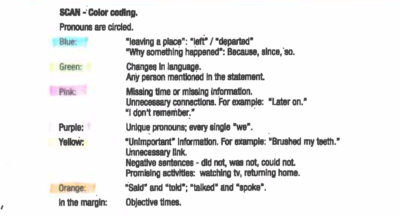
The SCAN course teaches students to diagram, circling pronouns and coloring in a statement with blue, green, purple, yellow, orange and pink. Yellow = “‘Unimportant’ information. For example: ‘Brushed my teeth.’” Pink = “Missing time or missing information. … For example: ‘Later on.’ ‘I don’t remember.’”
To show how SCAN works, Sapir, over the years, has used his invention to analyze statements from public officials and people in the news, including two former FBI directors, Robert Mueller and James Comey.
This year, ProPublica purchased Sapir’s sample analysis of the Mueller report ($2.99, on Kindle).
The report on its first page says the FBI opened an investigation “into whether individuals associated with the Trump Campaign were coordinating with the Russian government.”
“Please note,” Sapir writes: “The report says, ‘whether…’ and not ‘whether or not.’”
“By the omission of ‘or not’ it seems that the FBI was already concentrating on only one option,” Sapir writes.
To grammarians, the use of “or not” in that sentence would be redundant and therefore poor writing. To Sapir, the words’ absence reveals intent.
ProPublica also purchased Sapir’s analysis of Comey’s 2018 memoir, “A Higher Loyalty” ($5, as part of a package deal). A hard copy arrived in the mail with an introductory note from Sapir saying: “Realizing that the analysis of this book has political impact, I decided not to put this analysis on the internet.”
The analysis says: “There are several signals that Comey might be a victim of sexual abuse in childhood.” In the 290-page memoir, Sapir notes 14 instances in which Comey describes the opening or closing of a door, be it to a garage, an office or a minivan. “This activity when it enters an ‘open statement’ is correlated very strongly to child abuse in the speaker’s past,” Sapir writes. “This is due to the fact that child abuse starts when the door opens and it ends when the door is closed.”
Comey sometimes refers to former congressman Anthony Weiner’s computer as a “laptop.” Other times he calls the computer a “computer.” “This is ‘unjustified change of language’ indicating that deception might be present,” Sapir writes.
Twenty times, Sapir writes, Comey used the verb “left.” One time he used the verb “departed.” The ratio — 20 “left” to 1 “departed” — makes the scene with the latter word “quite likely to be deceptive,” Sapir writes. He footnotes this sentence and writes: “[‘Average’ vs. ‘deviation’ = 3 vs. 1 = likely deception; 4 vs. 1 = definite deception].” For these numbers, the footnote provides no source.
A ProPublica reporter emailed Comey, asking to interview him about SCAN and the above analysis of his book.
Comey emailed back: “No comment. Never heard of the alleged tool. (And by using the word ‘never’ in conjunction with the word ‘heard,’ I mean only ‘never heard’ and not to suggest childhood trauma. Yikes.) I’m sorry about your five bucks.”
The color coding key for Scientific Content Analysis, or SCAN. It teaches students to diagram, circling every pronoun and coloring in a statement with blue, green, purple, yellow, orange and pink. (Courtesy of Washington State Department of Fish and Wildlife, in response to a public records request)
Although Sapir has conducted SCAN training for more than 30 years, publicly available photos or video of him can be hard to find. But ProPublica purchased a DVD from LSI (cost, $10) showing Sapir on a local-access television station in Sterling Heights, Michigan, in the early 1990s.
On the show he is interviewed by Pat Lehman, then the city’s community relations director.
Lehman asked Sapir about Anita Hill, who testified in 1991 at the confirmation hearings for then-Supreme Court nominee Clarence Thomas. Hill told a Senate committee that when she worked for Thomas at the U.S. Department of Education, “I had a normal social life with other men outside of the office.”
“Let’s take this sentence,” Sapir told Lehman.
“There is only a certain group in society that can label themselves as normal,” Sapir said. “Only the people who were labeled abnormal before.”
“Oh, oh my goodness,” Lehman said.
Sapir went on.
“I don’t have a certificate that I am normal. I mean, I would imagine you don’t have one,” he told Lehman, who smiled and chuckled, a look of fascination on her face. “Who has a certificate that is normal? Only someone who was abnormal before he was labeled normal.”
“Hmm,” Lehman said.
“Think of it,” Sapir said.
In her Senate testimony, Hill once referred to herself as an “individual.” Another time she referred to herself as a “person.”
“Anita Hill never called herself a woman,” Sapir said on the television program. “Never did, even once.” Sapir wondered if Hill “didn’t have some, I would say, problem with sexual identity.”
Sapir also offered his take on Magic Johnson, who, in 1991, announced he was HIV positive. When interviewed by Connie Chung, Johnson said he contracted the virus while having sex with a woman.
Chung had asked Johnson about rumors that he might be gay or bisexual. Johnson had responded, “But I’m not gay.”
Sapir analyzed this exchange for Lehman. “He said, ‘I’m not gay.’ So let’s go on from there. So, you know, I have a calculator. See I have a calculator? I take two. We punch two. Why do we punch two? Because she said you might be either gay or bisexual. That’s two. And he denied one. Yeah? We deduct one, what is the total?”
“One,” Lehman said.
“The other one,” Sapir said.
“We Deduct One, What Is the Total?”
On a local-access television station, Avinoam Sapir, the creator of Scientific Content Analysis, attached a lot of meaning to a few words from Magic Johnson.
In 2009, in his first days in office, President Barack Obama signed Executive Order 13491, barring federal agents from using waterboarding and similar torture while gathering intelligence. The order also did something else: It created a special interagency task force to study the effectiveness of various approaches to interrogation.
In short, the government wanted to know: Which techniques work? Which ones don’t? In 2010, the research began. A task force, given the unwieldy name of the High-Value Detainee Interrogation Group (acronym, HIG), contracted with “world-renowned, Ph.D.-level scientists” who specialized in interrogation.
Three agencies make up the HIG: the FBI, CIA and the U.S. Department of Defense.
The review devoted just one paragraph to SCAN. Its synopsis was short but withering. SCAN “is widely employed in spite of a lack of supporting research,” the review said. Studies commonly cited in support of SCAN were scientifically flawed, the review said. “When all 12 SCAN criteria were used in a laboratory study, SCAN did not distinguish truth-tellers from liars above the level of chance,” the review said. The synopsis also specifically challenged two of those 12 criteria, noting: “Both gaps in memory and spontaneous corrections have been shown to be indicators of truth, contrary to what is claimed by SCAN.”
In a footnote, the review identified three specific agencies that use SCAN: the FBI, CIA and U.S. Army military intelligence, which falls under the Department of Defense.
Those were the very agencies responsible for this report, concluding there’s no reliable science behind SCAN.
GovSpend.com, which aggregates purchase orders from local, state and federal agencies, turns up four contracts between the Department of Defense and LSI. In 2015, the year before the HIG report, the Defense Department executed two contracts for a combined $97,000 on training from LSI. In 2014, the department spent at least $41,000 on SCAN training, and in 2012, $16,320. There was no competitive bidding, because the training had only one source, according to GovSpend’s data.
A spokesperson at the Pentagon said these contracts were awarded for the Defense Department’s Counter Narcoterrorism Technology Program Office and Counternarcotics and Global Threats Division.
GovSpend’s database is not comprehensive. But it does turn up one contract between the FBI and Sapir’s company. In 2018 — two years after the HIG report, citing the lack of scientific support for SCAN — the FBI spent at least $1,800 for training from LSI. (A public records request for that contract is pending.)
In line with the HIG report, the LSI website says the CIA has received training in SCAN. But when ProPublica submitted a public-records request for those records, the CIA responded that it “can neither confirm nor deny the existence or nonexistence of records responsive to your request. The fact of the existence or nonexistence of such records is itself currently and properly classified.”
The CIA declined to be interviewed about SCAN. “The CIA doesn’t discuss its sources and methods,” spokesperson Chelsea Robinson said. So did the FBI, which issued this statement: “The FBI uses a variety of tools and techniques in the course of our investigations. We consider each case individually and use the appropriate lawful methods. We decline to discuss particular contracts.”
In 2016, the same year the federal task force released its review of interrogation techniques, four scholars published a study on SCAN in the journal Frontiers in Psychology. The authors — three from the Netherlands, one from England — noted that there had been only four prior studies in peer-reviewed journals on SCAN’s effectiveness. Each of those studies (in 1996, 2012, 2014 and 2015) concluded that SCAN failed to help discriminate between truthful and fabricated statements. The 2016 study found the same. Raters trained in SCAN evaluated 234 statements — 117 true, 117 false. Their results in trying to separate fact from fiction were about the same as chance.
“Scientific Content Analysis has no empirical support to date,” the authors wrote in their conclusion. “As a result, we discourage the application of SCAN in its current form.”
One of the four authors was Aldert Vrij, a psychology professor at England’s University of Portsmouth who has published hundreds of articles or book chapters on verbal and nonverbal cues to deception. In 2008, he produced a textbook, “Detecting Lies and Deceit,” in which he devoted a chapter to SCAN. He hadn’t initially intended to, because research on SCAN was scarce and no researcher had strongly recommended its use, Vrij wrote in the book. But what changed his mind was a seminar he gave in the summer of 2006, attended by about 100 criminal investigators from countries that included the U.S., the United Kingdom, Canada and the Netherlands.
He asked the investigators which lie-detection tool they used the most. To Vrij’s surprise, the most frequent answer, “from investigators on both sides of the Atlantic,” was SCAN.
Vrij began putting SCAN to the test. In 2011, he co-authored an article in Law and Human Behavior on an experiment he helped conduct. The participants included 61 students at Israel’s Bar-Ilan University, Sapir’s alma mater, split into three groups. One group’s members committed a mock theft of a statistics exam from a departmental mailbox, then provided written statements, lying about everything they did that day. The members of a second group likewise stole the exam, but lied only about their thievery, while telling the truth about everything else. The students in the third group were innocent. They committed no theft and, in written statements, told no lies.
Coders analyzed the statements using SCAN criteria. Their results failed to discriminate between the three groups. “In sum, no support for the use of SCAN was found in the experiment,” the authors concluded.
Vrij has faulted SCAN for lack of standardization: Different evaluators seize upon different criteria. When asked about this by a ProPublica reporter, Vrij responded by email: “Yes, this is very dangerous because the outcome does not depend so much on the tool but on the person who is using it. Different users therefore can come to different conclusions when assessing the same case.”
One of Vrij’s co-authors on the Frontiers in Psychology article was Glynis Bogaard, now a psychology professor at Maastricht University in the Netherlands. Bogaard, who researched SCAN for her Ph.D. project, attended a training workshop led by Sapir in Ghent, Belgium, in 2010.
During the training, Bogaard said, Sapir never offered any scientific support for SCAN. When she asked for data, Sapir claimed he had it but wasn’t going to publish it. Bogaard recalled one of Sapir’s claims: “He said when people talk about closing and opening doors — this can be your home or car door or whatever — this means you’ve been sexually abused when you were younger. I couldn’t believe my ears.”
The workshop’s other attendees were Dutch and Belgian police officers, who, to Bogaard’s dismay, were much less skeptical. During lunch, she talked to them in Dutch: “Sapir doesn’t speak Dutch, so he couldn’t follow.”
She asked them: “Do you believe all this, do you want to use this?”
“And most of them actually believed what he said. Most of them said, ‘Well, this looks very promising.’”
Bogaard said police who believe in SCAN don’t put much stock in the research challenging its effectiveness, because those studies are performed in a controlled environment; asking someone to make up a story in a lab is one thing, they say, but taking a statement from a suspect in a real crime is another.
Steven Drizin, a Northwestern University law professor who specializes in wrongful convictions, said SCAN and assorted other lie-detection tools suffer from “over-claim syndrome” — big claims made without scientific grounding. Asked why police would trust such tools, Drizin said: “A lot has to do with hubris — a belief on the part of police officers that they can tell when someone is lying to them with a high degree of accuracy. These tools play in to that belief and confirm that belief.”
In 1997, a trial in North Carolina offered a rare example of SCAN making its way into court. A social worker trained in SCAN analyzed a questionnaire filled out by the defendant, a foster mother charged with child abuse. The defendant’s reference to trivial things — for example, “I brushed my teeth” — signaled deception, the social worker testified, according to a story in the Raleigh News & Observer. And the defendant’s reference to “the baby” — instead of “my” baby or using the toddler’s name — indicated child abuse, the social worker testified.
“At times, [the social worker’s] testimony prompted courtroom spectators to roll their eyes,” the news story said.
The foster mother was acquitted.
On its website, LSI lists law enforcement agencies from 49 states, plus the District of Columbia, that have received training in SCAN.
Despite the LSI website’s outdated design and dusty references (cassette tapes? fax machines?), SCAN’s appeal isn’t relegated to some bygone era.
Through public-records requests, ProPublica obtained documents from 40 state and local agencies that have purchased SCAN training, most within the last 10 years. In 2014, the Borough of Madison, New Jersey, spent $2,500 on training for two police lieutenants, two detectives and a sergeant. In 2017, the Franklin County Sheriff’s Office in Ohio paid $999.99 to get training for four detectives. That same year, Louisville police paid $5,000 to train 12 officers, including sergeants and detectives in sex crimes and homicides. In 2018, more than two dozen members of the Michigan State Police attended LSI’s basic or advanced workshop.
Over the years, the agencies that have spent public money to get SCAN training include the Maryland State Police; the Washington State Department of Fish and Wildlife; the Pennsylvania Office of the Attorney General; the prosecutor’s offices in New Jersey’s Middlesex, Morris and Union counties; and local police departments large (Los Angeles) and small (Apple Valley, Minnesota), according to records obtained by ProPublica.
Those 40 departments are just a sampling. ProPublica also submitted records requests to more than three dozen other federal, state and local agencies. Some requests are still pending — for example, the documents pertaining to a $132,500 purchase for SCAN training by the U.S. State Department in 2014. Some were denied because the reporter didn’t live where the records were requested (Tennessee, Alabama). And in one instance, ProPublica refused to pay when the Virginia State Police estimated that its charge for the records would be $35,007.09, which was $34,907.09 more than any other agency wanted.
On occasion, agencies that did provide records redacted attendees’ names. “It is better for the public good not to release the names of the particular people with this specialized skill,” wrote the Middlesex County Prosecutor’s Office in New Jersey. The Pennsylvania Attorney General’s Office also withheld names, saying it can’t identify individuals “performing an undercover or covert law enforcement activity.”
Records that were disclosed included sales brochures from LSI, featuring liberal use of italics, bold letters, multiple fonts and type sizes, all caps and exclamation points. One flyer is emblazoned at the top:
“ATTN: TRAINING OFFICERS AND ALL INVESTIGATORS
Turn every investigator into a ‘walking polygraph’!”
Those who completed the training received a gold-seal certificate, in letters black and blue, in English and Hebrew, with a quote from Deuteronomy: “Then shalt thou inquire, and make search, and ask diligently.”
ProPublica and the Tribune reached out to more than 20 agencies that have received SCAN training. Most declined interview requests or didn’t respond. One exception was Sgt. Mark Miller, who investigates homicides for the Maryland State Police. He received SCAN training last year from Sapir. “He’s a phenomenal teacher,” Miller said. The sergeant called SCAN a “pretty good tool,” which he now uses on occasion. “It’s like cooking,” Miller said. “You might use salt in one dish, in the next you might use salsa.”
Certificate of completion. Those who complete SCAN training receive a gold-seal certificate with a quote from Deuteronomy: “Then shalt thou inquire, and make search, and ask diligently.” (Courtesy of Washington State Department of Fish and Wildlife, in response to a public records request)
ProPublica obtained emails and other written communications of law enforcement administrators touting SCAN internally or to colleagues in other departments. An officer with the Franklin County Sheriff’s Office in Ohio wrote: “Most instructors in this field learned from Mr. Sapir and are 4th or 5th generation students. Mr. Sapir is considered the expert in this field.” A 2017 announcement from the Florham Park Police Detective Bureau in New Jersey said: “We have a couple Officers who took this course years ago and still use the teachings regularly. … This will help you know immediately when someone is being deceptive.”
But when it comes to enthusiasm for SCAN, it would be hard to top the Texas Rangers, one of the country’s most recognizable law enforcement agencies (big hat; western boots; badge above left shirt pocket; fanny packs prohibited). In 2017, Brian Burzynski, a company commander, endorsed SCAN in an email to his fellow majors. He had received the training in 1997 and 1998, attending the advanced course in Avinoam Sapir’s home in Phoenix. The training now being offered was “really, really cheap, especially since Avinoam is teaching the course,” Burzynski wrote, adding: “He is a true master at detecting deception, and his technique is way better than a polygraph.”
“I’ve never attended any course on interview and interrogation that was more useful, accurate, or productive than the LSI SCAN course,” Burzynski wrote.
In December 2017, the Rangers dispatched 26 people to get the training. The registration cost $4,999. Travel expenses added another $10,265.46.
This year, the Rangers sent two more waves. In July, seven Rangers received SCAN training in Austin. One week later, an additional 10 Rangers attended the course in Kingsville. The total cost, including registration and travel, came to about $10,000.
In September of this year, Burzynski was promoted to assistant chief, the Rangers’ No. 2 position.
The Rangers declined to be interviewed but issued a statement about their use of SCAN, saying in part: “The Rangers consider each investigative interviewing technique as a tool in their tool belt, and we believe that our investigations benefit from our Rangers having as many tools as possible at their disposal. Regardless of the techniques employed, the Texas Rangers must independently corroborate the veracity of statements and confessions.”
In Elkhart, Indiana, where Ricky Joyner was convicted of the 1992 murder of Sandra Hernandez, the last officer trained in SCAN retired a couple of years ago, Lt. Travis Snider said. Whether the department would use SCAN again, Snider said, “That’s hard to tell.”
Just south of Elkhart is Kosciusko County; there, Capt. Travis Marsh commands the sheriff’s department’s investigative and patrol divisions.
Marsh told a Tribune reporter that he has used SCAN for almost 20 years.
He received training in 2000 in Indianapolis, along with officers from the Greenwood and Syracuse police departments, the sheriff’s departments for Elkhart, Hamilton and Marion counties, and the Indiana State Police. Also getting the training was a man who worked for National City Bank.
Marsh said he has since performed SCAN analyses in dozens of cases, including robberies, arsons and sexual assaults. More often than not, he said, SCAN pointed him in the right direction.
Once, Marsh said, a sergeant tested him, giving him statements in a burglary case where a victim, suspect and witness were all women. Marsh said he concluded, correctly, that the suspect was a “disgruntled former lover” of the victim. “I had no idea what orientation they were,” Marsh said of the women. “The sergeant was quite surprised.”
Marsh has even applied SCAN at home. Years ago his wife left a note saying she and the kids were off doing one thing, whereas Marsh, analyzing her writing, could tell they had actually gone shopping. His wife has not left him another note in at least 15 years, Marsh said.
Marsh said he understands why some people might be skeptical of SCAN. But he believes in it, just as Steve Rezutko did in the early 1990s.
“You ask me how does SCAN work, I can’t tell you that,” Marsh said. “It really is, for lack of a better term, a faith-based system because you can’t see behind the curtain.”
Katie Zavadski, Alex Mierjeski and Doris Burke contributed to this report.
The most serious nationwide strike to hit France in years caused new weekend travel turmoil on Saturday, with unions warning the walkouts would last well into next week.
The challenge thrown to President Emmanuel Macron over his plans for radical pension reform has seen hundreds of thousands take to the streets and key transport services brought to a standstill.
The strikes, which began on Thursday, have recalled the winter of 1995, when three weeks of huge stoppages forced a social policy U-turn by the then-government.
Unions have vowed a second series of mass demonstrations nationwide on Tuesday after big rallies on Thursday and there is expected to be little easing of the transport freezes over the coming days.
AFP / Philippe LOPEZ Most of the metro lines in Paris are shuttered
The strikes could prove to be the biggest domestic challenge yet for Macron, who came to power in 2017 on the back of promises to radically reform France and has sought a prominent place on the international stage as Europe's number one statesman.
Macron was widely believed to have ridden out the challenge posed by the "yellow vests" whose weekly Saturday protests against inequality in France had shaken the government over the last year.
But the yellow vests have also sought to utilise the momentum of the strike movement and are expected to hold protests across France this Saturday.
- Government stands firm -
With Macron seeking for now to rise above the fray, Prime Minister Edouard Philippe insisted that the government would not abandon the plan even if it was prepared to bring it in more gradually.
AFP/File / Bertrand GUAY Prime Minister Edouard Philippe said the government was prepared to ease in the plan more gradually
He said the government would work with trade unions to introduce a single points-based pension scheme that would require the French to "work a bit longer" and replace dozens of more advantageous plans currently enjoyed by public-sector workers.
But the premier emphasised that the changes, which he said would be unveiled on Wednesday, were going to be introduced "progressively, without harshness".
The SNCF rail operator has warned that disruption at the weekend will be at the same level as the last two days with just 10-15 percent of high-speed and regional trains running.
AFP/File / Zakaria ABDELKAFI The walkout is the latest test of Macron's mettle
The Paris metro will remain severely disrupted with nine lines entirely shut, five only partially and just the driverless 1 and 14 lines working normally.
Many cancellations are also expected on the international Eurostar and Thalys services.
Air travel, which has been less impacted by the strikes, was returning closer to normal with air traffic restrictions now dropped by civil aviation authorities.
- Museums, opera closed -
Tourists in Paris may also face some disappointments: the world-famous Louvre Museum said it could open later Saturday with some rooms closed due to the strikes, while the landmark exhibition of painter El Greco at the Grand Palais was closed.
The Paris Opera has also cancelled its performances over the last days due to the strike.
AFP / Zakaria ABDELKAFI Unions say Macron's proposal for a single pension system would force millions of people to work well beyond the official retirement age
Businesses also feared that the lack of transport would affect shopping activity on a key weekend for the consumer economy just two weeks before Christmas.
The walkout is the latest test of Macron's mettle after months of protests from teachers, hospital workers, police and firefighters, capping a year of social unrest triggered by the yellow vest movement.
Unions say Macron's proposal for a single pension system would force millions of people in both the public and private sectors to work well beyond the official retirement age of 62.
At least 800,000 took part in rallies around the country on Thursday, according to the interior ministry -- one of the biggest demonstrations of union strength in nearly a decade.
AFP / BULENT KILIC While most of the rallies Thursday were peaceful, police fired tear gas to disperse dozens of protesters
Another day of strikes and rallies has been called for Tuesday, a day after union leaders are to meet again with government officials over the pension reform.
While most of the rallies Thursday were peaceful, police fired tear gas to disperse dozens of black-clad protesters smashing windows and throwing stones during the Paris march, with one construction trailer set on fire.
President Donald Trump has called off floated plans to use U.S. military for cross-border incursions into Mexico.
In November, Trump floated the idea, which was blasted as "deranged."
But in a Friday evening news announcement, Trump tweeted he would "temporarily suspend" the plan.
"All necessary work has been completed to declare Mexican Cartels terrorist organizations," Trump tweeted. "Statutorily we are ready to do so. However, at the request of a man who I like and respect, and has worked so well with us, President Andres Manuel we will temporarily hold off this designation and step up our joint efforts to deal decisively with these vicious and ever-growing organizations!"
The two men vying to be British prime minister in next week's election exchanged trademark blows Friday over the familiar faultlines of Brexit and healthcare in the final head-to-head TV debate of the month-old campaign.
In a lacklustre hour-long battle largely devoid of standout moments, Prime Minister Boris Johnson repeatedly criticized Labour leader Jeremy Corbyn's failure to say if he supports Britain leaving the EU while talking up his agenda.
"We have a fantastic plan to get Brexit done," Johnson said, referring to a divorce deal he finalized with EU leaders in October.
"How can you get... a new deal from Brussels for Brexit, if you don't actually believe in it?" he added, referring to Corbyn's vow to remain neutral in a second EU referendum he wants to hold within six months.
The Labour leader is proposing to negotiate a softer form of Brexit to put up against remaining in the bloc in the vote.
He said Johnson's vow to strike trade deals with both the European Union and the United States next year were unrealistic, and that Britain's cherished national health service (NHS) was under threat.
"What he will do is walk out of a relationship with the EU into a relationship with nobody," Corbyn said.
Corbyn has spent the campaign lagging in the polls and was in need of a breakthrough moment, but often found himself on the defensive on Brexit and other issues.
A snap poll by YouGov found the debate, the second head-to-head between the pair, was a draw, but that those questioned found Corbyn more trustworthy.
"Given the Conservatives went into this debate in the lead, they will hope the lack of a knockout blow means they can maintain this until voting day," said Chris Curtis, YouGov's Political Research Manager.
- Unprecedented interventions -
Johnson called the snap election -- the third in Britain in nearly five years -- last month to try to get a parliamentary majority which would enable him to secure backing for his divorce deal.
Voting takes place next Thursday. The Britain Elects poll aggregator puts the Conservatives on 42 percent, Labour on 33 percent and the Liberal Democrats on 13 percent.
The Greens and the arch-eurosceptic Brexit Party were both on three percent.
Ahead of Friday evening's debate former prime ministers Tony Blair and John Major launched unprecedented interventions, calling for people to vote tactically to help ensure a second referendum on Brexit.
Major, a Conservative who was in power from 1990 to 1997, and Labour's Blair, who ousted him and was in Downing Street until 2007, addressed a rally for another poll in London
Both want Britain to remain in the EU.
Major gave his backing to several candidates thrown out of the Conservative ranks for rebelling over Brexit.
"Let me make one thing crystal clear, none of them left the Conservative Party, the Conservative Party left them," he said via video-link.
"Were I resident in their constituency I would vote for them."
Asked about the comments, Johnson insisted his party retained "a very broad spectrum of views" and noted that all Tory candidates had taken a vow to back his deal.
But in a blow to Johnson, a senior British diplomat in the US quit on Friday, criticising the government over Brexit.
- 'Bermuda Triangle stuff' -
Alexandra Hall said she could no longer "peddle half-truths" on behalf of political leaders she did not "trust", according to CNN, which obtained a copy of her resignation letter.
Earlier Friday, Johnson came under fire for avoiding a set-piece television interview that all other major party leaders have already subjected themselves to.
The prime minister has so far declined to undergo an uncomfortable grilling from Andrew Neil, who is one of the BBC's top political interviewers, with less than a week to go until the election.
Former Sunday Times editor Andrew Neil said Johnson faced questions of trust, and it was his job to "scrutinise and hold to account those who would govern us".
Corbyn meanwhile used Friday to unveil leaked documents he said proved Johnson was "deliberately misleading the people" about his Brexit deal.
He said the finance ministry papers suggested there would be customs declarations and security checks between mainland Britain and Northern Ireland, contrary to what he had said.
Corbyn returned to the subject during the debate, while reiterating his claims US President Donald Trump was eyeing the NHS for America's pharmaceutical firms.
But Johnson strongly denied the claims.
"This is pure Bermuda Triangle stuff," he said.
"We'll be hearing about 'little green men' next.
"Under no circumstances will we sell it off to anybody in any kind of trade deal."
Indian police on Friday shot dead four gang-rape and murder suspects, prompting celebrations but also accusations that they were extrajudicial executions.
The men, who had been in custody for a week over the latest rape case to shock India, were shot in the early hours during a re-enactment of the crime organised by police in Shadnagar, outside the southern city of Hyderabad.
"The police brought the accused to the crime spot as part of the investigation. The accused then started attacking the police with stones and sticks and then snatched the weapons and started firing," police commissioner V.C. Sajjanar said.
"The police warned them and asked them to surrender but they continued to fire. Then we opened fire and they were killed in the encounter," he told reporters at the scene, adding that the men had confessed to the crime during interrogation.
Television images showed the shoeless bodies of the suspects still lying in an open field on Friday afternoon, with guns in the hands of two of them.
The four men were accused of gang-raping and murdering a 27-year-old veterinary doctor before setting fire to her body underneath an isolated bridge late on November 27.
In a separate case, an Indian woman died late Friday night after being set on fire, allegedly by men she was en route to give evidence against in court for raping her, according to the PTI newswire.
The victim told police that she was attacked by a group of five men, two of whom had previously raped her, on her way to the hearing in the northern state of Uttar Pradesh.
She died just before midnight following cardiac arrest at a hospital in New Delhi, according to a doctor cited by the newswire. PTI added that she suffered burns over 90 percent of her body.
All five suspects have been arrested and are being questioned, senior policeman Suvendra Kumar Bhagat told AFP.
Showered in petals
A huge backlog of cases in the slow Indian criminal justice means that many rape victims wait years for justice.
Police are often accused of using extrajudicial killings to bypass the legal process to cover-up botched investigations or to pacify public anger.
Several hundred people flocked to the scene of the four men's deaths on Friday, setting off firecrackers to celebrate and showering police with flower petals and hoisting them on their shoulders.
Women distributed sweets and tied Hindu ritual threads on the wrists of policemen to thank them.
Like in the infamous 2012 rape and murder of a woman on a Delhi bus, the case sparked widespread demonstrations and calls for swift and tough justice.
Shortly after the men's arrest, hundreds of protesters also tried to storm the police station where they were held.
At one demonstration in Delhi, some women wielded swords while one lawmaker called for the men to be "lynched" and another for rapists to be castrated.
Many social media users, including politicians, celebrities and athletes hailed their death.
"Great work #hyderabadpolice ..we salute u," top women's badminton player Saina Nehwal tweeted, while fellow badminton star P.V. Sindhu wrote that "Justice has been served!"
Cricketer Harbhajan Singh congratulated police and the state government for "showing this is how it is done(.) no one should dare doing something like this again in future".
And Rajyavardhan Rathore, a former minister and current MP from Prime Minister Narendra Modi's party wrote on Twitter: "Let all know this is the country where good will always prevail over evil".
'State murders'
But lawyer and activist Vrinda Grover told AFP the killings were "absolutely unacceptable".
"Instead of investigation and prosecution the state is committing murders to distract the public and avoid accountability," she said.
India's former federal minister for women and child development, Maneka Gandhi termed the incident "dangerous".
"They would have anyway got hanging for their heinous crime, but you can't just pick up guns and kill people because you want to. Because law is tardy, you can't kill people," Gandhi told reporters.
"To appease public rage over state failures against sexual assault, Indian authorities commit another violation," tweeted Meenakshi Ganguly from Human Rights Watch.
Amnesty International India said the "alleged extrajudicial execution" raised disturbing questions and called for an independent investigation.
Police said a postmortem was completed Friday of the four suspects' bodies, PTI reported.
The state high court directed that a video of the procedure be delivered to a principal district judge and that the bodies be preserved until Monday evening, the newswire said.
The US House of Representatives on Friday threw its weight behind a two-state solution for Israelis and Palestinians, in a warning to Prime Minister Benjamin Netanyahu as he mulls annexing the West Bank.
Passed largely along party lines, the House resolution also marked a shot across the bow to President Donald Trump, who has stood squarely behind Netanyahu.
In its first-ever resolution on a West Bank annexation, the House said that a two-state solution "can both ensure the state of Israel's survival as a Jewish and democratic state and fulfill the legitimate aspirations of the Palestinian people for a state of their own."
The United States should "discourage steps by either side that would put a peaceful end to the conflict further out of reach," the resolution said.
Such steps include "unilateral annexation of territory or efforts to achieve Palestinian statehood status outside the framework of negotiations with Israel," it said.
Representative Eliot Engel, the Democrat who heads the House Foreign Affairs Committee, recalled his longtime support of Israel and how he backed Trump's shift of the US embassy to the disputed holy city of Jerusalem.
But he said, in a choice turn of phrase, US security was being "trumped by decisions about our own political interests."
"Those of us that are strong supporters of Israel understand that Israel is best served by a two-state solution, that a two-state solution is good not only for Palestinians but also good for Jews," Engel said on the House floor.
The two-state solution had enjoyed support from successive US presidents and, until recently, House resolutions on Israel saw little dissent.
Republicans accused the Democrats of improperly intervening in Israeli decision-making and ignoring what they call incitement by the Palestinians.
"The resolution completely ignores the reason why the two-state solution has never gotten off the ground: Venomous voices among the Palestinians don't want two states, they want one -- a Palestinian state," said Republican Representative Steve Chabot.
The resolution "gives the Palestinians a vote over Israel's future. We shouldn't let that happen," he said.
Netanyahu, who is clinging to power after two inconclusive elections and a criminal indictment, has vowed to annex much of the West Bank -- a move that would doom prospects for a Palestinian state.
The Trump administration, whose evangelical Christian base staunchly backs Israel, has not condemned annexation and rallied behind Netanyahu.
In a step that could ease the way for annexation, Secretary of State Mike Pompeo said last month that the United States no longer shared the widely held international position that Israeli settlements in the West Bank are illegal.
Before taking part in a 500,000-strong climate march in Madrid, teen activist Greta Thunberg spoke plainly yet forcefully Friday about the impact the global climate strike movement has had thus far and reiterated the demand of the climate justice movement for global leaders to act with the urgency the planet's ecological emergency mandates.
Speaking to reporters at the cultural center La Casa Encendida in Madrid, Spain—where COP 25 is underway—Thunberg called herself "just... a climate activist—a small part of a big movement" that needs even more activists to effect change.
Global delegates attending the UN Climate Change Conference, Thunberg said, must heed the young marchers' call and commit to real action.
"I sincerely hope that the COP 25 will lead to something concrete and that will lead to also an increase in awareness among people in general." She said she hopes that those in power "grasp the urgency of the climate crisis because right now it doesn't seem like they are."
As such, the global Fridays for Future movement will continue sounding the alarm, said Thunberg.
"I know that we will do everything we can to make sure that this is something that cannot be ignored anymore, that they cannot just hide away anymore," Thunberg said. Some world leaders "are afraid of change," she said, but the status quo must be disrupted.
"Some people want everything to continue like now, and change is what we young people are bringing. And that's why they are trying to silence us. But that is just proof that we are having an impact, that our voices are being heard," Thunberg said, and is the reason powerful opponents "try so desperately to silence us."
Thunberg suggested that COP 25 may be viewed "as a kind of middle year," with next year's COP 26 seen as "the big event."
"But we cannot afford middle years," the Swedish teen said. "We cannot afford more days going by without real action being taken." COP 25, said Thunberg, mustn't be brushed off "because every chance we get to improve the situation we must take."
Speaking more about the school strike for climate actions—which have drawn millions of young people to the streets worldwide—Thunberg said the model is simply not sustainable.
"We have been striking now for over a year and still, basically, nothing has happened," said Thunberg. "The climate crisis is still being ignored by those in power and we cannot go on like this. It is not a sustainable solution that children skip school."
The strikers, Thunberg said, "don't want to continue. We would love some action from the people in power... because people are suffering and dying from the climate and ecological emergency today and we cannot wait any longer."
A lot has been achieved, added Thunberg. "We have have raised public awareness and we have created opinion and that is a big step in the right direction. But of course it's nowhere near enough."
"The CO2 emissions aren't reducing. They are in fact increasing," Thunberg continued, "so of course there is no victory because the only thing we want to see is real action and real action has not been happening. So of course we have achieved a lot," she added, "but if you look at it from a certain point of view we have achieved nothing."
Thunberg and other climate activists brought their demand for climate justice to the streets of Madrid later on Friday, a protest Fridays for Future Germany said showed that "The climate justice movement is bigger and closer than ever."
In a tweet from the march and rally, Thunberg said the marchers may have numbered as many as half a million—a figure echoed by GreenpeaceGermany.




 GETTY IMAGES NORTH AMERICA/AFP/File / Apu Gomes
  AFP/File / Lillian SUWANRUMPHA
  AFP / Sophie RAMIS
  AFP/File / JANEK SKARZYNSKI
  AFP / JANEK SKARZYNSKI
  AFP / JANEK SKARZYNSKI


 AFP / Philippe LOPEZ Most of the metro lines in Paris are shuttered
 AFP/File / Bertrand GUAY Prime Minister Edouard Philippe said the government was prepared to ease in the plan more gradually
 AFP/File / Zakaria ABDELKAFI The walkout is the latest test of Macron's mettle
 AFP / Zakaria ABDELKAFI Unions say Macron's proposal for a single pension system would force millions of people to work well beyond the official retirement age
 AFP / BULENT KILIC While most of the rallies Thursday were peaceful, police fired tear gas to disperse dozens of protesters