Israel's new hard-right defence minister on Sunday ordered officials to start planning a new Jewish settlement in the heart of the divided West Bank city of Hebron.
Naftali Bennett's announcement came as the prospects of a third snap election since April loomed larger, with the minister's New Right party leaning heavily on settlers for support at the polls.
The Defence Ministry said Bennett had instructed departments responsible for the Israeli occupied West Bank "to notify the Hebron municipality of planning a new Jewish neighbourhood in the wholesale market complex".
The market area is on Hebron's once-bustling Shuhada Street, which leads to a holy site where the biblical Abraham is believed to have been buried.
The street is now largely closed off to Palestinians, who have long demanded that it be reopened.
The city is holy to both Muslims and Jews and is a flashpoint for clashes between Palestinians and Israeli settlers.
On Saturday, Israeli forces shot dead a Palestinian southwest of Hebron, with the army saying he was one of three men throwing petrol bombs at a military vehicle.
About 800 Israeli settlers live in the ancient city under heavy military protection, amid around 200,000 Palestinians.
Sunday's statement said the planned new building project would "double the number of Jewish residents in the city".
Senior Palestinian official Saeb Erekat said the new project was a result of the United States' decision last month to no longer consider Israeli settlements illegal.
The Bennett plan, he wrote in English on Twitter, "is the first tangible result of the US decision to legitimise colonisation."
The move comes amid political turmoil in Israel after general elections in April and September ended in deadlock.
Neither Prime Minister Benjamin Netanyahu and allies like Bennett, nor their opponents, won enough parliamentary seats to form a viable coalition.
Lawmakers now have until December 11 to find a solution or see parliament dissolved once again.
At Sunday's weekly cabinet meeting, Netanyahu also offered good news for the settlers, pledging 40 million shekels ($11.5 million) for improved security.
"We are strengthening the security components in the communities in Judea and Samaria, of the Israeli citizens there," he said, using the biblical terms for the West Bank.
Israel's West Bank settlements are considered illegal under international law and are bitterly opposed by Palestinians.
Angela Merkel faces a rocky political road ahead as she battles to hang on until 2021 as German chancellor, after her junior coalition partner SPD elected a left-leaning leadership duo.
Rank and file Social Democrats late Saturday delivered a humiliating blow to Finance Minister Olaf Scholz's run for co-chair of his centre-left party, picking instead two relative unknowns as their new leaders.
The shock result heralded a week of uncertainty for the coalition, with next Friday a key date as the SPD is to vote on whether to stay in government when it meets for its annual congress.
Merkel, in power for 14 years, has said she would step down when her term ends in 2021.
But her departure may well be accelerated following Saturday's stunning vote.
- 'Unacceptable conditions?' -
Wounded by an election rout in 2017, the SPD had initially sought to go into opposition, but allowed itself reluctantly to be coaxed into renewing an alliance with Merkel.
Many within the party however remained wary of continuing to govern in Merkel's shadow, fearful that their social roots were being eroded by the conservatives.
The uneasy marriage from the start had left the coalition lurching from crisis to crisis.
A new series of regional and European electoral defeats had finally forced the SPD to seek a new leadership.
AFP / Odd ANDERSEN Merkel, in power for 14 years, has said she would step down when her term ends in 2021
Saturday's decision against Scholz is a "solid vote of no-confidence against the party establishment", said left-leaning TAZ daily.
"Within the SPD, it is believed that an exit from the GroKo is very possible" with the new leaders Nobert Walter-Borjans and Saskia Esken, added Bild daily.
Even if an immediate collapse of the government was averted, there is the "possible scenario that (the Social Democrats) would set unacceptable conditions to prepare an exit," added the newspaper.
The SPD's new leaders have already said they will push Merkel's centre-right alliance for greater investments in climate protection.
They have also questioned the "black zero" no new debt policy -- an absolute red line for Merkel and her centre-right alliance.
"If the two parties cannot agree on the further tilt of German policies to the left which the SPD activists desire, the coalition would end," noted Holger Schmieding, analyst at Berenberg.
- 'Minority government?' -
That would leave Merkel with the option of a minority government.
Merkel has repeatedly ruled out the option, but right-leaning Welt daily noted that this time round, the conditions were "not so bad" since 2020's budget has already been decided.
Ministerial posts vacated by SPD ministers could then be taken up by her conservative alliance.
Her planned successor Annegret Kramp-Karrenbauer could also assume the deputy chancellor role and potentially steer Germany as it takes on the presidency of the EU from next June, added Welt.
For now, party heavyweights on both sides have urged calm.
AFP / Odd ANDERSEN Rank and file Social Democrats delivered a humiliating blow to Finance Minister Olaf Scholz's run for co-chair of his centre-left party
CDU general secretary Paul Ziemiak stressed that "nothing has changed" in terms of the coalition deal between both sides.
Leading voices in his party have also underlined the responsibility of keeping the government stable.
The SPD's former chief Martin Schulz meanwhile warned his party against flight from the government.
"My advice is that the cure is not to seek an escape from the government, rather it lies in the power to shape things in the government," he told Tagesspiegel daily.
Google caught Prime Minister Boris Johnson's party attempting to deceive British voters ahead of the December 12th general election, according to a new report in The Independent.
"Google has banned eight different adverts paid for by the Conservatives over the last month because they broke its rules, The Independent can reveal. The move by the search giant comes amid mounting concerns about the Tories’ use of disinformation and fake news as campaigning tools at the general election," the newspaper reported.
"Six of the banned adverts were put up by the Tories on the day of the Labour manifesto launch – when the Conservative Party set up a fake website called labourmanifesto.co.uk purporting to contain the opposition’s policies," the newspaper reported. "During that incident, the Tories paid Google to push its fake version of the Labour manifesto to the top of search results for those searching for the deal document."
That was not the only deception scheme the party was caught running.
"That incident followed another earlier in the week in which the Tories set up a fake fact-checking service, which they used to pump out party lines from their press office to unsuspecting social media users," The Independent reported.
Labour Party Chair Ian Lavery blasted the tactics.
“The fact that the Conservatives are resorting to fake news shows that they have no plans or desire to improve the lives of people in Britain,” he charged. “While Labour is running the biggest, people-powered campaign for real change in a generation, the Tories are relying on cynical and dishonest tactics."
The Google ads did not occur in isolation.
"Other than the Google ads and the fake fact-checking service, the Tories have been criticised for other uses of disinformation or fake news. The latest scandal on Friday erupted after it emerged the party had edited footage of BBC reporters to make it look like they were endorsing Tory attack-lines about a “Brexit delay”. The party was also previously criticised for doctoring a video of Labour Brexit chief Keir Starmer. On another occasion, a candidate in a marginal seat was caught on camera setting up a fake encounter with a swing voter to try and deceive a journalist," The Independent explained.
While on vacation at Mar-a-Lago, President Donald Trump attacked Democrats for the impeachment inquiry into his solicitation of foreign election assistance.
"I will be representing our Country in London at NATO, while the Democrats are holding the most ridiculous Impeachment hearings in history," Trump argued
"Read the Transcripts, NOTHING was done or said wrong," Trump argued, despite the fact the transcript revealed him soliciting foreign election assistance in violation of federal law.
The scheme was also confessed on national TV by White House acting chief of staff Mick Mulvaney and Trump's defense attorney, Rudy Giuliani.
"The Radical Left is undercutting our Country. Hearings scheduled on same dates as NATO," Trump complained.
Prime Minister Boris Johnson vowed Saturday to review Britain's sentencing system after a convicted terrorist released early from prison stabbed two people to death and injured three in a London Bridge attack.
Members of the public have been hailed as heroes for preventing even greater loss of life by tackling Usman Khan -- one armed with a five-foot (1.5-metre) narwhal tusk and another with a fire extinguisher -- before police shot him dead.
Video footage of the confrontation showed Khan, 28, being challenged by a man, reportedly a Polish chef, wielding the tusk -- believed to have been grabbed from the historic hall where the stabbings began -- as another person sprayed him with the extinguisher.
Khan had been conditionally released from jail last December after serving less than half of a 16-year prison sentence for terrorism, and was wearing a fake explosive device.
On Saturday, the Islamic State group released a statement claiming responsibility for the attack.
"The person who carried out the London attack... was a fighter from the Islamic State, and did so in response to calls to target citizens of coalition countries," IS said, referring to a multi-country alliance against the group.
The incident comes two years after Islamist extremists in a van ploughed into pedestrians on London Bridge before attacking people at random with knives in nearby Borough Market.
On that occasion, eight people were killed and 48 wounded before the three attackers, who were wearing fake suicide devices, were shot dead by police.
Metropolitan Police Assistant Commissioner Neil Basu said five people had been stabbed in all inside Fishmonger's Hall before members of the public pursued the attacker onto London Bridge. The three survivors remain in hospital.
Basu added that Khan had been released under "an extensive list of licence conditions" with which he had previously been complying.
Police on Saturday searched two properties in Stoke-on-Trent, Khan's home city, and Stafford in central England.
The latest attack came less than two weeks before Britain's general election, and politicians temporarily suspended campaigning.
"It does not make sense for us as a society to be putting people who have been convicted of terrorist offences... out on early release," Johnson, who became Tory leader in July, said as he visited the scene.
"We argue that people should serve the tariff, serve the term, of which they are sentenced," the prime minister added, noting the Conservatives' manifesto called for a tougher sentencing regime.
'Bundle him to the ground'
Johnson spoke hours before the first victim of the attack was named as Jack Merritt, a course coordinator at Cambridge University's criminology institute, according to media reports.
The institute hosted a prisoner rehabilitation event at Fishmonger's Hall, a historic building on the north side of the bridge. Khan attended the event reportedly armed with two knives and the fake suicide vest.
As the confrontation moved from inside the hall to the pavement outside, a throng of people could be seen in videos grappling with Khan.
They reportedly included a convicted killer on day-release from prison and other ex-offenders also attending the criminology gathering.
Tour guide Stevie Hurst told BBC radio: "Everyone was just on top of him trying to bundle him to the ground.
"I saw that the knife was still in his hand so I just put a foot in to try and kick him in the head," he said.
A British Transport Police officer in a suit and tie who also intervened was seen carrying a large knife away.
"As we saw the worst of human kind, we saw the very best of human spirit and London," Met Commissioner Cressida Dick said Saturday as she visited London Bridge.
'Enduring thanks'
Khan, a British national, was handed an indeterminate sentence for the protection of the public in 2012, with at least eight years in prison.
He was part of an eight-man network inspired by Al-Qaeda who had plotted to bomb targets including the London Stock Exchange, and planned to take part in "terrorist training" in Pakistan.
But his sentence was quashed by the Court of Appeal in April 2013 and he received a new 21-year term, comprising a custodial sentence of 16 years and five years on conditional release.
Inmates are usually released half-way through this type of determinate sentence -- and time spent in custody before trial may have been taken into account.
The Parole Board said it had no involvement in his release and that it appeared to have happened automatically as required by law.
Johnson, who took over as prime minister in July, said the cases of other convicted terrorists released early were under urgent review.
Queen Elizabeth II expressed her "enduring thanks" to the "brave individuals who put their own lives at risk to selflessly help and protect others".
Dutch police arrested a homeless man on Saturday over a knife assault in a busy shopping street in The Hague which three teenagers were wounded.
The 35-year-old suspect was detained in the centre of the city a day after the stabbing which caused panic as shoppers hunted Black Friday bargains.
Police had earlier said they were investigating "several scenarios" and that it was "too early to speculate" about whether there was a possible terror motive.
The attack happened just hours after a terror suspect stabbed two people to death in London.
"Following the stabbing incident in Grote Marktstraat, a 35-year-old man has just been arrested in the centre of The Hague. The man has no fixed place of residence," police said on Twitter.
"He will be transferred to a police station where he will be questioned."
The victims were a 13-year-old boy and two 15-year-old girls, none of whom knew each other, police said. They were all treated in hospital but released overnight.
The male attacker ran off after the stabbings at a department store in the city centre, triggering a huge manhunt involving police helicopters.
Images on social media showed shoppers running in panic away from the scene, on a nighttime retail street lit by Christmas fairy lights.
Two teenage girls came running into the store after being stabbed, broadcaster NOS quoted witnesses as saying.
- 'Screaming and running away' -
"I saw two girls screaming and running away. A man fled. He jumped very athletically over benches to get away. He looked like a cheetah," one witness told NOS.
"People were trying to get away. but that didn't work. I was shocked."
Police forensics officers were seen examining a knife found at the scene overnight.
"It's a little too early to speculate about that kind of thing," police spokeswoman Marije Kuiper told AFP earlier when asked about a possible terrorist motive, adding that investigators were still looking at several possible scenarios.
AFP / AFP Stabbing attacks
The stabbing took place not far from parliament, which is the seat of government for the Netherlands and home to many international organisations and courts.
In Britain, two members of the public were killed in a stabbing on London Bridge in the heart of the capital on Friday.
The Netherlands has seen a series of terror attacks and plots, although not so far on the scale of those in other European countries.
In March four people were killed when a Turkish-born man opened fire on a tram in the city of Utrecht.
In August 2018 an Afghan man stabbed and seriously wounded two American tourists at Amsterdam's central station, saying he wanted to "protect the Prophet Mohammed".
He was jailed for 26 years in October this year.
Earlier this month a Pakistani man was sentenced to 10 years in jail for a plot to kill far-right Dutch politician Geert Wilders.
Martha Mendez and Susana Duenas were both teenagers when they committed their "crime": suffering a miscarriage.
Accused of having an abortion -- which is illegal in all but two states in Mexico -- Mendez was forced to ask her fetus for forgiveness. Duenas was jailed for seven years.
Both women's stories highlight the extreme views on abortion in Mexico, where the ruling party's push to legalize it nationwide has run into fiery resistance from conservatives.
Mexico City legalized abortion in 2007, followed by the southern state of Oaxaca this year.
But the procedure is outlawed in the other 30 Mexican states, permitted only in cases of rape or danger to the mother's life.
The situation is similar across much of traditionally Catholic Latin America, where just two countries, Cuba and Uruguay, have legalized abortion.
In Mexico, more than 4,200 women have been prosecuted since 2000 for having an abortion or miscarriage, according to Veronica Cruz of the rights group Las Libres (Free Women).
Prosecutions increased after abortion was legalized in the capital, in a case of widespread backlash in more conservative states, says Cruz.
"After Mexico City decriminalized abortion, the number of criminal cases shot up. But the worst thing isn't the justice system, it's the public hospitals, where medical personnel call the police if they suspect a woman of having an abortion," she told AFP.
Leftist President Andres Manuel Lopez Obrador's party has introduced a bill to decriminalize abortion nationwide for up to 12 weeks of pregnancy.
But it has stalled in Congress over conservative opposition, and Lopez Obrador -- who heads a broad and fragile coalition that spans the spectrum from veteran leftists to evangelical Christians -- has not pushed to move it forward, instead calling for a referendum on the issue.
- Poor and innocent -
Duenas, a 38-year-old janitor, comes from an impoverished area in the central state of Guanajuato.
At 19, she stopped having her period. But, having never received sex education of any kind, she did not realize she was pregnant.
"I was sleeping, and suddenly I felt like something was detaching from me," she said.
She went to the hospital, where a social worker told her she had just suffered a miscarriage. The woman accused her of provoking it on purpose.
"You had a baby. You threw it away, you killed it," Duenas remembered her saying.
She was arrested and taken to a police station, where an officer "took out a big crucifix and told me, 'Confess to him what you did,'" she said.
She was told to sign a piece of paper. She said it was blank at the time. Prosecutors later presented it in court as her confession.
She was convicted of homicide and sentenced to 25 years.
Duenas described her experience in prison as "hell." Her guards and some fellow inmates called her a "murderer."
But others put her in touch with Las Libres, which took on her case and managed to get her released.
While in prison, she got pregnant again, with another inmate she met at a theater workshop. Her baby daughter, born in prison, was sent to live with an aunt.
Now 12 years old, the girl calls her aunt "Mommy" and does not want to live with Duenas.
"I've lost all hope that she'll come back to me," Duenas said, sobbing.
- Forced apology -
Mendez was 18 and studying at a university in the eastern city of Veracruz when she realized she was pregnant.
She and the father had just broken up.
Two days later, she started bleeding and went to the hospital, where she miscarried.
"A nurse came with the dead fetus and put it in my face. 'Ask his forgiveness. You killed him,' she said. You end up thinking you did something wrong," Mendez says through tears.
The hospital gave the fetus a name and made Mendez give him a "Christian burial." Then she was arrested.
Las Libres managed to get her released.
But her story came out in the local tabloid press, and strangers would stop her on the street and call her a "murderer."
Las Libres helped her move to the central city of Leon, find a job and continue her studies.
Raised a Catholic, today she accompanies women who are having an abortion.
"I help them so they won't be mistreated the way I was," she said.
A Roman Catholic bishop went on trial in southern India on Saturday accused of repeatedly raping a nun.
Franco Mulakkal arrived in court in Kottayam, Kerala state, with a group of supporters after attending morning prayers.
While the Catholic church has been rocked by sexual assault and abuse cases in many countries, Mulakkal is the first Indian clergy to go on trial.
The bishop is charged with raping the nun several times between 2014 and 2016, while head of the Missionaries of Jesus order.
Mulakkal did not immediately make a plea in court but he has denied the accusations in the run-up to the trial. He faces a maximum sentence of life in jail if found guilty.
The bishop was arrested in October last year and granted bail. On Saturday, the court extended his bail until the next scheduled hearing on January 6.
Kerala police have filed a report of more than 100 pages on the case that included statements from nuns, priests and other bishops.
The nun filed a complaint in June last year but police only started investigating three months later, after five nuns staged near daily protests outside the state high court.
The nuns wrote to Catholic leaders in India as well as the Vatican, accusing the church hierarchy of failing to take the case seriously.
The nuns were criticized by many within the church and said their families were harassed.
Forty years ago, on Nov. 30, 1979, the English progressive rock band Pink Floyd released its 11th studio album, “The Wall.”
Featuring 26 tracks, two records and an opera-esque story line, the concept album would go on to become the number two bestselling double album in history. But it would also mark the last time Pink Floyd’s core members – Roger Waters, David Gilmour, Nick Mason and Richard Wright – would record an album together.
Years of touring and financial stress had taken their toll. The egomania of one member, Waters, during the recording of “The Wall” would be the tipping point.
Tensions mount
The unchecked egos of band members can often be difficult to rein in, and often lead to acrimony – to the point where the band breakup has almost become a cliche.
Tensions between the four members of The Beatles – John Lennon and Paul McCartney, in particular – famously led to the band’s breakup in 1970. Conflict between guitarist Johnny Marr and vocalist Morrissey triggered Marr’s decision to leave The Smiths. And let’s not forget The Eagles, which broke up on such bad terms that drummer and vocalist Don Henley said the band would reunite “when hell freezes over.”
By the time Pink Floyd started recording “The Wall” in January 1979, tensions had been simmering for years.
“The Dark Side of the Moon,” released in 1973, had catapulted Pink Floyd to superstardom. But the band members struggled over how to build off the success of “Dark Side” and make another hit album.
They had already fought among themselves when recording their follow-up albums, 1975’s “Wish You Were Here” and 1977’s “Animals.”
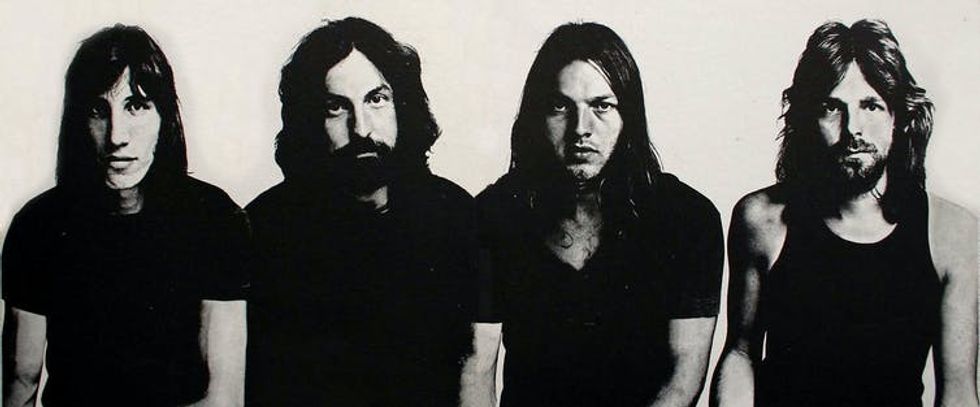
From left to right: Roger Waters, Nick Mason, David Gilmour and Richard Wright.
Roger Waters, the band’s bassist and co-lead singer, took charge for “Wish You Were Here.” He decided which tracks would appear and essentially dictated the album’s conceptual themes, which included alienation, a critique of the music industry and a tribute to former bandmate Syd Barrett, who had left the band in 1968 due to mental health struggles.
In the process, Waters ended up cutting the songs “Raving and Drooling” and “Gotta be Crazy” against guitarist and co-vocalist David Gilmour’s wishes.
“Dave was always clear that he wanted to do the other two songs,” Waters recalled. “He never quite copped what I was talking about. But Rick did and Nicky did, and he was outvoted so we went on.”
Perhaps feeling suffocated by Waters, Richard Wright and David Gilmour took a stab at solo albums in 1978, with Wright releasing “Wet Dream” and Gilmour debuting the self-titled “David Gilmour.”
Reflecting on his first solo album, Gilmour said, it “was important to me in terms of self respect. At first I didn’t think my name was big enough to carry it. Being in a group for so long can be a bit claustrophobic, and I needed to step out from behind Floyd’s shadow.”
The shadow of ‘The Wall’
“The Wall” would be the band’s next project – and, again, Waters asserted control.
Waters was partly inspired by an infamous incident that took place during the In the Flesh tour, which promoted the album “Animals.” Annoyed by the sound of firecrackers – and feeling as if the crowd wasn’t listening to their music or lyrics – Waters spat on the audience. He later mused about building a wall between him and his fans. The seed for “The Wall” was planted.
In July 1978, he presented a 90-minute demo to the rest of the band, proposing two concepts for the next album: “Bricks in the Wall” and “The Pros and Cons of Hitch Hiking.”
The band members agreed to make an album focused on the first of the two. It would be about the struggles and isolation of rock stardom, and its central character would be named Pink Floyd.
The name of the character belied the fact that this would largely be a one-man show. As musicologist Allan F. Moore observed, “Waters’ growing megalomania, much in evidence on ‘The Wall,’ became harder to handle.”
The fact that the album’s central story was semi-autobiographical, based on Waters and former band member Syd Barrett, probably didn’t help matters. The motif of walls symbolized the defense mechanisms Waters had built up against those who might hurt him – parents, teachers, wives and lovers. Some lyrics deal with the death of his father, others with infidelity.
If David Gilmour had ideas for ways to contribute to Waters’ vision, they were barely incorporated. Waters did include fragments from demos associated with Gilmour’s solo projects. But in the end, Gilmour only received three co-writing credits – for “Run Like Hell,” “Young Lust” and “Comfortably Numb.” Drummer Nick Mason and keyboardist Richard Wright didn’t receive any at all.
‘Young Lust’ is one of only three songs that David Gilmour received credits for.
On the track “Mother,” Waters even brought in Toto drummer and session percussionist Jeff Porcaro to replace Mason. On Mason’s limited drumming abilities, Roger Waters recalled:
“It’s got 5/4 bars in it. Nick, to his great credit, has no pretense about that, it was clear that he could not play it. He said ‘I can’t play that.’ Or maybe somebody said to him, ‘Nick, maybe you should get somebody else to play this because you’re struggling.’”
Keyboardist Richard Wright left, only to return later as a salaried sideman during Pink Floyd’s tours in 1980 and 1981. Pink Floyd – minus Wright – went on to record its 1983 album, “The Final Cut.” Waters eventually quit Pink Floyd in 1985 and sued members Gilmour and Mason in an attempt to stop them from using the band name, arguing that Pink Floyd was “a spent force creatively.”
Waters lost, and Gilmour and Mason went on to record three more albums under the name Pink Floyd: 1987’s “A Momentary Lapse of Reason,” 1994’s “The Division Bell” and 2014’s “The Endless River.”
None would match the critical or commercial success of “The Wall.”
The making of “The Wall” reflects a common experience faced by many other rock bands – how creative tension and competing visions can deteriorate relations between band members.
Luckily, Pink Floyd was able to keep it all together to record one final masterpiece.
Bolivia's interim government will file a case in The Hague against former president Evo Morales for "crimes against humanity," the interior minister announced Friday.
The government will file the lawsuit "in the next few days," the minister, Arturo Murillo, told state radio Patria Nueva.
The International Criminal Court sitting in The Hague has jurisdiction to prosecute individuals for crimes against humanity.
Murillo last week filed a criminal complaint in Bolivia accusing Morales of sedition and terrorism, after he allegedly called on supporters to blockade cities and cut off fuel and food supplies.
The ex-president "must answer to justice for what he has done, and is doing, in addition to his accomplices who have participated in the tragic events that Bolivians have experienced," Murillo said.
If Morales -- who fled to Mexico after resigning on November 10 -- were charged and convicted in a Bolivian court, he would face a maximum penalty of 30 years in jail.
Morales has in turn accused the interim government of "genocide" following the deaths of 32 people, mostly his indigenous supporters, in post-election violence.
Morales denied wrongdoing and said he was being persecuted for leading a pro-poor, pro-indigenous government and nationalizing the country's gas and other natural resources.
Congress last week gave a green light for a new vote without Morales, Bolivia's first indigenous president. He had been seeking a fourth term after nearly 14 years as leader of the poor but resource-rich country.
Meanwhile, Murillo expressed concern over the presence in the country of an Argentine human rights group.
"We recommend these foreigners who are arriving....to be careful," said Murillo. "We are looking at you. We are following you," he said in the radio interview.
"There is no tolerance for terrorism, sedition or armed movements. Zero tolerance," he said.
The Argentine rights delegation tweeted: "While the de facto government accuses us of being terrorists, we have started what we came to do, take testimony of the different human rights violations that the Bolivian people are enduring."
Germany's far-right AfD party will elect new leaders on Saturday, with its increasingly influential radical wing seeking to tighten its grip on the group after a series of electoral victories.
The anti-migrant party's extremists have the upper hand following a series of electoral gains in eastern regions in September and October that have caused widespread domestic and international consternation.
Underlining the polarising effect the party has on Germany, up to 12,000 protesters are expected to gather outside the congress hall in the city of Braunschweig to demonstrate against what they call a racist party.
On Friday night around a thousand protesters, all dressed in black, marched through the center of the city, heeding the call of an anti-fascist group.
Volkswagen, whose name is on the hall used by the AfD, has requested for its logo to be covered up.
Within the hall, tensions are also set to run high as 78-year-old Alexander Gauland is expected to step down from his co-chairman role, while 58-year-old Joerg Meuthen is set to defend his seat against a challenge from party radicals.
Bjoern Hoecke, the leader of the radical Fluegel ("Wing"), has not directly put forward his name for Gauland's spot.
But anyone seeking the post would have to get the backing of his faction, which is known for its criticism of Germany's culture of remembrance.
One likely candidate who might please all sides is Tino Chrupalla, a 44-year-old MP and former house-painter from the eastern state of Saxony.
Chrupalla, who met with former Donald Trump advisor Steve Bannon in Berlin earlier this year, can count on the support of Hoecke's Fluegel.
At the same time, Gauland has also tacitly given him his backing by pledging to stand aside if Chrupalla went for his post.
- Compromise candidate -
The AfD, which was only established six years ago, is riven with personal and ideological rivalries.
Yet Chrupalla is widely seen as the compromise candidate, palatable to the party's moderates and radicals alike.
His main challenger will be fellow AfD MP Gottfried Curio, a fiery orator whose parliamentary speeches have made him a far-right social media star.
Chrupalla has presented himself as a more serious candidate, but he too has prompted outrage with his rhetoric.
Last month, he was booed in parliament after accusing Chancellor Angela Merkel of treating her voters as "underlings" with "micro-aggressions against everything German".
He has also called the "Islamisation of the West" a "reality", saying that one could qualify it as a replacement of the population.
Unlike most German MPs, Chrupalla does not hold a doctorate, and has railed against perceived intellectual snobbery in Germany's political class.
He is also seen as a representative of the former East Germany, where the AfD took over 20 percent of the vote in three recent state elections.
Hoecke recently described Chrupalla as "one of the AfD's great representatives in the East".
Meanwhile one of the Fluegel's number, 49-year-old MP Nicole Hoechst, is now also plotting to unseat co-leader Joerg Meuthen, according to reports in the Welt and Taz newspapers.
Meuthen, a university professor from western Germany, represents the more moderate wing of the party.
- Protests -
With 91 MPs, the AfD is now the third political force in the German parliament after the CDU and SPD.
But its support in opinion polls has stagnated at around 13 to 15 percent.
The AfD started out as a eurosceptic party but became increasingly anti-migrant and opposed to Merkel after the chancellor welcomed around one million asylum-seekers in 2015 and 2016.
Mainstream parties have refused to work with the AfD and therefore prevented it from holding executive power on a national or regional level.
"The Wing" in particular has drawn scrutiny as it has attacked one of the foundation stones of Germany's post-war political culture -- atonement for its Nazi past.
Hoecke notoriously described Berlin's Holocaust Memorial as a "memorial of shame", while his colleague Andreas Kalbitz has been accused of association with neo-Nazi organisations.
Such accusations have failed to frighten off voters, but they have drawn the attention of the secret services to the party's activities.
A man suspected of stabbing two people to death in a terror attack on London Bridge was an ex-prisoner convicted of terrorism offences and released last year, police said on Saturday.
The knifeman, wearing a suspected fake suicide vest, was shot dead by police after Friday’s daylight assault that also saw bystanders intervene to try and disarm him.
Three more people were wounded in the stabbing spree that came less than two weeks before Britain votes in a general election, and revived memories of a three-man attack two years ago on London Bridge that killed eight.
Police named the suspect as 28-year-old Usman Khan, saying they were not actively seeking others in relation to the incident.
“This individual was known to authorities, having been convicted in 2012 for terrorism offences. He was released from prison in December 2018 on licence,” Neil Basu, head of UK counter-terrorism policing, said in a statement.
In 2012 Khan, from Stoke in central England, was jailed along with eight others in a terrorist group inspired by al-Qaeda that had plotted to bomb targets including the London Stock Exchange.
He was sentenced to a minimum of eight years in prison and was also found guilty of making longer-term plans including taking part in “terrorist training” in Pakistan.
Basu said Khan had attended an event on Friday afternoon at Fishmonger’s Hall, a historic building on the north side of the bridge in the centre of the capital.
“We believe that the attack began inside before he left the building and proceeded onto London Bridge, where he was detained and subsequently confronted and shot by armed officers,” he said.
Footage filmed by eyewitnesses and shared on social media showed a scrum of people tackling the suspect on the ground before the police arrived.
One man, wearing a suit and tie, was seen carrying a large knife away from the group.
Tour guide Stevie Hurst, who ran from his car to the scene, told BBC radio that “everyone was just on top of him trying to bundle him to the ground”.
“I saw that the knife was still in his hand so I just put a foot in to try and kick him in the head: we were trying to do as much as we could to try and dislodge the knife,” he said.
‘Targeted by terrorism’
Metropolitan Police chief Cressida Dick said she was “deeply saddened and angered that our city has again been targeted by terrorism”.
The attack took place just hours before three minors were stabbed in a main shopping street in the centre of Dutch city The Hague, with the victims later released from hospital.
It was not immediately clear if the two incidents were linked.
UK Prime Minister Boris Johnson, who is hoping to win a majority in a December 12 election to enable him to take the country out of the European Union, praised the emergency services and the public for their response.
Before chairing a meeting of the government’s emergencies committee, said he had “long argued” it was a “mistake to allow serious and violent criminals to come out of prison early”.
Johnson’s Conservatives and the main opposition Labour party have both pledged to put at least 20,000 more police officers on the streets.
But Brexit has raised questions about the extent of continued cooperation with Europe on security and intelligence matters.
Hoax device
Basu said Khan had been living in the Staffordshire region of central England and officers were searching an address in that area.
During the attack, he had been wearing an electronic tag used to monitor criminal offenders, according to a report in British newspaper The Times.
He also had equipment strapped to his body that police said they believed to be a “hoax explosive device”.
The event at Fishmonger’s Hall was called ‘Learning Together’, Basu said - part of a project run by academics at the University of Cambridge’s criminology institute.
Vice-Chancellor Stephen Toope said he was "devastated" that the university’s staff, students and alumni may have been targeted in the attack.
Later on Friday London Bridge remained closed, with evacuated buses at a standstill and forensics officers at the scene.
A White House spokesman said President Donald Trump had been briefed on the attack and was monitoring the situation.
Trump, who has previously criticised London’s mayor and stabbings in the British capital, is due to visit next week for a NATO summit.
On November 4, Britain downgraded its terrorism threat level from 'severe', the second-highest of five levels, to 'substantial' - the lowest rating in more than five years.
The 2017 London Bridge attack involved Islamist extremists in a van who ploughed into pedestrians on the bridge before attacking people at random with knives in nearby Borough Market.
Eight people were killed and 48 wounded. The three attackers, who were wearing fake suicide devices, were shot dead by police.
Labor rights activists and climate campaigners across Europe used the occasion of Black Friday, the busiest shopping day of the year, to call attention to and protest Amazon's "appalling" working conditions, paltry benefits, and destructive environmental practices.
"Workers are breaking bones, being knocked unconscious, and being taken away in ambulances," said Mick Rix, national officer with the GMB Union, which organized demonstrations at Amazon warehouses across the United Kingdom on Friday.
"Amazon has spent a fortune on fluffy adverts saying what a great place it is to work," Rix added. "Why not spend the money making their warehouses less dangerous places to work? Amazon workers want Jeff Bezos to know they are people—not robots."
GMB said Amazon employees at locations throughout the U.K. have reported being denied restroom breaks, penalized for taking sick days, and forced to work at a dangerous pace to meet the retail behemoth's productivity goals.
"GMB members report targets being so horrific they have to use plastic bottles to urinate in instead of going to the toilet, and pregnant women have been forced to stand for hours on end," the union said in a statement.
In France, demonstrators held sit-ins at Amazon's Clichy headquarters to condemn the retail giant's contributions to the climate crisis.
"We criticize Amazon for having a destructive policy for the planet, for social conditions, and Black Friday allows this company to achieve exponential revenue," said activist Sandy Olivar Calvo.
At an Amazon distribution center near Lyon, France, police assaulted and forcibly removed demonstrators who staged a sit-in to condemn the corporation's climate practices:




 AFP / Odd ANDERSEN Merkel, in power for 14 years, has said she would step down when her term ends in 2021
 AFP / Odd ANDERSEN Rank and file Social Democrats delivered a humiliating blow to Finance Minister Olaf Scholz's run for co-chair of his centre-left party
 AFP / AFP Stabbing attacks