On Tuesday, National Security Advisor John Bolton was ousted from the Trump administration.
"John Bolton was always an odd fit to be U.S. President Donald Trump's national security adviser: a conservative hawk who advocated for regime change in North Korea and Iran, supported the Iraq war and favored a tough stance toward Russia," Reuters reported Tuesday. "The mustachioed hard-liner's efforts to add bite to the bark of U.S. foreign policy met stiff resistance from a White House leery of foreign entanglements and came to an abrupt halt on Tuesday when Trump announced he had fired him."
Bolton did have one major success, getting Trump to end the nuclear deal with Iran.
"Bolton became national security adviser on April 9, 2018 and the next month Trump abandoned the Iran deal, meeting a promise he had made as a presidential candidate, which other wary West Wing advisers had persuaded him to put off," Reuters noted.
Trump should have known Bolton would not be a good pick, as Bolton was never shy about his views.
"In Washington's community of foreign policy veterans, Bolton has been a super-hawk for decades, whether as a tough-talking U.S. ambassador to the United Nations under President George W. Bush or as a prominent analyst on Fox News," Reuters noted. "Over the years, Bolton has advocated for regime change in a number of countries, including Iran and North Korea, opposed direct negotiations with both and said the United States should stage pre-emptive attacks against their nuclear facilities."
President Donald Trump is ready to meet his Iranian counterpart Hassan Rouhani without preconditions while maintaining "maximum pressure" on Tehran, US Treasury Secretary Steven Mnuchin said Tuesday.
"Now the president has made clear, he is happy to take a meeting with no preconditions, but we are maintaining the maximum pressure campaign," Mnuchin said, just days after Iran said it had fired up centrifuges to boost its enriched uranium stockpiles.
Secretary of State Mike Pompeo, standing alongside Mnuchin in the White House briefing room, said "sure" when asked whether Trump could meet Rouhani later this month on the sidelines of the United Nations General Assembly in New York.
The remarks came just 90 minutes after Trump announced he had removed John Bolton as his national security advisor.
But Mnuchin swatted away suggestions that the departure of the hawkish Bolton could signify a more moderate Iran policy, as the administration announced new terrorist designations against leaders of several organizations with close ties to Tehran.
The sanctions apply to commanders or senior leaders of groups including the Iran's Islamic Revolutionary Guard Corps-Qods Force, Hezbollah, the operational arm of Hamas, and the Palestinian Islamic Jihad.
"You know we've done more sanctions on Iran than anybody, and it's absolutely working," Mnuchin said.
"I would say Secretary Pompeo and myself and the president are completely aligned on our maximum pressure campaign."
Tensions have been escalating between Iran and the United States since May last year, when Trump pulled out of the 2015 nuclear accord with Tehran and began reimposing sanctions that have crippled the Iranian economy.
The announcement of new sanctions comes one day before the 18th anniversary of the 9/11 attacks on New York and Washington, which were carried out by Al-Qaeda.
Pompeo said the designations add "further muscle to US counterterrorism efforts (and) will help to ensure that the deadly attacks of September 11th that occurred 18 years ago this week are never repeated on American soil."
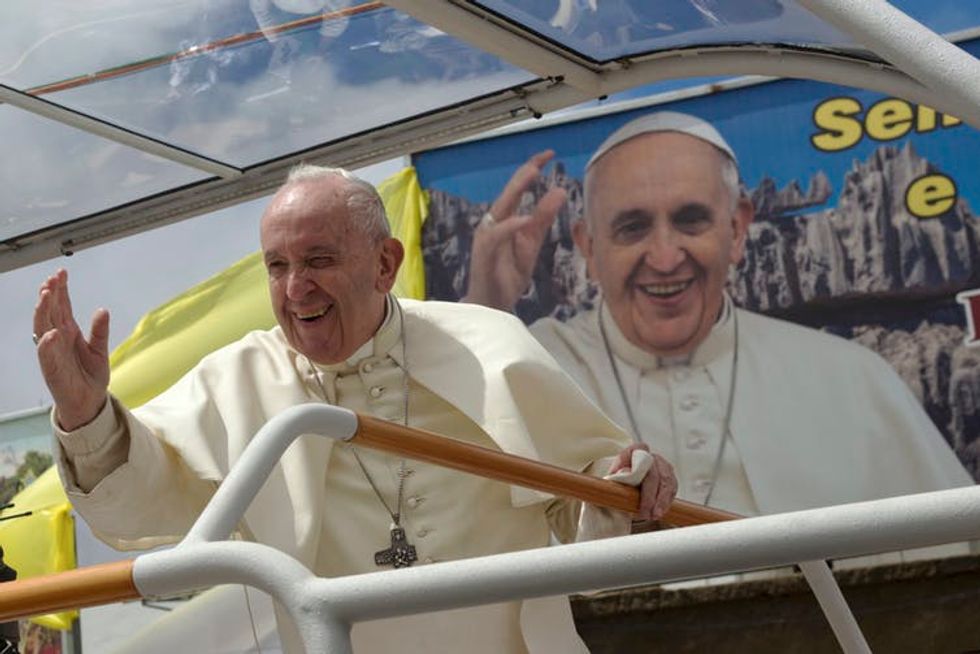
Pope Francis said Tuesday he was "not afraid" of a schism in the Roman Catholic Church, in reference to attacks by conservative cardinals who frequently take aim at his papacy.
"I'm not afraid of schisms. I pray that there won't be one, because the spiritual health of many people depends on it," the pontiff said on his return flight to Rome from a three-nation tour of Indian Ocean African countries.
The most famous breakaway from the Church was the so-called Great Schism of 1054 between Eastern and Western Christianity, which has lasted almost 1,000 years.
The most notable of the 20th century was led by French Archbishop Marcel Lefebvre, who broke away with a small number of Catholics, ordaining four bishops without the approval of the pope in 1988.
The ultra-conservative wing of the church in the United States frequently criticises Francis, saying he is not outspoken enough on abortion, too compassionate towards homosexuals and divorcees, and too accommodating towards Muslims.
Some have gone so far as to call for him to resign, accusing him of "heresies".
"The criticisms do not only come from the Americans (but) from everywhere, including the Curia", Francis said in reference to the Church's governing body.
Francis's critique of capitalism and support for the downtrodden have seen some label the leader of the world's 1.2 billion Catholics a communist.
But the pontiff insisted: "The social things I say are the same things that (former pope and popular Catholic leader) John Paul II said. The same things! I copy them".
He said that while he welcomed "constructive criticism", he had no time for "those who smile while stabbing you in the back".
Francis said those who behaved that way did not "want good for the Church" but were merely obsessing over goals such as "changing popes, changing styles, creating a schism".
Last week he shrugged off attacks on him by ultra-conservative US Catholics, describing them as an "honour".
The pontiff's fiercest and most vocal critic is US cardinal Raymond Leo Burke, a conservative heavyweight who has criticised in particular Francis's handling of the clerical paedophilia crisis, which Burke has blamed on homosexuality.
Scientists on Tuesday unveiled a new species pterosaur, the plane-sized reptiles that lorded over primeval skies above T-rex, Triceratops and other dinosaurs of the late Cretaceous.
With a wingspan of ten metres and weighing 250 kilos, Cryodrakon boreas rivals another pterosaur as the largest flying animal of all time, researchers reported in the Journal of Vertebrate Paleontology.
"This is a cool discovery," said David Hone, lead author of the study and a researcher at Queen Mary University in London.
"It is great that we can identify Cryodrakon as being distinct from Quetzalcoatlus," the other giant pterosaur for which it was initially mistaken, he said in a statement.
C. boreas was hiding in plain sight.
Its remains were first discovered more than 30 years ago in Alberta, Canada, yet elicited scant excitement because of the misclassification.
But a closer look at the fossil remains of a juvenile and the intact giant neck bone of a full-grown specimen left no doubt that a new species had been discovered.
Like other winged reptiles living at the same time, about 77 million years ago, C. boreas was carnivorous and probably fed on lizards, small mammals and even baby dinosaurs.
Despite a likely capacity to cross large bodies of water, the location of fossil remains and the animal's features point to an inland habitat, Hone said.
There are more than 100 known species of pterosaurs.
Despite their large size and wide distribution -- across North and South America, Asia, Africa and Europe -- only fragmentary remains have been unearthed, making the new find especially important.
Israeli Prime Minister Benjamin Netanyahu issued a deeply controversial pledge on Tuesday to annex the Jordan Valley in the occupied West Bank if re-elected in September 17 polls.
"There is one place where we can apply Israeli sovereignty immediately after the elections," Netanyahu said in a televised speech.
"If I receive from you, citizens of Israel, a clear mandate to do so ... today I announce my intention to apply with the formation of the next government Israeli sovereignty over the Jordan Valley and northern Dead Sea."
The prime minister also reiterated his intention to annex Israeli settlements throughout the West Bank if re-elected, though in coordination with US President Donald Trump, whose long-awaited peace plan is expected to be unveiled sometime after the vote.
Those moves could effectively kill any remaining hopes for a two-state solution to the Israeli-Palestinian conflict, long the focus of international diplomacy.
The Jordan Valley accounts for around one-third of the West Bank and Israeli right-wing politicians have long viewed the strategic area as a part of the territory they would never retreat from.
Israeli settlements are located in what is known as Area C of the West Bank, which accounts for some 60 percent of the territory, including most of the Jordan Valley.
The head of French soccer said Tuesday that he had instructed referees to no longer stop matches over homophobic abuse from fans, putting him on a collision course with the sports ministry and the soccer league.
Speaking to France Info, Noël Le Graët, president of the French Football Federation (FFF), said that stopping matches for anti-gay chants and banners in the stands was "a mistake", and that he hoped his decision would take effect from this weekend's games.
"I would stop a match for racist chants. I would stop a match for fighting or if there were a dangerous situation in the stands," Le Graët said.
But racism and homophobia "are not the same thing", he insisted, adding that it should be down to the clubs to stop those responsible from getting into stadiums.
"The clubs' security services have to check the people who go to games, there is security there to ensure that banners disappear quickly," he said.
Le Graët has already criticised the temporary stopping of matches in the French league over homophobic abuse.
On Friday he said "too many matches" had been halted due to new rules introduced over the summer by the Professional Football League (LFP), which runs France’s top Ligue 1 division, in a bid to stop the phenomenon.
He also claimed that politicians were trying to exploit the problem in an effort to look good "in front of television cameras".
'Discredit' to football
Le Graët drew the ire of sports minister Roxana Maracineanu, who in April launched the appeal for matches to be stopped in the event of homophobic abuse and on Saturday called the FFF chief's comments a "discredit" to football.
Several matches have been temporarily halted in France this season thanks to LFP's guidance, drawing praise from French politicians and heavy criticism from supporters.
Equalities minister Marlène Schiappa publicly praised referee Clément Turpin after he stopped Marseille's 2-1 win at Nice for over 10 minutes last month following sustained abusive chanting and banners from home fans.
Paris Saint-Germain's match at Metz two days later was also briefly halted for a banner unfurled by the hosts' supporters asking the French league (LFP) to allow them to aim homophobic chants at PSG.
Since the start of the French football season on August 9, there have been at least 20 cases of fans chanting homophobic slurs or showing anti-gay banners during domestic games. By contrast, there were 111 incidents of homophobic abuse in England over the course of the entire 2017-2018 season, according to Kick It Out, a British pressure group for equality in the sport.
Pope Francis has completed his seven-day tour of three East African countries: Mozambique, Madagascar and Mauritius. It was a significant trip for a number of reasons.
During his visit, the pope spoke on issues of peace and ecological sustainability that these countries are facing. Mozambique recently signed a peace accord with longtime rebels, and the country is still recovering from the cyclone earlier this year that killed over 1,000 people. Madagascar faces severe deforestation, and Mauritius too faces risks from climate change.
Africa has the world’s third largest Catholic population, after the Americas and Europe. Nearly 1 out of every 5 Africans – 19.2% – is Catholic. The Pew Research Center expects the number of African Christians south of the Sahara, including Catholics, to double by 2050.
From my perspective as a scholar of African religions, however, the pope’s visit needs to be understood against the background of the church’s longer history in Africa and the current challenges Catholicism faces in the continent.
Early Catholic history in Africa
Although Catholicism in Africa expanded dramatically under European colonialism in the 19th and 20th centuries, the church’s roots in Africa go back to its earliest days.
After the Islamic conquest of North Africa – from 634 to 711 A.D. – however, Islam grew faster than Christianity, making it the region’s dominant religion.
Muslim traders then took Islam across the Sahara Desert to West Africa and over the Indian Ocean to East Africa.
Spread of Christianity
The later arrival of Catholic missionaries on the western, central, southern and eastern coasts of Africa spread Christianity across the continent.
In the 15th and 16th centuries, the Portuguese came to Africa by ship and began winning converts in the Central African kingdom of Kongo.
On the other side of the continent, in today’s Mozambique, missionaries established Catholic communities that would eventually become the contemporary Mozambican Church.
French missionaries arrived in Madagascar in 1640. With the help of early converts, they produced a Catholic catechism, or teaching manual, in Malagash, the island’s indigenous language.
Because Catholic Portugal, and later France, expanded the trans-Atlantic slave trade, both priests and slave merchants followed in their wake.
African Catholics and European missionaries nonetheless protested against the slave trade. Even the Vatican condemned slavery in the 1680s. But many bishops and priests already possessed slaves, and the Vatican enslaved Africans to man its ships.
The church’s complicity in Africa’s subjugation only intensified in the colonial era in the 19th and 20th centuries as the church founded parishes, schools and hospitals across the continent, often with the encouragement of colonial authorities.
Reforms and end of colonialism
Catholic missionaries worked mostly in European languages, contributing to the continent’s linguistic and cultural colonization.
In fact, colonization and evangelization occurred in lockstep. The Portuguese colonized Mozambique; the French, Madagascar; and Britain, after initial French occupation, Mauritius.
But Catholic missionaries also criticized colonialism. In 1971, for example, authorities in Mozambique, still under Portuguese rule, expelled a Catholic order for criticizing the colonial regime for preventing missionaries from properly serving Mozambicans.
Elsewhere on the continent, during Africa’s transition from colonial rule to independence, from the late 1950s to 1980, many priests supported emerging ethnic and nationalist movements.
The long-term outcomes of these Catholic-backed independence movements have been mixed.
In what was to become Zimbabwe, for example, bishops supported resistance against white-led Rhodesia from the 1960s to 1980 but unwittingly brought dictator Robert Mugabe, who died recently, to power.
But in Malawi, Catholics in 1994 helped unseat the repressive president, Hastings Banda, and establish multiparty democracy.
And in many French-speaking African countries, bishops served as neutral mediators who led national conversations between autocratic rulers and civilians throughout the 1990s, often achieving democratic reforms.
Rise of Pentacostalism, Islam
Pope Francis greets worshippers in Antananarivo, Madagascar, on Sept. 8, 2019.
To many Africans today, in the wake of independence and the
church’s support for it, the Catholic Church has distanced itself from its colonial past to become an institution associated with sociopolitical reform, education and health care.
This accounts in part for its substantial growth in the three countries visited by the pope.
In Mozambique, Catholics are 30.3% of the population, the country’s largest religious group, surpassing indigenous religious practitioners and Muslims. In Mauritius, at 27.2%, Catholics take second place to Hindus but outnumber Muslims. And in Madagascar, they come in third at 21.7%.
But the church faces new challenges.
In 1970, Pentecostals represented less than 5% of all Africans. They now stand at 12%, a significant shift. In Mozambique alone, Pentecostals are the second largest Christian community.
And Islam is growing faster in Africa than Christianity. By 2050, African Muslims south of the Sahara are expected to increase from 30% to 35% of Africa’s population.
The pope’s visit, then, reflects a strategic commitment to the continent, for good reason.
The battle for souls is a struggle for statistics, enmeshed in the changing loyalties of the world’s largest Christian church.
A popular Russian rapper on Tuesday deleted a music video singing the praises of Moscow authorities ahead of contentious elections after it gathered almost 1.5 million dislikes on YouTube.
Timati, a 36-year-old rapper known for his fervent support of President Vladimir Putin, posted the video, titled simply "Moscow", shortly before Muscovites were set to vote in elections for city parliament on Sunday that had caused mass protests.
"I don't go to rallies, I don't bullshit," the song goes, apparently referring to weeks of protests in Moscow after the authorities barred opposition candidates from running in the polls.
Lyrics in the clip praise the Russian capital as a wealthy city that has become "world standard" and "doesn't hold gay parades."
"I will down a burger for Sobyanin," the song says, referring to Mayor Sergei Sobyanin, a Putin ally who has been in charge since 2010 and is detested by the opposition for refusing permission for rallies and cracking down on protesters.
Timati, who is ranked the seventh wealthiest celebrity under 40 in Russia by Forbes magazine, made the video together with another rapper, Guf.
The video had gained 1.48 million dislikes when Timati took it down on Tuesday, writing on Instagram that he did not intend any offense.
"I'm deleting the video to stop this wave of negativity," he wrote. "I made a record. Only I didn't have such a goal."
In Instagram comments, Russians mocked Timati, accusing him of being a sellout and getting paid by the authorities to make propaganda.
"The world's first government rapper. I'm sorry for his fans," one commentator wrote.
"Did you also return the money to those who ordered (the video)?" asked another.
Guf for his part posted an apologetic expletive-ridden video assuring his fans that he was "used" and "didn't get a penny for this, I swear."
"I am proud of our young people who understand politics," he says.
"I'm sorry that I don't follow the political situation in the country."
According to Wikipedia, the video is the 30th most disliked in YouTube history and the most disliked Russian music video.
The Russian opposition has accused celebrities of engaging in paid propaganda before.
Last year a wave of nearly identical messages praising the positive changes in Moscow appeared on celebrities' social media ahead of the mayoral polls swept by Sobyanin.
Other Russian rappers have performed at opposition protests and expressed solidarity with people arrested over the summer.
Japan's top government spokesman slapped down the environment minister on Tuesday after he said there was "no other option" but to release radioactive water from the crippled Fukushima nuclear power plant into the ocean.
"It is not true that we have decided on the disposal method," Chief Cabinet Minister Yoshihide Suga told reporters after Environment Minister Yoshiaki Harada's comments earlier in the day.
The operator, Tokyo Electric Power Co. (TEPCO), is storing more than one million tonnes of contaminated water in tanks at the site of Fukushima Daiichi Plant that was wrecked by the 2011 earthquake, tsunami and nuclear meltdown.
Besides water used to cool meltdown fuel, underground water flows into the complex daily and storage capacity will be full by mid-2022, leaving the operator with the huge problem of disposing of it safely.
Harada, who is expected to leave the cabinet in a reshuffle Wednesday, said "there is no other option than to release it (into the sea) and dilute it."
The minister had stressed that this was "just one opinion" and Suga emphasized that it was not the policy of the government, which has not yet given a timeframe for its final decision on what to do with the water.
Suga, seen as Prime Minister Shinzo Abe's right-hand man, noted that an expert panel was still working on what to do with the water and was taking into account concerns from local fishermen, who fear it could destroy their livelihood.
A mission from the International Atomic Energy Agency had earlier recommended that Japan release the treated water into the ocean.
Radioactive water from the plant has been filtered through the Advanced Liquid Processing System, which removes highly radioactive substances like strontium and caesium but leaves in the less dangerous tritium, according to TEPCO.
Water treated in earlier years has relatively higher radioactivity and needs to be treated again to bring down the levels of radioactive substances.
Margaret Atwood released the much-anticipated sequel to her award-winning 1985 novel "The Handmaid's Tale" on Tuesday, with "The Testaments" set to become a similar smash.
A terrifying, misogynistic dystopia set in the US northeast in the near-future, "The Handmaid's Tale" has been turned into a major television series and has become a feminist rallying point for the #MeToo generation.
Fans flocked to Waterstones' flagship bookstore in Piccadilly, central London, where Atwood, 79, read from her new novel to around 400 avid followers who could get their hands on the book at midnight.
"It's very accurate with what's going (on) at the moment, where the world is heading and that's kind of scary," said 27-year-old Melisa Kumas, from the Netherlands but living in London, who wore a red handmaid's outfit.
"It may be a bit of a warning to the people."
The sequel has already been nominated for the 2019 Booker Prize, one of the English-speaking world's most prestigious literary awards.
Its predecessor, which was nominated for the 1986 Booker Prize, was turned into a film in 1990, an opera in 2000, and an award-winning television drama series, which first aired in 2017.
The show has boosted sales of the novel, which has shifted eight million copies worldwide in English alone.
- Novel set 15 years on -
In the original novel, the United States has become the Republic of Gilead, a totalitarian religious state where women are sexually subjugated.
More than 15 years on from the events of "The Handmaid's Tale", the oppressive theocratic regime maintains its grip on power, but there are signs that it is beginning to rot from within.
The lives of three radically different women converge in the novel.
AFP/File / Daniel ROLAND Canadian writer Margaret Atwood's sequel "The Testaments" has already been nominated for the 2019 Booker Prize
Two, Agnes and Daisy, grew up in the first generation since the new order took over, while a third, Aunt Lydia, wields power through the ruthless accumulation and deployment of secrets.
Aunt Lydia was a character in "The Handmaid's Tale", while Agnes and Daisy also cropped up. They are the daughters of the first novel's protagonist and narrator June, who goes under the slave name Offred.
When the new story begins, Agnes lives in Gilead, while her sister lives in neighbouring Canada and is appalled by the human rights abuses being perpetrated across the border.
But the third narrator in particular holds the reader in suspense: the Machiavellian leader of the Aunts -- the group of women responsible for training and policing the handmaids.
The reader discovers her past as a free woman and her transformation into a monster through her survival instinct in the face of tyrannical men, and her aspiration for power to get her revenge.
- Feminist symbolism -
Canadian writer Atwood took more than three decades to create the sequel, inspired by questions asked by her readers about the characters in the first book.
"Thirty-five years is a long time to think about possible answers, and the answers have changed as society itself has changed," Atwood wrote in the novel's acknowledgements.
GETTY IMAGES NORTH AMERICA/AFP/File / Erik Voake The TV adaptation starring Elisabeth Moss has brought "The Handmaid's Tale" to a new audience
"Countries, including the United States, are under more stresses now than they were three decades ago."
The TV adaptation has brought "The Handmaid's Tale" to a new audience.
The handmaids' white hats and red dresses have become a symbol of feminist struggles such as abortion and women's rights campaigns in countries such as Argentina, Hungary, Ireland and Poland.
In the US, they have become an emblem of the anti-Trump and #MeToo movements.
Debbie Wythe, 57, a carer from Woking, southwest of London, is a new fan who came especially for the book launch.
"I just want to get my hands on it. I love books, to touch and smell it! I hope there is a happy conclusion in a way. I want to be hopeful and optimistic."
US agents extracted a high-level Russian government source who had confirmed Vladimir Putin's direct role in interfering in the 2016 presidential election, American media reported.
The individual had been providing information to US intelligence for decades, had access to Putin and had sent pictures of high-level documents on the Russian leader's desk, CNN said.
But the spy was pulled out of Russia, both CNN and the New York Times reported late Monday.
The Times reported that the CIA initially offered to extract the source in late 2016 over fears about media exposure, after officials revealed the severity of Russia’s election interference in extensive detail.
The informant initially refused -- citing family issues and prompting fears the individual had become a double agent, the Times said.
Months later, the agent relented as media inquiries about a mole continued.
CNN, citing an unnamed person it said was involved in discussions on the asset, said the 2017 extraction was over concerns that Trump and his cabinet could expose the agent after repeated mishandling of classified intelligence. The CIA vehemently denied this charge.
The network cited the intelligence community's particular concern after Trump confiscated a translator's notes following a 2017 private meeting with Putin.
The CIA's director of public affairs, Brittany Bramell, told CNN: "Misguided speculation that the President's handling of our nation's most sensitive intelligence -- which he has access to each and every day -- drove an alleged exfiltration operation is inaccurate."
White House press secretary Stephanie Grisham told the network: "CNN's reporting is not only incorrect, it has the potential to put lives in danger."
The individual was key in providing information that led US intelligence to conclude Putin directly orchestrated Russian interference in favor of Trump and against his Democratic rival Hillary Clinton in the 2016 election, the Times said.
The informant was also directly linked Putin to the hacking of the Democratic National Committee, resulting in the release of a flood of embarrassing messages, the newspaper reported.
According to the Times, the agent was the CIA's most valuable Russian asset.
The extraction "effectively blinded" American intelligence to the Kremlin's inner workings during the 2018 US midterm election, the Times report said, as well as the upcoming 2020 presidential election.
On Tuesday, Russian media named the alleged spy, reporting that he had worked at the Russian embassy in Washington before moving to Moscow.
Meanwhile, US network NBC claimed to have found a man living in the Washington area who -- according to two FBI sources -- matched the descriptions of the man in the CNN report.
When the NBC correspondent approached the home two men -- who identified themselves as friends of the Russian -- suddenly appeared and questioned why he wanted to speak to the occupant.
Since coming to power in July, Boris Johnson has shed his image as a jovial, wisecracking mophead to reveal a ruthless streak that has marked him out since childhood.
But his high-stakes Brexit approach of leaving the EU on October 31 come what may has led to a series of defeats in parliament that have left him totally humiliated.
The man with a lifelong ambition to be prime minister -- or "world king" in the words of his sister Rachel Johnson -- could end up becoming Britain's shortest-serving leader.
With a colorful and chequered career in politics and journalism, Johnson was already the country's most recognizable politician when he took power in the midst of Britain's deepest political crisis since World War II.
Born Alexander Boris de Pfeffel Johnson in New York in 1964, he is the embodiment of privilege, having attended the elite Eton College and Oxford University.
He started out as a journalist, writing for The Times, before being sacked for fabricating quotes. Undeterred, he went on to become Brussels correspondent for the Daily Telegraph and eventually editor of the Spectator magazine.
- 'Element of winging it' -
He became an MP in 2001, but was sacked as Conservative Party arts spokesman in 2004 for lying about an extra-marital affair, demonstrating a fast-and-loose relationship with the truth that has dogged him throughout his career.
AFP/File / LEON NEAL With a colorful and chequered career in politics and journalism, Johnson was already the country's most recognizable politician when he took power in the midst of Britain's deepest political crisis since World War II
His personality-driven approach helped him develop a celebrity status and to score an unlikely victory by becoming the Conservative mayor of multi-ethnic, Labour-voting London.
But it has led to frequent criticism over his attention to detail and his ability to govern, particularly during his poorly-received spell as foreign minster.
"He's great on rhetoric but lousy on delivery," Steve Norris, a former Conservative candidate for London mayor told The Guardian newspaper.
A former colleague, who asked to remain anonymous, told AFP that Johnson was "very much 'big vision'.
"Once he got a team he trusted, he'd leave you to get on with it," he said.
While he could master the detail when required, on some issues, "there's an element of winging it".
Johnson is proud of his record in London, pointing to low levels of crime, succesful delivery of the 2012 Olympics and investment in transport and housing as proof of his ability to get things done.
AFP/File / Ben STANSALL His personality-driven approach helped him develop a celebrity status and to score an unlikely victory by becoming the Conservative mayor of multi-ethnic, Labour-voting London
But critics cite expensive projects such as a cable car across River Thames, an aborted garden bridge and his decision to buy second-hand water cannons that police were not permitted to use.
It wasn't, however, until he successfully spearheaded the 2016 campaign to leave the European Union that he was transformed from a political sideshow into the deeply polarizing figure who now leads the country.
He made his first tilt at the Tory leadership shortly after the referendum but failed after his closest ally betrayed him, but he laid the groundwork for this year's contest early.
The winner, Theresa May, made him foreign secretary, but "where gravitas and grasp of detail were needed, Johnson supplied bon mots," the Chatham House think-tank said.
- Serial Philanderer -
The gaffes that had helped burnish his popularity in lower office were no longer a laughing matter and he was accused of jeopardising the case of Nazanin Zaghari-Ratcliffe, a British-Iranian woman held in Tehran for sedition, by mischaracterising her job.
He resigned a year ago in protest at May's EU strategy, cementing his position as the champion of Brexit.
His campaign to replace her was only briefly derailed by headlines about a police visit to his home following a noisy row with his girlfriend, Carrie Symonds.
AFP/File / -Johnson is proud of his record in London, pointing to low levels of crime, successful delivery of the 2012 Olympics and investment in transport and housing as proof of his ability to get things done
It reignited interest in the love life of a serial philanderer who has been married twice.
Despite his own socially liberal views -- he has long backed gay marriage and advocated an amnesty for illegal migrants as London mayor -- Johnson has also drawn accusations of "dog-whistle" politics.
His biographer Andrew Gimson said Johnson was not instinctively divisive but delighted in shocking the political establishment -- not unlike his highest profile supporter, US President Donald Trump.
The House of Commons broke into rare applause last week when a Labour MP spoke out about Johnson's previous characterization of Muslim women wearing burkhas as looking like "letterboxes".
He was also forced to apologize to the people of Papua New Guinea in 2006 after writing about "Papua New Guinea-style orgies of cannibalism and chief-killing".
Eritrea is the world's worst country for press censorship, a media watchdog said Tuesday in a report which also cites extreme measures in nine other countries including North Korea, China and Saudi Arabia.
Under the three worst regimes -- Eritrea, North Korea, and Turkmenistan -- the media "serves as a mouthpiece of the state, and any independent journalism is conducted from exile," said a report by the US-based Committee to Protect Journalists.
Other countries on the list of the 10 worst regimes for media "use a combination of blunt tactics like harassment and arbitrary detention as well as sophisticated surveillance and targeted hacking to silence the independent press," the report said.
Saudi Arabia, China, Vietnam, and Iran were cited for "jailing and harassing journalists and their families, while also engaging in digital monitoring and censorship of the internet and social media," the group said.
The rankings were based on factors including restrictions on privately owned or independent media; criminal defamation laws; restrictions on the dissemination of false news; blocking of websites; surveillance of journalists by authorities; license requirements for media; and targeted hacking or trolling.
"The internet was supposed to make censorship obsolete, but that hasn’t happened," said CPJ executive director Joel Simon.
"Many of the world's most censored countries are highly wired, with active online communities. These governments combine old-style brutality with new technology, often purchased from Western companies, to stifle dissent and control the media."
The report covers 10 countries where the government tightly controls the media, including Equatorial Guinea, Belarus, and Cuba.
It noted that in other countries including war-ravaged nations such as Syria, Yemen, and Somalia, conditions for the media are "extremely difficult, but not necessarily attributable solely to government censorship."
In Eritrea, the report noted, the state retains a legal monopoly of broadcast media and journalists' alternative sources of information, such as the internet or satellite broadcasts of radio stations in exile, are restricted via government-controlled internet services.
North Korean leader Kim Jong Un has stepped up the use of radio signal blockers and advanced radio detection equipment to prevent people from sharing information, CPJ said.
The group said Saudi Arabia's already-repressive environment for the press has "suffered sharp deterioration" under de facto ruler Crown Prince Mohammed bin Salman, according to the report.
China has the most sophisticated censorship apparatus, according to CPJ, which noted that Chinese internet users are blocked by the "Great Firewall" and that authorities monitor domestic social media networks and conduct surveillance of international journalists.





 AFP/File / Daniel ROLAND
  GETTY IMAGES NORTH AMERICA/AFP/File / Erik Voake
  AFP/File / LEON NEAL
  AFP/File / Ben STANSALL
  AFP/File / -