US moves against Chinese tech titan Huawei have had "no effect" on the firm's aviation business despite several countries taking steps to block its mobile services, a top company executive said Monday.
Huawei has been caught in an intensifying trade war between the United States and China, with President Donald Trump moving to blacklist the Chinese manufacturer over national security concerns.
But Eman Liu, president of Huawei's global transportation business unit, said the company's aviation business was untouched so far.
Huawei provides information and communication technology solutions to more than 50 airports and 15 airlines around the world, including Dubai Airports and the Changi Airport Group in Singapore.
Its services include video surveillance and airport cloud systems as well as wifi services and storage servers.
"Until now, there is no effect," Liu told AFP on the sidelines of the annual International Air Transport Association (IATA) conference in Seoul.
Huawei customers at the event had pledged to "keep cooperating" with the firm despite Washington's accusations, Liu said.
"For all the rest of the world, we are keeping doing business with them for more than 10 years," Liu said.
"Because this trust is not one day trust. It's a long-term trust for the past 15 years, even 30 years."
Huawei has risen to become the world leader in telecom networking equipment and one of the top smartphone manufacturers alongside Samsung and Apple.
The US Commerce Department last month placed the company on an "entity list" on grounds of national security, a move that curbs its access to US-made components it needs for its equipment. A 90-day reprieve was later issued.
A number of countries have also blocked Huawei from working on their mobile networks and companies have stepped back from the firm following the US ban, citing legal requirements.
"We cannot change the situation right now because we are businessmen," Liu said. "But we hope the United States can change their way."
If the US persisted with its moves, Liu said, it would "force us to use Plan B", referring to heavy investments in new technology, including developing its own chips.
Washington has long voiced suspicions that Huawei is controlled by the Chinese government and thus a global security threat -- charges strongly denied by the firm and by Beijing.
China's defence minister said Sunday that Huawei was "not a military company" despite its founder Ren Zhengfei's previous career in the People's Liberation Army.
A Swedish court heard arguments Monday before deciding if prosecutors can proceed to request Julian Assange's extradition from Britain, after a 2010 rape probe was re-opened in May.
Both sides presented their arguments to the Uppsala district court which adjourned to deliberate. It was expected to announce a decision at 4:00 pm (1400 GMT).
Swedish deputy director of public prosecutions Eva-Marie Persson said the WikiLeaks founder had not cooperated with the Swedish investigation previously, fleeing from an extradition order, and therefore needed to be detained and questioned in Sweden.
She asked the court to order Assange's detention in his absence, a standard part of Swedish legal procedure if a suspect is outside the country or cannot be located, and which would be the first step to having him extradited.
"The purpose of this detention is to be able to complete the investigation and bring Julian Assange to justice," Persson said.
Assange's Swedish lawyer, Per E Samuelson, meanwhile argued that a detention order was "meaningless" as Assange is currently imprisoned in Britain and should not be considered a flight risk.
He said it was not proportionate to ask for someone's detention merely to conduct a questioning session.
The Australian whistleblower, who holed himself up in Ecuador's embassy in London for seven years to avoid a British extradition order to Sweden, was arrested by British police on April 11 after Quito gave him up.
He was subsequently sentenced to 50 weeks in prison for breaching bail conditions when he took refuge in the embassy.
Following his arrest Swedish authorities reopened their 2010 rape investigation, which had been closed in 2017 with the argument that it was not possible to proceed with the probe as Assange could not be reached.
- Legal tug of war -
If the Uppsala court grants the prosecutor's request, Eva-Marie Persson has made clear she intends to issue a European Arrest Warrant "concerning surrender to Sweden".
Such a request would, however, have to compete with an extradition request from the United States, where Assange is facing a total of 18 charges, most of which relate to obtaining and disseminating classified information over the publishing of military documents and diplomatic cables through the website WikiLeaks.
Assange could be sentenced to 175 years in prison if convicted on all 18 counts.
"In the event of a conflict between a European Arrest Warrant and a request for extradition from the US, UK authorities will decide on the order of priority. The outcome of this process is impossible to predict," Persson said in May.
The decision of whether to extradite him to the United States or Sweden would rest with the British interior ministry.
- Health concerns -
On Thursday, a scheduled hearing on the US extradition request in London was pushed forward with chief magistrate Emma Arbuthnot referring to Assange as "not very well," and stating that the next hearing could be held at Belmarsh prison, where Assange is serving his sentence.
The day before, WikiLeaks expressed "grave concerns" over the condition of the organisation's founder and said he had been moved to the prison's health ward.
"During the seven weeks in Belmarsh his health has continued to deteriorate and he has dramatically lost weight," WikiLeaks said in a statement.
Assange's lawyer, Per E Samuelson, had also unsuccessfully requested the Uppsala district court to postpone the Swedish hearing, citing difficulties he had preparing the case with his client.
Samuelson told AFP he had met with Assange in Belmarsh's health ward on May 24, but had been unable to discuss the case properly since "it was difficult to have a normal conversation with him".
The United Nations special rapporteur on torture and other cruel, inhuman or degrading treatment, Nils Melzer, on Friday said the various drawn-out legal procedures against Assange amounted to "psychological torture".
Israel launched a second round of strikes against Syria in 24 hours on Sunday, state media reported, as US President Donald Trump called on Russia and Iran to "stop bombing the hell" out of the war-torn country.
Syria accused Israel of targeting an airbase in Homs province, reportedly killing five people, just hours after carrying out retaliatory attacks on military and intelligence posts south of Damascus, killing 10.
"Our air defences thwarted an Israeli aggression and destroyed two of the rockets that targeted the T-4 airbase," a military source told state news agency SANA said Sunday evening.
The remaining rockets "killed one soldier, wounded two others, and damaged an arms warehouse," the source added.
The Britain-based Syrian Observatory for Human Rights reported five killed, including one Syrian soldier, adding that a rocket warehouse was destroyed.
In addition to the Syrian army, Iranian fighters and Hezbollah paramilitary forces are also stationed at the airbase, according to the monitor.
Hours earlier, Israel said it had carried out strikes in the province of Quneitra, which includes the Golan Heights, most of which is occupied and annexed by Israel.
It said the attack was in response to rare rocket fire from its neighbour late Saturday.
Two rockets were fired from Syria at Mount Hermon in the Israeli-occupied Golan Heights and one had been "located within Israeli territory," the Israeli Army said.
The Observatory said 10 were killed, including Syrian soldiers and foreign fighters in the attack south of the capital.
- STOP! -
Late Sunday, Trump tweeted calling for an end to the bombing in the jihadist stronghold of the northwestern region of Idlib.
"Hearing word that Russia, Syria and, to a lesser extent, Iran, are bombing the hell out of Idlib Province in Syria, and indiscriminately killing many innocent civilians.
"The World is watching this butchery. What is the purpose, what will it get you? STOP!" he said on Twitter shortly before he departed for a state visit to Britain.
As well as killing dozens of civilians, the recent bombardments by Syrian and Russian forces allied to President Bashar al-Assad have pushed 300,000 people towards Turkey's border, Syrian NGOs have said.
Meanwhile, Israel has carried out hundreds of air strikes in Syria, most of them against what it says are Iranian and Hezbollah targets.
The country says it is determined to prevent its arch foe Iran from entrenching itself militarily in Syria, where Tehran backs President Bashar al-Assad in the country's eight-year war which has killed more than 370,000 people.
The Jewish state insists that it has the right to continue to target positions in Syria held by Iran and its Lebanese ally Hezbollah out of self-defence.
"We won't tolerate fire at our territory and will respond forcefully to any aggression against us," Israeli Prime Minister Benjamin Netanyahu said Sunday, after the first strikes.
The attacks come amid soaring tensions between Iran and the United States.
The stand-off had been simmering since the US last year withdrew from the 2015 nuclear treaty which Iran reached with major world powers.
In recent weeks Washington has accused Iran of alleged threats and deployed an aircraft carrier group and B-52 bombers to the Gulf.
President Donald Trump bashed London's mayor as Air Force One approached the city for a state visit.
The president insulted the city's Muslim mayor, Sadiq Khan, in a pair of tweets early Monday before arriving at London’s Stansted Airport.
"@SadiqKhan, who by all accounts has done a terrible job as Mayor of London, has been foolishly 'nasty' to the visiting President of the United States, by far the most important ally of the United Kingdom," Trump tweeted. "He is a stone cold loser who should focus on crime in London, not me."
"Kahn reminds me very much of our very dumb and incompetent Mayor of NYC, de Blasio, who has also done a terrible job - only half his height," he added. "In any event, I look forward to being a great friend to the United Kingdom, and am looking very much forward to my visit. Landing now!"
Khan’s spokesman responded by saying “childish insults” should be “beneath the president of the United States."
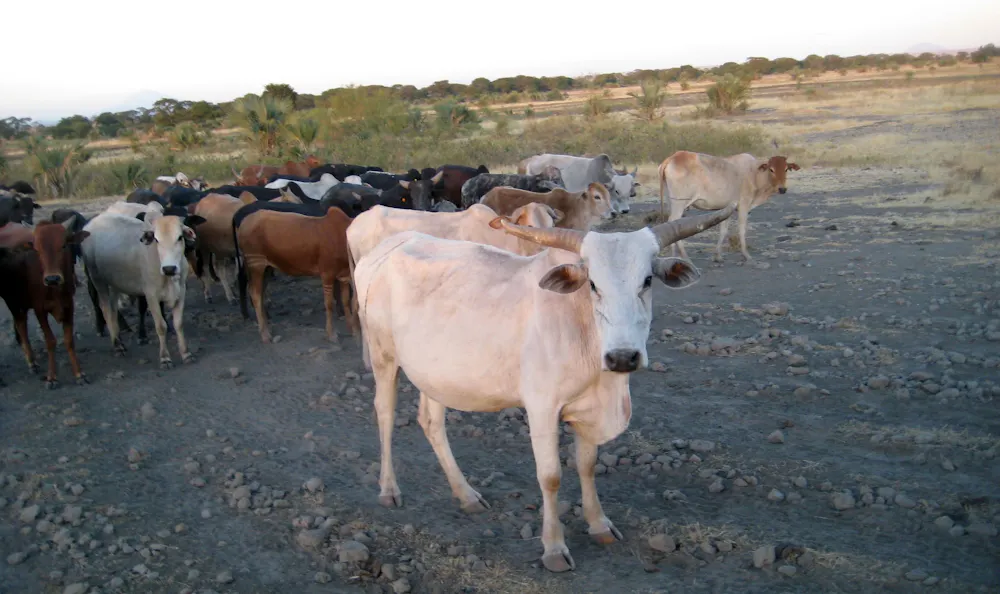
Visitors to East Africa are often amazed by massive herds of cattle with a gorgeous array of horn, hump and coat patterns. Pastoralism – a way of life centered around herding – is a central part of many Africans’ identity. It’s also a key economic strategy that is now threatened by climate change, rising demands for meat, urban sprawl and land conflicts.
Pastoralism’s roots could hold clues to help solve these modern challenges. Studies suggest that traditional ways of managing livestock – moving around and exchanging with other herders – enabled herders to cope with environmental instability and economic change over the past several thousand years. Research is also helping scientists understand how millennia of herding – and livestock dung – have shaped East Africa’s savannas and wildlife diversity.
So how did pastoralism get started in Africa? Currently most archaeologists think wild ancestors of today’s domestic cattle, sheep and goats were first domesticated in the “Fertile Crescent” of the Middle East. Archaeological research shows herding began to appear in and spread from what is now Egyptaround 8,000 years ago. By 5,000 years ago, herders were burying their dead in elaborate monumental cemeteries near a lakeshore in Kenya. Two millennia later, pastoralist settlements were present across a wide part of East Africa and by at least 2,000 years ago, livestock appear in South Africa.
Large herds of cattle graze near Lake Manyara in Tanzania, where they’ve been a key part of the economy for 3,000 years.
Much remains unanswered: Did animals spread mostly through exchange, just like cash circulates widely while people mostly stay put? Were people moving long distances with their herds, traversing the continent generation by generation? Were there many separate migrations or few, and what happened when immigrant herders met indigenous foragers? Wedecided to ask these questions using ancient DNA from archaeological skeletons from across East Africa.
Piecing together the genetic history of herders
Archaeologists study ancient people’s trash – broken clay pots, abandoned jewelry, leftover meals, even feces – but we also study the people themselves. Bioarchaeologists examine human bones and teeth as indicators of health, lifestyle and identity.
Now it’s also possible to sequence ancient DNA to look at genetic ancestry. Until recently, though, Africa has been on the sidelines of the “ancient DNA revolution” for a variety of reasons. Advances in DNA sequencing have created new opportunities to study African population history.
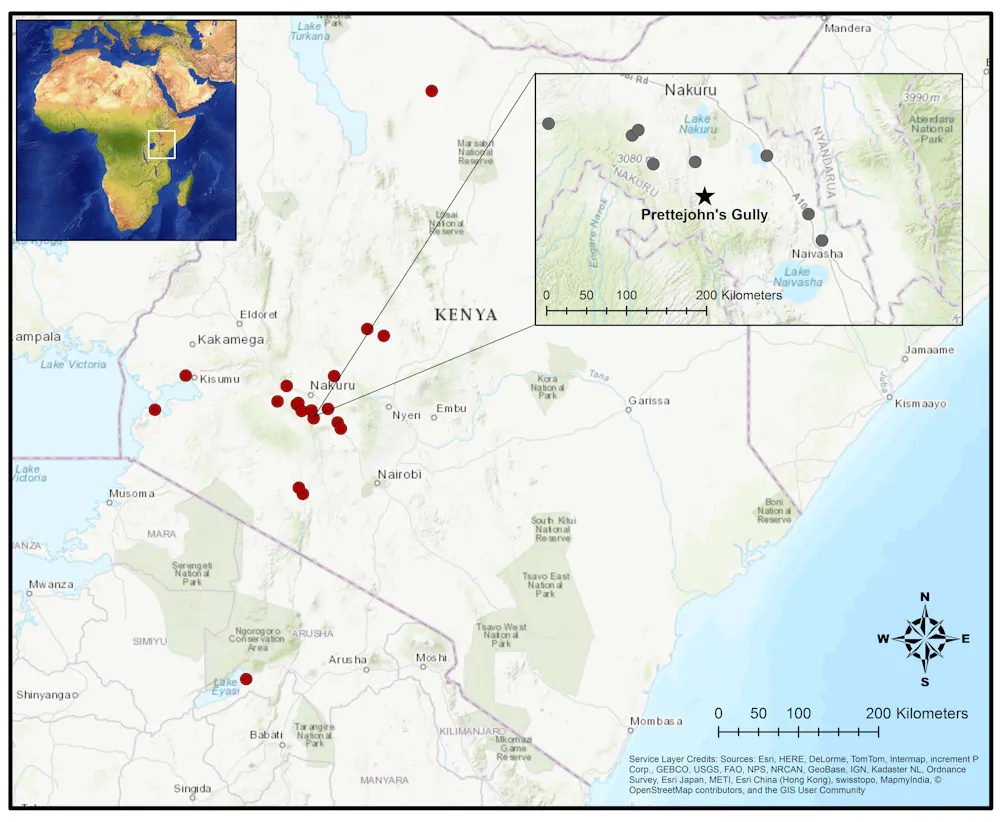
In our new research, our team sequenced the genomes of 41 people buried at archaeological sites in Kenya and Tanzania, more than doubling the number of ancient individuals with genome-wide data from sub-Saharan Africa. We obtained radiocarbon dates from the bones of 35 of these people – important because direct dates on human remains are virtually nonexistent in East Africa. Working as a team meant forging partnerships among curators, archaeologists and geneticists, despite our different work cultures and specialized vocabularies.
The people we studied were buried with a wide variety of archaeological evidence linking them to foraging, pastoralism and, in one case, farming. These associations are not airtight – people may have shifted between foraging and herding – but we rely on cultural traditions, artifact types and food remains to try to understand how people were getting their meals.
Red dots are archaeological sites in the authors’ study. Gray dots mark selected Rift Valley sites. Prettejohn’s Gully geological survey, marked by a black star, produced the oldest ancient DNA in Kenya.
After we grouped individuals based on the lifestyles we inferred from associated archaeological evidence, we compared their ancient genomes to those of hundreds of living people, and a few dozen ancient people from across Africa and the adjacent Middle East. We were looking for patterns of genetic relatedness.
Some of our ancient samples did not resemble other known groups. Despite major efforts to document the vastgenetic variation in Africa, there’s a long way to go. There are still gaps in modern data, and no ancient data at all for much of the continent. Although we can identify groups that share genetic similarities with the ancient herders, this picture no doubt will become clearer as more data become available.
Herding expanded in stages
So far we can tell that herding spread via a complex, multi-step process. The first step involved a “ghost population” – one for which we don’t have direct genetic evidence yet. These people drew about half of their ancestry from groups who lived in either the Middle East or presumably northeastern Africa (a region for which we have no relevant aDNA) or both, and about half from Sudanese groups. As this group spread southward – likely with livestock – they interacted and genetically integrated with foragers already living in East Africa. This period of interaction lasted from perhaps around 4,500-3,500 years ago.
After this occurred, it appears that ancient herders genetically kept to themselves. Methods that let us estimate the average date of admixture – that is, gene flow between previously isolated groups – indicate integration largely stopped by around 3,500 years ago. This suggests there were social barriers that kept herders and foragers from having children together, even if they interacted in plenty of other ways. Alternatively, there may have been far fewer foragers than herders, so that gene flow among these communities didn’t have a big demographic impact.
By around 1,200 years ago, we document new arrivals of people related to recent Sudanese and – for the first time – West African groups, associated with early iron-working and farming. After this point, a social mosaic made up of farmers, herders and foragers became typical of East Africa, and remains so today.
One interesting question is how early pastoralists used their herds. For instance, were they drinking milk? Although many East Africans today carry a genetic mutation that helps them digest milk into adulthood, this may be a recent development. We were able to test eight individuals for the genetic variant responsible for lactase persistence in many East African pastoralists today. Just one man, who lived in Tanzania 2,000 years ago, carried this variant. Maybe dairying was rare, but it’s also possible people found creative culinary solutions – for example, fermented milk or yogurt – to avoid indigestion.
Cultural and biological diversity are not the same
Archaeologists have a saying that “pots are not people.” Particular artifact styles are not assumed to reflect concrete identities – just as we wouldn’t assume today that the choice of kilts versus lederhosen is determined by DNA.
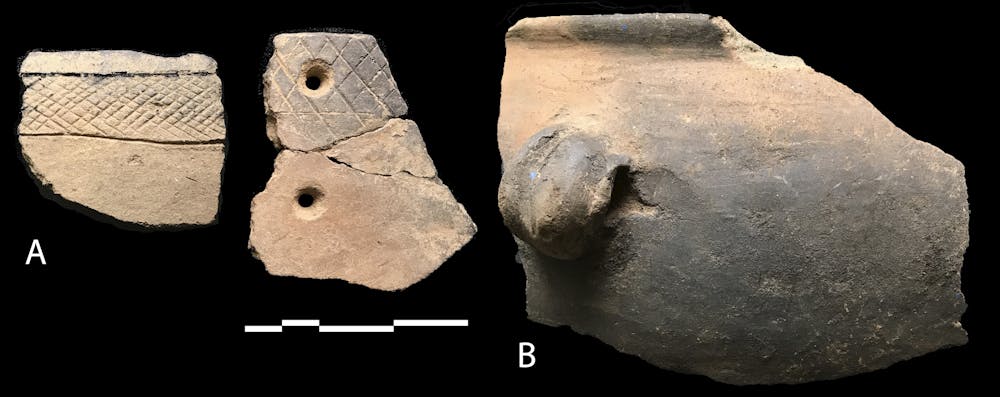
Pottery is the Tupperware of the past – durable and ubiquitous on archaeological sites. But there isn’t always a link between styles and ancestral identities. We compared burials associated with two distinctive artifact traditions – Savanna Pastoral Neolithic (A) and Elmenteitan (B) – and found no genetic differences.
Steven Goldstein at the National Museum of Kenya, CC BY-NC-ND
In Kenya and Tanzania, archaeologists had previously identified two early herder culturaltraditions distinguished by different pottery styles, stone tool sources, settlement patterns and burial practices. The people who created these cultures lived at roughly the same time and in the same area. Some scholars hypothesized that they spoke different languages and had different “ethnic” identities.
Our recent study found no evidence for genetic differentiation among people associated with these different cultures; in fact, we were struck by how closely related they were. Now archaeologists can ask a different question: Why did distinct cultures emerge among such closely related neighbors?
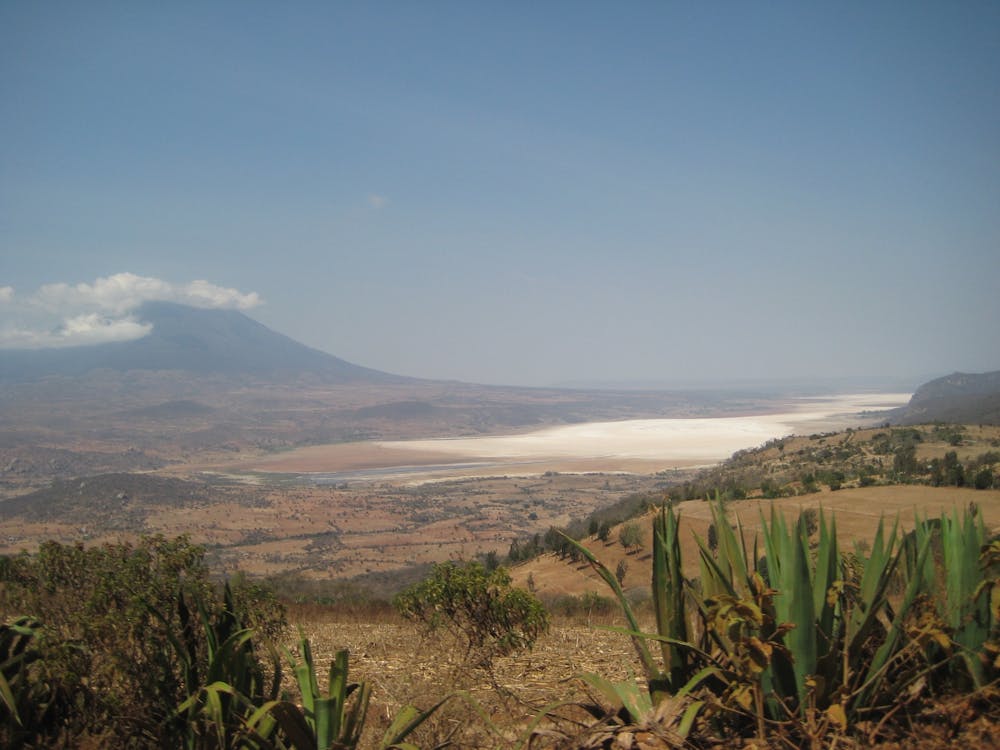
Ancient DNA is shedding new light on the history of key areas for early herding, like the East African Rift Valley.
Some of our most exciting findings came from unexpected places. Museum shelves are full of potentially game-changing collections that have yet to be studied or published. In a back corner of one storeroom, we found a tray containing two fragmentary human skeletons uncovered during a Rift Valley geological expedition at Prettejohn’s Gully in the 1960s. There was little contextual information, but with encouragement from curators we sampled the remains to see if we could at least determine their age.
We were shocked to learn that these 4,000-year-old burials provided the oldest DNA from Kenya, and that the man and woman buried at that site may have been some of the earliest herders in East Africa. Thanks to them, we can show that the spread of herding in Kenya involved several separate movements of ancestrally distinct groups. We have much to learn from older collections, and archaeologists don’t always need to dig to make new discoveries.
Archives are a key part of ancient DNA research, which sometimes leads to rediscovery of long-forgotten archaeological collections.
Elizabeth Sawchuk at the National Museum of Kenya, CC BY-NC-ND
Ancient DNA research doesn’t just answer questions about our shared past. It also raises new ones that must be answered by other fields. Our results don’t tell us what migration and admixture mean in social terms. What prompted people to move with livestock? What happened when people with radically different lifestyles met? What became of the foragers who were living across East Africa throughout the past, and whose descendants are few and far between today?
Ultimately, we hope that by studying pastoralism in the past – and demonstrating the resilience of this way of life – we can contribute in some way to understanding the challenges facing herders today.
Humans have a long history of living on water. Our water homes span the fishing villages in Southeast Asia, Peru and Bolivia to modern floating homes in Vancouver and Amsterdam. As our cities grapple with overcrowding and undesirable living situations, the ocean remains a potential frontier for sophisticated water-based communities.
The former tourism minister of French Polynesia, Marc Collins Chen, and architecture studio BIG advanced the proposal. Chen is involved with the Seasteading Institute, which is seeking to develop autonomous city-states floating in the shallow waters of “host nations”.
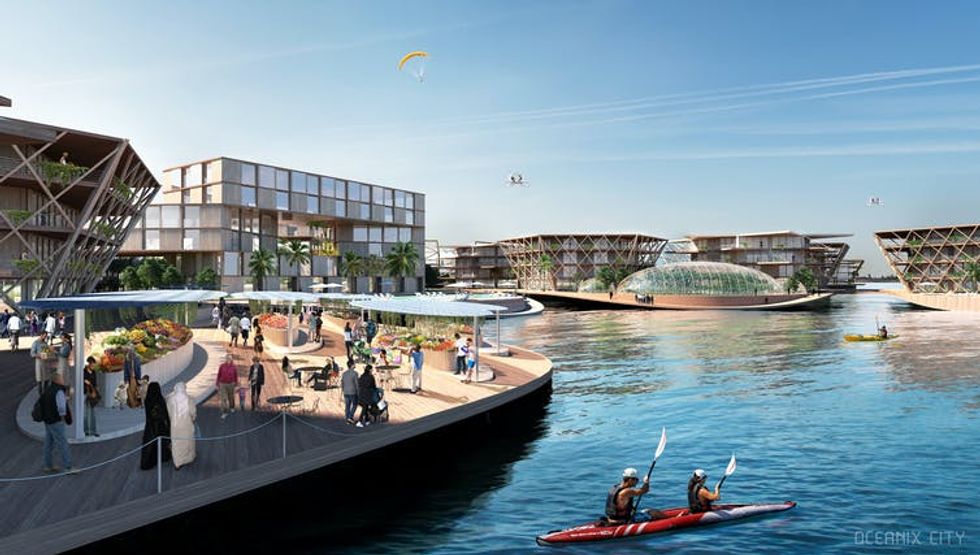
While this latest proposal has gained UN attention, it is an old idea we have repeatedly returned to over the past 70 years with little success. In fact, the Oceanix City proposal has not reached the same level of technical sophistication as previous models.
The architecture community was fascinated with marine utopias between the 1950s and ’70s. The technological optimism of this period led architects to consider whether we could build settlements in inhospitable places like the polar regions, the deserts and on the sea.
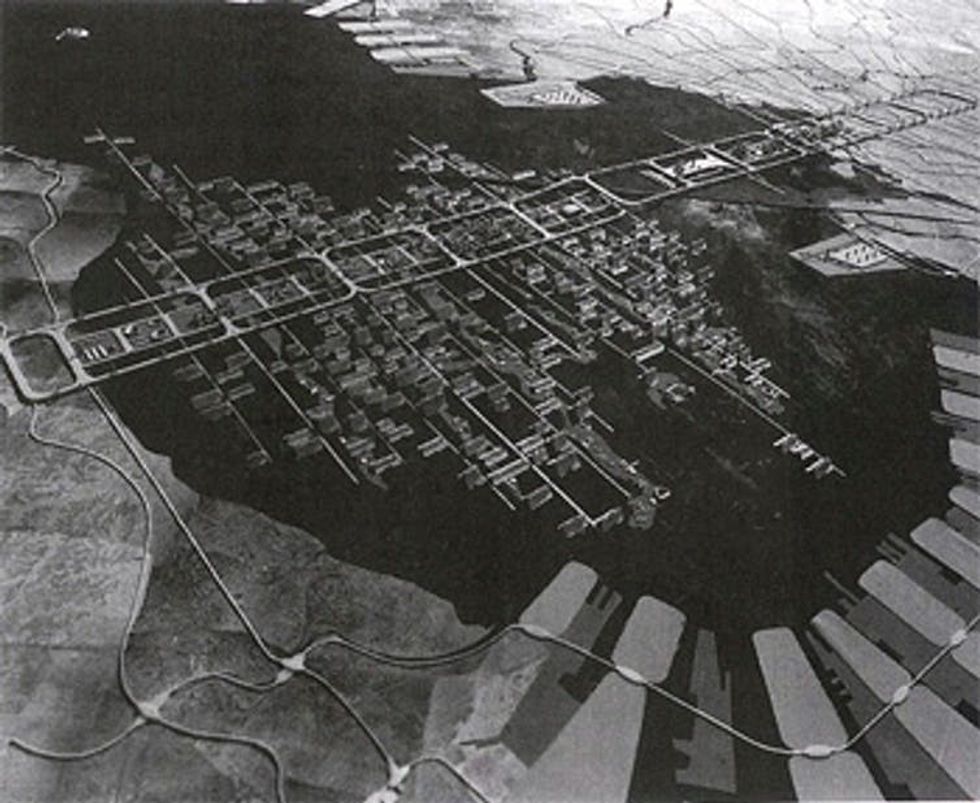
The Japanese Metabolists put forward incredible projects such as Kenzo Tange’s 1960 Tokyo Bay Plan and the marine city proposals of Kikutake and Kurokawa.
These proposals were directed at solving the impending urban crises of overpopulation and pressures on land-based resources. Many were even sophisticated enough to be patented.
The arc of this global architectural discussion was captured during the first UN Habitat conference (“Habitat I”) in Vancouver in 1976. In many ways, the UN has returned to the Vancouver Declaration from Habitat I to “[adopt] bold, meaningful and effective human settlement policies and spatial planning strategies” and to treat “human settlements as an instrument and object of development”.
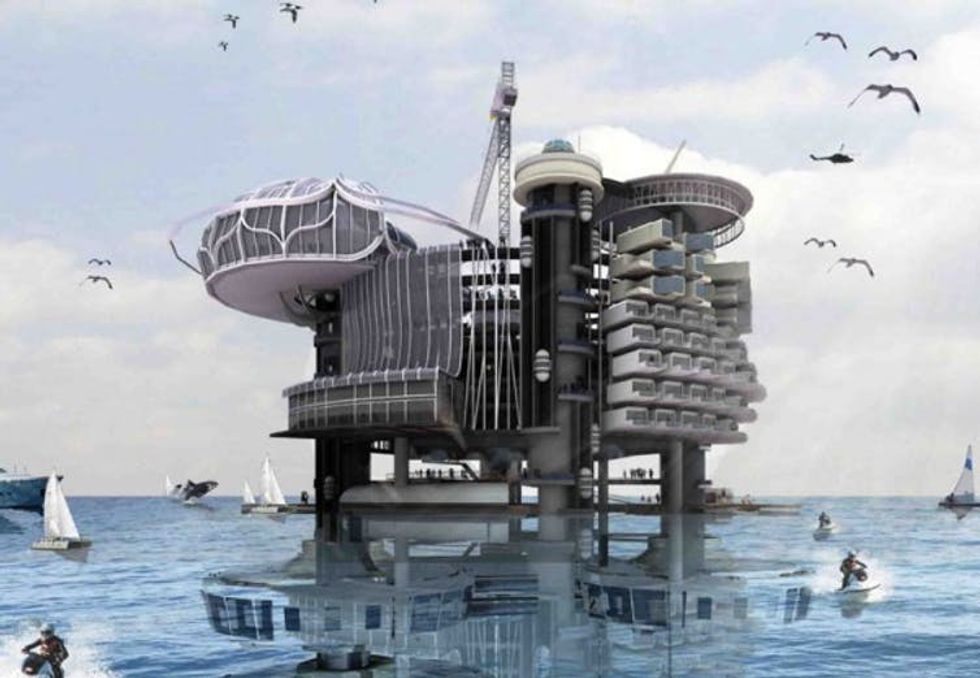
We are seeing a pivoting that began in 2008 with Vincent Callebaut’s “Lilypad” - a “floating ecopolis for ecological refugees”.
Where floating cities were once dismissed as too far-fetched, the concept has been repackaged and is re-emerging into public consciousness. This time in a more politically viable state - as a means of addressing the climate emergency.
The technology and types of floating city structures
No floating settlements have ever been created on the high seas. Current offshore engineering is concerned with how cities can locate infrastructure, such as airports, nuclear power stations, bridges, oil storage facilities and stadiums, in shallow coastal environments rather than in deep international waters.
Two main types of very large floating structures (VLFS) technology can be used to carry the weight of a floating settlement.
The first, pontoon structures, are flat slabs suitable for floating in sheltered waters close to shore.
Oceanix City is based on the pontoon structure. This would restrict it to shallower waters with breakwaters to limit the impacts of waves. This sort of structure could serve as an extension of a coastal city, as a life raft for island communities inundated by rising waters, or to provide mobile essential services to residents of flood-prone slums.
While some early marine utopian proposals were responses to emerging urban issues, many proposals conceptualised “seaborne leisure colonies”. These communities would be independent city-states allowing inhabitants to circumvent tax laws or restrictions on medical research in their own countries.
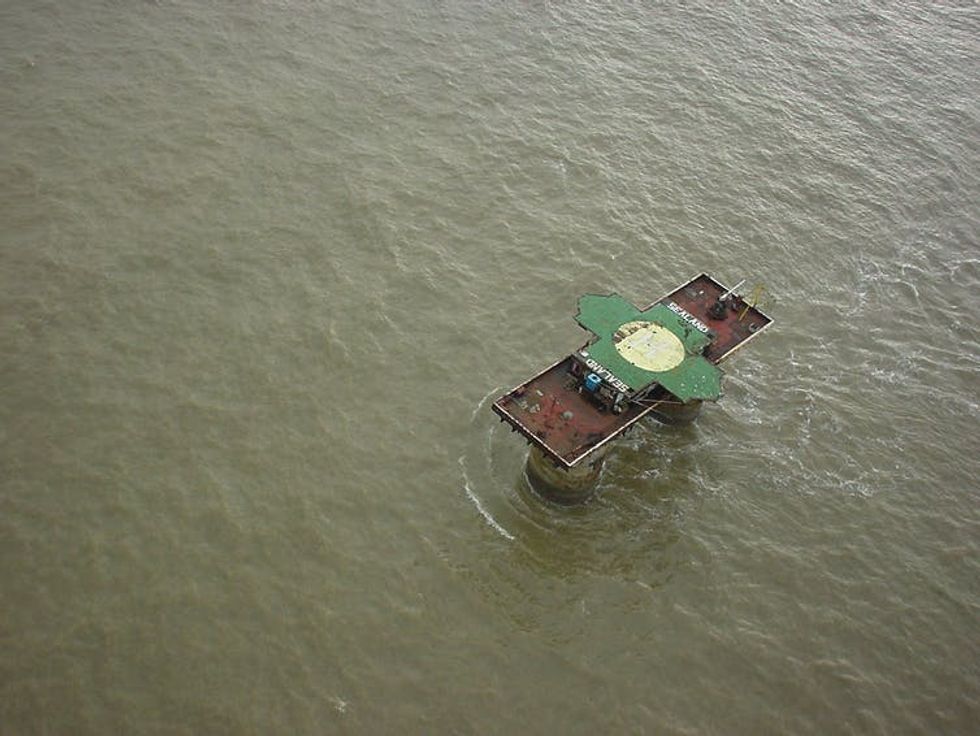
This sort of floating city was conceived of as a micronation with sovereignty and ability to provide citizenship to its occupants. The example was set by the Principality of Sealand, off the coast of Britain.
The Principality of Sealand is a micronation situated on Roughs Tower, a platform off the coast of Britain.
None of these proposals have succeeded. Even modern attempts such as the Freedom Ship and the Seasteading Institute’s plans for an autonomous floating settlement under French Polynesian jurisdiction have stalled. A recent attempt at creating a sovereign micronation (seastead) off Thailand led to its proponents becoming fugitives, potentially facing the death penalty.
Technology is not a barrier to floating cities in international waters. Advances in technology enable us to create structures for habitation in deep sea waters. These schemes have never really taken off because of political and commercial barriers.
While this time round proponents are packaging floating cities in a more politically viable concept as a life raft for climate refugees, commercial barriers remain. Apart from the UN, few organisation have the economic and political influence or reason to deliver a satellite floating city in the ocean.
In my view, the future of ocean cities is in technology campuses and in tourism. Given the significant risk of a community in extreme isolation in international waters, the solution to bringing people together in mid-ocean requires us to think about what connects us: technology, work and play. In these three elements we see, perhaps, the two lowest-hanging fruits (or the most buoyant of possibilities) for ocean cities.
The first is in floating tech campuses where large technology companies set up floating data centres and campuses in international waters. Situated outside national jurisdictions, these campuses could circumvent increasingly onerous privacy regimes or offer innovative technological services without having to negotiate regulatory barriers.
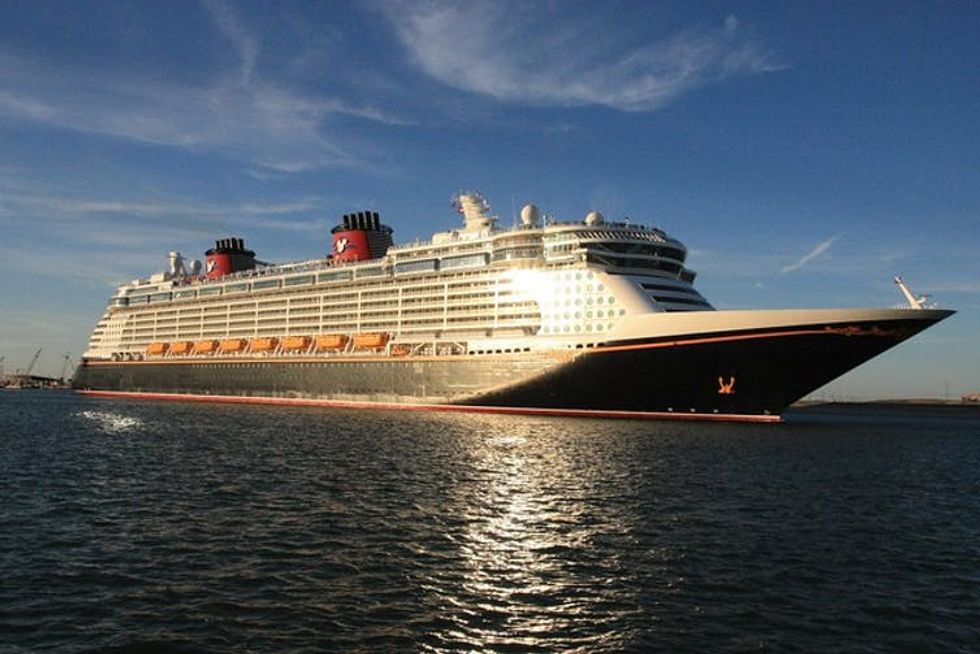
The second prospect is a return to the seaborne leisure colonies of the past. Companies like Disney could expand on their cruise offerings to build floating theme parks. These resorts could be sited in international waters or hosted by coastal cities.
Given our fascination with living on water, even if Oceanix City does not suceed, it won’t be long before we see another floating city proposal. And if we get the mix of social, political and commercial drivers right, we might just find ourselves living on one.
The Disney Cruise Line could potentially develop seaborne leisure colonies in future.
Pope Francis said Sunday politicians should "never sow hatred and fear" in an answer to a question about Matteo Salvini, Italy's strongman and leader of the far-right.
The pontiff told journalists on the return leg of a three-day trip to Romania that it would be "very unwise" of him to express an opinion on the deputy prime minister and interior minister, who heads the anti-immigrant League party.
And he insisted the reason he had not received Salvini -- who regularly waves aloft a Catholic rosary at his rallies -- was simply because the minister had not requested a private audience.
"I pray for all, for Italians to move forward, for them to unite," he said, days after Italy's far-right parties won over 40 percent in the European elections, largely thanks to an "Italians First", anti-migrant message.
"We must help politicians to be honest... Never should a politician sow hatred and fear, never," he said.
Francis also repeated his plea for Europe "to overcome divisions and borders".
"We see borders in Europe and they do no good. Please do not let Europe be defeated by pessimism or ideologies.
"Europe is being attacked not by guns or bombs, but by ideologies," he said.
The Athletics Integrity Unit (AIU) is investigating claims Russian officials tried to cover up a doping case involving high jumper Danil Lysenko, following a report in Britain's Sunday Times.
Lysenko was provisionally suspended last August on the eve of the European Championships in Berlin, after failing to make himself available for out-of-competition drug testing.
According to the Sunday Times, Russian athletics federation (RUSAF) officials fabricated documents to show the 2017 world silver medallist was too ill to provide his whereabouts.
The newspaper claimed these documents came from fake doctors working at a bogus clinic in Moscow.
"The address used is a real address where there is a demolished building," said a source with knowledge of the investigation in Russia.
The AIU, a watchdog founded by athletics' governing body to combat doping in the sport, confirmed it was looking into "a matter relating to the explanation provided by a Russian athlete in defence of a whereabouts violation in 2018".
It said it would make no further comment while the investigation is ongoing.
Investigators from the AIU have seized data from computers and other electric devices at RUSAF headquarters, the Sunday Times reported.
In an email sent Sunday to AFP, the IAAF said its taskforce "will prepare a report on all relevant matters and a recommendation for the IAAF Council, which will meet in Monaco on June 8 and 9."
Global athletics chiefs banned Russia in November 2015 because of evidence of state-sponsored doping, but Russian athletes cleared by the IAAF can compete as neutrals.
At the 2016 Olympics in Rio, US-based long jumper Darya Klishina was the only Russian athlete cleared to participate.
Last year Lysenko, the world indoor champion, had been one of 74 athletes allowed to compete under a neutral flag before losing his status.
Canada announced Sunday it was temporarily shutting its embassy in Venezuela, blaming President Nicolas Maduro for refusing to accredit diplomats critical of his regime.
At the same time, Ottawa is reviewing the status of Maduro envoys to Canada.
Foreign Minister Chrystia Freeland said in a statement that "the regime has taken steps to limit the ability of foreign embassies to function in Venezuela, particularly those advocating for the restoration of democracy" there.
In January Canada, along with the United States and major Latin American powers, was among the first to recognize Venezuelan opposition leader Juan Guaido's claim to be acting president, beginning a months-long power struggle between him and Maduro.
Soon, Canadian diplomats in Venezuela "will no longer be in a position to obtain diplomatic accreditation under the Maduro regime, and their visas will expire," Freeland said.
"Therefore, we are left with no choice but to temporarily suspend our operations at the Embassy of Canada to Venezuela, effective immediately."
More than 50 countries now recognize Guaido rather than leftist firebrand Maduro, who has presided over a crumbling economy and was re-elected in a ballot widely regarded as a sham.
Freeland also said Canada is "evaluating the status of Venezuelan diplomats appointed by the Maduro regime to Canada."
U.S. President Donald Trump arrives in Britain on Monday on a state visit laden with diplomatic peril, having already humiliated outgoing Prime Minister Theresa May over Brexit and challenged her to be tougher in dealing with China's Huawei.
Trump and his wife, Melania, will be treated to a display of British royal pageantry during the June 3-5 visit: lunch with Queen Elizabeth, tea with heir Prince Charles, a banquet at Buckingham Palace and a tour of Westminster Abbey, coronation church of English monarchs for 1,000 years.
Beyond the pomp, though, the proudly unpredictable 45th U.S. president also brings demands: He has praised a more radical Brexit-supporting potential successor to May and his envoys have urged a tougher British stance towards telecoms giant Huawei.
In an interview with the Sunday Times newspaper, Trump said the next British leader should send arch-Brexiteer Nigel Farage to conduct talks with the EU. Britain must leave the EU this year, Trump said.
"They've got to get it done," he said. "They have got to get the deal closed."
"If they don't get what they want, I would walk away. If you don't get a fair deal, you walk away."
Trump repeated his backing for those candidates to succeed May who have said Britain must leave on the due date of Oct. 31 with or without a deal.
Those candidates include former foreign secretary Boris Johnson, whom Trump praised in an interview with the Sun newspaper on Friday, along with former Brexit minister Dominic Raab and interior minister Sajid Javid.
Trump said it was a mistake for the Conservatives not to involve Farage, the Brexit Party leader, in talks with Brussels after his success in European Parliament elections last month.
"I like Nigel a lot. He has a lot to offer - he is a very smart person," Trump said. "They won’t bring him in but think how well they would do if they did. They just haven't figured that out yet."
On the Brexit divorce bill, Trump said: "If I were them, I wouldn’t pay 50 billion dollars. That is a tremendous number."
A meeting with either Johnson, favourite to succeed May, or Farage, a bombastic anti-establishment campaigner, would be seen as a snub for May who is bowing out after failing to negotiate a Brexit deal that parliament could ratify.
British officials are privately concerned that Trump could heap further ignominy on May, who battled in vain to unify her ruling Conservatives behind a deal and cried while announcing the end of her premiership in Downing Street last month.
Brexit
On his last visit to the United Kingdom, in July last year, Trump shocked Britain's political establishment by hammering May's Brexit negotiation for being too weak with the EU and by praising rival Johnson as a "great" potential prime minister.
Trump's national security adviser John Bolton said on Thursday the United States did not want to "get in the middle” of Brexit or a discussion of the next government's policies. Bolton dismissed concerns about Brexit: "You know, America declared its independence once – we made out okay," he quipped.
Brexit is the most significant geopolitical move for the United Kingdom since World War Two and if it ever happens then London will be more reliant on the United States as ties loosen with the other 27 members of the EU.
At a meeting with May, Trump will warn Britain that security cooperation could be hurt if London allows China's Huawei a role in building parts of the 5G network, the next generation of cellular technology.
The Trump administration has told allies not to use its 5G technology and equipment because of fears it would allow China to spy on sensitive communications and data. Huawei denies it is, or could be, a vehicle for Chinese intelligence.
Secretary of State Mike Pompeo told Britain last month it needed to change its attitude towards China and Huawei, casting the world's second largest economy as a threat to the West similar to that once posed by the Soviet Union.
Britain's so-called special relationship with the United States is an enduring alliance, but some British voters see Trump as crude, volatile and opposed to their values on issues ranging from global warming to his treatment of women.
Blimp
A blimp depicting Trump as a snarling, nappy-clad baby will fly outside Britain's parliament during the visit while protesters plan a "carnival of resistance" in central London.
"Trump is coming to Britain to commemorate the defeat of fascism after D-Day while at the very same time pursuing a dangerous far-right agenda and fanning the flames of hatred,” said Matt Bonner, its designer.
The first day of the visit, Monday, culminates in a lavish state banquet at Buckingham Palace - where men wear white tie coats with tails and women evening gowns.
Jeremy Corbyn, the socialist leader of Britain's opposition Labour Party, who has declined an invitation to attend the state banquet, scolded Trump for getting involved in British politics.
"President Trump’s attempt to decide who will be Britain’s next prime minister is an entirely unacceptable interference in our country’s democracy," Corbyn said.
The second day will focus on politics, including a breakfast with business leaders, talks with May in 10 Downing Street, a news conference and a dinner at the U.S. ambassador's residence.
On Wednesday, Trump joins the queen and veterans to mark the 75th anniversary of the D-Day landings in the southern English city of Portsmouth, and also makes a trip to Ireland. He will attend official D-Day ceremonies in France on Thursday.
Former Tennessee Rep. Diane Black (R) on Sunday put forward a false choice between embracing "socialism" and having a job that "brings character."
During a panel discussion on CNN, Democratic strategist Andrew Gillum noted that presidential candidate John Hickenlooper (D) had been booed by his own party for repeating Republican "tropes" about socialism.
Black argued that socialism would have deprived her of life lessons that she learned through working.
"You know, younger people, when they hear, 'Well, let's have everybody totally even -- everybody should get their part and you should take from this person and give to that person to make sure everyone is equal,'" Black said. "That is not what this country was founded upon."
"Look, I come from a background where I had to work my way up -- and good, hard work brings character," she added. "So, this whole thing about sharing and making sure everybody has the same thing. It's not what we were founded upon."
According to a report at Business Insider, the Chinese government claims it has made its last offer on a trade agreement with the U.S., while at the same time ridiculing President Donald Trump for being on the losing end of the trade war he began.
"On Sunday, a senior Chinese official made a series of statements outlining the Chinese government's terms for negotiation and pushed back on the United States' use of pressure to force concessions," the report begins before stating that Vice Commerce Minister Wang Shouwen, issued a statement saying, "During the consultations, China has overcome many difficulties and put forward pragmatic solutions. However, the U.S. has backtracked, and when you give them an inch, they want a yard."
The report goes on to state that a white paper submitted along with Wang's comments took a pointed dig at President Donald Trump by turning his favorite phrase back on him.
The trade war has not "made America great again," and has instead ravaged U.S. farmers and manufacturers alike the official Chinese government document claims.
US Secretary of State Mike Pompeo said Sunday his country was ready to talk with Tehran "with no preconditions", but with no indication lifting sanctions over Iran's nuclear programme is on the table.
The top US diplomat, who is considered a hawk on the Iran file, appeared to soften the US stance somewhat following weeks of escalating tensions with Tehran.
"We are prepared to engage in a conversation with no preconditions," Pompeo said in Switzerland, which in the absence of US-Iranian diplomatic ties represents Washington's interests in the Islamic Republic.
"We are ready to sit down with them," Pompeo told a joint news conference with his Swiss counterpart Ignazio Cassis at the impressive medieval Castelgrande castle in Bellinzona, nestled in the Alps in Switzerland's Italian-speaking Ticino region.
He was reacting to comments made by Iranian President Hassan Rouhani on Saturday insisting that his country would not be "bullied" into talks with the United States, and that any dialogue between the two countries needed to be grounded in "respect".
But Pompeo appeared to immediately back-pedal on the offer to have condition-free talks with Iran, stating that Washington was "certainly prepared to have (a) conversation when the Iranians will prove they are behaving as a normal nation."
- 'Malign activity' -
Pompeo's comments mark the first time the Trump administration has offered no-strngs-attached talks since the recent escalation began in the wake of the US withdrawal from a hard-won 2015 nuclear deal between Tehran and world powers.
But Pompeo stressed that "the American effort to fundamentally reverse the malign activity of this Islamic Republic, this revolutionary force, is going to continue."
In other words, Washington has no intention to let up on its campaign of "maximum pressure" on Iran.
Pompeo himself last year laid out 12 draconian demands he said Iran would need to meet before reaching a "new deal" with the United States, essentially addressing every aspect of Iran's missile program and what Washington calls its "malign influence" across the region.
Washington has since reimposed sanctions, and has been locked in an increasingly tense standoff with Tehran.
Last month it deployed an aircraft carrier task force, B-52 bombers and an amphibious assault ship to the Gulf, along with additional troops against what Washington's leaders believed was an imminent Iranian plan to attack US assets.
But at the same time, Trump has over the past week toned down the rhetoric, saying Washington does not seek "regime change" in Iran and holding out the possibility of talks.
He said the US was merely "looking for no nuclear weapons," adding that "I really believe that Iran would like to make a deal. I think that's very smart of them and I think there's a possibility for that to happen also."
- Swiss mediation? -
Swiss Foreign Minister Cassis meanwhile voiced his country's readiness to play the role of "intermediary" between the two countries.
But he stressed Switzerland could not be "mediators if there is not willingness on both sides."
Cassis also voiced concern about the "great suffering" in Iran brought about by the US sanctions, and urged Washington to identify a financial "channel" to allow the Iranians to purchase humanitarian aid without being slapped with US punitive measures.
Pompeo did not respond directly to this request, but he rejected the notion that US sanctions were causing suffering, instead blaming the leadership in Tehran.
The challenges facing Iranians "are not caused by our economic sanctions," he said. "They're caused by 40 years of the Islamic regime not taking care of their people and instead using their resources to destroy lives."
He meanwhile preferred to remain discreet about efforts, largely led by Switzerland, to ensure the release of a handful of American citizens being held in Iran, stating only that the issue was a top priority for Trump, and that Washington is "working with all willing nations to assist us."






#/media/File:Tokyo_Bay_Plan_by_Tange_1960.jpg)