The "Gang of 8" consists of the Senate Majority Leader and Senate Minority Leader, the Speaker of the House and the House Minority Leader. It also includes the top Democrat and top Republican from both the House and the Senate's Intelligence Committees.
"McCabe told me that his guess is that the White House 'immediately knew the steps I took after Jim [Comey] got fired, and the cases I opened' because of [Chairman Devin] Nunes," Bertrand writes on Twitter.
"When I was surprised to see Nunes at the briefing, I knew it would happen very quickly," McCabe told her, she adds.
She also points to a quote from McCabe's book, "The Threat: How the FBI Protects America in the Age of Terror and Trump," which was released today.
"We felt like we had credible, articulable facts to indicate that a threat to national security may exist,” McCabe told Bertrand, which she reports in The Atlantic. She adds, "FBI officials felt this way, he said, even before Trump fired Comey."
In their interview, McCabe tells Bertrand why the Bureau opened the counter-intelligence investigation into Trump, saying that Trump's obstruction of justice and possible threat to national-security are "two sides of the same coin."
"We were concerned," McCabe says, "and we felt like we had credible, articulable facts to indicate that a threat to national security may exist. And, in fact, that a crime may have been committed: obstruction of justice. My own view of it is that those two things, the obstruction and the national-security threat, are inextricable. They are two sides of the same coin. "
German haute-couture designer Karl Lagerfeld, artistic director at Chanel and an icon of the global fashion industry for over half a century, has died, a source at the French fashion house Chanel said on Tuesday. He was 85.
Lagerfeld, instantly recognizable in his dark suits, pony-tailed white hair and tinted sun glasses, was best known for his association with Chanel but simultaneously delivered collections for LVMH’s Fendi and his own eponymous label.
French celebrity online magazine Purepeople said Lagerfeld died on Tuesday morning after being rushed to a hospital in Neuilly-sur-Seine just outside Paris the night before.
A spokesman for Chanel was not immediately available for comment.
Reporting by Sudip Kar-Gupta; Editing by Richard Lough
A new map of the night sky published Tuesday charts hundreds of thousands of previously unknown galaxies discovered using a telescope that can detect light sources optical instruments cannot see.
The international team behind the unprecedented space survey said their discovery literally shed new light on some of the Universe's deepest secrets, including the physics of black holes and how clusters of galaxies evolve.
"This is a new window on the universe," Cyril Tasse, an astronomer at the Paris Observatory who was involved in the project, told AFP.
"When we saw the first images we were like: 'What is this?!' It didn't look anything at all like what we are used to seeing."
More than 200 astronomers from 18 countries were involved in the study, which used radio astronomy to look at a segment of sky over the northern hemisphere, and found 300,000 previously unseen light sources thought to be distant galaxies.
Radio astronomy allows scientists to detect radiation produced when massive celestial objects interact.
The team used the Low Frequency Array (LOFAR) telescope in the Netherlands to pick up traces -- or "jets" -- of ancient radiation produced when galaxies merge. These jets, previously undetected, can extend over millions of light years.
"With radio observations we can detect radiation from the tenuous medium that exists between galaxies," said Amanda Wilber, of the University of Hamburg.
"LOFAR allows us to detect many more of these sources and understand what is powering them."
The discovery of the new light sources may also help scientists better understand the behaviour of one of space's most enigmatic phenomena.
Black holes -- which have a gravitational pull so strong that no matter can escape them -- emit radiation when they engulf other high-mass objects such as stars and gas clouds.
Tasse said the new observation technique would allow astronomers to compare black holes over time to see how they form and develop.
"If you look at an active black hole, the jets (of radiation) disappear after millions of years, and you won't see them at a higher frequency (of light)," he said.
"But at a lower frequency they continue to emit these jets for hundreds of millions of years, so we can see far older electrons."
- 'Universe's oldest objects' -
The Hubble telescope has produced images that lead scientists to believe there are more than 100 billion galaxies in the Universe, although many are too old and distant to be observed using traditional detection techniques.
The map created by the LOFAR observations, part of which was published in the journal Astronomy & Astrophysics, contains data equivalent to ten million DVDs yet charts just two percent of the sky.
The LOFAR telescope is made up of a Europe-wide network of radio antenna across seven countries, forming the equivalent of a 1,300-kilometre (800-mile) diameter satellite dish.
The team plans to create high-resolution images of the entire northern sky, which they say will reveal as many as 15 million as-yet undetected radio sources.
"The oldest objects in the Universe are around 11-12 billion light years old," said Tasse. "So we are going to see lots more of these objects."
The great white shark, one of the most fearsome predators in the world’s oceans in both fact and fiction, is a formidable creature — right down to its genes.
Scientists on Monday said they have decoded the genome of Earth’s largest predatory fish, detecting numerous genetic traits that help explain its remarkable evolutionary success, including molecular adaptations to enhance wound healing as well as genomic stability such as DNA repair and DNA damage tolerance.
The great white shark, whose scientific name is Carcharodon carcharias, boasts a very large genome, 1-1/2 times bigger than the human genome.
In theory, large genomes with a lot of repeated DNA, like this shark possesses, and its large body size should promote a high incidence of genome instability, with much more DNA and many more cells seemingly vulnerable as targets for damage through an accumulation of routine mutations.
Just the opposite seems to be the case for this shark, thanks to adaptations in genes involved in preserving genome integrity.
“This knowledge, in addition to providing understanding into how sharks work at their most fundamental level — their genes — may also be useful in downstream applications to human medicine to combat cancers and age-related diseases that result from genome instability,” said Mahmood Shivji, director of the Save Our Seas Foundation Shark Research Center and Guy Harvey Research Institute at Nova Southeastern University in Florida.
This species, star of the 1975 Hollywood blockbuster “Jaws” and its multiple sequels, roams the world’s oceans, primarily in cool coastal waters.
Gray with a white underbelly and torpedo-shaped body, it can reach 20 feet (6 meters) long, weigh 7,000 pounds (3.18 tonnes) and dive to nearly 4,000 feet (1,200 meters) deep. It uses its mouthful of large, serrated teeth to rip into prey including fish, seals and dolphins, swallowing mouth-sized chunks of flesh whole.
Sharks are an evolutionary success story, thriving for more than 400 million years. Our species appeared roughly 300,000 years ago.
The great white shark also displayed genetic adaptations in several genes that play fundamental roles in wound healing. For example, a key gene involved in producing a major component of blood clots was found to have undergone adaptations.
“These adaptations and enrichments of essential wound-healing genes may underlie the ability of sharks to heal from wounds so efficiently,” said Cornell University’s Michael Stanhope, co-leader of the research published in the Proceedings of the National Academy of Sciences.
After years of struggling alone or finding support in national groups, survivors of sex abuse by priests have formed a new international alliance to pressure the Catholic Church to face up to its crimes.
The group, called Ending Clerical Abuse (ECA), brings together activists from dozens of countries on several continents, and will be mobilised in Rome this week when Pope Francis hosts a hotly awaited summit on tackling the wave of child sex abuse scandals shaking the Catholic Church.
"It's a momentous and a historic movement... to bring a global and unified voice," one of its co-founders, Peter Saunders, told AFP. "This is the first truly global initiative."
Saunders' personal story is among countless others suffered by people who grouped together to form ECA last June, including survivors from Chile, Poland, Switzerland, France, Italy, the Democratic Republic of Congo and other countries.
"I was abused at seven years old by a family member. I was also sexually abused by two Jesuit priests at my secondary school at about 12 years of age," he said.
The same priest targeted his brother Michael at the same school six years before him, and died aged 55 after a lifelong battle with drug and alcohol abuse.
"I think the Church has been resisting change for many, many years and I think at long last the Church is beginning to bow to the pressure put on by survivors, by our media colleagues around the world, and by public opinion," he added.
The group's objectives include forcing the Church to take a "zero tolerance" approach to paedophilia, working to overturn the statute of limitations on abuse cases, and supporting victims in areas where speaking out remains difficult, such as in various African and Asian countries.
- 'Counter-summit' -
From Wednesday to Sunday, ECA will bring together victims in Rome to put new pressure on Pope Francis, who has spoken out strongly over the last two years about abuse in the Church after a string of scandals worldwide.
But on the ground, survivors say the fight against the culture of secrecy within the Catholic hierarchy and an instinct to cover up abuse cases remains entrenched.
"Either I committed suicide or I spoke out," said a 70-year-old Swiss co-founder of ECA, who gives his name only as Jacques. "It was a long and painful fight."
He said a priest raped him continually when he was aged 14 to 20. After years of therapy, in 2009 he contacted the priest who abused him and attempted to reach closure.
Only after a five-year struggle did senior Church figures "understand the gravity of the acts of their colleague and accept moral responsibility on behalf of the institution," he said.
As he battled for justice, he also learned that the priest had been identified as a possible paedophile even before he was ordained and had been sent to France several times for "treatment".
In 2010, Jacques founded SAPEC, a victims group in French-speaking Switzerland, which led to the creation of a commission to investigate abuse and oversee compensation.
- 'No apology' -
In Poland, ECA co-founder Marek Lisinski, 50, said he had long dreamed of a new international organisation "to show Polish victims that they are not on their own."
He said he was "assaulted for 10 months by a vicar" at age 13 and his search for justice led to a prosecution.
"I was forced to become an adult at age 13," he said angrily.
Over several years he fought dependencies on alcohol and anti-depressants, made three suicide attempts and went through a divorce.
Finally, after nine years of legal proceedings, the vicar was suspended -- but just for three years.
"In 2018, the court ordered him to apologise to me, but did not award damages," he said. "I have never had the apology."
Lisinsky added: "The Church has ignored victims, moves the perpetrators around (from one parish to another) and refuses to meet with us despite the instructions from the pope. Officially it has apologised... but as an institution it has never accepted its responsibility."
In 2013, Lisinsky created the Don't Be Afraid Foundation, which gathered testimony from 700 victims.
He published a shocking map online in October showing among other things all the parishes where abuse had been reported.
"There is barely a day without a victim coming forward to our Foundation. The youngest is a boy of 11," he said.
Chilean activist Jose Andres Murillo, 43, struggled for 20 years before getting a measure of justice.
Also a founding member of ECA, Murillo was instrumental in bringing to light a huge scandal in Chile that led to 88-year-old priest Fernando Karadima being defrocked and prosecuted.
He said ECA needs to act "to create secure spaces within the Church", safe from abuse.
"Faith is something positive for a lot of people, which helps them get through difficult moments, but that does not give the Church the right to create trauma in people's lives," he said.
The United States has blocked efforts by a U.N. agency to improve civil aviation in North Korea at a time when Pyongyang is trying to reopen part of its airspace to foreign flights, three sources familiar with the matter told Reuters.
The U.S. move is part of a negotiating tactic to maintain sanctions pressure on North Korea, one of the sources said, ahead of a second summit between President Donald Trump and leader Kim Jong Un in Vietnam in late February.
Washington is seeking concrete commitments from Pyongyang at the summit to abandon its nuclear and missile programs.
The United Nations’ International Civil Aviation Organization (ICAO), with 192 member countries, has been working with Pyongyang to open a new air route that would pass through North and South Korean airspace.
Airlines currently take indirect routings to avoid North Korea due to the threat of unannounced missile launches, which have been witnessed by some passengers on commercial flights.
If the space was deemed safe, international airlines could save fuel and time on some routes between Asia and Europe and North America, and North Korea could begin reviving its own commercial aviation industry.
The cash-strapped country has a population of more than 25 million but its economy has been squeezed by a series of sanctions for its nuclear and ballistic missile programs.
Montreal-based ICAO was prepared to help improve North Korea’s aviation system by leading training sessions between its military and civil aviation staff, two sources said.
North Korea also asked ICAO for access to U.S.-produced aeronautical charts, they said.
U.S SEEKS LEVERAGE
But the United States discouraged the U.N. agency from helping North Korea with its air program as Washington wanted to “pool all the leverages and incentives” until Pyongyang makes substantial progress on denuclearization, a third source said.
“They would keep tight hold of all available leverage to make sure there is no loophole until the North Koreans take action that deserves a reward,” the source said.
All sources spoke on condition of anonymity due to the sensitivity of the matter.
ICAO cannot impose binding rules on governments, but wields clout through its safety and security standards which are approved by its member states.
Asked for comment, a U.S. State Department official said it does not publicly discuss details of diplomatic conversations. An ICAO spokesman did not immediately respond to a request for comment.
South Korea’s foreign ministry declined to comment, and North Korean mission to the United Nations in New York did not respond to a request for comment.
In 2017, the United States proposed the U.N. Security Council freeze the assets of state-carrier Air Koryo, which flies to a handful of cities in China and Russia, as part of new sanctions on Pyongyang. The measure was dropped during negotiations between the 15 members.
Airlines including Air Koryo and Air China Ltd offer less than 200,000 available seats a year in the North Korean market, according to a January note from independent research firm CAPA Centre for Aviation.
That compares with over 13 million seats available in the South Korean market, which has roughly double the population, CAPA said.
The biggest beneficiaries of lifting air restrictions over North Korea would be South Korean carriers including Korean Air Lines and Asiana Airlines Inc, according to CAPA.
DENUCLEARIZATION PRESSURE
The United States has doubled down on sanctions enforcement ahead of the planned second summit amid concerns Pyongyang is not committed to denuclearization, though Washington promised to relax some rules on humanitarian aid.
South and North Korea, meanwhile, have rapidly advanced relations, which prompted U.S. officials to openly warn against moving too quickly without sufficient progress on denuclearization.
A fourth source told Reuters that the U.S. move to facilitate humanitarian aid was intended to appease South Korea, facing some complaints that Washington is not willing to make any concessions.
“But they made it clear that there will be no relief of economic sanctions until they see substantial progress,” said the source who also spoke on condition of anonymity due to the sensitivity of the issue.
Reporting By Allison Lampert in Montreal and Hyonhee Shin in Seoul. Additional reporting by Jamie Freed in Singapore, David Shepardson in Washington and Michelle Nichols in New York; Editing by Tracy Rucinski and Lincoln Feast
U.S. President Donald Trump on Monday warned members of Venezuela’s military who are helping President Nicolas Maduro to stay in power that they are risking their future and their lives and urged them to allow humanitarian aid into the country.
Speaking to a cheering crowd mostly of Venezuelan and Cuban immigrants, Trump said if the Venezuelan military continues supporting Maduro, “you will find no safe harbor, no easy exit and no way out. You’ll lose everything.” He said he wanted a peaceful transition of power in Venezuela but that all options remained open.
Reporting By Matt Spetalnick; Editing by Dan Grebler
Scientists said Monday they had discovered immune cells that can fight all known flu viruses in what was hailed as an "extraordinary breakthrough" that could lead to a universal, one-shot vaccine against the killer disease.
Influenza epidemics, largely seasonal, kill hundreds of thousands of people each year, according to the World Health Organization.
Due to its mutating strains, vaccine formulas must be regularly updated and only offer limited protection currently.
Researchers in Australia said that "killer T cells" -- found in over half the world's population -- had shown in testing to be effective in fighting all common flu varieties.
This means the cells could potentially be used to develop an all-encompassing flu shot that did not need to be changed annually, and even be effective in people who don't naturally possess them.
"Influenza viruses continuously mutate to evade recognition by our immune system, and they are vastly diverse, making it nearly impossible to predict and vaccinate against the strain that will cause the next influenza pandemic," said Marios Koutsakos, a researcher at the University of Melbourne's Doherty Institute.
T cells are a type of white blood cell that roams the body scanning for abnormalities and infections. They are essential for human immunity against a host of invading bacteria and viruses.
So-called "killer" T cells are unique in that they can directly target and kill other infected cells.
Koutsakos and his colleagues used mass spectrometry -- a scanning technique that helps separate molecules based on their mass -- to identify parts of the virus that are shared across all flu strains, and realised that killer T cells could effectively fight variations of influenza A, B and C.
Flu is especially dangerous for elderly people, children and those with compromised immune systems, as well as certain ethnic groups who never developed immune responses to the disease.
The team behind the research has patented their discovery, and researchers said they hoped it would enable them to develop a universal influenza vaccine "to reduce the impact of pandemic and seasonal influenza around the world".
The U.S. auto industry urged President Donald Trump’s administration on Monday not to saddle imported cars and auto parts with steep tariffs, after the U.S. Commerce Department sent a confidential report to the White House late on Sunday with its recommendations for how to proceed.
Some trade organizations also blasted the Commerce Department for keeping the details of its “Section 232” national security report shrouded in secrecy, which will make it much harder for the industry to react during the next 90 days Trump will have to review it.
“Secrecy around the report only increases the uncertainty and concern across the industry created by the threat of tariffs,” the Motor and Equipment Manufacturers Association said in a statement, adding that it was “alarmed and dismayed.”
“It is critical that our industry have the opportunity to review the recommendations and advise the White House on how proposed tariffs, if they are recommended, will put jobs at risk, impact consumers, and trigger a reduction in U.S. investments that could set us back decades.”
Representatives from the White House and the Commerce Department could not immediately be reached.
The industry has warned that possible tariffs of up to 25 percent on millions of imported cars and parts would add thousands of dollars to vehicle costs and potentially devastate the U.S economy by slashing jobs.
Administration officials have said tariff threats on autos are a way to win concessions from Japan and the EU. Last year, Trump agreed not to impose tariffs as long as talks with the two trading partners were proceeding in a productive manner.
“We believe the imposition of higher import tariffs on automotive products under Section 232 and the likely retaliatory tariffs against U.S. auto exports would undermine - and not help - the economic and employment contributions that FCA, US, Ford Motor Company and General Motors make to the U.S. economy,” said former Missouri Governor Matt Blunt, the president of the American Automotive Policy Council.
Some Republican lawmakers have also said they share the industry’s concerns.
In a statement issued on Monday, Republican Congresswoman Jackie Walorski said she fears the Commerce Department’s report could “set the stage for costly tariffs on cars and auto parts.”
“President Trump is right to seek a level playing field for American businesses and workers, but the best way to do that is with a scalpel, not an axe,” she added.
Reporting by David Shepardson and David Lawder; Writing by Sarah N. Lynch; Editing by Dan Grebler
The sailor pictured kissing a woman in Times Square as people celebrated the end of World War II has died at age 95, his daughter told the Providence Journal.
George Mendonsa had a seizure Sunday after falling at an assisted living facility in Middleton, Rhode Island, his daughter Sharon Molleur said.
In the famous image, one of four taken by Alfred Eisenstadt for Life magazine, Mendonsa is seen ecstatically bending over and kissing a woman in a white nurse's uniform.
The picture was published by Life as "V-J Day in Times Square."
Mendonsa, who served in the Pacific during World War II, was on home leave when the picture was taken.
He had long claimed to be the sailor in the picture, but it wasn't confirmed until recently with the use of facial recognition technology.
Greta Zimmer Friedman, the woman in the picture, died in 2016 at age 92.
Eisenstadt did not get the names of the kissing strangers.
He later described watching the sailor running along the street, and grabbing any girl in sight.
"I was running ahead of him with my Leica looking back over my shoulder but none of the pictures that were possible pleased me," he wrote in "Eisenstadt on Eisenstadt."
"Then suddenly, in a flash, I saw something white being grabbed. I turned around and clicked the moment the sailor kissed the nurse. If she had been dressed in a dark dress I would never have taken the picture."
Mendonsa, who served in the Pacific during World War II, was on home leave when the picture was taken.
A scathing British parliamentary report on Monday branded Facebook "digital gangsters" that knowingly violated data privacy and competition laws.
Lawmakers' 18-month investigation into disinformation and "fake news" also accused Facebook of failing to faithfully fight Russia's alleged attempts to influence elections.
Cultural select committee chair Damian Collins said Facebook "deliberately sought to frustrate our work by giving incomplete, disingenuous and at times misleading answers to our questions."
Facebook co-founder and chief Mark Zuckerberg turned down three requests to appear before the committee.
"Companies like Facebook should not be allowed to behave like 'digital gangsters' in the online world, considering themselves to be ahead of and beyond the law," the report said.
"Social media companies cannot hide behind the claim of being merely a 'platform' and maintain that they have no responsibility themselves in regulating the content of their sites."
The committee urged a compulsory code of ethics for all tech companies that would be overseen by an independent regulator.
It said Facebook should be obliged to take down "sources of harmful content" and disinformation.
"We further recommend that the Government launches an independent investigation into past elections — including the UK election of 2017, the UK Referendum of 2016, and the Scottish Referendum of 2014 — to explore what actually happened with regard to foreign influence," the report said.
British media quoted a response from Facebook saying it shared the committee's concerns about fake news and election integrity.
"We are open to meaningful regulation and support the committee's recommendation for electoral law reform," the company was quoted as saying.
But it added: "No other channel for political advertising is as transparent and offers the tools that we do".
The world's largest social media platform has come under growing pressure over the past two years over its handling of users' private data as well as Russia's alleged attempts to influence US and various European elections.
The committee had earlier found that Facebook's engineers had flagged potentially malicious Russian activity as early as 2014 -- long before it became public.
It also accused Facebook of offering Netflix and other popular apps preferential access to people's data even after it had tightened its privacy rules.
President Donald Trump may soon do a huge favor for Cuba’s wealthy, upper-class exiles, many of whom are now U.S. citizens living in Miami.
Some of them still dream of recouping their lost fortunes in Cuba, and Trump may try to make that possible.
Much of that wealthy upper class went into exile in Miami in the 1960s, when the Cuban revolution turned to socialism and Fidel Castro’s government nationalized their businesses and confiscated their property.
More than 20 years ago, Congress passed a sanctions law that included a provision to help these Cuban exiles who are now U.S. citizens. The provision would allow them to sue in U.S. courts companies that operate using property that the exiles lost in the 1959 revolution.
If Trump activates the provision, it could reignite that opposition, complicating already rocky relations with Mexico, Canada, the European Union – and obviously Cuba – at a time when the U.S. needs their help to deal with the crisis in Venezuela.
As a scholar of U.S. relations with Latin America, especially Cuba, I’ve closely followed the Trump administration’s growing antagonism toward Havana. But activating Title III would represent a quantum leap in hostility.
Triggering new sanctions
The people who stand to benefit from activating this law are Cuba’s pre-revolutionary rich – what was once Cuba’s “One Percent.”
They arrived in the U.S. expecting Washington to quickly overthrow Fidel Castro and restore their power, property and privilege. Instead, the revolutionary government survived and by the 1990s was attracting foreign direct investment from Canada, Europe and Latin America.
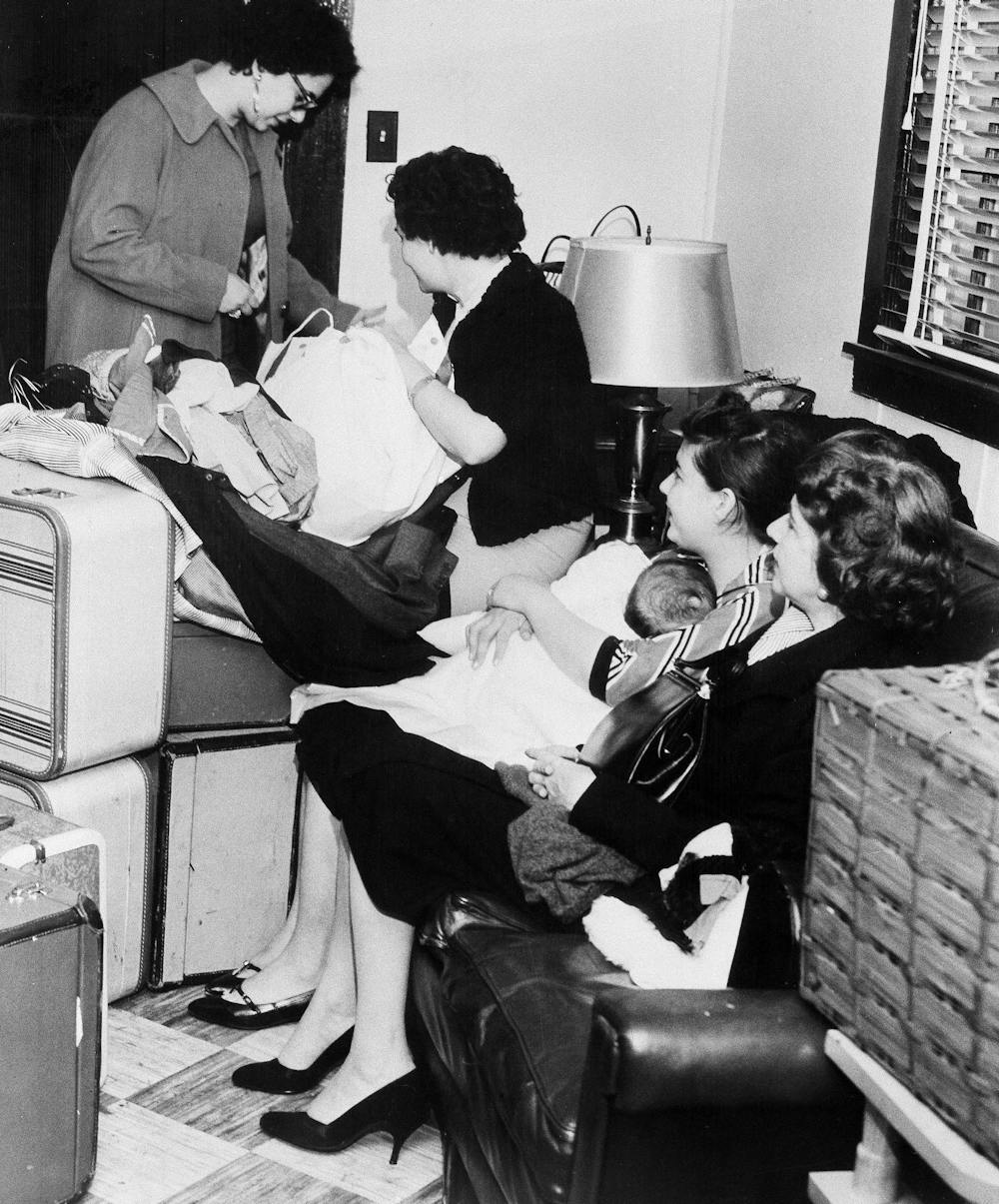
Cuban women who fled their country in an Immigration Service room in Jacksonville, Fla., while arrangements are made to grant them political asylum in the U.S., Jan. 1, 1959.
Normally, U.S. courts have no jurisdiction over property owned by non-citizens that is nationalized by a foreign government. For U.S. courts to sit in judgment of another government’s actions towards its own citizens would be a challenge to that government’s sovereignty.
Since virtually all property in pre-revolutionary Cuba was privately held, the foreign companies operating there, including many that also do business in the U.S., fear being accused of profiting from confiscated property and getting caught up in Title III lawsuits.
Consequently, U.S. allies bitterly opposed the law as illegal U.S. interference in their commerce with Cuba.
The European Union filed a complaint against the U.S. with the World Trade Organization in 1996 and adopted a statute prohibiting EU members and their companies from complying with Title III. Mexico, Canada and the United Kingdom passed similar legislation.
In response, President Bill Clinton suspended Title III of the act for six months, which the law allowed. The suspension has to be renewed every six months. Since then, every president, Democrat and Republican, has renewed the suspension. Donald Trump has already renewed it three times.
But recently, there have been indications that the longtime practice of suspending Title III’s provisions may end soon.
In November 2018, National Security Adviser John Bolton threatened to activate Title III, saying, “This time, we’ll give it a very serious review.” In January, Secretary of State Mike Pompeo announced a short 45-day suspension while the administration studied the issue.
The president has until the end of February to notify Congress if he decides to extend the suspension. Otherwise, Title III takes effect automatically.
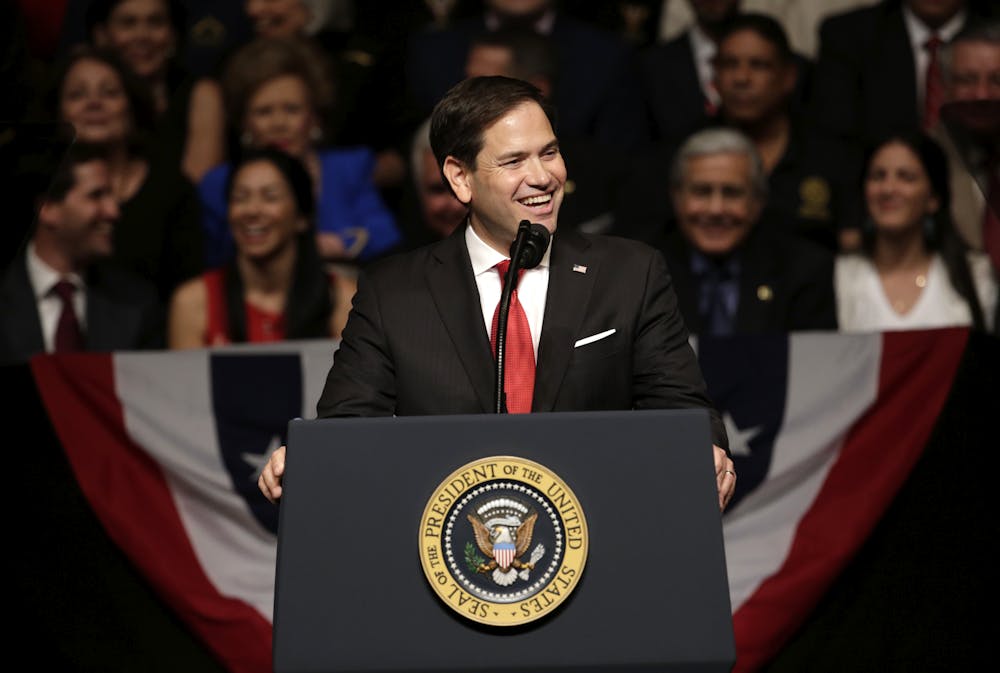
Sen. Marco Rubio, R-Fla., at a Miami event in 2017 where President Trump announced the revised policy against Cuba.
According to The New Yorker magazine, Trump gave White House staff paltry guidance on Cuba policy at the beginning of his administration.
“Make Rubio happy,” he told them.
Sen. Marco Rubio, R-Fla., and Rep. Mario Díaz-Balart, R-Fla, are the principal advocates for Title III. They are Cuban-Americans who represent the oldest, most conservative and wealthiest segment of the Miami Cuban community. From their mansions in Miami, that elite still wields disproportionate influence over U.S. policy through these legislators.
Most Cuban-Americans will gain nothing from Title III. It exempts private residences from compensation. So, if an exile’s main asset was their home, they are out of luck.
Still, a 1996 State Department analysis estimated that Title III could flood U.S. federal courts with as many as 200,000 lawsuits, creating a legal morass that would take years to sort out.
In the meantime, most U.S. firms and some foreign ones would likely hesitate to enter into commercial relations with Cuba for fear of becoming litigation targets in the United States. That’s a major purpose of Title III – to stymie Cuba’s economic development.
Cuban American families have already voiced claims for the port of Havana and José Martí International Airport, putting cruise ship companies and airlines on notice that they could face potential legal jeopardy over their use of these properties.
If these companies pull out of the Cuban market, Americans would still have a right to travel to Cuba, but no way to get there.
If Title III reduces foreign investment in Cuba, it will damage Cuba’s already fragile economy, which in turn would hurt the standard of living of ordinary Cubans.
In retaliation, Havana might well stop buying agricultural goods from U.S. farmers. That’s a market of over $250 million annually that American farmers can ill afford to lose when exports are down due to Trump’s trade wars.
Trump believes he won Florida in 2016 because of the Cuban-American vote, and he thinks Rubio can deliver it again in 2020.
I think Trump is miscalculating.
The remnants of Cuba’s pre-revolutionary “One Percent” no longer represent the Cuban-American community as a whole. By decisive majorities, Cuban-Americans support free travel between the U.S. and Cuba, broader commercial ties and President Obama’s decision to normalize relations. Every year, they send $3 billion to family on the island, and hundreds of thousands of them travel there to visit.
Those Cuban-American voters may not want to inflict more economic pain on ordinary Cubans, including their friends and family. Come 2020, they may punish a president who does.
The commander of U.S.-backed forces in Syria called on Monday for about 1,000 to 1,500 international forces to remain in Syria to help fight Islamic State and expressed hope that the United States, in particular, would halt plans for a total pullout.
The remarks by Mazloum Kobani, the commander-in-chief of the Kurdish-led Syrian Democratic Forces, followed talks with senior U.S. generals at an airbase in northeast Syria and offered perhaps the most comprehensive view to date of his requests for an enduring military assistance from the U.S.-led coalition.
“We would like to have air cover, air support and a force on the ground to coordinate with us,” Kobani told a small group of reporters who traveled with the U.S. military to an airbase at an undisclosed location in northeast Syria.
With U.S. help, the Kurdish-led fighters are poised to seize Islamic State’s last holdout in eastern Syria. At the height of its power four years ago, Islamic State held about a third of both Iraq and Syria in a self-proclaimed Caliphate.
But Islamic State still has thousands of fighters, who, now dispersed, are expected to turn to guerrilla-style attacks.
Kobani said there was discussions about perhaps French and British troops supporting the SDF in Syria. But he stressed he also wanted at least “a partial group of American forces,” who now number more than 2,000 in Syria, to stay as well.
U.S. Army General Joseph Votel, head of Central Command, said after the talks with Kobani that he was still carrying out President Donald Trump’s December order for a complete U.S. withdrawal of American forces.
“We certainly understand what they would like us to do, but of course that’s not the path we’re on at this particular point,” Votel told reporters.
U.S. PRESENCE
Asked about any discussions on a continuing U.S. presence in Syria, Votel said: “So the discussion really isn’t about U.S. forces staying here. We’ve looked at potentially what coalition (forces) might be able to do here.”
Trump’s surprise December decision to withdraw all the U.S. troops from Syria has triggered deep concern among U.S. allies about the risk of an eventual resurgence of Islamic State.
But the pullout raises an even more immediate threat to Kobani’s SDF, which fears that Turkey will make good on threats to attack them. He warned of a “new genocide” in SDF controlled areas of Syria.
Kobani thanked Trump for publicly stating his intent to protect the SDF but said: “I want him to live up to his word.”
Without a deal with the U.S.-led coalition, experts say Kobani may have to strike a deal with Syrian President Bashar al-Assad to avoid a Turkish sweep or a resurgence of Islamic State.
Votel is recommending continued support to the SDF as long as it keeps up pressure on Islamic State militants.
But Army Lieutenant General Paul LaCamera, who is the commander of the U.S.-led coalition battling Islamic State in Iraq and Syria, cautioned on Sunday that the United States would be legally unable to support the SDF if they partnered with Assad or Assad’s Russian backers.
Kobani stressed he was not seeking a military deal with Damascus.
Perhaps sensing an opportunity to stoke doubt among the Kurdish communities, Assad warned on Sunday the United States would not protect those depending on it.
“We say to those groups who are betting on the Americans, the Americans will not protect you,” he said. “The Americans will put you in their pockets so you can be tools in the barter, and they have started with (it).”
Senator Angus King, an independent from Maine, is among the U.S. lawmakers expressing concern the U.S. withdrawal could deal a devastating blow to Kurdish forces and warned that any sense of U.S. betrayal could cast a long shadow for years to come.
“It will chill future potential groups from assisting us if we’re going to treat the people who have been so stalwart on our behalf in this way. It is very dangerous in terms of national security,” he has said.
Reporting by Phil Stewart; Editing by Alison Williams