A heat wave in North Korea has led to rice, maize and other crops withering in the fields, “with potentially catastrophic effects”, the International Federation of Red Cross and Red Crescent Societies said on Friday.
The world’s largest disaster relief network warned of a risk of a “full-blown food security crisis” in the isolated country hit by international sanctions. The population is already stressed and vulnerable with malnutrition among children that could worsen, it said.
Reporting by Stephanie Nebehay, editing by Tom Miles
Turkish President Tayyip Erdogan has dismissed concerns over the tumbling lira, calling on Turks to “have no worries”, after the currency hit record lows in recent weeks on the back of a widening rift with the United States.
Ankara and Washington, NATO allies, have been at loggerheads over the detention in Turkey of U.S. evangelical pastor Andrew Brunson on terrorism charges, prompting U.S. sanctions on two of Erdogan’s ministers and threats of trade restrictions.
Early on Friday, the lira hit a new record low, plunging to as far as 6 against the U.S. dollar after a Turkish delegation returned from talks in Washington on Thursday with no apparent solutions to an ongoing crisis.
Speaking to supporters in the Black Sea province of Rize late on Thursday, Erdogan brushed off concerns over the currency as campaigns against Turkey.
“There are various campaigns being carried out. Don’t heed them,” Erdogan said.
“Don’t forget, if they have their dollars, we have our people, our God. We are working hard. Look at what we were 16 years ago and look at us now,” he said.
The recent sell-off in the lira has been fueled by investor concerns over Erdogan’s grip on monetary policy under a new powerful executive presidency and the ongoing row with the United States.
Erdogan, a self-described “enemy of interest rates”, wants banks to lend cheap credit to fuel growth, but investors fear the economy is overheating and could be due for a hard landing.
They are also concerned over the central bank’s ability to rein in persistent double-digit inflation with the president repeatedly calling for lower rates.
Last week, Erdogan called on citizens to convert their hard currency and gold into lira in order to prop up the plunging currency with a “domestic and national stance”.
The unorthodox approach of the president, who has dominated Turkish politics for more than 15 years, has unnerved investors who have voiced concerns over Turkey’s authoritarian trajectory under Erdogan.
Reporting by Tuvan Gumrukcu; Editing by Dominic Evans
The number of immigrant children in U.S. care who have still not been reunited with their families after being separated at the Mexican border has barely budged in the past week, as the government struggles to locate parents no longer in the United States.
Over 500 children out of more than 2,500 separated from their parents by officials at the border remain in the care of the government. The number dipped to 559 this week from 572 last week, according to a court filing on Thursday.
The children were removed from their parents as part of President Donald Trump’s ‘zero tolerance’ policy to discourage illegal immigration. The policy was abandoned on June 20 in the face of criticism at home and abroad.
Shortly after, U.S. Judge Dana Sabraw ordered that the government reunite the families within 30 days.
Since the bulk of the reunifications in July, there has been little progress, largely because many of the remaining parents have been removed from the United States to Guatemala and Honduras.
The government said in Thursday’s court filing that it still had not finalized a plan for reuniting 386 children whose parents were removed from the country, but said it had named representatives from four U.S. agencies to oversee the process in concert with plaintiffs in the case.
On Tuesday, the government provided the American Civil Liberties Union, which brought the case, with contact information for parents and relatives of those children, according to the court filing.
The ACLU said it was working with various charities to find the parents, but had been frustrated by the government’s slowness in providing information. Last week, Sabraw called the government progress “unacceptable.”
Nine children were returned to Guatemala on Tuesday, the first from that country to be flown from the United States to be reunited with a parent.
Reporting by Tom Hals in Wilmington, Delaware, Editing by Rosalba O'Brien
The Los Angeles District Attorney’s office said on Thursday that it was reviewing new sexual assault cases involving three celebrities: film producer Harvey Weinstein, action movie star Steven Seagal, and actor Anthony Anderson, the star of the television comedy series “Black-ish.”
The case involving Weinstein brings to six the number under review by Los Angeles prosecutors.
District Attorney spokesman Greg Risling did not give details of the allegations or when the alleged assaults took place.
Representatives for Weinstein and Seagal did not immediately respond to requests for comment on Thursday.
Weinstein has been charged in New York with three cases of sexual assault. He has been accused by more than 70 women of sexual misconduct, including rape, but has denied ever having non consensual sex with anyone.
The initial accusations against Weinstein in 2017 sparked the #MeToo social media movement that has seen many people publicly accuse men in business, politics and entertainment of sexual misconduct and many resigned as a result.
Seagal, 66, the star of 1980s movies like “Under Siege,” was made a Russian citizen by President Vladimir Putin in 2016 and earlier this month was made a special representative for Russian-U.S. humanitarian ties.
The claims involving Anderson, 47, were first reported by U.S. media in July.
Entertainment news website “The Blast” said a woman had filed a report with Los Angeles police accusing Anderson of assaulting her last year after she catered an event thrown by the actor.
Representatives for Anderson said in a statement that authorities have not contacted him or his representatives about the matter.
“It’s unfortunate that anyone can file a police report whether it is true or false,” the statement said. “Anthony unequivocally disputes the claim.”
Anderson was nominated last month for an Emmy award for his performance as the head of an African-American family in the comedy series “Black-ish.”
Reporting by Jill Serjeant; editing by Clive McKeef
Unswayed by the estimated 2 million abortion rights activists gathered outside its doors, Argentina’s conservative-leaning Senate on August 9 rejected a bill that would have made abortion legal up to 14 weeks of pregnancy.
Since 1921 Argentine law has allowed women to end a pregnancy only if it is the product of rape or is a danger to the woman’s life or health. An illegal abortion is punishable with one to four years in prison for both the woman and her doctor.
“If I knew with certainty that after voting [against the bill] there would be no more abortions in Argentina, I wouldn’t hesitate to raise my hand,” said Sen. Cristina Fernández de Kirchner, Argentina’s former president, when the vote finally happened after a 16-hour debate.
But, she added, “We are rejecting a bill without proposing any alternative, so the situation will stay the same.”
A public health problem, not a religious one
Kirchner, who is Catholic, voted for abortion. She said her view on the issue changed after “thousands and thousands of girls took to the street” and reframed abortion as women’s rights and a public health issue. “The future will be … feminist,” she said.
Other senators agreed that faith was not the topic at hand.
“I am a religious man,” said Sen. Luis Naidenoff, from the province of Formosa. “But one’s personal life should not decide state matters.”
Naidoff was one of the 17 men and 14 women who voted to legalize abortion. Twenty-four men and 14 women opposed the bill.
Many anti-abortion lawmakers put their religion squarely at the center of their abortion stance. Sen. Esteban Bullrich, a former education minister, said that “as a practicing Catholic” his aim was to defend life.
The tension between women’s rights and Catholic orthodoxy has for months put Argentina’s Catholic Church – the subject of my academic research – in an awkward but familiar position. It is morally, theologically and doctrinally opposed to an incredibly popular social reform.
The Catholic Church also fought laws that, in 2002, mandated sex education in schools and the distribution of contraception in public hospitals, even halting contraception distribution entirely in some provinces.
A groundswell of popular support for abortion
But the persistence and popularity of the Campaign for the Right to Legal, Safe and Free Abortion, which began in 2003, forced the church to rethink its approach – somewhat.
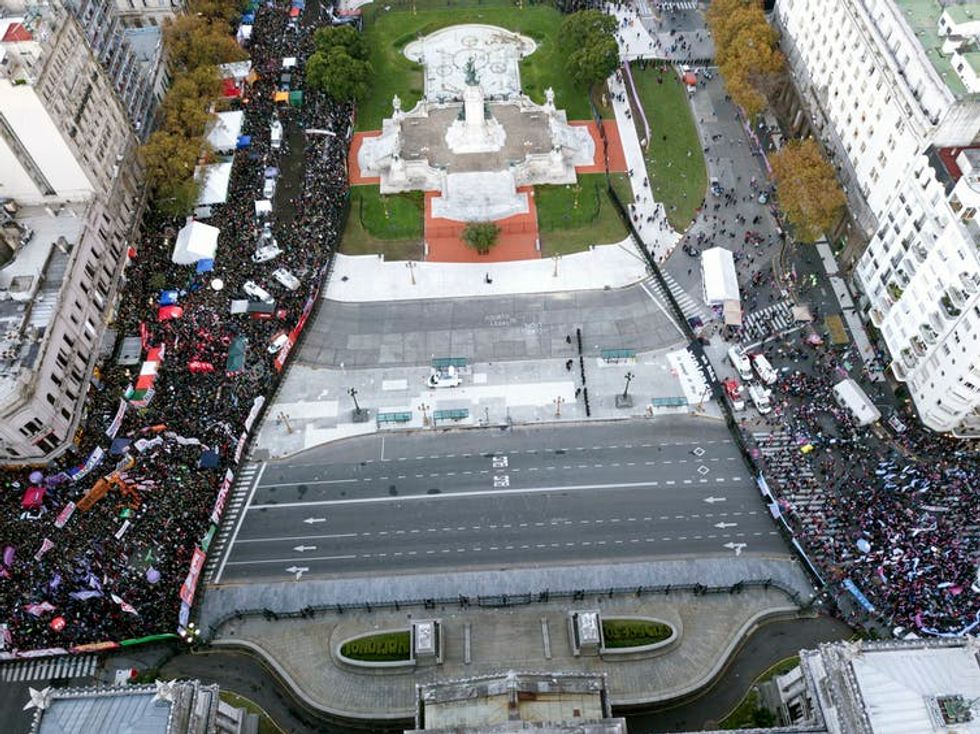
On March 10, at least 500,000 people – mostly women and young people – rallied outside Congress in Buenos Aires, waving green bandannas, the symbol of their movement. Nationwide, an estimated 1 million marched to demand women’s reproductive rights.
And, increasingly, they’re finding priests – including, often, the pope himself – who hear and understand their demands.
In a statement on April 20, after the Chamber of Deputies announced it would draft an abortion bill, the Argentine Episcopal Conference clearly affirmed the Catholic Church’s “defense of all life.”
However, it continued, “it is not our way to condemn anyone, but to enter into a reasonable dialogue about the question of life. We have done little to protect women who find themselves in this situation.”
The anti-abortion movement
A virulent anti-abortion movement did arise in Argentina in recent months. Protesters united under the color blue and the motto “Let’s save both lives” have marched daily since March 25, brandishing a giant papier-mache fetus.
Argentina’s pro-abortion demonstrations outside Congress, left, were far larger than pro-life protests, right.
AP Photo/Jorge Saenz
While Argentine church officials congratulated the “Catholics who fight for both lives,” the anti-abortion groups had stronger support from Argentina’s evangelical churches than from the Catholic Church, which did not institutionally endorse their marches.
Catholic opposition to legal abortion grew stronger in the months leading up to the Senate vote.
A “sacred mass for life” was celebrated in the historic Metropolitan Cathedral of Buenos Aires, a short walk from Congress, as lawmakers debated. After the vote, the Episcopal Conference celebrated bill’s demise, calling for Argentina to focus on “responsible sexual education.”
Abortion activists, for their part, say they will continue to fight for Argentine women’s right to choose. For the first time ever, abortion will be an issue in the general election next year.
With abortion, the Catholic Church now confronts the same dilemma it faced with divorce, gay marriage, trans rights and other major social changes in Argentina. If it continues to espouse the extreme stance of its conservative leadership, it will alienate Argentina’s increasingly moderate Catholic churchgoers.
Despite the Senate’s recent vote, in my analysis, it’s only a matter of time until Argentina legalizes abortion. And the Catholic Church, for its part, has been evolving to avoid obsolescence for over 20 centuries.
A federal judge on Thursday ordered an immigrant mother and daughter brought back to the United States after learning during a court hearing that the government had put them on a deportation flight.
The pair were among 12 plaintiffs in a lawsuit brought by the American Civil Liberties Union (ACLU) challenging changes in asylum policies ordered by U.S. Attorney General Jeff Sessions.
Washington D.C. District Court Judge Emmet Sullivan was hearing a request to stay the plaintiffs’ deportations, when the ACLU learned that two of them were already on a flight to Central America, the civil rights group said.
Upon hearing the news, Sullivan ordered their flight returned and suggested that Sessions could be held in contempt of court, according to the ACLU.
A spokesman for the Department of Justice did not immediately respond to a request for comment.
During the hearing, the judge ordered a temporary stay on deporting the nine women and three children who filed the lawsuit, according to a court filing.
The lawsuit was filed on Tuesday in the District of Columbia by the ACLU. It challenges a recent tightening on standards for seeking U.S. asylum, which makes it far more difficult for those fleeing domestic or gang violence to win the right to remain in the United States.
Sessions has led efforts by the Trump Administration to crack down on illegal immigration, including the adoption of a zero tolerance policy that briefly included separating immigrant parents from their children while they were in U.S. detention.
The family separation policy led to widespread criticism and was abandoned in June.
Reporting by Tom Hals in Wilmington, Delaware; editing by Sue Horton and Bill Berkrot
Facebook Inc is removing content related to instructions on 3D printing of firearms, a company spokesperson said on Thursday, as debate around access to gun in the United States intensifies.
“Sharing instructions on how to print firearms using 3D printers is not allowed under our Community Standards. In line with our policies, we are removing this content from Facebook,” the social media giant said.
Facebook did not clarify if it would remove only the related posts or the host pages and accounts as well, but said it would soon share an updated policy on restricted goods.
Reporting by Munsif Vengattil in Bengaluru; Editing by Arun Koyyur
Pumping carbon dioxide into the air makes the planet greener; the United Nations puts out fake science about climate change to control the global energy market; and wind and solar energy are simply “dumb”.
These are among the messages that flowed from the America First Energy Conference in New Orleans this week, hosted by some of the country’s most vocal climate change doubters - and attended by a handful of Trump administration officials.
The second annual conference, organized by the conservative thinktank the Heartland Institute, pulled together speakers from JunkScience, the Committee for a Constructive Tomorrow, and the Center For Industrial Progress, along with officials from the U.S. Department of Interior and the White House for panels that included: “Carbon Taxes, Cap & Trade, and Other Bad Ideas,” “Fiduciary Malpractice: The Sustainable Investment Movement,” and “Why CO2 Emissions Are Not Creating A Climate Crisis.”
The day-long conference reflected the political rise of global warming skeptics in Donald Trump’s America that is occurring despite mounting scientific evidence – including from U.S. government agencies - that burning oil, coal, and natural gas is heating the planet and leading to drought, floods, wildfires, and more frequent powerful storms.
A similar conference blasting the link between fossil fuels and climate change last year drew then-Environmental Protection Agency chief Scott Pruitt, who was appointed by Trump to reverse Obama-era climate initiatives and roll back regulation hindering drillers and miners but who has since resigned in a flurry of ethical controversies.
The U.S. officials who joined included White House Special Assistant Brooke Rollins, Interior Department Assistant Secretary Joe Balash, and Jason Funes, an assistant in the office of external affairs at Interior. They praised the administration’s moves to clear the way for oil industry activity, and steered clear of commenting on climate change.
But their presence gave climate change doubters at the conference a boost: “It’s a step in the right direction,” said self-described climate change doubter Roy Spencer, a principal research scientist at the University of Alabama, referring to the U.S. officials in attendance.
In an email, Interior Department spokeswoman Heather Swift said department officials “speak at thousands of conferences every year and share ideas with a diverse group of individuals.” A White House spokesperson did not immediately comment.
Tim Huelskamp, president and CEO of the Heartland Institute, said the views presented at the conference – once on the fringes of U.S. politics – would be proven right.
“The leftist claims about sea level rise are overblown, overstated or frankly just wrong,” he said in an interview. Regarding the United Nations’ findings on climate change, he said it was “fake science” motivated by a desire for “power and control.”
“COMING SOON”
Evidence of sea level rise, however, is strewn across the state that hosted the conference.
New Orleans has been ravaged repeatedly by hurricanes that scientists say will become stronger and more frequent due to climate change. And the rest of Louisiana is losing coastline at one of the fastest rates on the planet due to sea level rise and encroaching industry, according to the National Oceanographic and Atmospheric Administration.
“It’s a nice world they live in,” said Steve Cochran, campaign director of Restore the Mississippi River Delta, an environmental consortium involved in coastal restoration programs, referring to the attendees of the America First Energy Conference. “It’s not the world we live in.”
The Governor’s Office of Louisiana, a state that has earmarked tens of billions of dollars to fend off coastal erosion and relocate a Native American tribe from a sinking offshore island, did not respond to requests for comment about the conference.
In the conference exhibit hall, the words “Coming Soon!” in big orange letters framed a Heartland Institute advertisement for the fifth volume in its “Climate Change Reconsidered” book series. Attendees also passed around a book titled “Dumb Energy: A Rant Against Wind and Solar Energy.”
The more than 40 speakers praised Trump for withdrawing from the Paris climate accords, a global agreement to fight climate change mainly by cutting carbon emissions; and for rolling back regulations to allow oil companies to lead the biggest energy surge in the nation’s history.
But they warned that proponents of the U.S. oil and gas boom are still locked in an epic struggle with climate activists in academia and within federal agencies.
“The deep state is real,” said Congressman Clay Higgins, a Louisiana Republican, addressing the conference. “They’re certainly anti-fossil fuel.”
Higgins joked about renewable energy sources, like wind and solar, saying there is probably a conference somewhere in the United States where people are talking about “how the future of the world’s engine will be provided by rainbow dust and unicorn milk.”
David Legates, professor of climatology at the University of Delaware, argued that increased carbon dioxide emissions will not only leave the planet unharmed, but benefit plant life by allowing them to consume water more efficiently.
“So, you would expect, therefore, that this will be a greener planet,” Legates said.
Funes of the Interior Department spoke on a panel called “The Future of Coal, Oil, and Natural Gas,” alongside Joe Leimkuhler, vice president of drilling at LLOG Exploration Co. and Fred Palmer, who joined Heartland in 2016 after retiring from coal company Peabody Energy.
“Oil production under President Trump has increased 2 million barrels per day since the beginning of his administration,” Funes said. “The U.S. is exporting four times as much oil as it exported a decade ago.”
On the sidelines of the conference, Funes said he only attended the conference to speak about the nation’s surging oil production, and he refused to comment about the views of other speakers.
Efforts to reach Balash and Rollins were unsuccessful.
But on the dinner keynote address, Balash embraced the most obvious mutual terrain between the conference organizers and the Trump administration – the U.S. deregulation push.
“Last year, this administration rolled back 22 regulations for every one that it proposed,” Balash said. “Unfortunately, I think we need about a decade of that to get back to a reasonable place.”
The judge in the trial of U.S. President Donald Trump’s former campaign chairman Paul Manafort expressed contrition on Thursday to jurors for harsh commentary directed at prosecutors.
“I may have made a mistake. It has nothing to do with your consideration in this case,” U.S. District Judge T.S. Ellis said as the trial went into its eighth day in federal court in Alexandria, Virginia.
Ellis has repeatedly prodded prosecutors to move swiftly while seemingly giving Manafort’s defense team more latitude. He also has repeatedly made comments that some legal experts said may prejudice the jury against the prosecution.
Manafort has pleaded not guilty to 18 counts of bank fraud, tax fraud and failing to disclose foreign bank accounts. He is the first person to be tried on charges brought by Special Counsel Robert Mueller’s investigation into Russian interference in the 2016 U.S. election.
On Thursday, prosecutors in a legal filing asked the judge to correct some statements he had made on Wednesday.
Ellis had chastised the prosecution for allowing IRS agent Michael Welch to be present during court proceedings before taking his turn to testify.
Ellis has said he did not like having witnesses listen to the proceedings before they take the stand but the prosecution had previously requested case agents and experts be allowed. The prosecutors on Wednesday said Ellis had approved having them sit in, but the judge screamed at the lawyers in front of the jury, ‘”Don’t ever do that again.”
On Thursday morning, Mueller’s team requested that Ellis issue a “curative instruction” to the jury, saying he has “mistakenly faulted” the prosecution. In a filing to the court, prosecutors said that on the first day of the trial, they had told Ellis that Welch would remain in the courtroom, and he had not objected then.
Reporting by Sarah N. Lynch, Warren Strobel; editing by Doina Chiacu and Grant McCool
Mercedes-Benz sports utility vehicles built in Tuscaloosa, Alabama, are being checked for potential problems by Shanghai customs authorities, Daimler confirmed on Thursday, as a trade dispute between the United States and China heats up.
Mercedes-Benz GLE and GLS models, built in the United States between May 4 and June 12, 2018, have a brake issue which poses a “safety risk,” according to a Chinese customs document circulating on Chinese social media.
The document said authorities in Shanghai had found the rear brakes on these vehicles to be “insufficient.” The authenticity of the documents could not be verified with Chinese authorities.
Daimler said the company had been made aware of a potential brake issue related to vehicles in China imported from the United States.
“We are working with the relevant authorities to resolve the issue,” a spokeswoman said on Thursday. Daimler could not immediately comment on the number of vehicles affected, and is seeking to resolve what it described as an “entirely technical issue.”
On Wednesday, Chinese authorities said they would impose additional tariffs of 25 percent on $16 billion worth of U.S. imports from steel products to autos, in an escalation of the trade dispute between China and the United States.
In June, Daimler cut its 2018 profit forecast because of the trade war between China and the United States, sparking fears of a wave of earnings downgrades in the auto industry.
Reporting by Yilei Sun in Beijing and Edward Taylor in Frankfurt. Editing by Jane Merriman
The Kremlin on Thursday vowed to retaliate against "unacceptable" new US sanctions against Russia over its alleged role in a nerve agent attack on a former spy as the ruble and Russian stocks tumbled.
The action by the US State Department is the latest salvo in a series of disputes between the rival powers and comes less than a month after US President Donald Trump met his Russian counterpart Vladimir Putin in Helsinki.
The State Department said Wednesday the new sanctions were in response to "the use of a 'Novichok' nerve agent in an attempt to assassinate UK citizen Sergei Skripal" -- who was a Russian double agent -- and his daughter Yulia on English soil in March.
They are aimed at punishing Putin's government for having "used chemical or biological weapons in violation of international law," spokeswoman Heather Nauert said in a statement.
But the punitive measures triggered a furious reaction from Moscow.
Russia will "work on developing retaliatory measures," foreign ministry spokeswoman Maria Zakharova told journalists, accusing the US of "demonising Russia".
"We consider categorically unacceptable the linking of new restrictions, which we as before consider illegal, to the case in Salisbury," Kremlin spokesman Dmitry Peskov told journalists.
He called the US an unpredictable partner but said "Moscow retains hopes of building constructive relations with Washington".
The announcement of sanctions caused Russian stock markets to drop dramatically on opening and the ruble reached its lowest point since November 2016. The markets and the currency rebounded slightly over the day while remaining sharply down.
Finance minister Anton Siluanov assured Russians that the government and the central bank have "all the necessary tools to ensure financial stability," saying the economy has become more resistant to external shocks in recent years.
- Threat of wider sanctions -
The move could cut off hundreds of millions of dollars worth of exports to Russia, said a senior State Department official on condition of anonymity.
The official told reporters the administration decided to impose a "presumption of denial" for the sale to Russia of "national security sensitive" US technologies that require federal government approval.
Such technologies have often been used in items including electronic devices as well as calibration equipment. The exports were previously allowed on a case-by-case basis.
In the event of non-compliance, the official added, a second round of "draconian" sanctions would be given a green light. These could go as far as a ban on Russian airlines using US airports.
The latest US action follows the Treasury's imposition of sanctions in March against 19 Russian citizens and five entities for interfering in the 2016 US election -- the toughest steps against Moscow since Trump took office.
Also in March, Washington ordered the expulsion of 60 Russian diplomats, and the closure of Russia's consulate general in Seattle.
Moscow ordered 60 American diplomats expelled in a tit-for-tat response.
- 'Provocative, reckless behaviour' -
Britain said it welcomed the US response to the chemical attack in Salisbury, the sleepy English town where the Skripals were poisoned.
A spokesman for Prime Minister Theresa May said the sanctions send "an unequivocal message to Russia that its provocative, reckless behaviour will not go unchallenged".
This week, Britain's Guardian newspaper reported London is preparing to ask Moscow to extradite two Russian citizens suspected of carrying out the Salisbury attack.
The Skripals survived but a British couple was poisoned by the same Novichok agent in a nearby town, one of whom, 44-year-old Dawn Sturgess, subsequently died.
Moscow has angrily rejected any involvement in the poisoning, plunging diplomatic relations with London into crisis.
The Russian economy is still reeling from international sanctions imposed on Moscow in 2014 over its actions in Ukraine and a crash in oil prices the same year.
While Russia returned to growth in 2017 after two years of recession, it pales in comparison with growth figures seen during Putin's first two terms in office from 2000 to 2008 thanks to soaring oil prices.
WikiLeaks founder Julian Assange is considering an offer to appear before the U.S. Senate Intelligence Committee to discuss alleged Russian interference in the 2016 U.S. election, his lawyer said on Thursday.
“The U.S. Senate Select Committee request confirms their interest in hearing from Mr Assange,” his lawyer Jennifer Robinson said in a statement.
“The inquiry has asked for him to appear in person at a mutually agreeable time and place. We are seriously considering the offer but must ensure Mr Assange’s protection is guaranteed.”
Reporting by Michael Holden, editing by Elizabeth Piper
Tribune Media Co has terminated its $3.9 billion deal to be bought by Sinclair Broadcast Group, the company said on Thursday, after regulators objected to the acquisition that had received support from U.S. President Donald Trump.
Tribune also filed a lawsuit against Sinclair, alleging material breach of contract, the company said.
“To maintain control over stations it was obligated to sell, Sinclair engaged in unnecessarily aggressive and protracted negotiations with the Department of Justice and the FCC over regulatory requirements,” Tribune said.
The Federal Communications Commission (FCC) said in July that Sinclair “did not fully disclose” facts about the merger, raising questions about whether the company “attempted to skirt the commission’s broadcast ownership rules.”
FCC Chairman Ajit Pai has been vocal in his opposition to the deal, a stance that was criticized by Trump.
“So sad and unfair that the FCC wouldn’t approve the Sinclair Broadcast merger with Tribune. This would have been a great and much needed Conservative voice for and of the People,” Trump tweeted in July.
The FCC later voted to refer the proposed merger to an administrative law judge to review questions about Sinclair’s candor, a move that analysts had then said would likely lead to the deal’s collapse.
“In light of the FCC’s unanimous decision, referring the issue of Sinclair’s conduct for a hearing before an administrative law judge, our merger cannot be completed within an acceptable time frame, if ever,” said Tribune Media Chief Executive Officer Peter Kern.
“This uncertainty and delay would be detrimental to our company and our shareholders.”
Under the terms of the deal, Tribune and Sinclair had the right to call off the deal without paying a termination fee if it was not completed by Aug. 8.
Reporting by Arjun Panchadar in Bengaluru; Editing by Saumyadeb Chakrabarty




 Despite the Senate’s recent vote, in my analysis, it’s only a matter of time until Argentina legalizes abortion. And the Catholic Church, for its part, has been evolving to avoid obsolescence for over 20 centuries.