Conservative Republican Representative Mark Meadows said on Monday he expects an immigration bill to be offered in the House of Representatives on Tuesday will fail, but that it will be followed by legislation aimed at keeping immigrant families together at the Mexican border.
Asked on Fox News about the prospects of a second immigration bill passing or failing on Tuesday, Meadows told Fox News: “I would think fail right now.”
He said he had held discussions over the weekend about possible changes to the legislation.
The House on Thursday rejected a measure favored by conservatives that would have halted the practice of splitting up families and addressed a range of other immigration issues.
Meadows said that even if the compromise measure failed, he expected follow-up legislation aimed primarily at preventing children from being separated from their parents at the border.
“Representative Cathy McMorris Rodgers has given some thoughtful insight in terms of how we keep those families together, some of those things that a lot of us want to do, so I think if it doesn’t pass on Tuesday night you’ll see a follow-up piece of legislation within days,” he said.
The administration of President Donald Trump has faced a global outcry over images and video of crying children and their distraught parents separated at the U.S.-Mexico border. Critics in Trump’s Republican Party, as well as his wife and daughter, urged him to abandon the policy.
The president buckled to the pressure on Wednesday, issuing an executive order that ended the separations. But the government has yet to reunite more than 2,000 children with their parents.
Reporting by Doina Chiacu; Writing by Eric Walsh; Editing by Chizu Nomiyama and Steve Orlofsky
A meeting between adult film actress Stormy Daniels and federal prosecutors in New York investigating President Donald Trump’s longtime personal attorney Michael Cohen scheduled for Monday has been canceled, a lawyer representing Daniels said late on Sunday.
Attorney Michael Avenatti said in a Twitter post he had been informed by the U.S. Attorney’s Office that the meeting was canceled because media had found out about it and “they can’t handle a few cameras outside their offices.”
Prosecutors are investigating Cohen for possible crimes related to his business dealings, a source familiar with the investigation told Reuters in April. He has not been charged.
The probe stems in part from a referral by Special Counsel Robert Mueller, who is investigating whether there was any coordination between associates in Trump’s 2016 election campaign and Russia. Trump has repeatedly said there was no collusion, and Russia has denied election meddling.
Avenatti represents Daniels, whose real name is Stephanie Clifford, in separate civil litigation against Cohen and Trump.
Daniels has said she had sex with Trump in 2006 and that Cohen paid her $130,000 to keep the encounter secret shortly before the presidential election. Cohen has admitted making the payment, but Trump has denied the encounter with Daniels.
Reporting by Eric Walsh; Editing by Jeffrey Benkoe
Harley-Davidson Inc said on Monday it would not raise retail or wholesale prices for its dealers to cover the costs of the retaliatory tariffs by the European Union on U.S. products.
The tremendous expense if passed onto its dealers and retail customers would have a lasting detrimental impact to its business in the region, the company said in a regulatory filing bit.
Last week, the European Commission said it would start charging import duties of 25 percent on a range of U.S. products after Washington imposed tariffs on EU steel and aluminum at the start of June.
The company sees an annual impact due to the tariffs of about $90 million to $100 million and expects an incremental cost of about $2,200 per average motorcycle exported from the United States to the EU.
The company expects the incremental cost for the rest of 2018 to be $30 million to $45 million.
Harley said it plans to shift production of motorcycles for EU destinations from the United States to its international facilities to avoid the tariff burden.
Reporting by Sanjana Shivdas in Bengaluru; Editing by Maju Samuel
Working in West Antarctica is profoundly humbling. We scientists work from tiny field camps incongruously airdropped onto a vast plain of kilometers-thick glacial ice extending from horizon to horizon. It is initially difficult to conceive that this vast polar desert icescape could drastically change over the course of a human lifetime.
Yet, recent studies have revealed that ice loss is accelerating. In addition, floating ice shelves that help restrict Antarctic glaciers from flowing into the Southern Ocean are thinning and weakening.
In both cases the primary culprit is warming ocean currents that are melting the undersides of these vast glacial systems where they are afloat. Sea level rise from glacial melt in Antarctica, Greenland, and rapidly dwindling mountain glaciers, compounded by thermally expanding oceans, could disrupt the lives of hundreds of millions as soon as 2100.
In a rare bit of good news on Antarctica, our new study found that the bedrock underneath the West Antarctic ice sheet is lifting much faster than previously thought. This rebound effect – the land underneath the ice sheet uplifting as the ice melts – is a result of a newly recognized Earth structure, and can possibly slow melting.
The ice storehouse
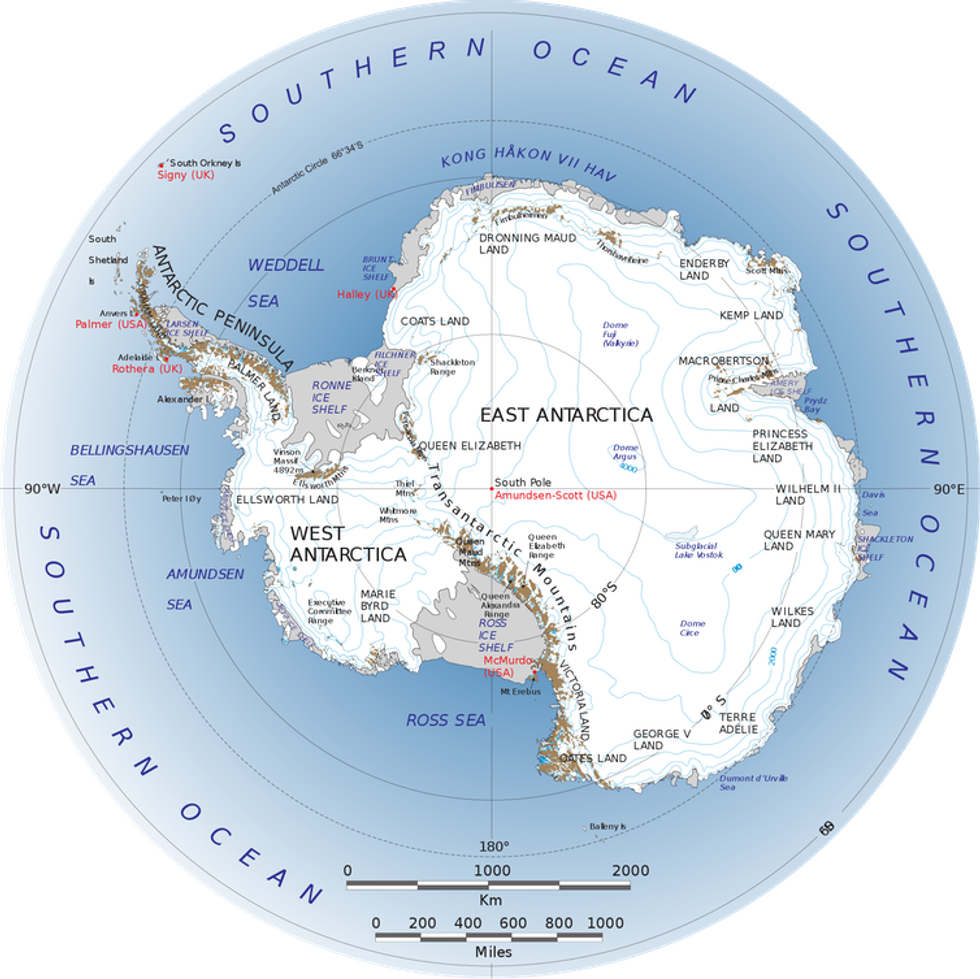
The vast majority of Earth’s ice resides in two distinct Antarctic ice sheets that, together, sequester about 90 percent of Earth’s fresh water in approximately 26.5 million cubic kilometers of ice. Together, they reflect millions of years of snow accumulation and glacial flow. Their prosaic names, East and West, reflect their approximate hemispheric locations. Antarctica’s ice, if wholly melted, would raise average sea level by an apocalyptic 60 meters.
The gargantuan East Antarctic Ice Sheet is very thick (up to 4,800 meters, or nearly three miles), high, cold, and its base is overwhelmingly above sea level. The smaller West Antarctic Ice Sheet is thinner, warmer and, importantly, occupies a rough bowl-like topography, with its deepest interior points plunging to more than 2,800 meters, or 1.7 miles, below sea level.
Scientists recognized in the 1960s that this peculiar geography makes the West Antarctic Ice Sheet susceptible to runaway instability. Under warming ocean and atmospheric conditions, it could collapse and deliver its ice to the sea on a time scale of just centuries to millennia.
Melting of the entire West Antarctic Ice Sheet would transform nearly every coastline, and coastal habitation, on Earth by adding about three meters to average global sea level. The Antarctic ice sheet is also so vast that its gravity attracts an enormous body of the nearby ocean. Release of this bulge would raise sea level in parts of the distant Northern Hemisphere by up to an additional meter.
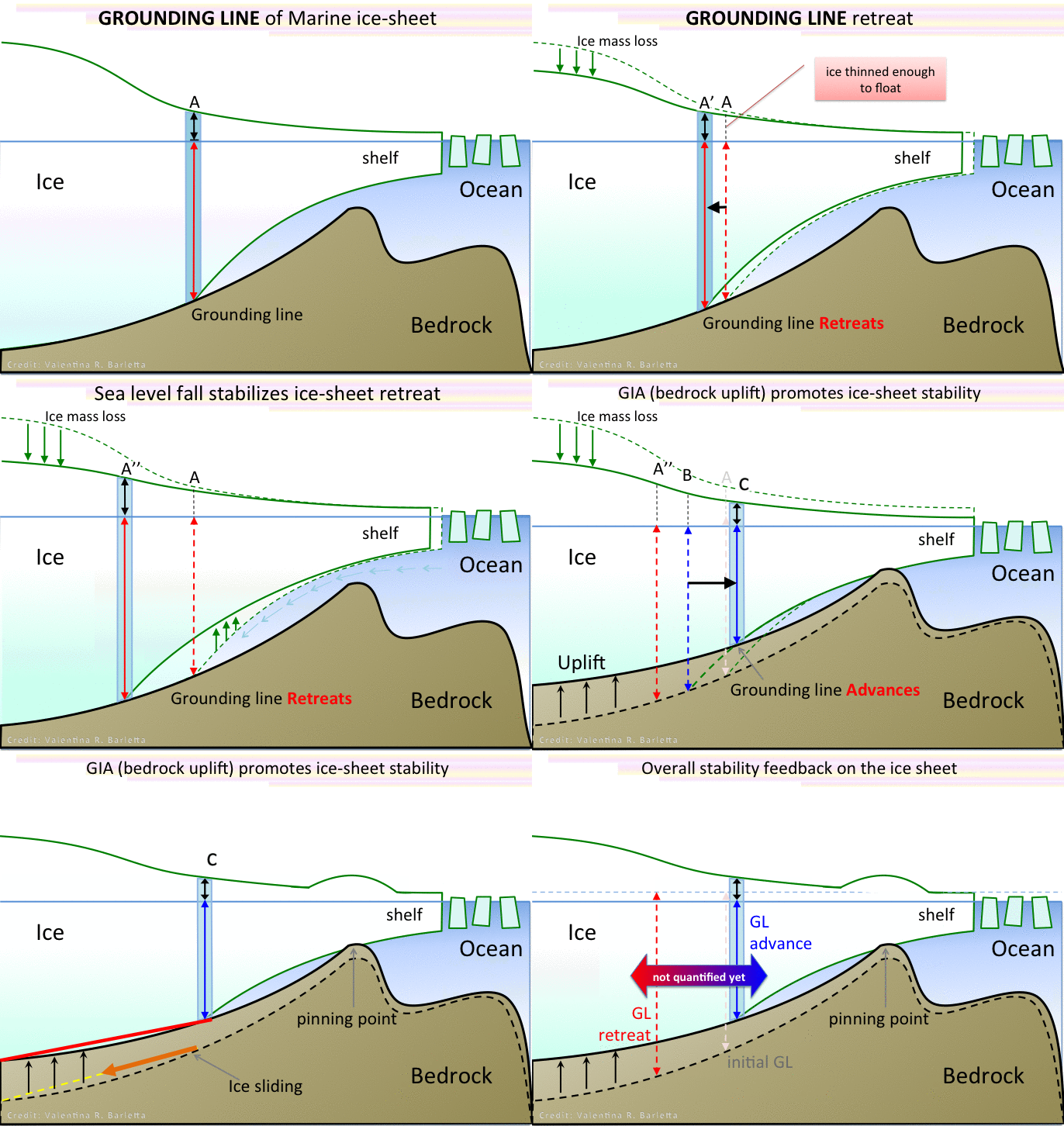
Grounding Line animation (topography greatly exaggerated) (Credit: Valentina R. Barletta, CC-BY)
Stability of West Antarctic Ice Sheet depends critically on where it is floating and where it is in contact with seafloor bedrock or sediments. The demarcation between grounded and floating regions is called the grounding line – this is the point deep beneath the ice sheet where it no longer in contact with land but is floating in ocean waters instead.
If the ice sheet thins due to melting from below, it floats higher and its grounding line will move inland. In this manner, more and more ice goes afloat, ice is more easily transported to sea to melt and potentially runaway collapse ensues.
A rebounding Earth and a seismic CAT scan
Credit: ESA/Planetary Vision
However, as ice mass is lost, the Earth also uplifts via a process called glacial isostatic adjustment. This provides a feedback that can moderate the ice instability. It was believed that the process would take too long, several millennia, to have practical effects on present-day ice loss. More recently, though, it has been recognized that if bedrock uplift is rapid enough – on the scale of centuries – it could protect West Antarctic Ice Sheet from collapse, at least under moderate levels of climate change.
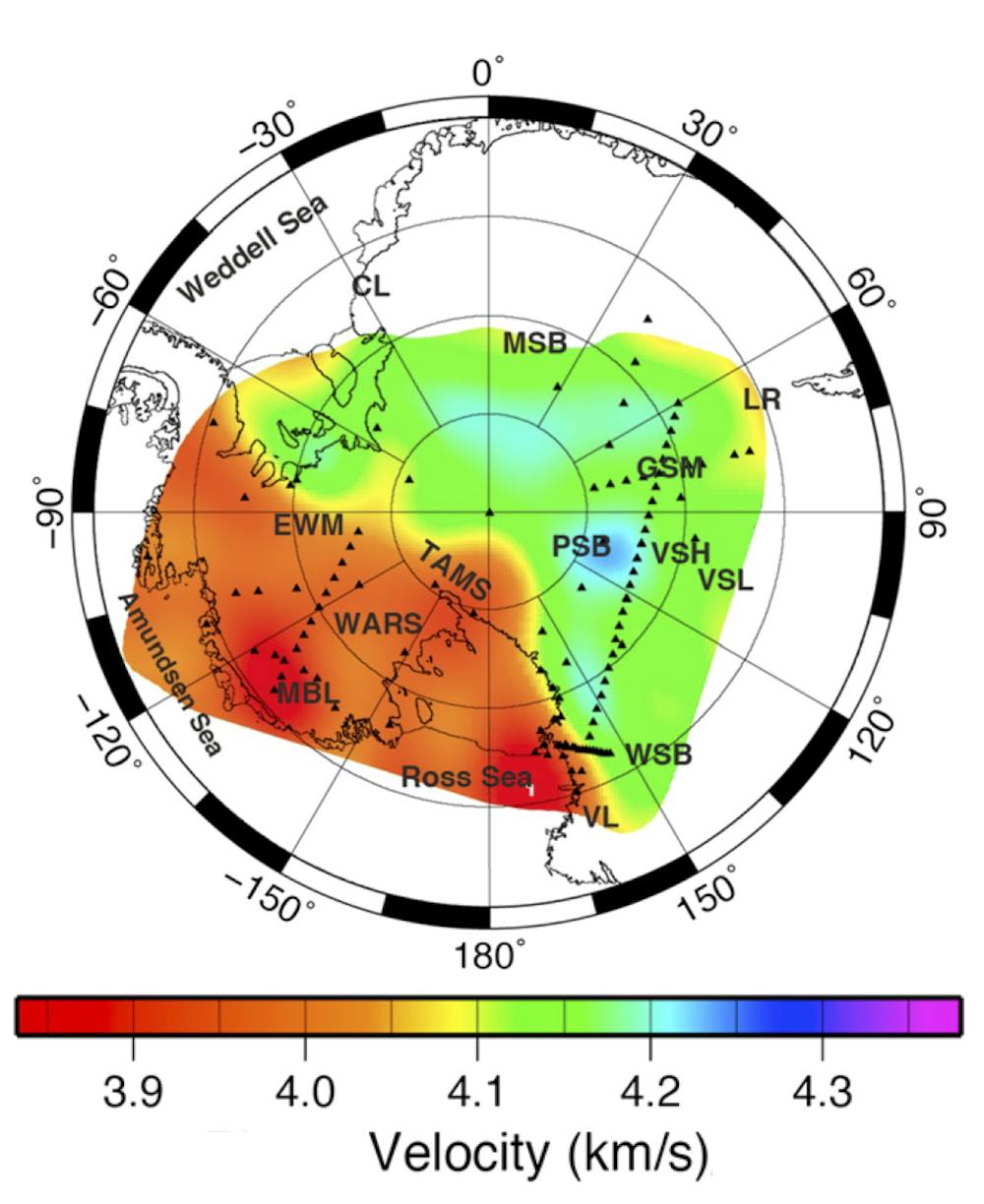
In our newly published paper, we and co-authors use data that we collected in West Antarctica to show that glacial isostatic adjustment is occurring much more rapidly than previously thought. Our imaging of the deep Earth using CAT scan-like seismic techniques also delineates a large region where the mantle (that is, 50 kilometers below the Earth’s crust) is unusually warm and relatively fluid. Together, these observations improve our understanding of how the solid Earth below West Antarctic Ice Sheet will respond to ice loss.
Slow seismic wave speeds in the mantle below the West Antarctic Rift System (WARS) and Marie Byrd Land (MBL) in West Antarctica indicate warm, low-viscosity mantle that leads to rapid uplift as ice mass is lost from the region.
A useful analogy for glacial isostatic adjustment is that of a double-layer mattress. First, the surface immediately springs back when ice is removed (think of a spring mattress at the top of the system) in response to reduced weight.
Secondly, and critically, there is a delayed uplift caused by slow responsive flow in the viscous mantle. This process is analogous to a deeper “memory foam” mattress that “remembers” its past load while it creeps back to its unloaded shape. If the mantle is cold and dry, this delayed uplift occurs on time scales in excess of millennia – regions near Hudson Bay and in Northern Europe are uplifting today in a ghostly response to the 10,000-years-gone northern ice sheets of the last ice age. If the mantle is relatively warm and hydrated, its viscosity will be much less, and the response can occur over just decades to centuries.
Uplift promotes stability
Deploying high-precision GPS instruments on remote rock outcrops, we discovered that glacial isostatic adjustment uplift in West Antarctica is among the fastest ever measured for a glacial region (up to 41 milimeters/year), and we showed that this is attributable to underlying warm and low-viscosity mantle. Theoretical calculations indicate that this surprisingly rapid uplift can inhibit or slow inland grounding line retreat and thus will make the West Antarctic Ice Sheet more stable. We furthermore predict that this rate should accelerate in coming decades.
Should society succeed in limiting the greenhouse gas concentrations of the atmosphere, the newly recognized rapid glacial isostatic adjustment uplift may cause the West Antarctic Ice Sheet
to slow down in its ice retreat and stabilize at a smaller volume.
If glacial losses elsewhere also abate, sea level might then level out after a rise of approximately one meter from today. However, if we do not succeed in limiting emissions and global warming, the uplift, even rapid, will be insufficient to stabilize the West Antarctic Ice Sheet grounding line and, ultimately, insufficient to stabilize the ice sheet.
While it may be impossible to know what Melania Trump meant when she wore a coat emblazoned with that statement during a recent visit to a children’s shelter in Texas, to many the message was clear: This administration does not care about the fate of over 2,300 or so migrant children who have been separated from their detained parents.
But it’s still worth taking the coat question seriously. Why should people care about the undocumented children Trump visited? Or, for that matter, the millions of kids and adults currently living in the U.S. without legal documents.
My work as the director of the Cornell Farmworker Program involves meeting with undocumented workers in New York, and the farmers who employ them. In my research, I’ve learned many reasons why Americans should care.
Far from the dangerous threat the president makes them out to be, undocumented immigrant workers play vital roles in the U.S. economy, erecting American buildings, picking American apples and grapes, and taking care of American babies. Oh, and paying American taxes.
So if our shared humanity isn’t enough to care, let’s examine the other reasons.
Many wondered what Melania Trump meant by wearing this coat on a trip to meet with children separated from their parents.
AP Photo/Andrew Harnik
A snapshot of who they are
Pew Research Center estimates that about 11.3 million people are currently living in the U.S. without authorization, down from a peak of 12.2 million in 2007. More than half come from Mexico, and about 15 percent come from other parts Latin America.
About 8 million of them have jobs, making up 5 percent of the U.S. workforce, figures that have remained more or less steady for the past decade.
Geographically, these unauthorized workers are spread throughout the U.S. but are unsurprisingly most concentrated in border states like California and Texas, where they make up about 9 percent of both states’ workforces, while in Nevada, their share is over 10 percent.
Their representation in particular industries is even more pronounced, and the Department of Agriculture estimates that about half of the nation’s farmworkers are unauthorized, while 15 percent of those in construction lack papers – more than the share of legal immigrants in either industry. In the service sector, which would include jobs such as fast food and domestic help, the figure is about 9 percent.
Further studies show that the importance of this population of workers will only grow in coming years. For example, in 2014, unauthorized immigrants made up 24 percent of maids and cleaners, an occupation expected to need 112,000 more workers by 2024. In construction, the number of additional laborers needed is estimated at close to 150,000. And while only 4 percent of personal care and home health aides are undocumented, the U.S. will soon require more than 800,000 people to fill the jobs necessary to take care of retiring baby boomers.
Overall, the agricultural industry in the United States has been on the decline since 1950. Back then, farming was a family business that employed more than 10 million workers, 77 percent of whom were classified as “family.” As of 2000 – the latest such data available – only 3 million work on farms, and as noted earlier, an estimated half are undocumented.
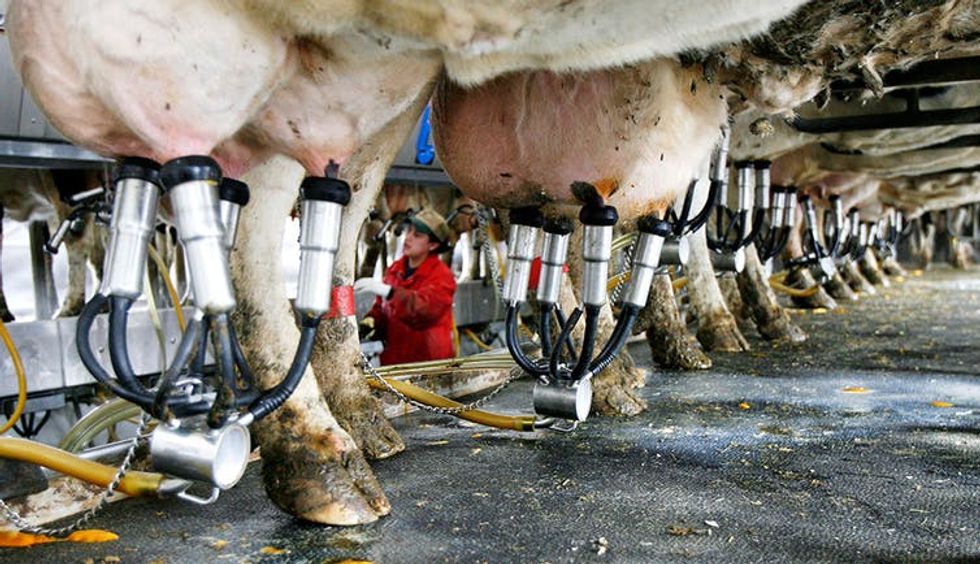
Increasingly, dairy farms such as those in New York rely on workers from Mexico and Guatemala, many of whom are believed to be undocumented. Currently, there is no visa program for year-round workers on dairy farms, so the precarious status of these workers poses serious concerns for the economic viability of the dairy industry.
In recent research conducted by the Cornell Farmworker Program, 30 New York dairy farmers told us they turned to undocumented workers because they were unable to find and keep reliable U.S. citizens to do the jobs. That’s in part because farm work can be physically demanding, dirty and socially denigrated work. More importantly, it is one the most dangerous occupations in the U.S.
A study commissioned by the dairy industry suggested that if federal labor and immigration policies reduced the number of foreign-born workers by 50 percent, more than 3,500 dairy farms would close, leading to a big drop in milk production and a spike in prices of about 30 percent. Total elimination of immigrant labor would increase milk prices by 90 percent.
The U.S. fruit, vegetable and meat industries are similarly at risk, and without the help of unauthorized workers, production would drop and consumers would likely see higher prices.
Although the focus is usually on the southern border, what happens in the north matters as well, in part because the Border Patrol’s 100-mile jurisdiction means immigrants living in most of New England can be pursued anywhere. As such, the surge in immigration enforcement along the border with Canada in recent years has resulted in more farmworkers being deported.
It also has meant fresh produce has been gone unpicked, left to rot in fields. One New York apple grower told us that due to labor shortages and dwindling prices for his red delicious variety, he plans to let his 100-year-old orchard go, because any investments in production would result in significant economic loss.
A Hispanic worker watches the milking operation at a farm in Fairfield, Vermont.
AP Photo/Toby Talbot
Who cares? Most Americans
Judging by the pronouncements from the White House, you might think most people don’t realize how integral undocumented immigrants are to the U.S. economy. But in fact, polls suggest that Americans do understand this, and also don’t believe that immigrants take their jobs.
In a soon-to-be-published poll Cornell conducted in 2017, we asked New Yorkers, “How do you believe undocumented farmworkers impact local communities?”
About 75 percent of those we polled said they have “generally positive impacts,” up from 62 percent in 2008. Of those who had a positive impression, most said it was because migrants fill jobs unwanted by citizens or provide essential farm help and keep prices low.
And national polling backs this up. A 2016 Pew poll found that 76 percent believe undocumented immigrants are as honest and hard-working as U.S. citizens, while 71 percent said they mostly fill jobs that Americans aren’t willing to do.
In other words, in response to Melania Trump’s coat question, not only are there lots of reasons to care, the vast majority of Americans actually do.
The mysterious British street artist Banksy appears to have taken aim at the French government's crackdown on migrants in a series of new murals in Paris.
The world's best known graffiti painter apparently "blitzed" the French capital over the last few days, leaving as many as six works on walls across the city.
None of the works were signed -- as has been Banksy's wont in recent years -- but experts told AFP that they look genuine.
The most political takes issue with France's tough anti-migrant policy, with nearly 40 makeshift camps razed in Paris in the last three years and President Emmanuel Macron determined that the city does not become a magnet for refugees.
In the mural a young black girl sprays a pink wallpaper pattern over a swastika on a wall next to her sleeping bag and teddy bear in an attempt to make her patch of pavement more cosy.
The image is on a wall in northern Paris next to an official refugee shelter which was controversially closed in March despite protests from the city's Socialist mayor Anne Hidalgo.
Since then around 2,000 migrants, including children and teenagers, have been sleeping rough along canals and under motorway bridges.
Migrants were still sleeping next to the mural on Sunday.
Experts said the image echoes the artist's 2009 painting "Go Flock Yourself".
- Artist defends migrants -
Banksy, a long-time supporter of the refugee cause, has not yet confirmed the works are his.
However, he has often travelled to make powerful political points with his art about everything from Brexit to the fate of the Palestinians.
In 2015, he painted a mural on the edge of the Calais "jungle" camp built by migrants trying to get to Britain, which has since been razed by the authorities.
"The Son of a Migrant from Syria" depicted Apple co-founder Steve Jobs -- who was of Syrian descent -- carrying a knapsack and an Apple computer.
He sprayed another, his take on Gericault's "The Raft of the Medusa", on the wall of a house in the northern French port -- a reference to the shipwrecked hopes of migrants trying to cross the English Channel.
Art historian and street art expert Paul Ardenne told AFP that the Paris murals were very much in Banksy's style.
"The colour, the line, the subject and the way he has adapted the images from photos ... all point to them being Banksy's style. There is a very particular signature. If (the mural of the girl) is not by Banksy, it is a very good copy," he said.
- Napoleon in a headscarf? -
AFP / Philippe LOPEZIn this mural Banksy appears to take a swipe at politicians and business leaders with a man in a suit offering a dog a bone having first sawn the animal's leg off
Another of the new works appears to touch on the equally sensitive subject of the ban on the niqab in France. It shows Napoleon rearing his horse as he crosses the Alps to invade Italy in 1800, his face and body wrapped in his red cloak.
The pastiche of David's canvass, one of the most iconic in French 19th-century art, appeared on a wall in a ethnically-mixed district of northern Paris.
Others, however, have seen it as a metaphor for a lack of political leadership, the general blinded by his own hubris.
And a third image near the Sorbonne university on the Left Bank -- which was rocked by a student uprising 50 years ago -- appeared to be a dig at the death of French revolutionary spirit.
One of Banksy's trademark rats -- his avatar for wronged ordinary people -- sits under the legend "May 1968" wearing a Minnie Mouse bow. The Disneyland Paris theme park just outside the French capital is now one of its biggest employers.
A fourth mural nearby took a swipe at politicians and business leaders. A man in a suit offers a dog a bone having first sawn the animal's leg off.
Two more Banksy rats appear in further images discovered this weekend, one dynamiting a road sign and another riding a popped cork from a champagne bottle.
Ardenne said it does not matter if the murals are by Banksy, but they do "show that the Banksy effect, and its ability to manipulate the media, works," he argued.
"We will look at them far more now thinking they are by Banksy rather than if it had been by any old artist," he added.
Banksy's apparent visit to Paris comes as another street art star who has also become an art world darling unveiled his latest creation in the French capital.
KAWS, aka American Brian Donnelly, made a 10-metre (33-feet) high statue of the French fashion legend Christian Dior with 70,000 flowers as the centrepiece of his erstwhile label's Paris men's fashion week show on Saturday.
After mocking censors working over time to delete comparisons of President Xi Jinping with the cartoon bear, comedian John Oliver and now the website of TV giant HBO have fallen victim to China's censorship machine.
Chinese authorities blocked HBO's website in China, just days after Oliver took Xi to task, anti-censorship and monitoring group GreatFire.org said on Saturday.
HBO joins a long list of Western media outlets that have had their websites blocked in China including The New York Times, Facebook, and Twitter.
"China: the country responsible for huge technological advances but it still can't seem to get pandas to f***," Oliver opened the episode of "Last Week Tonight" that is causing the problems.
Those technological advances include draconian surveillance and censorship measures which appear to have made HBO and Oliver their latest victims.
Oliver's name and that of the show he hosts were censored on China's popular twitter like Weibo.
"Send failure" Weibo returned when AFP attempted to post Oliver's name.
"Content is illegal!" the service said.
YouTube, which also airs "Last Week Tonight", has long been blocked in China.
Oliver's segment dug into Xi's distaste at comparisons to the self-described "bear of very little brain" and introduced viewers to repressive changes underway in the world's most populous country.
Chinese netizens have often compared Xi to A.A. Milne's most famous creation, something that censors have been quick to purge inside the Great Firewall.
The segment also recounted recent headlines: from Xi becoming "emperor for life" to a corruption purge that targeted his political rivals, to a crackdown on freedom of expression, human rights, and religion, to an ongoing suppression and imprisonment campaign against China's Uighur ethnic minority.
"Xi is actively removing the post-Mao guardrails that were put in place," Oliver said of changes to China's constitution which allow him to remain in power indefinitely.
"China is becoming more authoritarian just as it has major plans for expansion onto the world stage," Oliver said as the segment neared an end.
Australia is breaching commitments to protect the embattled Great Barrier Reef from the effects of land clearing, environmental groups claimed Monday and called on the UN to probe the alleged failures.
Canberra has pledged to step up efforts to protect the reef as it reels from mass coral bleaching and coral-eating crown-of-thorns starfish, which have proliferated due to pollution and agricultural runoff.
But the groups said the federal government had failed to stop a key threat to the World Heritage-list area -- the impending bulldozing of large swathes of land in reef catchments.
Experts have warned that deforestation increases runoff into the reef, reducing water quality and the light needed for coral growth, while fuelling outbreaks of crown-of-thorns starfish.
In a letter to the United Nations, the Wilderness Society, WWF-Australia, the Australian Conservation Foundation and the Australian Marine Conservation Society called for an urgent investigation as the UNESCO World Heritage Committee's annual meeting starts in Bahrain.
"Allowing this clearing to go ahead is not consistent with the promises the Australian government has made to the international community to protect and restore the Great Barrier Reef," Australian Conservation Foundation chief Kelly O'Shanassy said in a statement.
The conservationists said some 36,600 hectares (90,000 acres) of old-growth forest -- about half the size of Bahrain -- was earmarked to be cut down in reef catchments under permits issued by the former Queensland state government, but that Canberra had the power to stop them from going ahead.
Environment Minister Josh Frydenberg refuted the allegations and said the responsibility for planning and approval of land clearing lay with states.
He added that Canberra had won "significant praise" from the UN for a Aus$2.0 billion (US$1.5 billion) "Reef 2050" plan to protect the reef.
"On top of this investment the... government has also invested an additional Aus$500 million, representing the single largest investment in reef protection and restoration in Australia's history," Frydenberg said in a statement to AFP.
The bulk of the new Aus$500 million funding -- just over Aus$200 million -- announced in April was earmarked to improve water quality by changing farming practices and adopting new technologies and land management.
UNESCO's World Heritage Committee last year decided not to place the reef on its list of sites "in danger" despite concern over the mass bleaching, citing Canberra's conservation plans.
The Great Barrier Reef is one of Australia's best known natural wonders and stretches more than 2,300 kilometres (1,400 miles) along the northeastern coast.
The two Koreas Monday marked their war anniversary in a mood of detente, with Pyongyang dropping its customary anti-US rhetoric and Seoul saying talks have begun on moving the North's artillery back from the tense border.
Pyongyang's tightly controlled official media are normally packed with anti-American invective on June 25, when the North launched a mass invasion of the South in 1950.
But this year proved to be a marked exception in the wake of the historic Singapore summit.
In the South, Prime Minister Lee Nak-yon said discussions were taking place about relocating Pyongyang's long-range artillery away from their border.
North Korea is estimated to have around 1,000 artillery pieces along the frontier, threatening much of the South's capital Seoul only 50 kilometres (30 miles) away.
The North has long accused the US of provoking the 1950-53 Korean War as part of a plan for global domination and blames it for the division of the peninsula, agreed between Moscow and Washington in the closing days of World War II.
A US-led 16-country United Nations force supported the South in the conflict while China backed the North.
"Every year on this day, our army and people row the boat of memories, full of creed and determination to defend the nation," read a report in the North's state-run Rodong Sinmun.
"What surprised the world even more was... our people's solidarity to annihilate the enemy," it added -- without identifying the enemy by name in any of its coverage.
In stark contrast, all six pages of the newspaper last year were filled with colourful criticisms of the "US imperialists", blaming Americans for "a holocaust in which they massacred countless Koreans in the most brutal and barbarous way".
This year's anniversary comes less than two weeks after North Korean leader Kim Jong Un and US President Donald Trump shook hands at the unprecedented summit in Singapore.
More virulent forms of anti-US propaganda have been disappearing from the streets of Pyongyang, while images of missile launches and military formations on a prominent site outside the city train station have been replaced with visuals of industry and agriculture.
Analysts say the rare omission of the US in North Korean media coverage of the anniversary may be part of the regime's efforts to maintain the current diplomatic momentum.
"It's remarkable," said Peter Ward, a North Korea researcher at Seoul National University. "On this day of all days it's nowhere to be found."
"North Korean anti-Americanism may have popular roots (nourished by decades of agitprop), but what we see is what the state wants us to," he added.
Across the border at a war anniversary ceremony in Seoul, Prime Minister Lee acknowledged that the conflict began "due to North Korea's invasion".
But Lee noted the diplomatic rapprochement on the peninsula, with two inter-Korean summits preceding the meeting in Singapore -- after which Trump announced the suspension of joint military exercises with the South, the US's security ally.
In Singapore Kim and Trump signed a joint statement in which Pyongyang committed to "work toward complete denuclearisation of the Korean Peninsula".
But critics have said the encounter between the two mercurial leaders was more style than substance, producing a document short on details about the key issue of the North's atomic weapons.
British singer and actor Sting called world leaders “half men and cowards” on Saturday for their inability to solve the refugee crisis.
German Chancellor Angela Merkel has already played down expectations of a breakthrough at hastily-arranged talks among EU leaders on Sunday on the migration dispute dividing Europe and threatening her own government.
Austrian Vice Chancellor Heinz-Christian Strache said on Saturday he expects a chain reaction across the European Union if Germany closes its borders to refugees.
Migration policies in the U.S. have also been in the spotlight.
Thank God for Greece because you have shown the way,” said Sting, whose real name is Gordon Sumner, at an Amnesty International event in Athens.
“You have shown how to treat refugees when other people are building walls. When children are being taken from their mothers and put in cages, you are acting with compassion and generosity and commonsense,” he said.
“Because our so-called leaders, a sad parade of half-men, cowards, have not got the solutions ... Once again Greece has shown us how to be civilized.”
Nearly a million refugees passed through and got support from Greece in 2015, as the country was dealing with its own major financial crisis.
U.S. President Donald Trump on Wednesday abandoned a policy of separating migrant children from their parents on the U.S.-Mexico border, after images of youngsters in cages sparked outrage at home and abroad.
Sting told Reuters the family separation policy was “brutal” and “barbaric”.
The former frontman for The Police was in Athens for two concerts as part of world tour.
Reporting by Renee Maltezou; Editing by Michele Kambas and Andrew Bolton
The U.S. Treasury Department is drafting curbs that would block firms with at least 25 percent Chinese ownership from buying U.S. companies with “industrially significant technology,” a government official briefed on the matter said on Sunday.
The official, whose comments matched a report by the Wall Street Journal, emphasized that the Chinese ownership threshold may change before the restrictions are announced on Friday.
The move marks another escalation of President Donald Trump’s trade conflict with China, which threatens to roil financial markets and dent global growth.
Tariffs on $34 billion worth of Chinese goods, the first of a potential total of $450 billion, are due to take effect on July 6 over U.S. complaints that China is misappropriating U.S. technology through joint venture rules and other policies.
The Treasury investment restrictions are expected to target key sectors, including several China is trying to develop as part of its “Made in China 2025” industrial plan, the U.S. official said.
Among its objectives, the plan aims to upgrade China’s capabilities in advanced information technology, aerospace, marine engineering, pharmaceuticals, advanced energy vehicles, robotics and other high-technology industries.
The Wall Street Journal also said the U.S. Commerce Department and National Security Council were proposing “enhanced” export controls to keep such technologies from being shipped to China.
Spokespersons for the Treasury, Commerce Department and the White House did not immediately respond to Reuters’ requests for comment on the proposed restrictions.
The government official said the Treasury would invoke the International Emergency Economic Powers Act of 1977 (IEEPA) to devise the restrictions.
The act gives the president sweeping authority to restrict assets based on national security concerns. IEEPA was invoked broadly after the 9/11 attacks in 2001 to cut off financing for terrorist networks.
The Journal said the administration would look only at new deals and would not try to unwind existing ones, adding that the planned investment bar would not distinguish between Chinese state-owned and private companies.
The White House on May 29 said the Trump administration would press ahead with restrictions on investment by Chinese companies in the United States as well as “enhanced” export controls for goods exported to China, with details to be announced by June 30.
It also said it would unveil a revised list of Chinese goods for tariffs, which it did on June 15.
Reporting by Arshad Mohammed, Julia Harte, David Lawder and David Shepardson; Editing by Peter Cooney and Clarence Fernandez
The U.S. military is preparing to build temporary camps at two military bases to house immigrants, Defense Secretary Jim Mattis said on Sunday, in the latest sign of a growing U.S. military support role for President Donald Trump’s politically charged immigration policies.
Mattis, speaking to reporters during a flight to Alaska, did not specify the names of the bases or say whether they would house immigrant children or their parents, or both.
“The details are being worked out ... about exactly how much capacity they need at the two bases, what other kinds of facilities they need built,” Mattis said, as he disclosed the request for the facilities from the government’s Department of Homeland Security.
In the face of outrage at home and overseas over his crackdown on illegal immigration, Trump was forced last week to abandon his policy of separating children from parents who are apprehended for illegally crossing the U.S.-Mexico border.
Even though the president has now ordered that families be kept together in detention during immigration proceedings, it remained unclear where families would be held while the parents face criminal charges.
The U.S. military, and Mattis in particular, have stressed that it is simply providing logistical support to the Department of Homeland Security, which deals with immigration issues.
Mattis said the U.S. military had for decades provided shelter to immigrants, including for Vietnamese refugees in the aftermath of the Vietnam War.
“Providing shelter for people without shelter, we consider that to be a logistics function that is quite appropriate,” he said, when asked whether he had any concerns about a U.S. military role in immigration policies.
Although Mattis did not cite how many people could be housed at the bases, the U.S. military said on Thursday it had been asked by the government to get ready to house up to 20,000 immigrant children.
It said the government had already assessed three military bases in Texas and would review another in Arkansas.
Trump has previously turned to the military to help with his border crackdown. Earlier this year, U.S. National Guard forces were dispatched to border states to help tighten security.
Reporting by Phil Stewart; Editing by Peter Cooney
John Oliver began his Sunday show, "Last Week Tonight," by hammering President Donald Trump and Fox Business for their lack of compassion for the children they put in cages.
Oliver outright called Trump, "the abusive father everyone will be talking about in therapy for the next 40 years."
He went on to call out Trump for claiming that he had no power to change the policy that resulted in thousands of children being separated from their families and thrown into detention centers.
"His hands were tied. There was nothing he could do. Well, guess what?" Oliver asked, before showing a clip of the president doing the opposite. "Yes, Trump claimed he couldn't do a thing, and then he did it. Which is a little strange, because he usually claims he can do things and then doesn't do them, like 'draining the swamp,' or 'locking up Hillary,' or attending Tiffany's sweet 16."
Oliver cited reports that the children will now be held with families, however, there's a problem with that: children can only be held for 20 days legally. It's unclear what will happen to the children when the 20 days are up and their parents are still behind the cage doors.
"Which means, in less than three weeks, they could start splitting families up all over again," Oliver said.
When the host brought up the administrations plan to reunite children with their families, he explained that it's about as detailed as any Trump plan. According to a CNN report, they have everything put together except how long it would take and how it would get done.
"Well, hold on, because those are some pretty major pieces to leave out," Oliver said. "In fact, it's all the pieces."
When it came to Trump's apologists, Oliver said they were spinning in overdrive trying to come up with others they could blame for the crisis. That is, except for Fox Business host Stuart Varney.
"It took Fox's Stuart Varney to come up with the argument, 'Who gives a sh*t,'" Oliver summarized. He played a clip of Varney saying that the story the media isn't talking about is the success of Trump's tax cut. According to him, that's the real story.
"Wait: 'Why are we talking about this, we should be talking about something else,'" Oliver explained. "That deflection technique doesn't really work when the thing you're deflecting from is children in cages. If a realtor selling a house were to say, 'Why are we talking about the children in cages? The kitchen has marble counter tops.' The only acceptable response would be, 'Because they're children and they're in cages. Someone needs to let them out you f*cking monster!'"




 If glacial losses elsewhere also abate, sea level might then level out after a rise of approximately one meter from today. However, if we do not succeed in limiting emissions and global warming, the uplift, even rapid, will be insufficient to stabilize the West Antarctic Ice Sheet grounding line and, ultimately, insufficient to stabilize the ice sheet.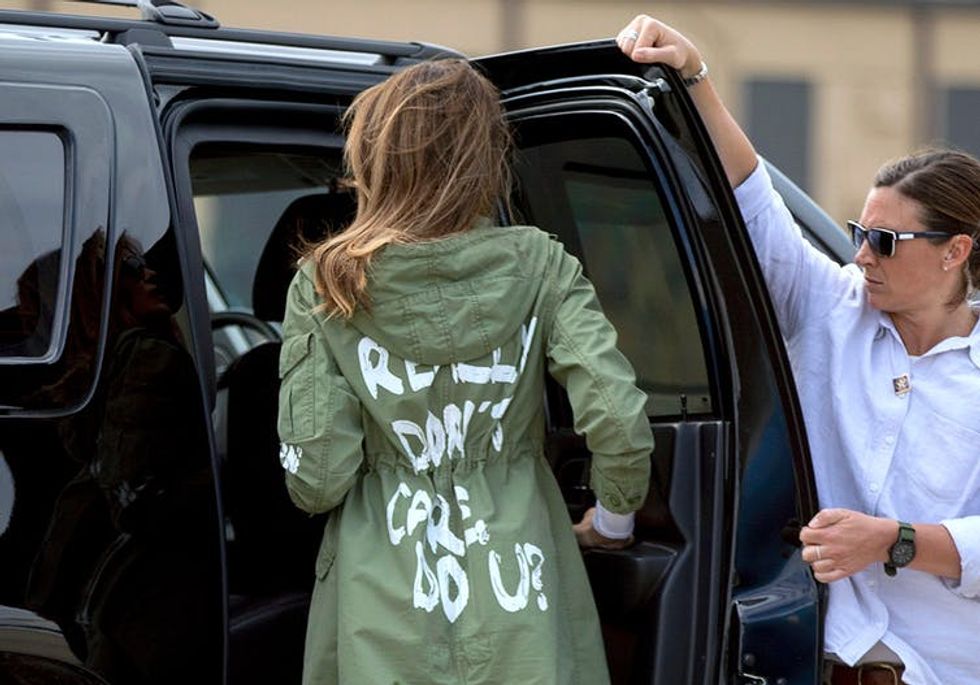
 In other words, in response to Melania Trump’s coat question, not only are there lots of reasons to care, the vast majority of Americans actually do.
 AFP / Philippe LOPEZ