Senate Minority Leader Chuck Schumer (D-NY) on Wednesday blasted President Donald Trump's administration for reportedly shelving a Centers from Disease Control (CDC) plan to deal with the novel coronavirus pandemic.
"Last week, Americans learned that the TrumpWhite House had blocked release by the Centers for Disease Control of a document that contained guidance for safely reopening up the country," Schumer explained during a speech on the Senate floor. "Making the wrong decision about when, where and how to reopen could result in loss of precious life that could be otherwise saved and in the occurrence of a COVID second wave that, God forbid, could be worse than the first."
"The country needs guidance of the nation's best medical and scientific experts," he continued. "But the White house has blocked the release of the CDC guidance reportedly so the president and his political appointees can make changes to it."
Schumer added: "As we all know, the president is not a doctor. The president is not a scientist. Many don't even believe he's a stable genius like he thinks he is. It has become painfully clear over the last two months how unfamiliar he is with the disciplines of science and medicine. Anyone who would say, 'Drink bleach -- use bleach to protect yourself,' is not much of a medical expert."
In her new report for The Intercept on the “Screen New Deal,” Naomi Klein looks at how the coronavirus pandemic is more high-tech than previous disasters — and how the future we’re being rushed into could transform our lives into a “living laboratory for a permanent — and highly profitable — no-touch future.” She joins us to discuss what she found, and says, “I think we’re going to see very incomplete so-called solutions … that massively benefit private tech interests.”
Federal Reserve Chairman Jerome Powell on Wednesday issued a stark warning about a potentially slow economic recovery from the coronavirus pandemic.
The Wall Street Journal reports that Powell argued that lawmakers in Washington shouldn't be afraid to inject more money into the economy, as he said that hopes for a quick recovery from the pandemic have dimmed in recent weeks.
"There is a sense, a growing sense I think, that the recovery will come more slowly than we would like," he said.
Powell argued that the "scope and speed of this downturn are without modern precedent, significantly worse than any recession since World War II," although he said that it would have been far worse without quick federal intervention to soften the blow for workers and businesses.
Nonetheless, Powell argued that now is not the time to take the foot off the gas pedal.
"The path ahead is both highly uncertain and subject to significant downside risks," he said. "Additional fiscal support could be costly but worth it if it helps avoid long-term economic damage and leaves us with a stronger recovery."
Even as the coronavirus continues to rage with 20,000 new cases diagnosed each day, President Trump has seemingly moved on and shifted his focus to reopening the economy -- in what many see as a desperate push to save his reelection chances. Writing for Slate this Wednesday, Elliot Hannon says that Trump and his cronies are going to try to mess with the 2020 election as much as possible to bolster their chances in November.
Hannon cites a recent TIME interview with Jared Kushner where he said he wasn't sure if the pandemic would postpone the November 3 election. Kushner later clarified to the New York Times that there are no plans to do such a thing. But Hannon writes that since so many lies come out of the White House it's impossible to be sure.
"The U.S. presidential election is, by law, held 'the Tuesday after the first Monday in November' and has been since 1845," Hannon writes. "Kushner acknowledged in his remarks to Time that the executive branch doesn’t have the power unilaterally to change the date of the election, as it would require Congress to alter the law. But 'the law,' as written, hasn’t stopped the Trump Train from bulldozing through things that were once considered sacrosanct in American life either to enrich himself or prop up is political conspirators."
While Trump is gung-ho for Americans to get out of their houses and get back to work, when it comes to Americans voting he's not so enthusiastic, Hannon contends. "Even if Trump and his allies don’t alter the date, they will do everything in their power to impede the process and impugn the result. They’re already doing just that."
The now-shelved guidelines for easing stay-at-home orders placed far more restrictions on reopening than the plan ultimately released by the White House.
The Associated Press obtained a copy of the 63-page plan developed by the Centers for Disease Control and shelved by Trump administration officials, and the in-depth document shares some similarities with the White House’s “Opening Up America Again” plan -- but also contains specific steps officials should take to ensure public safety.
“Many different places are considering how to safely develop return-to-work procedures," said Stephen Morse, a Columbia University expert on infectious disease. "Having more guidance on that earlier on might have been more reassuring to people, and it might have prevented some cases."
CDC staffers were always uncomfortable tying their guidance specifically to reopening and voiced their objections to White House officials responsible for approving the guidance for release, a CDC official told the AP.
Their detailed guidance was set aside April 30 by the White House, which released its plan to reopen a week and a half earlier, on April 17.
The shelved guidelines cautions against all nonessential travel until the last phase of reopening, and says such travel could potentially be considered after 42 consecutive days of declining cases of COVID-19.
“Travel patterns within and between jurisdictions will impact efforts to reduce community transmission too,” the report states. "Coordination across state and local jurisdictions is critical -- especially between jurisdictions with different mitigation needs."
The White House plan, on the other hand, recommends minimized travel in Phase 1 and opens the door to nonessential travel after 28 days of declining cases.
The CDC plan admits that COVID-19 cases will likely surge after states reopen, and advises local governments to closely monitor cases, while the White House lacks specific guidance for tracking outbreaks.
Instead, the White House plan offers only broad guidance, such as "protect the health and safety of workers in critical industries" and "protect the vulnerable."
As part of the global response to the current pandemic, scientists are trying to identify the source of the SARS-CoV-2 virus. Some commentators have promoted unsubstantiated theories suggesting that “factory farming,” or intensive large-scale livestock agriculture is to blame for this virus.
While these coronaviruses originated in animals, not one of these species is associated with “factory farming.” That makes it hard to follow the logic that farmed animals, rather than wildlife, resulted in the current pandemic. Animals, including pets, sometimes carry harmful germs that can spread to people. But studies show that the majority of emerging zoonotic diseases originate in wildlife.
And as an animal scientist, I have seen solid evidence that biosecurity practices associated with commercial animal agriculture decrease the risk of disease. While these practices – vaccination, physical distancing and preventing contact with wildlife - may not align with popular ideas of “naturalness,” they make livestock operations safer for both animals and humans.
Curbing outbreaks in livestock
Just as humans can experience pandemics, animal populations are also vulnerable to widespread disease events, known as panzootics. The World Organization of Animal Health estimates that illness and death due to animal diseases cause annual losses of at least 20% of livestock production globally.
The world’s 1 billion livestock keepers have a strong incentive to control zoonotic diseases. These outbreaks threaten animal farmers’ health and economic well-being. In general, large-scale intensive industries are able to implement biosecurity more effectively than small-holder or extensive industries, where animals are outdoors.
Toward this end, multidisciplinary “One Health” experts work in partnership on approaches to achieve the best health outcomes for people, animals and the environment. Commercial livestock farmers consult regularly with veterinarians and animal nutritionists, vaccinate against diseases, “socially distance” their young stock from each other and physically distance their herds and flocks from wildlife to reduce their exposure to natural reservoirs of microbes. The risk of disease outbreaks increases when biosecurity protocols fail, or are absent.
Basic biosecurity for U.S. teens exhibiting animals at fairs.
Cattle get pneumonia too
To see how livestock farmers work to curb infectious outbreaks, let’s consider viral respiratory diseases. These pathogens can cause pneumonia in cattle, just as SARS-CoV-2 does in people. Over 1.2 million cattle die each year in the U.S. from bovine respiratory diseases – about 1% of the national herd. This disease is epizootic, meaning that it does not infect humans, and is associated with multiple viruses, including a bovine coronavirus.
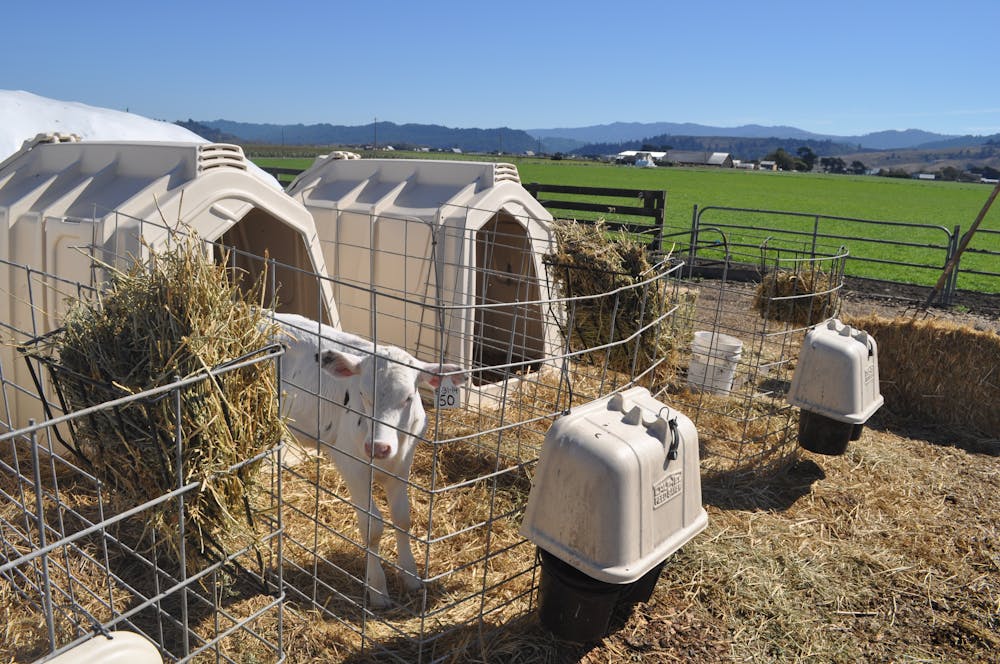
Respiratory pathogens spread through close contact and aerosol transmission. This is one reason why commercial dairy farmers raise their calves in hutches that are spaced roughly 4 feet apart, to prevent nose-to-nose contact. Think of it as bovine social distancing.
A dairy farm in California physically distances individual calves to prevent nose-to-nose contact.
On the other hand, commingling the animals this way poses a high risk of spreading germs. Just as humans are staying apart now to reduce transmission of the novel coronavirus, housing calves apart sacrifices some social interaction to reduce disease risks.
Respiratory disease in chickens
Isolating farm animals from infectious diseases spread by wildlife is a major reason why poultry and pigs are housed indoors. Animals raised in the open are at greater risk for predation and contracting infectious diseases from wildlife.
This was evident in the spring of 2018, when virulent Newcastle disease – a highly contagious viral respiratory infection – was reported in backyard chickens in Los Angeles. Since then, over 1.2 million birds have been euthanized or died from the disease. The infection has since spread to over 470 flocks in California, Utah and Arizona, most of them backyard flocks. Although vaccines are part of an effective biosecurity plan, less than 10% of backyard poultry are vaccinated.
China has the world’s largest pig population and provides half of global pork production. Small-scale and backyard farms with minimal biosecurity produce more than 60% of Chinese pork. Feeding pigs food waste, such as uncooked meat or food products – referred to as swill – is a high biosecurity risk, but is common practice on Chinese farms.
For many years China feared the introduction of a highly contagious and deadly tick-borne virus that causes African swine fever, or ASF. This deadly hemorrhagic disease, with mortality rates approaching 100%, was first detected in Kenya in the 1920s. Since there is no vaccine available, the only approach to control the disease is biosecurity. The virus moves between pigs, wild boar and soft ticks, but is harmless to humans.
A prophetic 2017 paper warned that ASF could reach China due to factors including international travel and commerce, swill feeding practices and the presence of wild boar populations. The disease surfaced there in 2018, likely through contaminated feed, and has rapidly spread into every Chinese province.
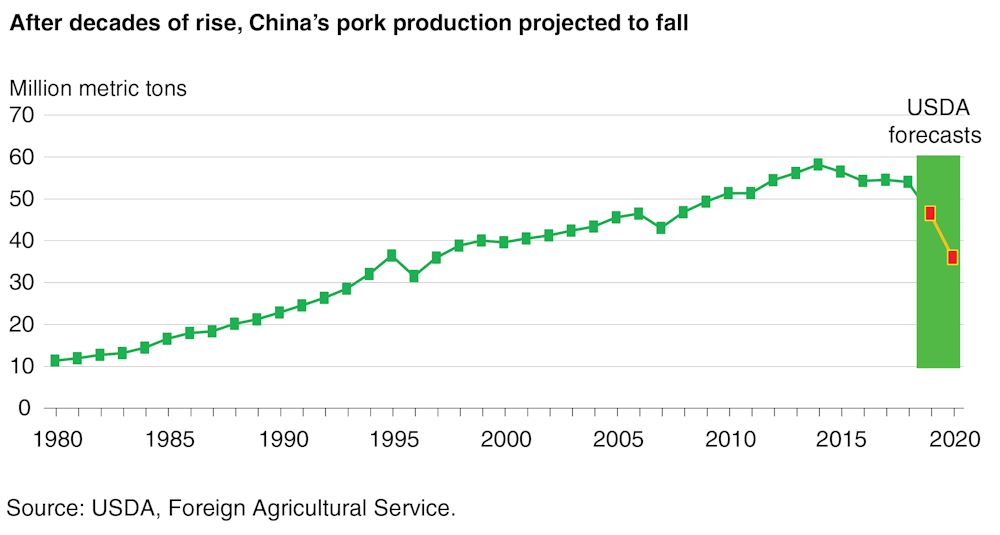
Before the ASF panzootic, China’s pork output was almost five times larger than U.S. production. That output has dropped sharply, doubling the price of pork in China, where it is the nation’s most-consumed meat.
An outbreak of African swine fever, likely caused by contaminated feed, has sharply reduced pork production in China since 2018.
ASF has spread to much of Asia and still threatens pig populations globally. Commercial pig producers in non-ASF countries have implemented strict biosecurity protocols, including managing feed sources,
and customs agents are on high alert for smuggled pork products that could spread the disease further. Unfortunately, some travelers seem oblivious to the potentially devastating impacts of dodging biosecurity measures.
Biosecurity works
Livestock farmers in developed nations understand the importance of biosecurity practices. That is why scientists believe the next important emerging pathogen is least likely to originate from livestock in these countries.
In my view, the focus should be on controlling and eradicating emerging animal diseases in resource-poor countries. Without such effort, more severe epizootic and zoonotic disease outbreaks are inevitable, threatening global health and food security.
This feels like it could be the most revolutionary moment in U.S. campaign history: Candidates are robbed of the typical ways for connecting with supporters and changing the hearts and minds of the voting public.
The coronavirus has ground the presidential campaigns of Joe Biden and Donald Trump to a near halt. Public rallies aren’t happening, and to follow social distancing guidelines, many of the campaigns’ local offices have stopped bringing in volunteers for phone banking or knocking on doors in local neighborhoods.
I have studied presidential campaigning since the 1996 election. In my book, “Presidential Campaigning in the Internet Age,” I document the ways that campaigns have evolved their campaign tactics to incorporate digital media.
For many years, political operatives have been perfecting their use of the internet’s vast array of social media platforms, websites and digital tools. They’ve identified effective strategies of digital communication with supporters and the press.
Now that traditional in-person campaigning has been severely limited, I believe campaigns will lean heavily on that digital experience, focusing in three areas: social media, campaign-specific mobile apps and paid advertising on social media.
A recent post from President Donald Trump’s Instagram account.
An initial slowdown
In general, political campaigns group voters into three categories: supporters, opponents and a group in the middle, sometimes called “persuadables,” who don’t have a strong connection to a political party or who aren’t that into politics. The members of this third group could be persuaded to vote for the candidate on Election Day.
The key function of a campaign is to identify supporters and mobilize them to be the workhorses for the cause: give money, volunteer, promote the candidate and – of course – vote. Campaigns also need to find and communicate to the persuadables, in hopes of getting their backing. And campaigns need to identify those who oppose their candidates, so they don’t waste time and money getting them to vote, which would only help the other side.
Regrouping before the conventions
There are natural slowdowns and lulls in the campaign season, including when the presumptive nominees are settled on, but before the party conventions make the nominations official – like now.
During these periods, the candidates reduce their activities aimed at the persuadables, like running TV ads. Instead, they reorganize their campaigns to complete the primary phase, and set up staffing and strategy for the general election.
During this time, the campaigns continue to engage with their supporters in hopes of amassing a large war chest and an army of volunteers to take on the opponent.
Campaigns also use this lull to expand their databases. Data about the public is as vital as money. It’s not enough to know a supporter’s name and address: Understanding their likes, habits, political behavior and even psychological predispositions can give a deeper picture, letting campaigns identify people with similar characteristics as potential supporters.
For the next few months, here are three things to watch.
Social media
As I explain in my book, since 1996 the Democratic and Republican party machines have been honing their strategies of communicating through digital media. They use Facebook, Instagram, Twitter and Snapchat alongside YouTube, email and websites in an integrated communications system.
Even though the digital platforms allow easy two-way communication on blogs, forums and social media, that’s not what the campaigns are looking for. They don’t want long, drawn-out policy debates on their pages. Instead, they want to use interactive elements of the internet to convert supporters and get them to give up data about themselves.
The social media accounts are the workhorses to cultivate supporters and draw them to the campaign’s website, which is home base. That’s where campaigns can deliver their most direct messages and collect that valuable data about their supporters.
The campaigns use a tactic I call “controlled interactivity” on social media to entice followers to share information about themselves. On the campaigns’ official feeds, they post polls, hawk merchandise and push an endless stream of requests to sign up for email or to give money. Anytime someone interacts with one of those posts, the campaign gets a little bit more data. For example, Trump’s Facebook page features posts about his virtual events with “Team Trump.” A click on the “join” link goes to the campaign website, where visitors are asked to give up their personal information: name, address, phone number and email address. When they do, the campaign just got a new supporter to target.
Mobile apps
The Trump campaign has an app encouraging supporters to join the effort.
Both Trump and Biden have launched mobile applications for iOS and Android devices. It’s worth their campaigns’ money and effort because it can keep supporters energized, and collect more data.
Only supporters – and perhaps curious reporters and opponents’ campaign staff – will download and seriously use the app. Once downloaded, its function is to make supporters feel like an insider by giving them news and “inside looks” at the campaign, tools to donate money and opportunities to become local organizers. Trump’s app encourages users to “Become a Trump Team Leader” by registering voters and knocking on doors in their community.
Most of these political apps are also designed to help grow campaigns’ voter contact lists. Not only do they collect the user’s own contact information but they often seek to access the phone’s entire contact list. These apps may also want access to photos, the user’s social media accounts and location information.
All of this data gives campaigns more extensive pictures of who their most ardent supporters are. That helps them target others with similar characteristics, to bring them into the campaign fold.
Paid ads
On television, most ads target persuadables in an effort to influence how they think about the candidates. That’s because television ads do not allow for the degree of fine-grained or micro-targeted advertising that digital media ads provide.
TV ads blanket whole regions, while social media ads pinpoint-target specific people based on the desirable traits that the campaign is after – typically people who look like supporters. This is where all that data comes in. Social media platforms like Facebook, Instagram and Google allow advertisers to create “look-alike” campaigns, where the advertiser feeds the social media company the names and email addresses of known supporters. Then the company’s proprietary algorithms find the email addresses that match, analyze the known Facebook profiles for their interests and behaviors and then find other users with similar likes, interests and behaviors.
Those people get targeted with ads; if they click on the poll or buy a hat that’s advertised, the campaign grows its support base while also improving its data about who is likely to respond positively to future ads. Political watchers have even speculated that this technique helped Trump win in 2016.
With the conventions now postponed to the end of the summer, Trump and Biden have more time to grow their databases, their financial war chests and their supporter bases.
Although it may seem an unprecedented campaign season that the candidates were ill-equipped for, the truth is that digital campaigning has been well-honed over six election seasons. They just need to do more online than they had planned for.
As more Americans lose all or part of their incomes and struggle with mounting debts, another crisis looms: a wave of personal bankruptcies.
Bankruptcy can discharge or erase many types of debts and stop foreclosures, repossessions and wage garnishments. But our research shows the bankruptcy system is difficult to navigate even in normal times, particularly for minorities, the elderly and those in rural areas.
COVID-19 is exacerbating the existing challenges of accessing bankruptcy at a time when these vulnerable groups – who are bearing the brunt of both the economic and health impact of the coronavirus pandemic – may need its protections the most.
If Americans think about turning to bankruptcy for help, they will likely find a system that is ill-prepared for their arrival.
It’s a hard road
There are many benefits to filing bankruptcy.
For example, it can allow households to avoid home foreclosure, evictions and car repossession. The “automatic stay” triggered at the start of the process immediately halts all debt collection efforts, garnishments and property seizures. And the process ends with a discharge of most unsecured debts, which sets people on a course to regain some financial stability.
We know from our empirical research, however, that filing for bankruptcy comes with costs. In a Chapter 7 case, known as a liquidation when a debtor’s property is sold and distributed to creditors, households may be required to surrender some of their assets. The post-bankruptcy path to financial stability is often bumpy.
Nonetheless, struggling Americans may find bankruptcy one of few viable options to address their worsening money problems, particularly as the pandemic shows no signs of ending soon.
In the last 10 days of March, when states began issuing such orders, we found that Chapter 13 filings fell 45% compared with the last 10 days of March 2019, based on a docket search on Bloomberg Law. Filings in all of April – when most states were under lockdown – plunged 60%, while Chapter 7 filings were down 40%.
This suggests that there’s pent-up demand for bankruptcy protection – in terms of what we’d normally expect – on top of the impact from the coronavirus recession.
In somedistricts, only attorneys can file electronically, so people handling the process themselves must mail in their petition or find some other way of getting it to the courts, such as via physical drop boxes.
But such methods still assume access to technology. A computer, the internet and a printer are needed to access and print the petition. Libraries and other institutions that traditionally provide technology access for those who do not have it are, for the most part, closed.
Some courts are allowing initial email submission of the petition from those without attorneys, but petitioners are still required to follow up by sending original documents via the mail or drop boxes. Access to a computer, the internet and a printer remains necessary.
Finally many states require “wet signatures” on bankruptcy petitions. That is, people have to sign their names in ink, as opposed to using an electronic signature. To smooth filings while courts are physically closed, several states have waived this requirement for those using an attorney.
But even then, access issues still abound. People must first send their attorney the vast array of documents needed for filing – typically amounting to dozens of pages. Filers still need to be able to copy, scan and email documents. For those without computer access, they have to mail original documents, a somewhat risky proposition when important papers could get delayed, stolen or lost.
A bad time to file
In other words, the middle of a pandemic is not the best time to file for bankruptcy.
But a first priority should be shoring up individuals, for whom bankruptcy is seen as a last resort. If more aid isn’t forthcoming, the bankruptcy system may be too overwhelmed to handle even that.
[The Conversation’s newsletter explains what’s going on with the coronavirus pandemic. Subscribe now.]
Have you noticed grabbing an extra bag of chips at the supermarket? Or eating more frozen dinners than you used to? Or even eating snacks that you haven’t eaten since you were a little kid?
The COVID-19 pandemic has upended nearly every facet of our daily lives, from how we dress, to how we work, to how we exercise.
It’s also changing the way we eat. As a registered dietitian and nutrition researcher, I’m fascinated by the types of food people are buying during this strange time.
One recent survey found that 42% of respondents indicated they’re purchasing more packaged food than they typically would and less fresh food.
Sales of frozen pizza have almost doubled. Sales of frozen appetizers and snacks – think Bagel Bites – are over a third, while ice cream sales have increased 36%.
According to Uber Eats, the most common food delivery order in the United States has been french fries, while the most popular beverage has been soda.
To me, these foods have one thing in common: They’re the stuff we ate as kids.
Why might grown adults be reaching back into the pantry of their pasts? What is it about a pandemic that makes us feel like we’re teenagers at a sleepover?
The reasons are deeply rooted.
At its core, the purpose of food is to nourish. Of course food provides us with the necessary energy and balance of vitamins and minerals to power and fuel the body. But anyone who’s reached for a pint of Ben and Jerry’s after a particularly stressful day will know that nourishment is about more than nutrition.
Yes, a delicious slice of rich chocolate cake can be just as good as drugs.
We tend to call many of these foods “comfort foods,” but the definition of comfort food is a bit slippery. Food is deeply personal. The foods that comfort people depend on their cultural background, taste preference, and personal experience. We know, however, that food can induce feelings of nostalgia that transport us back to simpler times.
So perhaps it’s no surprise that, during a period of uncertainty that has many of us desperate for some relief and comfort, the foods of our childhood can act as a salve. For some of us, that bowl of Lucky Charms isn’t just a sweet treat; it’s a reminder of days gone by, a time of safety and stability.
There’s nothing inherently wrong in finding temporary relief from chaos and uncertainty through food. But it’s probably best to view these changes in eating behavior as a temporary habit during a weird time. After all, a diet rich in macaroni and cheese and chicken nuggets doesn’t exactly set our bodies up for long-term success.
As people’s lives start to regain some sense of normalcy, diet can actually be a major part of the equation. Returning to a more health-conscious diet could be part of reestablishing your previous routines. And if you’ve never been able to find the time to prioritize healthy eating, now could actually be a good opportunity to start laying the groundwork for habits that become the new normal.
First independence. Then Brexit. Now Scotland's handling of the coronavirus outbreak has stirred up fresh tensions with the UK government, despite an initial unified approach.
The leader of the Scottish government, Nicola Sturgeon, has put clear water between Edinburgh and London by refusing to implement the same easing of lockdown measures.
At the weekend, she warned lives could be at risk if stay-at-home restrictions were lifted too soon, just before British Prime Minister Boris Johnson announced a plan for a gradual return to normality.
Johnson's ruling Conservatives have been criticized in the crisis, particularly for a lack of widespread testing and the supply of protective equipment for frontline workers.
The prime minister has also been questioned about his claim to have stopped the outbreak successfully, when more than 32,000 people have died -- the second-highest in the world.
But in Scotland, where figures released on Tuesday showed just under 2,000 deaths from nearly 14,000 positive tests, Sturgeon is perceived to be doing a good job.
A YouGov poll last week indicated 71 percent of people were confident Sturgeon would make the right decision, compared to just 40 percent for Johnson.
The approval rating comes on the back of indications of an increase in support for her Scottish National Party (SNP).
- 'Russian roulette' -
The latest crack in fragile relations between the UK government and the devolved administration in Edinburgh mostly centers around messaging.
Until Sunday, the UK-wide advice to the public was "Stay at Home" to avoid transmitting the virus and stop the state-run National Health Service being overwhelmed with cases.
But Johnson changed the slogan to "Stay Alert" as he sketched out plans to open up the economy again to certain sectors, after passing the peak of the outbreak.
"I don't know what 'stay alert' means," Sturgeon told reporters at the weekend.
"If I say to you, my message now is stay alert and you say to me, but does that mean I stay at home or not, and I can't give you a straight answer, I am failing in my duty to be clear in terms of what I'm asking you to do."
She argued rates of transmission were still too high in Scotland and kept restrictions in place.
"Let me be very blunt about the consequences if we were to do that. People will die unnecessarily," she added, later saying she wouldn't play "Russian roulette" with lives.
The devolved administrations in Wales and Northern Ireland took her lead, leaving only England to start moves towards the reopening of schools, shops and other businesses.
But confusion reigns, with uncertainty about who should go back to work and when, what safety measures should be in place, and the exact guidance on what is allowed.
The situation is one of the clearest demonstrations since the devolved administrations were set up in the late 1990s of different parts of the UK treading a markedly different path.
The leader of Welsh nationalists Plaid Cymru, Liz Saville Roberts, even referred to Johnson in parliament this week as "the prime minister of England".
But in Scotland, the stakes are high, with Sturgeon pushing hard for a new independence vote, six years after Scots voted by a majority of 55 percent to keep the three-centuries-old political union with England.
Johnson has emphatically ruled that out, despite SNP claims Scotland's overwhelming support for remaining in the European Union had moved the goalposts in the constitutional arrangement.
- Political capital? -
Chris Deerin, contributing editor for Scotland at the New Statesman magazine, said Sturgeon had won trust for remaining apolitical, cooperating closely with the UK government and "treating voters like grown-ups".
How much the SNP can turn the situation to its political advantage in the longer term is unclear, even as Scottish parliamentary elections approach next year.
Sturgeon is looking to consolidate her party's grip on power, and capitalize on indications of an increase in support for independence in recent months.
But Deerin said potential post-pandemic job losses and a lengthy economic downturn is likely to influence "those in the middle" in any future vote on going it alone.
"People may be nervous about moving ahead with independence," he told AFP.
"There has been a social coming together during the pandemic which may also affect the appetite for independence."
Marc Geddes, a lecturer in British politics at the University of Edinburgh, agreed.
"This crisis is also global in nature and the virus does not recognize borders," he said.
"This might well stem the tide for the independence movement because this pandemic requires close partnership and cooperation."
The World Health Organization is focusing on a handful of promising treatments for the deadly coronavirus.
The Geneva-based organization wants to learn more about four or five treatments that appear to be limiting the severity or length of the COVID-19 disease that has infected 4.19 million people around the world, reported Reuters.
“We do have some treatments that seem to be in very early studies limiting the severity or the length of the illness but we do not have anything that can kill or stop the virus,” said WHO spokeswoman Margaret Harris. “We do have potentially positive data coming out but we need to see more data to be 100 percent confident that we can say this treatment over that one."
Harris didn't identify any of the treatments that have been showing good results, but pharmaceutical firm Gilead has previously claimed its antiviral drug remdesivir seemed to help COVID-19 patients.
A CNN supercut of footage from Fox News on Tuesday night revealed how the network has launched a coordinated attack on Dr. Anthony Fauci, the director of the National Institute of Allergy and Infectious Diseases.
During a segment about clashes between medical experts and White House economic advisers on reopening the American economy, CNN's Alisyn Camerota played a montage of Fox News hosts slamming Fauci this week -- and she encouraged viewers to "see if you can spot the coordinated talking points."
The video started with Tucker Carlson arguing that Fauci "has not been elected to anything," and accused people of treating him like "he should be a dictator."
It then shows Sean Hannity accusing Fauci of trying to implement the Democrats' political agenda, while Laura Ingraham then attacked Fauci because "no one elected him to anything."
"Sometimes the talking point just hits you over the head with a mallet," Camerota commented. "Why Dr. Fauci? Why does he have a target on his back now?"
Analyst David Gregory responded by saying that Fox News is going after Fauci because "he has so much credibility and because, as a scientist, he seems to bring nothing but sober analysis and projections about this virus."
President Donald Trump doesn't usually attend his coronavirus task force meetings, according to a White House correspondent.
Associated Press reporter Jonathan Lemire told MSNBC's "Morning Joe" the president doesn't seem to understand that reopening businesses too soon will lead to another surge of infections and set the economy back even further, because he doesn't interact much with his public health experts.
"You are having some of the public health officials like Dr. [Anthony] Fauci and Dr. [Deborah] Birx are saying that publicly but also privately in the Situation Room in the task force meetings chaired by the vice president," Lemire said. "Meetings, mind you, the president himself usually doesn't attend. But those are happening less frequently, even within the building there's the focus towards the economy now, less of the public health."
That's not to say the president hasn't heard any warnings about the risks from reopening, Lemire said.
"There are some congressional allies and outside advisers who are still warning the president about how devastating it would be if there were a major flare-ups again over the summer or, indeed, that second wave that Dr. Fauci yesterday, again, said he believes is coming," Lemire said, "that there will be a second wave this fall and that that, of course, would devastate the economy in addition to costing thousands of Americans their lives."
"The president has, on occasion, bent to the public health advice," he added. "He did most famously, of course, when he backed off his idea of reopening the country by Easter. Instead, he pushed it back a few weeks. But the CDC guidelines were created."
The president hasn't exerted his leadership to help contain the pandemic, and instead has delegated his duties to governors and local officials.
"States haven't met the threshold to reopen, but the White House is not stopping them either," Lemire said. "In some ways that's because the White House is putting the onus, again, on the states, so if things go bad perhaps the president can blame others for what happened rather than himself, which is sort of par for the course throughout this particular crisis."