Senate Democratic leader Harry Reid is calling on the FBI to conduct a quick and thorough investigation into concerns the Russian government is trying to undermine the U.S. presidential election, including by tampering with official election results.
"The prospect of a hostile government actively seeking to undermine our free and fair elections represents one of the gravest threats to our democracy since the Cold War," Reid said in a letter to FBI Director James Comey.
"It is critical for the Federal Bureau of Investigation to use every resource available to investigate this matter thoroughly and in a timely fashion," Reid added. The letter, dated Aug. 27, was obtained by The New York Times and posted on its website on Monday.
Comey, speaking at a cyber security conference on Tuesday, declined to give details about what the FBI was investigating in connection with the political hacking but indicated the agency was closely watching what foreign countries are doing.
"We take very seriously any effort by any actor, ... especially nation states, that moves beyond the collection of information ... and offers the prospect of an effort to influence the conduct of affairs in our country, whether that is an election or something else," he said.
Reid's letter follows a spate of hacking attacks targeting U.S. political databases, including some that officials and cyber security experts have blamed on hackers with links to the Russian government.
The FBI discovered breaches in voter registration databases in Illinois and Arizona but did not specify who might have been behind it.
Officials and cyber security experts say recent breaches at the Democratic National Committee and elsewhere in the Democratic Party were likely carried out by people within the Russian government. Kremlin officials have denied that.
Reid, a Democrat, said that the threat of Russian government tampering in the election was "more extensive than widely known and may include the intent to falsify official election results."
He also voiced concerns about possible Russian government efforts to manipulate Republican presidential candidate Donald Trump's campaign ahead of the Nov. 8 election, and to use it as a vehicle to advance the interests of Russian President Vladimir Putin.
(Reporting by Dustin Volz and David Alexander; Editing by Frances Kerry)
Perennially cranky comedian Lewis Black made a rare appearance on MSNBC's Morning Joe on Tuesday and blasted the hosts for their detachment from reality in covering the 2016 presidential race.
"This is fiction!" said Black. "We are living in fictional times."
If you read what's happening now in a book, he said, it would be a great book. Living through it, on the other hand, is another matter.
This is the year, he said, when political satire and reality have met, fused together and become one.
Pastor Mark Burns, a surrogate for Republican presidential candidate Donald Trump, told CNN that he did not realize that a cartoon depicting Democratic nominee Hillary Clinton in blackface would be "divisive."
In an apology posted to Periscope on Monday, Burns explained that he regreted posting the controversial political cartoon, which he said was meant to show that Democrats "were using black people just for their votes."
"It was never my intention to hurt anyone or to offend anyone," Burns insisted to CNN host Alisyn Camerota on Tuesday. "Obviously, my message, I stand by. But the methodology, I do not."
Camerota noted that Burns also tweeted a hoax photo that he claimed showed Bill Clinton standing next to Hillary Clinton in blackface.
"Of course, I didn't have the correct information knowing it wasn't Bill Clinton," Burns said. "I think that's what the true message of grace is that once you discover new information, you change your opinion and get back on the right path. And that's what I'm doing right now to the whole world."
"My job as a pastor is to draw people together, not to push them away," he continued. "And once I began to discover how it was pulling people apart, it is completely contrary to the message of unity that I've been declaring around the world -- speaking at Mr. Trump's rallies around this country -- is that we as Americans should be focusing on the colors that unite us and not those colors that divide us."
"It was, in hindsight, a horrible image to use. For me, the blackface wasn't the focal point of the picture. For me, when I saw it, it was showing how Hillary Clinton and the Democrat [SIC] Party panders after the black vote."
Watch the video below from CNN, broadcast Aug. 30, 2016.
Donald Trump has repeatedly said that the United States is no longer a great country -- in fact, he's repeatedly said that we're like a third-world nation.
Despite this, Trump seems awfully offended that 49ers quarterback Colin Kaepernick is refusing to stand during the national anthem to protest police brutality against black people.
The Guardian notes that during an interview with Dori Monson on KIRO Radio, Trump said that if America is such a bad country, he should leave it and try to find a better country.
"Maybe he should find a country that works better for him," Trump said. "Let him try."
Of course, according to Trump, there are lots of countries that are better than the United States.
Remember when he kicked off his presidential campaign by bemoaning the fact that China is so much better than the U.S. at delivering infrastructure ("They have bridges that make the George Washington Bridge look like small potatoes")?
Donald Trump’s new outreach to “minority voters” is already showing signs of strain.
Soon after the shooting death of Nykea Aldridge, cousin of basketball star Dwyane Wade, Trump sent a controversial tweet:
Trump’s missive drew widespread condemnation for its opportunism and insensitivity, particularly in the context of Chicago. Shootings in the city surged more than 88 percent in the first three months of 2016 alone.
The furor that ensued after the tweet raised an important question: How would Trump’s gun policies affect life for minority and low-income people in cities like Chicago?
Prior to running for president, Trump supported banning assault rifles, requiring waiting periods on gun purchases, regulating gun sales to persons on terrorism watch lists, limiting guns in classrooms and a host of other gun violence prevention strategies.
Now, however, the New York real estate developer positions himself as the defender of even the most extreme gun rights as part of his broader transition to a guardian of law and order.
“I alone can fix it,” he told a national audience in his Republican National Convention acceptance speech, casting himself as the candidate of law and order. In the aftermath of the Orlando shooting, he made far-reaching statements that patrons should bring loaded guns with them into nightclubs. His claims prompted even the National Rifle Association, a group that endorsed Trump, to respond saying that the candidate defied common sense.
According to an interview with a far-right French magazine, Trump now carries a weapon with him at all times. He also named a vice presidential nominee, Mike Pence, who repeatedly voted to block liability lawsuits against gun manufacturers and boasts an A rating from the NRA.
As a gun violence researcher, I believe epidemic rates of American gun injury and death would get even worse if the positions Trump now claims to support are translated into national policies.
Eliminating gun regulations
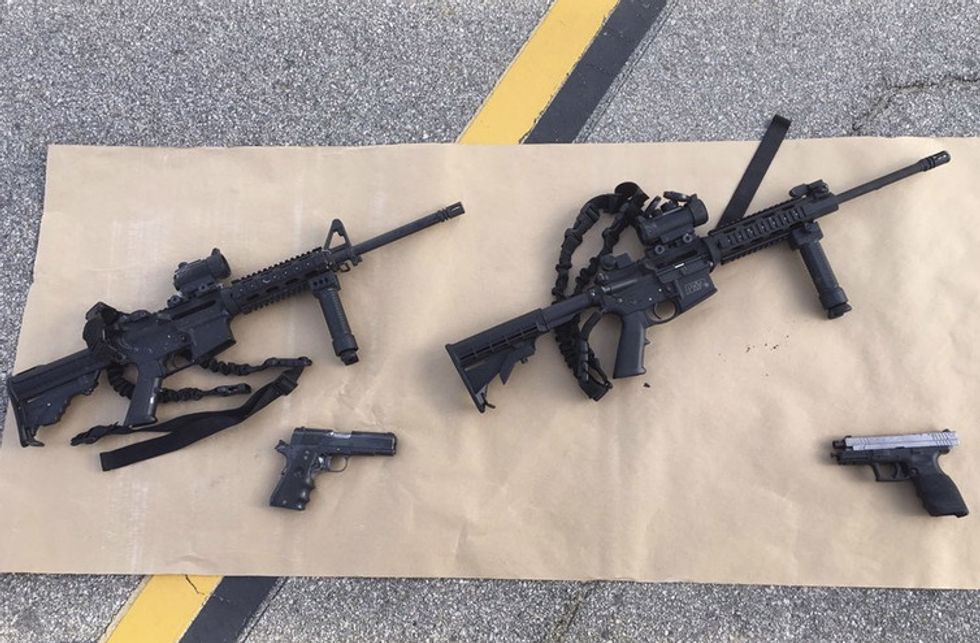
For instance, in sharp contrast to positions outlined by Hillary Clinton and vice presidential nominee Tim Kaine, Trump promises to eliminate most gun and ammunition regulations. This includes regulations that monitor sales of the assault-style rifles that have been used in practically every recent mass shooting, and in recent killings of police officers.
Weapons confiscated from attack in San Bernardino, California.
REUTERS
These popular, military-grade rifles, which were subjected to federal ban until 2004, are the weapons of choice for criminals and terrorists seeking mass casualty. The firearms are capable of accurately firing many rounds of ammunition in short bursts.
For these reasons, many states and cities such as Chicago regulate their sale and use. Yet under a Trump administration, such regulations could be in jeopardy. Trump’s website states, “the government has no business dictating what types of firearms good, honest people are allowed to own.“ It is unclear exactly how he would enforce such restrictions on states or come up with a standard of "good honest people,” and particularly so without the use of background checks.
Trump also supports a so-called national right-to-carry permit that allows gun owners to conceal and carry anywhere in the United States. This position could effectively make it illegal for cities like Chicago, or states like Illinois, to pass their own laws regulating guns. He also advocates for expansion of controversial “stand-your-ground” laws, and minimizes the rights of states to revoke gun permits.
So too, the Trump campaign rejects expansion of the federal background check system. This, despite the fact that most Americans – as many as 92 percent in a recent CNN poll – support requiring criminal background checks on all gun sales. Data also suggest that states where background checks are required have half the gun-related gun suicide, domestic violence, trafficking and violence against the police as states that do not. One study by the Johns Hopkins Center for Gun Policy and Research found the murder rate in Missouri jumped 14 percent after the repeal of a state law that required anyone purchasing a handgun to obtain a permit showing they had passed a background check.
Trump also supports the elimination of all gun-free zones. “I will get rid of gun-free zones on schools,” he said at a campaign rally earlier this year. His position would end long-held and often successful efforts to limit firearms in places like schools and classrooms, military bases, airports and even inside the RNC convention. For instance, advocacy groups that track classroom gun violence report that gun-free zones have been highly effective in minimizing gun homicides on college campuses.
Changing the law of the land
Perhaps most important, Trump’s promises to appointSupreme Court justices who will assure that these policies become the law of the land for generations to come. Indeed, Trump released a list of staunchly pro-gun potential Supreme Court nominees as a sign of his commitment to upholding the Second Amendment while speaking at the recent NRA convention.
If brought to reality, I believe Trump’s positions would worsen a state of affairs in which the U.S. has by far the most privately owned guns and the highest rates of gun violence among developed nations. Gun proliferation and increasingly lax gun laws would undermine his newly found commitments to promoting safety, law and order for the people of Chicago and elsewhere. Research consistently shows that more guns lead to more death, and particularly so among communities that Trump now says he aims to protect, such as African-Americans, people who live in “inner cities,” people with mental illness and even the police.
More broadly, Trump’s Twitter misstep and series of related comments raise questions about whether the candidate truly wants to improve the lives of communities of color. The policies he supports could make life markedly more dangerous for everyone, and particularly for minority and low-income populations living in cities like Chicago.
Almost everyone enjoys a bank holiday. A three-day weekend means more time to spend with family and friends, to go out and explore the world, and to relax from the pressures of working life. Imagine if, rather than a few times a year, we had a three-day weekend every week. This isn’t just a nice idea. Beyond the possibilities for leisure, three-day weekends might also be one of the easiest steps we could take to radically reduce our environmental impact – and future-proof our economy.
A reduction in working hours generally correlates with marked reductions in energy consumption, as economists David Rosnick and Mark Weisbrot have argued. In fact, if Americans simply followed European levels of working hours, for example, they would see an estimated 20% reduction in energy use – and hence in carbon emissions.
With a four-day week, huge amounts of commuting to and from work could be avoided, as well as the energy outputs from running workplaces. At a point when we need to massively cut back our carbon outputs, instituting a three-day weekend could be the simplest and most elegant way to make our economy more environmentally friendly.
It’s happened before. For example, in 2007 the US state of Utah redefined the working week for state employees, with extended hours on Monday to Thursday meaning it could eliminate Fridays entirely. In its first ten months, the move saved the state at least US$1.8m (£1.36m) in energy costs. Fewer working days meant less office lighting, less air conditioning and less time spent running computers and other equipment – all without even reducing the total number of hours worked.
For one day a week, thousands of commuters were able to stay at home. If the reductions in their greenhouse gas emissions from travel were included, the state estimated a saving of more than 12,000 tons of CO2 each year.
Utah abandoned the experiment in 2011 after residents complained they were unable to access services on Fridays. It seems this sort of change has to be accompanied by a shift in our expectations so that Friday becomes a “third weekend” rather than simply a weekday without work. What Utah does show is that, replicated across an entire country, a four day week would see substantial progress towards an economy that does less damage to the environment.
Yet there would be other benefits too. Working less would improve the elusive “work/life balance”, and help to restore our mental health and physical well-being. It would also give us more time to spend on social activities, to care for children and the elderly, and to engage with our communities. Experiments with reduced working hours at select workplaces in Sweden in 2015 reduced sickness and even increased productivity.
Directing gains in economic efficiency towards increased free time and reduced energy consumption, rather than making more stuff, could create a better and more environmentally safe world.
No commuting on Fridays would lead to an immediate reduction in emissions.Alex Segre / shutterstockAn obvious objection might be: “How could we afford this?” But there are serious economic and technological reasons for why governments, political parties, think tanks and social movements should all start to think about advocating for the implementation of three-day weekends.
As anthropologist David Graeber has recently contended, many of us work jobs that, at least partially, seem pointless. Indeed, economists have long been aware of the redundant hours contained in many working days, with employees effectively under-utilised in their workplaces, yet unable to leave due to the persistent issue of “presenteeism” – where workers are valued by managers for hours logged in the office rather than productivity. Rather than work longer hours for little productive benefit, we could embrace a shorter working week and help save our planet and our own well-being.
Looking more into the long-term, a new wave of workplace automation featuring advanced robotics and machine learning systems is predicted to replace 47% of current jobs in the US in coming decades, and 54% in Europe. In these circumstances, where there will be significantly less work available, instituting policies such as three-day weekends becomes essential to make life liveable under these changed economic conditions.
As Nick Srnicek and I have argued in our book Inventing the Future, automation will soon offer us the prospect of a very different world of work. More automation would make many production processes more efficient, using less energy and less human labour until, eventually, we are largely freed from work.
The key to capturing the benefits of automation without drastic social dislocation depends in part on developing policies which work to share the gains. This means a reduced working week thanks to an extended weekend, together with a universal basic income.
None of this will happen overnight. But, if you’re in the UK and are lucky enough to have Monday off, don’t forget that extra day at home or in the park is not only fun but will help fight climate change.
In a Monday night appearance on Seth Meyers' "Late Night," documentarian and liberal activist Michael Moore admitted that Donald Trump "played" him during filming for Roseanne Barr's old television talk show in 1998.
Trump told producers he was nervous to appear with Moore and threatened to walk out on the show. Moore, understandably, felt guilty and went over to try and reason with Trump and put him at ease.
“So I walk over to him, and I said, ‘Mr. Trump, it’s Michael Moore.’ And I shook his hand, and it’s all clammy.” Moore said, before adding “I don’t remember the size of the hand.”
Moore had just filmed the documentary Roger and Me about General Motors CEO Roger Smith and the plants he closed down in Flint, Michigan, during the mid-1980s.
“I’m having to talk him off the ledge from this,” Moore continued. “You know, grow some gonads here.” As a result of Trump's "fears" Moore was much nicer to Trump on the show, instead of hitting him hard about corporate practices. He admitted that it was years later he realized Trump "played" him. “I felt sorry for him, and the hands were so wet!” Moore explained.
Trump was a different person in the late 1990s, however. Moore recalls that the New York businessman “was extremely progressive," he described. "He was saying we should invest more in education, and we need health care. He said all the things that Hillary’s saying. That’s why I know that it’s just a con. The whole f*cking thing. It’s a scam, a con, and it’s rigged.”
Seth Meyers slammed GOP presidential candidate Donald Trump on Monday's "Late Night" for employing a strange and unsuccessful schoolyard style campaign strategy of "I know you are but what am I?"
Clinton slammed Trump for his association with the racist alt-right, while Trump tried to turn it around and claim that Clinton was the real racist — and he would be the best and biggest candidate for African American and Latino voters.
"There is a difference, though," Meyers began. "Hillary is using facts and evidence to document Trump's history of stoking racial resentment. And Trump might think 'bigot' is a compliment because it has the word 'big' in it."
He went on to imitate Trump saying that he wasn't just a "bigot" but a "hugeit."
While the two candidates are fighting it out over racism, they're also preparing for the upcoming debates. Clinton is poring over briefing books and rehearsal with top debate coaches. "So, just your laid-back classic Hillary," Meyers said, mocking the overachiever. "It sounds so intense I wouldn't be surprised if she was hooked up to a bunch of computers with steroids being pumped into her veins like Ivan Drago. When she shows up to the first debate to shake Trump's hand she's going to be like—" and he showed a clip of "Rocky" where Drago says "I must break you."
Trump, on the other hand, is preparing by summoning his counselors to his New Jersey golf course on Sunday for chats over bacon cheeseburgers, hot dogs and glasses of Coca-Cola, according to a Washington Post story.
"On top of the KFC and Taco Bowls if Trump doesn't get the job of president may I recommend Prilosec spokesman?" Meyers joked about the candidate's notorious proclivity for fast food and greasy dishes.
According to The Post, Trump tends to echo the words of the last person to whom he spoke. "That explains why Trump recently opened a press conference by saying, 'I don't want to do this anymore. I want to go home to Slovenia,'" Meyers joked, showing a photo of Melania Trump.
If predictions are accurate, we could all be in for quite the night of television. Trump is reportedly treating the debates like a reality show. "He wants to be a showstopper at the Roman Colosseum, the main event at WrestleMania," WaPo reported.
Ohio Gov. John Kasich's advisor John Weaver described debate prep last year as like a NASCAR driver preparing for a race knowing one of the drivers would be drunk. "And if you think drunken race car driver isn't exactly what Americans want in a president, don't worry, because Giuliani thinks Trump has an advantage," Meyers continued, showing a clip of the former mayor saying the bar is so low he's likely to clear it.
"That's right, Trump's biggest advantage is how low the bar is currently set," Meyers began. "Basically, as long as he doesn't walk on stage, take a whiz on the side of the podium and make up a story about how Hillary robbed him at gunpoint, he will exceed expectations," as a photo of scandalous Olympian Ryan Lochte flashed on screen.
The other thing we know about Trump's debate strategy, "no matter who it is, he will complain about the debate moderator. In fact, he's already started to complain preemptively, saying, he wants to make sure the moderator is fair to him," Meyers teased. The bipartisan commission on debates is taking the comments seriously too. They had planned to announce the moderators by late August, but that's now been pushed off to Sept. 5 because it's taking them longer to find individuals immune to accusations of bias.
"Look, guys, don't bend over backward for Trump. The only way he won't complain is if he gets to moderate the debate himself," Meyers continued, making up a potential question about Clinton's secret illness and why she loves ISIS.
VP candidate Mike Pence is looking for someone to play rival Tim Kaine, but Meyers suggested he simply go to Home Depot and grab a sheet of drywall. The VP debate will be about as exciting as a WWE match followed by 'Prairie Home Companion.' "You might as well hold the debate in an abandoned shopping mall with a racoon as the moderator," Meyers closed.
August is typically a terrible month for news. Congress is in recess, people are off on vacations and kids are going back to school.
"Fortunately, something popped up: Anthony Weiner," Colbert said on Monday night's "Late Show." “I just want to extend my thanks to him for rising to the occasion with this truly rock solid story.” Then, just to hammer it home, he randomly threw in an extra “boner” for good measure.
Just a month ago, Weiner was on the "Late Show" to talk politics and poke fun at himself. Colbert couldn't remember if Weiner said anything about his penis during that appearance. He cut to clips of that show, shocked to find Weiner's topic was about the last “eight years of remarkable growth.” Now, he's poking a different tune.
“You know what they say: Fool me once, shame on you,” Colbert said. “Fool me twice, shame on me. Fool me three times, dammit, Anthony, just keep it in your pants until after the election!”
Late Show host Stephen Colbert gave his own diagnosis on Monday of Harold Bornstein's assessment of Donald Trump.
"Bornstein proved he's a true gastroenterologist because the letter seems like he yanked it from where the sun don't shine," Colbert said of Bornstein's heavily-criticized letter describing the GOP presidential nominee's health last December.
Colbert pointed out that critics have wondered whether Trump himself wrote the letter, given the use of terms like "astonishingly excellent" and Bornstein gloating that the real estate magnate's exams had yielded only "positive" results.
Besides the fact that he looked like a "very questionable Gandalf," Colbert was concerned over Bornstein's admission that he was "rushed" and "anxious" when he wrote the letter, given that Trump had a driver waiting for him outside of his office.
"Rushed, anxious, five minutes, driver waiting," said Colbert. "You definitely want the candidate's physical to sound like losing your virginity on prom night."
Watch Colbert's commentary, as aired on Monday, below.
Donald Trump supporter Scottie Nell Hughes' latest attempt to boost his pitch to black voters was quickly challenged by political strategist Angela Rye.
In arguing that Trump could bring jobs and "hope" to black communities, Hughes told host Anderson Cooper that "it's these urban areas, 44 cities, where crime is going up as well as gang violence. So there's an issue that needs to be addressed by those kinds of -- those communities, and they need to be supported whether it's through law enforcement or education."
"A couple of things. One is -- gun violence specifically -- the overall crime rate has been on a steady decline since the 1980s," Rye said in response. "But I think that it's really important to watch the words that we use. When we say, 'Those communities, those people,' who are we talking about?"
Rye then alluded to an interview aired earlier in the segment in which three black women whose sons each died as a result of shootings expressed skepticism regarding Trump's boast that he could solve Chicago's crime issues in "a week."
She also made reference to the Black Lives Matter movement's emphasis on the disproportionate lack of empathy shown toward black shooting victims.
"Donald Trump was busy calling people who look like me thugs, blaming the victim in these instances of gun violence and police brutality," said Rye. "That is deeply troubling to me and not only to me, but I'm sure to several other -- I can't speak for all African-Americans -- but to other African-Americans."
Pastor Mark Burns went to great lengths on Monday to derail MSNBC host Kristen Welker's questioning regarding his posting an image depicting Hillary Clinton in blackface.
"You're accusing Hillary Clinton of pandering to African-American voters -- and yet Donald Trump has yet to lay out and enumerate his plans to create jobs, to deal with the crime issues that he's talking about," Welker told Burns, who has acted as a surrogate for Trump. "So how can African-American voters feel as though he is validly trying to address some of their top concerns when he has not spoken directly to them and to their communities?"
"Tell me: where are your ancestors from?" Burns asked her.
"I have a lot of ancestors," Welker replied. "Let's just stick on the topic, though."
"When you talk to one black family, you're not talking to all black families," said Burns, who is black. "We need to quit talking as though when you talk to 'the African-American community' as though that resonates with all --"
"But he's not talking to them at all, Pastor Burns, that's my point," she interjected.
"That's not true. He's talking to Americans!" Burns yelled. "And we as African-Americans are Americans. We are American. We are American. and we deserve to have the same respect as all Americans. When Donald Trump talked about jobs, he didn't talk to white America -- he talked to America. And that's the problem we have in this society."
While Trump drew criticism last week for making his pitch to African-American voters in front of all-white audiences, Burns did so on Monday for posting the drawing of Clinton, along with the caption, "Black Americans, THANK YOU FOR YOUR VOTES and letting me use you again..See you again in 4 years." A screenshot of the picture can be seen below.
"I am standing behind that picture," Burns insisted. "We as African-Americans, we need to make Democrats fight for our vote. We need to make them fight for us. We need to make them do what they say they are gonna do, because we are just as valuable as every race in the great state of the United States of America."
Katrina Pierson admitted on Monday that Donald Trump had no basis for trying to connect Hillary Clinton to Anthony Weiner's latest "sexting" issues. But tried to justify it anyway.
"Mr. Trump, obviously [is] using the scandal to question Secretary Clinton's judgment to say that Weiner might have learned of information through his wife," host Jake Tapper said to Pierson, adding, "There's no actual evidence that he has learned anything classified."
"Well no, which is exactly why he asked the question," Pierson replied. "Huma Abedin is one of the individuals that played a dual role at the State Department, at the Clinton Foundation. We all know now that classified information was recklessly and carelessly handled and he just asked the question. Who knows what he learned and who he told, if he did learn something."
Pierson's speculation was quickly shot down by Democratic strategist Steve McMahon, who said he was questioning Abedin's judgement instead of Clinton's.
"It has nothing to do with [Clinton's] judgement," he said. "You can question Huma's judgement in staying for the third time."
"I don't think it's gonna have any effect at all," he said. "Huma Abedin is an aide to Secretary Clinton. She's not a central figure in the campaign in the sense that her judgement and her choices in her personal life are gonna affect the country."
"There was never a clearer case for 'delete your account,'" said Tapper's other guest, conservative writer Mary Katherine Ham.
As the Los Angeles Times reported, Trump released a statement calling Clinton "careless and negligent in allowing Weiner to have such close proximity to highly classified information" following reports that Weiner had engaged in another round of sexually-suggestive text messages with a woman outside of his marriage with Abedin.
Abedin subsequently announced on Monday afternoon that she was separating from the former Democratic congressman.