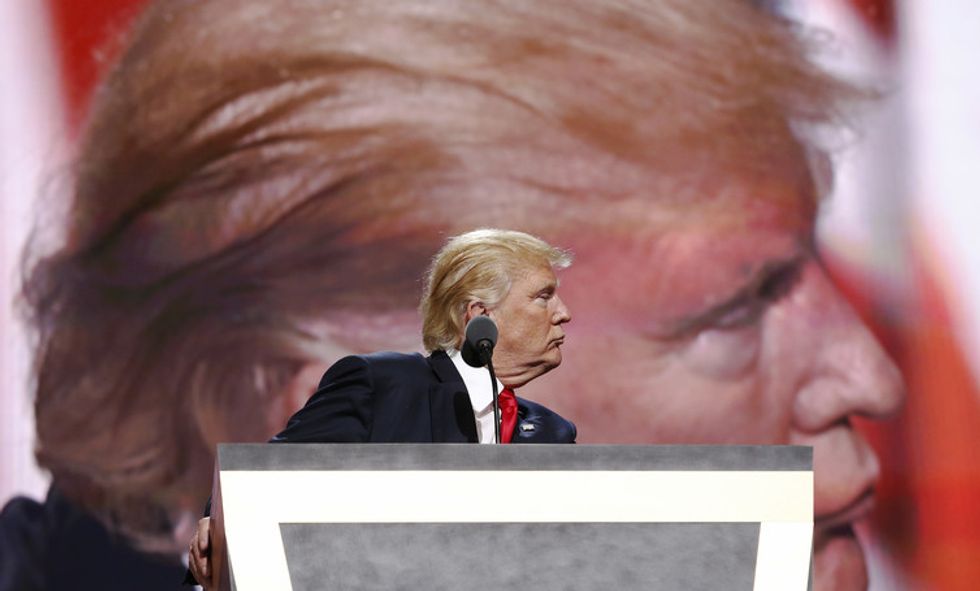
CLEVELAND -- They may have come to praise Republican presidential nominee Donald Trump, but mostly they came to bury former U.S. Secretary of State Hillary Clinton. Praise for Trump paled in comparison with the attacks leveled against the presumptive Democratic presidential nominee. Here are 17 of them: Actor Scott Baio: "Hillary Clinton ... someow feels she's…
While panels on HBO's Real Time can become contentious, Fridays night's discussion about voting rights went completely out of control as a former GOP lawmaker went to war with columnist Ana Marie Cox and actress/activist America Ferrera.
Discussing getting out the vote, Ferrera described how important it was to register first-time voters in minority communities early and then educate them. She then pointed out that laws that have put been in place in some states that make voting more difficult instead of easier, saying, "There is an active campaign against voter rights in this country."
Cox chimed in to say, "And you know who is making it harder? Its the Republicans," with host Maher adding, "Because that's how they win elections. They cheat."
Former Republican lawmaker Jack Kingston, dismissed their concerns about voting restrictions saying it is easy to vote and inferring voters were somehow dumb for not being able to figure it out.
Confronted with a laundry list of difficulties visited upon voters in Republican controlled states -- including long lines in Arizona's Maricopa County during the primary -- Kingston laughed them off, which rankled Ferrera who repeatedly called Kingston a liar.
"This is the lie and the lack of nuance that confuses people," Ferrera lectured the lawmaker. "Because it promotes the lie that Latinos and people of color don't show up because they're lazy and they don't show up."
Shaking her finger at Kingston, she ripped into him, proclaiming, "That is a lie! 'Don't show up.' Because they have minimum wage jobs, that they have to take a day off to travel 20 miles to get to the nearest government office to get an ID that cost more money!"
After the dust settled, columnist Cox has summed up November's election featuring Hillary Clinton and Donald Trump beautifully.
"This is a really important point," she began. "This is a really historic election, right? We're either going to elect the first female president or the last president -- period."
The Virginia Supreme Court ruled on Friday against Democratic Governor Terry McAuliffe's order restoring voting rights to more than 200,000 felons who completed their sentences, court documents show.
The court in a 4-3 ruling said McAuliffe overstepped his clemency powers under the state constitution by issuing a sweeping order in April restoring rights to all ex-offenders who are no longer incarcerated or on probation or parole.
In its opinion, the Virginia Supreme Court said that none of the state's previous 71 governors had ever issued a clemency order to a class of felons.
"To be sure, no governor of Virginia, until now, has even suggested that such a power exists," the court said. "And the only governors who have seriously considered the question concluded that no such power exists."
If the court had upheld McAuliffe's April 22 executive order, it could have helped to tip Virginia, a perennial swing state in presidential elections, in favor of presumptive Democratic presidential nominee Hillary Clinton.
Clinton chose U.S. Senator Tim Kaine of Virginia as her vice presidential running mate on Friday to help her do battle with Republican nominee Donald Trump in November's election.
John Whitbeck, chairman of the Republican Party of Virginia, hailed the ruling, saying in a statement that McAuliffe's decision amounted to "a blatant effort to stack the deck for Hillary Clinton in November."
Lawyers for leaders in the Republican-controlled Virginia legislature had argued that McAuliffe exceeded his authority by restoring voting rights en masse, rather than on a case-by-case basis.
Virginia is one of four states whose constitutions permanently disenfranchise felons but allow the governor to restore voting rights, according to the Brennan Center for Justice, a non-partisan civil liberties group.
McAuliffe said in a statement after the ruling that the court "has placed Virginia as an outlier in the struggle for civil and human rights."
"It is a disgrace that the Republican leadership of Virginia would file a lawsuit to deny more than 200,000 of their own citizens the right to vote," he said.
McAuliffe said he would sign "nearly 13,000 individual orders to restore the fundamental rights of the citizens who have had their rights restored and registered to vote."
Many of the convicts benefiting from the order are African-Americans or Latinos, two groups that have voted overwhelmingly for Democratic candidates in the past.
President Barack Obama, a Democrat, won Virginia in 2012 by about 150,000 votes and in 2008 by about 235,000 votes.
(Reporting by Gary Robertson in Richmond, Virginia; Additional reporting by Eric Beech in Washington, D.C., and Eric M. Johnson in Seattle; Writing by Eric M. Johnson; Editing by Mohammad Zargham and Leslie Adler)
Having already made two appearances this week on HBO's Real Time, host Bill Maher unloaded on newly-minted GOP candidate Donald Trump's speech on Thursday night, comparing it to the script from slasher film "Saw."
Noting the doom and gloom described by Trump who painted America as a crime-ridden hellscape, Maher quipped: "Did you see Donald Trump's speech? If that had been any darker it would have been shot by the police."
"It made me nostalgic for the light-hearted remarks of Rudy Giuliani," he continued. "He used the word 'violence' a dozen times, the word 'murder' a half-dozen times -- and that was just the part about Ted Cruz."
"If you didn't see it, to recap: it's morning in America where the walls are streaked with blood," Maher said as he ticked off the points. "We are a shining city on a hill where we will make our last stand against the zombies. And ISIS and illegal immigrants are coming to kill us all."
"Unfortunately there is no one left to save us because Hillary wiped out the police with her email."
Along with having a reputation for being "boring," another portrait of Virginia Sen. Tim Kaine -- Hillary Clinton's VP choice -- has emerged from those who have covered him and those who have worked him.
He a nice guy who doesn't seem to have an enemy in the world.
Appearing on The Rachel Maddow Show, avid Hillary Clinton supporter, Minnesota Sen. Amy Klobuchar (D), as well as former NAACP exec Benjamin Jealous -- who supported Bernie Sanders -- both complimented Kaine for being a "good guy," although they parted ways on how much he would help the ticket.
On Twitter, Klouchar wrote, "Congrats to my good friend @timkaine on being @HillaryClinton's running mate. Longtime fighter for middle class families & born in St. Paul!"
New Jersey Sen. Cory Booker, also reportedly on Clinton short-listed tweeted a simple: "KAINE IS ABLE!!!"
While Clinton rival Bernie Sanders was quiet on the Twitter front -- after an evening of watching Donald Trump's acceptance speech -- Kaine received a thumbs up from Arizona Sen. Jeff Flake who wrote: "Trying to count the ways I hate @timkaine. Drawing a blank. Congrats to a good man and a good friend."
Earlier in the week, Flake took his party to task for their calling for the jailing of Clinton, writing: ".@HillaryClinton now belongs in prison? C'mon. We can make the case that she shouldn't be elected without jumping the shark."
Flake defended hammering his associates on medium.com writing, "“Republicans are not going to defeat Hillary Clinton in November by insisting that she belongs in prison any more than we defeated Barack Obama by pretending that he was born in Kenya. So let’s drop the references to orange pant suits and chants of ‘lock her up.’ These jokes and bromides may play well in rare venues and limited circles, but they cheapen the very real arguments that need to be made to the broader public against a Hillary Clinton presidency.”
Now he has failed to be a GOP attack dog on Kaine.
Donald Trump is not a normal American presidential nominee, and there has been very little normal about the Republican convention that has now officially confirmed his nomination.
Trump’s defining attributes have always been intemperance, divisiveness and indiscipline, so it should surprise no-one that “his” convention was so intemperate, divided, and close to outright farce.
But however “eventful” the convention might have been, Trump’s formal nomination was always to be the centrepiece of the occasion. With due respect to the cast of reluctant colleagues, relatives and d-listcelebrities spread out over the days before, Trump was always centre of attention.
Likewise, it was during his acceptance speech that the largest part of the general public tuned into proceedings – many perhaps paying full attention to the campaign for the first time.
For his committed supporters, meanwhile, Trump played exactly the tunes they wanted to hear, his performance coloured by a dark intensity. He painted a bleak (and inaccurate) picture of an America overwhelmed by violent crime, before declaring himself “the law and order candidate” and promising that upon his election “safety will be restored”.
He told tales of Americans tragically killed by illegal immigrants, affirming one of his longest-standing pledges: to build a “border wall” and find and deport those already illegally in the country.
He blamed his Democratic opponent Hillary Clinton, who served as secretary of state during president Obama’s first term, for the rise of Islamic State and other agents of radical militant Islamism. Lamenting that “America is far less safe and the world is far less stable” than it was when she took charge of US foreign policy, he reassured the crowd that he would “defeat them fast” if he were elected.
He warned of the threat of terror attacks in the US, but pledged to neutralise them in part by suspending immigration from any country “compromised by terrorism” – without specifying what countries this would include.
And he extended sympathy to the plight of workers whose jobs had been taken away by “disastrous” trade deals, promising to get rid of current “bad” agreements with the likes of China and replace them with “great” ones instead.
In short, Trump used his address to stoke fear, to blame his political opponents for that which is frightening, and to offer himself as the singularly capable agent of change and renewal demanded by the times.
Scorning any imperative to offer realistic solutions to the problems he railed against, Trump delivered a clear pitch: that, flying in the face of a “corrupt” establishment, he alone can speak for the “forgotten” working men and women who have suffered at the hands of a “rigged” system. “I am your voice!” he proclaimed.
As the blogger Andrew Sullivan summarised it: “Everything is terrible. I alone can solve [everything]. Just don’t ask me how.”
A crisis in waiting
That Trump should present himself as the candidate of law and order is darkly ironic, since his campaign has provided ample evidence that in office he would be a threat to both.
Even many on the right have questioned whether his proposal for a ban on immigration by Muslims is constitutional. He has threatened to use the law to curb media organisations that subjected him to unfavourable reporting. He has encouraged violence against protesters at his rallies and offered to pay the legal fees of those who commit it (not reassuring in someone who if elected would acquire the power of presidential pardon).
In his discussion of foreign policy, he has demonstrated at best ignorance and at worst active hostility to the institutions and arrangements that underpin the liberal world order. He has said that he would order those under his command to commit torture and war crimes in pursuit of his security policy. He has, in effect, threatened to mount a trade war against China and others.
He has suggested that the US might not live up to its security commitments to Europe under NATO, while cultivating mutual admiration with Vladimir Putin, Russia’s authoritarian strongman.
His discussion of the national debt and how he might seek to renegotiate it suggests a dizzying ignorance of the rudiments of how national and international economics work.
In short, if Trump wins, a major global crisis – whether economic or military, and whether caused by design or by cluelessness – would become dramatically more likely.
Fear and loathing
One of the most disturbing themes of the convention was the sheer venom with which Trump Republicans attacked Hillary Clinton, whom they regard as not merely a political opponent but a criminal. And not just a petty one; in Trump’s phrase, she is guilty of “terrible, terrible crimes” that have been swept under the carpet by a corrupt FBI.
“Lock her up” was an enthusiastic chant, reappearing during Trump’s speech but originating in New Jersey governor Chris Christie’s audition for the job of Attorney General in a Trump administration, in which he staged a mock show-trial of Clinton for supposed crimes ranging from corruption to “bad judgment” skirting the edges of treason.
As others have noted, demands for the jailing of opponents do not form a normal part of politics in a healthy democratic society, and for good reason. That they are now the stock-in-trade of a major party’s nominee speaks to a serious erosion of the US’s liberal democratic norms.
Experts are uncertain about just what has to happen at a convention to benefit the nominee, but this was an especially unedifying week, with enough unpleasant surprises and unforced embarrassments to give any professional political stage manager an ulcer.
And Trump, obliged to adhere more closely to a fixed script than in his free-associative primary-night rants, was at times strained and halting in his delivery. But we won’t know how it has been received by the public until the first post-convention polls come in.
Whatever they say, the most important point is abundantly clear: Trump is a terrifying candidate.
He is skilled in the dark arts of fear, agitation, and insecurity; he is duly marketing himself as an avenger of law and order to meet the demand he has inflamed. His constituency is shockingly large. But a Trump presidency would be a greater danger to American security than any threat it proposes to address – perhaps even an existential threat to American democracy itself.
Run the word "boring" and "Tim Kaine" in a Google search, and be prepared for an avalanche of results. But is the man who Hillary Clinton named as her choice to be her running mate really a humdrum guy, or the kind of social justice warrior likely to keep rightwing keyboard warriors furiously typing in their basements?
Turns out, Tim Kaine presents himself as a moderate, but throughout his career, both he and his wife, Virginia Department of Education head Anne Holton, have put themselves on the front lines in changing Virginia's entrenched system of segregation.
1. Kaine's first case as an attorney was a racial discrimination complaint. At a 2015 conference hosted by the Department of Housing and Urban Development, Kaine related on arriving in Richmond after graduating Harvard Law School and renting his first apartment. His first client was a black woman who had been turned away from renting an apartment on the basis of her skin color. Kaine described it as a "There but for the grace of God" moment." He said that when he sat across from the client, he imagined what a negative impact it would have to be told that this positive thing -- of renting your first apartment -- could not happen because of skin color.
During his tenure as an attorney, Kaine was one of the few Virginia attorneys who focused on fair housing cases. Approximately 75 percent of his practice was devoted to them, many of them taken on a pro bono status.
2. When Kaine was mayor of Richmond, he won a huge settlement against insurance giant Nationwide. It turns out, Nationwide is on your side if you were white. In 1998, Kaine won a $100.5 million suit against the insurance company for "redlining," the discriminatory practice of restricting insurance provision in minority neighborhoods.
The suit alleged that: "Nationwide and its agents have intentionally, maliciously, wantonly, and oppressively engaged in discrimination in the provision of property insurance in African-American neighborhoods in the Richmond metropolitan area on the basis of race."
3. Kaine lived abroad for a year, and the experience changed his life. Kaine was educated as a Jesuit. He took a year off from law school to live in Honduras. He worked as a missionary, and he taught welding and carpentry to teenagers. While in Honduras, he became fluent in Spanish. His experience in Honduras has had a huge impact on his view of the world of the haves and have-nots.
According to the Washington Post profile: "The Rev. Patricio Wade, 79, still working in Honduras, remembers Kaine as wide-eyed at his first brush with overwhelming poverty. “Tim saw a system where very few people dominated and had all the money and power."
4. Kaine is an accomplished tenor. His love of music fuels his welcoming of cultural diversity.Kaine loves to sing and he loves music. He also plays harmonica on bluegrass tunes. One of the reasons that Kaine champions immigration is that it leads to a cultural richness that supports the arts in the community. “Immigration reform is fundamentally about wanting to be the most talented place on earth," the Post quoted him as saying to a community group.
5. Kaine will be able to troll Trump in Spanish. Tim Kaine made history on the Senate floor in 2013, when he delivered a full 13-minute speech in Spanish (providing an English translation for insertion into the Congressional Record). While other legislators have delivered partial remarks in Spanish, Kaine gave the full speech in support of the immigration bill that was written by the so-called "Gang of Eight."
As if anticipating Trump's incendiary comments on who does and does not belong in America, Kane prefaced his Spanish speech with these remarks, which reminded senators that the Spanish colonized Florida prior to the English arrival at Jamestown in 1607. NPR quoted Kaine:
"I think it is appropriate that I spend a few minutes explaining the bill in Spanish, a language that has been spoken in this country since Spanish missionaries founded St. Augustine, Florida, in 1565," Kaine explained in la lengua de Cervantes. "Spanish is also spoken by more than 40 million Americans with a huge investment in the result of this debate."
6. Anne Holton, Kaine's wife, shares his passion for social justice. Anne Holton has the distinction of having been the daughter of one Virginia governor -- her father A. Linwood Holton, Jr. -- and wife of Tim Kaine. When she was a girl, her parents made the decision to send her and her siblings to the largely black public schools. It was a controversial decision that required police protection for Anne and her sister, but it began Holton's dedication to the cause of public education.
Hillary Clinton's campaign also chipped in with some Kaine factoids after Friday's announcement, see below:
Hillary Clinton named U.S. Senator Tim Kaine as her running mate on Friday, making a safe choice that will help her present the Democratic ticket as a steady alternative to the unpredictable campaign of Republican presidential rival Donald Trump.
The selection of Kaine, a self-described "boring" Virginian with wide governing experience and a reputation for low-key competence, could appeal to independents and moderates but is likely to anger liberal groups who object to his advocacy for an Asian free-trade pact.
But the Spanish-speaking former Virginia governor and Richmond mayor fits Clinton's long-stated criteria that the vice presidential choice be a capable partner who is ready to take over the presidency if necessary.
Clinton made the announcement via Twitter after the first day of a two-day campaign swing in Florida.
Kaine, 58, edged out two other finalists - Cory Booker, a U.S. senator from New Jersey, and Agriculture Secretary Tom Vilsack, according to a Democratic source familiar with the discussions.
Clinton also bypassed candidates who would have generated more excitement among liberal and Hispanic activists, including progressive favorite U.S. Senator Elizabeth Warren and two Hispanic Cabinet members, Julian Castro and Thomas Perez.
The former secretary of state will be formally nominated as the party's presidential candidate for the Nov. 8 election at next week's Democratic convention in Philadelphia. She leads Trump in many opinion polls.
Clinton's choice of a running mate could give her campaign momentum heading into the convention, as the fight for the White House begins a more than three-month push to the finish.
Clinton acknowledged in an interview earlier this week that even Kaine admits he is boring, and said she did not mind.
"I love that about him," she told Charlie Rose of CBS News and PBS. "He's never lost an election. He was a world-class mayor, governor and senator and is one of the most highly respected senators I know."
Kaine's first appearance with Clinton could come on Saturday at an event in Miami.
(Additional reporting by Amanda Becker in Florida; Editing by Leslie Adler)
A U.S. judge on Friday tentatively rejected Republican presidential nominee Donald Trump's bid to dismiss a lawsuit by Trump University students who said they were defrauded through its real-estate seminars.
U.S. District Judge Gonzalo Curiel in San Diego told a hearing he would take under consideration arguments on both sides in the case and issue a formal written ruling in the coming weeks.
The lawsuit, one of at least three over the defunct Trump University, was filed on behalf of students who paid up to $35,000 to learn Trump's real estate investing "secrets" from his "hand-picked" instructors.
The students have sought class-action status to cover a larger number of claimants.
The cases against Trump University have regularly cropped up during the presidential campaign and Trump was roundly criticized in May when he accused Curiel, who is of Mexican descent, of being biased against him because of the candidate's pledge to build a border wall between the United States and Mexico.
Curiel, who was born in Indiana, is presiding over two of the cases, with one set for trial in late November. A separate lawsuit by New York's attorney general is pending in that state.
Trump's lawyers say Curiel should toss the 2013 California lawsuit on the grounds that the New York real estate mogul, though personally involved in developing the concept and curriculum, relied on other executives to manage Trump University by the time the plaintiffs purchased their seminars.
In addition, Trump's lawyers claim references in marketing materials to "secrets," "hand-picked" instructors or "university" were mere sales "puffery." According to the defense, there is no evidence Trump intended to defraud students.
Lawyers for the students have rejected those arguments, saying the New York developer conducted the marketing for Trump University more than anyone else, starring in and approving promotional materials.
They claim Trump University instructors were high-pressure sales people, not "professors and adjunct professors" as Trump touted, and that New York authorities told Trump back in 2005 to stop calling his unaccredited venture a university.
Trump owned 92 percent of Trump University and had control over all major decisions, plaintiffs' court papers say, and should be held liable under a statute targeting racketeering.
The court papers also say Trump confessed to misrepresentations in sworn testimony, and that evidence of his intent to defraud is "overwhelming."
(Additional reporting by Karen Freifeld and Dan Whitcomb; Editing by Anthony Lin and Tom Brown)
Donald Trump has been branded a bigot. Yet his acceptance speech suggests a radical rejection of heteronormativity and an embrace of radical queer identity politics.
By opposing both Islam and heterosexism, and using the phrase LGBTQ, Trump may have positioned himself as a woke nominee. For the sake of the unwoke reader who doesn't know what woke means, MTV News defines it as "Being aware -- specifically in reference to current events and cultural issues." Urban dictionary says, “Being Woke means being aware. Knowing whats going on in the community. (Relating to Racism and Social Injustice)." If we include-- as we must-- homophobia in our definition of Social Injustice, we must also frame Trump's seeming Islamophobia in its rightful woke context.
Trump clearly grounded his Islamophobia in a fierce, even fabulous, commitment to LGBTQ rights as he addressed the RNC Thursday night at Cleveland's Quicken Loans arena:
Only weeks ago, in Orlando, Florida, 49 wonderful Americans were savagely murdered by an Islamic terrorist. This time, the terrorist targeted our LGBTQ community. As your president, I will do everything in my power to protect our LGBTQ citizens from the violence and oppression of a hateful foreign ideology.
A cursory textual analysis reveals the problematic nature of Trump's argument. There is no proof that the man who murdered 49 people at the Pulse night club in Orlando was influenced by Islam. And Trump conflates Islam with an inherently violent and hateful ideology. Perhaps most troubling is Trump's exoneration of the homophobia, violence and hate perpetuated by his own religion, Christianity, and by his very own running-mate, Indiana Governor Mike Pence, who self- identifies as “a Christian, a conservative, and a Republican, in that order." And yet, despite his intersectional self-definition, Pence's record, which includes pushing through the “Religious Freedom Restoration Act,” allowing businesses to turn away and corporation to deny health insurance to LGBTQ people, suggests he has not freed himself of the shackles of homophobia.
But Donald Trump, at the very least, is laying bare what we talk about when we talk about intersectional identity politics. And he should be commended for initiating this much needed conversation.
In order to further support his subversive rejection of heteronormativity , we must push Trump even further, empowering him to use his unique voice to give voice to the voiceless. Of course, we must do this in a way that honors his authenticity, uniqueness, and agency. What better way to do this than by turning to Trump's own words and recasting them in the radical voice he has already discovered. Here is just one example of how he could apply his woke and intersectional framing to things he has already said:
"I will build a great wall safe space-- and nobody builds safe spaces better than me, believe me --and I'll build them very inexpensively. I will build a great, great safe space, and I will make straight, cis, able-bodies, men Mexico pay for that safe space. Mark my words."
It is incumbent upon us to thoroughly reflect on, process and unpack the potential wokeness of Trump. And yet, we would also be remiss if we failed to interrogate this question. I will be offering more thoughts and sharing some concrete suggestion in a follow-up post.
In the mean time, I urge readers to share their own ideas on Twitter. Please tag me, @kthalps, and use the hashtag #WokeTrump.
Three decades after becoming a Republican Party activist, a member of the York Township Republican Committeemen’s Organization resigned from the party citing the rise of Donald Trump as GOP's choice for president in the November election.
In a resignation letter posted to his blog, GOPLifer, Chris Ladd writes about his longtime history with the party in Texas, including his friendship with former Texas Gov, Rick Perry, which dates back to their college days.
But now Ladd has had enough, and wrote a devastating takedown of the Republican Party including some of its leaders.
Addressing the chairman of the York Township Committee, Ladd wrote, "Almost thirty years ago as a teenager in Texas, I attended my first county Republican convention. As a college student I met a young Rick Perry, fresh from his conversion to the GOP, as he was launching his first campaign for statewide office. Through Associated Republicans of Texas I contributed and volunteered for business-friendly Republican state and local candidates."
Having established his history, he continued "Despite the bold rhetoric, we all know Trump will lose. Why throw away a great personal investment over one bad nominee? Trump is not merely a poor candidate, but an indictment of our character. Preserving a party is not a morally defensible goal if that party has lost its legitimacy."
"Fast-forward to our present leadership and the nature of our dilemma is clear. I watched Paul Ryan speak at Donald Trump’s convention the way a young child watches his father march off to prison," he wrote. "Thousands of Republican figures that loathe Donald Trump, understand the danger he represents, and privately hope he loses, are publicly declaring their support for him. In Illinois our local and state GOP organizations, faced with a choice, have decided on complicity."
"Evasion and cowardice has prevailed over conscience. We are now, and shall indefinitely remain, the Party of Donald Trump," he continued. "I will not contribute my name, my work, or my character to an utterly indefensible cause. No sensible adult demands moral purity from a political party, but conscience is meaningless without constraints."
"A party willing to lend its collective capital to Donald Trump has entered a compromise beyond any credible threshold of legitimacy. There is no redemption in being one of the 'good Nazis,'" he concluded.
Ladd then added a YouTube video of fellow Texan Willie Nelson singing, "The Party's Over."
Republican presidential nominee Donald Trump has pulled nearly even with Democratic rival Hillary Clinton for the first time since May, according to a Reuters/Ipsos poll taken over the course of the Republican National Convention in Cleveland this week.
The July 18-22 national online poll found that 41 percent of likely voters supported Clinton, while 38 percent supported Trump. Given the poll's credibility interval of about 4 percentage points, Trump and Clinton should be considered to be about even in the race.
Just before Republicans opened the convention on Monday, Trump had trailed Clinton by nearly 10 percentage points in the poll.
The New York businessman-turned-politician formally accepted the Republican nomination for the Nov. 8 presidential election during a convention at which the party at times struggled to show unity.
The week started with a dustup between convention leaders and delegates who wanted to change the party's rules to derail Trump's nomination. Later in the week, Senator Ted Cruz of Texas, who dropped out of the nomination race in May, refused to endorse Trump in a prime-time speech.
Yet, on the final night of the convention, Republicans gave Trump a standing ovation as he pledged to take back a country that he said is plagued by crime, terrorism and ineffective leadership.
Party conventions are partly meant to introduce the candidate to the country, and nominees tend to get a boost in opinion polls afterward. In 2012, then-Republican nominee Mitt Romney rose by about 5 percentage points in the Reuters/Ipsos poll after his party's convention.
Clinton, who is expected to be formally nominated by her party at its convention in Philadelphia next week, has led Trump most of the year in the poll.
The last time Trump drew about even with Clinton was in mid-May, after his last two rivals for the Republican nomination dropped out of the race and party leaders started to get behind his campaign.
The Reuters/Ipsos poll was conducted in English in all 50 states with 1,036 likely voters.
According to Biddle, the email was sent on May 15:
From:MARSHALL@dnc.org
To: MirandaL@dnc.org, PaustenbachM@dnc.org, DaceyA@dnc.org
Date: 2016-05-05 03:31
Subject: No shit
It might may no difference, but for KY and WVA can we get someone to ask his belief. Does he believe in a God. He had skated on saying he has a Jewish heritage. I think I read he is an atheist. This could make several points difference with my peeps. My Southern Baptist peeps would draw a big difference between a Jew and an atheist.
Biddle reported that at 1:03 EDT, Marshall emailed Biddle to respond to publication of this letter. Marshall wrote, "I do not recall this. I can say it would not have been Sanders. It would probably be about a surrogate.” Biddle then says that, as of publication time, he was still waiting for Marshall's response as to who the surrogate could "possibly be."
Previous investigations of Guccifer 2.0, who allowed himself to be interviewed in June, have led DNC officials to tell online magazine Motherboard, “Our experts are confident in their assessment that the Russian government hackers were the actors responsible for the breach detected in April, and we believe that the subsequent release and the claims around it may be a part of a disinformation campaign by the Russians.”