"Young people should not be underestimated—we have a voice and we are strong."
Youth organizers of a Friday climate protest in Bristol, United Kingdom said they have "no time for being patronized" after local police sent a letter to parents warning of inadequate safety measures for the upcoming demonstration, which teenage activist Greta Thunberg and thousands of others are expected to attend.
"Social media has gone viral with interest, which leads me to believe it will be thousands of people," wrote Bristol police commander Andy Bennett. "We have confirmation of people traveling from across the U.K. by car, bus, coach, and train. I am told in Hamburg approximately 60,000 came to see Greta speak. Whilst I am not suggesting it will be this big, you can see the scale of the potential attendance."
Bennett warned of the "potential for trips, slips, falls, and crushing" and urged attendees to take extra precautions.
Bristol Youth Strike 4 Climate, which organized the demonstration, tweeted Thursday that authorities' safety concerns are exaggerated.
"But of course," the group added in a follow-up tweet, "in a public event everyone should also be aware of their personal safety at all times. Be kind to others and look out for each other."
Thunberg announced her plans to attend the demonstration in a tweet last Saturday. The Telegraphreported Thursday that the world renowned 17-year-old climate activist "had originally intended to visit London, but as the area planned for the protest in the capital was too small the organizers had recommended Bristol instead."
In a joint statement Wednesday, Bennett and Bristol City Council executive director Mike Jackson said the youth-led demonstration will likely cause "major disruptions."
"We have seen a number of protests over the last year. However this one will be significantly larger," said Bennett and Jackson. "Please do not underestimate the scale of this protest."
Willow, a 15-year-old activist from Gloucestershire who plans to skip school to attend the protest, toldThe Guardian that the expected size of the demonstration "shows that young people should not be underestimated—we have a voice and we are strong."
Glowing amphibians may be far more common than thought, scientists reported Thursday, suggesting that the ability may help them locate each other in low light.
Jennifer Lamb and Matthew Davis from St Cloud State University in Minnesota exposed 32 species of the frogs, salamanders, newts and eels to blue or ultraviolet light, finding that the creatures emitted colorful patterns in a process known as "biofluorescence."
These patterns ranged from blotches and stripes to glowing bones or even all-over fluorescence, in various hues of green, orange, and yellow, the authors said in a new study published in Scientific Reports.
Some even had fluorescent green skin secretions and urine.
Biofluorescence is where organisms emit a glow after first absorbing light energy, and before the current study had only been observed in one salamander and three frog species.
It happens through various mechanisms through the presence of fluorescent proteins in skin and bones. Some of the amphibians also have chromatophores, or pigment-containing and light-reflecting cells.
The authors wrote that many amphibians are nocturnal and inhabit dense forests, and so the ability to glow may thus help them find each other, as their eyes contain rod cells that are sensitive to green or blue light.
Biofluorescence might also create more contrast between amphibians and their environment, allowing them to be more easily detected by other amphibians.
In other species, glowing has been found to help creatures camouflage, signal themselves to potential mates, or even help them mimic the appearance of their predators.
Last year, a different set of US researchers the molecules responsible for allowing swell sharks to glow, hypothesizing that it might perform functions other than identification, including fighting microbial infection.
The first known case of coronavirus possibly the result of "community spread" in the United States was diagnosed in California, but despite doctors' requests the patient was not tested for days. The New York Times reports the CDC refused to test because the patient did not meet CDC's "narrow testing criteria."
“Upon admission, our team asked public health officials if this case could be Covid-19,” a letter sent by doctors at the University of California, Davis Medical Center said. The doctors requested testing by the Centers for Disease Control and Prevention. “Since the patient did not fit the existing C.D.C. criteria for Covid-19, a test was not immediately administered. U.C. Davis Health does not control the testing process.”
The CDC announced the first suspected case of "community spread" coronavirus in the U.S. Wednesday, just around the time President Donald Trump was delivering a press conference during which he minimized the threat of coronavirus.
"The Centers for Disease Control and Prevention (CDC) has confirmed an infection with the virus that causes COVID-19 in California in a person who reportedly did not have relevant travel history or exposure to another known patient with COVID-19," the CDC reported.
"At this time, the patient’s exposure is unknown," the CDC added. "It’s possible this could be an instance of community spread of COVID-19, which would be the first time this has happened in the United States. Community spread means spread of an illness for which the source of infection is unknown. It’s also possible, however, that the patient may have been exposed to a returned traveler who was infected."
The CDC's website currently states it has tested 445 people for coronavirus. As of Wednesday there were 60 confirmed cases in the U.S.
Editor’s note: Public health officials in the U.S. warned that the coronavirus, which has in large part spared the U.S., is coming and that the country needs to be prepared. But just what does this mean for you, as well as for public health officials? Aubree Gordon, public health scholar at the University of Michigan, explains.
1. How do we prepare for something we can’t predict?
First and foremost, people need to be prepared for their daily life to be affected by public health measures that are put into place to try to limit the spread of the virus.
This could be anything from relatively benign social distancing measures, such as canceling large gatherings, to measures that may have a larger impact on day-to-day life, such as school and business closures. It is also possible that people may be asked to remain in their homes for an extended period of time if there is a large outbreak in their local area, such as what has occurred in China.
To prepare for this, it is best to have a two-week supply of food, personal hygiene items and sufficient supplies of any required prescription or nonprescription drugs. It is also important to keep copies of medical records for reference.
2. The US has only 57 cases so far. Why might that increase?
So far, all cases in the U.S. have been imported or directly connected to travel. That is, either someone came to the U.S. who was infected or had contact with someone who had recently traveled out of the country.
To track down these cases, public health officials have been testing all travelers who present symptoms that have recently been to China, have been in contact with a recent traveler from China, where the outbreak started, or had contact with a confirmed case. People who tested positive have been isolated. In addition, travelers returning from locations of outbreaks have been asked to quarantine themselves in their houses or have been quarantined by the U.S. government for 14 days in order to prevent onward transmission in the event that they were infected but not yet showing symptoms.
However, as the virus establishes itself in multiple countries, the U.S. will have more introductions, meaning that travelers will bring it into the U.S. from other countries. It is inevitable that we will miss some cases, which will result in community transmission in the U.S.
In addition, right now public health systems are concentrating on testing individuals with connections to known outbreak locations or confirmed cases. Public health officials and medical personnel are looking for the cases in the most likely places, but that means that we may not detect cases early where we are not expecting them. U.S. officials will know this has happened if they detect a cluster of severe cases, at which point there likely will have been multiple rounds of transmission, and an outbreak will have begun.
3. What has changed to make public health officials more worried?
The outbreaks are now occurring in multiple countries. Also, the fact that there are multiple, concurrent outbreaks – and that public health officials do not know the scope of those outbreaks – is worrisome.
As the virus spreads into more countries, particularly those with weaker health systems, it will become much harder to control the spread worldwide. As the number of cases increases in a location, the likelihood that someone who is traveling from that location is infected increases. And, this in turn, increases the probability of the virus being introduced into another location.
For example, there had been very few cases of COVID-19 detected in Italy until Feb. 22, 2020, and they were all related to travel. However, a few days later, officials detected a cluster of COVID-19 cases. There was no clear link to travel in the confirmed cases, indicating that community transmission was occurring. Now, cases imported from Italy, either by Italian tourists or by citizens returning from Italy, have been detected in multiple countries. Likewise, Iran now has community transmission and has exported cases to multiple countries.
In the coming weeks and months, this pattern will likely repeat itself in multiple locations.
Earth has acquired a second "mini-moon" about the size of a car, according to astronomers who spotted the object circling our planet.
The mass -- roughly 1.9-3.5 meters (6-11 feet) in diameter -- was observed by researchers Kacper Wierzchos and Teddy Pruyne at the NASA-funded Catalina Sky Survey in Arizona on the night of February 15.
"BIG NEWS. Earth has a new temporarily captured object/Possible mini-moon called 2020 CD3," likely to be a C-type asteroid, Wierzchos tweeted on Wednesday.
The astronomer said it was a "big deal" as "this is just the second asteroid known to orbit Earth (after 2006 RH120, which was also discovered by the Catalina Sky Survey)."
Its route suggests it entered Earth's orbit three years ago, he said.
The Smithsonian Astrophysical Observatory's Minor Planet Center, which collects data on minor planets and asteroids, in an announcement said "no link to a known artificial object has been found," implying it was likely an asteroid captured by Earth's gravity.
"Orbit integrations indicate that this object is temporarily bound to the Earth."
Tech entrepreneur Elon Musk said the car-sized object was not the Telsa Roadster he launched into space in 2018, which is now orbiting the Sun.
"It's not mine," he tweeted.
Earth's new neighbor is not in a stable orbit around the planet and is unlikely to be around for very long.
"It is heading away from the Earth-moon system as we speak," Grigori Fedorets, research fellow at Queen's University Belfast in Northern Ireland, told New Scientist magazine, and was likely to escape in April.
The only other asteroid known to orbit Earth, 2006 RH120, rotated the planet from September 2006 to June 2007.
President Donald Trump did a Wednesday press conference where he said that the coronavirus was under control and only a little over one dozen people had it and it would be down to five people soon. In fact, the U.S. hit its 60th person. One dramatic shift happened in the virus, however.
A Solano County patient “had no known exposure to the virus through travel or close contact with a known infected individual,” said the California Department of Public Health.
"At this time, the patient’s exposure is unknown," CDC said. "It’s possible this could be an instance of community spread of COVID-19, which would be the first time this has happened in the United States."
The news broke just as Trump was finishing his press conference telling Americans that there was no need for concern.
Perhaps the most concerning fact, however, was the revelation that the person was transferred from another hospital about one week ago. The CDC declined to test them, raising the possibility of exposure.
Appearing on CNN's " New Day," on Wednesday, the director of the National Institute of Allergy and Infectious Diseases claimed that Donald Trump's administration is running behind on containing the coronavirus -- and that the public shouldn't expect a viable vaccine for at least a year.
Speaking with host John Berman, Dr. Anthony Fauci addressed the efforts of the Trump administration attempting to get their arms around the rapidly growing health threat before cautioning viewers not to expect an immediate fix.
"I want to ask you one more question which is one of the things the president said yesterday," host Berman stated. "We're very close to a vaccine. Now, I know this is something you know a lot about -- this is your job. How close are we to a vaccine?"
"Well, the confusion is we're close to starting a phase one trial to determine safety," Fauci explained. "We're going to do that in about one and a half to two months --but that doesn't mean you have a vaccine. In order to get a vaccine, that's practically deployable for people to use, it's going to be at least a year to a year and a half at best."
Trump economic adviser Larry Kudlow on Tuesday tried to play down fears of a coronavirus outbreak in the United States, even as officials from the Centers for Disease Control were warning lawmakers that the problem was very likely to get worse.
While appearing on CNBC, Kudlow said that Americans shouldn't worry about the virus's impact because the Trump administration had it almost totally under control.
"We have contained this, I won't say airtight, but pretty close to airtight," Kudlow said.
The Trump adviser also downplayed the possibility that the virus outbreak would hurt the American economy, even though it could grind economic activity in China down to a halt.
"There will be some stumbles," he admitted. "We’re looking at numbers; it’s a little iffy... But at the moment, the numbers that we’re looking at... there’s no supply disruptions out there yet.”
Kudlow's rosy assessment of the situation contradicts statements made just hours earlier by Dr. Nancy Messonnier, director of the National Center for Immunization and Respiratory Diseases at the CDC.
"It’s not so much of a question of if this will happen in this country any more but a question of when this will happen," Messonnier said of the disease spreading to the United States. "We are asking the American public to prepare for the expectation that this might be bad."
Health officials from the Centers for Disease Control and Prevention are now warning that the spread of the coronavirus inside the U.S. is inevitable. The Trump administration has been slammed both Democrats and Republicans alike for ignoring that possibility and for taking little action to stop it, to increase awareness, and to prepare.
“Ultimately we expect we will see community spread in the United States,” Nancy Messonnier, a top official at the CDC, told reporters, the Washington Post reports.
“It’s not a question of if this will happen but when this will happen and how many people in this country will have severe illnesses.”
“We are asking the American public to prepare for the expectation that this might be bad,” Dr. Messonnier said, The New York Times adds.
Currently there are 53 confirmed cases of coronavirus in the U.S., despite President Donald Trump saying just hours ago, "We're really down to probably about 10."
Markets have plummeted this week in response. The DOW dropped 1032 points on Monday, and as of this writing it is down another 336 points.
This is a breaking news and developing story. Details may change. This story will be updated, and NCRM will likely publish follow-up stories on this news. Stay tuned and refresh for updates.
“Now they have studied it, they know very much. In fact, we are very close to a vaccine,” he said.
Trump also predicted that the virus is "a problem that’s going to go away."
But just hours later, U.S. officials reportedly told senators that a vaccine could take 12 to 18 months to develop.
“The vaccine for the coronavirus is moving more rapidly than any vaccine we have already tried to approve - but it will take a year or 18 months," Sen. Lamar Alexander told CNN's Manu Raju. "The way to stop [an outbreak] is quarantine and monitoring.”
Katherine Johnson, a ground-breaking black NASA mathematician whose life was portrayed in the movie "Hidden Figures," died on Monday aged 101, the space agency said.
Johnson's calculations helped put the first man on the Moon in 1969, but she was little known until the 2017 Oscar-nominated film told the stories of three black women who worked at NASA.
"She was an American hero and her pioneering legacy will never be forgotten," NASA Administrator Jim Bridenstine said, honoring "her courage and the milestones we could not have reached without her."
Johnson and a colleague were the first to calculate the parameters of the suborbital 1961 flight of astronaut Alan Shepard, the first American in space.
Her math talents later helped determine the trajectory of the Apollo 11 flight that landed Neil Armstrong and Buzz Aldrin on the Moon in July 1969.
US president Barack Obama presented Johnson with the Presidential Medal of Freedom, the highest civilian honor in the country, in 2015.
Two years later, Johnson -- then aged 98 -- attended the 2017 Oscars when "Hidden Figures" was nominated, taking the stage to receive a standing ovation.
"Ms Johnson helped our nation enlarge the frontiers of space even as she made huge strides that also opened doors for women and people of color," Bridenstine said in a statement.
Mars is a constantly tremoring "living" body, researchers said Monday as they unveiled measurements of seismic activity on the red planet showing similar tremble rates to Earth or the Moon.
For 15 months NASA's InSight robot craft scoured the surface of Earth's neighbor, and measured hundreds of so-called "Marsquakes".
These included several tremors that contained the same frequency patterns as tremors caused by the movement of Earth's own tectonic plates.
"This is the first mission focused on taking direct geophysical measurements of any planet besides Earth, and it's given us our first real understanding of Mars' interior structure and geological processes," said Nicholas Schmerr, an assistant professor of geology at the University of Maryland and a co-author of the study in Nature Geoscience.
Another team of researchers found that at least 20 of the quakes measured by the InSight lander had the equivalent strength of a magnitude 3-4 earthquake.
After a six-and-a-half-month voyage through 480 million kilometers of space, the NASA probe landed on Mars' Elysium plain in November 2018, pressing an ear to the planet for the first time.
Mars had long been thought to be seismically active, but the InSight lander gave scientists proof of consistent and occasionally powerful tremors.
- Windy planet -
While the studies show at least 170 tremors measured over 225 days, the quakes have continued to the present day, according to Philippe Lognonne, a researcher at Paris' Institut de Physique du Globe, part of the 500-strong international team working on InSight.
He said at least 460 events had been picked up by InSight's instruments.
Charles Yana, project chief of the InSight monitoring system at the French Cnes space agency, said that the frequency of seismic activity was "pretty surprising as the models hadn't predicted so many."
InSight is also providing data to scientists about Mars' weather patterns, its atmosphere, geology and magnetic field.
The probe has even established a daily profile of wind strengths on the red planet.
During the day, heating from the Sun causes wind to build, reaching its peak in late afternoon. By evening, the wind is gone and there is silence on the surface.
For Schmerr, "understanding these processes is part of a bigger question about the planet itself.
"Can it support life, or did it ever? Life exists at the edge, where the equilibrium is off," he said.
"Think of areas on Earth such as the thermal vents at the deep ocean ridges where chemistry provides the energy for life rather than the Sun."
A key mystery of Mars remains unresolved, however -- whether or not its core is still liquid, like Earth's.
"If it turns out there is liquid magma on Mars, and if we can pinpoint where the planet is most geologically active, it might guide future missions searching for the potential for life," said Schmerr.
Blacks are at higher risk for several health conditions in the U.S. This is true for heart disease, hypertension, type 2 diabetes and stroke, which are often chronic diseases. And it is also for Alzheimer’s disease, in which blacks have two times higher incidence rates than whites.
So, why do these disparities exist, especially in Alzheimer’s disease, which isn’t typically considered a chronic disease but a progressive one, or one that worsens over time?
Some researchers attribute the gap to both societal and systemic factors related to inequities in education, socioeconomics, income and health care access. Other factors such as stress, diet, lifestyle and genetics may also contribute. However, there’s a less-explored question in Alzheimer’s that could contribute to this disparity: Is the underlying biology of the disease somehow different in blacks and non-Hispanic whites?
I am a basic science researcher who studies racial disparities in Alzheimer’s disease. I have begun to uncover that the biology underlying the disease may not be the same in African Americans and non-Hispanic whites.
My laboratory is working on several projects to better understand the biology of Alzheimer’s disease in African Americans and how it may be the same or different in non-Hispanic whites. We will share our preliminary findings soon, as this work is necessary to help understand the root cause of this disparity. Even more important, this will help us to understand the disease for everyone.
I believe that many factors together contribute to health disparities in Alzheimer’s disease, and biology is one very worth exploring. Even when considering clinical trials for Alzheimer’s disease, blacks represent fewer than 5% of participants, whereas they represent about 13% of the U.S. population. That makes it hard to know if and how these potential therapies may work for blacks and other underrepresented groups. This makes it important to understand the biology of the disparities because it could impact the development and effectiveness of potential therapies.
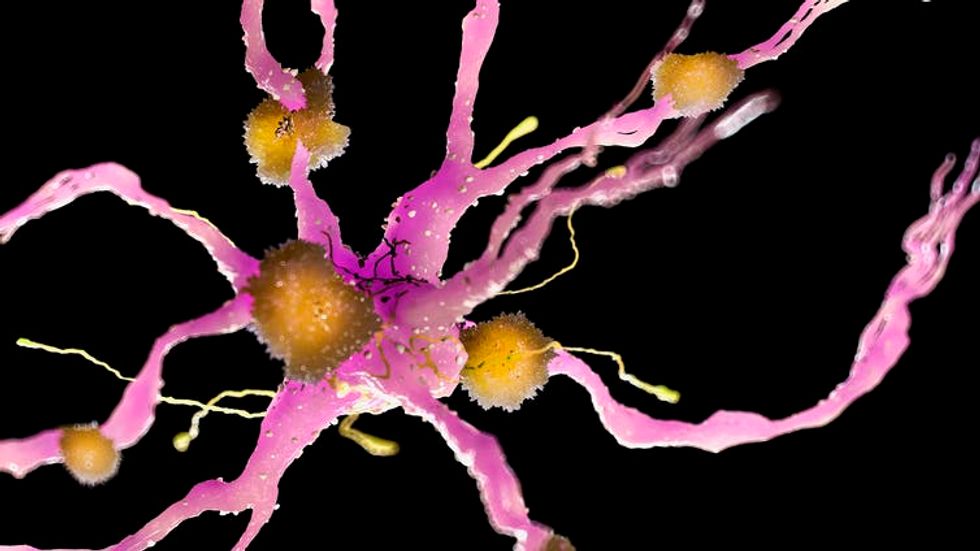
Illustration of amyloid plaques on a nerverticale cell, which are found in the brain.
Genetics may be one contributing factor to racial disparities in Alzheimer’s disease. In the general population, inherited forms of Alzheimer’s disease account for less than 5% of all cases.
Among African Americans a few genes have been identified that are associated with higher risk of Alzheimer’s disease specific to this population. One is ABCA7. This gene has been demonstrated by several independent studies to lead to higher risk of disease in African Americans for developing Alzheimer’s disease.
The ABCA7 gene is involved in lipid transport, meaning that is important for moving lipids, or fatty acids, in the blood and the brain. However, we researchers do not yet exactly understand how this gene or others increases risk in African Americans.
It almost seems obvious that the higher incidences of disease, including in Alzheimer’s disease, experienced by African Americans must be related. For example, hypertension increases risk for Alzheimer’s disease, and 40% of African American adults have hypertension.
Could it be possible that there are similar biological factors driving these high incidences in both diseases?
We are beginning to answer this question with a $4.2 million award recently received from the National Institutes of Health. We will study proteins from the blood of Africans Americans with hypertension or with Alzheimer’s disease. By comparing our findings in these subpopulations, we will be able to determine if there are any similarities in the biology of both diseases. For a smaller number of participants, we will be able to study proteins in autopsied brains. We expect some initial results in the early part of 2021.
For example, in our own work and that of others, we are led to believe that differences in inflammation and lipid metabolism may be responsible for some of the disparities that exist in Alzheimer’s disease.
Could proteins in the brain be different?
In one preliminary study, we have compared several thousands of proteins – an analysis called proteomics – in three different autopsied brain regions from African Americans and non-Hispanic whites. We found many proteins that are related to having Alzheimer’s disease that are the same in both African Americans and non-Hispanic whites, but we were surprised to find that there were changes related to having Alzheimer’s disease that were unique to the African Americans. We have ongoing studies to replicate these findings.
This kind of result, though, raises a few major points. First, researchers can learn more about the biology of Alzheimer’s disease by ensuring that diverse and especially disparate groups of subjects are included in their studies. Second, the disease may behave somewhat differently underneath the surface in different populations. This is critical to know in order to develop diagnostics or therapies that can be tailored accordingly. Finally, more of these kinds of studies are necessary in order to get us closer to finding a cure for the disease.
Big “omics” studies, which can measure thousands of genes, proteins, lipids and metabolites, when applied to racial disparities in Alzheimer’s disease, will give a wealth of information to help explain why these disparities exist. Other researchers are beginning to apply these kinds of techniques. Recently, researchers have confirmed the importance of inflammation in Alzheimer’s disease and note that specific inflammatory genes only show up in African Americans or non-Hispanic whites. Additionally, in the utility of amyloid and tau biomarkers for Alzheimer’s, recent work supports that race is an important factor in establishing these biomarkers.
How you can participate in a clinical trial. Courtesy National Institute On Aging/YouTube.
The truth of the matter is when we used the PubMed database to search for omics studies of African Americans in Alzheimer’s disease, we found that African Americans were grossly underrepresented. Many of the studies excluded African Americans. Thus, even beginning to explain why disparities exist – much less reducing and eliminating them – is challenging, because basic science research studies are not including African Americans enough.
Inclusion of diverse groups in basic science research and clinical trials of Alzheimer’s disease is a critical first step to helping reduce and eliminate health disparities. It will further our understanding of the disease. It will more rapidly facilitate the search for diagnostic markers or therapies that will yield strategies effective for helping everyone.
With another recent clinical trial of two promising Alzheimer’s disease drugs failing, we need a complete picture of the disease. The medical community can best achieve this by ensuring that blacks, Hispanics and other disparate groups are included in all studies, especially those that are basic science research studies.