





GREENSBORO, N.C. — In July 1979, a North Carolina Ku Klux Klan leader named Joe Grady summoned two FBI agents to a Waffle House to warn them “about possible violence in the future.”
Earlier that month, members of the Workers Viewpoint Organization and local Black residents had forced armed Klansmen to retreat inside a community center where they were screening the hugely controversial movie Birth of a Nation. The euphoric anti-Klan protesters celebrated by stealing their Confederate flag and burning it.
That confrontation in the town of China Grove was only the most recent in a string of incidents of leftist harassment that Grady complained had violated the Klan’s constitutional rights.
An official memo describing the meeting is one of thousands of pages recently released by the FBI that detail the agency’s handling of one of the most notorious episodes of white supremacist violence in the past 50 years. About three months after Grady’s warning, a caravan of Klan and Nazis, led by a former FBI informant also working with the police, drove into a Black public housing community in Greensboro and opened fire on an anti-Klan march, killing five leaders of the Workers Viewpoint Organization (later renamed Communist Workers Party).
The FBI said it was releasing the documents in response to Freedom of Information Act requests.
The memo about the July 1979 meeting with the Klan leader also indicates that the FBI's awareness of potential violence was so sufficiently heightened that they asked Grady if the KKK had automatic weapons in its possession.
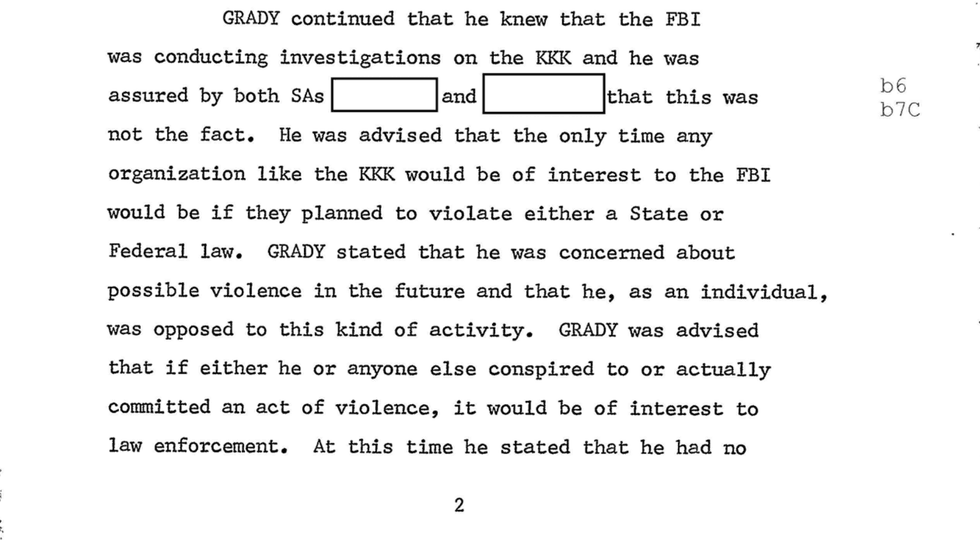 An official FBI memo details a meeting that took place between two FBI agents and Klan leader Joe Grady in July 1979. (Courtesy FBI)
Despite live television coverage capturing the carnage, Klan and Nazi defendants were acquitted of murder in a state trial and acquitted of civil rights violations in a subsequent federal trial. The Klan and Nazis were later found jointly liable with the Greensboro Police Department for the death of one of the demonstrators in a federal civil lawsuit brought by survivors.
In 2020, the city issued a formal apology acknowledging that the police department “failed to warn the marchers of their extensive knowledge of the racist, violent attack planned against the marchers” by the Klan and Nazis, “with the assistance of a paid GPD informant.”
Less attention has focused on the FBI, whose agents accessed the same stream of intelligence about the Klan and Nazis’ plans to disrupt the rally. A 2006 report issued by an independent truth and reconciliation commission determined that “the single most important element that contributed to the violent outcome of the confrontation was the absence of police,” while finding it “immoral and unconscionable for the FBI and the Bureau of Alcohol, Tobacco and Firearms — which both had their own inside intelligence on the Klan and Nazis about the potential for violence on Nov. 3, 1979 — to fail to share that information with local law enforcement.”
The civil suit brought by the survivors put the FBI together with the Klan, Nazis and police at the defense table during the federal trial for an alleged conspiracy to deprive those killed and injured in the attack “of their equal rights, privileges and immunities,” which they argued was motivated by their “hostility to communists, labor organizers and advocates of equal rights for Black people.”
Cecil Moses, who managed the FBI’s investigation of the massacre as assistant special agent in charge of the Charlotte Division, was one of the individual defendants. The judge dismissed Moses as a defendant.
“I could tell you under oath that I had absolutely no information,” Moses told Raw Story. “Nobody from the Greensboro office had mentioned to me that there might be problems that day.”
North Carolina was unfamiliar territory for Moses at the time. Only one month before the massacre, Moses had been transferred from the Memphis office and received a promotion to the number two position in Charlotte. His new boss, Special Agent in Charge Herb Monahan, was away on a hunting trip in the mountains for annual leave at the time of the massacre. Moses was at home doing his laundry on Nov. 3 when the deputy director in Washington saw the massacre unfolding on live TV and told him, “You better get up there on the double.”
The memo describing Klan leader Joe Grady’s July 1979 meeting with the agents reveals an effort to bring Moses up to speed on the agency’s pre-Nov. 3 intelligence on the potential for violence, so he could respond to awkward questions from the media.
Dated Nov. 26, 1979, the memo authored by an unidentified agent notes that “the information is being submitted at this time to assist ASAC Moses in his comments to the press concerning Joe Grady’s statement to the press that he contacted two FBI agents at Winston-Salem, North Carolina, during July, 1979.” The note goes on to say that agents didn’t bother to document the meeting at the time because it was “nonspecific and did not fall within any current FBI investigative guidelines.”
Another retroactive memo, dated Dec. 5, 1979, describes a phone call by Eddie Dawson to his former FBI agent handler, Len Bogaty, at his home on Halloween night “to advise that he was now working for the Greensboro Police Department and he was furnishing information concerning a forthcoming ‘Commie’ rally in Greensboro, North Carolina, which the Klan might attend.
The memo goes on to say that the following day, Bogaty contacted a lieutenant in the police department, who “indicated he had received the information concerning possible disruption of the WVO rally by the Klan.”
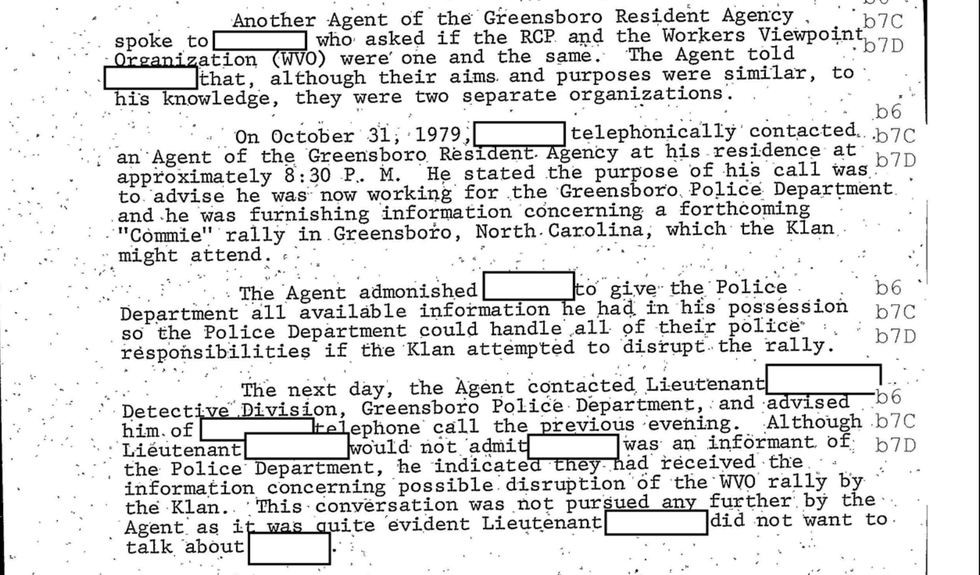 An official FBI memo details Klansman and former FBI informant Eddie Dawson's contact with the FBI three days before the Greensboro Massacre, and an unidentified FBI agent's contact with the Greensboro Police Department to confirm Dawson's information was received. (Courtesy FBI)
Moses, now 89, said he doesn’t remember the memo.
“I had not been fully briefed on everything,” Moses said. “I didn’t even know we had an active Klan in North Carolina. I didn’t know we had a Communist Workers Party.”
Notwithstanding Moses’ avowed lack of awareness about the two opposing groups, the 2006 Greensboro Truth and Reconciliation Commission Report asserts that the FBI initiated surveillance on Workers Viewpoint Organization on Oct. 23 “as a result of the China Grove confrontation,” and then closed the preliminary investigation on Nov. 2 — one day before the massacre.
Moses acknowledged the existence of the investigation to Raw Story, but he said he hadn’t known about it until after it was closed.
“It didn’t rise to my level,” he said. “I hadn’t been informed of it. They didn’t brief me on it.”
When Moses got the call about the shootings, he noted that Andy Pelczar, the supervisory senior resident agent, and another Greensboro agent were competing in a golf tournament. That should put to rest any doubts that they expected serious violence in Greensboro, he argued.
“I don’t believe anybody in the Bureau had any reason to believe there was going to be a big confrontation and shooting between the Klan and the communist party,” Moses told Raw Story. “Andy assured me he had no information that there was going to be anything other than some hecklers.”
Evidence introduced at the civil trial suggested otherwise.
A Bureau of Alcohol, Tobacco and Firearms memo leaked to the plaintiffs showed that the agency coordinated with the FBI on an investigation involving an undercover employee who infiltrated the Nazi contingent ostensibly to investigate potential violations of federal firearms laws. Bernard Butkovich, the BATF employee, would later testify at the civil trial that two days before the massacre he heard a Klansman say that pipe bombs “would work good thrown into a crowd of n-----s.”
Another warning came from Mordechai Levy, a Jewish Defense League activist who provided an affidavit for the plaintiffs stating that he had called in a tip to the Raleigh FBI office on Nov. 2 relaying that he had learned that North Carolina Nazis “planned to attack and possibly kill people at an anti-Klan gathering this week in North Carolina.”
The agent admitted under oath that he’d received the call, according to a 2024 book about the Greensboro Massacre by author Aran Shetterly.
Moses told Raw Story any present-day judgment on the FBI’s handling of such information needs to take into account that in 1976 U.S. Attorney General Edward H. Levi had imposed new guidelines on domestic security investigations. The guidelines came as a result of the Church Committee hearings, which revealed, among other things, that the FBI’s Cointelpro program had on occasion engaged in illegal tactics to disrupt both far-left and far-right groups.
“We were obviously frustrated we were ordered to be hands-off on such matters,” Moses told Raw Story. “We had zero jurisdiction.”
Lewis Pitts, who represented the survivors in the federal civil trial, told Raw Story he always believed the question of federal law enforcement complicity in the massacre was more important than that of the Greensboro police. As the federal government under President Donald Trump renews a campaign to crush the left, the FBI’s role in the Greensboro Massacre has become even more important, he argued.
“The larger and more important role that we’re trying to figure out — and it’s become such an existential issue — is the role of the federal government,” said Pitts, who still lives in Greensboro. “There is strong evidence that the federal government knowingly played a role to unleash the Klan and Nazis, with the highest knowledge that there would be death and injury — and did nothing to prevent it. Then, they lied like crazy to cover it all up.”
When Moses arrived in Greensboro on Nov. 3, 1979 to assess the situation, he asked police Chief William Swing if the slain demonstrators had a permit to march. Upon learning that they did have a permit, Moses made the decision to open an investigation into potential civil rights violations. Despite the acquittal of the Klan-Nazi defendants during the federal civil rights trial, Moses received a commendation from the agency, and was promoted to lead the FBI division in Birmingham, Ala.
The FBI’s initial reaction to the massacre, at least officially, is captured in a Nov. 3, 1979 memo authored by an unidentified special agent for the benefit of the special agent in charge in Charlotte.
After describing how nine to 10 people had jumped out of van owned by a known Klansmen and opened fire on “a peaceful rally,” killing five people, the memo delivers a jarring assessment: “FBI participation not requested at this time; no civil rights violation or racial overtones present.”
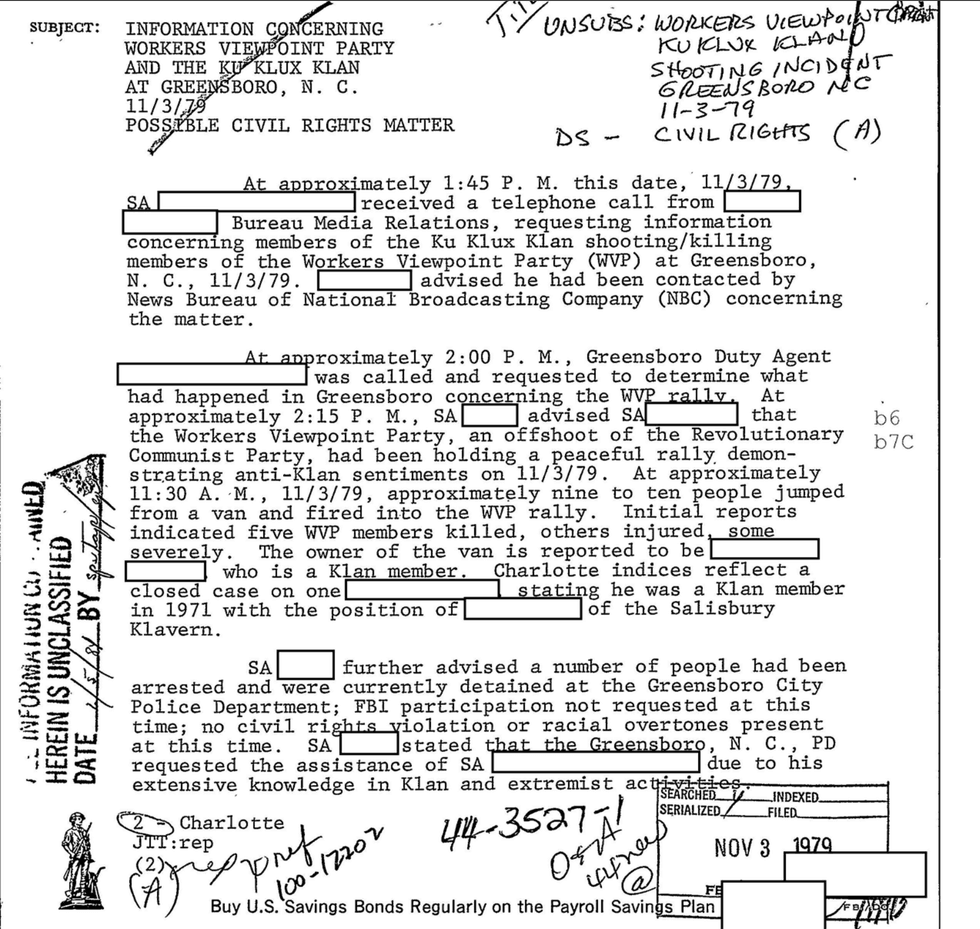 A Nov. 3, 1979 memo details the FBI's response to the Greensboro Massacre. (Courtesy FBI)
Aside from the obvious fact that Klan had a long history of racial terrorism and that the massacre took place in a Black public housing project, the assessment displayed a stunning degree of cluelessness. Nelson Johnson, the local leader of the Workers Viewpoint Organization, was Black and had been a target of FBI surveillance while leading community organizing projects in Greensboro’s Black community for more than a decade. Sandra Smith, one of the five demonstrators killed on Nov. 3, was also Black. She had graduated from Bennett College, a historically Black women’s college, five years earlier. Smith had been elected student body president at Bennett, which is located about a mile from the site of the massacre.
“I wasn’t aware of any racial overtones,” Moses told Raw Story.
“None of the key members of the Communist Workers Party were — they would not cooperate one iota,” he quickly added. “I want you to quote me on that.”
The records bear Moses out on that one fact.
A teletype from the Charlotte office to FBI Director William H. Webster reports that two agents went to the home of the widow of one of the slain organizers four days after the massacre. A young man met the agents at the door and told them the widow was “making funeral arrangements and not at her residence,” according to the memo, which is part of the recently released trove of FBI documents. The agents told the man they wanted to interview her.
A couple of hours later, the agents returned, met this time by two men. The FBI’s message had been conveyed to the widow, they said, and she had a message for them in return.
The memo duly reports that “her response is substantially as follows: The FBI killed her husband and she did not want the FBI on her property.”
CORRECTION: This story misstated former FBI official Cecil Moses as a defendant in the federal civil trial. He was dismissed as a defendant by the judge, as opposed to being found not liable by the jury.
