School shooter may get inheritance � and be ordered to spend it on legal bills
MIAMI — Parkland school shooter Nikolas Cruz appears to have been in line for a sizable inheritance. He'll never get to spend it — except perhaps on defense attorneys. The amount could be enough to compel a judge to order him to hire a private lawyer rather than be represented by the taxpayer-funded Broward County Public Defender's Office.
Leading into a discussion on lawmakers refusing to do anything to curb the proliferation of assault weapons, CNN host Anderson Cooper suggested that the harsh reality of what a bullet from an AR-15 can do to a body has been withheld from Americans and that a wake-up call was needed.
The introduction turned into a monologue as an emotional Cooper proposed showing the carnage to "open people's eyes."
"One of the things General McChrystal said, I think he said this in the wake of one of the shootings," Cooper began. "He said a .223-caliber round, when it hits the human body, the effects are just devastating - it's designed for that. He talked about he didn't think there was a need for that kind of weaponry on the streets. that was after Newtown."
Turning to former Republican lawmaker Jack Kingston, Cooper continued, "I often think we don't focus on the reality of what an AR-15 does to a child. If anyone has been on a battlefield and you see what a weapon like this does to a soldier, if people actually saw this and saw the saw the reality of this, it would open people's eyes."
"We all say, 'oh, these children lost their lives,'" Cooper continued choking up a bit. "They didn't lose their lives, their lives were were ripped out of their bodies, their brains were splattered on the floor, their intestines were hanging out. It was sickening."
"We're talking about this in an ant antiseptic way, and we're shocked that this kids are angry but these kids were hiding in the closets while their friends were dead," he concluded.
"And that's why the law enforcement people are standing by the young people saying, 'we do need to do something different,'" CNN host Van Jones interjected. "Republicans are saying, 'These Democrats, they're emotional, they're irrational, they're exploiting kids because they want to grab all of our guns.' They're actually the ones who are rational and sane."
"The kids hiding under the desks and the cops going to save them are saying the same exact thing, that it makes no sense at all for this to be the reality in America," Jones continued. "They have a thousand excuses. And, I have to say, whenever this thing happens, if it's a Muslim, they want to politicize it within seconds. If it's a Mexican -- build the wall. If it's a black person -- more cops and prisons. If it's a white person, it's mental health."
Former Rep. Jack Kingston (R-GA) went on CNN's "AC 360" Tuesday to double-down on the allegation he made earlier in the day that survivors of the Marjory Stoneman Douglas High School school shooting massacre were left-wing pawns.
"It's so tough to see the distinction between those young people who are so clear, so forthright. Disagree with them, don't like their policies, if you feel that way, that's fine," CNN contributor Van Jones explained. "But if you look at the character of these young people, how clear they are, how forthright they are, how much integrity they have, and to have that -- right up against these presidential tweets -- you couldn't imagine a more juvenile response to a mass killing of children than to use that opportunity to try to stick your finger in the eye of the people who you didn't like before, anyway."
"Those young people are better-spoken than most of us on television and they've never been on television before," Jones observed. So if there's any hope in the country, it's in this generation that's rising."
Jones added, "to stand over the bodies of children and poke your finger in the eye of your add adversary is as low as you can possibly go in public life, and it's a shame the president did that, but I'm proud of these young people."
"You think they are being hijacked by left-wing groups?" host Anderson Cooper asked.
"I was referring to the national rally," Kingston replied. "It would shock me, I hope I'm wrong, but it would shock me if 17-year-olds around the country -- and I agree with you, Van, very articulate, very sincere -- but it would shock me if they did a nationwide rally and the pro-gun control left kept their hands off."
Groans could be heard as Kingston tried to validate his conspiracy theory, by stating, " As Rahm Rahm Emanuel famously said, ‘don’t waste a good crisis.'"
MSNBC "Hardball" anchor Chris Matthews needed multiple angles of questioning while trying to pin down a gun-owning Democratic Party congressman about the age that should be required to purchase an AR-style semi-automatic rifle.
"Let me ask you, where are you on the AR-15, which is the gun of choice of these school shootings?" Matthews asked Congressman Tim Ryan (D-OH) on Tuesday.
"At the very least, they need to be limited. You can't let 18-year-old kids go out there and get these kind of guns and I think that should be the first step as we start limiting the ability of certain people to get these things," Rep. Ryan replied.
"You would put a national age requirement, of what? To get an AR-15?" Matthews followed-up.
"You got to figure it out like these kids in Florida were so articulate about. You can't buy a beer but you can go out and buy one you have these, you know, assault weapons. To me, that doesn't make any sense," Ryan replied.
"Beer is 21. Ar-15s is 18. What do you think of those numbers?" Matthews said, rephrasing his question yet again. "I mean you're a legislator, I'm asking you to legislate. What do you think we should have as a number? I know it's tough -- this is "Hardball" -- that's what I do here."
Frustrated at not being able to pin down Congressman Ryan, the host asked his other guest, Congressman Charlie Dent (R-PA), where he stood on the issue of raising the age required to buy an AR.
"Chris, in order to buy a pistol in this country, an individual has to be 21 years-of-age. We should look at this issue of making sure an 18-year-old can't buy a high-powered, I'll say AR-15, we should at least make that conform with the pistols," Congressman Dent replied.
The question of the minimum age requirement to purchase a semi-automatic rifle was not the only gun control issue where the Republican from Pennsylvania was pushing harder than the Democrat from Ohio.
"We should also focus what we can actually do in Congress. Let's do this: let's ban the bump stock. Let's have universal background checks for all private sales," Dent suggested. "We did this in Pennsylvania in 1995 with [Republican] Tom Ridge as governor and with a Republican General Assembly. We brought the NRA, gun control groups, and law enforcement together in a room and we expanded background checks for private sales of pistols. We should do that."
"There are things we should be doing for greater gun safety," the Republican lawmaker concluded.
As students watch, Fla. lawmakers debate porn but refuse to take up assault weapons ban
TALLAHASSEE, Fla. — A move to push a bill banning assault weapons and high-capacity magazines directly to the Florida House floor Tuesday afternoon was rejected on mostly party lines, six days after a gunman killed 17 people and injured several more at Marjory Stoneman Douglas High School in Parkland.
Despite last week’s tragic shooting at a Florida high school, the man who had been housing gunman Nikolas Cruz after his mother’s death still believes it’s his “right” to own the weapon he used to kill 17 people.
In an address Tuesday afternoon, President Donald Trump stated that he has issued a memorandum to the Justice Department asking the Attorney General to ban bump stocks for rifles.
According to the president, he has asked the Justice Department to propose regulations to “ban all devices that turn legal weapons into machine guns.”
In a blow to gun rights activists, the U.S. Supreme Court on Tuesday turned away a challenge to California's 10-day waiting period for firearms purchases that is intended to guard against impulsive violence and suicides.
The court's action underscored its continued reluctance to step into the national debate over gun control roiled by a series of mass shootings including one at a Florida school last week. One of the court's most conservative justices, Clarence Thomas, dissented from the decision to reject the case and accused his colleagues of showing contempt toward constitutional protections for gun rights.
The gun rights groups and individual gun owners who challenged the law had argued that it violated their right to keep and bear arms under the U.S. Constitution's Second Amendment. The challengers did not seek to invalidate California's waiting period for everyone, just for people who already owned guns and passed a background check.
In his dissent, Thomas scolded his colleagues. "If a lower court treated another right so cavalierly, I have little doubt this court would intervene," Thomas wrote. "But as evidenced by our continued inaction in this area, the Second Amendment is a disfavored right in this court."
The Supreme Court has not taken up a major firearms case since issuing important gun rulings in 2008 and 2010.
The United States has among the most lenient gun control laws in the world. With the U.S. Congress deeply divided over gun control, it has fallen to states and localities to impose firearms restrictions. Democratic-governed California has some of the broadest firearms measures of any state.
A series of mass shootings including one in which a gunman killed 17 people at a Parkland, Florida high school on Feb. 14 have added to the long-simmering U.S. debate over gun control and the availability of firearms.
In another gun case, the high court on Tuesday also declined to take up a National Rifle Association challenge to California's refusal to lower its fees on firearms sales and instead use a surplus generated by the fees to fund efforts to track down illegal weapons.
Thomas said he suspected that the Supreme Court would readily hear cases involving potentially unconstitutional waiting periods if they involved abortion, racist publications or police traffic stops.
"The right to keep and bear arms is apparently this court's constitutional orphan. And the lower courts seem to have gotten the message," Thomas added.
Lead plaintiff Jeff Silvester, the Calguns Foundation and its executive director Brandon Combs, and the Second Amendment Foundation in 2011 challenged the 10-day waiting period between the purchase of a firearm and its actual delivery to the buyer, saying it violated the Second Amendment for individuals who already lawfully own a firearm or are licensed to carry one.
The waiting period gives a gun buyer inclined to use it for an impulsive purpose a "cooling off" period before obtaining it, which has been shown in studies to reduce handgun suicides and homicides, the state said in a legal filing. The waiting period also gives officials time to run background checks and ensure that weapons being sold are not stolen or being purchased for someone prohibited from gun ownership, the state said.
The states of California, Hawaii, Rhode Island, Illinois, Minnesota, Florida, Iowa, Maryland and New Jersey as well as Washington, D.C., have waiting periods that vary in duration and type of firearm, according to the Giffords Law Center to Prevent Gun Violence gun control advocacy group.
The San Francisco-based 9th U.S. Circuit Court of Appeals upheld California's law in 2016, reversing a federal trial court that had ruled it unconstitutional.
Last year, the Supreme Court left in place a California law that bars permits to carry a concealed gun in public places unless the applicant can show "good cause" for having it.
(Reporting by Andrew Chung; Editing by Will Dunham)
MSNBC anchor Katy Tur warned against getting "lost in any illusions" that President Donald Trump and the Republican Congress would address gun control in the wake of the Parkland shooting massacre.
"In this moment, is there movement on guns?" Tur wondered.
"Today, we're seeing what could be a movement of teenagers, who are angry about gun violence and want lawmakers to listen," the host noted. "And we're also seeing what could be movement from those lawmakers who have yet another opportunity to do something -- or nothing -- about gun violence."
"Now, though, the White House says the president is open to looking at what can be done to prevent this from happening again, announcing they'd get behind a bipartisan effort that's aimed at making the background check system more effective," Tur noted.
"Let's not get lost in any illusions here, though. Remember, this bill has been out there since after the mass shootings in Texas and Las Vegas last fall," she reminded. "Remember, that moment, a potential movement on guns came and went, without any action."
"Remember, this bill, that the president is open to, wouldn't necessarily have kept a gun out of the hands of Nikolas Cruz," Tur continued.
"Remember, any action on anything related to guns is a serious uphill climb in Washington. Five years ago, a Democratic president couldn't even pass background check legislation through a Democratic Senate," the host recalled.
"Remember, we have a Republican president, a Republican House, and a Republican Senate," Tur emphasized.
Fox News host Brian Kilmeade argued on Monday that the way to prevent school shootings was for the Department of Education to be more like the Transportation and Security Agency (TSA), which is tasked with keeping firearms out of airports.
During a discussion about the Parkland school shooting on Fox & Friends, co-host Steve Doocy said that the lesson from the incident was that "unstable people should not have access to guns."
"Something needs to happen from both sides to prevent bad people from doing bad things," he remarked. "Who knows? Maybe something will be done to federal background checks because the way it's working right now ain't working."
Co-host Ainsley Earhardt asserted that there needs to more armed security in schools.
Kilmeade noted that while one guard at Marjory Stoneman Douglas High School in Parkland had a gun, a coach who was killed in the mass shooting was not armed.
"I think the one thing that could emerge from this that I think most people would embrace is -- I don't want to set up a TSA for schools but I would like some standardized security for schools, allow and not allow."
"So we could have a Department of Education and Security," he added. "At the same time."
"This school had it all," Doocy replied. "Unfortunately, this shooter at closing time figured out at closing time, they're going to be opening the gates. And I can go in at that time."
As a parent, I understand the desire for practical responses to school shootings. I also absolutely believe the government should do more to prevent such incidents. But the gun control debate has proven so divisive and ineffective that I am weary of waiting for politicians to act.
I study the kind of aggressive childhood behavior that often predates school shootings. That research suggests what communities and families can start doing today to better protect children. Here are 10 actions we can all take while the federal government drags its heels.
What schools can do
Because educators observe students’ emotional and behavioral development daily, they are best positioned to detect troubled behaviors and intervene. In Los Angeles, for example, schools have successfully used outreach and training to identify potentially violent students before problems occur.
1. Teach social and emotional skills
Children learn social skills from everyday interactions with each other. Playtime teaches young people how to control their emotions, recognize others’ feelings and to negotiate. Neighborhood “kick the can” games, for example, require cooperation to have fun – all without adult supervision.
But social and emotional skills can – and should – be taught in school as a way to prevent student violence. Students with more fluent social skills connect better with others and may be more able to recognize troubled peers who need help.
2. Hire more counselors and school resource officers
In my opinion, school resource officers – trained police officers who work with children – are also helpful for students. While untrained officers may pose a threat to students, well-trained school resource officers can connect with kids who have few other relationships, acting as a support system. They are also on hand to respond quickly if crime or violence erupts.
Putting trained school resource officers and counselors in every school will cost money, but I believe it will save lives.
3. Use technology to identify troubled students
Technology may challenge kids’ social development, but it can also be harnessed for good. Anonymous reporting systems – perhaps text-message based – can make it easier for parents and students to alert law enforcement and school counselors to kids who seem disconnected or disturbed. That enables early intervention.
In Steamboat Springs, Colorado, one such tip appeared to prevent extreme violence in May 2017. Police took a young man who’d threatened to harm his peers into protective custody before he could act on his words.
What communities can do
Communities also help raise children. With many eyes and ears, they can detect often smaller problems before young people grow into violence.
4. Doctors should conduct standard mental health screenings
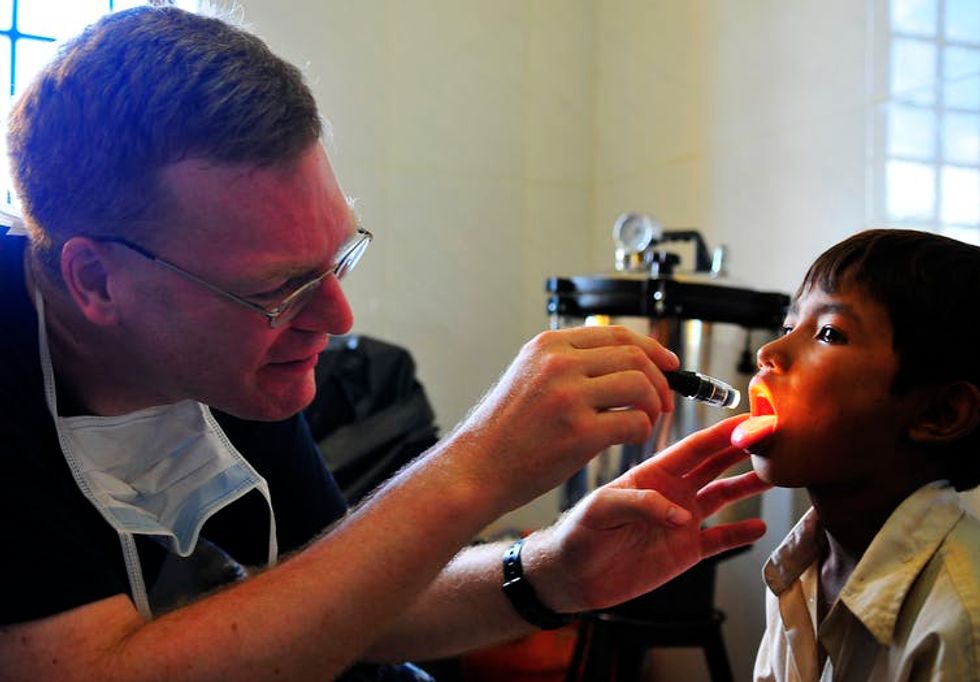
Doctors could detect these problems early on with a standardized screening at health checkups. If concerns arise, referrals to counseling or other mental health professionals might follow.
Doctors are an underutilized community resource. Regular check-ups could help prevent violence.
I would like to see companies like Instagram, Twitter and Snapchat create algorithms that identify repeated online threats and automatically alert local law enforcement.
What parents can do
Parents and guardians are often the first to detect their child’s emotional struggles. Here are some tips for monitoring and promoting healthy emotional development at home.
6. Think critically about your child’s social media use
From virtual war games to cruel trolls, the internet is full of violence. The relationship between violent content and aggression hasn’t been consistent in research: Some studies see no relationship at all, while others find some correlation between violent video games and violent behavior.
This mixed evidence suggests that online content affects children differently, so parents must assess how well their child handles it. If your daughter likes “Assassin’s Creed” but is gentle, socially successful and happy, the onscreen violence may not be strongly impacting her.
But if your child is drawn to violent games and tends to be aggressive or troubled, discuss the situation with your pediatrician or school counselor.
Like adults, children need confidants to feel invested in and connected with their community. The trusted person can be parent, a family member or a friend – just make sure someone’s playing that role.
For children who struggle to make friends and build relationships, there are programs that can help them learn how.
Children need confidants to feel connected to their communities.
So rather than just fret over screen time, focus instead on how children can benefit from a variety of activities. Evidence shows that children who experience different pursuits over the course of their day – from sports and music to an after-school job – are happier and healthier for it.
10. Talk with your child
This is both the easiest and hardest way to make sure your kids are doing OK. Children, especially teenagers, don’t always want to talk about how life is going. Ask anyway.
My research shows that simply asking children about their friends, their technology use and their day is an important way to show you care. Even if they don’t respond, your interest demonstrates that you’re there for them.
Try this one now. Ask your children what they’re thinking about the shooting in Florida and how they like their friends and school. Then listen.
Stunned by the deadliest high school shooting in U.S. history, students mobilized across the country on Sunday to organize rallies and a national walkout in support of stronger gun laws, challenging politicians they say have failed to protect them.
Students from Marjory Stoneman Douglas High School, where a former student is accused of murdering 17 people on Wednesday using an assault-style rifle, joined others on social media to plan the events, including a Washington march.
"I felt like it was our time to take a stand," said Lane Murdock, 15, of Connecticut. "We're the ones in these schools, we're the ones who are having shooters come into our classrooms and our spaces."
Murdock, who lives 20 miles (32 km) from Sandy Hook Elementary School where 20 children and six adults were shot to death five years ago, drew more than 50,000 signatures on an online petition on Sunday calling on students to walk out of their high schools on April 20.
Instead of going to classes, she urged her fellow students to stage protests on the 19th anniversary of an earlier mass shooting at Columbine High School in Colorado.
Students from the Florida high school are planning a "March for Our Lives" in Washington on March 24 to call attention to school safety and ask lawmakers to enact gun control.
They also plan to rally for gun control, mental health issues and school safety on Wednesday in Tallahassee, the state capital. The students were expected to meet with a lawmaker who is seeking to ban the sale of assault-style weapons like the AR-15 allegedly used in the school shooting.
The demands for change by many still too young to vote has inflamed the country's long-simmering debate between advocates for gun control and gun ownership.
Students from the Florida school have lashed out at political leaders, including Republican President Donald Trump, for inaction on the issue. Many criticized Trump for insensitivity after he said in a weekend Twitter post that the FBI may have been too distracted with a Russia probe to follow leads that could have prevented the massacre.
"You can't blame the bureaucracy for this when it's you, Mr. President, who's overall responsible," David Hogg, an 18-year-old Douglas senior, said in a phone interview.
'LISTENING SESSION'
The White House said Trump planned to host "a listening session" with high school students and teachers on Wednesday, but did not specify which students or school would be involved.
Democratic leaders vowed to redouble efforts to fight the nation's powerful gun lobby to reduce violence from firearms.
"We're the adults. We're the leaders in this country who are supposed to keep our children safe - and again and again, our country has let them down," Democratic National Committee Chairman Tom Perez said on Twitter.
The suspect in the Parkland shooting, Nikolas Cruz, 19, faces multiple murder charges in the deaths of 14 students and three staff members, and the wounding of more than a dozen others in a rampage that eclipsed Columbine as the country's worst mass shooting at a high school.
Cruz was reported to have been investigated by police and state officials as far back as 2016 after slashing his arm in a social media video, and saying he wanted to buy a gun. Authorities determined, however, he was receiving sufficient support, newspapers said on Saturday.
In addition, the Federal Bureau of Investigation admitted on Friday that it failed to investigate a warning that Cruz possessed a gun and the desire to kill.
A couple who opened their home to Cruz after his mother's recent death saw no signs he was planning a rampage, according to the Sun Sentinel in south Florida.
Kimberly and James Snead told the newspaper they knew Cruz had guns, and that they made him lock them in a safe. They thought they had the only key, they said.
Cruz faces charges that could bring the death penalty. Prosecutors have not yet said if they will seek capital punishment.
Four people still hospitalized with wounds from the shooting were in fair condition on Sunday, a spokeswoman for the Broward Health system said.
School officials in Broward County said on Sunday they were aiming to have staff return to the high school campus by the end of the week. They did not say when classes would resume.
(Writing and additional reporting by Peter Szekely in New York, Letitia Stein in Detroit and Jeff Mason in West Palm Beach, Fla.; Editing by Daniel Wallis and Peter Cooney)




 Try this one now. Ask your children what they’re thinking about the shooting in Florida and how they like their friends and school. Then listen.