


The Bexar County Republican Party chair has a new conspiracy theory. #satx #txelex


"It was a terrible thing — never should have happened. Something snapped, I think, with the policeman and the other three watching it. I guess you can't put it in the same category, but it was certainly in a very bad category," the president told his first White House press secretary turned TV host.
"Nothing good comes out of that," he added. "No, it was a very bad thing."
Chauvin was filmed kneeling on Floyd's neck with his hand in his pocket. Floyd, in handcuffs, repeatedly said he could not breathe and begged for help from his dead mother. Chauvin has been charged with second-degree murder.
The president laced into Minneapolis' Democratic Mayor Jacob Frey, a white man, for crying over Floyd's death. A nationwide outpouring of grief erupted into the most explosive bouts of civil unrest which the country has seen in decades.
"Super-liberal mayor. He was crying," Trump said. "It's not nice, but the mayor can't cry in cases like that."
"We have a very different attitude on things. I am law and order — they're not. If they're not for law and order, you're going to lose the country," he told his first press secretary, who went on to write a book in which he describes Trump as "a unicorn, riding a unicorn over a rainbow."
The president characterized the individuals protesting racial injustice as hypocrites amid the social distancing guidelines necessitated in recent months by the coronavirus pandemic.
"We want to be back to normal, but it's a little bit soon," Trump said. "But I watch these protesters — and they're the ones all claiming social distancing and everything else — it's really interesting."
"They do that — and then they're jumping on top of each other by the thousands when they're screaming, and ranting and raving, which is not a good thing," he added.
Spicer also asked Trump about the events surrounding his Monday evening photo-op at St. John's Episcopal Church, which he claimed had been "handled very well" by authorities.
"I went there because somebody suggested it was a good idea," the president claimed. "And I thought it was a great idea, and it was a great idea."
However, according to The New York Times, the photo-op was masterminded by first daughter Ivanka Trump.
The president also tried to distance himself from the decision to unleash tear gas, rubber bullets and flash-bang shells to clear out peaceful protesters so he could be photographed holding an upside-down Bible where they had been standing.
"The military moved them back. I guess they just reported there were no — what do you call them? The rubber bullets. There was none of that used. They just moved them back," Trump told Spicer.
Spicer admitted on national TV to defending the president's falsehoods to the American people for months, beginning on the first day of the administration over the crowd size at Trump's inauguration.
"They didn't know until just shortly before that I was going there. Somebody suggested — I said, 'Let's go. Let's walk.' And we walked from the White House, and I think everything was handled very well," Trump said.
"I will tell you," he added. "Religious leaders loved it."
But religious leaders such as the bishop of the Episcopal Diocese of Washington condemned the assault, in which two priests were gassed.
When Spicer asked Trump if he had "grown in his faith" during his first term, the president said: "I think, maybe I have, from the standpoint that I see so much that I can do."
"I've done so much for religion," Trump added.
In a 2018 appearance on the "Today Show," Spicer reflected on Trump's controversial relationship with the truth.
"Look, he's the ultimate salesman," the Republican said. "I think he talks about it in his books how he uses hyperbole to sell issues and that's how he his — he's a salesman, and a negotiator and a businessman first and foremost."
You can watch the full Trump-Spicer interview below via YouTube:
Republican leaders in four Texas counties shared racist Facebook posts, some of which also floated conspiracy theories, leading Gov. Greg Abbott to call for two of them to resign.
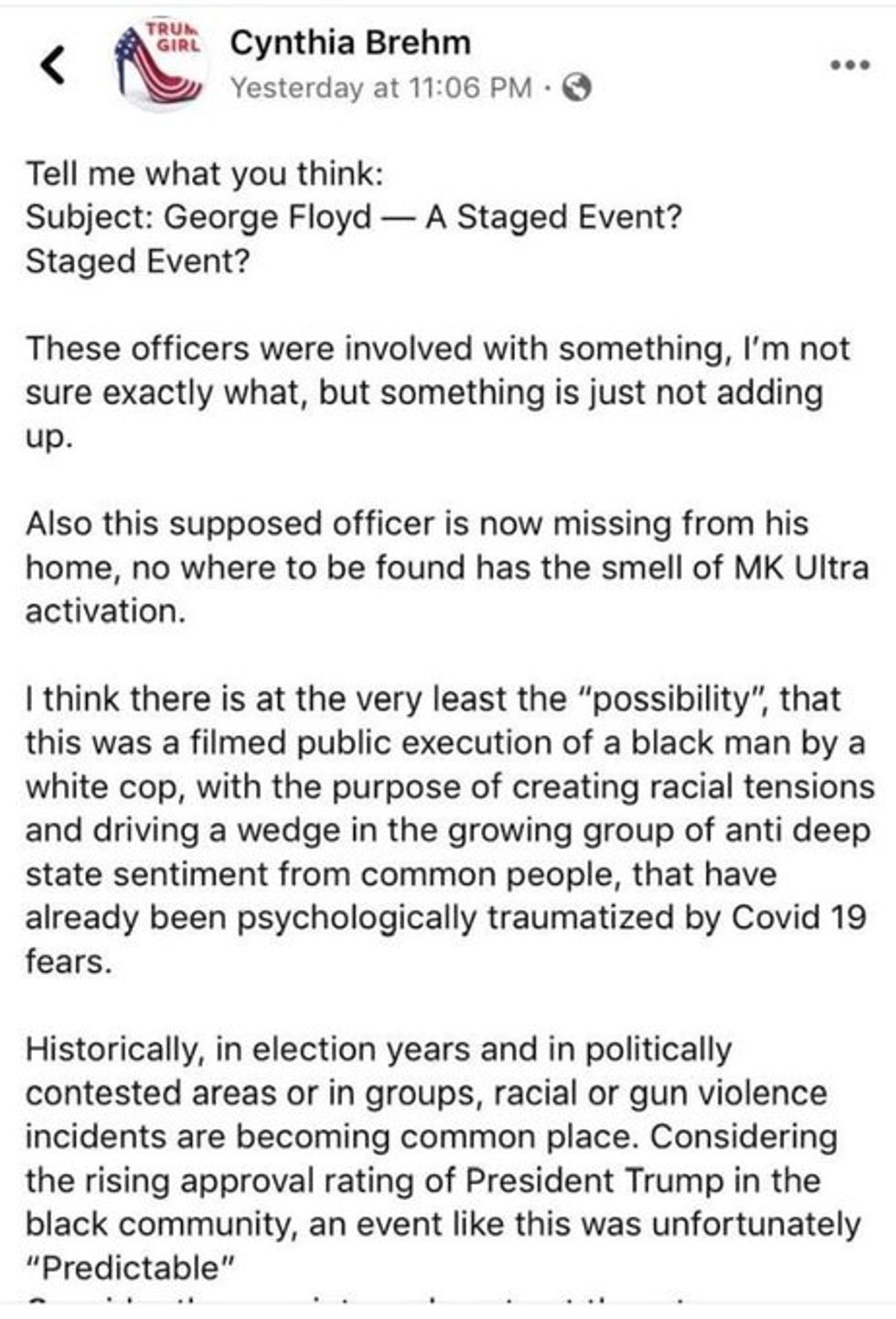
Abbott and other top Texas Republicans called for the resignation of the GOP chairs in Bexar and Nueces counties after they shared on social media a conspiracy theory that Floyd's death was a "staged event," apparently to gin up opposition to President Donald Trump. There is no evidence to support that claim; Floyd, a black Minnesota man, died last week after a white police officer kneeled on his neck for nearly nine minutes.
"These comments are disgusting and have no place in the Republican Party or in public discourse," Abbott spokesman John Wittman said in a statement Thursday morning.
Meanwhile, the GOP chairman-elect in Harris County, Keith Nielsen, posted an image on Facebook earlier this week that showed a Martin Luther King Jr. quote — "Injustice anywhere is a threat to justice everywhere" — on a background with a banana. The juxtaposition of the quote and the banana can be read as an allusion to equating black people with monkeys, a well-worn racist trope. Nielsen appears to have deleted the post and apparently addressed it on his Facebook page Thursday evening.
"It is unfortunate that the sentiment of the quote and my admiration for Dr. Martin Luther King Jr. has been overshadowed by people's misinterpretation of an image," Nielsen wrote, calling for "racial reconciliation" in America. "My hope is I will continue to be part of the solution and never part of the problem."
The Texas Tribune became aware of Nielsen's post after Abbott called for the resignation of the Bexar County and Nueces County chairs. Wittman could not immediately be reached for comment about the third post.
U.S. Rep. Dan Crenshaw, a Houston Republican, said in a statement to the Tribune that "Nielsen has no place in our party. Not now. Not ever" — and called his post "a sad reminder that such blatant ignorance and bigotry still exists."
Even later Thursday, Democrats also criticized a fourth post from a GOP chair on Facebook. Sue Piner, chair of the Comal County GOP, shared a post on Sunday that included an image of liberal billionaire George Soros and text that said, "I pay white cops to murder black people. And then I pay black people to riot because race wars keep the sheep in line."
Piner could not be immediately reached for comment about the post. The unfounded Soros conspiracy theory is among many that have spread online as Americans have protested policy brutality.
Republican Texas Land Commissioner George P. Bush late Thursday said all four county leaders should step down.
"I have said it before and I will say it again now: the GOP must not tolerate racism. Of any kind. At any time," he said in a Tweet.
In Bexar County, home to San Antonio, GOP Chairwoman Cynthia Brehm did not respond to request for comment for this story but told Spectrum News that she would not resign over her post. She told the TV station that she did not agree with the post and rebuffed the cast of GOP leaders calling for her to step down, saying they "do a lot of things, too, that I don’t agree with, but I don’t ask for their resignation."
In the post on Facebook, Brehm described the situation in which Floyd died as the "possibility" that "this was a filmed public execution" for the "purpose of creating racial tensions." She also cited the "rising approval rating of President Trump in the black community" as a reason for why "an event like this was unfortunately predictable."
Brehm was not the only big-city county GOP chair to spread the conspiracy theory. After she received wide condemnation Thursday, it surfaced that the chairman in Nueces County — home to Corpus Christi — had posted the same text on Facebook last week. The post from the chairman, Jim Kaelin, called it an "interesting perspective."
Wittman told The Texas Tribune that the governor also wanted to Kaelin to step aside.
"Spreading conspiracy theories that the murder was staged simply defies reality; it is irresponsible, and unbecoming of anyone who holds a position in the GOP," Wittman said in a statement.
Abbott's call for Brehm to resign earlier Thursday prompted a swift succession of condemnation. Shortly after Wittman's statement, U.S. Sen. John Cornyn's campaign said he believes Brehm should resign as well. Similar resignation calls came Thursday afternoon from Texas GOP Chairman James Dickey, U.S. Sen. Ted Cruz, Lt. Gov. Dan Patrick and Texas House Speaker Dennis Bonnen. Dickey said in a statement that he had "personally reached out" to Brehm to ask her to step down.
Brehm has been a lightning rod since she took over the party in Bexar County in 2018. She made headlines last month for declaring the new coronavirus a hoax pushed by Democrats.
At least one San Antonio Republican, former Texas House Speaker Joe Straus, acknowledged that Brehm has a "long history of making racist and inflammatory statements, peddling conspiracy theories, and bringing embarrassment upon Bexar County Republicans." He said in a statement it was "well past time for her to resign."
Brehm's Facebook post about Floyd began receiving wide attention Wednesday after Gilbert Garcia, columnist for the San Antonio Express-News, posted a screenshot of it on Twitter. He later said he had taken the screenshot from her Facebook page Wednesday morning, and it was apparently deleted that afternoon.
Garcia's tweet prompted U.S. Rep. Chip Roy, R-Austin, whose district includes Bexar County, to call for Brehm to step down immediately. The other Republican who represents Bexar County in the U.S. House, Rep. Will Hurd of Helotes, said he agreed Brehm should resign after Abbott's call Thursday.
State Sen. Donna Campbell, R-New Braunfels, who represents Bexar County as well, also pressured Brehm to resign Thursday afternoon. So did another GOP state senator whose district includes Bexar County, Sen. Pete Flores of Pleasanton.
"Cynthia Brehm’s comments are flat out wrong and dangerous," party spokesman Abhi Rahman said in a statement. "Enough is enough."
Democrats also called on Republicans to denounce Brehm’s comments last month about the coronavirus crisis, which she said "has been promulgated by the Democrats to undo all of the good that President Trump has done for our country." The Democratic Congressional Campaign Committee had specifically called on Roy and two other San Antonio-area GOP candidates to condemn those remarks.
Roy's chief of staff, Joseph Wade Miller, said Wednesday evening he was unaware of Brehm's coronavirus comments and the Democratic calls to denounce them. "Just another reason why she should resign though," he tweeted.
"Coronavirus clearly isn't a hoax," Miller told The Texas Tribune on Thursday. "It's a very serious public health problem."
Cassandra Pollock contributed to this report.
Correction: Due to an editing error, an earlier version of this story misspelled Nueces County.
With the country’s long history of racist killings, it may be confusing to think that racists and white supremacists are among those objecting to the killing of people of color.
But people affiliated with far-right groups aren’t trying to be part of the overall protest movement. Having researched these groups, we think it’s likely that they are attempting to hijack the event for their own purposes.
As researchers of street gangs and far-right groups, we see that in this case, they want to stoke a civil war between the races – one they think they can win. By antagonizing police, destroying property, or intimidating the public by adopting military gear – including weapons – these groups are attempting to instigate violence between the police, protesters and the public. Rousting law enforcement to violently retaliate against black people en masse is the first step.
The far-right is not unified by a strict ideology. It is a broad movement with various factions vying for greater amounts of attention and influence.
In spite of this tension, our research shows that many share the conspiracy belief that Western governments are corrupt and controlled by the New World Order, a cabal of wealthy Jewish elites. To them, wealthy Jewish investor and democracy advocate George Soros is the puppet master of the world economy.
William Luther Pierce’s 1978 novel “The Turner Diaries,” which has come to be known as “the bible of the racist right,” lays out a plan to instigate a race war and bring about the federal government’s collapse. The book has inspired violence from the far-right, most notably the 1995 bombing at the Alfred P. Murrah Federal Building in Oklahoma City.
“Accelerationism” – the idea that inducing chaos, provoking law enforcement, and promoting political tension will hasten the collapse of Western government – has taken root among far-right groups. One such group, the “Boogaloo Bois,” identified by their penchant for wearing Hawaiian shirts, has been observed at protests in Minnesota, Florida, Georgia, Texas, Pennsylvania, Colorado and Oregon. As with any far-right movement, “Boogaloo Bois” groups are rather unstructured and have varied beliefs, lacking any hierarchical organization.
In Las Vegas, three “Boogaloo Bois” were arrested with firearms and a plan to incite violence during George Floyd protests. Social media posts and online chat groups have also shown them attempting to infiltrate other protests across the country.
Joining the crowds provides these groups an opportunity to discredit protesters by inciting looting, rioting, violence and vandalism – which they hope will spark like-minded white Americans to resist the civil disobedience of protesters. Already, there are roving bands of armed white counterprotesters at protests across America.
Other far-right extremists are talking on social media about the protests requiring a lot of police attention and see an opportunity to engage in targeted terror attacks. Their overall intention is the same: fanning flames to burn down the federal government, making room for them to establish a whites-only country.
[Deep knowledge, daily. Sign up for The Conversation’s newsletter.]
Matthew Valasik, Associate Professor of Sociology, Louisiana State University and Shannon Reid, Associate Professor, University of North Carolina – Charlotte
This article is republished from The Conversation under a Creative Commons license. Read the original article.
This push to give money to support everything from food banks to vaccine research comes a decade after the Giving Pledge, a voluntary effort to give away at least half of an immense fortune during the signatory’s lifetime, first launched.
When signatories join the Giving Pledge, they can voluntarily submit a letter explaining their commitment to philanthropy that’s posted on the internet. Together with my colleagues and fellow philanthropy scholars Elena McCollim and George E. Mitchell, I analyzed these letters to better understand how billionaires make sense of their generosity.
Following the Great Recession, Microsoft co-founder Bill Gates and his wife Melinda Gates teamed up with investor Warren Buffett and a few of their wealthy friends to hatch this plan to increase giving among billionaires.
By March 2020, 120 couples, 78 single men and 11 single women had signed on. The members of the Giving Pledge represent about 10% of the more than 2,000 known billionaires in the world. To be eligible to join, an individual or a couple must have a combined net worth of US$1 billion, including assets they already donated.
Five of the 10 richest men in the United States have joined the Giving Pledge. Besides Gates and Buffett, that includes Facebook co-founder Mark Zuckerberg, Oracle co-founder Larry Ellison and the entrepreneur and politician Michael Bloomberg. Taken together, the current combined wealth of those five fortunes adds up to about $385 billion. The total wealth of everyone who signed the pledge in its first decade was at least an estimated $1.14 trillion as of the end of 2019, according to Forbes Magazine.
The letters are typically fairly short and addressed to Buffett or Gates. Many describe why the donors engage in philanthropy and identify a few favorite causes. We found that 187 of the 209 signatories have submitted them.
You cannot assume that the letters contain the true motives for making this pledge, but these missives do open a window into why these billionaires believe they should give away so much of their wealth. None referred to a desire to become more famous, for example, or openly acknowledged any sense of guilt. Yet those feelings might contribute to the personal motivation these rich people have to join the Giving Pledge.
In reviewing the letters, we found 10 distinct explanations for giving. The top five appeared in at least 20% of the letters, while the remaining five were in 10% or fewer.
A desire to be seen as grateful and altruistic dominated many of these accounts, with more than a third describing a drive to make a difference.
“Helping disadvantaged groups live decent lives in the process of creating wealth has been my personal credo,” wrote Dong Fangjun, a Chinese investor who now funds efforts to clean up China’s polluted countryside.
The second most common reason was a desire to give back.
“I have so much gratitude for being a woman in America,” wrote Sara Blakely, the founder of the Spanx undergarment company and a supporter of several women’s causes. “I never lose sight that I was born in the right country, at the right time.”
The letters also highlighted the joy of giving.
“I get tremendous pleasure from helping others,” wrote Bill Ackman, an investor and hedge fund manager who funds a wide range of arts, social justice and other kinds of nonprofits. “It’s what makes my life worth living.”
The life lessons taught by parents were another common reason these major donors say they became interested in giving.
“From as far back as I can remember, my parents taught me the importance of giving back, whether we had a little or a lot,” wrote Jim Pattison, a Canadian businessman who supports a wide range of nonprofits, including hospitals.
Many of the letters conveyed a sense of “noblesse oblige,” a French term for the idea that being wealthy creates a duty to give.
“I strongly believe that those of us, who are privileged to have wealth, should contribute significantly to try and create a better world for the millions who are far less privileged,” wrote Azim Premji, a tech industry leader who has become India’s biggest philanthropist.
Among the five least common explanations our team identified were references to principles of justice, concerns about the downside of immense inheritances, having no other use for vast wealth, religious beliefs and a sense that luck played a big role in becoming rich.
Some of the younger donors described themselves as being only stewards of their wealth. In this view, principles of justice and equality demand that the wealthy share generously.
For example, Jeff Lawson, a co-founder of LinkedIn, and his wife Erica Lawson included a quote by Bryan Stevenson, the founder of the Equal Justice Initiative: “The opposite of poverty is not wealth; the opposite of poverty is justice.”
About a tenth of the letters cited concerns over the possible harm a large inheritance could do to their own kids and grandchildren.
“We all know second- and third-generation wealth where the recipients were actually born on third base but think and act like they hit a triple,” wrote John W. “Jay” Jordan II, an American investor with three children and two stepchildren and one of the biggest donors ever to the University of Notre Dame, his alma mater.
Some pledgers said they see nothing better to do with their excessive wealth. The late real estate investors Herb and Marion Sandler, whose fortune launched the investigative news outlet Pro Publica, put it this way: “How many residences, automobiles, airplanes and other luxury items can one acquire and use?”
Religion and spirituality play a surprisingly minor role, with some exceptions.
“We were both raised in the Church, and a key theme of the Bible is the importance, the necessity, of giving,” explained Paul Tudor Jones, a hedge fund manager, and his wife Sonia Jones. The couple has made education and inequality high priorities in their giving.
Finally, a few of these big donors attributed their eagerness to give away much of their money to being aware of their good fortune. “To be repeatedly in the right place at the right time, that is the mother of all luck,” wrote Mo Ibrahim, the Sudanese telecommunications entrepreneur who invests in improving African leadership and governance.
But what sets these donors truly apart from the rest of us is what we philanthropy scholars call “hyperagency” – the desire to singlehandedly change the world in accordance with their ideas and dreams.
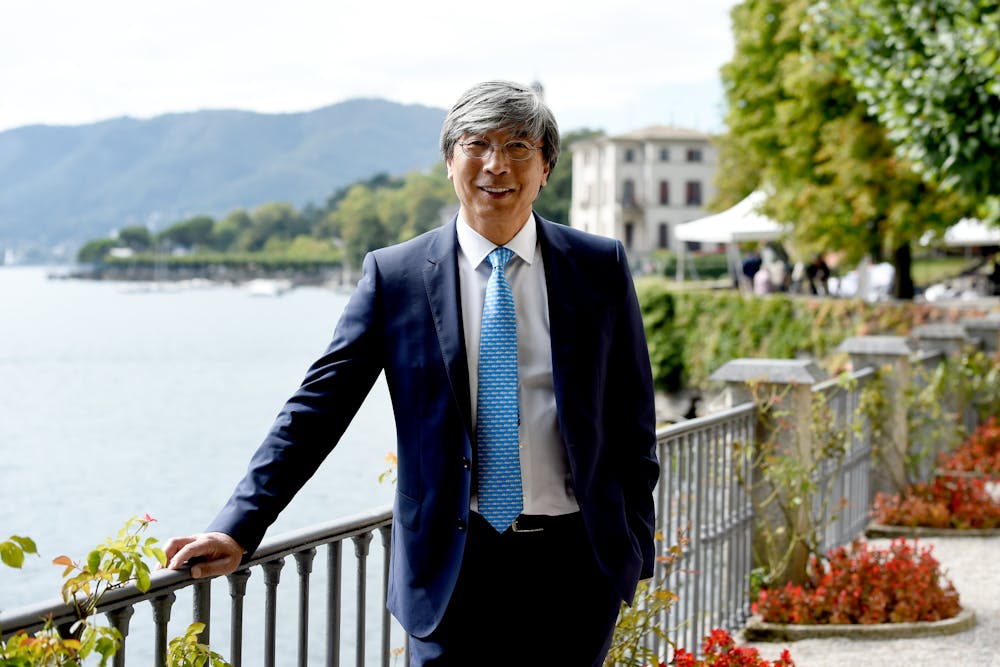
For example, Patrick Soon-Shiong, the surgeon and entrepreneur who owns the Los Angeles Times, the San Diego Union-Tribune and the Los Angeles Lakers, and his wife Michele B. Chan, made an ambitious statement in their letter: “Our passion, our mission is to transform health and health care, in America and beyond.”
In other words, Giving Pledge letters harbor contradictions with their messages about both ambition and humility. Many of the wealthy people who embraced this campaign have seen themselves as uniquely capable of changing the world. At the same time, they would like others to see them as modest, grateful and selfless.
[Deep knowledge, daily. Sign up for The Conversation’s newsletter.]
Hans Peter Schmitz, Associate Professor, University of San Diego
This article is republished from The Conversation under a Creative Commons license. Read the original article.