Estimated deaths from the coronavirus passed 30,000 Americans this week, but that still hasn't stopped President Donald Trump from boasting about his supposedly strong poll numbers.
On Thursday morning, the president tweeted about a purported poll conducted by right-wing news network OAN that showed he had a 52 percent approval rating in North Carolina. The president also gloated that the same poll also showed him besting former Vice President Joe Biden by seven points in the state.
However, many Twitter users were not in the mood to hear the president talking about his poll numbers at a time when 30,000 Americans died from COVID-19 in the last month, and more than 5 million more people filed unemployment claims in just the last week.
President Donald Trump on Wednesday held a call with top Wall Street executives and bankers to discuss reopening the economy. But according to Politico reporter Ben White, things did not go well.
"The whole thing was a bit of a disaster, the way they announced this on Tuesday," White explained on MSNBC, "read a lot of corporate CEO names that had no idea they were a part of this effort to reopen the economy, didn't give anybody really time to plan to be on these calls. Among the Wall Street executives, a lot of them had earnings yesterday and couldn't be on the call. One JP Morgan executive tried for 20 minutes to get in and couldn't."
"What they're telling the president is, yes, of course we want the economy reopened. We want businesses to start up again," he continued. "But we cannot do that, our employees will not feel safe until the testing regime is much more widespread, until people don't feel like they're going out to be guinea pigs to get the virus. There's simply no way to do it that way. Make people feel safe. Make business owners feel like demand is going to be there and then you can start to reopen. So the whole thing was slap dash in the way it was set up, and slap dash in the way it was executed and I think Trump heard a lot of things maybe he didn't want to hear."
According to White's Politico article, one top executive described the call with Trump as a "sh*t show."
PHILADELPHIA — Gloria Santiago would love to avoid the coronavirus by ordering groceries from home and having them delivered, just like the Acme and Whole Foods shoppers she hears about.“The pressure would be less heavy than bringing my 7-year-old and 3-year-old into the store with me, worrying about them touching everything, worrying about them being at risk for bringing home the virus,” said Santiago, 29, of Philadelphia’s Fairhill section, a single mother and now-unemployed waitress from a recently shuttered local restaurant. She qualifies for food stamps.Under federal rules, however, it is...
President Donald Trump appears hellbent on "reopening" the American economy next month, but American University School of Public Affairs law professor David Malet is warning that it won't be the glorious return to normalcy that the president is craving.
Writing in the Washington Post, Malet says that recent research he's conducted has shown that "much of the public will not tolerate any level of risk -- and will not trust experts or officials who tell them that it’s safe to go out again" during the COVID-19 pandemic.
Citing a study that he conducted last decade, Malet said that many Americans are likely to stay in quarantine during the pandemic even if they're told that they can go out to bars and restaurants again.
"Three months into the exercise, when presented with choices about which quarantine and decontamination approaches to support, virtually every participant opted to try to bring risk down to zero," he writes. "The goal of the study was to determine public tolerance for acceptable risk. The experiment found that no risk levels were acceptable -- even for participants who initially believed there was no risk."
In fact, Malet found that people were so scared of getting infected that they would refuse to come out even when told the risk was absolutely minimal.
"Nearly half the experiment’s total responses involved our ordinary citizens telling us that no actions -- not even the most extreme efforts -- were enough to reassure them," he writes. "One official told us that a 99.99 percent effective treatment for anthrax, which would have required shutting off the city’s water for one week, was unacceptable because 'I don’t want to be the 0.01 percent who gets anthrax.'"
Months after President Donald Trump promised to open FBI files to help families of the 9/11 victims in a civil lawsuit against the Saudi government, the Justice Department has doubled down on its claim that the information is a state secret.
In a series of filings just before a midnight court deadline on Monday, the attorney general, William Barr; the acting director of national intelligence, Richard Grenell; and other senior officials insisted to a federal judge in the civil case that further disclosures about Saudi connections to the 9/11 plot would imperil national security.
But the administration insisted in court filings that even its justification for that secrecy needed to remain secret. Four statements to the court by FBI and Justice Department officials were filed under seal so they could not be seen by the public. An additional five, including one from the CIA, were shared only with the judge and cannot be read even by the plaintiffs’ lawyers.
Barr insisted to the court that public discussion of the issue “would reveal information that could cause the very harms my assertion of the state secrets privilege is intended to prevent.”
What the various security agencies are trying to hide remains a mystery.
Since the plaintiffs filed their lawsuit in federal district court in New York in 2017, their primary focus has been on the relationship between the hijackers and relatively low-level Saudi officials. Those include at least two Saudis who crossed paths in Southern California with the first two Al Qaeda operatives who were sent to the United States by Osama bin Laden in January 2000.
Yet the broad outlines of the hijackers’ connections to those two Saudi officials — a diplomat at the kingdom’s Los Angeles consulate and a suspected Saudi spy living as an exchange student in San Diego — have been publicly known for years. The FBI shared thousands of pages of its files on the plot with the bipartisan 9/11 Commission, which explored them in its 2004 report.
“The extraordinary lengths that they’re going to here suggest that there must be some deep, dark secret that they’re still trying very hard to hide after almost 20 years,” said a lawyer for the families, Steven Pounian. “But who are they protecting? Something might be a Saudi government secret. But how can these be secrets that still need to be kept from the American people after all this time?”
The Justice Department has declassified some information about the Saudi role in 9/11 and shared it with lawyers for the plaintiffs under a protective order that allows them to read it but not make it public. But the department has not asked the lawyers to obtain security clearances to view other material, as is fairly common in national security cases involving American and foreign citizens whose constitutional rights are at issue.
The chorus of senior national security officials who wrote in support of the Trump administration’s secrets claim appeared to respond in part to Justice Department guidelines set down by the Obama administration in 2009. Those rules were intended to restrain overly aggressive use of the privilege, which the administration of George W. Bush had often cited after 9/11 to block legal challenges to its policies on torture, extraordinary rendition and warrantless surveillance.
Barr cited those more restrictive guidelines in his statement to the district court, noting that they prohibited the government from asserting a state secrets claim in order to conceal illegalities or potential embarrassment. He assured the magistrate judge in the case, Sarah Netburn, that those guidelines had been met.
At a ceremonial gathering at the White House last Sept. 11, representatives of the families of those killed in the attacks repeatedly asked Trump for fuller access to the FBI’s secret files in the case. According to more than a half-dozen people who were at the meeting, he assured several of them he would help.
“He looked us in the eye on 9/11, he shook our hands in the White House and said, ‘I’m going to help you — it’s done,’” recalled one of those present, Brett Eagleson, a banker whose father was killed in the World Trade Center. “I think the 9/11 families have lost all hope that the president is going to step up and do the right thing. He’s too beholden to the Saudis.”
The White House press office did not immediately respond Wednesday to a request for comment on the families’ characterizations of the meeting. One day after that encounter, Justice Department officials agreed to release the name of one mid-level Saudi religious official who had been tied to the case in an FBI document that had been partially declassified earlier. At the same time, however, Barr asserted the state secrets privilege to protect other FBI documents sought by the families. The latest flurry of statements supporting that claim responded to challenges from the plaintiffs.
Although the close alliance between the United States and the Saudi kingdom has survived countless moments of tension, it has frayed in recent months in ways that could prove helpful to plaintiffs in the 9/11 lawsuit.
In recent weeks, Republican senators from states that have been hard hit by the collapse of world oil prices have criticized the Saudi government with growing intensity. On March 25, before the Trump administration negotiated a cut in Saudi oil production, Sen. Lisa Murkowski of Alaska cited the law under which the 9/11 families were allowed to sue the Saudi government as one of the levers of pressure that the United States could use if the kingdom did not take account of American concerns.
In a letter on Monday, three other influential senators asked the Justice Department’s inspector general to examine in depth why the FBI has refused to disclose more information about Saudi connections to the plot in response to a subpoena filed by the 9/11 families in 2018.
“The September 11 attacks represent a singular and defining tragedy in the history of our Nation,” the senators wrote to the Justice Department inspector general, Michael Horowitz. “Nearly 20 years later, the 9/11 families and the American public still have not received the full and transparent accounting of the potential sources of support for those attacks to which they are entitled.”
Roughly every 20 years, Zombie Chicken Little rises from his grave and predicts the end of the comic book industry. The last time was in the late ‘90s, sooo … yep, here he comes, shambling along right on schedule.And, honestly, he could be right this time. A few weeks ago, Diamond Comic Distributors Inc. — which has a virtual monopoly on distributing comic books in North America — announced it would stop distributing to retailers all material scheduled for April and beyond, and directed printers not to send it any new shipments.That was unwelcome news to virtually everyone. Retailers need the ...
As the new coronavirus continues to cripple the travel industry, consumers are clamoring to get their money back for the unused airline tickets, lodging, tours, car rentals and cruises booked before their plans were hijacked by a pandemic.For some, recouping what they spent has been straightforward and simple, or they’re content to accept credits for future travel in lieu of cash.Others have found that in a world without sports, getting refunds is the new national pastime. They’ve spent countless hours on hold, ping-ponged between travel providers passing the buck and struggled to make sense o...
For the past few months, Stefanie Craft, her five kids and two pets, a cat and a dog, have been camped out in the Economy Inn and Suites in North Charleston, S.C. It wasn’t her first choice: Black mold crawling up the walls of their rental house forced her hand.Still, it’s home, for now, so they’re riding out the pandemic in one room with a “sink-sized kitchen.”Now Craft, 44, who says she has always paid her $325 weekly motel rent on time, is facing eviction. She lost her job supervising a local car wash when the coronavirus shuttered her city. A local church paid her rent this week, she said,...
Gil Humberto Basurto made a life for himself and his family as a farmer in his native Ecuador.He loved the land and all that his hard work produced.Basurto came to the United States and settled in Elizabeth 15 years ago to be closer to his children and his growing flock of grandkids.His family is now in mourning and believes the 75-year-old was a victim of the coronavirus pandemic— whether he had the virus or not.They feel he would still be alive today if he had received the medical care they say he was denied by EMTs who were fearful he may have COVID-19.A doctor said Basurto likely died of a...
Jesenia Gonzalez was at her wits’ end.After repeatedly trying to reach someone at the Elizabeth Nursing and Rehabilitation Centerby telephone to talk to her 88-year-old grandmother, Luisa Milian, she decided to pay a visit to try and say hello through a window."We asked if she could go to the window so we could wave to her,” said Gonzelez, who went to the facility with her mom in tow. She did not want her grandmother - who’d lived at the facility for over a year - to feel abandoned or alone.Once there, the family said a female attendant told them Milian was given medication for a pain in her l...
During an interview with MSNBC's "Morning Joe," the former vice president tore Trump to pieces for his almost total lack of empathy for Americans suffering under the twin crises of the pandemic itself and the crippling economic recession that has taken hold in its wake.
"These are people who are frightened and they're looking for leadership" Biden said. "What bothers me, what bothers me so much, is the president of the United States doesn't take responsibility. The president of the United States acts like... nothing is his fault. Nothing is his responsibility. You know, Franklin Roosevelt made the case that, look, just tell the American people the truth... they can handle it. But you have to let them know what you are doing. You have to let them know you understand their pain."
Biden then came back to throttle Trump again for refusing to take any responsibility for the pandemic that is costing the country tens of thousands of lives and millions of jobs.
"The president is supposed to take care of things!" Biden emphasized "He says, 'I take no responsibility for that, it is not my fault, it is somebody else's fault." He is doing the exact -- I know it sounds sort of strange -- but he is doing the exact thing we teach our kids not to do, blame somebody else. Not me, the other guy."
Coronavirus testing in the United States is moving into a new phase as scientists begin looking into people’s blood for signs they’ve been infected by SARS-CoV-2, the virus that causes COVID-19. This technique is called serological testing.
Virologist Daniel Stadlbauer helped develop a serological test to detect SARS-CoV-2 antibodies and helped transfer it from the research lab to the clinical setting. Epidemiologist Aubree Gordon regularly uses serological assays in her research studies on influenza and dengue fever. She’s now established serological testing for SARS-CoV-2 in her research lab.
Here, the collaborators explain how the technology works.
What do these tests look for?
Serological tests for SARS-CoV-2 are blood tests. They look at serum or plasma – basically blood that has been processed to remove the cells – for evidence that at some point you’ve been infected with the coronavirus.
These tests look for antibodies that your body’s immune system generated to fight the infection. So, the tests detect the response to the virus, not the virus itself. They cannot be used early in infection, before a patient’s body has mounted an antibody response.
A serological test may focus on different types of antibodies. It can measure what are called neutralizing antibodies, which protect against the virus in question. Or it may measure what are called binding antibodies, a type that recognizes SARS-CoV-2 but does not necessarily protect against it.
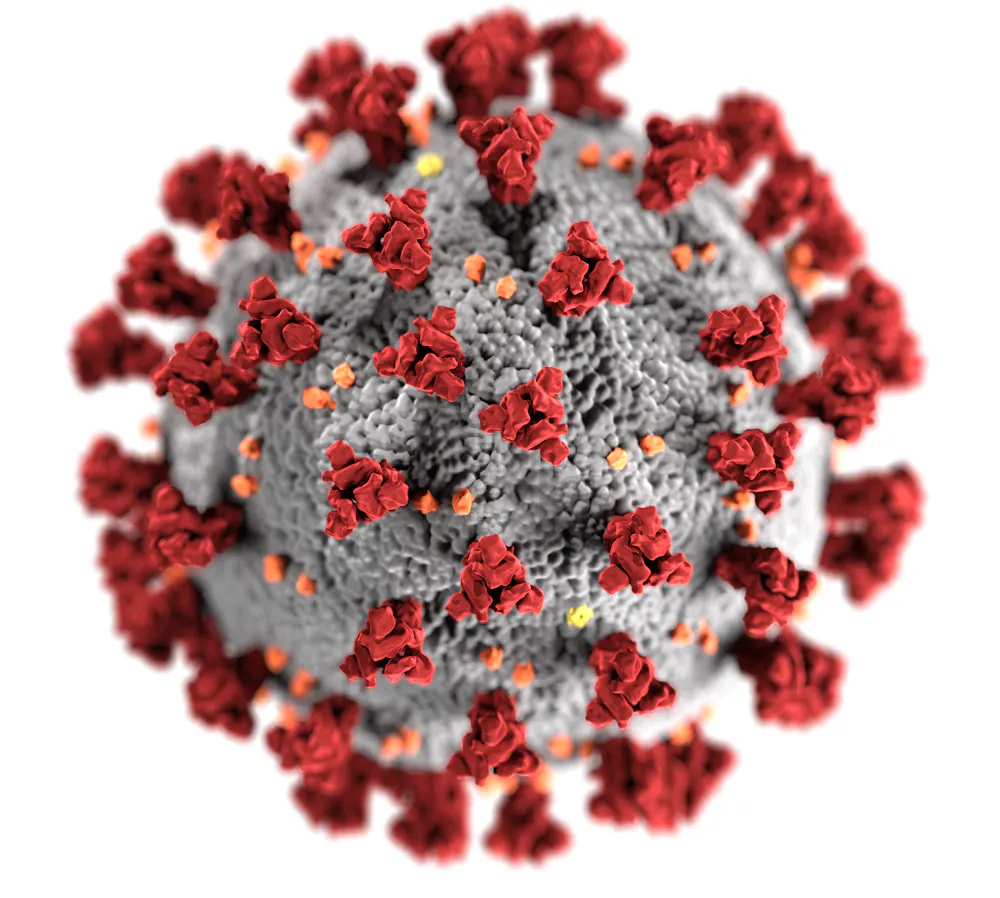
An illustration of one SARS-CoV-2 virus particle shows its spike proteins (in red) scattered across its surface.
Several types of serological tests for SARS-CoV-2 exist. Clinical laboratories and research laboratories typically use what’s called an enzyme-linked immunosorbent assay (ELISA) that consists of plastic plates that are coated with lab-made proteins that match those on the surface of the virus. For the test to be specific, it uses the spike protein from the surface of SARS-CoV-2 that gives the coronavirus its crown-like appearance.
This spike protein is immunogenic, meaning it’s one of the main targets of the body’s immune response; an infected person would make antibodies against the spike protein. The test measures if and how many serum antibodies in the sample bind to the viral proteins on the plates.
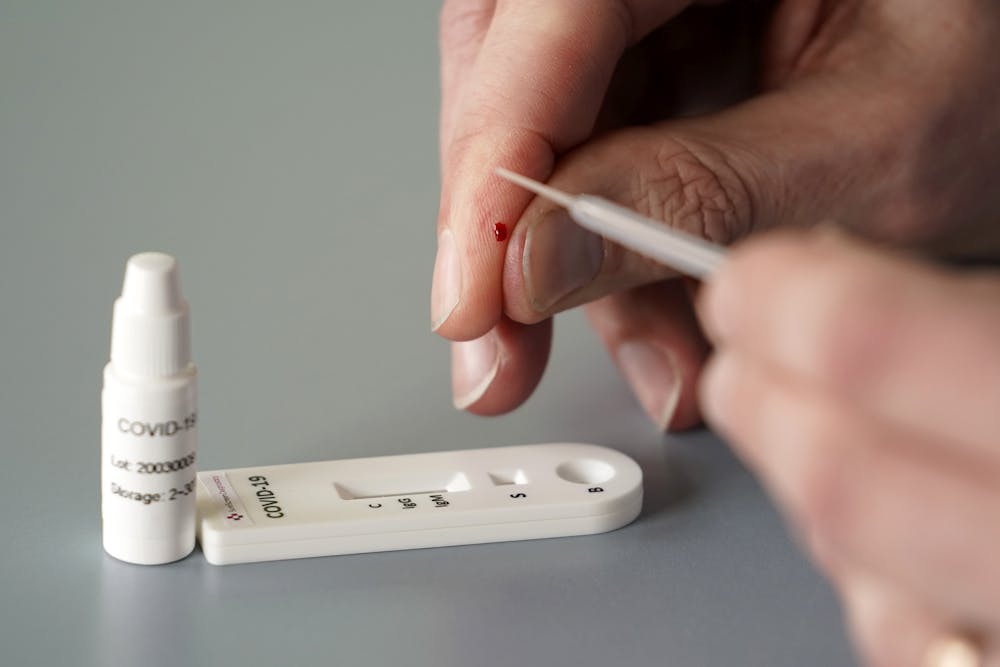
Another type of serological test uses what’s called a lateral flow assay. A variety of medical tests, including at-home pregnancy tests, use this technique. It relies on liquid flowing over a pad treated with chemicals that will interact with the molecule you are testing for. Usually the test will indicate the presence or absence of antibodies through easy-to-read lines. They have the benefit of being relatively simple and rapid, but are generally less sensitive and do not give a measure of the amount of antibody present. The FDA has so far approved one test of this type, from the company Cellex.
Why is it helpful to know who has antibodies against the virus?
From a public health perspective, knowing who has already been exposed to SARS-CoV-2 paints a clearer picture of how widespread the virus is in the local population.
Some people are asymptomatic or only came down with mild symptoms, so they might not be counted in other COVID-19 statistics. Epidemiologists can use the serology results to determine how common those cases are. Serological studies can also help figure out a death rate for COVID-19, by clarifying how many people in total have been sick.
Serosurveys are currently generating this kind of data. They use the serological techniques to test a large number of serum samples from people without a confirmed SARS-CoV-2 infection, coming up with statistics about the group as a whole.
Knowing a true rate of infection allows public health workers to better predict the likely future course of the pandemic in individual locations and figure out what interventions are needed to control an outbreak. That’s because researchers think, although no one’s entirely sure yet, that once you have antibodies to the virus it will confer immunity, meaning you’ll be protected for some period of time.
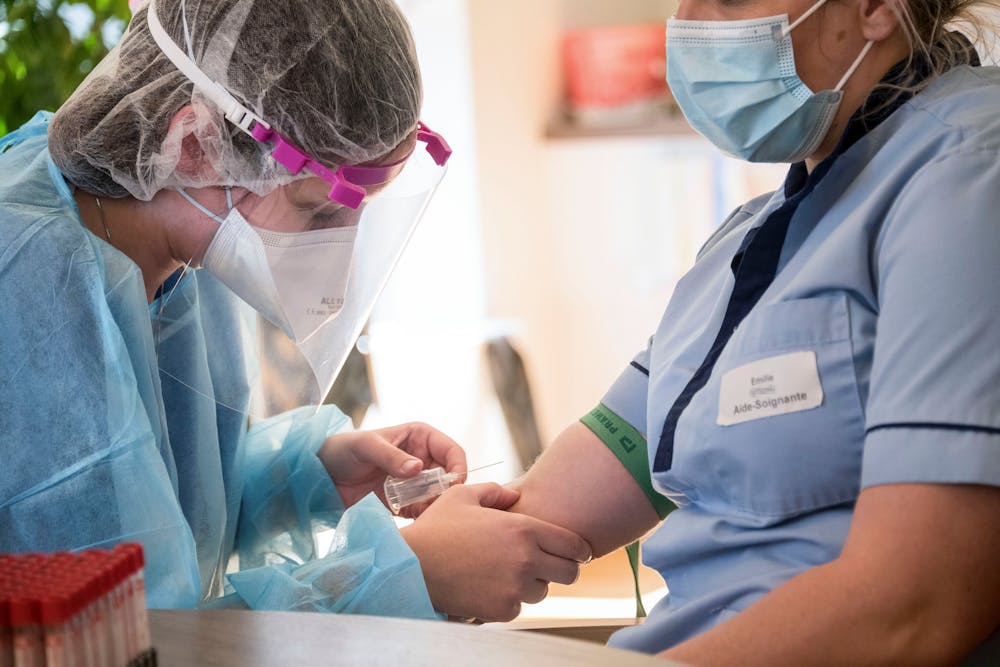
A nurse has blood drawn to check whether she has antibodies to SARS-CoV-2, and hopefully immunity.
Serological testing could also be used to make strategic staffing decisions about essential workers, including medical personnel – for instance, assigning to the front lines those who are have antibodies and are thus presumably immune. These people would be able to go back to work without the risk of getting sick or infecting others.
Identifying individuals who were already infected and who are now potentially immune could play an important part in when and how social distancing restrictions are lifted. Broad SARS-CoV-2 antibody testing could help control the pandemic until a potent vaccine is available – the real coronavirus “end game.”
Where are these tests being performed so far?
Serological testing is already being used to identify people who can serve as plasma donors.
In a process called plasmapheresis, doctors transfer plasma that contains antibodies to a disease into an ill person. Plasmapheresis has been used for decades to treat a variety of diseases.
In this case, plasma from someone who has recovered from COVID-19 – or was infected with the disease but didn’t develop symptoms and has a high level of antibodies – is transferred into a sick patient, typically someone critically ill. At Mount Sinai hospital in New York City, medical workers have started transferring plasma into patients with the hope of neutralizing the virus and alleviating the disease. In other locations, hospitals have started or are preparing to begin this process as well.
Serological testing is also being used to diagnose individual patients who are suspected SARS-CoV-2 cases, but have not tested positive for the virus using the molecular test that looks for the virus’s genetic material.
Multiple serosurveys are underway, or soon will be, in medical systems and in the general population. For instance, Beaumont Hospital System in Michigan has begun a large serosurvey in their medical staff. The Krammer and Simon research labs at Mount Sinai have started a serosurvey with samples from New York City.
No self-administered finger prick tests have yet been approved by the FDA.
Commercial companies have also developed serological tests, including many rapid tests, that are making their way into the marketplace. Ultimately these may be very useful for letting individuals know their infection status. But the currently available commercial tests haven’t been validated by the FDA or a similar authority to say they work well.
There is such high, unmet demand that for the most part, clinical laboratories are choosing to put together their own serological tests, using publicly available instructions, something which is common in research laboratories, but not done as often in U.S. clinical laboratories. Though it takes more time and effort than purchasing ready-to-go tests, which are hard to come by anyway, it provides the clinical labs access to serological tests that have been proven to work well.
Among the most hard-hit are veterans, who are particularly susceptible to both health and economic threats from the pandemic. These veterans face homelessness, lack of health care, delays in receiving financial support and even death.
I have spent the past four years studying veterans with substance use and mental health disorders who are in the criminal justice system. This work revealed gaps in health care and financial support for veterans, even though they have the best publicly funded benefits in the country.
Here are the eight ways the pandemic threatens veterans:
Age and respiratory illnesses are both risk factors for COVID-19 mortality. As of April 13, 241 patients in Veterans Administration health care facilities had died of COVID-19 and 4,000 have tested positive.
2. Dangerous residential facilities
Veterans needing end-of-life care, those with cognitive disabilities, or those needing substance use treatment often live in crowded VA or state-funded residential facilities.
When a person transitions from active military service to become a veteran, they receive a Certificate of Discharge or Release. This certificate provides information about the circumstances of the discharge or release. It includes characterizations such as “honorable,” “other than honorable,” “bad conduct” or “dishonorable.” These are crucial distinctions, because that status determines whether the Veterans Administration will give them benefits.
Research shows that some veterans with discharges that limit their benefits have PTSD symptoms, military sexual trauma or other behaviors related to military stress. Veterans from Iraq and Afghanistan have disproportionately more of these negative discharges than veterans from other eras, for reasons still unclear.
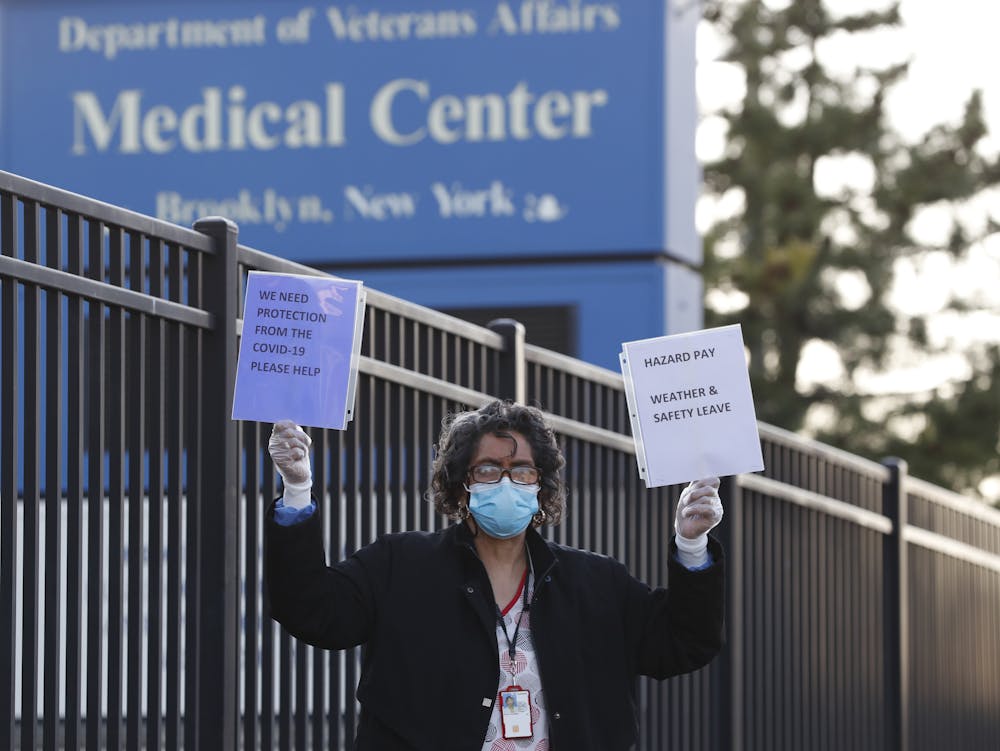
VA hospitals across the country are short-staffed and don’t have the resources they need to protect their workers.
The Veterans Administration frequently and perhaps unlawfully denies benefits to veterans with “other than honorable” discharges.
Many veterans have requested upgrades to their discharge status. There is a significant backlog of these upgrade requests, and the pandemic will add to it, further delaying access to health care and other benefits.
4. Diminished access to health care
Dental surgery, routine visits and elective surgeries at Veterans Administration medical centers have been postponed since mid-March. VA hospitals are understaffed – just before the pandemic, the VA reported 43,000 staff vacancies out of more than 400,000 health care staff. Access to health care will be even more difficult when those medical centers finally reopen.
As of Monday, April 13, 1,520 VA health care workers have tested positive for COVID-19, and thousands of health care workers are under quarantine. The VA is asking doctors and nurses to come out of retirement to help already understaffed hospitals.
5. Mental health may get worse
An average of 20 veterans commit suicide every day. A national task force is currently addressing this scourge.
6. Complications for homeless veterans and those in the justice system
An estimated 45,000 veterans are homeless on any given night, and 181,500 veterans are in prison or jail. Thousands more are under court-supervised substance use and mental health treatment in Veterans Treatment Courts. More than half of veterans involved with the justice system have either mental health problems or substance use disorders.
As residential facilities close to new participants, many veterans eligible to leave prison or jail have nowhere to go. They may stay incarcerated or become homeless.
Courts are moving online or ceasing operations altogether. It is unclear whether participants will face delays graduating from court-supervised treatments.
Further, some Veterans Treatment Courts still require participants to take drug tests. With COVID-19 circulating, participants must put their health at risk to travel to licensed testing facilities.
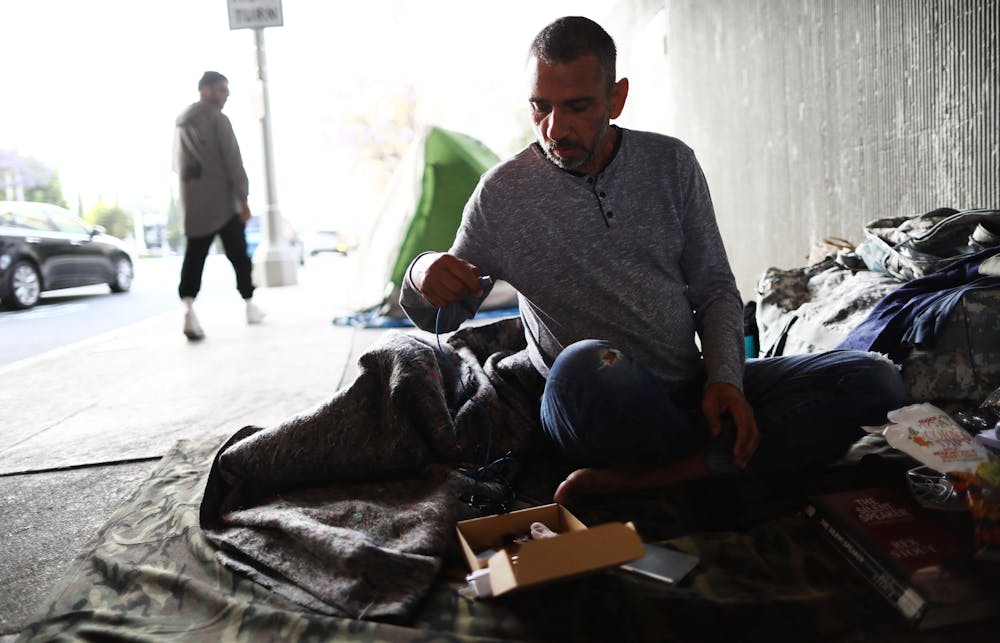
As veterans’ facilities close to new participants, many veterans eligible to leave prison or jail have nowhere to go and may become homeless, like this Navy veteran in Los Angeles.
In the pandemic’s epicenter in New York, tens of thousands of veterans should have access to VA benefits because of their low income – but don’t, so far.
The pandemic has exacerbated existing delays in finding veterans in need, filing their paperwork and waiting for decisions. Ryan Foley, an attorney in New York’s Legal Assistance Group, a nonprofit legal services organization, noted in a personal communication that these benefits are worth “tens of millions of dollars to veterans and their families” in the midst of a health and economic disaster.
All 56 regional Veterans Administration offices are closed to encourage social distancing. Compensation and disability evaluations, which determine how much money veterans can get, are usually done in person. Now, they must be done electronically, via telehealth services in which the veteran communicates with a health care provider via computer.
But getting telehealth up and running is taking time, adding to the longstanding VA backlog. Currently, approximately 75,000 veterans wait more than 125 days for a decision. (That is what the VA defines as a backlog – anything less than 125 days is not considered a delay on benefit claims.)
8. Obstacles to getting stimulus checks
Veterans with the greatest financial need may not automatically receive their stimulus checks. Currently, those living on tax-exempt income from the VA must file a tax return to get a check.
But e-filing a tax return is a significant obstacle for many, especially severely disabled veterans who may not have computers or know how to use e-file software.
There are many social groups to pay attention to, all with their own problems to face during the pandemic. With veterans, many of the problems they face now existed long before the coronavirus arrived on U.S. shores.
But with the challenges posed by the situation today, veterans who were already lacking adequate benefits and resources are now in deeper trouble, and it will be harder to answer their needs.