The warning came from one of the hundreds of FBI employees tasked with a round-the-clock scramble to process more than 100,000 pages of investigative files related to convicted sex trafficker Jeffrey Epstein.
The Department of Justice was at risk of breaking the law by disclosing victims’ identities, they said.
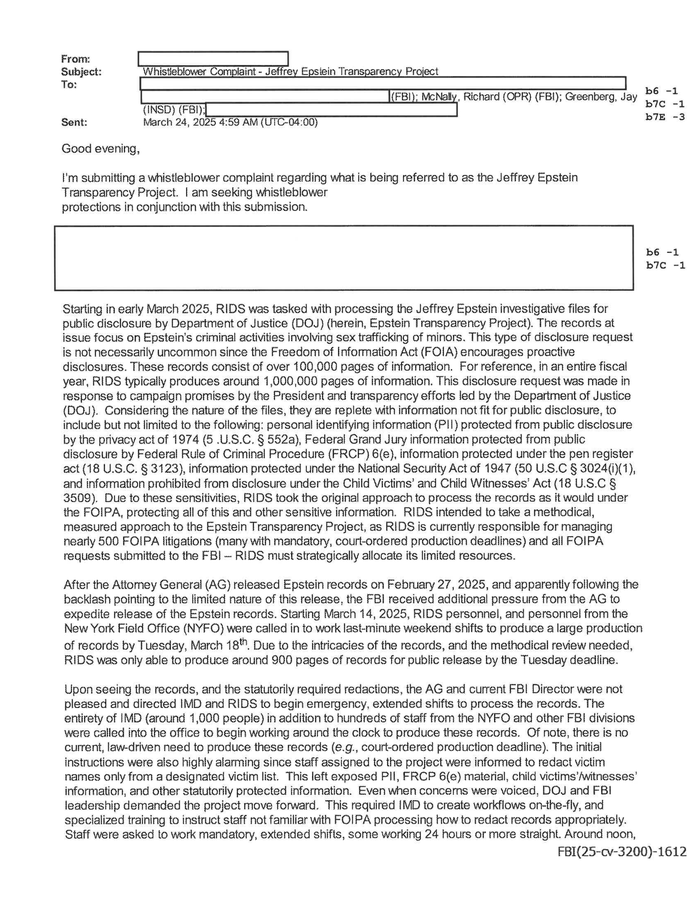
“DOJ leadership is pushing for the release of records that, if released in their current format, would violate multiple statutes,” the FBI whistleblower wrote in a complaint filed with the agency’s Office of Integrity and Compliance, while expressing concern that the project’s “rush deadline” would “lead to mistakes that could destroy people’s lives.”
The whistleblower’s identity remains unknown, and their name was redacted in FBI documents released by the bureau in recent weeks in response to a Freedom of Information Act lawsuit filed by the pro-democracy group American Oversight. The whistleblower complaint is being reported for the first time here by Raw Story.
The concerns outlined in the March 2025 complaint about the risk of exposing Epstein’s victims would prove prophetic. The initial review, overseen by then-Deputy Attorney General Todd Blanche, would culminate in a memo jointly released that July by the FBI and Department of Justice with the conclusion “no further disclosure would be appropriate or warranted.”
The passage of the Epstein Files Transparency Act, in defiance of the Trump administration’s effort to smother the growing scandal, would lead to another round of document reviews by the Department of Justice. The 100,000-some pages processed by the FBI in March 2025 were only a fraction of the 3.5 million-plus pages ultimately released to the public in late 2025 and early 2026, but the haphazard manner in which victims’ information was handled during that early push appears to have set the mold for the Department of Justice’s later redaction efforts.
A federal lawsuit brought by Epstein survivors accuses the Department of Justice of negligent infliction of emotional distress and violation of their privacy when it outed about 100 survivors through the document dump.
Survivor Dani Bensky confronted Blanche about the disclosures during his Senate confirmation hearing in July. “It’s been absolutely devastating,” she testified. “Outing survivors causes real and irrevocable harm. While coping with our emotional distress and psychological trauma, we also have lost our privacy and confidentiality, suffered reputational harm, lost jobs, and now fear for our personal safety.”
The FBI employees allegedly received instructions from FBI and DOJ leadership to only redact victims’ names if they were on a “designated victim list,” according to the complaint. The complaint describes the decision to limit victim information redactions as “highly alarming” considering that it exposed personally identifiable information, grand jury materials, and information about child victims and witnesses. The Wall Street Journal has previously reported that employees were directed to disclose geographical information about victims, including city and state.
“I am concerned that people who are determined to find the victims will be able to piece together the information that we were instructed to not redact [and it] will lead to harassment or worse for the victims,” the whistleblower wrote in an email to a supervisor four days before filing the complaint.
FBI employees questioned an FBI lawyer from the New York Field Office about the “legality” of the DOJ’s handling of the redaction project about a week into the effort, according to the whistleblower, who added they were “not heartened” to hear responses that included the words “probably,” “we think,” and “maybe.”
The New York Field Office did not respond to questions from Raw Story seeking confirmation of the FBI lawyer’s consultation on the redaction project.
A March 10, 2025 email from Shannon Parry, then the assistant director of the FBI’s Information Management Division, that was reviewed by Raw Story shows that she told FBI General Counsel Sam Ramer that FBI leadership at the New York and Washington field offices had asked her what “types of redactions the FBI should apply to these files.”
A former white-collar criminal defense attorney and member of the conservative Federalist Society who previously served in the first Trump administration, Ramer had been appointed to the FBI post only a month earlier.
Department of Justice officials who visited the FBI’s Information Management Division’s “central processing site” in Winchester, Virginia, in March 2025 received a briefing “on the legal implications of the release,” according to the whistleblower, and then issued orders to initiate a fourth round of redactions as the chaotic process lurched forward.
“Though a lot more information is being protected, statutorily exempt information is still being proposed for release,” the whistleblower said at the time.
While risking the disclosure of information about victims, the whistleblower alleged that “staff were instructed to flag any records in which the current President is mentioned.” As previously reported by Raw Story, the materials the FBI turned over to the Department of Justice on March 25, 2025 included “flagged items” that listed “public figures” referenced in the 2006 criminal investigation of Epstein in south Florida and the 2019 investigation in the Southern District of New York.
The allegations in the whistleblower complaint are consistent with a description of the FBI’s redaction effort in a letter from Sen. Dick Durbin (D-IL), the ranking Democrat on the Senate Judiciary Committee, to Bondi in July 2025. Emily Hampsten, a spokesperson for Durbin, told Raw Story the substance of the complaint “is almost 100 percent identical” to the information the senator received from an FBI whistleblower in 2025.
The complaint also aligns with previous reporting by independent journalist Allison Gill based on a former FBI analyst and others involved in the redaction effort.
At the time of the complaint, the whistleblower wrote that the FBI’s Information Management Division “and many of its partner divisions have been on a mandatory 24-hour posture for over a week to process these records for seemingly political reasons,” with many staff members being called to work extended shifts, sometimes “well beyond 12 hours.”
“Staff is at physical and emotional breaking points, with many suffering health problems from lack of sleep and undue stress,” the whistleblower wrote. The demand on staff “to commute to the office with little or no sleep for days” was so significant that the whistleblower argued it posed a “substantial and specific danger to public health or safety.”
Emails reviewed by Raw Story show that the whistleblower conveyed their concerns to a lawyer in the FBI’s Office of Integrity and Compliance, who told them their concerns would be more appropriately addressed by the Department of Justice Office of the Inspector General. The email indicates that the day after the whistleblower complaint was filed, the FBI’s Office of Integrity and Compliance made the determination that the matter was considered closed.
The email containing the whistleblower complaint indicates it was copied to the Department of Justice Office of the Inspector General and the Senate Judiciary Committee, chaired by Sen. Chuck Grassley (R-IA). A separate email chain outlining the whistleblower’s concerns also made its way to Catherine Bruno, the FBI’s chief ethics and compliance officer. Bruno said in an email reviewed by Raw Story that she intended to refer the matter to the DOJ Office of the Inspector General. Bruno told Raw Story she was forced to retire from the FBI in May 2025.
John S. Lavinsky, a spokesperson for the DOJ Office of the Inspector General, told Raw Story the office doesn’t confirm or deny the existence of an investigation. The Office of the Inspector General is currently conducting an audit of the Department of Justice’s compliance with the Epstein Files Transparency Act, including redactions, that could widen in scope.
FBI whistleblower complaint
 FBI whistleblower complaint www.documentcloud.org
Whistleblower complaint filed by FBI employee alleging potential violations of law by the U.S. Department of Justice through the disclosure of protected victim information during the redaction of the Epstein files