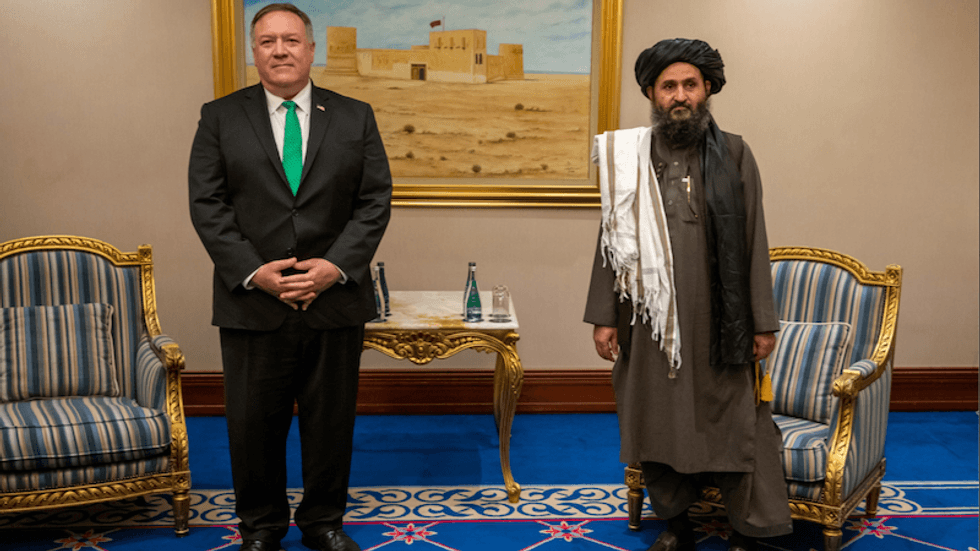
Secretary of State Mike Pompeo with Taliban co-founder Abdul Ghani Baradar in 2020. (Twitter)

As former President Donald Trump looked for political and policy stunts a year ahead of the 2020 election, a key item on his list was a draw-down in Afghanistan to meet his campaign promise of ending Middle East wars.
In a discussion with Cabinet leaders, former Secretary of Defense Mark Esper recalled discussions about troop levels that they could get away with while also keeping embassy staff safe. John Bolton made it clear he was against signing any agreement with the Taliban.
While at his Bedminster club, Trump told advisers "he wanted any public statement we might release about the peace deal to say that the U.S. would be at 'zero [troops] in October' 2020, just before the election. November 3, 2020, was the lens through which he viewed the agreement. It was an important takeaway for me."
Once they were back at the White House, specifics expanded in an effort to outline a final plan.
IN OTHER NEWS: Georgia deputies infuriate school officials with ‘humiliating’ roadside search of Black lacrosse team’s luggage
"Trump was now more curious than before about the optics of the deal, the reaction of the Democrats, the backlash from Republicans, and the views of his base," Esper wrote. He suggested bringing Congress in on the deal so it appeared like an American plan and stem any possible opposition before it started. Trump was against it.
Trump demanded court martial of retired Navy SEAL who led bin Laden raid / RawStory.TVroar-assets-auto.rbl.ms
"Congressional outreach was such a simple thing to do, and an important one when you are considering a peace deal to end America’s longest war. Starting and ending wars are significant decisions for which you want broad bipartisan support, especially if you want to bring the American people along with you," said Esper.
Then Trump stopped everyone cold. “I want to meet with the Taliban” here in Washington, he decided.
Esper described stunned silence as the officials all looked at each other trying to figure out if the president was joking. He was serious.
READ MORE: Has Russia been beaten? This military expert says that moment is coming soon
"Trump asked Pence what he thought, to which the vice president rightly cautioned that we give the idea more thought. Trump then said he wanted to meet with [Afghan president Ashraf] Ghani too, proposing separate meetings in D.C. with him and the Taliban leadership. So, we can meet with the Taliban but not congressional leadership? I thought disgustedly."
Trump began dreaming of the talking points and how it would appear in the press.
"Trump would often look up into the air, chin raised, as he searched for the right words, then drop his head, and say, 'How about . . . ‘The president has agreed to a meeting’' and then, 'Wait, wait, . . . let’s say ‘he’s looking forward to the meeting.''
No one in the room thought it was a good idea and some were outright disgusted at the concept of embracing the group that killed so many Americans on and after Sept. 11.
IN OTHER NEWS: Louisiana GOP official arrested again after witnesses say he held 4-year-old upside down and whipped him
After the meeting, Trump was still planning the event, although Esper said he saw Trump tell the press it would be at Camp David and not the White House. All of the military leaders were to join in the event. Esper was disgusted and said neither he or Gen. Joseph Dunford were going to participate.
"It was not lost on many of us, either, that the eighteenth anniversary of the 9/11 attacks was coming up in a week or so. This idea was terrible in so many ways," he wrote.
Then the Taliban did a car bombing and Trump was furious. The event was off and the peace talks ended. A year later he was praising them again as partners.
Trump later relayed to Hugh Hewitt that he threatened the Taliban leader with bombing his home and threatened he was willing to go even further.
NOW WATCH: Georgia’s Record-Setting Early Voting Process Experiences Challenges
Georgia’s Record Setting Early Voting Process Experiences Challenges www.youtube.com
Report typos and corrections to corrections@rawstory.com.
For customer support contact support@rawstory.com.