China accused the United States on Tuesday of "bullying" over popular video app TikTok, after President Donald Trump ramped up pressure for its US operations to be sold to an American company.
In the latest of a series of diplomatic spats between the world's two biggest economies, Beijing hit back after Trump gave TikTok six weeks to arrange a sale of its US operations -- and said that his government wanted a financial benefit from the deal.
"This goes against the principles of the market economy and the (World Trade Organization's) principles of openness, transparency and non-discrimination," said foreign ministry spokesman Wang Wenbin.
"It's outright bullying."
The app has been under formal investigation on US national security grounds, because it collects large amounts of personal data on users and is legally bound to share it with authorities in Beijing if they demand it.
Trump said that Microsoft was in talks to buy TikTok, and has given ByteDance until mid-September to strike a deal, a tactic that is almost unheard of.
"It's got to be an American company... it's got to be owned here," Trump said on Monday. "We don't want to have any problem with security."
Beijing slammed the move as "political manipulation".
Wang told a regular press briefing Tuesday: "The US, without providing any evidence, has been using an abused concept of national security... unjustifiably suppressing certain non-US companies."
He said the national security grounds for the US's clampdown on Chinese firms "does not hold water", adding that the companies conduct their business activities in accordance with international rules and US laws.
"But the US is cracking down on them on trumped-up charges," said Wang, who warned the US not to "open Pandora's box".
TikTok has as many as one billion worldwide users, who make quirky 60-second videos with its smartphone app.
But the pressure for a sale of its US and international business, based in Los Angeles, has left the company and its Chinese parent ByteDance facing tough decisions.
- 'Global company' -
On Monday, ByteDance said in a statement that it has always been committed to becoming a global company.
"Based on the current situation, ByteDance is considering re-establishing TikTok headquarters in major markets outside the United States to better serve global users," the statement said.
UK media reported that it was considering a relocation to London.
ByteDance founder Zhang Yiming also acknowledged on Monday "mounting complexities across the geopolitical landscape and significant external pressure" faced by the company, in a letter to staff, reported by Chinese media.
He added that the company has "always been committed to ensuring user data security, as well as the platform neutrality and transparency".
Meanwhile, Wang urged the US on Tuesday to "refrain from politicizing economic issues" and to provide an open, fair and non-discriminatory environment for foreign market players.
Israel launched air strikes on Syrian military targets in southern Syria late Monday, after thwarting an attack near the Israeli-occupied sector of the Golan Heights.
In Damascus, the state-run news agency Sana said Israeli helicopters rocketed Syrian army positions near Quneitra in the south but caused only material damage. It also said air defences had gone into action near the Syrian capital.
The Israeli army said its fighters jets, attack helicopters and other warplanes struck Syrian army positions in retaliation for the attempt to lay explosives in the Golan Heights.
"The targets struck include observation posts and intelligence collection systems, anti-aircraft artillery facilities and command and control systems in SAF (Syrian Armed Forces) bases," the army said in statement.
"The IDF holds the Syrian government responsible for all activities on Syrian soil, and will continue operating with determination against any violation of Israeli sovereignty," it said.
Tensions are already high between bitter rivals Israel and Syria.
Last month, Israeli army helicopters struck military targets in southern Syria in retaliation for earlier "munitions" fire towards Israel.
Israel did not directly blame Syrian forces for the munitions fire, but said it held the Damascus government responsible.
And earlier Monday, the Israeli army said it had killed four men laying explosives near the Israeli-occupied sector of the Golan Heights.
'Inside Israeli territory'
"They were inside Israeli territory but beyond the fence," military spokesman Lieutenant Colonel Jonathan Conricus told journalists in a telephone briefing.
He said an Israeli commando unit lying in wait attacked the intruders shortly after 11 pm Sunday (2000 GMT) with assault rifles and sniper fire backed by air strikes.
"Our estimate is that all four were killed," Conricus said in English, adding that there were no Israeli casualties.
Prime Minister Benjamin Netanyahu said in a statement Monday that "the army thwarted an attempted attack on the Syrian front".
"We don't let our guard down," he said, recalling an incident at the Lebanese border last week that prompted Israeli artillery fire across the frontier, as well as rocket fire Sunday evening from the Hamas-controlled Gaza Strip which led to retaliatory Israeli air strikes.
Israel will "strike anyone who attacks us or tries to attack us", he added.
Possible Hezbollah links
Several Israeli media outlets reported that Monday's actions were in response to an increased threat from the Iran-backed Lebanese Shiite group Hezbollah, which has a significant presence in Syria.
Last month, five Iran-backed fighters were killed in an Israeli missile strike south of Damascus, according to Britain-based monitoring group the Syrian Observatory for Human Rights.
Then last Monday, Israel said it had thwarted an infiltration attempt from Lebanon by up to five Hezbollah gunmen, a claim denied by the Iran-backed group.
Israel reported an exchange of fire that forced the "terrorists" back into Lebanon. It said it fired artillery across the heavily guarded border for "defensive" purposes.
"We do not know at this stage and we cannot confirm a link between this terrorist squad and Hezbollah or Iranians," Conricus said.
"We know that there are many different factions operating on Syrian soil."
The Syrian Observatory said it was likely, but could not be confirmed, that the attackers were from the Syrian Resistance to Liberate the Golan.
The Hezbollah-linked group was formed more than six years ago to launch attacks in the Israeli-occupied zone.
The Syrian Observatory said late Monday there were Israeli air raids on the southern province of Quneitra and on Boukamal city, near the Iraqi border in the northeast.
Conricus said that Israel's Maglan commando unit had been deployed at the attack site for several days.
"We spotted irregular night-time activity in this specific location for the past week and we had a commando unit deployed in the area," he said.
When Katherine Reed heard Melbourne's virus-inflicted lockdown would be tightened and extend for six more weeks, she began to cry.
The 32-year-old lives alone and has been working at home since March, when the southern hemisphere summer turned to autumn.
Like millions of others living in Australia's second city she now faces at least another six weeks of winter isolation.
"I understand the increased lockdown," she said, lamenting "cruel and misguided" rules that allow partners, but not friends, to visit.
From the start of this world-enveloping pandemic, experts had warned there would be bad times and good, setbacks and advances in bringing the virus to heel.
But that has not made the new stop-start existence any less strange or any less difficult to bear.
Australia had appeared to have the virus in hand, but a few clusters quickly turned into hundreds of cases a day, forcing the country's most restrictive lockdown yet.
On Monday, as curfews loomed and authorities ordered non-essential businesses to close, book store manager Bill Morton witnessed his normally "vibrant, lovely" patch of the city transform into a "ghost town".
Melbourne's tram bells seem to ring out louder and longer, a reminder that the streets are nearly deserted of the city's almost five million residents.
"People are pretty demoralized," Morton told AFP.
"Pretty well everything is closed around here. So it's a very strange, quite eerie atmosphere."
During the day, the few masked walkers out for an hour-long window for exercise cautiously maneuvered around each other, conscious of social distancing rules.
The feted theaters, live music venues and buzzing restaurants of Australia's premier cultural hub have fallen silent, with their staff and owners facing more months of uncertainty.
- 'Years to recover' -
From Wednesday evening offices and most businesses will be closed, and a complex set of rules will dictate when people can leave home and where they can go.
Bar owner Andrew Park has stayed afloat so far during the pandemic by scaling back to cocktail deliveries, but he is now more worried than ever.
"Foot traffic will be completely gone," he told AFP, predicting that a curfew after 8 pm will see customers cocoon, even if food and drink purchases are still allowed in the daytime.
"My fear is people will just altogether stop ordering from local, small businesses."
Victoria Premier Daniel Andrews warned it could take the state, which includes Melbourne, "years to recover".
Maggie May, who owns a gift shop with her husband, had adapted during an earlier lockdown.
She sold items online for the first time, a challenging but ultimately positive learning experience.
"You're constantly trying to pep yourself up (because) if you sink into an anxiety hole then nothing is going to get done and at the end of the day you're just going to get more anxious," she told AFP.
The country's hardest-hit state has recorded almost 12,000 of the roughly 18,000 cases in Australia and more than half of the 221 fatalities from COVID-19.
Morton said the book store had seen revenue drop to around 25 percent of pre-pandemic levels, leaving the 50-year-old business heavily reliant on government support schemes and rent deferrals.
"We can hang in for the time being but operating at the reduced revenue that we are, we can't do it indefinitely," he said.
"I think there's a lot of concern for a lot of the businesses around here, whether they'll be able to see it through," adding that many had already closed down permanently.
"This virus, this pandemic is taking a heavy toll", Prime Minister Scott Morrison said Monday, acknowledging that many in Victoria will have "reached breaking point".
The best people in Melbourne can now hope for is that case numbers are brought under control and, in six weeks' time, they can cautiously celebrate a reopening in spring.
Dozens of mostly young Thais wearing striped "Harry Potter" scarves rallied Monday against the government, vowing to "cast a spell" for democracy as the nascent movement grows increasingly bold in targeting the powerful elite.
For more than two weeks, young Thais across the country have held near daily protests at universities and town halls to denounce the military-aligned government of Prime Minister Prayut Chan-O-Cha.
Some have also waded into sensitive territory in recent weeks by holding up placards opposing Thailand's lese majeste law, one of the world's harshest.
It shields the monarchy and its super-rich King Maha Vajiralongkorn from criticism, making open scrutiny of the monarch virtually impossible.
But younger Thais have grown bolder in lock-step with their rising discontent of Prayut -- whose hold on power is regarded as a legacy of a royalist junta regime.
As night fell Monday, the protesters -- who rally organisers had said would "cast a spell" for democracy -- listened in rapt attention as an organiser recounted the plot of the popular J.K. Rowling novels about the adventures of a young wizard.
Prominent lawyer Anon Numpa -- wearing a striped Gryffindor scarf and black robe -- took the stage under the gaze of dozens of police officers to denounce Prayut.
He accused the former army chief of using his position to "gain benefits".
The government "must stop this before the country finds itself in another... confrontation," Anon said.
The kingdom's draconian lese majeste law carries a sentence of up to 15 years per charge, making reporting of any criticism by Thailand-based media forbidden.
The subversive protest was held at Bangkok's Democracy Monument, built to mark the 1932 revolution that established a constitutional monarchy.
Analysts say the kingdom risks slipping back towards absolutism under the reign of Rama X and the hardline royalist generals around him.
The pandemic has also sent Thailand's economy into freefall, laying bare the inequalities of a society perceived to favour the elite pro-military establishment.
Young Thais on Monday harpooned the government for its mishandling of the economy, calling a protester dressed as deputy prime minister Prawit Wongsuwan a "tax eater", referencing the "death eaters" of the Harry Potter world.
A British TV news program gave airtime to a panel of white women named Karen who say they have been unfairly maligned.
In a segment on Monday, ITV's Morning Show talked to three women about "memes" that use their name as a slur.
"I just noticed a few memes and TikToks going on and it started of being quite funny," Karen Masters told the program. "And when the Black Lives Matter protests started, there was a lot of media putting Karen as racist. It sort of took on a life of its own."
"And I feel that we can't, as Karens, now talk about how it's affecting us because we are told that we're entitled if we do this," she continued. "So I set up a Change.org [petition] to show that this is not fair for us to have to put up with this."
Masters added: "We're labeled as racist, entitled and we're just not that sort of person. It's totally unfair and we want the media and the tabloid and the papers to stop using our name to describe racist people. I think you should describe racist people as racist."
The World Health Organization warned Monday that there might never be a "silver bullet" for the new coronavirus, despite the rush to discover effective vaccines.
The WHO urged governments and citizens to focus on doing the known basics, such as testing, contact tracing, maintaining physical distance and wearing a mask in order to suppress the pandemic, which has upended normal life around the globe and triggered a devastating economic crisis.
"We all hope to have a number of effective vaccines that can help prevent people from infection," WHO director-general Tedros Adhanom Ghebreyesus told a virtual press conference.
"However, there's no silver bullet at the moment -- and there might never be.
"For now, stopping outbreaks comes down to the basics of public health and disease control.
"Do it all," he urged.
The novel coronavirus has killed nearly 690,000 people and infected at least 18.1 million since the outbreak emerged in Wuhan in China last December, according to a tally from official sources compiled by AFP.
- China mission -
The WHO began pressing China in early May to invite in its experts to help investigate the animal origins of COVID-19.
The UN health agency sent an epidemiologist and an animal health specialist to Beijing on July 10 to lay the groundwork for a probe aimed at identifying how the virus entered the human species.
Their scoping mission is now complete, said Tedros.
"The WHO advance team that travelled to China has now concluded their mission to lay the groundwork for further joint efforts to identify the virus origins," he said.
"WHO and Chinese experts have drafted the terms of reference for the studies and programme of work for an international team, led by WHO.
"The international team will include leading scientists and researchers from China and around the world.
"Epidemiological studies will begin in Wuhan to identify the potential source of infection of the early cases.
"Evidence and hypotheses generated through this work will lay the ground for further, longer-term studies."
The pair have not yet returned to the WHO's Geneva headquarters for a debriefing.
Scientists believe the killer virus jumped from animals to humans, possibly from a market in the city of Wuhan selling exotic animals for meat.
Chinese officials said early in the outbreak that the virus may have spread from a market in the city, which sold live and wild animals, but no further confirmation of that has been revealed.
Workers started dismantling Notre-Dame's grand organ on Monday in the hopes that experts can restore it in time for the fifth anniversary of the devastating fire that severely damaged the Paris cathedral.
The organ — the biggest musical instrument in France — was not burned by the flames that destroyed the cathedral's roof and spire on April 15, 2019. But it was covered in soot and damaged by humidity.
"It is an absolute miracle that it has survived. An organ like this is enormous and looks indestructible, but it is actually very fragile," Olivier Latry, one of Notre-Dame's official organ players, told Europe 1 radio.
The mammoth task of dismantling, cleaning and re-assembling the precious instrument started Monday and is expected to last nearly four years.
Workers will dismantle its five keyboards, pedalboard and the 109 stop knobs that control airflow to its 8,000 pipes, some as high as 10 metres. The pieces will be placed in special containers inside the huge cathedral, where the cleaning and restoration will take place.
The organ, which sits under the Gothic cathedral's huge rose window, was completed in 1867, shortly after the spire, which crashed through the roof during the fire.
"We can't wait for Notre-Dame and the organ to be restored. There is some kind of magic between this instrument and the place ... it makes the stones sing," Philippe Lefebvre, another cathedral organist, told TF1 television.
President Emmanuel Macron promised after the fire to rebuild Notre-Dame within five years, a target many architects say is unrealistic.
Church officials also hope Notre-Dame will be open for Mass by 2024, when Paris is due to host the Olympic Games.
However, it has taken more than a year to clear out dangerous lead residue along with scaffolding that had been in place before the fire for a previous renovation effort. Reconstruction of the landmark has yet to begin.
The racism that is now the target of protest across the globe is rooted in the tragic choices of leaders seeking to roll back change a century ago.
Nearly all historians now agree that at the end of World War I, the choice to return to an imperialist world order by the victorious Allied, or Entente, powers – France, Britain, Russia, Italy, Japan and the United States – was a historic error. It not only prepared the ground for the rise of fascism in Europe, but also sparked decades of political violence in Asia and Africa by people denied their rights and humanity.
Amid these multiple crises, the Paris Peace Conference opened in January 1919. American President Woodrow Wilson personally traveled to Paris to ensure that the conference would make the world “safe for democracy.”
Wilson had promised a new era of peace and justice in his famous Fourteen Points statement of war aims, which included an end to secret treaties, the curtailment of colonial empires, the right of all people to choose their own government and a League of Nations to adjudicate international conflicts.
In 1920, like 2020, race became the pivot of a historic turning point. In both moments, world leaders faced a choice: to restore the previous status quo that had produced the crisis – or to embrace the need for a new world order.
The European members of the Entente powers at Paris – Britain, France, and Italy – ignored Wilson’s call for world order based on law and rights. With the implementation of the Treaty of Versailles in January 1920, they chose to restore a racial hierarchy across the globe, extending their colonial rule over territories once held by the defeated German and Ottoman empires in Africa, Asia and the Middle East.
The treaty, which included establishment of the League of Nations, betrayed not only Wilson’s ideals, but also the Entente’s nonwhite allies and the colonial soldiers who fought in the “war to end all wars.” The racial injustice of the 1919-20 peace settlement sparked decades of political violence – not only in the colonized Middle East, Africa and Asia, but also in the United States.
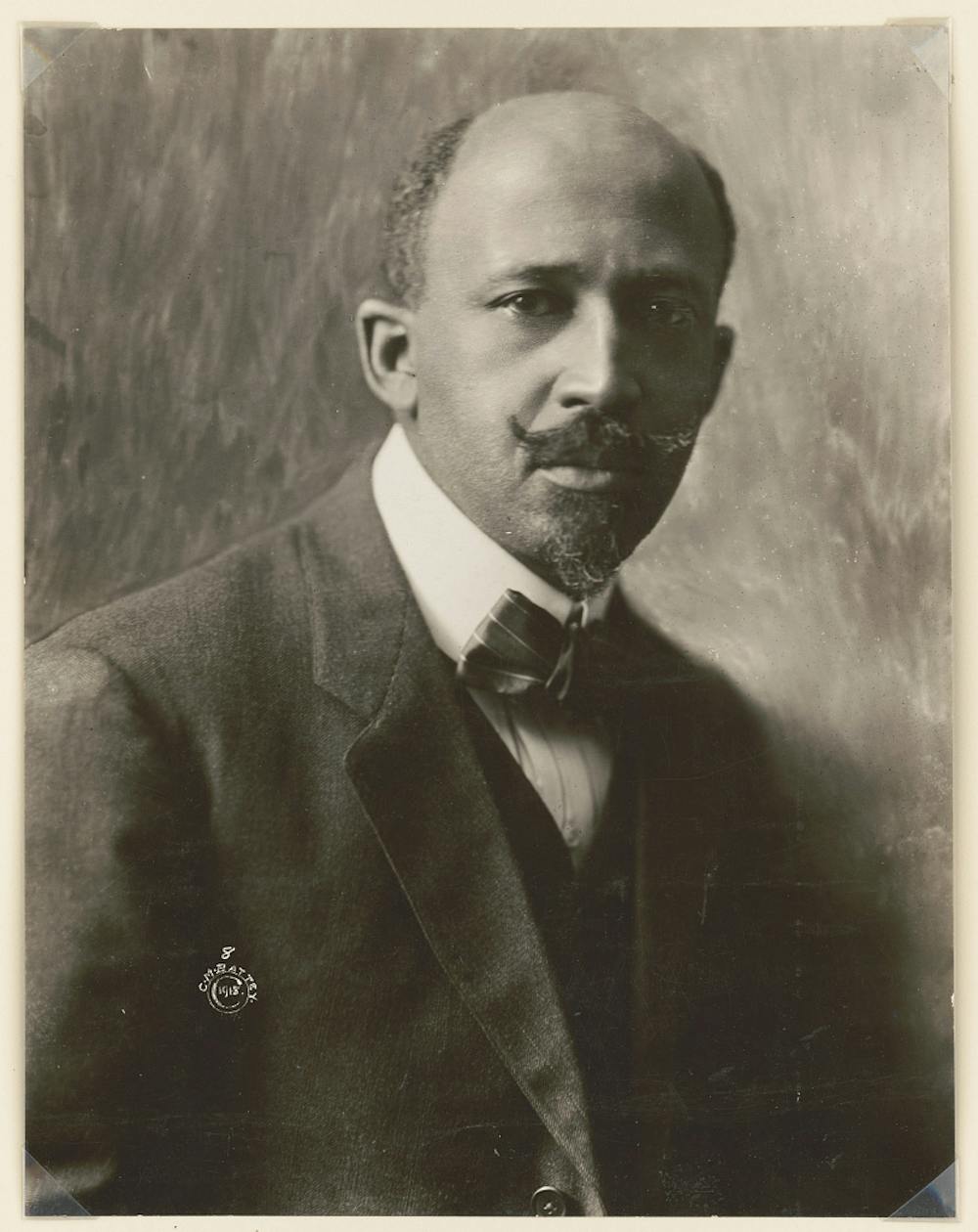
NAACP leader W.E.B. Du Bois went to Paris to try to ensure that racist laws like the U.S. had would not be imposed in Africa to the detriment of African rights.
In January 1919, activists from around the world traveled to Paris despite risks to their health. They embraced Wilson’s Fourteen Points as a chance to remake a broken world system of imperial rivalry that had led to World War I and the deaths of 10 million soldiers and 50 million civilians.
Among those activists was NAACP leader W.E.B. Du Bois, who had fought against the spread of racist, segregationist Jim Crow laws from southern states to the North. He now feared that a similar legal double standard might be imposed in international law, to the detriment of African rights.
Du Bois asked to join the American delegation at Paris, but the Wilson administration refused him. Wilson feared that Du Bois’ call for racial equality might spoil his negotiations with the other conference leaders – prime ministers of Britain, France and Italy – who ruled most of Africa as colonies.
Like Du Bois and his African allies, Arabs and Egyptians claimed their right to sovereignty. But they found that the Entente leaders also considered Arab Muslims a lower species of human, unfit for self-rule.
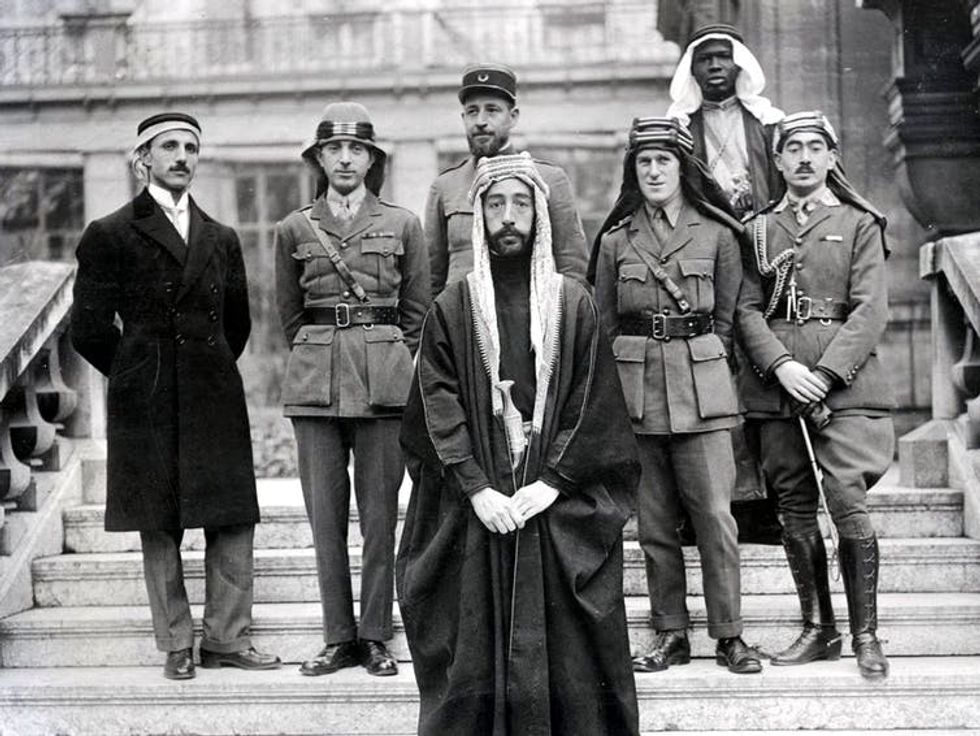
Prince Faisal of Mecca gained entry to the conference because his Arab army had fought against the Ottoman Turks alongside Britain, with the understanding that Arabs would gain an independent state. But the British broke their promise and denied independence to Faisal’s Syrian Arab Kingdom. They instead joined French colonialists to divide Arab lands between them.
Asians, too, were regarded as an inferior race. Japan had fought alongside the victorious Allies and had won a leading role at the conference.
But when the Japanese delegation proposed a racial equality clause for the Covenant of the new League of Nations, the conference’s white leaders rejected it.
The Japanese delegation, shown here, proposed a racial equality clause for the charter of the new League of Nations. The leading powers rejected it.
The Covenant of the League of Nations, drafted by those same leaders at Paris in 1919, codified the inequality of races in international law.
Article 22 denied independence to Arabs, Africans and Pacific Islanders once ruled by the Ottomans and Germans.
In the condescending language of moral uplift, the article designated them as “peoples not yet able to stand by themselves under the strenuous conditions of the modern world.” Therefore, they would be placed under temporary European rule as “a sacred trust of civilisation.”
In other words, the League of Nations would administer temporary colonies, called mandates, to tutor uncivilized (nonwhite) people in politics. Racial inequality was enshrined in the very institution, the League of Nations, that was to ensure the governance of international law.
The mandates were imposed by gunpoint, with no pretense to respect self-determination. In July 1920, the French army occupied Damascus, destroyed the Syrian Arab Kingdom and sent Faisal into exile. Likewise, the British battled mass opposition to claim its mandates in Iraq and Palestine. Meanwhile, South Africa imposed a brutal racist regime upon southwest Africa.
Racial exclusion from the club of so-called civilized nations provoked anti-colonial movements for the rest of the 20th century.
The president of the Syrian Arab Kingdom’s Congress, Sheikh Rashid Rida, foresaw violent consequences in his 1921 appeal to the League of Nations.
“It does not befit the honor of this League, which President Wilson proposed to include all civilized nations for the good of all human beings,” he wrote, “for it to be used as a tool by two colonial states. These states seek to use this Assembly to guarantee … the subjugation of peoples.”
Prince Faisal of Mecca with his delegation at the Peace Conference.
Rida prophetically warned that “Syria, Palestine, and other Arab countries will ignite the fires of war in both the West and the East.” The bitter sheikh turned against European liberalism and inspired the founding of the Muslim Brotherhood in Egypt in 1928.
In the later 20th century, this racial exclusion of Arab Muslims inspired the violent Islamist movements that drew the United States into seeming endless conflict in Afghanistan, Iraq and Syria.
Jim Crow stays
In the United States, racial hierarchy was similarly reimposed by violence. Black veterans returned from Europe to confront lynching and race riots.
[The Conversation’s newsletter explains what’s going on with the coronavirus pandemic. Subscribe now.]
The link between the American racial order and the new world order was made explicit by President Wilson’s adviser, Colonel Edward M. House. He advised Wilson that racial equality would cost him votes in the South and California. Worse, such a clause could empower the League of Nations to intervene in the United States against Jim Crow laws.
In March 1920, the U.S. Senate rejected American membership in the League of Nations precisely because clauses on transnational law enforcement and collective security threatened U.S. sovereignty.
It is no accident that the current crisis in the U.S. has come to focus on racial injustice. Among its several sources are the decisions made 100 years ago by white men from powerful countries who believed maintaining their dominance was more important than seeking peace through justice.
From biblical plague to modern day protein, one Israeli firm wants to make locusts a sustainable food choice in the Holy Land and beyond.
As for whether or not the insects are kosher, the answer is not so simple.
At Hargol Foodtech's farm in the Israeli-occupied Golan Heights, a rectangular enclosure that once served as a chicken coop is filled with thousands of locusts, a grasshopper species that has a highly destructive swarming phase.
Contained in a series of meticulously stacked, climate-controlled mesh cages, the insects are served wheatgrass through their three-month life-cycle, before being cooled, killed and baked.
Hargol's chief executive Dror Tamir told AFP that he grew up hearing stories of how locusts destroyed the fields of his kibbutz in the 1950s.
Yet the Yemenite Jews in the area did not view locusts as crop-ruining pests, but as an edible source of nutrients, Tamir recalled.
- Grasshoppers the 'solution' -
As an adult, Tamir became a food and nutrition entrepreneur increasingly concerned about the environmental cost of providing the world's growing population with enough animal protein.
Tamir said he founded Hargol -- Hebrew for grasshopper -- six and a half years ago after realizing the insects were the solution.
The company's goal is to be "the first in the world to grow grasshoppers on a commercial scale, and provide the world with a healthier and more sustainable source of protein".
Ram Reifen, a professor of human nutrition at Hebrew University, agreed that the planet is facing growing food supply challenges.
With Earth's population expected to hit 10 billion by 2050, raising livestock to feed the planet will become increasingly unsustainable, given the massive water and land resources required.
"The fear is there will be a scarcity of protein," Reifen told AFP.
- 'Yuck' factor -
Tamir said that unprocessed locusts consist of more than 70 percent protein and contain all amino acids, along with other nutrients.
"What they do lack is saturated fat and cholesterol," he said. "They have the good stuff. They don't have the bad stuff."
According to his own estimate, around 2.5 billion people -- mainly in developing nations -- consume insects as part of their regular diet.
And, the "most widely-eaten insects in the world are grasshoppers," Tamir said.
But, he added, "when trying to target North American and European customers, it's really hard to overcome the 'yuck' factor".
To make their product more palatable to Westerners, Hargol turns locusts into powder, which can be mixed into various foods.
Tamir said they were about to launch sales of locust-enhanced pancake mix and smoothie powders worldwide.
Some goods produced in the Golan Heights face export restrictions, including strict labelling requirements, because most of the international community does not recognize Israeli sovereignty in the area.
But Tamir said that while the locusts are grown in the Golan and another site in the Galilee, the powder is produced elsewhere within Israel, enabling him to avoid export restrictions.
Investor support has helped sustain the company before sales tick up, he added.
- But is it kosher? -
In the Bible, locusts appear in the Old Testament Book of Exodus as one of the Ten Plagues unleashed on the Egyptians to force the Pharaoh to free the Israelites from slavery.
In Leviticus, there is a passage stating that certain kinds of grasshopper, including locusts, are kosher.
Jews in Yemen and North Africa have been eating locusts for generations, but European, or Ashkenazi Jews have not.
Tamir said he hoped that he could bring locusts into mainstream Israeli cuisine by getting a kosher certification for his product from the country's chief rabbinate.
Rabbi Eliezer Simcha Weisz, a member of the Chief Rabbinate Council, Israel's top religious adjudication body, told AFP the "phenomenal issue" of whether locusts are kosher had been discussed at "great length".
And while the Torah designates some species as kosher -- including the one raised by Tamir -- it forbids others, he said.
In the rabbinic literature of Ashkenazi Jews, "for the last 400 to 500 years, it's specifically stated that we have a tradition to not eat these locusts," he said.
"That's why it probably will not be accepted generally by all communities to eat the locusts," he said, noting the chief rabbinate has put off a final decision on the question.
But Weisz said that despite the complexity of getting approval from the chief rabbinate, a local Golan rabbi could approve the product.
Overall, he said, the return of locusts to Jewish cuisine was "a wonderful thing".
"I think the fact that in the Torah it says you can eat them, it seems to indicate... that it could be the food of the future," Weisz said.
"Who would have thought!"
Tamir remained optimistic the rabbinate would ultimately give its approval, noting support from prominent rabbis and a planned cooperation with Tnuva, Israel's largest food producer, to manufacture locust protein powder for athletes by the end of the year.
Meanwhile, Tamir is aiming his products at American and European Christians with grasshopper-enhanced energy bars and jars of roasted grasshoppers alongside Israeli honey.
"According to the New Testament, John the Baptist used to eat locusts with honey," he said.
Former Pope Benedict XVI became seriously ill himself after visiting his sick brother in Germany in June and is "extremely frail", according to a report in the Monday edition of the German Passauer Neue Presse newspaper.
Benedict, 93, is suffering from erysipelas of the face, a virus that causes a facial rash and episodes of severe pain, the newspaper reported, citing the former pope's biographer Peter Seewald.
"According to Seewald, the Pope emeritus is now extremely frail," the report says. "His thinking and his memory are quick, but his voice is hardly audible at the moment."
Seewald reportedly visited Benedict in Rome on Saturday to present him with his biography.
"At the meeting the emeritus Pope, despite his illness, was optimistic and declared that if his strength increased again he would possibly take up his pen again," the paper said.
Benedict visited his sick brother Georg in Germany in June, marking his first trip out of Italy since his shock resignation in 2013.
Georg Ratzinger died just two weeks later, aged 96.
The former pontiff, whose original name is Joseph Ratzinger, now lives in a small former monastery inside the Vatican.
He has largely stayed out of the public eye since he became the first pope in 600 years to resign, citing health reasons.
A traditionalist in the Catholic Church, he was replaced by the reformist Pope Francis.
John Hume, a Roman Catholic architect of Northern Ireland's Good Friday peace agreement who won the Nobel Peace Prize for his role in ending 30 years of sectarian violence, died on Monday at the age of 83, his SDLP party said.
Hume, who is credited with kick-starting peace negotiations in the British region, shared the Nobel Peace Prize in 1998 with Northern Ireland's then first minister, David Trimble of the Protestant Ulster Unionist Party.
Hume died in a care home in his native Londonderry in the early hours of Monday morning, his family said in a statement.
"The death of John Hume represents the loss of 20th century Ireland’s most significant and consequential political figure," SDLP leader Colum Eastwood said in a statement.
"This is an historic moment on this island but most of all it is a moment of deep, deep sadness."
Hume, a moderate nationalist and civil rights campaigner, held pioneering talks with Gerry Adams, who was at the time the leader of the Sinn Fein party that was then the political wing of the Irish Republican Army (IRA).
The talks helped pave the way for a joint initiative by the British and Irish governments in 1993.
That spawned a peace process and an IRA truce in 1994 and talks that produced the watershed Good Friday accord.
"All of us, should bow our heads in respect & thanks. What an extraordinary man, peacemaker, politician, leader, civil rights campaigner, family man, Derryman, inspiration," Irish Foreign Minister Simon Coveney said in a statement.
According to CNN analyst Nic Robertson, Donald Trump's inexplicable plan to withdraw 12,000 troops from Germanyis a parting gift to Vladimir Putin that has the added benefit of angering a staunch U.S. ally much to the delight of the Russian strongman.
Noting that the president re-election prospects are in "freefall," Roberson called Trump, "the gift that keeps on giving for the Kremlin: his unpredictability, while often a pain, for them is continual grist for their propaganda mill."
At issue has been the president's contentious relationship with Germany's Angela Merkel who he considers a rival on the world stage, which has led to several years of confrontations.
"The reality is Trump has bullied German Chancellor Angela Merkel from the get-go, and not just on Germany's sub-par defence spending commitment of 1.38% of GDP, but about exports of BMW cars and trade in general," he wrote. "At their first meeting in the White House in spring 2017 the President barely looked Merkel in the eye, refusing to shake her hand; at a NATO summit in 2018 he berated her over breakfast. And now this."
"Whatever Trump's motive, be it petulance or indeed a strategic pivot to Asia, as [Defense Secretary] Esper has explained in recent weeks, the reality leaves allies rattled and runs counter to the US's long-term benefit; now those European countries must look to themselves for defense -- not for a quick fix, but as a major strategic shift," Robertson explained. "Trump hasn't caused a common European defense agreement to spring up overnight but he has compressed the wait until there is one, and none of this is good for America right now."
He went on to note that it is unlikely the president will back off on his decision which has been widely criticized, saying one need only look at how badly Trump has managed the coronavirus pandemic and his refusal to change course or take responsibility for it.
"He is simultaneously enabling Russian President Vladimir Putin, a strategic foe who is already on the offensive, while disabling allies vital in that same fight. It is a double own goal, typical of a US President who insists on playing by his own rules. If the Covid-19 pandemic, which appears to be running the clock down on his presidency, can't teach him that sometimes convention does have the answers, there is little likelihood he'll reverse course on the 12,000 troops," he wrote. "Perhaps a new American president will be elected this November with enough time and persuasive powers to repair the rift Trump has caused with his country's allies. It won't be easy, as Trump's trust deficit is compounded by all those who stood by his side."
Paris (AFP) - Paris prosecutors said Saturday they had asked for an investigation into rape allegations against French actor Gerard Depardieu to be reopened after an earlier probe was dropped last year. An actress in her 20s accuses Depardieu of assaulting and raping her in his Paris home in August 2018. After she reported her allegations against the celebrated actor -- who is 71 and who denies any wrongdoing -- prosecutors in the southern city of Aix-en-Provence opened a preliminary investigation which they then passed on to their Paris colleagues. The Paris probe was dropped after nine months i...