China has been the origin of several major viral epidemics over recent decades, with the current outbreak of a new deadly coronavirus emerging in the central city of Wuhan.
A recap of the main epidemics:
- 2003: SARS -
The Severe Acute Respiratory Syndrome emerged in November 2002 in the southern Guangdong province.
Believed to be from bats, it was apparently transmitted to humans via civet cats sold for meat in wildlife markets.
Also a "coronavirus", so-named because of its crown-like appearance when seen under an electron microscope, SARS was highly contagious and caused acute and sometimes fatal pneumonia.
From early 2003 it caused major panic across Asia, mainly in China, Hong Kong and Singapore. The World Health Organization (WHO) on March 12 issued a global health alert.
The SARS epidemic caused 774 deaths worldwide from more than 8,000 infections in around 30 countries. Eighty percent of the victims were in China and Hong Kong.
- 1997: Bird Flu A(H5N1) -
The A(H5N1) strain of bird flu claimed its first lives in Hong Kong in 1997, leaving six dead.
It resurfaced in 2003 in Southeast Asia, killing 282 people from 468 infections in 15 countries, according to a WHO toll.
But the virus was particularly dangerous for farmed fowl and almost all human cases were among people who had direct contact with infected birds.
Infections between people were extremely limited, even though there were fears the virus would evolve into an easily transmissible form, so bird flu was not considered a human epidemic.
- 1968: Hong Kong Flu -
A new influenza virus of the A type -- among the three seasonal varieties -- started spreading in Hong Kong from July 1968, going on to infect 500,000 people or 15 percent of the population.
It then moved into the rest of Asia, reaching the United States and Europe weeks later.
Considered the first pandemic of modern times, its spread was aided by the increase in international air travel.
The epidemic spurred major international mobilisation coordinated by the WHO. From November 1968 effective vaccines were developed.
The pandemic is estimated to have killed one million people, according to the US Centers for Disease Control and Prevention (CDC).
- 1957: Asian Flu -
The first cases of this variant of the flu, also a type A, were identified in February 1957 in China's southwestern province of Guizhou. The virus spread throughout China and the rest of Asia and the world in the most serious pandemic since the Spanish flu of 1918.
It is estimated to have killed 1.1 million people, according to the CDC.
Rudy Giuliani told U.S. prosecutors that his wealthy Venezuelan client deserved leniency in a criminal investigation, according to his indicted associate Lev Parnas and others.
Alejandro Betancourt, who's reportedly an unindicted co-conspirator in a money laundering case, introduced President Donald Trump's lawyer to the father of Venezuela’s opposition leader Juan Guaido, reported Reuters.
Betancourt told Guiliani at a meeting in Spain that he secretly bankrolled Guaido’s efforts to take over leadership of Venezuela, according to four people familiar with the situation.
The Venezuelan businessman hoped that would help Giuliani persuade Trump's Justice Department to drop the money laundering and bribery case against him in Florida, the sources said.
The president's personal attorney urged officials at the Justice Department to go easy on Betancourt, according to Parnas and another person with direct knowledge.
Parnas told Reuters that Giuliani told him about the meeting soon afterward, and he and the other person said the president's lawyer told prosecutors that Betancourt was helping U.S. interests by funding Guaido’s political efforts.
“Lev Parnas has no right to be talking about that meeting,” Giuliani told Reuters. “It was a confidential meeting -- if it did happen.”
“Lev Parnas’s credibility is worth nothing,” Giuliani added.
US President Donald Trump relaunched a major trade offensive against Europe on Wednesday, threatening to hit the EU with damaging auto tariffs if Europeans failed to agree a long-delayed trade deal.
"The European Union is tougher to deal with than anybody. They've taken advantage of our country for many years." Trump told Fox Business News on the sidelines of the World Economic Forum in Davos.
"Ultimately, it will be very easy because if we can't make a deal, we'll have to put 25 percent tariffs on their cars," he added.
Trump added that his attention would now to turn to Europe, after he sealed a trade truce with China after several years of a trade war that destabilised the world economy.
"I wanted to wait till I finished China, to be honest with you. I always like to be very transparent. I wanted to wait till I finished China. I didn't want to go with China and Europe at the same time."
- 'Arbitrarily putting taxes' -
Trumps comments followed a warning by US Treasury Secretary Steven Mnuchin that Washington would deliver on long threatened auto tariffs if Europeans go through with a digital tax that mainly targets US firms.
"If people want to arbitrarily put taxes on our digital companies we will consider putting taxes arbitrarily on car companies," Mnuchin told a panel at the four-day talk-fest.
EU-US trade relations deteriorated soon after Trump came to power three years ago and declared a war against the yawning trade deficit with Europe.
The earliest transatlantic skirmish came when Trump imposed tariffs on steel and aluminium imports, notably from the EU, which responded by taxing iconic US products, including denim jeans and motorcycles.
Trump then threatened duties on European cars, which is of particular concern to Germany, but has so far backed down under the pressure of US lawmakers.
The US and EU agreed to pursue a trade deal in July 2017 as a tentative truce, but negotiations have stalled over farming.
Trump's comments came a day after he said he held positive meeting with new EU Commission President Ursula von der Leyen on working towards reaching a US-EU trade pact.
A French diplomatic source said over the weekend that French President Emmanauel Macron and Trump agreed in telephone talks to give negotiations a chance to avoid "a trade war that will benefit no one".
Washington had also moved this month to ease tensions on other trade fronts.
The US Senate this month voted to approve a new trade agreement linking the United States, Canada and Mexico. The United States and China also signed a long-awaited, if partial, deal to ease trade frictions.
We’re in the middle of a teen mental health crisis – and girls are at its epicenter.
Since 2010, depression, self-harm and suicide rates have increased among teen boys. But rates of major depression among teen girls in the U.S. increased even more – from 12% in 2011 to 20% in 2017. In 2015, three times as many 10- to 14-year-old girls were admitted to the emergency room after deliberately harming themselves than in 2010. Meanwhile, the suicide rate for adolescent girls has doubled since 2007.
Rates of depression started to tick up just as smartphones became popular, so digital media could be playing a role. The generation of teens born after 1995 – known as iGen or Gen Z – were the first to spend their entire adolescence in the age of the smartphone. They’re also the first group of teens to experience social media as an indispensable part of social life.
Of course, both boys and girls started using smartphones around the same time. So why are girls experiencing more mental health issues?
We found that teen boys and girls spend their digital media time in different ways: Boys spend more time gaming, while girls spend more time on their smartphones, texting and using social media.
Gaming involves different forms of communication. Gamers often interact with each other in real time, talking to each other via their headsets.
In contrast, social media often involves messaging via images or text. Yet even something as simple as a brief pause before receiving a response can elicit anxiety.
Then, of course, there’s the way social media creates a hierarchy, with the number of likes and followers wielding social power. Images are curated, personas cultivated, texts crafted, deleted and rewritten. All of this can be stressful, and one study found that simply comparing yourself with others on social media made you more likely to be depressed.
It’s not just that girls and boys spend their digital media time on different activities. It may also be that social media use has a stronger effect on girls than boys.
Both girls and boys experience an increase in unhappiness the more time they spend on their devices. But for girls, that increase is larger.
Only 15% of girls who spent about 30 minutes a day on social media were unhappy, but 26% of girls who spent six hours a day or more on social media reported being unhappy. For boys, the difference in unhappiness was less noticeable: 11% of those who spent 30 minutes a day on social media said they were unhappy, which ticked up to 18% for those who spent six-plus hours per day doing the same.
Why might girls be more prone to unhappiness when using social media?
Popularity and positive social interactions tend to have a more pronounced effect on teen girls’ happiness than boys’ happiness. Social media can be both a cold arbiter of popularity and a platform for bullying, shaming and disputes.
Among older teens, the situation is more complex, because social media use is so pervasive.
Still, groups of friends can talk about these challenges. Many are probably aware, on some level, that social media can make them feel anxious or sad. They might agree to call each other more, take breaks or let others know that they’re not always going to respond instantly – and that this doesn’t mean they are angry or upset.
China said Wednesday it has "no intention to participate" in trilateral arms control negotiations, a day after Washington called on Beijing to join its nuclear arms talks with Moscow.
The United States has held two rounds of talks with Russia, aimed at reducing misunderstandings around critical security issues since the collapse of a Cold War nuclear pact last year -- which triggered fears of a new arms race.
Washington has hinted that Beijing should also join the discussions.
But Chinese foreign ministry spokesman Geng Shuang accused the US of using Chinese involvement as "a pretext to shirk and shift its own nuclear disarmament responsibilities".
"China has no intention to participate in the so-called China-US-Russia trilateral arms controls negotiations," Geng said at a regular press briefing in Beijing.
Washington has warned about a lack of transparency around China's growing nuclear arsenal, and US President Donald Trump has insisted that any new disarmament pact would need China to come on board.
Geng said that "the country with the largest and most advanced weapons arsenal in the world should earnestly fulfil its special responsibilities for nuclear disarmament", referring to the US.
According to US Ambassador to the Conference on Disarmament in Geneva Robert Wood on Tuesday, China's nuclear stockpile is expected to double over the next decade.
"We have to deal with this serious threat to strategic stability, which is the lack of transparency around China's nuclear stockpile enhancement," he said.
Washington and Moscow walked away from the 1987 Intermediate-Range Nuclear Forces treaty in August last year, after each accused the other of violating the terms of the deal.
Greece's parliament on Wednesday elected the first woman president in the country's history, a senior judge with an expertise in environmental and constitutional law.
A cross-party majority of 261 MPs voted in favour of 63-year-old Ekaterini Sakellaropoulou, parliament chief Costas Tassoulas said.
"Ekaterini Sakellaropoulou has been elected president of the republic," Tassoulas said.
The new president, until now the head of Greece's top administrative court, the Council of State, will take her oath of office on March 13, he added.
The daughter of a Supreme Court judge, Sakellaropoulou completed postgraduate studies at Paris's Sorbonne university.
She was also the first woman to head the Council of State.
Although the president is nominally the head of the Greek state and commander-in-chief, the post is largely ceremonial.
Greek presidents confirm governments and laws and technically have the power to declare war, but only in conjunction with the government.
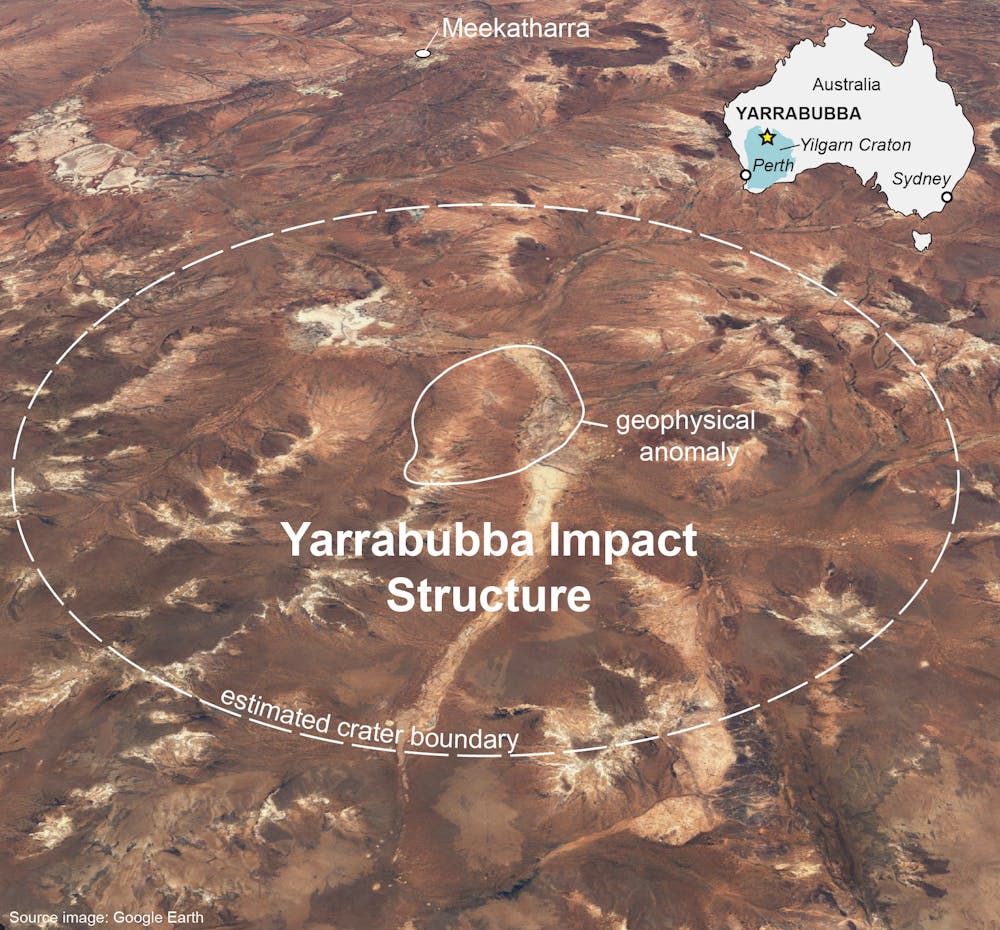
The world’s oldest remaining asteroid crater is at a place called Yarrabubba, southeast of the town of Meekatharra in Western Australia.
Our new study puts a precise age on the cataclysmic impact – showing Yarrabubba is the oldest known crater and dating it at the right time to trigger the end of an ancient glacial period and the warming of the entire planet.
What we found at Yarrabubba
Yarrrabubba holds the eroded remnants of a crater 70 kilometres wide that was first described in 2003, based on minerals at the site that showed unique signs of impact. But its true age was not known.
The Yarrabubba crater is about 70 kilometres across.
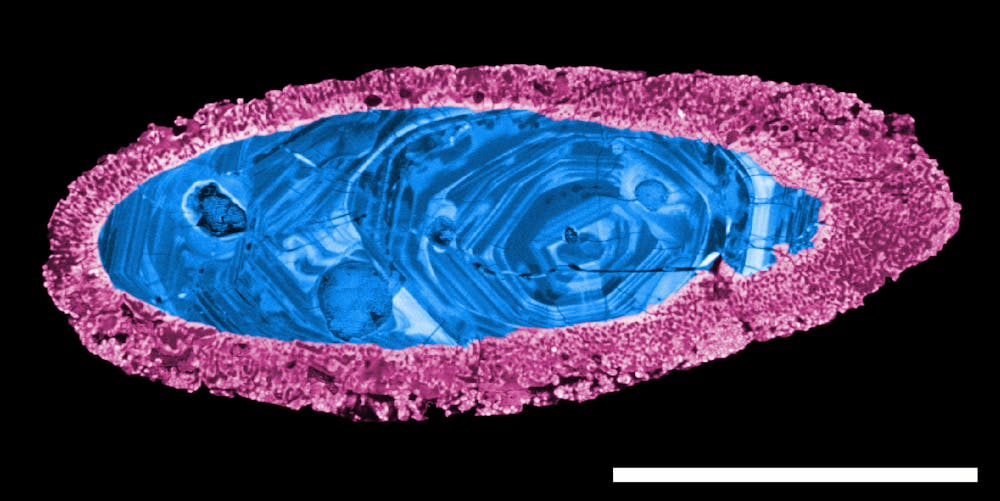
We studied tiny “impact-shocked” crystals found at the site, which show the crater formed 2.229 billion years ago (give or take 5 million years).
This new, precise date establishes Yarrabubba as the oldest recognised impact structure on Earth. It is some 200 million years older than the next oldest, the Vredefort impact in South Africa.
More intriguing, the geological record shows the Earth had glacial ice before the time of the impact – but afterwards, ice disappeared for hundreds of millions of years. Was the Yarrabubba impact a trigger for global climate change?
An asteroid strike is one of the most violent geologic events. In an instant, Earth’s crust is squeezed to unimaginable pressures, before exploding and ejecting carnage across the landscape. Large impacts leave behind scars the size of a small city.
The basin formed by an impact will partly fill with molten and pulverised rock from the Earth and from the asteroid itself. The edge of the crater forms a ring of mountains; over time erosion gradually erases the story.
Today, Yarrabubba has been worn down into a minor feature on a barren landscape.
To place the Yarrabubba event in a geologic context, we had to find its age. To find the age, we had to look carefully at minerals in the rocks shocked by the impact.
Geologists date events using “isotopic clocks” in minerals like zircon and monazite. These minerals contain small amounts of uranium, which gradually decays into lead at a known rate.
A shocked zircon crystal used to date the Yarrabubba impact. The margin (pink) recrystallised during impact, leaving the inner core (blue) intact. Scale bar is 80 micrometres, the width of human hair.
Author provided
Asteroid strikes raise the temperature in rocks they hit, causing minerals to lose their accumulated lead, which resets the clock. After impact, the isotopic clocks start ticking again as new lead accumulates.
So by measuring the isotopes of uranium and lead in these minerals, we can calculate how much time has passed since the impact.
At Yarrabubba, we identified tiny crystals of zircon and monazite – each about the width of human hair – with textures that show they had been heated by a massive impact.
We analysed the amounts of lead and uranium isotopes in these crystals using mass spectrometry, and found their clocks had been reset 2.229 billion years ago (give or take five million years). That’s when we realised Yarrabubba coincided with a major change in Earth’s climate.
A different Earth
The Yarrabubba impact occurred during a period in Earth’s history called the Proterozoic eon. Long before plants, fish, or dinosaurs, life at this time consisted of simple, multicellular organisms.
These simple bacteria had already begun changing the composition of air. Previously dominated by carbon dioxide and methane, Earth’s atmosphere gradually became oxygenated by life about 2.4 billion years ago.
As oxygen levels built up, rocks started weathering more, and the atmosphere cooled down. And then ice came, plunging Earth into globally frigid conditions.
Earth has repeatedly dipped into glacial conditions over the last 4.5 billion years. We know about these periods because of deposits of solidified rock and mud that were ground up by glaciers as they bulldozed across Earth’s surface.
Studies have found multiple periods in Earth’s history in which glacial deposits occur in rocks of the same age across many continents. These deposits may represent worldwide glacial conditions, often referred to as a “Snowball Earth” event.
In these periods, ice forms from the poles well into the tropics, covering nearly all of Earth.
There is geological evidence that Earth was in an icy phase during the Yarrabubba impact. Rocks in South Africa show that glaciers were present at this time. But it’s not clear if the amount of ice was similar to today, or if it covered the world.
Fire and ice
So we found Earth’s oldest preserved impact crater, and worked out when the asteroid hit. We also know Earth had ice at the time, but not how much.
To understand the effect of the impact on an ice-covered world, we used computer models based on the physics of shockwaves to estimate how much ice would end up in the atmosphere as water vapour. As it turns out, it’s quite a lot.
Our models show that if the Yarrabubba asteroid hit an ice sheet 5 kilometres thick (not an unreasonable estimate), more than 200 billion tons of water vapour would be ejected into the atmosphere. That’s about 2% of the total amount of water vapour in today’s atmosphere, but would have been a much bigger fraction back then.
Water vapour is a serious greenhouse gas. It’s responsible for about half of the heat absorption from solar radiation today.
Global climate models don’t yet exist for the Proterozoic Earth, so we don’t yet know for sure if the Yarrabubba impact pushed the planet past a tipping point that led to more warming and the end of a possible Snowball Earth.
Most of us don’t give much thought to going to the toilet. We go when we need to go.
But for a small minority of people, the act of urinating or defecating can be a major source of anxiety – especially when public restrooms are the only facilities available.
Paruresis (shy bladder) and parcopresis (shy bowel) are little known mental health conditions, yet they can significantly compromise a person’s quality of life.
We don’t know how many people have shy bowel, but research has estimated around 2.8%-16.4% of the population are affected by shy bladder. The condition is more common in males.
Our research explored the thought processes that underpin these conditions, with a view to understanding how they might best be treated.
Most of us will feel a little “grossed out” from time to time when using public toilets. But what we’re talking about here is different and more serious.
People with shy bladder and shy bowel experience significant anxiety when trying to go to the toilet, especially in public places like shopping centres, restaurants, at work or at school. Sufferers may also experience symptoms in their own home when family or friends are around.
Their anxiety can present in the form of increased heart rate, excessive sweating, rapid breathing, muscle tension, heart palpitations, blushing, nausea, trembling, or a combination of these.
Most of us prefer to go to the toilet at home. But people with shy bladder or shy bowel may struggle to go anywhere else.
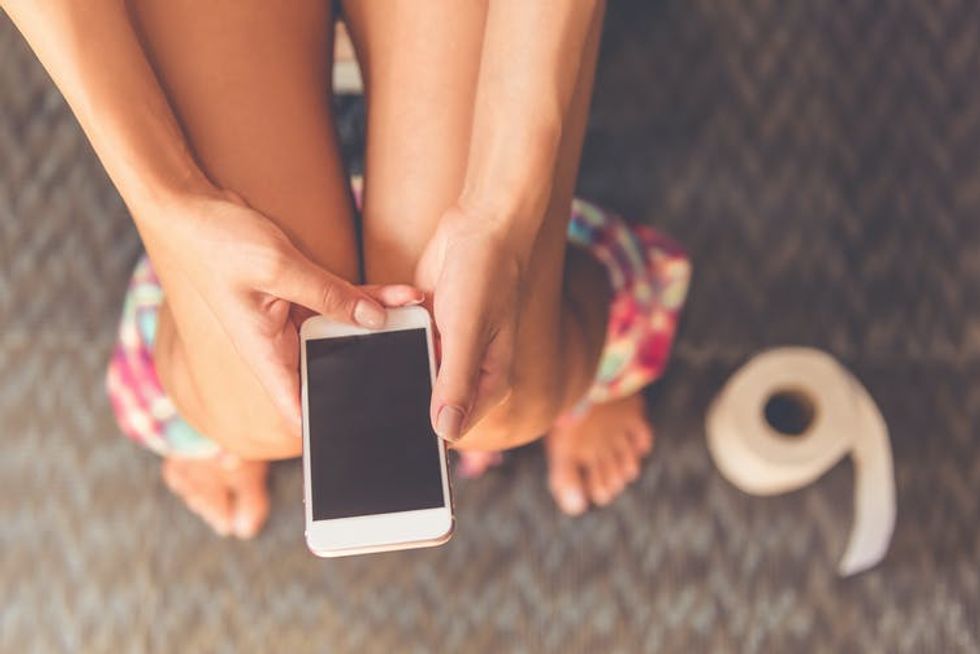
From shutterstock.com
Symptoms range in severity. Some people who are more mildly affected can experience anxiety but still be able to “go”, for example when the bathroom is completely empty. Others may urinate or defecate with difficulty – for example their urine stream may be inconsistent. Some people will sit on the toilet and not be able to go at all.
In severe cases, sufferers may hold it in until they get home. This is uncomfortable and can even have health consequences, such as urinary tract infections.
Sufferers report difficulties relating to employment, relationships and social life. For example, they might avoid travelling, going to parties, or attending large events like sports matches because of their symptoms.
Unfortunately, people with shy bladder or shy bowel will often feel shame and embarrassment, making them less likely to seek help.
It’s a type of social anxiety disorder
The DSM-5, a manual designed to help clinicians diagnose mental health conditions, classifies shy bladder as a sub-type of social anxiety disorder.
The DSM-5 doesn’t make specific mention of shy bowel, but with more research we hope to see it included in the future.
Social anxiety disorder is characterised by an excessive fear of social situations, including contact with strangers. People with the condition fear scrutiny by others, whether negative or positive evaluation.
We wanted to understand whether the thought processes that underpin shy bladder and shy bowel are similar to those demonstrated in people with social anxiety disorder.
We canvassed 316 undergraduate students in an online survey on shy bladder and shy bowel. Some 72 participants (22.8%) self-reported symptoms of either one or both conditions.
We found these symptoms were influenced by particular patterns of thinking, including:
a misinterpretation or distortion of information (for example, interpreting laughter in the restroom as being directed towards them)
fears around potential perceived negative evaluation (for example, a fear of being criticised for taking too long to defecate, or for sounds and smells produced during urination or defecation)
fears around potential perceived positive evaluation (for example, a fear of being evaluated too positively for a strong urine stream).
Using statistical modelling, we found fear of negative evaluation was the factor most strongly associated with shy bladder or shy bowel symptoms.
A mental health professional is likely to be able to help.
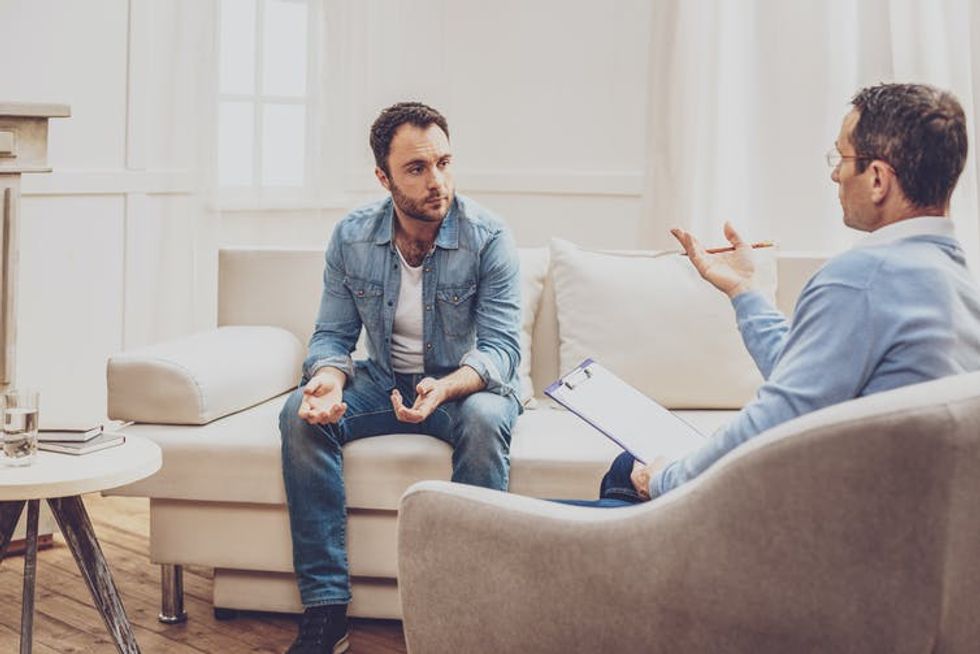
From shutterstock.com
Treatment
While our study was small and more research is needed, the thought processes we identified as underpinning shy bladder and shy bowel are very similar to those we know predict social anxiety symptoms.
As such, people with shy bladder or shy bowel may benefit from the sorts of treatments that help people with social anxiety disorder.
Cognitive behavioural therapy, for example, is known to reduce social anxiety symptoms.
The best way to help people with these conditions will be addressing the thought processes behind shy bladder and shy bowel, especially concerns around the perceptions others might evaluate or criticise one’s urination or defecation.
As well as targeting unhelpful thinking, like all anxiety conditions, reducing avoidance through gradual exposure work (putting oneself in anxiety-inducing situations where one will build confidence and tolerance around anxiety) is also likely to help.
If you can’t do what you need to do in a public restroom, know you’re not alone and you’re not going crazy. Shy bladder and shy bowel are genuine anxiety conditions and can have significant effects on your day-to-day functioning.
Discussing these symptoms with your doctor and/or mental health professional is likely to be an important step to freeing yourself from these conditions.
Peru is installing security cameras at its world renowned Machu Picchu site after it was damaged earlier this month by foreign tourists, authorities said Tuesday.
"We are going to strengthen security at Machu Picchu by installing high-tech cameras," Jose Bastante, head of the archeological park, told AFP.
Bastante said 18 cameras will be located at three strategic points of the citadel as well as access points from surrounding mountains.
"This will allow us to better control visitors and avoid any action or infraction to the regulations, also any type of risk," he said, adding that drones were also being used for security.
Five tourists accused of damaging the iconic site were deported to Bolivia last week and barred from returning to the country for 15 years.
A sixth, from Argentina, was fined $360 and must pay $1,500 to the culture ministry for repairs after he admitted to damaging the Temple of the Sun at the ancient Inca sanctuary.
The Argentine, 28-year-old Nahuel Gomez, also received a suspended sentenced of three years and four months, but can leave the country once the fines are paid.
Gomez admitted to causing a stone slab to fall from a temple wall. It was chipped when it fell, causing a crack in the floor.
"The damaged caused is significant. The integrity of Machu Picchu has been broken," Bastante said.
Members of the group were also suspected of defecating inside the 600-year-old temple.
The Machu Picchu complex -- which includes three distinct areas for agriculture, housing and religious ceremonies -- is the most iconic site from the Inca empire, which ruled over a large swath of western South America for 100 years before the Spanish conquest in the 16th century.
Machu Picchu, which means "old mountain" in the Quechua language indigenous to the area, is at the top of a lush mountain and was built during the reign of the Inca emperor Pachacuti (1438-1471).
It's 9:15 am on Sunday July 26 and excitement is building at the Tokyo Aquatics centre as the first swimming medals are up for grabs. Nearby at the Ariake Gymnastics Centre, US superstar Simone Biles is warming up for her first appearance at the 2020 Olympics.
Without warning a 7.3-magnitude earthquake rips through Tokyo Bay, the ground shakes violently causing citywide damage, widespread panic and multiple casualties.
Fortunately, this is just an imagined scenario at a disaster drill carried out just before Christmas, as Tokyo 2020 organisers prepare for the worst, while hoping they will never have to do it for real.
At the gymnastics venue in Tokyo Bay the public address springs into action in Japanese and English.
"There has been an earthquake. Please stay calm and protect yourself. This venue is safe," the advice crackles.
"Taking action in a panic may lead to danger. Please stay calm and follow the staff's instructions. The elevators may not be used."
Emergency first aid
Within minutes, blue uniformed officers from the Tokyo fire department in their white helmets stream into the stadium.
"Are you OK?" emergency first responders shout as they tend to bodies littering the stands. Officials urge calm via loudspeakers and console elderly spectators.
Fifteen minutes later, troops from the Japanese self-defence forces in military uniform burst into the venue and are briefed on the situation as the evacuation gathers pace.
Troops bring in white stretchers and carry the injured to a triage area hastily set up adjacent to the gymnastics mats.
Medics perform emergency first aid on people laid out on red blankets as commanders bark out orders in a fevered but efficient atmosphere, sending less urgent cases to another venue.
Dozens of spectators, including the walking wounded and those in wheelchairs, are evacuated through the wide boulevards of the Tokyo Bay area, but efforts are hampered by a 6.0-magnitude aftershock at 10:30am.
Across town, at the imposing Tokyo Metropolitan Government building, city governor Yuriko Koike convenes an emergency gathering with 40 of her top officials from the city authorities, fire department, coastguard and self-defence forces.
She receives a briefing on the evolving situation in her quake-hit city, with a dozen monitors showing still images of the damage at the gymnastics venue and the location of fires burning around Tokyo.
Koike orders that all resources be diverted to saving lives but that infrastructure such as port and river facilities must also be inspected and repaired if necessary.
"We have many guests domestically and from abroad for the Tokyo 2020 Games," she says, wrapping up the meeting.
"Please exert your utmost efforts to ensure the safety of spectators and Games workers as much as you do for Tokyo residents," she orders.
The large-scale drill, over two locations and involving more than 500 volunteers, is part of Tokyo 2020's contingency planning as they gear up to host the Games in one of the world's most seismically active countries.
Typhoons and terror
Sports fans already had a taste of Japan's vulnerability to natural disasters when a powerful typhoon struck during the Rugby World Cup, forcing the unprecedented cancellation of three matches.
While July and August, when the Olympics are held, is not peak typhoon season, they can strike at any time -- as can earthquakes or terrorist attacks -- and organisers want to be as prepared as possible.
Tokyo firefighters included an anti-terrorism drill alongside emergency preparations in their traditional new year display.
While visitors from around the world may be unnerved by earthquakes, officials stress there is no country better prepared or equipped.
Japan experiences thousands of tremors per year of varying sizes and the vast majority cause little or no damage, with emergency services well drilled.
Paralympic boss Andrew Parsons recalled in a recent AFP interview being in a Tokyo hotel when a medium-sized earthquake shook his room and he rushed to reception in a mild panic.
"I was the only one who seemed to notice," he laughed, amused by the blase response of local residents.
A new virus that has killed nine people, infected hundreds and already reached the United States could mutate and spread, China warned Wednesday, as authorities scrambled to contain the disease during the Lunar New Year travel season.
The coronavirus has caused alarm for its similarity to SARS (Severe Acute Respiratory Syndrome), which killed nearly 650 people across mainland China and Hong Kong in 2002-2003.
In Wuhan, the epicentre of the outbreak, authorities cancelled large public events and urged visitors to stay away, telling residents not to leave the central Chinese city of 11 million people.
The illness is mainly transmitted via the respiratory tract and there "is the possibility of viral mutation and further spread of the disease," National Health Commission vice minister Li Bin said at a news conference in Beijing.
The World Health Organization (WHO) will hold an emergency meeting Wednesday to determine whether to declare a rare global public health emergency over the disease, which has now been detected in the United States, Taiwan, Thailand, Japan, South Korea and Macau.
The Chinese government has classified the outbreak in the same category as the SARS epidemic, meaning compulsory isolation for those diagnosed with the illness and the potential to implement quarantine measures.
But they still have not been able to confirm the exact source of the virus, which has infected 440 people across the country.
"We will step up research efforts to identify the source and transmission of the disease," Li said, although he said experts believe "the cases are mostly linked to Wuhan."
Plane passengers are facing screening measures at five US airports and a host of transport hubs across Asia.
North Korea will ban foreign tourists entirely to protect itself against the virus, according to a major tour operator.
Virus source
A prominent expert from China's National Health Commission confirmed this week that the virus can be passed between people.
However, animals are suspected to be the primary source of the outbreak, as a seafood market where live animals were sold in the Wuhan was identified as ground zero for the virus.
"We already know that the disease originated from a market which conducted illegal transaction of wild animals," said Gao Fu, director of the Chinese centre for disease control and prevention.
"This might be the cause, so the disease could be on an animal, and then passed on from this animal to a human."
He said it was clear "this virus is adapting and mutating."
Countries have been intensifying efforts to stop the spread of the pathogen -- known by its technical name 2019 Novel Coronavirus (2019-nCoV) -- as the number of cases jumped, raising concerns in the middle of a major Chinese holiday travel rush.
This week, China celebrates the Lunar New Year, the most important event in the Chinese calendar, with hundreds of millions of people travelling across the country to celebrate with family. Many also venture abroad.
Containment
On Wednesday, the commission announced measures to contain the disease, including sterilisation and ventilation at airports and bus stations, as well as inside planes and trains.
People are being urged to wash their hands regularly, avoid crowded places, open windows to allow in fresh air, and wear a mask if they have a cough.
Anyone with a cough or fever should go to a hospital, Li said.
At Beijing's main international airport on Wednesday, the majority of people were wearing masks.
In Wuhan, Mayor Zhou Xianwang urged residents not to leave the city and visitors to stay away if there is no reason for them to come.
"If it's not necessary we suggest that people don't come to Wuhan," Wang told state broadcaster CCTV.
Police were conducting spot checks for live poultry or wild animals in vehicles leaving and entering the city, state media said.
The local government has cancelled public activities during the holiday, including the annual prayer-giving at the city's Guiyan Temple -- which attracted 700,000 tourists during last year's holiday.
Tour groups heading out of the city have also been cancelled.
Hong Kong and British scientists have estimated that between 1,300 and 1,700 people in Wuhan may have been infected.
The Saudi embassy in Washington on Tuesday dismissed suggestions the kingdom hacked the phone of Washington Post owner Jeff Bezos, as media reports linked the security breach to a WhatsApp message from an account of Crown Prince Mohammed bin Salman.
The 2018 intrusion into the device led to the release of intimate images of Amazon founder Bezos, whose Post newspaper employed as a contributing columnist Jamal Khashoggi, a Saudi journalist murdered later that same year at Riyadh's consulate in Istanbul.
"Recent media reports that suggest the Kingdom is behind a hacking of Mr Jeff Bezos' phone are absurd," the Saudi Arabian embassy said on its Twitter account.
"We call for an investigation on these claims so that we can have all the facts out."
Late Tuesday, The Washington Post reported that a United Nations investigation will report on Wednesday that Bezos's cell phone was hacked after he got the WhatsApp message from an account purportedly belonging to Prince Mohammed, the kingdom's de facto ruler.
Soon after the message was sent, a massive amount of data was extracted from Bezos's phone, the Post said investigators concluded.
The Guardian earlier reported that the encrypted message from the number used by Prince Mohammed is believed to have included a malicious file that infiltrated Bezos's phone, according to a digital forensic analysis.
The two men were having a seemingly friendly WhatsApp exchange when the unsolicited file was sent, according to sources cited by The Guardian.
Bezos hired Gavin de Becker & Associates to find out how his intimate text messages and photos made their way into the hands of the National Enquirer, which reported on the Amazon chief's extramarital affair, leading to his divorce.
In March last year de Becker said he concluded that Saudi Arabian authorities hacked the Amazon chief's phone to access his personal data.
"Our investigators and several experts concluded with high confidence that the Saudis had access to Bezos' phone, and gained private information," de Becker wrote on The Daily Beast website at the time.
But de Becker did not specify which part of the Saudi government he was blaming for the hack, and gave few details about the investigation that led him to the conclusion that the kingdom was responsible.
In December a Saudi court exonerated Prince Mohammed's top aides over the murder of Khashoggi, a verdict condemned globally as a travesty of justice but backed by Washington.
Both the CIA and United Nations special envoy Agnes Callamard have directly linked Prince Mohammed to the killing, a charge the kingdom vehemently denies.
The House of Saud crown prince was implicated in the hacking of Washington Post owner and Amazon founder Jeff Bezos's cell phone in a bombshell new report in The Guardian.
"The Amazon billionaire Jeff Bezos had his mobile phone “hacked” in 2018 after receiving a WhatsApp message that had apparently been sent from the personal account of the crown prince of Saudi Arabia, sources have told the Guardian. The encrypted message from the number used by Mohammed bin Salman is believed to have included a malicious file that infiltrated the phone of the world’s richest man, according to the results of a digital forensic analysis," The Guardian reported.
Justin Sink, a White House correspondent for Bloomberg News, noted the implications of the report.
"This invites the obvious question of if MBS has ever sent certain senior members of the White House video messages via WhatsApp," Sink noted.
Ryan Grim, the DC bureau chief for The Intercept, took the reasoning a step further.
“As we previously reported, Kushner chatted regularly with MBS on WhatsApp. It is near-certain that MBS pulled this same hack on Kushner and Saudi [Arabia] has therefore had secret access to his phone for years,” Grim noted.
" Trump forced his security clearance through," Grim added.