Belgian Paralympic champion Marieke Vervoort ended her life through euthanasia at the age of 40 on Tuesday, Belgian media reported.
Euthanasia is legal in Belgium and the spiky-haired athlete announced her intentions after the Rio Games in 2016 to follow that path if her degenerative condition worsened her suffering.
But she said at the time that sport had given her a reason to keep living.
"I'm still enjoying every little moment. When the moment comes when I have more bad days than good days, then I have my euthanasia papers, but the time is not there yet," she told a news conference during the 2016 Paralympic Games.
Vervoort suffered a degenerative muscle disease that caused constant pain, paralysis in her legs and left her barely able to sleep, and gradually her life became torture.
She was just 14 years old when diagnosed but Vervoort pursued a sporting life with passion -- playing wheelchair basketball, swimming and racing in triathlons.
She won the 100m gold and 200m silver wheelchair races at the 2012 London Games, as well as the 400m silver and 100m bronze in Brazil four years later.
AFP/File / YASUYOSHI CHIBA Vervoort with her 400m silver in Rio
By then her eyesight had deteriorated and she suffered from epileptic attacks, and she said that Rio would be her last competition.
"After the Paralympic Games, when I quit, I'm going to enjoy every little moment in my life and I'm going to put more energy in my family and friends, which I couldn't do with top sports because I had to train every day," she said in 2016.
Vervoort signed the paperwork to be euthanised back in 2008.
She said in Rio that access to legal assisted dying had given her the courage to continue living for as long as she had, and insisted the practice should not be characterised as "murder".
"It gives a feeling of rest to people," she said then.
"If I hadn't gotten those (euthanasia) papers I think I would already have committed suicide because it's very hard to live with so much pain and suffering and this unsureness.
"I know when it's enough for me, I have those papers."
President Donald Trump has alienated Evangelical Christians and Kurds over his decision to allow Turkish ethnic cleansing in Syria. His political problems with both groups expanded on Tuesday after actions by the Trump Organization.
"A Christian aid group that planned a gathering to honor and pray for the Kurdish people at President Trump’s hotel in Washington were told by hotel staff this week that the event was canceled, according to two members of the aid group," Washington Postreported Tuesay. "The event, called 'A Night of Prayer for the Kurds,' was to be hosted by Frontier Alliance International (FAI), a religious nonprofit group that provides medical help in the Middle East, including to the Kurds, according to its website."
Trump has received public pushback from Evangelical supporters of the Kurds.
The cancellation came two days after the group's founder, Dalton Thomas, posted a video defending the decision to hold the event at Trump's Hotel despite his abandonment of America's Kurdish allies.
"We’ve been bombarded with emails and responses on social media and phone calls of people who are understandably confused by why we would choose to do [the event] at this location, at Trump hotel, which is owned by the president who made this decision that is causing so much bloodshed and turmoil right now for the Kurds,” Thomas said in the video.
“It’s their prerogative to cancel. I think it’s a shame they used that prerogative though as this was an opportunity for the Trump administration,” Thomas said. “It seems as though they set out to ‘[snatch] defeat from the jaws of victory’ this month on everything.”
The investigation into associates of Rudy Giuliani has expanded into a second United States Attorney's district, The Washington Postreported Tuesday.
"When two business associates of Rudolph W. Giuliani, President Trump’s personal lawyer, were arrested this month on charges that they funneled foreign money into U.S. elections, federal prosecutors working on a different case in Chicago took note," the newspaper noted. "The investigators had previously come across the two men, Lev Parnas and Igor Fruman, as they pursued a long-standing case against a Ukrainian gas tycoon accused of bribery, according to two people familiar with the matter."
The Chicago office is now reportedly working with the Southern District of New York on the case.
"Parnas had been working as an interpreter for the lawyers of the tycoon, Dmytro Firtash, since late July," the newspaper noted. "Chicago prosecutors suspect there might be a broader relationship among Firtash, Parnas and Fruman, the people familiar with the matter said."
Firtash reportedly has ties to Semion Mogilevich, who is known as the “boss of bosses."
"In 2010, WikiLeaks published an internal U.S. diplomatic cable from years earlier in which then-U.S. Ambassador to Ukraine William Taylor wrote that Firtash had 'acknowledged ties' to Mogilevich in a private meeting," The Post reported. "Taylor wrote that Firtash had denied breaking the law but said 'he needed Mogilevich’s approval to get into business in the first place.'”
The investigation into two associates of former New York City Mayor Rudy Giuliani has expanded significantly, BuzzFeed News reported Tuesday.
"A federal grand jury investigating activities surrounding Rudy Giuliani’s back-channel campaign in Ukraine has demanded legal documents that include records of extravagant spending at Trump hotels and millions of dollars in financial transfers by Lev Parnas and Igor Fruman, two key operatives who carried out the plan," BuzzFeed reported, based on a source familiar with the subpoena.
"The documents requested by a subpoena that was issued in Florida last week could shed light on whether other people, including foreign nationals, were trying to influence the top levels of government and impact the 2020 presidential campaign," BuzzFeed explained. "The subpoena also shows the investigation has extended beyond campaign finance violations — the current charges against two of the defendants in the shadow campaign — and may examine more serious financial crimes."
Prosecutors are examining more than $3 million in wire transfers.
"The subpoena, which was served on a source who requested anonymity, led to the release of information that included records detailing bank statements for several corporations controlled by Parnas, his wife, and Fruman, dating back at least three years," BuzzFeed reported. "Hundreds of thousands of dollars were transferred among the partners last year — in some cases back and forth — while some of the funds were sent to family members in patterns not consistent with normal business transactions, the experts said."
The report also details lavish spending, including spending nearly $7,200 at the Trump International Hotel in Washington, DC and $6,240 at Wynn Las Vegas, which is owned by Steve Wynn, who was Trump's finance chairman for the Republican National Committee from 2017 to 2018.
Buzzfeed interviewed Florida attorney Scott Chapman, who says Parnas owes him a debt involving a 1995 Ferrari 456 GT that has grown to $122,000.
“Whether he is just a front man for another powerful person, I just don’t know," Chapman said. Someone is paying for it.”
Ambassador Bill Taylor's 15-page opening statement is being called "devastating" by political analysts and experts who recognize Taylor outed President Donald Trump for an impeachable offense, as outlined in the Constitution.
Namely, Taylor outlined that Rudy Giuliani was taking direction directly from the president of the United States, said national security and legal analyst, Susan Hennessey.
Taylor also testified that he sent a memo to Secretary of State Mike Pompeo about the concerns he was seeing. It's the first indication that a memo exists as a warning and it was acknowledged by Trump's officials.
Giuliani "is personally under investigation and we’ve seen he tried to assert attorney/client privilege with the president," said Hennessey. "That said, Bill Taylor is laying out a story that shows that Rudy Giuliani was taking direction directly from the president of the United States himself and unlike past scandals in which we’ve seen presidents harmed by things staffers were doing. It is very clear this is being driven personally by the president of the United States."
Among the findings in the 15-page testimony, CNN's Wolf Blitzer noted that Trump wanted Ukraine President Volodymyr Zelensky to do an interview, specifically mentioning CNN.
"That is what the president really wanted," Blitzer explained. "A public statement that he was going to investigate this firm Burisma and the Bidens, the 2016 election, and Ukrainian involvement, allegations that Ukrainian, as opposed to Russia, was interfering in the American election and they wanted a public statement from President Zelinsky."
CNN's Abbey Phillips too noted that she was confused why they would need a public statement, specifically on camera and with a network like CNN. She noted that such a video could be replayed over and over and end up in campaign ads.
"And Taylor also — alluded to the fact that [Trump] wanted President Zelinsky to personally do it himself," Phillips said. "And it leads to questions. The most obvious explanation could be this is exactly the kind of thing that can become part of a political campaign. It can be used against Vice President Joe Biden. And based on Rudy Giuliani’s own public statements in the months leading up to all of this, Giuliani made it very clear that he believed that this issue of Burisma and Joe Biden should be a part of the 2020 campaign. It should be counted against the former vice president. So we have to measure up what we’re learning from the hearings, from Bill Taylor and also what Giuliani actually said out loud publicly to everyone who would potentially hear it about what he was trying to do politically for the president."
She also added that former national security adviser John Bolton had a lot to say about the incident. It's unknown if Bolton will be willing to testify before the House committees against the president. The CNN panel noted that he left on bad terms.
Zelensky, who was elected promising a crack-down on corruption, has been dragged into Trump's web of lies and demands that could end in an investigation of the president's involvement with Trump's attempt to manufacture another Democratic scandal, but for the 2020 campaign.
British MPs on Tuesday gave their initial approval to a law implementing Prime Minister Boris Johnson's Brexit deal, but could still derail his attempts to get the agreement passed in time to leave the EU on October 31.
Johnson won the first of two crucial votes in the House of Commons, which will determine if he can fulfil his "do or die" promise to deliver Brexit next week.
MPs voted by 329 to 299 to approve in principle the Withdrawal Agreement Bill, which implements the divorce treaty he agreed with European Union leaders last week.
But they could still now vote against the government's timetable to rush through the 110-page bill by Thursday evening, to allow its ratification before October 31.
The Conservative leader warned earlier Tuesday that failure to pass the motion would see him abandon the legislation -- and instead seek to call a snap general election.
The prime minister was forced on Saturday to ask EU leaders to postpone Brexit -- something he once said he would rather be "dead in a ditch" than do -- after MPs declined to back his new deal.
But he could still avoid having to delay by getting the deal ratified by October 31.
Opening the debate, Johnson -- a key figure in the 2016 EU membership referendum Leave campaign -- urged MPs to support the legislation so "we can get Brexit done and move our country on".
If not, he said the "bill will have to be pulled" and he would seek an early election -- although he needs the support of Labour to do this, and it has twice refused.
Opposition parties, many of whom dislike the Brexit deal, have said it is "ludicrous" to expect proper scrutiny of the legislation in less than three days.
AFP / Gal ROMA Key Brexit dates
Labour leader Jeremy Corbyn, who has called for a second referendum on Brexit, said Johnson was trying to "blindside" MPs into supporting a "rotten bill".
It "fails to protect our rights and our natural world, fails to protect jobs and the economy, fails to protect every region and every nation in the UK", he said.
The Democratic Unionist Party, Johnson's Northern Irish allies, accuse him of duping them about new trading arrangements for the province.
DUP MP Sammy Wilson said he "nearly choked" when he heard Johnson's assurances, adding: "The prime minister thinks I can't read the agreement."
- EU 'will be ready' -
The timetable motion is intended to ensure the House of Commons debates the bill quickly, allowing it to go onto the unelected upper House of Lords.
Johnson warned that seeking further time would kill any hope of leaving the EU with a deal next week -- and risks a "no-deal" exit if the EU declines to approve a delay.
In Strasbourg, European Council President Donald Tusk said the other 27 EU leaders were mulling Johnson's request, but the result "will very much depend on what the British parliament decides".
He said the EU should be "ready for every scenario", although he added on Twitter: "A no-deal Brexit will never be our decision."
In Paris, French Foreign Minister Jean-Yves Le Drian said he saw "no justification at this stage" for further delay.
"We've been waiting for three years for this decision," he said.
"It's important for it to be announced today, because otherwise there will no option except 'no deal', which is not the solution we prefer."
Businesses and markets on both sides of the Channel fear a "no-deal" Brexit, where Britain severs ties with its closest trading partner with no new plans in place after 46 years of integration.
- More hurdles ahead -
If Johnson wins both votes on Tuesday, MPs could still derail his bill, which must also be ratified by the European Parliament.
The deal covers EU citizens' rights, Britain's financial settlements, a post-Brexit transition period until at least the end of 2020 and new trade arrangements for Northern Ireland.
It also sets out vague plans for a loose free trade agreement with the EU after Brexit.
But some MPs are seeking to amend the bill to demand Britain stay in the bloc's customs union, and others want a greater say for parliament in deciding future ties.
After tens of thousands of people demonstrated in London on Saturday for a second referendum, others could try to attach plans for a "People's Vote".
There could also be attempts to strengthen protections for environmental and workers' rights.
An earlier Brexit text agreed by Johnson's predecessor Theresa May was rejected three times by MPs earlier this year.
A blockbuster retrospective of Leonardo da Vinci opens Thursday at the Louvre museum to mark 500 years since the death of the Renaissance master in the historic town of Amboise, France.
Nearly 200,000 people have already reserved their place in line for the exhibition, the biggest ever organised to showcase the Tuscan polymath's indelible contributions to humanity -- with an emphasis on his painting.
A decade in the planning, the show simply titled "Leonardo da Vinci" groups 162 works, including 24 drawings loaned by Queen Elizabeth II of Britain from the Royal Collection.
The British Museum, the Hermitage of Saint Petersburg and the Vatican have also contributed, as well as, of course, Italy -- after a sometimes acrimonious tug-of-war between Rome and Paris over the loans.
The exhibition in the Hall Napoleon features 11 of the fewer than 20 paintings definitively attributed to the Renaissance master, as well as drawings, manuscripts, sculptures and other objets d'art.
The show walks the visitor through the timeline of the master's peripatetic life under the tutelage of dukes, princes and kings, from Florence to Milan, Venice and Rome, and finally France, where he spent the last three years of his life.
- Two no-shows -
Two works are missing from the show, starting with the Mona Lisa.
Organisers decided the world's most famous painting should remain in the Louvre's Salle des Etats -- its normal home -- to help avoid overcrowding.
As it is, the masterpiece attracts nearly 30,000 people a day.
The Mona Lisa's ineffable smile will however beguile visitors in a virtual reality experience at the end of the Leonardo show, which runs until February 24.
The other notable no-show is the Salvator Mundi, the work that became the most expensive painting ever sold when it fetched $450 million (400 million euros) at a Christie?s auction in 2017.
Mystery now surrounds the painting -- whose authenticity is disputed by some experts -- as it has not been seen in public ever since the stunning sale.
Officially, it was to be displayed at the Louvre Abu Dhabi but an unveiling set for September 2018 was inexplicably postponed. The Louvre said the museum's request to borrow the work is still pending.
- The Vitruvian Man -
The final act in the row between Paris and Rome over Italy's contributions to the show came with a last-minute legal effort to halt the loan of the iconic Vitruvian Man drawing.
Last week an Italian court rejected a bid by an association advocating for the protection of Italy's heritage -- Italia Nostra (Our Italy) -- to block the loan of the work dating from the late 15th century, arguing that it was too fragile to travel.
A spat over Italy's contributions to the Louvre show erupted late last year when the new populist rulers in Rome took issue with the previous government's agreement with Paris.
Lucia Borgonzoni, the number two in Italy?s culture ministry and a member of the anti-immigration League party, argued that the accord was lopsided in favour of France.
At the height of the row, it appeared that Italy would cancel the accord altogether. It was finally resolved with Paris pledging to loan several Raphaels to Rome next year, the quincentenary of that artist's death.
The Vitruvian Man -- which Italian media say is insured for at least one billion euros -- joined the Louvre show with just days to spare before the opening. It will stay only eight weeks rather than the full four months.
The drawing, kept in a climate-controlled vault in the Accademia Gallery in Venice, is rarely displayed to the public.
The exhibition curated by the Louvre's Vincent Delieuvin and Louis Frank, the heads of the museum's painting and graphic arts departments, includes infrared reflectographs that offer an insight into the master painter's techniques.
US Secretary of State Mike Pompeo said Tuesday it was too early to know if an accord to end Turkey's assault in Syria would succeed, ahead of a deadline for Kurdish fighters to leave border areas.
"Some progress has certainly been made," Pompeo said at the Heritage Foundation in Washington hours before the 1900 GMT deadline for formerly US-allied Kurdish fighters to pull out.
But he added: "It is a complicated story, to be sure. The success of the outcome there is not yet fully determined."
Turkey launched an assault against the Kurdish YPG militia after President Donald Trump told his Turkish counterpart Recep Tayyip Erdogan in a telephone call that he would pull out US troops who had served as a buffer between the two sides.
Under heavy criticism, Trump slapped sanctions on Turkey and sent Pompeo and Vice President Mike Pence to Ankara, where they reached a deal Thursday under which the YPG would pull out of a "safe zone" within five days.
"We think now we are in a better place" than before the accord, Pompeo said.
Quoting Trump, Pompeo said that the United States needed to demonstrate "some tough love" to NATO ally Turkey.
Turkey has warned that it would resume its offensive if the Kurds do not withdraw within the deadline.
Turkey links the YPG to banned separatists at home, but the Kurdish fighters enjoy wide support in Washington for bearing the brunt of the battle to crush the extremist Islamic State movement.
According to the director of the "Going Clear," the definitive documentary on Scientology, the rise of both Donald Trump and Russian President Vladimir Putin neatly mirror each other in the way that they have propelled themselves into office by using media manipulation as their most potent weapon.
As part of a discussion with the Daily Beast about his latest work, Citizen K, a look at the life of Russian dissident Mikhail Khodorkovsky, Alex Gibney said Putin's career trajectory became a major part of his story -- and he noticed extraordinary parallels with Trump.
"Citizen K traces Putin’s evolution from political newbie to uncompromising autocrat whose ability to harness the power of TV allowed him to gain total control over a democratic state," The Beast reports, with Gibney admitting, "It’s a cautionary tale. There’s a lot that Putin and Trump share in common.”
According to the documentary maker, Putin made his move into politics by watching how his predecessor Boris Yeltsin used television to manipulate the populace.
“The lesson that Putin saw was: ‘Yeah. All right. I get it. Just lie. Use the media to lie,’” Gibney explained. “I didn’t realize what a manufactured character he was. What a TV-manufactured character. He learned the lessons of television very well. He wasn’t a kind of born politician. The people around him, their ability to use TV to create this larger-than-life James Bond-like figure—that took over.”
According to the report, the documentary shows "Putin telling obvious, outright lies about the attempted murder of Russian double agent Sergei Skripal in Salisbury, in southwest England. At the time, Putin backed the claims made on camera by two Russian intelligence agents, who were caught on CCTV heading to Salisbury on the day of the nerve-agent attack, saying they had flown to England simply to see the local cathedral and hoped to squeeze in a trip to Stonehenge."
That led the director to make a salient point.
“Talking about the whole Skripal attempted killings, it’s like Putin is saying: ‘We’re obviously lying. We don’t care that you know we’re lying. And by the way, we’re going to do it anyway. So go fuck yourselves,'" he noted. "It’s like Trump saying, ‘There were more people at my inauguration than any other inauguration in history.’ You can look at the photographs. You don’t have to count the numbers. It’s a lie. But maybe more than a lie, it’s bullshit.”
Gibney added another note, saying it might be as difficult to force Trump out of power as it would be to oust Putin.
“I think in the back of everyone’s minds they’re terrified of the idea that whether Trump loses in 2020 or whether he gets another four years, how can he imagine stepping down?” lamented Gibney. “So many norms have been bent and twisted out of shape. With Trump, there is a real fear that whenever he steps down—if he steps down—from his perspective, he’ll be prosecuted, he’ll be sent to jail. How do you forestall that eventuality? It’s the same thing with Putin—there are a lot of parallels in the film.”
Former armed forces chief Benny Gantz has a shot at ending Israeli Prime Minister Benjamin Netanyahu's record-breaking term in office, but still faces a tough battle to capture the premiership.
Netanyahu announced on Monday evening he could not form a new government following a deadlocked September election, making way for Gantz to try.
But although Gantz's centrist Blue and White alliance won 33 seats in parliament, one more than Netanyahu's Likud, he has not so far secured the support of the majority of the 120 lawmakers needed to form a stable coalition.
Gantz, a 60-year-old former paratrooper, had no previous political experience when he declared himself Netanyahu's electoral rival in December.
Blue and White and Likud each won 35 seats in an April election, but Netanyahu was given the first chance to try to form a majority coalition.
He failed and rather than leaving Gantz to have a go, he opted for a snap second election, held on September 17, despite facing potential indictment for corruption.
This time around Blue and White inched ahead of Likud, but neither has a clear path to a majority coalition.
"Gantz managed to do what much more experienced politicians than him... all failed to accomplish over the years," analyst Yossi Verter wrote Tuesday in Israeli newspaper Haaretz.
But he said that Gantz's chances of succeeding where veteran political operator Netanyahu had failed were slim.
"The election results are familiar to all, and no fairy can appear and magically move blocks around so that they add up to a governing majority," Verter wrote.
Gantz presents himself as someone who can heal divisions in Israeli society, which he says have been exacerbated by Netanyahu.
- Security hawk, social liberal -
Gantz was born on June 9, 1959, in Kfar Ahim, a southern Israeli village that his immigrant parents, both Holocaust survivors, helped to establish.
He joined the army in 1977, completing the tough selection course for paratroopers.
He went on to command Shaldag, an air force special operations unit. In 1994, he returned to the army to command a brigade and then a division in the occupied West Bank.
According to his official army biography, he was Israel's military attache to the United States from 2005 until 2009.
He was chief of staff from 2011 to 2015, when he retired, and has boasted in video clips of the number of Palestinian militants killed and targets destroyed under his command in the 2014 war with Gaza's Islamist Hamas rulers.
Gantz has a BA in history from Tel Aviv University, a master's degree in political science from Haifa University and a master's in national resource management from the National Defence University in the United States.
He is married and a father of four.
A security hawk, he is determined -- like Netanyahu -- to keep the Jordan Valley in the occupied West Bank under Israeli control and to maintain Israeli sovereignty over annexed Arab east Jerusalem.
The two are also in step on external threats, such as archfoe Iran and its Lebanese ally Hezbollah.
Gantz has pledged to improve public services and show "zero tolerance" for corruption -- a reference to graft allegations facing Netanyahu.
Regarding the Palestinians, the Blue and White election manifesto speaks of wanting to separate from them, but does not specifically mention a two-state solution.
Gantz is liberal on social issues related to religion and the state, favouring the introduction of civil marriage.
A Ukrainian oligarch fighting extradition to the U.S. has aligned his legal strategy to match President Donald Trump's, and even hired two attorneys associated with the president and Rudy Giuliani.
Dmytro Firtash is wanted in the United States on bribery and related charges, and he hired pro-Trump attorneys Joseph DiGenova and Victoria Toensing to help paint his prosecution as part of a global conspiracy involving Joe Biden, reported the Wall Street Journal.
Firtash paid the couple $1 million as part of an effort to dig up dirt on Biden, and the attorneys also charged the oligarch for the services of Giuliani associates Lev Parnas and Igor Fruman -- who were arrested this month on campaign finance laws.
The natural gas tycoon has aligned himself with Trump associates who are trying to push conspiracy theories involving Biden, Ukraine and the 2016 election that conflict with conclusions drawn by U.S. law enforcement agencies and intelligence services.
The president is facing an impeachment inquiry into his efforts with Giuliani to pressure Ukraine's government into investigating alleged corruption by Biden and his son Hunter Biden.
Firtash remains in Vienna, despite a ruling in June by Austria’s Supreme Court that he should be extradited to face charges brought by the U.S. Justice Department.
What kicked off the Earth’s rapid cooling 12,800 years ago?
In the space of just a couple of years, average temperatures abruptly dropped, resulting in temperatures as much as 14 degrees Fahrenheit cooler in some regions of the Northern Hemisphere. If a drop like that happened today, it would mean the average temperature of Miami Beach would quickly change to that of current Montreal, Canada. Layers of ice in Greenland show that this cool period in the Northern Hemisphere lasted about 1,400 years.
This climate event, called the Younger Dryas by scientists, marked the beginning of a decline in ice-age megafauna, such as mammoth and mastodon, eventually leading to extinction of more than 35 genera of animals across North America. Although disputed, some research suggests that Younger Dryas environmental changes led to a population decline among the Native Americans known for their distinctive Clovis spear points.
Conventional geologic wisdom blames the Younger Dryas on the failure of glacial ice dams holding back huge lakes in central North America and the sudden, massive blast of freshwater they released into the north Atlantic. This freshwater influx shut down ocean circulation and ended up cooling the climate.
Some geologists, however, subscribe to what is called the impact hypothesis: the idea that a fragmented comet or asteroid collided with the Earth 12,800 years ago and caused this abrupt climate event. Along with disrupting the glacial ice-sheet and shutting down ocean currents, this hypothesis holds that the extraterrestrial impact also triggered an “impact winter” by setting off massive wildfires that blocked sunlight with their smoke.
The evidence is mounting that the cause of the Younger Dryas’ cooling climate came from outer space. My own recent fieldwork at a South Carolina lake that has been around for at least 20,000 years adds to the growing pile of evidence.
A collision from space would leave its mark on Earth.
Around the globe, scientists analyzing ocean, lake, terrestrial and ice core records have identified large peaks in particles associated with burning, such as charcoal and soot, right at the time the Younger Dryas kicked in. These would be natural results of the cataclysmic wildfires you would expect to see in the wake of Earth taking an extraterrestrial hit. As much as 10% of global forests and grasslands may have burned at this time.
Looking for more clues, researchers have pored through the widely distributed Younger Dryas Boundary stratigraphic layer. That’s a distinctive layer of sediments laid down over a given period of time by processes like large floods or movement of sediment by wind or water. If you imagine the surface of the Earth as like a cake, the Younger Dryas Boundary is the layer that was frosted onto its surface 12,800 years ago, subsequently covered by other layers over the millennia.
In the last few years, scientists have found a variety of exotic impact-related materials in the Younger Dryas Boundary layer all over the globe.
In the southeastern United States, there are no ice cores to turn to in the quest for ancient climate data. Instead, geologists and archaeologists like me can look to natural lakes. They accumulate sediments over time, preserving layer by layer a record of past climate and environmental conditions.
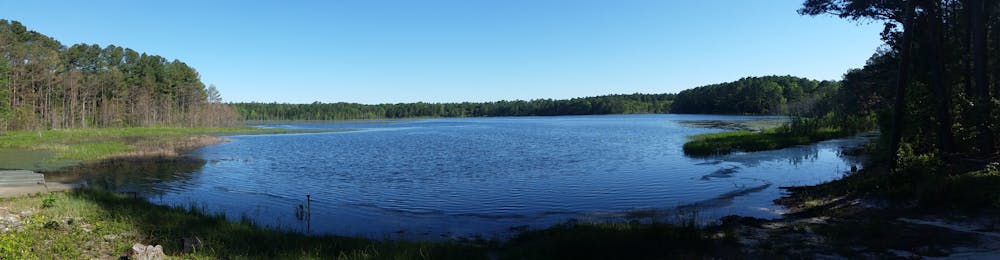
White Pond is one such natural lake, situated in southern Kershaw County, South Carolina. It covers nearly 26 hectares and is generally shallow, less than 2 meters even at its deepest portions. Within the lake itself, peat and organic-rich mud and silt deposits upwards of 6-meters thick have accumulated at least since the peak of the last ice age more than 20,000 years ago.
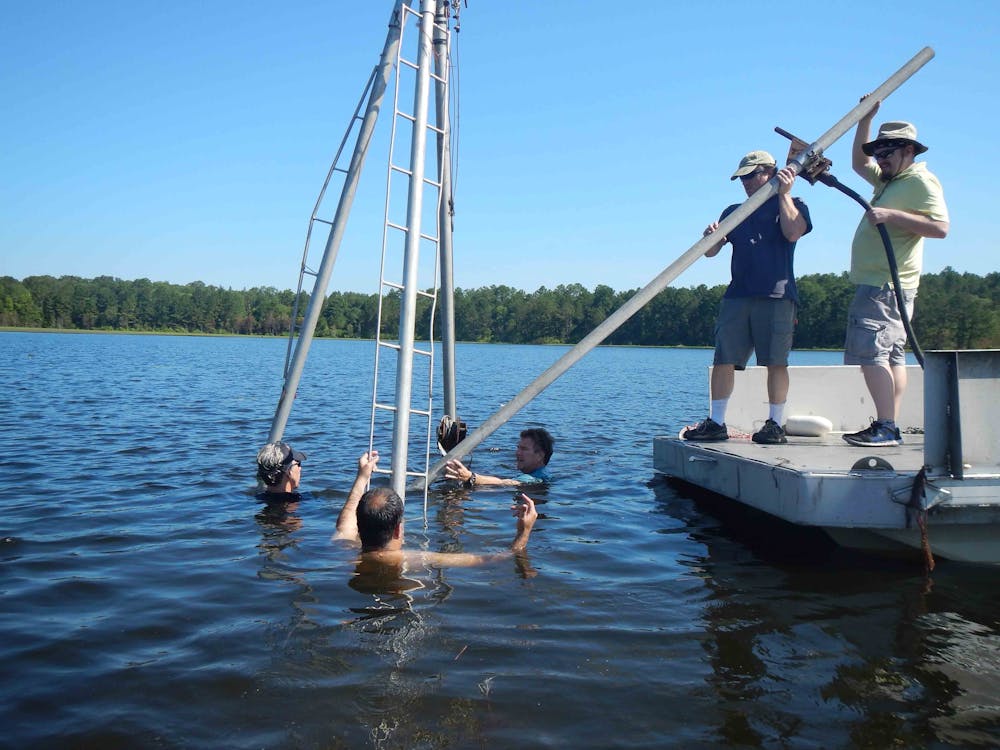
Collecting sediment cores from White Pond in 2016.
So in 2016, my colleagues and I extracted sediment from the bottom of White Pond. Using 4-meter-long tubes, we were able to preserve the order and integrity of the many sediment layers that have accumulated over the eons.
The long sediment cores are cut in half in order to extract samples for analysis.
Based on preserved seeds and wood charcoal that we radiocarbon dated, my team determined there was about a 10-centimeter thick layer that dated to the Younger Dryas Boundary, from between 12,835 and 12,735 years ago. That is where we concentrated our hunt for evidence of an extraterrestrial impact.
We were particularly looking for platinum. This dense metal is present in the Earth’s crust only at very low concentrations but is common in comets and asteroids. Previous research had identified a large “platinum anomaly” – widespread elevated levels of platinum, consistent with a global extraterrestrial impact source in Younger Dryas layers from Greenland ice cores as well as across North and South America.
Most recently, the Younger Dryas platinum anomaly has been found in South Africa. This discovery significantly extends the geographic range of the anomaly and adds support to the idea that the Younger Dryas impact was indeed a global event.
Volcanic eruptions are another possible source of platinum, but Younger Dryas Boundary sites with elevated platinum do not have other markers of large-scale volcanism.
More evidence of an extraterrestrial impact
In the White Pond samples, we did indeed find high levels of platinum. The sediments also had an unusual ratio of platinum to palladium.
Both of these rare earth elements occur naturally in very small quantities. The fact that there was so much more platinum than palladium suggests that the extra platinum came from an outside source, such as atmospheric fallout in the aftermath of an extraterrestrial impact.
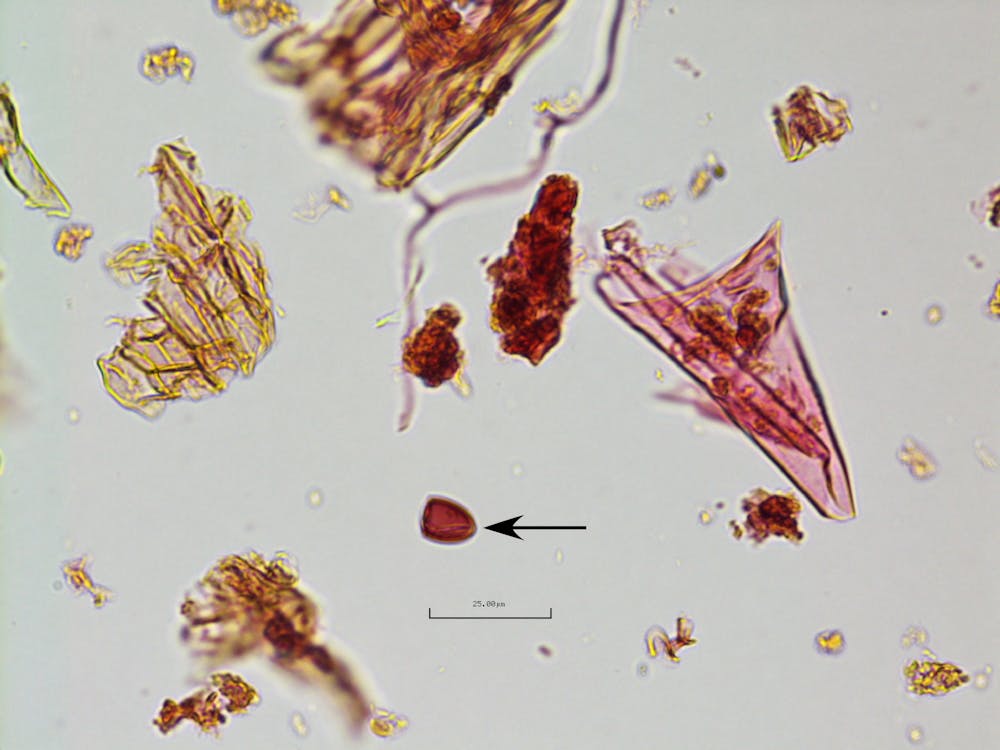
My team also found a large increase in soot, indicative of large-scale regional wildfires. Additionally, the amount of fungal spores that are usually associated with the dung of large herbivores decreased in this layer compared to previous time periods, suggesting a sudden decline in ice-age megafauna in the region at this time.
Photomicrograph of Sporormiella – fungal spores associated with the dung of megaherbivores – from White Pond.
While my colleagues and I can show that the platinum and soot anomalies and fungal spore decline all happened at the same time, we cannot prove a cause.
The data from White Pond are, however, consistent with the growing body of evidence that a comet or asteroid collision caused continent-scale environmental calamity 12,800 years ago, via vast burning and a brief impact winter. The climate change associated with the Younger Dryas, megafaunal extinctions and temporary declines or shifts in early Clovis hunter-gatherer populations in North America at this time may have their origins in space.
A White Pond sediment core is like a timeline of the stratigraphic layers. What researchers found in each layer provides hints of climate and environment at that time.
Shutterstock.com/Allen West/NASA/Sedwick C (2008) PLoS Biol 6(4): e99/Martin Pate/Southeast Archaeological Center, CC BY-ND
Christopher R. Moore, Archaeologist and Special Projects Director at the Savannah River Archaeological Research Program and South Carolina Institute of Archaeology and Anthropology, University of South Carolina
British Prime Minister Boris Johnson faces two crucial Brexit votes Tuesday that could decide if he still has a reasonable shot at securing his EU divorce by next week's deadline.
The UK is entering a cliffhanger finale to a drama that has divided families and embittered politics ever since voters backed a split from Britain's 27 EU allies and trading partners in 2016.
Johnson has set himself a very high bar by promising that he will get Brexit done -- "do or die'" -- by the twice-delayed October 31 departure date.
The Conservative leader now hopes parliament gives initial support to a Brexit bill that translates the revised withdrawal agreement he struck with Brussels last week into UK law.
He then hopes the lower House of Commons commits to passing the entire legislation in three days -- a heavy lift for a 110-page text designed to unwind 46 years of intricate EU-UK ties.
Failure in either of Tuesday's votes could deliver a potentially devastating blow to Johnson that will probably see the process prolonged again.
Parliament has already forced Johnson to request a three-month extension that European leaders will consider once they get a clearer picture of how the battles in parliament play out.
Outgoing European Commission President Jean-Claude Juncker said Tuesday the EU has "done all in our power" to assure an orderly divorce.
Extra time could allow opposition lawmakers to try and secure much closer future trade relations with the bloc than the firmer break envisioned by Johnson.
Pro-European Britons have also held massive rallies in London demanding a second Brexit referendum, which could allow for the result of the first to be overturned.
A delay would give Johnson a fresh stab at an early election designed to give him the parliamentary majority needed to avoid these scenarios and get his legislation through.
- 'Move on' -
And victory in both of Tuesday's votes would by no means guarantee that Johnson will manage to get Britain out in the remaining eight days.
The main opposition Labour Party has vowed to fight the government's attempt to ram through the legislation at breakneck speed.
UK PARLIAMENT/AFP / JESSICA TAYLOR Johnson has set himself a very high by bar by promising that he will get Brexit done -- "do or die'" -- by the twice-delayed October 31 departure date
A three-day process would still likely see Labour and its allies try to attach amendments that are unpalatable to the government.
"Labour will seize every opportunity through the passage of the Withdrawal Agreement Bill to safeguard workers' rights, protect our economy and ensure the people are given the final say," the left-wing party's finance spokesman John McDonnell wrote in the Daily Mirror newspaper.
"MPs have an opportunity to reject the false choice between Boris Johnson's bad deal and no deal," he wrote.
Government sources told The Daily Telegraph newspaper that Johnson could pull the bill if it gets weighed down with amendments his Conservatives cannot accept.
The same sources warned that Johnson would then try to call an "immediate" election that could be held as early as next month.
Johnson said most Britons just wanted to get Brexit resolved.
"The public doesn't want any more delays, neither do other European leaders and neither do I," Johnson said Monday.
"Let's get Brexit done on 31 October and move on."
- 'Repetitive and disorderly' -
Johnson is coming off a string of parliamentary defeats that underscore the travails his minority government faces as it oversees a historic break from Europe.
His initial attempts to get a version of the new Brexit legislation through were thwarted at a very rare weekend sitting and then again Monday.
AFP / Gal ROMA Key Brexit dates
House of Commons Speaker John Bercow ruled the government's bid to push the same Brexit proposal through parliament twice in three days "repetitive and disorderly".
British newspapers expect Johnson to win the first vote Tuesday that essentially agrees to examine the proposed legislation.
But the second vote on the shortened timeline is widely seen as too close to call.
Johnson's rapid success would see the legislation move to the upper House of Lords of Friday.
The debate there is expected to last two days.
The new deal must further ratified by the European Parliament before Brexit finally takes effect.




 AFP/File / YASUYOSHI CHIBA Vervoort with her 400m silver in Rio
 AFP / Gal ROMA



 UK PARLIAMENT/AFP / JESSICA TAYLOR