Former New York City Mayor Rudy Giuliani is under investigation for violating federal lobbying laws, The New York Times reported Friday evening.
"Federal prosecutors in Manhattan are investigating whether President Trump’s personal lawyer Rudolph W. Giuliani broke lobbying laws in his dealings in Ukraine, according to two people familiar with the inquiry," The Timesreported.
"The investigators are examining Mr. Giuliani’s efforts to undermine the American ambassador to Ukraine, Marie L. Yovanovitch, one of the people said. She was recalled in the spring as part of Mr. Trump’s broader campaign to pressure Ukraine into helping his political prospects," the newspaper reported.
The investigation is being conducted by prosecutors in the Southern District of New York -- which was once headed by Giuliani.
"Federal law requires American citizens to disclose to the Justice Department any contacts with the government or media in the United States at the direction or request of foreign politicians or government officials, regardless of whether they pay for the representation," The Times noted. "A criminal investigation of Mr. Giuliani raises the stakes of the Ukraine scandal for the president, whose dealings with the country are already the subject of an impeachment inquiry."
"A criminal investigation of Mr. Giuliani raises the stakes of the Ukraine scandal for the president, whose dealings with the country are already the subject of an impeachment inquiry," the newspaper noted.
MSNBC anchor Chris Hayes revealed why President Donald Trump's plan for foreign election interference didn't work during a special edition of "All In" before a live studio audience.
"We’re not even three weeks into the formal impeachment inquiry," Hayes noted. "We’re already in the star witness phase of things. Today in defiance of Donald Trump, in defiance of the State Department, in defiance of Mike Pompeo, this woman just wrapped up over nine hours of testifying before the House investigative committee. Yes, that’s a long time. "
"Her name is Marie Yovanovitch. Now she’s a career diplomat, has multiple foreign postings, and she’s also the former U.S. ambassador to Ukraine," he said.
Hayes offered his theory for explaining the tension within the federal government during the Trump era.
"In fact, I think you can tell the whole story of this scandal and indeed the whole Trump Era as a story of two archetypes, the bagman Rudy Giuliani and the civil servant Marie Yovanovitch," he explained. "Trumpism can only be implemented by lackeys and by bagmen like Rudy Giuliani."
"Rudy Giuliani is just a fixer with a law degree, and he has apparently been tasked with a pretty clear mission by the president, which is to 'manufacture dirt on my political enemies so that I can get re-elected.' Instead of running a foreign policy for the people of the country that represents our collective interests, Donald Trump and Rudy Giuliani are running and have been running a shadow foreign policy that has nothing to do with the interests of the United States," he explained.
"And now as the sheer scope of this thing keeps getting bigger and bigger, they’re all desperate to cover it up. But the problem here is that there are more Marie Yovanovitch's out there," Hayes concluded. "Believe me."
Rudy Giuliani business associates Lev Parnas and Igor Fruman were indicted and arrested Thursday morning as they were fleeing the country on a one-way flight to Europe. David Correia and Andrey Kukushkin were also charged in what Mother Jones reporter David Corn called "overlapping capers."
According to the indictments, Parnes and Fruman made secret donations to Republicans that would further their business interest and promote their agenda. They also teamed up with Parnas business partners, Correia and Kukushkin, to make donations financed by a Russian national to GOP candidates in Nevada to influence a cannabis business they wanted to start in the state.
A mysterious Russian businessman agreed to be part of the legal marijuana business and sent $1 million from an overseas account to Fruman for political contributions.
The indictment doesn't outline who the mysterious Russia businessman is, referring to them only as "Foreign National-1." However, according to state records obtained by Mother Jones from California, a Russian businessman named Andrey Muraviev worked with Kukushkin to build a cannabis enterprise in the state.
"In 2016, Kukushkin and Muraviev joined with a Sacramento businessman named Garib Karapetyan, who has been involved in the recreational marijuana business, to create a corporation called Legacy Botanical Company LLC, which was listed at a Sacramento address, according to a filing with the secretary of state in California," wrote Corn.
An email obtained cc'd Alexander Mikhalev, who says he's the chief financial officer of Parus Capital on his LinkedIn page. The fund was established in 2008 by Muraviev. In another email, Kukushkin was curious about cultivation places in Sonoma County in Northern California. He specifically mentioned "contributions" he was willing to make to ensure he got a license.
"The indictment states that in early September 2018, Parnas, Fruman, Correia, Kukushkin, and the Russian national met in Las Vegas to discuss their business venture and that 'shortly after that' the four Americans 'began to formalize' their deal with the Russian to 'fund their lobbying efforts,'" wrote Corn. "But, it adds, they 'took steps to hide' the Russian’s involvement in the venture and in any 'political contributions associated' with the project. That was due to, as Kukushkin supposedly put it, their backer’s 'Russian roots and current political paranoia about it.'"
The cannabis venture ultimately went nowhere.
It's unclear if Muraviev is "Foreign National-1" but Corn speculates he likely was, unless "Kukushkin has worked with more than one wealthy Russian businessman eager to enter the American pot market."
In her opening statement, Marie Yovanovitch said she wasn't sure why Rudy Giuliani went after her. According to her statements to Congress behind closed doors, she said that she never tried to interfere in President Donald Trump's conspiracy against former Vice President Joe Biden and his family.
During her testimony, she said she didn't know Giuliani's motives but that the anti-corruption efforts in Ukraine could have "stymied" the Giuliani attempts to score lucrative contracts. She denied that she was personally involved in barring any probes into corruption because their anti-corruption efforts were such a serious part of their work for Ukraine.
According to NBC News reporter Ken Dilanian, it was clear the men were doing business with Ukraine at the same time they were trying to uncover dirt on Joe.
"This is essentially the government saying these people were corrupt," Dilanian said about Giuliani's associates. "That means there was corruption at the heart of Rudy Giuliani’s inquiry in Ukraine to try to get the Ukrainians to investigate Joe Biden, to dig up dirt on Donald Trump’s political opponent. Trump is pressing Ukraine to do this, and so is Rudy Giuliani, and he’s in business with these now accused criminals."
He went on to wonder if crimes were being committed in the course of Giuliani's efforts to score a natural gas deal in Ukraine and change the board of the gas company. He called it a kind of "mixing of personal profit motive" with digging up dirt on the Biden family.
A federal judge has just issued an order blocking President Donald Trump's new policy of banning poor immigrants, calling it "repugnant to the American Dream."
President Trump has ordered that immigrants must prove they have enough money to buy health insurance or prove they already have access to health insurance so they do not become a "public charge." The Trump administration is seeking to block the issuance of green cards and visa applications to those who might later have to access public services.
Bloomberg News reports U.S. District Judge George Daniels called the new Trump rule "repugnant to the American Dream of the opportunity for prosperity and success through hard work and upward mobility."
Judge Daniels also said: "Defendants do not articulate why they are changing the public charge definition, why this new definition is needed now, or why the definition set forth in the rule -- which has absolutely no support in the history of U.S. Immigration law -- is reasonable."
Trump specifically reversed the portion of President Barack Obama's Affordable Care Act that mandated everyone have health insurance. Many have noted the hypocrisy of forcing migrants, especially those seeking refugee status, to have to prove they have health coverage while not making American citizens equally responsible.
"Under the new more expansive definition, immigrants aren’t supposed to use public benefits like Medicaid, public housing assistance, or food stamps for more than 12 months over a 36-month period," Bloomberg adds. "Immigration officials will consider an immigrant’s age, health, education, and wealth to see if they are at risk of becoming a 'public charge.'"
The policy, at least for now, has been blocked from going into effect.
This is a breaking news and developing story. Details may change. This story will be updated, and NCRM will likely publish follow-up stories on this news. Stay tuned and refresh for updates.
According to Newsweek, the Turkish government's bombings against Kurdish allies are now striking against American soldiers.
Citing both Iraqi Kurdish intelligence officials and Pentagon officials, the report said that special forces in the Mashtenour hill in the city of Kobani fell under artillery fire from Turkey, which is conducting their so-called "Operation Peace Spring" against the Kurdish people.
According to a senior Pentagon official, the Turkish forces should have been aware of where the U.S. was positioned "down to the grid." So, it's unclear why they would begin firing on the American soldiers. There were somewhere between 15 and 100 troops in the area, the official said, describing it as a "small number below company level."
“A senior Pentagon official said shelling was so heavy that the U.S. personnel considered firing back in self-defense,” a Politico reporter tweeted.
Defense Secretary Mark Espers tried to convince reporters that 50 Special Forces Operators were repositioned near the Syrian border.
Almost a month has passed since the September 14 attack on Saudi Arabia’s oil facilities, which members of both President Donald Trump’s administration and the Saudi government have blamed on Iran. And on Friday, according to Reuters, the Pentagon confirmed that the U.S. will be sending a large military deployment to Saudi Arabia to help Saudi forces.
In an official statement, Jonathan Hoffman, a spokesman for the Pentagon, said, “Taken together with other deployments, this constitutes an additional 3,000 forces that have been extended or authorized within the last month.”
The Pentagon, according to Reuters, said the military aid for Saudi Arabia will range from air defense personnel to fighter squadrons. Following the September 14 attack, Trump’s administration has reiterated that it considers Saudi Arabia a valuable ally of the United States.
Ironically, earlier in the same week, Trump defended abandoning the United States’ Kurdish allies as they face an onslaught from Turkey:
Although bad blood exists between the Saudi government — including Crown Prince Mohammed bin Salman — and the government of Iran, Iranian officials have denied that Iran played any role in the September 14 attack, which has worried the global energy market at a time when the U.S. economy appears to be softening and economists fear a possible recession.
One thing that remains unclear, Reuters reported, is whether or not the aircraft carrier the USS Abraham Lincoln will be replaced after its deployment in the Middle East ends.
Bloomberg News reports the "new deployment of U.S. forces to the Middle East" will begin "as tensions rise over Turkey’s military operations in northern Syria and an explosion on an Iranian oil tanker."
In defending his highly-criticized decision to withdraw U.S. troops from Northern Syria, Trump repeatedly said he was fulfilling his promise to end "endless wars."
This is a breaking news and developing story. Details may change. This story will be updated, and NCRM will likely publish follow-up stories on this news. Stay tuned and refresh for updates.
The German suspect in a deadly attack targeting a synagogue has admitted to the shooting rampage and confessed that it was motivated by anti-Semitism and right-wing extremism, federal prosecutors said Friday.
Stephan Balliet, 27, made a "very comprehensive" confession during an interrogation lasting several hours, said a spokesman for the federal prosecutor's office in Karlsruhe.
"He gave an extensive confession. He confirmed far-right and anti-Semitic motives" for the attack, the spokesman said.
Balliet is accused of shooting dead two people in the eastern German city of Halle on Wednesday, after he tried and failed to storm a synagogue.
The man, who was described by neighbors and his father as a loner who spent much of his time at a computer, had filmed and live-streamed the assault.
The victims, a German man and woman, appeared to be chosen at random when the assailant failed to gain access to the synagogue he had besieged with gunfire and homemade explosives, as the frightened congregation barricaded itself inside.
Police eventually captured Balliet after a gun battle that left him wounded.
DPA/AFP/File / Hendrik Schmidt Jewish leaders have demanded authorities to do more to protect the community
Balliet's lawyer Hans-Dieter Weber told public broadcaster Suedwestrundfunk that his client stood by his actions.
"It would be nonsensical to deny it, and he didn't do that," said Weber.
"In his view of the world, he blames others for his own misery and that's what ultimately triggered his action."
- 'Loser' -
Balliet's confession came as Jews prepared to mark the Sabbath from sundown, with solidarity action also planned across the country, including at the synagogue targeted in Halle.
Hours ahead of the Sabbath, Max Privorozki, who heads the Jewish community in Halle, said Jews would not allow themselves to be intimidated by the assault.
Around 50 people were in the synagogue to mark the holy Jewish day of Yom Kippur, when the assailant had tried to shoot his way into the Jewish temple.
Armed with weapons he is believed to have built himself and along with four kilos (nine pounds) of explosives in his car, Balliet began his rampage at noon.
Throughout a video the shooter made of his actions using a helmet-mounted smartphone, his rage bubbles to the surface, when he calls himself a "fucking idiot", a "failure" and a "loser".
- 'Massacre planned' -
Investigators searching Balliet's father's apartment found a 3-D printer, which could have been used to manufacture firearms, according to Spiegel magazine.
Police have also confiscated a hard-drive from his bedroom in the apartment he shared with his divorced mother.
Federal prosecutor Peter Frank called the act "terror" and said it had been planned to be a "massacre".
Noting that it was only thanks to the Halle synagogue's own security measures that the assailant had been kept from penetrating the temple, Jewish leaders have demanded authorities to do more to protect the community.
On Thursday, Chancellor Angela Merkel vowed that there would be "zero tolerance" for hate, while Interior Minister Horst Seehofer said protection will be stepped up immediately for all Jewish sites and institutions in Germany.
Germany has taken pride in the rebirth of Jewish life since the Nazis' World War II slaughter of six million Jews across Europe.
The community has grown to about 225,000 thanks in large part to an influx from the ex-Soviet Union after the fall of the Berlin Wall.
A vivid fresco depicting an armour-clad gladiator standing victorious as his wounded opponent stumbles gushing blood has been discovered in the ancient Roman city of Pompeii, Italy's culture ministry said Friday.
The striking scene in gold, blue and red was uncovered in what experts think was a tavern frequented by gladiators, who fought each other, prisoners and wild animals for the public's entertainment.
"We do not know how this fight ended. Gladiators were killed or shown mercy," Pompeii's director Massimo Osanna said.
A "Murmillo" fighter wearing a plumed, wide-brimmed helmet with visor, holds aloft his large rectangular shield in his left hand, as he grips his short sword in the right.
On the ground next to him lies the shield of the defeated "Thraex", who has suffered deep wounds and is on the point of collapse.
"What is particularly interesting is the extremely realistic representation of the wounds, such as the one on the wrist and chest of the unsuccessful gladiator, from which the blood runs, wetting his leggings," Osanna said.
"The Thraex is gesturing with his hand, possibly asking for mercy," he said.
The fresco -- which measures 1.12 metres by 1.5 metres -- was found in what excavators believe was a basement room, as the imprint of a wooden staircase can be seen above it.
- Treasures of a ruined city -
The building was situated not far from the gladiators' barracks in Regio V, an entire quarter of the site that has recently offered up several impressive archaeological finds but is yet to open to the public.
It was most likely a tavern with an upper floor of rooms used either by the innkeeper or by prostitutes, the ministry said.
The discovery was made during works to secure an area of the north of the archaeological park under the Great Pompeii Project, launched after years of bad maintenance and poor weather caused a series of wall collapses.
Culture Minister Dario Franceschini said the find showed Pompeii was "an inexhaustible mine of research and knowledge for the archaeologists of today and the future".
PRESS OFFICE OF THE POMPEI ARCHAEOLOGICAL PARK/AFP / HandoutIt was found in what excavators believe was a basement room
The ruined city in southern Italy is the second most visited tourist site in the country, after the Colosseum in Rome, with more than 3.6 million visitors in 2018.
Perhaps the most significant find at the Regio V so far has been an inscription uncovered last year that proves the city was destroyed by Mount Vesuvius after October 17, 79 AD and not on August 24 as previously thought.
The most eye-catching one, however, was the skeleton of a man in 2018 whose torso was found protruding from a large stone block which had crushed his head.
He appeared to have survived the initial eruption, and attempted to flee as volcanic ash blanketed the city, but was slowed down by a limp and was probably overcome by lethal gases, experts said.
Counter-terror police were on Friday probing a mass stabbing at a shopping centre in northwest England that left several people injured and needing hospital treatment.
The attack happened at the Arndale shopping centre in the heart of Manchester, where an Islamist extremist suicide bomber killed 22 after an Ariana Grande concert in 2017.
A man in his 40s was arrested on suspicion of serious assault.
Footage posted online appeared to show one police officer restraining the suspect on the floor as another stands over him pointing a Taser.
A shop worker who gave his name only as Jordan, 23, told Britain's domestic Press Association news agency that "a man was running around with a knife lunging at multiple people, one of which came into my store visibly shaken with a small graze".
Greater Manchester Police and North West Ambulance Service said four people were injured during the incident, revising downwards an initial toll of five.
AFP / Sabrina BLANCHARD Close-up map of Manchester locating the shopping centre Arndale where five people were stabbed Friday
Two women -- one of them aged 19 -- were taken to hospital with stab wounds and were said to be in a stable condition following the attack, which happened shortly after 11:00 am (1000 GMT).
A man in his 50s was also being treated while the fourth victim, a woman in her 40s, did not require treatment, police said.
More details were expected at a news conference later on Friday afternoon.
Earlier, the force said: "Given the location of the incident and its nature, officers from Counter Terrorism Police North West are leading the investigation as we determine the circumstances."
Officers were "keeping an open mind about the motivation", the force said.
Prime Minister Boris Johnson said he was "shocked by the incident in Manchester and my thoughts are with the injured and all those affected".
- Running amok -
AFP / Oli SCARFF In 2017, an Islamist extremist suicide bomber killed 22 after an Ariana Grande concert in Manchester
Among the pictures circulating on social media was one of paramedics screening off a cafe to treat victims after the shopping centre was evacuated.
Freddie Houlder, 22, said he was in the centre when he heard "a load of screams" before a woman told him she was nearly stabbed.
"Luckily she had quite a thick jacket -- she thought originally it was a fake knife because of how easily it grazed off but police came in and said it was a real knife and she burst into tears," he said.
"I definitely don't think it was gang violence because this guy was going around trying to stab random people, I believe."
POOL/AFP / Owen Humphreys Two people were seriously injured last New Year's Eve when a man went on a stabbing rampage near Manchester's Victoria railway station
The Arndale Centre had already been the scene of a terror attack in 1996 when the largest peacetime bomb ever detonated in Britain injured 212.
The 1,500-kilogram truck bomb, planted by the Provisional Irish Republican Army, caused an estimated £770 million ($970 million, 880 million euros) damage, and led to the centre being completely redeveloped.
Two people were also seriously injured last New Year's Eve when a 25-year-old man went on a stabbing rampage near the city's Victoria railway station, reportedly shouting "Allah" during the attack.
He was later detained under mental health legislation.
The Arndale Centre is near the Manchester Arena, where the Ariana Grande concert attack happened, and the railway station.
The Trump administration is continuing its efforts to keep Central American asylum seekers away from the United States’ border.
On Sept. 20 the U.S. signed an agreement with El Salvador to accept asylum seekers sent out of the United States. U.S. officials have avoided specifics in discussing the deal and implied that only Salvadoran migrants would be sent to El Salvador.
The actual text of the agreement, however, is vague. It leaves open the possibility that asylum seekers who never set foot in El Salvador – for example, Guatemalan migrants who reach the U.S. via Mexico – could be sent there to wait out their U.S. asylum process.
None of these migration deals has yet gone into effect.
The suggestion that El Salvador can protect asylum seekers – people who say they were persecuted in their home countries for their race, religion, nationality, membership of a particular social group or political opinion – is misleading.
El Salvador may be relatively comfortable for wealthy Salvadorans, who frequently live in secured compounds, replete with razor wire fences and armed guards. But it is a very dangerous country for refugees of violence.
Roots of impunity
Roughly the size of New Jersey, El Salvador is densely populated and highly connected by cellphone service and social media. The vulnerable groups protected under international asylum law cannot easily go under the radar or relocate if targeted by gangs, corrupt police or domestic abusers.
Hundreds of Salvadorans are killed every month. In July, the country went a day without a murder, and it was headline news. Murders, disappearances and tortures almost always go unsolved in El Salvador. Criminals, especially those with access to power, are rarely punished for their wrongdoing.
I have documented this culture of impunity across Central America and Mexico, focusing on the indigenous people, women and political dissidents who are so often victims of political violence.
This violence dates back centuries, to Spain’s bloody conquest of the Americas. As in the U.S., colonial-era brutality has lasting impacts on the region’s race, class and gender divisions.
In 1932, the massacre of indigenous Salvadorans and leftists who rebelled against dictator Maximiliano Hernández Martínez left between 10,000 and 30,000 dead.
Communist Party member Farabundo Martí, who led Salvadoran peasant farmers in their revolt against political corruption and unjust resource allocation, was assassinated after the massacre. But the struggle continued.
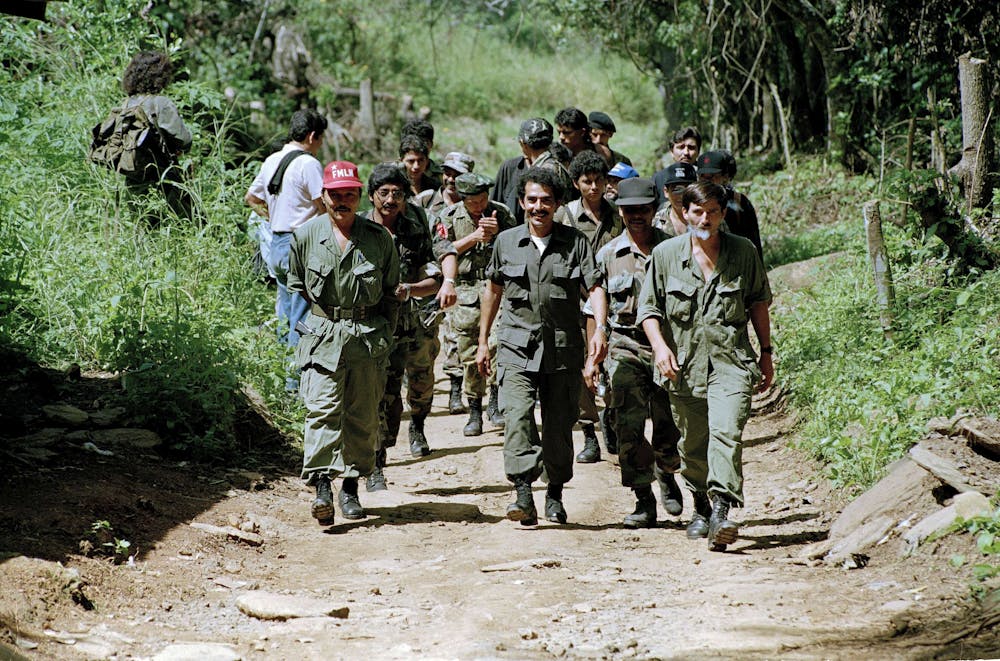
By the 1970s, dissident factions had again organized against state oppression. United as the Farabundo Martí National Liberation Front, these groups eventually waged war on the ruling ARENA party, which they blamed for oppressing the Salvadoran working class.
As a result, the root causes of El Salvador’s conflict – particularly, unequal access to insufficient resources – still plague society. So does the very weak rule of law that allowed civil war criminals to go unpunished.
Neither the rightist or leftist governments that have held power since have managed to change this.
Risking the unknown violence of migration rather than guaranteed violence at home is, for many Salvadorans, a logical decision.
Human security
President Nayib Bukele’s new centrist party, the Grand Alliance for National Unity, says combating crime and impunity is a priority for his administration.
Since Bukele took office in June 2019, murders in El Salvador are down. The president credits his tough-on-gangs policing with improving security in the country.
But some crime analysts say the apparent drop in homicides change is actually a manipulation of crime data. The government recently changed how it counts murders, eliminating deaths that result from confrontation with security forces – police killings – from the homicide category.
Police regularly turn a blind eye to violence by gang members, including both MS-13 and Barrio 18 gangs, either due to corruption or concern for their own safety. As a result, Salvadoran police frequently fail to meaningfully protect people from gang violence.
Often, officers themselves victimize Salvadorans, roughing up suspected gang members who may just be teenage boys hanging out on the street.
Human rights law
In these circumstances, sending migrants from the U.S.-Mexico border to El Salvador may violate an international law called “non-refoulement.”
According to the 1954 United Nations Convention on the Status of Refugees, which both the U.S. and El Salvador signed, states cannot expel refugees to a territory “where his life or freedom would be threatened.”
The future of the U.S.-El Salvador migration agreement is not assured, as the Salvadoran Congress has not yet approved the measure. But if it goes into effect, migrants seeking asylum in the U.S. may soon become collateral damage from this political deal.
Alexei Leonov, a Soviet-era cosmonaut who was the first man to conduct a spacewalk in 1965, died in Moscow on Friday aged 85 after a long illness.
The Russian space agency Roscosmos said it was saddened to announce the death of "cosmonaut No 11" who was twice decorated with the country's top honour, the Hero of the Soviet Union.
Leonov was a close friend of Yury Gagarin, who became the first human to go to outer space in 1961.
Four years later Leonov made history when he left a spacecraft during the Voskhod 2 mission for a spacewalk that lasted 12 minutes and nine seconds.
The flight and spacewalk were successful on the whole but his return to Earth nearly ended in tragedy when Leonov and another cosmonaut, Pavel Belyayev, crash-landed in Siberian woods.
His assistant Natalia Filimonova told AFP that Leonov died at Moscow's Burdenko hospital after a long illness.
"It's a huge tragedy for us all," said the wife of cosmonaut Boris Volynov, Tamara Volynova, who wrote a book about cosmonauts.




 DPA/AFP/File / Hendrik Schmidt
  PRESS OFFICE OF THE POMPEI ARCHAEOLOGICAL PARK/AFP / Handout
 AFP / Sabrina BLANCHARD
  AFP / Oli SCARFF
  POOL/AFP / Owen Humphreys