The Scotch whisky industry said Thursday it would be hit hard by a proposed 25-percent tariff on imports to the United States.
Washington has been given the go-ahead by the World Trade Organization to retaliate with trade tariffs on the European Union over state subsidies for aircraft manufacturer Airbus.
Single malt Scotch and liqueurs from Britain are being lined up for a 25-percent tariff on imports from October 18.
"This is a blow to the Scotch whisky industry," the Scotch Whisky Association trade organization's chief executive Karen Betts said in a statement.
"Despite the fact that this dispute is about aircraft subsidies, our sector has been hit hard, with single malt scotch whisky representing over half of the total value of UK products on the US government tariff list," amounting to more than $460 million (420 million euros)
"The tariff will undoubtedly damage the Scotch whisky sector. The US is our largest and most valuable single market, and over £1 billion ($1.25 billion, 1.12 billion euros) of Scotch whisky was exported there last year."
Other goods set to be hit by the total $7.5-billion of import tariffs include cheeses and French wine.
Among other British items, "Made in England" suits, cashmere sweaters and pyjamas face being hit.
A leading science facility in the English countryside is helping in a bid to decipher Roman-era scrolls carbonized in the deadly eruption of Mount Vesuvius nearly 2,000 years ago.
Researchers led by antiquities decoder Professor Brent Seales have turned to Diamond, Britain's national synchrotron in Didcot, Oxfordshire, to examine the papyri, which are described as "fragile like butterfly wings".
They hope the synchrotron -- which harnesses the power of electrons to produce powerful scans -- could now end a decades-long effort to read the historic artefacts owned by the Institut de France.
"Our normal idea of a scroll is that you can just unroll it and read it," Seales, director of the Digital Restoration Initiative at the University of Kentucky, told AFP during a recent tour of the site in Didcot.
"But these scrolls can't be unrolled because the carbonization makes them completely brittle and that brittle nature would damage it completely if you tried to bend it at all."
Instead, the Diamond facility acts like a giant microscope, producing light 10 billion times brighter than the sun that allows scientists to study anything from fossils and jet engines to viruses and vaccines.
"When the beam goes through the sample, it creates the possibility of an image that we can't really create any other way," Seales said.
- 'Difficult to read' -
The scrolls were discovered between 1752 and 1754 during excavations at the Herculaneum site near the Bay of Naples in southern Italy, in a house believed to have belonged to the family of Julius Caesar.
AFP / GEOFF CADDICKA fragment of the Herculaneum scroll dating back nearly 2,000 years which researchers hope to be able to decipher with the help of a high energy X-ray beamline
Unlike Pompeii, which was ravaged by lava during the eruption of Vesuvius in 79 AD, Herculanum was struck by a fiery cloud, which covered the city with ash, entombing everything intact.
One of the houses -- the "Villa of Papyrus" -- housed an important library of more than 1,800 text scrolls.
They were preserved by the ashes but carbonized and therefore impossible to unroll.
In 1802, six of these rolls were donated by the king of Naples to Napoleon Bonaparte, who entrusted them to the library of the Institut de France in Paris to decipher.
But unfurling and reading them in their delicate state proved impossible, with two attempts in 1817 then in 1877 both failing.
More than a century later, in 1986, experts used a method involving chemicals to detach one scroll into several hundred small fragments.
"(It was) very difficult to read," said Yoann Brault, a researcher at the Institut's library, noting they were not able to trace the ink used.
- 'Extremely fragile' -
However, advances in technology and special processes developed by Seales mean it may now be possible to virtually unwrap the Herculaneum papyri and uncover their contents.
"We rotate and view all 360 degrees around the outside (of) the object," Seales explained.
"(It) gives us the information of what was inside the object. We get that computationally, not physically."
Transporting the "entirely burnt and extremely fragile" scrolls from Paris to southern England presented "some risks", according to Francoise Berard, director of the Institut de France's library.
"The ideal would be not to handle them at all but obviously we want to help in the discovery of the contents," she said.
"Therefore we accepted certain risks of deterioration during transport but we take maximum precautions because they are fragile like butterfly wings."
Other scientists have also tried non-invasive techniques to decode the documents to varying degrees of success.
In 2014 Daniel Delattre, a researcher at France's National Centre for Scientific Research, used a type of intensive X-ray to glimpse some of the scrolls' contents.
The method revealed Greek letters thought to be from the pen of Philodemus of Gadara, an Epicurean philosopher.
Michel Zink, of France's Academy of Inscriptions and Letters, said such texts "have rarely been preserved" in any form.
"This is why these rolls are so important," the historian added.
"We can hope to succeed in reading entire sentences and perhaps one day, an entire text."
Israeli Prime Minister Benjamin Netanyahu may call for primaries within his Likud to show the party is unified behind him as he struggles to form a coalition after deadlocked elections, a statement said Thursday.
Netanyahu's main rival Benny Gantz and his centrist Blue and White alliance have suggested Likud members abandon their longtime leader in favour of someone else in order to form a unity government.
The prime minister was "considering the possibility of holding Likud primaries," the party said in a statement.
"The aim of the move is to shatter the illusion of a 'Likud rebellion' hoped for by other parties".
There has been little sign so far of Likud members willing to challenge Netanyahu, but one of his main rivals in the party signalled on Thursday he could do so.
"I'm ready," former minister Gideon Saar tweeted, without further explanation.
September 17 elections saw Blue and White finish with the largest number of seats -- 33 compared to Likud's 32.
But neither has a clear path to a majority coalition.
Netanyahu received one more endorsement for prime minister than Gantz from MPs, resulting in President Reuven Rivlin tasking him with forming a government last week.
A man wielding a knife stabbed and killed four officers at the police headquarters in the heart of central Paris on Thursday, before being shot dead.
The premises were cordoned off after the lunchtime attack in the historic centre of Paris, usually thronged with tourists, and a dozens of police and emergency vehicles had converged at the scene, AFP journalists reported.
At least one metro station in the vicinity of the building, which is close to Notre-Dame cathedral and other major tourist attractions, was closed.
Sources told AFP the attacker was shot dead by police in the courtyard of the building, where he was employed.
The man worked in an administrative capacity but it was not immediately clear what his precise work role was.
An emergency message was broadcast over loudspeakers at the courthouse next door, announcing "an attack" at the police headquarters and stating the area was "under surveillance".
- Scenes of 'panic' -
Interior Minister Christophe Castaner, who was due to visit Turkey later on Thursday, postponed his trip to visit the scene of the attack.
"People were running everywhere, there was crying everywhere," said Emery Siamandi, and interpreter who was in the building when the attack happened.
"I heard a shot, I gathered it was inside," he told AFP. "Moments later, I saw police officers crying. They were in a panic."
Investigators suspect a workplace dispute sparked the deadliest attack on police in France in years, sources said, but there were no immediate further details.
The Paris prosecutor is at the scene, but anti-terror agencies have not been involved at this stage.
"Did he snap, or was there some other reason? It's still too early to say," Loic Travers, head of the Alliance Police union for the Paris region, told BFM television.
- Succession of attacks -
There was no immediate indication of the possible motives of the attacker.
France has been rocked since 2015 by a succession of attacks blamed on jihadists, which have included both large synchronised assaults and isolated knife and gun attacks, killing more than 250 people.
The country remains on high alert after these attacks.
In January 2015, two men armed with Kalashnikov rifles stormed the Paris offices of satirical weekly Charlie Hebdo, killing 12 people.
A policewoman was killed just outside Paris the following day, while a gunman took hostages at a Jewish supermarket, four of whom were killed.
On November 15 that year, France was hit by the worst terror attacks in its history.
Islamic State jihadists armed with assault rifles and explosives struck outside a France-Germany football match at the national stadium, Paris cafes, and the Bataclan concert hall in a coordinated assault that left 130 people dead and more than 350 wounded.
On July 14, 2016 a Tunisian ploughed a truck through a large crowd gathered for Bastille Day fireworks in the Mediterranean city of Nice. The attack killed 86 people and injured more than 400.
The attack at the police headquarters also came as tension grows within the ranks of the police force, who have been stretched to the limit by policing the "yellow vest" protests against President Emmanuel Macron and have themselves been accused of heavy-handed tactics.
Thousands of French police officers demonstrated in Paris on Wednesday for better working conditions in a rare protest by the force, against the backdrop of a spike in suicides within their ranks.
Organisers estimated that 27,000 officers took part, out of 150,000 police staff nationwide. No independent estimate was available.
Ukraine's former president categorically denied that Joe Biden had ever asked him to open or close any criminal cases, effectively knocking down President Donald Trump's conspiracy theory about the former vice president.
Petro Poroshenko, who served as the nation's president from 2014 until earlier this year, joined a growing list of Ukrainian officials who said they never saw Biden take any improper actions involving his son's business work there, reported Bloomberg.
“The former vice president, at least in personal conversations, didn’t raise any requests to open or close any concrete cases,” Poroshenko told Bloomberg in a statement.
Poroshenko made similar comments in recent days to CNN and the Los Angeles Times.
Trump and his personal lawyer Rudy Giuliani have claimed, without any evidence, that Biden abused his government position in 2016 to push out Ukraine's prosecutor general to stop an investigation of a natural gas company where his son Hunter Biden sat on the board.
Poroshenko and other Ukrainian officials have said that simply isn't true.
The former Ukrainian president said Viktor Shokin resigned as prosecutor general three years ago after "massive campaigns" by activists, more than two-thirds of parliament and Ukrainian media seeking his ouster.
Poroshenko said he accepted the resignation to "restore public confidence and trust" in the country's law enforcement.
He also denied that Ukraine had interfered in the 2016 U.S. election, as Trump has claimed, and said the country had always sought support from both American political parties in its territorial dispute with Russia.
“It’s very important to secure such support at this moment,” Poroshenko told Bloomberg. “It should not be harmed as the result of internal processes in the U.S. and should not depend on the outcome of the U.S. presidential election.”
An Australian police officer is being investigated after an online video appeared to show him stoning a wombat to death, police said Thursday.
The video shows a shirtless man pursuing a slow-moving wombat down a dirt road, throwing rocks at it as another man films the night-time encounter from a car and calls out encouragement.
After giving a thumbs-up to the camera, the first man strikes the marsupial at least three times before it falls to the ground and stops moving.
The man raises his arms in victory to the driver, who responds with a laugh: "Oh no, you killed him, bro."
Squat and furry, wombats are small burrow-dwelling marsupials that are largely nocturnal and walk on all fours. They are a protected species across Australia.
National broadcaster ABC reported South Australia police commissioner Grant Stevens had confirmed the man was a police officer and that the matter would be dealt with internally, with potential criminal offenses also to be investigated.
South Australia state police said they were "aware" of a video circulating on social media that depicted a man "inflicting injuries upon a wombat".
"At this time (police) can confirm they are taking the situation very seriously and are closely examining the video," the statement said.
"An inquiry is being undertaken into this matter to first formally identify the man; and then take appropriate action as required."
The Wombat Awareness Organization, a non-profit rescue group that posted the video on Facebook late Wednesday, said "this has to stop".
"I am tired of reporting such cruelty for it to be ignored," they said in a post.
"May this baby not have suffered and died in vain."
North Korea says its latest weapons test was of a submarine-launched ballistic missile that marked a "new phase" in its defense capability, just days before the resumption of stalled nuclear talks with the US.
The test was by far the most provocative since Pyongyang first began a dialogue with Washington in 2018, and marked a significant step in North Korea's nuclear weapons program, analysts said.
A proven submarine-based missile capability would take the North's arsenal to a new level, allowing deployment far beyond the Korean peninsula and a second-strike capability in the event of an attack on its military bases.
"The new-type ballistic missile was fired in vertical mode" on Wednesday in the waters off Wonsan Bay, the Korean Central News Agency (KCNA) reported, identifying the weapon as a Pukguksong-3.
"The successful new-type SLBM test-firing comes to be of great significance as it ushered in a new phase in containing the outside forces' threat," it added.
The North's leader Kim Jong Un sent "warm congratulations" to research units involved in the launch.
Kim has personally supervised recent land-based missile tests.
Photos carried by the official Rodong Sinmun newspaper showed a black and white missile emerging from the water and appearing to shoot into the sky.
The images also showed a small towing vessel next to the missile, which analysts said indicates the test was conducted from a submersible barge rather than an actual submarine, and that the system was in its early stages.
Ankit Panda of the Federation of American Scientists called it Pyongyang's longest-range-capable solid-fuel missile, adding Wednesday's launch was "unambiguously the first nuclear-capable missile test since November 2017".
"Kim Jong Un's 'rocket men' kept busy during the diplomatic charm offensives of 2018-2019," said Panda.
The North carried out a successful test of the solid-fuel Pukguksong-1, also known as KN-11, in August 2016, which flew around 500 kilometers.
KCNA VIA KNS/AFP / KCNA VIA KNS Analysts say the missile was likely launched from an underwater barge or other stationary object, not from a submarine
In July, North Korean state media had published pictures of Kim Jong Un inspecting a new type of submarine that also showed a poster of the Pukguksong-3 on a wall, fueling concerns that Pyongyang was pushing ahead with an SLBM program.
Tokyo said a part of Wednesday's missile landed in waters within Japan's exclusive economic zone -- a 200-kilometer band around Japanese territory.
Washington voiced alarm, with a State Department spokesperson calling on Pyongyang "to refrain from provocations" and "remain engaged in substantive and sustained negotiations" aimed at bringing stability and denuclearization.
North Korea is banned from ballistic missile launches by United Nations Security Council resolutions.
- Working-level talks -
The launch came ahead of planned resumption of working-level talks between Pyongyang and Washington which is slated for later this week in an undisclosed location.
AFP/File / Brendan Smialowski Kim Jong Un and Donald Trump have met three times
North Korea frequently couples diplomatic overtures with military moves as a way of maintaining pressure on negotiating partners, analysts say, and may believe this weapons system gives it added leverage.
Pyongyang tested what it called a "super-large" rocket launcher last month just hours after the North said was willing to resume working-level talks with Washington.
Kim Dong-yub, a researcher at the Institute for Far Eastern Studies, noted Kim's absence at Wednesday's launch -- a rarity as the North Korean leader has been present at all recent weapons tests.
"It's likely not unrelated to the talks between Pyongyang and Washington currently under way," he said, adding that Kim was trying to carry out weapons modernization without jeopardizing dialogue with the US.
AFP /North Korea missile launch
Negotiations have been deadlocked since a second summit between Kim and US President Donald Trump in February ended without a deal.
The two agreed to restart dialogue during an impromptu meeting at the Demilitarized Zone dividing the two Koreas in June, but those talks have yet to materialize.
Pyongyang also carried out several weapons tests since the meeting that have been downplayed by Trump, who dismissed them as "small" and insisted his personal ties with Kim remained good.
One of the world's deadliest fungi has been discovered in Australia's far north for the first time -- thousands of miles from its native habitat in the mountains of Japan and Korea.
The Poison Fire Coral fungus was discovered in a suburb of Cairns by a local photographer and subsequently identified by scientists, James Cook University announced Thursday.
Several people have died in Japan and Korea after mistaking the bright red fungi for edible mushrooms that are used in traditional medicine, and brewing it into a tea.
James Cook University mycologist Matt Barrett, who confirmed the identity of the toxic mushroom found in Australia, said the discovery extends its known distribution "considerably".
Poison Fire Coral is the only known mushroom with toxins that can be absorbed through the skin, and causes a "horrifying" array of symptoms if eaten, including vomiting, diarrhoea, fever and numbness.
If left untreated, it can cause multiple organ failure or brain damage leading to death.
"The fact that we can find such a distinctive and medically important fungus like Poison Fire Coral right in our backyard shows we have much to learn about fungi in northern Australia," Barrett said.
Ray Palmer, a self-described "fungi fanatic" who found the specimen told AFP he had spent the past decade photographing various fungi in the rainforest surrounding his home city of Cairns.
"It didn't surprise me because I have been finding quite a few things over the years," he said.
"No one traipses around the rainforest up here photographing fungi. There are quite a few (more) things to be found and they probably will be in the coming years."
The US government plans to collect the DNA of all migrants detained after entering the country illegally, officials said Wednesday.
The Department of Homeland Security (DHS) is developing a plan to take DNA samples from each of the undocumented immigrants and store it in a national database for criminal DNA profiles, they said.
Speaking to journalists on grounds of anonymity, DHS officials said the new policy would give immigration and border control agents a broader picture of the migrant and detainee situation.
And stored on the FBI's CODIS DNA database, it could also be used by others in law enforcement and beyond.
"It does enhance our ability to further identify someone who has illegally entered the country," said one official.
"It will assist other organizations as well in their identification ability."
Officials said they were in fact required to take the DNA samples by rules about the handling of arrested and convicted people that were issued by the Justice Department in 2006 and 2010, but which had not been implemented.
They said the program for collecting DNA was still being developed, and they did not have a date set for implementation.
Collecting and storing the DNA of people simply detained and not tried or convicted of a crime has drawn criticism from civil rights advocates.
"Forced DNA collection raises serious privacy and civil liberties concerns and lacks justification, especially when DHS is already using less intrusive identification methods like fingerprinting," Vera Eidelman, an attorney with the American Civil Liberties Union, said in a statement.
"This kind of mass collection also alters the purpose of DNA collection from one of criminal investigation to population surveillance, which is contrary to our basic notions of freedom and autonomy," Eidelman said.
Earlier this year the US Border Patrol began performing "rapid DNA" tests on migrants who cross the border as family units to determine if the individuals were actually related and were not making fraudulent claims.
The new program will collect much more genetic information than that program, and will store it.
"This is fundamentally different from rapid DNA," said a second official.
The teenager who was the first victim of police gunfire in Hong Kong’s months-long pro-democracy protests is being charged with attacking police and rioting, police said Thursday.
The shooting occurred during widespread violence across the semi-autonomous Chinese territory that marred China’s National Day celebrations and has deepened anger against police, who have been accused of being heavy-handed against protesters.
The officer fired as 18-year-old Tsang Chi-kin struck him with a metal rod Tuesday. The government has said Tsang’s condition was stable after surgery.
A police statement said the case against Tsang will be heard by a court Thursday afternoon. He will be among seven people charged with rioting and faces two additional counts of attacking police, the statement said.
It is unclear if Tsang will appear in court, as the charges can be made in his absence. Rioting carries a possible penalty of up to 10 years in prison.
Thousands of people rallied Wednesday to demand police accountability for the shooting, with many saying the use of lethal weaponry was unjustified.
Pockets of black-clad youths vented their anger late Wednesday night, lobbing gas bombs at police quarters, vandalizing subway stations and blocking traffic in several districts. Police responded with tear gas in some areas.
More than 1,000 students marched Thursday at the Chinese University in a continuing show of support for Tsang and vowing to keep up their fight for more democratic freedoms. Many students felt that firing at Tsang's chest, close to his heart, was an attempt to kill him.
But police defended the shooting as “reasonable and lawful” as the officer had feared for his life and that of his colleagues.
Experts are cautious, but bookies are tipping teenage climate campaigner Greta Thunberg for the Nobel Peace Prize next week, while two literature laureates will be crowned after last year's award was postponed over a sex harassment scandal.
Odds from bookmakers such as Ladbrokes indicate the 16-year-old activist is the one to beat for the Nobel Peace Prize after she launched a school strike that inspired millions to join her "Fridays for Future" movement.
However any prediction carries a great deal of uncertainty, since the list of candidates considered by the Nobel Committee isn't made public, and experts are still divided over whether there is a direct link between climate and violent conflicts.
A day before the Peace Prize announcement on October 11 in Oslo, the Swedish Academy, which awards the Literature Prize, will reveal its choices in Stockholm.
The literary body is at pains to restore its honor after a scandal exposed members' scheming, conflicts of interest, and a culture of silence and harassment.
Long held up as Sweden's bearers of culture, Academy members traded barbs in the media and seven of the 18 members resigned. For the first time in 70 years, the 2018 prize was postponed, as the institution found itself without a quorum to make key decisions.
This year, there will be one Literature Prize announced for 2018 and one for 2019, each accompanied by a gold medal and nine million kronor (830,000 euros, $908,000).
Unless "the winner or winners refuse it" because they think the prize has been tarnished, warned Madelaine Levy, literary critic for Swedish daily Svenska Dagbladet.
Each year since the prizes were first awarded in 1901, literary circles are abuzz with speculation -- often more a reflection of their own wishes than any real insight into the Academy's leanings.
Among those mentioned are Polish writer Olga Tokarczuk, Kenyan author Ngugi Wa Thiong'o, Albania's Ismail Kadare, US novelist Joyce Carol Oates and Haruki Murakami of Japan.
The Academy is widely expected to try to steer clear of controversy this year, and is therefore seen making conservative picks. The laureates are expected to include at least one woman.
The unorthodox decision to honor US singer-songwriter Bob Dylan in 2016 outraged traditionalists.
The subsequent 2017 nod to "Remains of the Day" author Kazuo Ishiguro, a British novelist of Japanese origin, was seen as a consensual choice aimed at making amends.
- A French Weinstein-
The Academy's turmoil began in November 2017, when 18 women spoke out in the media and accused a cultural figure with close ties to the Academy of sexual assault, rape and harassment.
That was shortly after the start of the global #MeToo anti-sexism movement sparked by allegations against US movie mogul Harvey Weinstein.
In the Swedish affair, the cultural figure was revealed to be Jean-Claude Arnault, a Frenchman married to Academy member Katarina Frostenson.
The allegations caused a rift in the venerable institution over how to handle their ties to him, unleashing a vicious power struggle.
In an extremely rare move, Academy patron King Carl XVI Gustaf stepped in, changing the statutes to enable members -- appointed for life -- to be able to resign.
Arnault has since been convicted of rape and is serving a two-and-a-half year sentence, while his wife has quit the Academy.
Having appointed new members, the Academy has vowed more transparency.
- Peace Prize for Greta? -
Last year, the honor of the Nobel Peace Prize went to two champions of the fight against sexual violence, Congolese rape surgeon Denis Mukwege and Yazidi campaigner Nadia Murad.
The bookmakers' favorite this year is Swedish climate activist Greta Thunberg, who recently won Amnesty International's highest honor.
The 16-year-old has mobilized millions of youths since starting her "School Strike for the Climate" alone outside the Swedish parliament in August 2018.
"What she has done over the past year is extraordinary," said Dan Smith, the director of Stockholm international peace research institute SIPRI.
"Climate change is an issue which is strongly related to security and peace."
However, his counterpart at the Peace Research Institute Oslo, Henrik Urdal, said he didn't think she would win.
"Extremely unlikely," he said, noting her young age and the fact that a link between climate change and armed conflict remains unproven.
Also mentioned as possible winners are Ethiopian Prime Minister Abiy Ahmed, who has made peace with his bitter foe Eritrea, and NGOs including Reporters Without Borders and the Committee to Protect Journalists (CPJ).
The Norwegian Nobel Committee received 301 nominations this year, but it never discloses the names.
The Nobel season opens Monday with the Medicine Prize, followed by the Physics and Chemistry Prizes. The awards wind up on October 14 with the Economics Prize.
What is the difference between a planet-satellite system as we have with the Earth and Moon, versus a binary planet – two planets orbiting each other in a cosmic do-si-do?
I am an astronomer interested in planets orbiting nearby stars, and gas giants – Jupiter, Saturn, Uranus and Neptune in our solar system – are the largest and easiest planets to detect. The crushing pressure within their gassy atmosphere means they are unlikely to be hospitable to life. But the rocky moons orbiting such planets could have conditions that are more welcoming. Last year, astronomers discovered a planet-sized exomoon orbiting another gas giant planet outside our solar system.
In a new paper, I argue that this exomoon is really what is called a captured planet.
Is the first detected ‘exomoon’ really a moon?
True Earth analogues, that orbit Sun-like stars, are very hard to detect, even with the large Keck telescopes. The task is easier if the host star is less massive. But then the planet has to be closer to the star to be warm enough, and the star’s gravitational tides may trap the planet in a state with a permanent hot side and a permanent cold side. This makes such planets less attractive as a potential location that could harbor life. When gas giants orbiting Sun-like stars have rocky moons, these may be more likely places to find life.
In 2018, two astronomers from Columbia University reported the first tentative observation of an exomoon – a satellite orbiting a planet that itself orbits another star. One curious feature was that this exomoon Kepler-1625b-i was much more massive than any moon found in our solar system. It has a mass similar to Neptune and orbits a planet similar in size to Jupiter.
Astronomers expect moons of planets like Jupiter and Saturn to have masses only a few percent of Earth. But this new exomoon was almost a thousand times larger than the corresponding bodies of our solar system – moons like Ganymede and Titan which orbit Jupiter and Saturn, respectively. It is very difficult to explain the formation of such a large satellite using current models of moon formation.
In a new model I developed, I discuss how such a massive exomoon forms through a different process, wherein it is really a captured planet.
All planets, large and small, start by gathering together asteroid-sized bodies to make a rocky core. At this early stage in the evolution of a planetary system, the rocky cores are still surrounded by a gaseous disk left over from the formation of the parent star. If a core can grow fast enough to reach a mass equivalent to 10 Earths, then it will have the gravitational strength to pull gas in from the surrounding space and grow to the massive size of Jupiter and Saturn. However, this gaseous accumulation is short-lived, as the star is draining away most of the gas in the disk, the dust and gas surrounding a newly formed star.
If there are two cores growing in close proximity, then they compete to capture rock and gas. If one core gets slightly larger, it gains an advantage and can capture the bulk of the gas in the neighborhood for itself. This leaves the second body without any further gas to capture. The increased gravitational pull of its neighbor drags the smaller body into the role of a satellite, albeit a very large one. The former planet is left as a super-sized moon, orbiting the planet that beat it out in the race to capture gas.
A remnant core as a look back into history
Viewed in this context, the captured planet is unlikely to be habitable. Growing planetary cores have gaseous envelopes, which make them more like Uranus and Neptune – a mix of rocks, ice and gas that would have become a Jupiter if it had not been so rudely cut off by its larger neighbor.
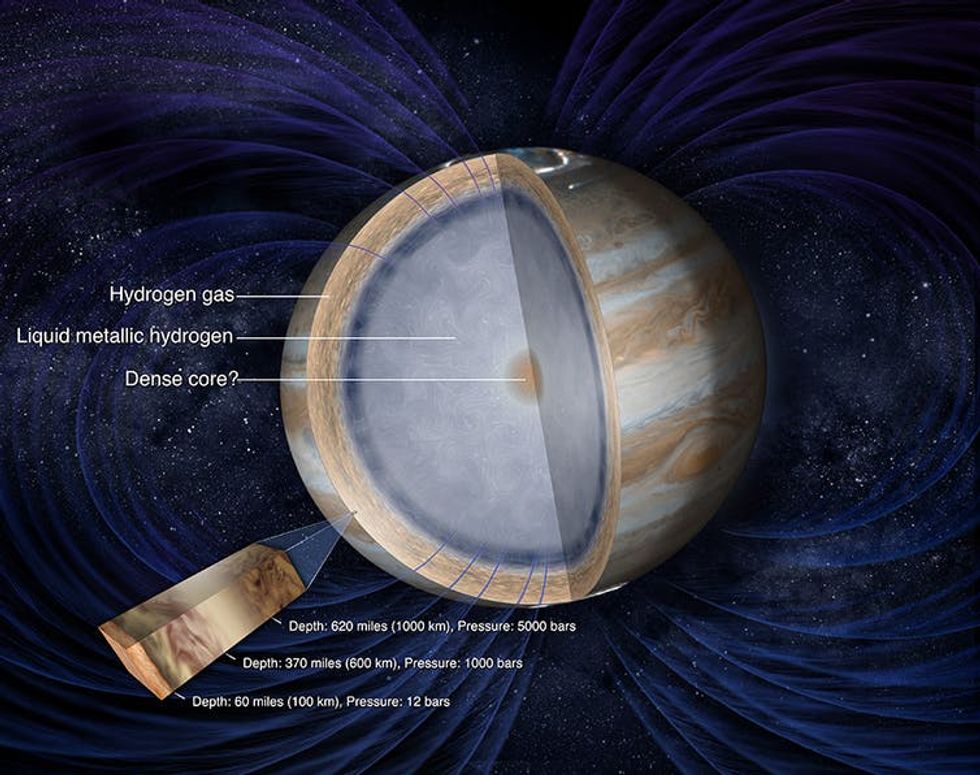
However, there are other implications that are almost as interesting. Studying the cores of giant planets is very difficult, because they are buried under several hundred Earth masses of hydrogen and helium. Currently, the JUNO mission is attempting to do this for Jupiter. However, studying the properties of this exomoon may enable astronomers to see the naked core of a giant gaseous planet when it is stripped of its gaseous envelope. This can provide a snapshot of what Jupiter may have looked like before it grew to its current enormous size.
This exomoon system Kepler-1625b-i is right at the edge of what is detectable with current technology. There may be many more objects like this that could be uncovered with future improvements in telescope capabilities. As astronomers’ census of exoplanets continues to grow, systems like the exomoon and its host highlight an issue that will become more important as we go forward. This exomoon reveals that the properties of a planet are not solely a consequence of its mass and position, but can depend on its history and the environment in which it formed.
Exomoons may reveal secrets about how gas giants like Jupiter formed and what is in their core.
Gandhi's 150th birthday: A little-remembered philosopher translated the Mahatma's ideas of nonviolence for Americans
October this year marks Mahatma Gandhi’s 150th birthday. One of the 20th century’s most iconic figures, Gandhi’s legacy defines how many people think about peace, self-reflection and the path to a more just world.
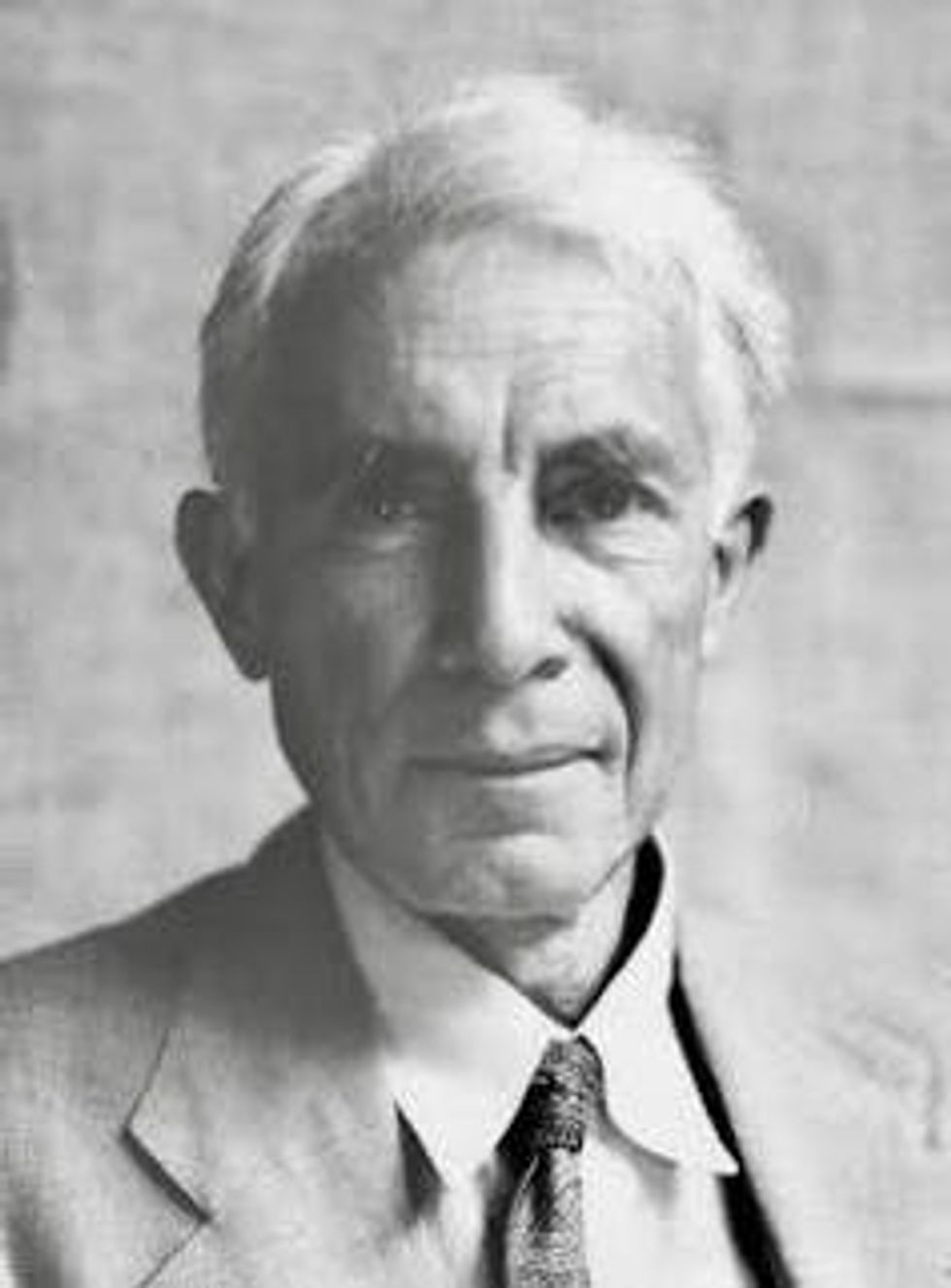
Much less celebrated is Gandhi’s friend and follower, the American pacifist Richard Bartlett Gregg.
Gregg never made any significant speeches, so no grainy newsreels feature his words. And his books are not required reading in college courses.
Gregg has nonetheless been an influential figure in taking forward Gandhi’s message regarding the power of nonviolence. Gregg explained Gandhi’s ideas in a way that made sense to a Western audience. His books even influenced Martin Luther King Jr.‘s understanding of nonviolent resistance.
Discovering Gandhi
My own interest in Gregg was something of an accident. I’m a political scientist with interest in peace activists as agents of change. I learned of Gregg a few years ago from a colleague, who told me that dozens of Gregg’s personal notebooks were moldering in a yurt on a farm up in northern Maine. These journals soon became the subject of my scholarship.
Gregg was born to a Congregational minister in 1885. It was a time of rapid industrial growth and industrial conflict, as railroads and industrialization proceeded quickly.
Gregg discovered Gandhi in a journal article he read in a bookstore in Chicago in 1924. Deeply impressed by Gandhi’s philosophy, at the age of 38, Gregg, a largely self-taught scholar, resolved to study with him in India.
In a long letter to his family explaining his decision to move to India, Gregg said he was so profoundly disenchanted with the violence of American labor relations and the American system that he sought alternatives.
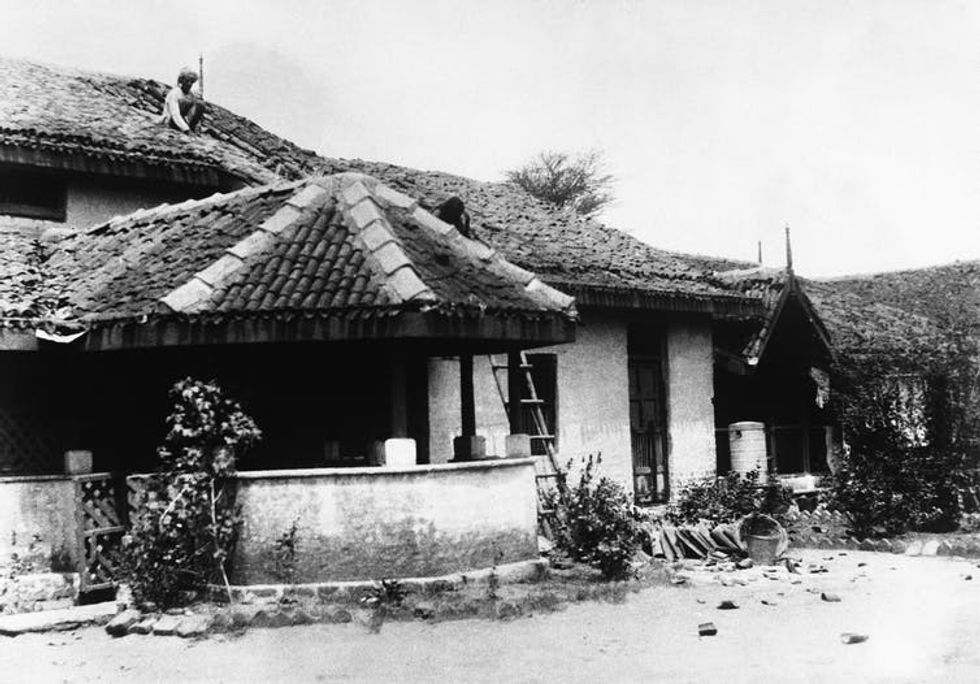
Mahatma Gandhi’s home in Sabarmati Ashram in the western state of Gujarat.
As I write in my forthcoming book, Gregg arrived at Sabarmati Ashram in the western Indian state of Gujarat in early February 1925. Gandhi, just released from prison, returned to his home at the ashram a few days after Gregg arrived.
During an evening walk, Gregg writes in his notes, he told Gandhi why he had come to India:
“I felt at first awed by his presence, but he listened attentively to what I said and made me feel entirely at ease,” Gregg recalls.
At the time, a pacifist movement was emerging around the world. Pacifists are those who believe in confronting both domestic and international violence with peaceful resistance.
Gregg learned more deeply about Gandhi’s own strategy of nonviolence and in his first four years with him and wrote an important book, “The Power of Nonviolence,” which provided guidance on how to make pacifism more effective.
Gregg argued that onlookers should see the violent assailant, when confronted by nonviolent resistance, as “excessive and undignified – even a little ineffective.”
This was a tactic that Gandhi had used with enormous effect during the Salt March against Britain’s domination of India in 1930. The march demonstrated Gandhi’s ability to mobilize tens of thousands of Indians, who were forced to pay a salt tax to the British colonialists.
The peaceful demonstrators, who followed Gandhi to the Arabian Sea Coast to make their own salt, were beaten up and more than 60,000 arrested by British troops. The world watched, appalled at the repression of the British colonial rule.
Learning from Gandhi, Gregg also wrote that nonviolent protests should serve as a media spectacle. He knew nonviolence was not passive resistance: It was an active planned strategy that required intense – even military-style – training, both physical and spiritual.
Gregg learned Hindi during his time with Gandhi and came to understand the Gandhian values of simplicity, self-reliance and how to live in harmony with the world.
Gandhi encouraged each home to have its own spinning wheel so Indians would not have to depend on cloth made in British factories. Gregg embraced the philosophy behind each Indian home spinning its own khadi cloth and became a leading advocate of organic farming and simple living.
Like Gandhi, Gregg believed that a peaceful world could only come about as humans developed inner peace and recognized their harmony with nature.
In 1936 Gregg published The Value of Voluntary Simplicity, a term he coined while serving as director of the Quaker retreat at Pendle Hill in Pennsylvania. In that post, he continued to build on Gandhi’s belief in simple living and harmony with nature as part of the true path to peace.
He was not, however, a Quaker; he remained deeply Christian.
Although he rejected Marxism and Soviet-style socialism, Gregg came to believe that the only solution to violence and injustice lay in a complete transformation of production and consumption.
What Gregg brought to America
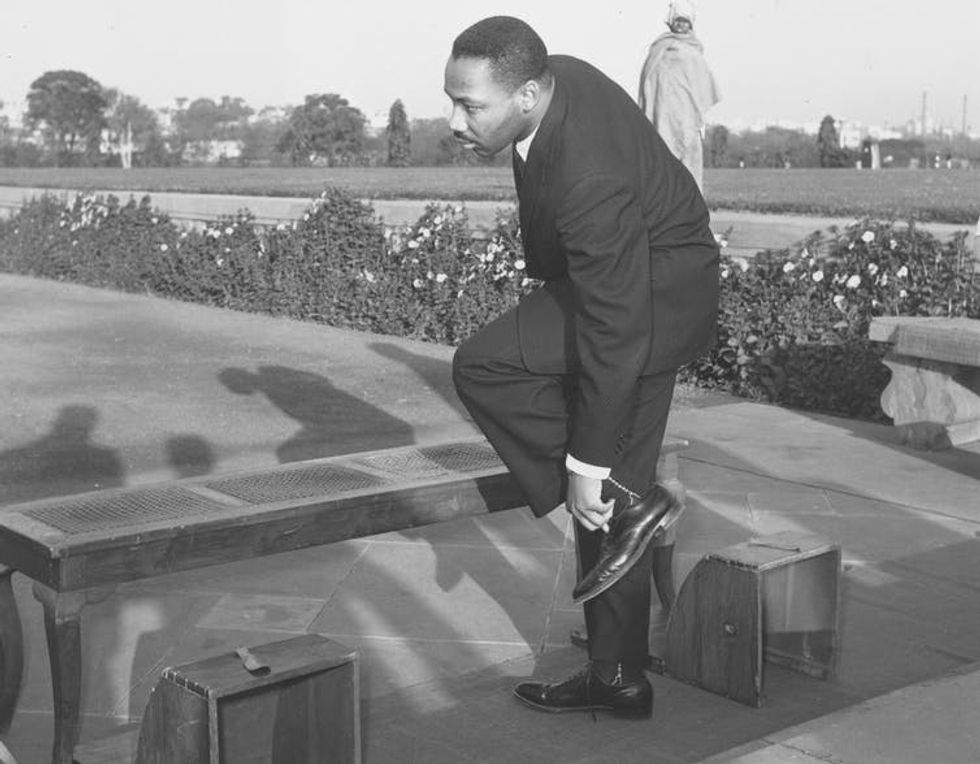
Rev. Martin Luther King Jr. removes his shoes before entering Mahatma Gandhi’s shrine in New Delhi, India, on Feb. 11, 1959.
There is no doubt that Martin Luther King Jr. was aware of Gandhi’s ideas from other sources. But Gregg’s book, “The Power of Nonviolence,” deeply affected how he thought about passive resistance. Gregg put these ideas in a context that more closely fit the American civil rights struggle.
I argue, King’s writing during this period carried very similar themes and perspectives to those laid out by Gregg. King made the distinction that nonviolent resistance was not cowardice but rather a brave act that required great training.
In 1959, King wrote the foreword for “The Power of Nonviolence,” having already become deeply familiar with Gregg’s earlier editions of the work. It went on to be published in 108 editions in six languages.
On the 150th anniversary of Gandhi’s birth, Gregg’s role in translating the Mahatma – meaning a great soul – for a Western audience and in being an early advocate of simplicity is worth commemorating, too.
How deeply he understood Gandhi’s ideas is evident in Gandhi’s own words, recorded in a personal letter to him from a friend in India:
“If you understood me as well as Richard Gregg does,” he once said to a group of Indian independence leaders, “I would die happy.”




 AFP / GEOFF CADDICK
 KCNA VIA KNS/AFP / KCNA VIA KNS
  AFP/File / Brendan Smialowski
  AFP /
AFP /