US President Donald Trump phoned his Iranian counterpart Hassan Rouhani on the sidelines of the UN summit last month but he refused to take the call, a French diplomatic source said on Tuesday.
The call happened on September 24, the source said, after French President Emmanuel Macron had shuttled between the US and Iranian leaders in a bid to arrange a historic encounter that he hoped would reduce the risk of all-out war in the Middle East.
"In New York, up to the last moment, Emmanuel Macron tried to broker contact, as his talks with presidents Trump and Rouhani led him to think contact was possible," the diplomatic source said.
Speculation was abuzz last month that the leaders could meet on the sidelines of the General Assembly.
But Rouhani said he would only hold talks with the US if Trump lifted economic sanctions on Tehran.
Macron used his 48 hours in New York to see Trump three times and Rouhani twice, urging them to engage directly.
The source said Macron made a last-ditch attempt before flying back to Paris, with French technicians installing a secure phone line linking Trump's Lotte hotel and the Millennium, hosting the Iranian delegation.
The plan involved Trump calling at 9pm despite doubts over the Iranian reaction.
Macron went to the Millennium to ensure the phone call took place. Trump made the call, but Rouhani informed the French president he would not take it, the source said.
"The discussion continued to founder on the Iranians first wanting US sanctions lifted. Donald Trump wants Iran first to make commitments on its nuclear (ambitions) and ballistic and regional activities," the source said.
The French diplomatic source comments come after US reports emerged earlier this week about Macron's initiative to get the leaders to talk.
Tensions have been escalating between Iran and the United States since May last year when President Donald Trump pulled out of the nuclear accord and began reimposing sanctions that have crippled the Iranian economy.
Britain, France and Germany have repeatedly said they are committed to saving the deal that gave Iran relief from sanctions in exchange for curbs on its nuclear programme, but their efforts have so far borne little fruit.
Former Secretary of State Hillary Clinton offered a hilarious response to Rudy Giuliani's latest conspiracy theory.
Giuliani, in his role as President Donald Trump's television lawyer, has been trying to convince the public that it is actually the Democrats who are corrupt as he attempts to deflect from Trump's admissions at the center of his impeachment inquiry.
"[Washington Post], NBC, and CNN are going after me because I’m the messenger, and covering up the message, Dem corruption," Giuliani argued.
"Meanwhile, they have yet to ask Biden difficult questions because he is protected and immune like the Clintons and crooked Clinton Foundation," the former mayor of New York City added.
Art fans and curious shoppers crowded around a disused shop in south London on Monday after notorious street artist Banksy set up a mini art exhibition in protest at a greetings card company.
Scores of people vied for a view of some of the guerilla graffiti artist's works, including the stab vest he designed for grime artist Stormzy to wear during his headline performance at this year's Glastonbury Festival.
The exhibition popped up overnight on Surrey Street, in Croydon, with the exhibits shown behind large glass windows, under a shop sign reading "Gross Domestic Product".
Banksy said in a statement that his motivation was "possibly the least poetic reason to ever make some art".
"A greetings cards company is contesting the trademark I hold to my art, and attempting to take custody of my name so they can sell their fake Banksy merchandise legally," he wrote.
Banksy said he had been prompted to open a shop as a way to get around copyright law after the greetings card company launched a legal bid to use his name to sell "fake" merchandise.
"I think they're banking on the idea I won't show up in court to defend myself," he added.
Banksy said that proceeds would go towards buying a new migrant rescue boat to replace one confiscated by Italy.
Other works on show include a baby's crib underneath a mobile made of security cameras and a reimagining of breakfast cereal character Tony the Tiger as a rug.
Framed images of his works adorn the shop walls, while a battered armchair decorated with cushions reading "life's too short" sits in front of a fireplace.
Ukrainian President Volodmyr Zelensky on Tuesday denied that he ever met with or spoke with Trump attorney Rudy Giuliani.
Reuters reports that the Ukrainian president never followed through on Trump's requests that he work with Giuliani to help investigate former Vice President Joe Biden, who is one of Trump's potential rivals in the 2020 presidential race.
During the now-infamous July 25th phone call between Trump and Zelensky, the American president repeatedly pushed his Ukrainian counterpart to look into discredited allegations of corruption on the part of Biden. Zelensky seemed generally receptive to working with Giuliani but made no concrete promises to do so.
The intelligence community whistleblower's complaint against Trump claimed that Ukrainian officials generally understood that Zelensky would have to be willing to discuss Biden with Trump as a precondition for having a phone call with the American president.
Trump's phone call with Zelensky is now at the center of an impeachment inquiry into the president being led by House Democrats.
"It's not a principled stance for businesses to stand against the Saudi murderers of Jamal Khashoggi until they hope people have forgotten about him (which in any event they haven't)."
Executives from some of the world's largest corporations are quietly planning to attend a major investment conference in Saudi Arabia set to take place just days after the one-year anniversary of the brutal murder of journalist Jamal Khashoggi.
Khashoggi's disappearance last October sparked a mass exodus from the annual event—informally known as "Davos in the Desert"—as executives worried attendance could harm their companies' brands.
But the Washington Postreported Monday that, just over a year later, more than 150 executives representing firms like JPMorgan Chase, BlackRock, and Goldman Sachs are back on the list of expected conference attendees.
"The greed of Goldman Sachs, JPMorgan, Citigroup and BlackRock is insatiable. Who cares if the Saudis are starving millions of Yemeni civilians or that our planet faces a climate emergency? Profiting off of $1.5 trillion in Saudi oil is just too important."
—Sen. Bernie Sanders
BlackRock chief executive Larry Fink insisted in a LinkedIn post that he is attending the event to push for reform in Saudi Arabia. Critics countered that executives like Fink are hoping the people of the world have forgotten about the gruesome murder of Khashoggi at the hands of the Saudi kingdom.
"Corporations like BlackRock may have decided it's time to move on from the Saudi government's murder of Jamal Khashoggi, but we haven't," tweeted progressive anti-war group CodePink. "Not until there is #JusticeForJamal."
Sen. Bernie Sanders (I-Vt.), a 2020 Democratic presidential candidate, condemned the "insatiable" greed of corporate executives who are willing to overlook the killing of Khashoggi and the Saudi Kingdom's war crimes in Yemen to profit off the country's oil.
The Post reported that over 150 executives—including 40 from U.S. corporations—have confirmed they plan to attend the conference, which is slated to begin Oct. 29.
Jared Kushner, President Donald Trump's son-in-law and senior adviser, is also expected to attend.
"A cheery invitation to the Future Investment Initiative sent by Yasir al-Rumayyan, who is the head of Saudi Arabia's sovereign wealth fund and was recently named chair of Aramco, promised 'unparalleled networking among CEOs, world leaders, and experts,'" according to the Post, which reviewed a copy of the invitation.
Jameel Jaffer, director of Columbia University's Knight First Amendment Institute, slammed "American businesses willing to overlook the imprisonment and killing of journalists in order to make a buck."
"Are there any major financial institutions that have declined this blood-stained invitation?" Jaffer asked.
Spokespeople for Citigroup and JPMorgan Chase refused to comment when the Post asked about the conference.
"It's not a principled stance for businesses to stand against the Saudi murderers of Jamal Khashoggi until they hope people have forgotten about him (which in any event they haven't)," said Kenneth Roth, executive director of Human Rights Watch.
A detailed United Nations report published in June concluded it is "inconceivable" that Saudi Crown Prince Mohammed bin Salman (MbS) was not involved in the murder of Khashoggi, whose body has not been found.
In a "60 Minutes" interview Sunday, MbS denied ordering the Khashoggi murder but conceded it was "it was committed by individuals working for the Saudi government."
Joel Simon, executive director of the Committee to Protect Journalists, said Monday it is "shocking that one year has passed without justice" for Khashoggi.
"Saudi Arabia must not be allowed to cover up this murder and go about business as usual, detaining and harassing its critics," Simon said in a statement. "The U.S. must make public what the intelligence community knew about threats to Khashoggi and who it has determined is responsible for his murder. The public deserves to know the truth, and governments around the world must know that depraved acts of violence will not go unpunished."
The scandal that erupted in response to the July phone conversation between President Donald Trump and Ukraine’s President Volodymyr Zelenskiy has had obvious consequences for Trump.
But there also are consequences for the newly elected Zelenskiy and his team, as well as for Ukraine more generally.
In the phone call, Trump urged Zelenskiy to investigate Joe Biden – a leading Democratic candidate to challenge Trump in 2020 – and his son for corruption related to the son’s business dealings in Ukraine. Much of the conversation seemed focused on Ukraine’s history of corruption and attempts to root it out.
During his press conference with Donald Trump in New York on Sept. 25, during the U.N. summit, Zelenskiy attempted to remind the world that Ukraine is a sovereign nation with its own national interests, which he, as president, is charged to defend.
He also said that he cannot be forced or pressured to do anything and refused to be drawn in the middle of U.S. politics.
“Sure, we had – I think good phone call. It was normal,” said Zelenskiy. “We spoke about many things, and I – so I think and you read it that nobody pushed me.”
Whether Zelenskiy likes it or not, Ukraine is in the middle of a U.S. political scandal.
Regardless of the results of the political process in the U.S., Ukraine’s reluctant role in the scandal reinforced the notion of deeply entrenched corruption in Ukraine. At the time when the new Ukrainian administration is trying to fight corruption and attract foreign investment, this incident might prove damaging.
And as has been the case throughout history, Ukraine appears to be the victim of international politics rather than an equal player.
In 2014, Russian troops like those shown here in trucks annexed Ukraine’s Crimean peninsula.
Ukraine has been forced into a costly war to defend its sovereignty and territorial integrity against what it sees as Russian aggression. Diplomatic, economic and military support from the U.S. and Europe have been crucial in this effort.
So when Zelenskiy made critical comments towards the European Union and European partners in the phone call with Trump, he was placing those crucial alliances at risk.
In his response to Trump’s comments that Europe “should be helping you more than they are. Germany does almost nothing for you,” Zelenskiy said that he agrees with Trump “not only 100%, but actually 1000%” and that “the European Union should be our biggest partner but technically the United States is a much bigger partner than the European Union.”
It will require diplomacy to control the possible consequences for Ukrainian security.
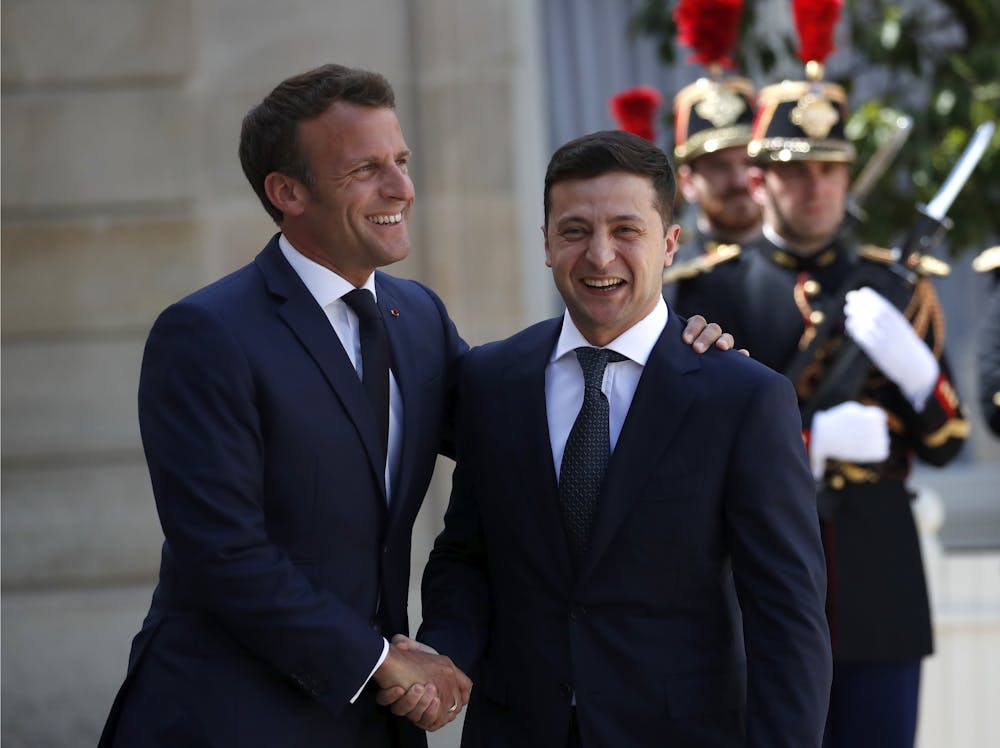
Zelenskiy may have damaged relations with European allies by his phone call with Trump. Here, Zelenskiy, right, is seen with French President Emmanuel Macron, in Paris, June 17, 2019.
But behind his revealing comments about the EU in the phone call with Trump are newly growing doubts among the Ukrainian public about the commitments of European allies to Ukraine. That’s particularly the case when it comes to sanctions on Russia, which Ukraine sees as crucial in restoring Ukraine’s occupied territories and applying pressure on pro-Russian militants.
Feeding those doubts is the continued joint Russian-German construction of a controversial natural gas pipeline from Russia to Germany that would bypass Ukraine. That project is predicted to damage Ukraine both politically and economically because Ukraine has been the major transit country for Russian gas, which brings its government billions in fees and economic activity.
Inside Ukraine, the Trump conflict has produced a mixed response.
Zelenskiy ran on the platform of fighting corruption, which has long plagued Ukraine’s government. He will likely have to answer for his statement to Trump that the new prosecutor general, who was investigating corruption, is “100% his man,” rather than an independent investigator.
In the press conference with Trump, Zelenskiy said that he merely meant that he trusts the professionalism and independence of the new prosecutor.
“He is my friend (comrade), it is true,” Zelenskiy said. “All my team are my people. They are not my property. I can not tell them what to do.”
However, his guarantee of independence for the prosecutor may not have been enough to satisfy domestic critics. The day after the press conference, a member of the opposition party in the Ukrainian parliament requested a full transcript of the phone conversation in Ukrainian.
The conversation has given his political adversaries powerful ammunition. Luckily for Zelenskiy, his party has a super-majority in the parliament, which will offer him a degree of political protection.
President Zelenskiy ran on the platform of ending the war in Donbas and initiated a well-publicized prisoner exchange with the Russian Federation in early September in hopes of softening tensions with Moscow.
Prior to his visit to New York, Zelenskiy’s administration was working on various formulas in preparation for possible peace talks with Russia that would include France, Germany and perhaps the U.S. and the U.K.
But Ukraine might lose support from its strategic partners in this and other efforts. Without the support of the Western allies, Russia will gain the upper hand to pressure Ukraine to accept the peace on Russia’s terms. That could include giving up Crimea and/or giving greater political autonomy to the breakaway region by amending the Ukrainian Constitution.
Moreover, Russian propaganda has long suggested that Ukraine is a pawn in the hands of the West. The Ukrainian political elite, according to the Moscow propagandists, is controlled by the Western interests.
Looted amidst the tumult of Egypt's 2011 revolution, the golden coffin of priest Nedjemankh was unveiled on Tuesday in Cairo after its return from New York.
Standing at 1.8 metres (six foot), the fine gilded sarcophagus has gained notoriety, apart from for its historical value, for its role at the centre of an international trafficking ring
Dating back to the Ptolemaic period (1st-2nd century BC), the ornate wooden coffin was designed for Nedjemankh, a high priest of the ram-headed god Heryshef.
The shimmering artefact adorned with gesso reliefs had been housed since 2017 in New York's Metropolitan Museum, which purchased it from a Paris art dealer for around 3.5 million euros ($3.8 million).
But in February, a Met exhibition which named the high priest had to shut down after being informed the sarcophagus had been plundered by a multi-national trafficking ring.
It had been smuggled out of Minya in southern Egypt in 2011, the year that long-time autocrat Hosni Mubarak was toppled in a popular revolt.
It had then made its way to the United Arab Emirates and Germany before landing up in France.
"I am very happy to have this piece back again in Egypt... We will know all the details about the theft later," Mostafa Waziri, secretary general of the Egyptian Supreme Council of Antiquities, told reporters at the National Museum of Egyptian Civilisation unveiling.
Egypt has sought to promote its archaeological heritage in a bid to revive its vital tourism sector, which took a battering from political turmoil after the revolution.
Saudi operatives suspected of killing the journalist Jamal Khashoggi at the country's Istanbul consulate were heard joking and talking about dismemberment before his arrival, according to secret tapes heard by UN investigators.
Helena Kennedy, a British lawyer assisting the UN probe into Khashoggi's death, said recordings she had heard from inside the kingdom's mission in Turkey referred to the Saudi critic as a "sacrificial animal."
"There was a discussion about 'will the body and the hips fit into a bag this way'?", she told BBC television's Panorama documentary program broadcast on Monday night.
Saudi Crown Prince Mohammed bin Salman, a self-styled modernizer, was feted by global leaders and business titans before the gruesome murder on October 2 last year.
But the global fallout from the killing rendered him a pariah.
Kennedy said Turkish bugs in the Saudi consulate picked up a forensic pathologist suspected of cutting up Khashoggi's body as saying, "I often play music when I'm cutting cadavers. Sometimes I have a coffee and a cigar at hand."
The pathologist also says, "'It's the first time in my life that I've had to cut pieces on the ground -- even if you are a butcher and want to cut, he hangs the animal up to do so'," she added.
"They speak about waiting for Khashoggi to arrive and they say, 'Has the sacrificial animal arrived?'. You could hear them laughing, it's a chilling business."
Turkey handed over 45 minutes of recordings to the United Nations in order for them to investigate the incident.
Khashoggi visited the consulate to secure the divorce papers needed to marry his fiancee but did not make it out alive.
"There's a point where you can hear Khashoggi moving from a man who is being a confident person, towards a sense of fear, a sense of rising anxiety, rising terror and then knowing something fatal is going to happen," said Kennedy.
UN special rapporteur Agnes Callamard, who also heard the tapes, said Khashoggi asked his suspected killers, "Are you going to give me an injection?", to which they replied 'yes'."
She added: "The sound heard after that point indicates that he is being suffocated, probably with a plastic bag over his head."
Shortly afterwards, Kennedy said the recording picked up someone saying, "he's a dog, put this on his head, wrap it, wrap it."
"One can only assume that they had removed his head," she explained.
Hong Kong police shot a pro-democracy protestor in the chest on Tuesday as violent clashes erupted across the city hours after China held a massive military parade in Beijing to celebrate 70 years of Communist Party rule.
It was the first such injury from a live round in nearly four months of increasingly violent protests and threatened to strip the spotlight from China’s carefully-choreographed birthday party, designed to underscore its status as a global superpower.
While President Xi Jinping took salutes from some 15,000 troops in the capital, pro-democracy protesters in Hong Kong threw eggs at his portrait, with tens of thousands of people defying police orders to disperse.
Running battles raged for hours across multiple locations, with some hardcore protesters hurling rocks and Molotov cocktails, while police responded for the most part with tear gas, rubber bullets and water cannon.
AFP / Anthony WALLACE Protesters lit fires in Hong Kong as a day of violence unfurled
But in one area north of the skyscraper district, a police officer unloaded his weapon at close range into a young man, video footage showed.
"An officer discharged his firearm after coming under attack and a protester was struck in the chest in Tsuen Wan district today," a police source said, requesting anonymity.
The wounded protester received initial first aid from officers before paramedics arrived and took him to hospital, the source added.
Many of the fights in the city were especially fierce with police in one district having corrosive liquid thrown at them and officers in another area retreating into a town hall from projectile-throwing crowds.
AFP / Greg BAKER China's President Xi Jinping told a huge gathering in Tiananmen Square that 'no force' can undermine China
Burning barricades sent a pall of black smoke over the city, a regional hub for some of the world's biggest banks.
The violence cast a shadow over the lavish parade in Beijing where tanks, new nuclear missiles and a supersonic drone paraded down the Avenue of Eternal Peace as Xi and other Communist Party leaders watched from a rostrum overlooking Beijing's Tiananmen Square.
The event was meant to showcase China's journey from a poor nation broken by war to the world's second largest economy.
- New weapons -
Xi, who wore the distinctive "Mao suit", delivered a speech invoking the "Chinese dream" of national rejuvenation -- his grand vision of restoring the country to perceived past glory.
"There is no force that can shake the foundation of this great nation," Xi said from the Tiananmen rostrum where Chairman Mao Zedong proclaimed the People's Republic of China on October 1, 1949.
AFP / Greg BAKER Thousands of troops marched through the square in tight formation
Helicopters flew in a "70" formation over the city as troops goosestepped across Tiananmen Square in what state media described as the country's biggest ever military parade, featuring 580 pieces of armament and 160 aircraft.
The People's Liberation Army brought out its newest hardware, including the DF-41, a nuclear-capable intercontinental ballistic missile with range enough to reach the entire United States, and the DF-17, a launcher for a hypersonic glider.
Warplanes including the J-20 stealth fighter soared through the smog-choked skies, and state media said a high-altitude, high-speed reconnaissance drone made a public appearance for the first time.
AFP / Mohd RASFAN Hong Kong has been convulsed by protests for nearly four months
"The party hopes that this occasion will add to its legitimacy and rally support at a time of internal and external challenges," Adam Ni, China researcher at Macquarie University in Sydney, told AFP.
US trade war negotiations have dragged on, and African swine fever has raced through the country's pig supply, sending pork prices soaring.
AFP / Greg BAKER Communist Party grandees watched the huge display of force
But a major headache remains Hong Kong.
Despite increasing levels of violence, there is still huge public support for a movement that presents the most serious threat to Beijing's rule since Britain returned it to China in 1997.
In his speech, Xi said China "must adhere" to the one country, two systems policy governing Hong Kong and "maintain the long-term prosperity and stability" of the city.
AFP / HECTOR RETAMAL People clamored to catch a glimpse of the huge parade
He also called for the "peaceful development" of relations with self-governed Taiwan but also reiterated his determination to seize the island, by force if necessary.
- Mao portrait -
The Beijing festivities continued with a pageant involving 100,000 civilians and 70 floats depicting China's greatest achievements.
AFP / Philip FONG\Police have fired thousands of rounds of tear gas in the last few months
A giant portrait of Mao, followed by those of past leaders and Xi, streamed across the avenue as the president and other officials waved.
Replicas of a space rocket, a homegrown passenger plane and high-speed trains were followed by smiling ethnic minorities -- imagery that glosses over accusations of human rights abuses in the frontier regions of Tibet and Xinjiang.
- Party survives -
The Communist Party has repeatedly defied the odds to remain in power for seven decades.
Under Mao, tens of millions of people died during the disastrous Great Leap Forward, and the country was plunged into violent chaos during the decade-long Cultural Revolution.
After Mao's death in 1976, the party launched the reform and opening-up policy under paramount leader Deng Xiaoping, starting decades of breakneck growth and development.
But the party retained a stranglehold on power, sending troops to end the biggest challenge to its rule in 1989 when pro-democracy protesters occupied Tiananmen Square.
North Korea and the United States will hold working-level nuclear talks on Saturday, Pyongyang said, signalling the resumption of a dialogue process that has been effectively stalled since the collapse of a summit in February.
The two sides agreed to have "preliminary contact" on October 4 and hold working-level negotiations the following day, the North's vice foreign minister Choe Son Hui said in a statement carried by the official Korean Central News Agency.
"It is my expectation that the working-level negotiations would accelerate the positive development of the DPRK-US relations," she added without disclosing the talks' venue.
North Korean officials were "ready" to enter the discussions, she said. There was no immediate confirmation from the American side.
Negotiations between Pyongyang and Washington have been gridlocked since a second summit between North Korea's Kim Jong Un and President Donald Trump in February ended without a deal.
The two agreed to restart working-level dialogue during an impromptu meeting at the Demilitarized Zone dividing the two Koreas in June, but the North's anger at a US refusal to cancel joint military deals with South Korea placed the process on hold.
Relations thawed last month after Trump fired his hawkish national security advisor John Bolton, who Pyongyang had repeatedly denounced as a warmonger.
North Korea's chief negotiator also responded positively to Trump's suggestion that the two sides try a "new method" of approaching their discussions.
Trump had criticised Bolton's suggestion of the "Libyan model" for North Korea, a reference to a denuclearisation deal with the African nation's former dictator Moamer Kadhafi -- who was killed after being deposed in 2011.
Pyongyang had bristled at that comment, which Trump said had "set us back very badly".
Despite the gridlock, Pyongyang has continued to praise Trump, calling him "bold" and "wise".
- Consensus reached? -
Analysts say Bolton's dismissal from the White House could have helped Pyongyang's decision to come to the table.
South Korea's presidential Blue House welcomed the resumption of dialogue between the North and the US.
"We hope to see the realisation of practical steps towards permanent peace regime and complete denuclearisation of the Korean peninsula through the upcoming talks," said spokeswoman Ko Min-jung.
The announcement on the new talks could be an "indication" that the two sides have narrowed their differences behind the scenes, said Koh Yu-hwan, professor of North Korean studies at Dongguk University in Seoul.
"The North has demanded security guarantee in return for denuclearisation measures and called on the US to come up with 'new calculation', he said.
"Consensus between the two might have been reached regarding the matter in the lead-up to the Tuesday announcement," he added.
Thirty years after Denmark became the first country to allow same-sex couples to register in legal unions, the world has become more accepting. But in 1989, it was a trailblazing move.
"It was a ceremony that takes place every day at city hall," Ivan Larsen recalls. "But for us, for the first time in history two men could experience this ceremony."
Ivan had met his partner, psychologist Ove Carlsen, three and a half years earlier.
On October 1 1989, the very same day Denmark first allowed same-sex couples to register in civil unions, Larsen -- himself a Lutheran pastor in Church of Denmark -- legally joined with his partner.
As the couple prepared to celebrate their pearl wedding anniversary, they recalled their vivid memories of that occasion with AFP.
It was a Sunday in the country's capital Copenhagen and deputy mayor Tom Ahlberg opened the massive gates of the city hall to officiate the "partnerships" -- the official term -- of 11 same-sex couples.
Both dressed in cream-colored suits, Ove wore a pink bow tie, Ivan wore a blue one, and at 42 years old they became the second couple to formalize their union.
The first was Axel and Eigil Axgil, 74 and 67 years old at the time but now both deceased.
- A 'pioneering act' -
"We had been told that you can have 25 guests with you at city hall," said Ivan Larsen. "We had three."
"Because of the journalists," his husband added.
Following the ceremony the newly joined couples were greeted by enthusiastic supporters throwing rice.
Although it was in stark contrast with their modest everyday style, Ivan and Ove embraced the media spotlight their historic union provided.
"We thought it was necessary to talk about what was happening in Denmark ? to spread the message: it's OK and it was possible," Ove Carlsen said.
"It was a pioneering act to get married that day," Ivan Larsen said.
In Denmark "until 1866 homosexuality was punishable by death and one couldn't be openly homosexual until 1933," Larsen explained.
True to the Danes' progressive reputation, civil union was in most ways equal to marriage in respect to the law -- but the right to adopt was excluded.
"As long as it didn't touch the symbolic realm of reproduction and family it was OK," Michael Nebeling Petersen, a lecturer in cultural studies at the University of Southern Denmark told AFP.
The idea behind the law, he said, was above all to offer financial security for homosexual men, allowing them to inherit from each other at a time when AIDS was spreading fast.
"It was first of all practical," Nebeling Petersen said.
- Other countries follow -
Since it still wasn't technically a marriage, ceremonies could not be held in most churches and the partnerships were not recognized by other nations.
Between 1989 and 2012, 7,491 civil unions were formed. And in 2010 same-sex couples were granted the right to adopt.
In June of 2012 the civil partnerships were abandoned in favour of new legislation allowing same-sex couples to get married just like heterosexual couples.
Soon after that law passed, Ivan and Ove were wed by one of Ivan's colleagues.
By that time, Denmark was no longer leading the way.
Same-sex marriages had already been adopted by several other countries, including Belgium, Canada, Spain, and the Danes' Nordic neighbors Norway and Sweden.
The first country to legalize same-sex marriages was The Netherlands, whose parliament passed its first legislation on the matter a decade earlier in 2000.
Almost 30 countries have now legalized same-sex marriages.
Ivan and Ove are now content to enjoy their retirement in their cosy apartment in one of Copenhagen's quiet districts.
Despite the progress in gay rights however, they are worried about what they say is a rise in homophobia. In response, they urge people to be open about their sexuality in everyday life.
"Some people would say, 'You always talk about being gay'," said Ivan.
"No I don't. I just told you that I've been to the cinema with my husband," he added with a smile.
Papua New Guinea's volatile Ulawun volcano erupted early Tuesday, sending a column of red lava shooting up into the sky and forcing the evacuation of recently returned residents.
Mount Ulawan, situated on the remote Bismarck Archipelago chain, displaced between 7,000 and 13,000 people from their homes when it last erupted in June.
Seismic activity started at midday on Monday before the volcano erupted at about 4:30am Tuesday, according to Rabaul Volcano Observatory assistant director Ima Itikarai.
"It was noiseless and in the dark just before dawn; the eruption was visible (with) a distinct shard (of) red incandescent glow shooting up less than 100 metres from the base," he told AFP.
As light dawned, billowing clouds of grey ash could be seen rising several hundred metres into the sky, he said, while local Chris Lagisa said residents could hear the noise of gushing gas and flowing lava.
While most people affected by the previous eruption had remained at evacuation centres, an official with the West New Britain Disaster Office said a number who had returned to tend to their homes and gardens at the base of the volcano had to be evacuated again.
The volcano is one of the world's most hazardous, featuring on a list of 16 "Decade Volcanoes" targeted for research because they pose a significant risk of large, violent eruptions.
Leaders of Austria's far-right Freedom Party (FPOe) gather Tuesday in Vienna as they reel from heavy losses in Sunday's elections and corruption scandals hanging over the party intensify.
The man at the centre of those scandals, its former leader Heinz-Christian Strache, has invited journalists to a "personal statement" on Tuesday morning as speculation mounts that he will be suspended or even expelled from the party.
Voters delivered a stinging rebuke to the FPOe, which plunged 10 points to 16 percent in the aftermath of May's so-called "Ibiza-gate" affair.
That scandal brought down Strache and saw the FPOe's government with the centre-right People's Party (OeVP) collapse.
Since the result on Sunday evening, one grim-faced FPOe politician after another has toured the TV studios to make clear that the party needs a spell in opposition to put its house in order -- a process that may well mean the knives are out for Strache.
On Monday evening the leader of the party in Upper Austria province, Manfred Haimbuchner, told Austrian media that he expected Strache to be suspended.
On Tuesday leaders of the Vienna branch of the party are expected to discuss yet another scandal which broke in the days leading up to the election, this time involving Strache's use of party money.
Prosecutors confirmed Thursday they were investigating Strache's expenses and had questioned his former bodyguard and his former office manager "on the suspicion... of submitting fake receipts" costing the party more than 5,000 euros ($5,500).
The FPOe's national executive will also meet on Tuesday in the presence of new leader Norbert Hofer to discuss how to "reconstruct" the party.
- Rising recriminations -
In the immediate aftermath of "Ibiza-gate", the party closed ranks around Strache, who was filmed appearing to offer public contracts to a woman he believed was a Russian oligarch's niece in return for campaign help.
Strache himself initially contritely resigned his posts but soon turned to loudly protesting his innocence and bemoaning a conspiracy against him.
In the run-up to May's European elections, a successful social media campaign launched by party supporters encouraged a "preference vote" for Strache in order to demonstrate his continuing support among the party's base.
While he eventually turned that seat down, the Strache family name may not disappear from the corridors of power entirely as his wife Philippa is still in the running for one of the FPOe's seats in parliament.
However, in recent days the recriminations against him have been rising within the party.
Strache's erstwhile colleague in government, FPOe ex-Defence Minister Mario Kunasek, said that if the expenses allegations against Strache "proved to be true, I don't see any other option" but to expel him, "however painful it is".
Some comments aimed at Strache online from people claiming to be FPOe voters have been even less forgiving.
"Keep quiet for once! The quicker the party expels you the better for its future," reads one.
- Ghost of Haider -
In a country of 8.8 million people, Strache's Facebook page has almost 800,000 fans and some have speculated that he may be tempted to see if his personal following is enough to start his own party.
In 2020 there are key municipal elections in Vienna, and before the current turmoil there were rumours that Strache was preparing a run for mayor.
Watchers of Austrian politics would be forgiven for feeling a bout of deja-vu coming on.
In the early 2000s, a previous OeVP-FPOe government also collapsed amid infighting, with the far-right's charismatic Joerg Haider eventually setting up his own rival movement.
Watching the rows on the far-right with some trepidation will be the winner of Sunday's election, OeVP leader Sebastian Kurz.
He had made it clear that the FPOe was one of his preferred coalition partners but this option may be off the table for the foreseeable future.
"In future Kurz will have to take into account the instability in the FPOe which will make it very difficult for him to fulfil his ambition to govern in a stable way over the next five years," political analyst Thomas Hofer told AFP.







 AFP / Anthony WALLACE
  AFP / Greg BAKER
  AFP / Greg BAKER
  AFP / Mohd RASFAN
  AFP / Greg BAKER
  AFP / HECTOR RETAMAL
  AFP / Philip FONG\
.png)