A man who donated sperm so his gay friend could have a baby more than a decade ago has parental rights over their daughter, Australia's High Court ruled Wednesday.
The court said that because the man was listed on the birth certificate and had an "extremely close" relationship with the girl, he was the father and should have a say in whether she is taken to live in New Zealand.
The man -- who goes by the pseudonym 'Robert' for legal reasons -- agreed to donate his sperm to a friend in 2006 via artificial insemination.
Despite them not living together, Robert had "an ongoing role in the child's financial support, health, education and general welfare", the court said.
Problems arose when the girl's mother and her same-sex partner wanted to move to New Zealand in 2015.
Judge Margaret Cleary ruled that a lower court was wrong to rule against the father and concluded that the child should remain in Australia so he can have visitation rights.
It is unclear, given the specifics of this relationship, whether the case could set a precedent for future judgements.
More than 70 million people were counted last year as displaced from their homes, a record that underestimates the real number of refugees and asylum seekers, the UN said Wednesday.
In its annual global trends report, the United Nations refugee agency (UNHCR) described the figure of 70.8 million at the end of 2018 as "conservative", particularly because the number of people who fled Venezuela's devastating crisis is undercounted.
At the end of 2017, by comparison, 68.5 million people were counted as being forcibly displaced by violence or persecution.
The UNHCR attributed the increase partly to surging displacement in Ethiopia caused by inter-ethnic conflict, and in Venezuela, where thousands are fleeing every day amid an economic collapse that has triggered shortages of basic food and medicine.
An estimated 3.3 million people have left Venezuela since the start of 2016, according to the UN.
UNHCR head Filippo Grandi told reporters in Geneva the figure of 70.8 million only includes Venezuelans who had officially applied for asylum -- roughly half a million people.
Overall, the number of displaced people in the world has doubled over the last 20 years and now exceeds the population of Thailand.
The trend, Grandi said, continues to go in "the wrong direction".
- Conflicts 'never' end -
According to Amnesty International, a refugee is a person who flees their home country and cannot or will not return due to conflict or fear of persecution.
The report lists 41.3 million internally displaced people (IDPs), 25.9 million refugees, and 3.5 million asylum seekers -- those awaiting a decision on their bid for official refugee protection.
AFP/File / JOSEPH EID Syria is among the countries with the highest number of internally displaced people, the UN says.
The countries with the most internally displaced people -- fleeing within their own countries -- are Syria, wracked by conflict since 2011 and Colombia, plagued by decades of violence, said the UNHCR.
The group of refugees, it added, included 5.5 million Palestinians scattered across several countries, notably Lebanon and Jordan.
The best solution for a refugee is to be able to return home once their country stabilises, but Grandi noted that 20 percent have been in exile for more than two decades.
"We have become almost unable to make peace," the UNHCR chief said.
"It is true there are new conflicts, new situations producing refugees..., (but) the old ones never get resolved," he added. "When is the last conflict that you remember was resolved?"
The UNHCR has at times sought to push back against the phrase "migrant crisis", especially as it has been applied to an influx of people into Europe via the Mediterranean sea.
The agency has argued that while mass migration does pose serious challenges, it can be managed, particularly by wealthier nations.
AFP/File / FATHI NASRI The UN has praised Germany for accepting migrants arriving in Europe via the Mediterranean sea.
Grandi praised Germany for its acceptance of migrants and its efforts to "demystify" the notion that migration is unmanageable, "even when the numbers are very big."
"I usually don't like to praise and criticise but I think in this case, I'd like to praise Germany for what it has done," said Grandi in Geneva, ahead of the report's launch in Berlin.
He noted that Chancellor Angela Merkel had paid a "heavy price" politically for her openness to migration, arguing this made her actions "even more courageous".
" Iran does not want war," said Iranian President Hassan Rouhani. US Secretary of State Mike Pompeo echoed this message, saying, "We are there to deter aggression, President Trump does not want war." Our France 24 correspondant added that this sentiment is equally shared among the members of the EU who remain part of the 2015 nuclear deal with Iran, as well as by China and Russia. Russian Deputy Foreign Minister Sergei Ryabkov added that the US should stop placing "military pressure on Iran in quite a provocative way.
Saudi Arabia has rendered toothless the once-feared religious police amid a liberalisation drive, but a planned "public decency" law is stoking controversy with some fearing a revival of morality policing.
Crown Prince Mohammed bin Salman has sought to shake off his country's ultra-conservative image with the reopening of cinemas, mixed-gender concerts and party-fuelled sporting extravaganzas, while vowing to take the kingdom towards moderate Islam.
The relaxed social norms in a kingdom seldom associated with fun in the past have been welcomed by many Saudis, two-thirds of whom are under 30, in the midst of painful economic reforms geared towards a post-oil future.
But Saudi Arabia now aims to police its citizens' behaviour with a new public decency law approved by cabinet in April, though it remains unclear when it will be enforced.
The law seeks to uphold Saudi "values and principles", banning in public clothing deemed to "offend public tastes" -- including men's shorts -- and graffiti that could be interpreted as "harmful", according to local media.
Violators reportedly risk facing a fine of up to 5,000 riyals ($1,333).
"The haia (religious police) is back without the beards," academic Sultan al-Amer said on Twitter.
The bearded enforcers of the religious police were long notorious for patrolling streets and malls to chastise women wearing bright nail polish and for rigidly imposing sex segregation, but their powers have been clipped in recent years.
- 'Effecting change is an art' -
The law, widely perceived to be vague, has sparked public concern that it would be open to interpretation, leading to arbitrary penalties and, more light-heartedly, prompted humorous banter on social media.
The Arabic hashtag "shorts don't offend public morals" has gained traction alongside memes of men sweating it out on treadmills in loose-fitting traditional robes.
"It's Saudi Arabia meets Singapore," Kristin Diwan, of the Arab Gulf States Institute in Washington, told AFP.
AFP/File / -A planned "public decency" law is stoking controversy in Saudi Arabia with some fearing a revival of morality policing
"The Saudi leadership wants to undermine the Islamist basis of social power while still maintaining absolute political control and public order."
Pro-government Saudi media reported the law was meant to be implemented from May 25, with the interior ministry and tourism authority enforcing the rules.
But on May 27, state media said the law was yet to be enforced. It did not specify a new date.
"This (law) is an effort to balance the pressure from conservative elements of society that accuse the (government) of allowing things to go 'out of control'," said Ali Shihabi, founder of the pro-Saudi think-tank Arabia Foundation.
"Effecting social change is an art form -- you want to push as fast as possible without provoking a counter reaction. Not easy!"
- Modernisation drive -
Prince Mohammed, who has amassed powers unseen by previous rulers, has cut back the political role of the ultra-conservative religious establishment while promoting hyper-nationalism in a historic reordering of the Saudi state.
The kingdom's de facto ruler has projected himself as a modern-day reformer, while arresting several clerics -- including some perceived to be moderate -- and tightly controlling religious discourse as part of what observers call a broad centralisation of power.
Many other clerics appear to be toeing the official line, bestowing religious sanction on the prince's modernisation drive.
Prominent Salafi scholar Ayedh al-Qarni recently issued a televised apology for his previously well-known hardline interpretations of Islam, while throwing his weight behind the young prince.
AFP/File / Fayez Nureldine Reforms kickstarted by Saudi Crown Prince Mohamed bin Salman include the historic decision to allow women to drive in the kingdom
While Saudi cleric Adil al-Kalbani, former imam of Mecca's Grand Mosque, has challenged the long-taboo subject of mixing the sexes by denouncing gender segregation in mosques as a "kind of phobia".
Still, the social transformation appears to meet resentment in conservative quarters, with many calling on the state to police public behaviour.
Last year, a viral video of a veiled Saudi woman and a man dancing and twirling on a busy street provoked fury, with many asking "Where are the religious police?".
Such calls could only grow louder, observers say, amid a previously unthinkable push to create a Dubai-style leisure and entertainment sector.
Testing the waters, self-styled religious scholars are openly advocating against shutting down businesses during prayer times and backing the opening of a temporary alcohol-free nightclub during a cultural festival in western Jeddah city.
"They (Saudis) are creating a broader realm for personal expression but only at the pleasure of the state," said Diwan.
The battle to make the two-man shortlist to become Britain's prime minister, which will almost certainly include Boris Johnson, heats up on Wednesday when another contender will be eliminated.
After a fractious TV debate, in which Brexit figurehead Johnson managed to avoid any trademark gaffes and emerged largely unscathed after an onslaught from his four remaining rivals, the Conservative Party's 313 MPS will vote once again to remove the candidate with the least support.
The former foreign minister grabbed more votes than his three nearest challengers combined in Tuesday's second-round, and the only question appears to be who will eventually join him in the final two to face the party's 160,000 members.
Johnson had ducked out of the first TV debate on Sunday and has carefully stage-managed his media engagements in a contest that remains his to lose.
He cast himself Tuesday as the one politician able to bring Britain successfully out of the European Union and therefore deliver the Brexit that UK voters called for three years ago.
"We must come out on October 31 because otherwise I'm afraid we face a catastrophic loss of confidence in politics," said Johnson in the hour-long BBC question-and-answer session with voters.
"I think the British people are thoroughly fed up."
But neither he nor the others raised their hands when asked by the BBC to do so if they could "guarantee" that Brexit will happen by October 31.
- Frantic search for leader -
Tuesday's debate did little to alter a growing sense that Johnson would need to make an error of monumental proportions not to win at this stage.
The Guardian newspaper called Johnson's performance "sober and sensible".
AFP / Gillian HANDYSIDE Boris Johnson
"Still the clear front-runner, still almost certainly the next PM," it wrote.
Johnson picked up 126 of the 313 Conservative MPs' votes cast Tuesday.
Foreign Minister Jeremy Hunt won 46 votes and environment minister Michael Gove 41.
International development minister Rory Stewart continued his against-the-odds challenge by nearly doubling his support base to 37.
Interior minister Sajid Javid scraped through with exactly the 33 required to make the third round.
Britain is frantically searching for a leader after Prime Minister Theresa May stepped down last month over her repeated failure to deliver Brexit on time.
Her successor will be saddled with both resolving Britain's deepest political crisis in generations and setting the terms of how it deals with the rest of Europe for decades to come.
An additional two rounds of voting will whittle the list of contenders down to just two on Thursday.
The finalists will face the ruling party's grassroots members in a vote next month to decide who wins.
- 'Not credible' -
Johnson's lead is so substantial that some UK media say the others are simply fighting for a good spot in his future government.
Stewart fired the most direct barbs at Johnson on Tuesday by arguing that "no-deal is not a credible threat".
Both Hunt and Gove repeated that a further delay may be required if a Brexit deal was within reach.
"If we were nearly there, then I would take a bit longer," Hunt said.
But Javid said it was "fundamental" to get out by the new deadline no matter what.
Johnson has warned throughout that he is prepared to take Britain out of the European Union without an agreement -- as long as it is done by the October 31 deadline.
But he has also called this tough talk a negotiating tactic designed to scare Brussels and force it to compromise on the nagging issue of the Irish border.
EU leaders have long ruled out re-opening the binding part of the agreement they all signed with May last year.
Only Stewart is openly trying to salvage May's pact in the hope of pushing it through Britain's splintered parliament at the fourth attempt.
"In the end, there is only one route to getting this done which is through parliament and there is only one deal," Stewart told BBC Radio on Wednesday.
The Daily Telegraph suggested that Stewart and Johnson had moved closer to a face-to-face showdown "after emerging as the big winners" from Tuesday's vote and debate.
Chinese President Xi Jinping has written a rare opinion piece in North Korea's official newspaper Wednesday, just a day before his scheduled visit to Pyongyang, saying Beijing's friendship with the isolated North is "irreplaceable".
Xi is to visit Pyongyang on Thursday and Friday at the invitation of North Korean leader Kim Jong Un.
The visit comes as nuclear negotiations between Kim and US President Donald Trump have soured after a second summit in February broke up without a deal, failing to agree on what Pyongyang would be willing to give up in exchange for sanctions relief.
In the op-ed piece in the Rodong Sinmun -- the official mouthpiece of the North's ruling Worker's Party -- Xi said Beijing is willing to make a joint plan with Pyongyang to achieve "permanent stability" in the East Asian region.
"We will actively contribute to regional peace, stability, development and prosperity by strengthening communication and coordination with North Korea and other relevant parties to make progress in talks and negotiations on the issues on the Korean Peninsula," Xi said in the piece.
China and North Korea have worked to improve relations in the past year after they deteriorated as Beijing backed a series of UN sanctions against its Cold War-era ally over its nuclear activities.
The trip by the leader of the North's key diplomatic ally and main provider of trade and aid has long been awaited, and comes after Kim travelled to China four times for meetings with Xi.
It will be the first trip to Pyongyang by a Chinese president since Hu Jintao went in 2005.
In the op-ed, Xi stressed that this year marks the 70th anniversary of Beijing-Pyongyang relations, and said their friendship only gets stronger as time passes.
"Over the past 70 years we (North Korea and China) have been unyieldingly advancing forward on the same boat, breaking through rain and wind," Xi wrote.
"One can say this friendship is irreplaceable even with millions of fortune".
The timing of Xi's visit is likely to raise eyebrows at the White House as it comes one week before the G20 summit in Japan, where Trump expects to meet with Xi to discuss their protracted trade war.
Analysts say that Xi's journey is intended as a signal to Trump of his influence and backing for Kim.
The word uncertainty is used a lot in quantum mechanics. One school of thought is that this means there’s something out there in the world that we are uncertain about. But most physicists believe nature itself is uncertain.
Intrinsic uncertainty was central to the way German physicist Werner Heisenberg, one of the originators of modern quantum mechanics, presented the theory.
He put forward the Uncertainty Principle that showed we can never know all the properties of a particle at the same time.
For example, measuring the particle’s position would allow us to know its position. But this measurement would necessarily disturb its velocity, by an amount inversely proportional to the accuracy of the position measurement.
Was Heisenberg wrong?
Heisenberg used the Uncertainty Principle to explain how measurement would destroy that classic feature of quantum mechanics, the two-slit interference pattern (more on this below).
But back in the 1990s, some eminent quantum physicists claimed to have proved it is possible to determine which of the two slits a particle goes through, without significantly disturbing its velocity.
Does that mean Heisenberg’s explanation must be wrong? In work just published in Science Advances, my experimental colleagues and I have shown that it would be unwise to jump to that conclusion.
We show a velocity disturbance — of the size expected from the Uncertainty Principle — always exists, in a certain sense.
But before getting into the details we need to explain briefly about the two-slit experiment.
The two-slit experiment
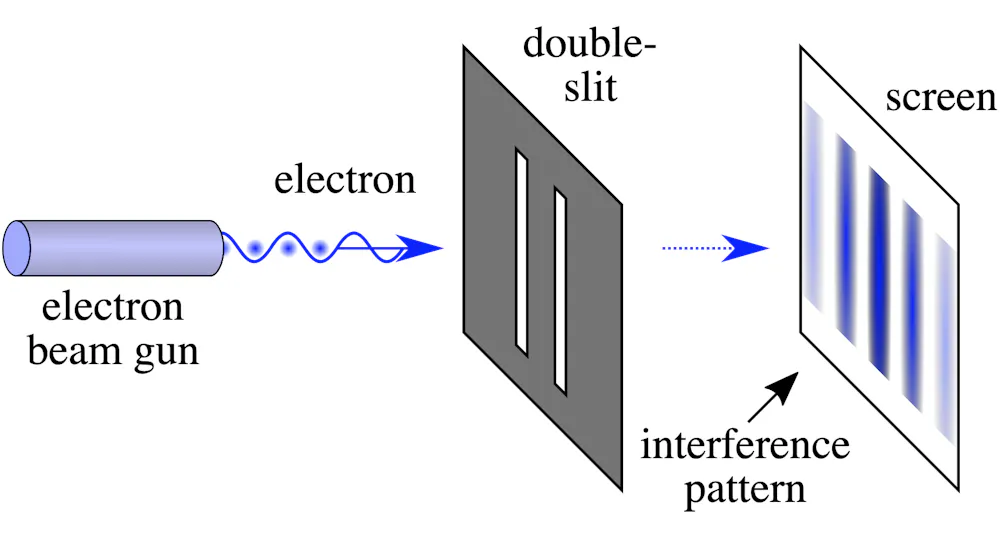
In this type of experiment there is a barrier with two holes or slits. We also have a quantum particle with a position uncertainty large enough to cover both slits if it is fired at the barrier.
Since we can’t know which slit the particle goes through, it acts as if it goes through both slits. The signature of this is the so-called “interference pattern”: ripples in the distribution of where the particle is likely to be found at a screen in the far field beyond the slits, meaning a long way (often several metres) past the slits.
Particles going through two slits at once form an interference pattern on a screen in the far field. There are bands (dark) where they are more likely to show up separated by bands (light) where they are less likely to show up.
Wikimedia/NekoJaNekoJa/Johannes Kalliauer, CC BY-SA
But what if we put a measuring device near the barrier to find out which slit the particle goes through? Will we still see the interference pattern?
We know the answer is no, and Heisenberg’s explanation was that if the position measurement is accurate enough to tell which slit the particle goes through, it will give a random disturbance to its velocity just large enough to affect where it ends up in the far field, and thus wash out the ripples of interference.
What the eminent quantum physicists realised is that finding out which slit the particle goes through doesn’t require a position measurement as such. Any measurement that gives different results depending on which slit the particle goes through will do.
And they came up with a device whose effect on the particle is not that of a random velocity kick as it goes through. Hence, they argued, it is not Heisenberg’s Uncertainty Principle that explains the loss of interference, but some other mechanism.
As Heisenberg predicted
We don’t have to get into what they claimed was the mechanism for destroying interference, because our experiment has shown there is an effect on the velocity of the particle, of just the size Heisenberg predicted.
We saw what others have missed because this velocity disturbance doesn’t happen as the particle goes through the measurement device. Rather it is delayed until the particle is well past the slits, on the way towards the far field.
How is this possible? Well, because quantum particles are not really just particles. They are also waves.
In fact, the theory behind our experiment was one in which both wave and particle nature are manifest — the wave guides the motion of the particle according to the interpretation introduced by theoretical physicist David Bohm, a generation after Heisenberg.
Let’s experiment
In our latest experiment, scientists in China followed a technique suggested by me in 2007 to reconstruct the hypothesised motion of the quantum particles, from many different possible starting points across both slits, and for both results of the measurement.
They compared the velocities over time when there was no measurement device present to those when there was, and so determined the change in the velocities as a result of the measurement.
The experiment showed that the effect of the measurement on the velocity of the particles continued long after the particles had cleared the measurement device itself, as far as 5 metres away from it.
By that point, in the far field, the cumulative change in velocity was just large enough, on average, to wash out the ripples in the interference pattern.
So, in the end, Heisenberg’s Uncertainty Principle emerges triumphant.
The take-home message? Don’t make far-reaching claims about what principle can or cannot explain a phenomenon until you have considered all theoretical formulations of the principle.
Yes, that’s a bit of an abstract message, but it’s advice that could apply in fields far from physics.
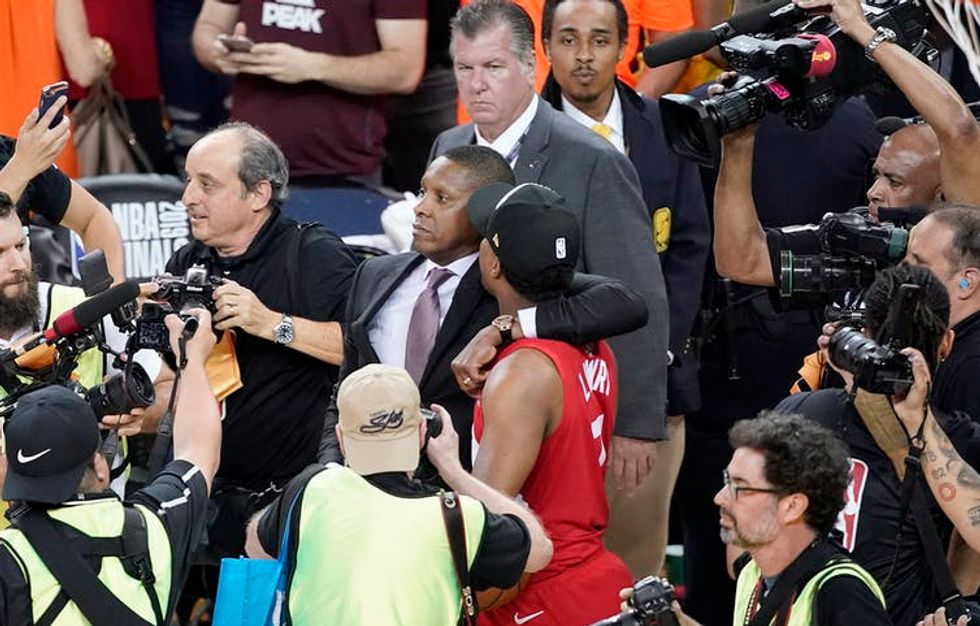
During what was probably one of the most exciting and gratifying moments of his professional life, moments after the Raptors’ NBA finals victory on Thursday, a California sheriff’s deputy stopped Raptors president, Masai Ujiri from walking onto the court for the Raptors’ trophy presentation The deputy carded him and asked him for his credentials.
Even though he is the president of the Toronto Raptors’ basketball team and even though it was his own team’s victory ceremony, as a Black executive, he was treated with suspicion, as if he was trespassing.
Toronto Raptors president Masai Ujiri, centre left, with guard Kyle Lowry after the Raptors defeated the Golden State Warriors in Game 6 of the NBA Finals. Authorities are investigating an incident between Ujiri and a sheriff’s deputy.
(AP Photo/Tony Avelar)
That same day, a conflict studies and human rights student at the University of Ottawa and vice-president of academic affairs for the program’s student association, Jamal Koulmiye-Boyce, was also racially profiled, carded and harassed by security, on his own campus. According to Koulmiye-Boyce as well as bystander accounts with audio and video recordings, he was skateboarding on campus when security asked him to stop.
Security guards then demanded he show ID. When he explained that he left his wallet with his ID in his on-campus student office, the guards accused him of trespassing, and aggressively handcuffed and detained him. They then called the police.
Koulmiye-Boyce was held for several hours in the back of a police car before he was allowed to leave. The only reason guards held him? Skateboarding without a wallet. Even though Jamal is like many other students on campus, he was treated as a security threat because he is a Black student.
For too many Black Canadians, this type of scrutiny is a reality.
How do we reconcile the daily racism that Black people face in our country with our public expressions of multicultural pride?
Canadians loved watching the Raptors achieve their dream of becoming NBA champions for many reasons: the tough losses and inspired comebacks; the “business trip” attitude that athletes maintained under extreme pressure; the giant parties emulating Jurassic Park popping up all over the county.
But I believe that for many Canadians, one of the most exciting aspects of the Raptors’ playoff victory was its feel-good multiculturalism.
Multiculturalism and anti-Black racism
Many Raptors’ fans are proud that General Manager Ujiri is the first African GM in the NBA. Ujiri often praises Canadian multiculturalism and makes jokes about how much better Canada is than the United States when it comes to welcoming immigrants, thanking “Donald Trump for making Toronto an unbelievable sports destination.”
The sight of superfan Nav Bhatia leading what he calls a “beautiful rainbow” of Canadian fans after a Raptors’ win in the land of Trump sure feels good. And media stories about fans like 15-year-old Yasmin Said help as well. Said matches her red hijab to the Raptors’ logo when she plays basketball with the Hijabi Ballers, a group that encourages young Muslim women to get involved in sports. As a nation, we seem delighted by these beautiful multicultural moments.
Canadians, Daigle contends, are letting themselves and the entire nation off the hook because Canada doesn’t suck as badly as “the nation could possibly suck.”
At the University of Ottawa campus, we need resources, events and supports specifically dedicated to combatting anti-Black racism and supporting Black students, staff and faculty as well as recruitment and retention related to Black students, staff and faculty. And white campus members need to learn about anti-Black racism and do the work of sharing this knowledge with other white people as well.
While displays of Canadian multicultural unity may feel good, including expressions of Raptors fandom in the form of parades and jerseys, as long as Black Canadians are singled out for greater scrutiny in Canadian society, multiculturalism acts as a facade that allows anti-Black racism to continue.
This is an important year in Chinese history. It marks the anniversaries of two political movements involving students and scholars: the May Fourth Movement and the Tiananmen Square protests – known in China as the June Fourth Incident.
The May Fourth Movement of 1919 challenged traditional Chinese values and authorities and demanded freedom of speech and democracy. Seventy years later – and 40 years after the Chinese Communist Party (CCP) had taken power – students, scholars, and other citizens mobilised again in defence of freedom of speech, human rights, and democratic values. But on June 4 1989, the CCP brutally crushed their movement. The crackdown created a legacy of heavily censored wrongs that cannot be righted while the current system lasts.
After 1989, the Chinese government stepped up its control over students through “patriotic” education campaigns. It also imposed more restrictions on scholars. Yet academics working in universities, think-tanks and NGOs have, over the years, continued to expose and criticise systemic injustices – especially on the internet and social media, although censorship on these platforms has increased under president of China, Xi Jinping.
Since assuming power in 2012, Xi Jinping has more tightly controlled civil society, the media and universities and strengthened ideological indoctrination. New bans and restrictions of research and teaching on topics such as constitutionalism and civil society have further impeded independent scholarship.
Numerous critical scholars have been silenced. Some have gone into exile. Among the courageous scholars who continue to insist on the freedom to write is law professor Xu Zhangrun. His sharp critique of President Xi’s “new era” recently earned him a suspensionfrom his university.
All Russell Group universities have extensive links with China across different disciplines and areas of activity.
In the Xinjiang Uyghur Autonomous Region in north-west China, more than 300 intellectuals have reportedly been incarcerated in camps. These camps are thought to hold about 1.1m Chinese citizens from predominantly Muslim ethnic minorities. Among the victims are Rahile Dawut, an expert on Uyghur folklore, and Ilham Tohti, an economist who was sentenced to life imprisonment in 2014.
The persecution of these intellectuals has effects well beyond China’s borders. It deprives the entire academic community of important critical voices.
Communist party influence
In 1919 and 1989, foreign universities had only limited exchanges with Chinese universities. Today, they are heavily involved – and invested in joint ventures with China. Many have come to rely on increasing numbers of Chinese students – it’s estimated that one in five international students in UK universities are from China.
Some receive support through Confucius Institutes – Chinese government-funded centres of Chinese language and cultural education. Scholars and their institutions are also attracted by research facilities in and grants from China.
The expansion of Chinese academic repression is particularly concerning in the Hong Kong Special Administrative Region, where civil liberties used to be fairly well protected. In April 2019, Benny Tai, a law professor at Hong Kong University was sent to prison, along with others, for his role in the 2014 Umbrella movement – a peaceful civil disobedience movement.
While Tai awaits the outcome of his appeal, there have already been worrying calls for his dismissal. And his case has had a palpable chilling effect on academic freedom in the city.
In other parts of the world, Chinese pressure is felt in different ways. Self-censorship is of increasing concern, as some scholars and their institutions no longer dare to engage in critical research or to speak up for Chinese colleagues at risk. One of the most striking examples of responsiveness to pressure has been the readiness of international academic publishers to censor their own journals at China’s request.
Collective action
It bears noting that many Chinese and Western universities have signed on to the 2013 Hefei Statement. This commits signatories to “the exercise of academic freedom by faculty … without undue constraint”. The European Parliament has expressed its concern about threats to academic freedom and called for initiatives to safeguard academic values in external relations.
But so far, there are no mechanisms to safeguard academic values in co-operation and exchange with repressive countries. To change this, we need a principled commitment to defending academic freedom transnationally. This will require the adoption of Codes of Conduct, such as those recommended by Human Rights Watch – as well as the creation of university committees on the ethics of global academic engagement.
There also must be transparency about the terms on which universities “engage” with counterparts in countries of concern, including external sources of funding for research and teaching. Intelligent rules and mechanisms to screen out academic funding from problematic sources that would come with strings attached, must also be introduced.
Universities and academics around the world must take a firm stance when academic freedom is threatened abroad. In 2018, Cornell University’s School of Industrial and Labour Relations terminated an exchange programme with a Chinese university it said was collusive in persecuting its students. Moves like this are important, because ultimately, the global challenge of defending academic freedom requires collective and institutionalised action.
Of the 29 seats won by Nigel Farage’s Brexit Party in the European elections, eight were taken by women. At 28%, this is far short of the proportion of women in the electorate, but not dissimilar to the gender split of political representation in many other parties, especially those on the right.
But it’s when you look at who voted for the Brexit Party that the figures get really surprising. Something about this party makes it far less attractive to women than to men.
A YouGov poll conducted at the end of May shows that the Brexit Party has the biggest marked difference in voting preferences between the sexes of all the political parties. While 26% of male respondents would cast a vote for the party, only 18% of women would.
This means that while the Brexit Party would top the poll of men’s votes, it would come fourth among women. In this ranking, the Liberal Democrats land narrowly in first place, with 22% of women’s votes. The Conservatives and Labour follow, both with 21%. You could even infer from these results that women may have played a part in swaying the result of the recent Peterborough by-election, with just 606 votes between Labour and the Brexit Party.
What would happen in a full-blown general election is of course unknown, but we do know that in recent years gender has been a critical factor in election results. In 2017 there was a sizeable gap in party support between men and women. In particular, significantly fewer women than men voted Conservative, a factor that hindered the party’s ability to secure a majority. Women make up 51% of the adult population and a greater proportion of the electorate, so if the Brexit Party is serious about making a breakthrough into Westminster, and others are serious about winning a majority, they can ill afford to ignore women’s votes.
Why the difference?
Although there was no sizeable difference between men and women’s support for Brexit in 2016, women do tend to be less supportive of a hard Brexit. While 18% of men think that leaving the EU without a deal would be a very good outcome, only 11% of women hold this position.
Beyond Brexit, there could be other factors at play too. Compared with men, women are generally less supportive of spending cuts to public services, and this is even true among supporters of parties of the right. Women are also more likely to give priority to healthcare and the NHS. The YouGov poll found that 37% of women selected health as one of the three most important issues currently facing Britain – ten percentage points more than the 27% of men who felt the same.
So although the Brexit Party has focused solely on the issue of leaving the EU, media coverage of Farage’s position on opening up the NHS to more privatisation might have a bigger, negative impact on women’s vote choice than men’s – especially if US access to the NHS in a future trade deal continues to be a live issue.
When it comes to tax and spend, many (but not all) hard Brexiteers take a libertarian view, favouring lower tax and lower public spending. This might have turned women voters off the Brexit Party, as they tend to prioritise welfare spending over tax cuts more than men.
Increasing tolerance may also be a factor for the party’s poor showing among women. Rates of racial prejudice have fallen more quickly among women than men, and although Farage states that neither he nor the Brexit Party tolerate racism, his comradeships with the US president, Donald Trump, the Italian deputy prime minister, Matteo Salvini, and France’s far-right politician Marine Le Pen are probably not helping the party’s efforts to be seen as inclusive and welcoming.
Nor is Farage’s personal style helping – clear as its appeal may be for many (mainly male) voters. Women are almost 50% less likely than men to rate Farage favourably. We can’t be certain why this is, but his “bloke down the pub” image doesn’t necessarily make a positive impression among all women.
Added to the Brexit Party’s woman problem is its generational one. Unsurprisingly, given the age divide in Brexit/Remain support, the party fares poorly among the under 50s, with just 5% of those aged 18 to 24 intending to vote for them, compared with 33% of over-65s.
So while Farage will have to appeal to a broader slice of the electorate if he’s to overtake the established parties that have long dominated Westminster, his current voter-targeting strategy mostly appears to be successful in recruiting the old boys.
This article has been published in partnership with the UK in Changing Europe.
The Canadian government on Tuesday approved a controversial pipeline expansion project to deliver oil to the Pacific coast for shipping overseas, setting the stage for a major political battle ahead of elections.
Prime Minister Justin Trudeau's administration had given the project the go-ahead in 2016 on the grounds it was in Canada's "national interest."
But it was stalled by legal challenges and protests by indigenous groups and environmental activists, and a federal court last August ordered the government to take a second look.
"Today, I am announcing that our government has approved the Trans Mountain expansion project going forward," Trudeau told a press conference in Ottawa.
"The company plans to have shovels in the ground this construction season," he said
Tax revenues and proceeds from the eventual sale of the pipeline -- which Ottawa purchased last year for Can$4.4 billion (US$3.3 billion) from Kinder Morgan to salvage the troubled expansion project -- would be invested in "Canada's transition to clean energy."
The project is to replace an aging conduit built in 1953 to deliver 890,000 barrels of oil a day from landlocked Alberta to the Pacific coast for shipping to new markets in Asia and elsewhere.
Most of Canada's oil output currently is sold to the United States at a discount.
The government, after an initial environmental review, concluded that the Trans Mountain pipeline was needed to ease Canada's reliance on the US market, boost local production and get a better price for its oil.
But environmentalists and indigenous tribes worry that increased shipping from a marine terminal in Vancouver could impede the recovery of local killer whale populations.
"We need markets for our resources so long as the world is still dependent on conventional resources," Trudeau said. "We need money to pay for innovation and the transition towards a greener economy."
"Fundamentally, this isn't a choice between producing more conventional energy or less. It's a choice about where we can sell it and how we get it there safely."
Critics were unconvinced, vowing to step up protests and legal challenges against the project, while Trans Mountain proponents were hesitant to declare a victory until the new pipeline is actually built.
"We've learned that approved is not built," the Canadian Chamber of Commerce said in a statement.
- Climate versus oil -
The issue also confronts Trudeau with a political dilemma.
The pipeline's most vocal opponents are normally key Trudeau supporters. And yet, failure to get it built could spell economic trouble for one of Canada's top industries while plunging Trudeau into a political fight with Canada's provincial governments over environmental policy.
Trudeau's Liberals have more seats at stake in the upcoming October election in westernmost British Columbia, where opposition to the pipeline is strongest, than in oil-rich Alberta.
Standing up for the oil patch also runs counter to Trudeau's championing action on climate change.
Environmental groups called him out for passing a motion in parliament declaring a national climate emergency and reaffirming measures to curb CO2 emissions late Monday, and then approving an oil pipeline the next day that could add as much as 15 million tons of carbon.
But further delays in construction of the Trans Mountain project would give ammunition to Trudeau's main rival, Conservative leader Andrew Scheer, who has tapped into oil sector grievances since oil prices plunged in 2015.
Scheer has gained a slight lead in recent polls promising to roll back environmental protections, while echoing provincial leaders who warned in an open letter that the federal government's resources management is having "detrimental effects on national unity."
In addition to lamenting a lack of new pipeline capacity, oil proponents have also taken aim at Trudeau's push to strengthen environmental assessments on major new energy projects, saying the new law will dash plans for any future pipelines.
Further complicating matters, a deal Trudeau had reached with Alberta to impose a cap on oil sands CO2 emissions in exchange for increased pipeline capacity has come apart.
The oil sands are the world's third-largest oil reserve as well as the single largest polluter in the country, and so any effort to meet Canada's Paris Agreement target of reducing CO2 emissions by 30 percent from 2005 levels by 2030 must include Alberta.
But a new Tory government in Alberta this month walked away from those commitments.
Ecuador President Lenin Moreno insisted Tuesday the United States would not be installing a military base on the Galapagos Islands, a day after the government revealed that American aircraft would be able to use an airstrip there.
"There are not, nor will there be, foreign military bases in the country," Moreno wrote on Twitter, expressing his commitment to preserving the Galapagos Islands.
Defense Minister Oswaldo Jarrin caused a stir on Monday when he revealed that an air surveillance agreement signed with Washington would allow US planes to refuel or temporarily be stationed at the San Cristobal airport.
Jarrin said those planes would be taking part in surveillance to combat drug trafficking and illegal fishing, but would only use the airstrip "once a month, for no more than three days."
Moreno stressed that "aerial surveillance is a joint activity between several countries to protect this world heritage" site that lies around 1,000 kilometers (600 miles) off Ecuador's Pacific coast.
"Peace, sovereignty and national security are our legacy," added the president.
Jarrin had been called before Congress' international relations commission to explain the US agreement, while several lawmakers voiced concerns over Ecuador's sovereignty and the impact on the environment.
The Galapagos Islands are best known for their unique flora and fauna, which inspired naturalist Charles Darwin to write his landmark 1859 study on evolution, "On the Origin of Species."
They are home to species of tortoises, iguanas, birds and fish found nowhere else.
Ecuador's constitution, adopted in 2008, prohibits the installation of foreign military bases in the country.
Moreno's predecessor, Rafael Correa decided in 2007 not to extend beyond 2009 the lease of a US base in the Manta fishing port, which was used to carry out anti-drug trafficking flights.
However, since last September, US planes started taking off from the southwestern coastal town of Guayaquil on missions to combat drug trafficking and illegal fishing following a new pact signed between Quito and Washington.
Relations between the two countries were tense during socialist Correa's decade in power from 2007-17 but have improved since Moreno took over.
Correa has lived in Belgium since 2017 and sources close to the former president claim he has requested political asylum there.
He is wanted in his homeland on suspicion of kidnapping, a charge he has dismissed as "political persecution."
President Donald Trump was slammed on MSNBC by a former four-star Army general for his foreign policy blunders.
MSNBC anchor Nicolle Wallace interviewed Barry McCaffrey on "Deadline: White House" on Tuesday.
"This picture of constant gyrations around the deliberations around Iran seems to be fulfilling the old expression, 'when America sneezes, the world catches a cold,'" Wallace noted.
"Nicolle, I’ve followed these foreign policy and national security policy issues for the better part of fifty years, you almost have to be at a loss for words for what's going on," McCaffrey replied.
"Probably the biggest problem is we have no structure in government left," he explained. "The Pentagon and Homeland Security office, the White House, except for Ivanka [Trump] and Jared [Kushner] and [John] Bolton, it’s hard to know whose voice is being listened to, with an impulsive, badly-educated president tweeting out U.S. foreign policy," he explained.
"The second problem is we lost most of our allies," he continued. "They have no idea what we’re doing, they get publicly insulted. Even people like the Saudis and the gulf coast states and the president said in a Time magazine interview, look, we’re not worried about oil. He sort of hung out to dry, the Japanese, the gulf coast states, Europeans, who do worry about oil."
"There’s no coherence what we’re doing, we’re operating on a whim," McCaffrey said.




 AFP/File / JOSEPH EID
  AFP/File / FATHI NASRI
  AFP/File / -
 AFP/File / Fayez Nureldine
  AFP / Gillian HANDYSIDE