The White House is quietly trying to repair the American government's fractured relationship with Canada as President Donald Trump is in Singapore to meet with North Korean leader Kim Jong-un, Politico reported Monday.
Following the G7 meeting, President Trump lashed out at Canadian Prime Minister Justin Trudeau, trashing his "false statements" and describing Trudeau as "dishonest and weak."
White House trade adviser Peter Navarro further escalated those attacks during an appearance on Fox News Sunday.
“There’s a special place in hell for any foreign leader that engages in bad faith diplomacy with President Donald J. Trump,” Navarro insisted. “And then tries to stab him in the back on the way out the door. And that’s what bad faith Justin Trudeau did at that stunt press conference.”
On CNN's State of the Union, Trump economic advisor Larry Kudlow labeled Trudeau as “polarizing,” “sophomoric,” “deceptive,” and “amateurish."
Now, Politico reports the administration is in "damage control" over Trump's splintered alliance with our northern neighbor.
On Monday, Agriculture Secretary Sonny Perdue announced a trip to Canada later this week to meet Lawrence MacAulay, his Canadian counterpart. The trip is meant to highlight cooperation between the two countries.
U.S. Trade Representative Robert Lighthizer also had a call scheduled with Canadian Foreign Minister Chrystia Freeland to discuss NAFTA renegotiation.
All of the countries attending the G7 meeting agreed to a communique showing shared priorities. President Trump withdrew from the communique in a fit of rage on Saturday.
High-ranking Russians had contact with NRA officials during the 2016 election campaign -- when the gun lobbying organization spent at least $70 million to elect President Donald Trump and other Republicans.
Those contacts have come to light as the Justice Department investigates money allegedly -- and illegally -- plowed into the NRA by lifetime member and Russian banker Alexander Torshin toward Trump's campaign, reported McClatchy.
"Other influential Russians who met with NRA representatives during the campaign include Dmitry Rogozin, who until last month served as a deputy prime minister overseeing Russia’s defense industry, and Sergei Rudov, head of one of Russia’s largest philanthropies, the St. Basil the Great Charitable Foundation," reported Peter Stone and Greg Gordon. "The foundation was launched by an ultra-nationalist ally of Russian President (Vladimir) Putin."
Members of Putin's inner circle and leaders of the Russian Orthodox Church met with NRA representatives mostly in Moscow, as Kremlin operatives were hacking into email systems in search of damaging information against Hillary Clinton -- which was then offered to the Trump campaign and dumped online by WikiLeaks.
Federal law prohibits the use or donation of foreign money in U.S. election campaigns.
Special counsel Robert Mueller has been investigating whether Torhsin or others directed Russian money to the NRA, which spent $30 million on Trump's campaign -- more than double what the group spent on Mitt Romney's GOP campaign in 2012.
NRA spokesman Andrew Arulanandam told McClatchy the FBI has not contacted the gun lobbying group.
Torshin, deputy governor of Russia's central bank, was among 38 Russian government officials, oligarchs and companies sanctioned by the United States in April for Kremlin election interference an aggression in Ukraine and Syria.
The lifetime NRA member was implicated by Spanish authorities in a lengthy investigation into money laundering by Russian mobsters, and the prosecutor who directed that case met with FBI officials for several hours last month in Washington.
"Torshin has denied mob ties, as well as any role in money-laundering in Spain or in secretly routing money to the NRA," Stone and Gordon reported.
The lobbying group spent $261 million during the 2012 presidential election and $204 million in 2008 for all of its operations in those years -- which includes law enforcement, education and training programs.
More than two-thirds of the Trump donations -- $21 million -- was spent by the NRA's lobbying arm, which does not have to publicly report its donors.
Two NRA insiders told McClatchy the group spent at least $70 million on Republican campaigns two years ago, including the presidential election.
Democratic Reps. Ted Lieu (CA) and Kathleen Rice (NY) asked FBI Director Christopher Wray last month to investigate whether Russian money was illegally funneled through the NRA into GOP campaigns.
After months of back-and-forth insults and compliments the US president, Donald Trump, is finally going to meet with North Korean leader Kim Jong-un in a historic summit in Singapore. It has been hinted that this could be the first of several such meetings, since defusing North Korea’s nuclear strategy will probably take some time.
The volatile and unpredictable nature of both leaders has many onlookers worrying about whether this high-stakes summit will run smoothly. But Trump and Kim aren’t the only people at the table. Also involved will be an underrated team of players who are bound to influence the tenor of the negotiations – the interpreters.
The critical role that interpreters play in political encounters is often overlooked. They are usually considered accessories rather than participants, but in fact, they have tremendous responsibilities in historic talks such as these. There are fears, however, that Trump might suddenly decide to speak to Kim without an interpreter present, as he reportedly did with Russian president Vladimir Putin at the 2017 G20 summit.
Although he has been briefed continuously in recent weeks, Trump’s critics worry that he is not well prepared for the talks and may decide to improvise and to make “seat-of-the-pants” decisions. And while there are plenty of “third rails” for him to avoid, foregoing the interpreter would be a big mistake for at least three reasons.
Understanding Trump
Much has already been written on the US president’s habitual mangling of the English language. Even language experts have struggled with his strange jargon, jumbled syntax, leaps of logic, and outright vulgarity. So it would be unreasonable to expect that Kim Jong-un would fare any better when confronted with Trump’s unique way of expressing himself.
While the extent of Kim’s knowledge of English is unclear, it is thought that he is able to speak it well enough to “chat”– whatever that means. In Trump world, this may be enough encouragement to forego the interpreters – but their diplomatic skills are crucially important for diffusing dangerous situations, particularly in face-to-face dialogue.
If the negotiations turn sour, or Trump suddenly decides to call North Korea a “shithole”, as he has done for other countries in the past, Kim might not take kindly to it (to put it mildly), and the world might be thankful if the interpreter decided to use the tamer version that Taiwan’s Central News Agency has previously opted for: “countries where birds don’t lay eggs”.
Translation scholar Jeremy Munday argues that translators and interpreters are able to intervene where original discourse is particularly harsh or ambiguous – and they often do. As an example, he points to the English translation of a speech by Venezuelan president Hugo Chávez to the United Nations General Assembly in New York in 2006, where the reference to the US president as “señor dictador imperialista” (Mr imperialist dictator) was softened in the translation to read “dear world dictator”.
Filling in the gaps
It is widely reported that Trump generally does not read briefs and that those he does read have generally been “dumbed down, denuded of nuance, and larded with maps and pictures because he can’t be bothered to read a lot of words”. His approach to the forthcoming summit doesn’t seem to be very different.
Just days before the negotiations, he said that he didn’t think he had to prepare very much, as it’s all about attitude anyway. Worryingly, Trump trusts his gut over his briefing notes – and his doubters and critics worry he could be outsmarted in negotiations.
His propensity for recklessness combined with his ignorance could land him in hot water if he decided not to use an interpreter. Indeed, interpreters use their knowledge and subject matter expertise to fill in the gaps. As professional diplomatic interpreter Harry Obst notes: interpreters travelling with the president get to see his talking points and 80-200 page briefing book. They will study it carefully and should be able to communicate the nuances that escape Trump.
For the record
A climate of paranoia hangs over any diplomacy with North Korea, and spoken conversations are particularly sensitive. During previous meetings between US secretary of state Mike Pompeo and North Korean leaders, and CIA agent Andrew Kim apparently used his Korean language skills to make sure that the North Korean interpreters were conveying his messages accurately. And, with US officials expecting Chinese intelligence to spy on discussions at the June 12 meeting, it seems vital that meetings are recorded as accurately as possible to mitigate against any misinformation or misapprehension.
If Trump insists on a one-on-one with Kim Jong-un, he’ll need an American interpreter there to produce this record. Indeed, Obst argues that the interpreter’s notes are the only way to guarantee that an official written record of the meeting is produced for the US National Archives and for the secretary of state. After all, the North Korean record of such a meeting might present quite a different version of events.
It is vitally important that Trump does not shut out his interpreters. Interpreters are much more than conduits for conversations between other individuals, and they are crucial for keeping Trump out of diplomatic trouble. But since the president reportedly “wants to go big or go home”, it’s fair to say that we should expect the unexpected.
Joseph Yun, a former diplomat and North Korea expert, explained during a Monday morning CNN segment exactly how Donald Trump's "Trudeau temper tantrum" at the Group of Seven summit is a breach of protocol the likes of which he's never seen before.
"I have never seen anything like it," the expert told CNN's John Berman and Jim Scuitto as the three men spoke live from Singapore. "Certainly, we use a lot of colorful words, [but] behind the scenes I have never seen such a statement."
He went on to blast White House economic adviser Larry Kudlow for his bizarre claim suggesting the success or failure of the Singapore summit between Trump and North Korea leader rests with Trudeau.
"Number one, protocol is a little unusual for staff to go and say something like that publicly about a head of government," Yun continued. "So I feel a little bit uncomfortable."
He went on to urge American audiences as well as Berman and Sciutto to separate the G7 comments from the upcoming summit in North Korea, suggesting Trump's tough tariff talk and sensitive nuclear policy are apples and oranges.
North Korean leader Kim Jong-un apparently isn't taking any chances for his trip to Singapore this week for his big meeting with President Donald Trump.
South Korean newspaper Chosun Ilbo reports that Kim this week brought his own personal toilet with him to Singapore as a way to "deny determined sewer divers insights into to the supreme leader's stools."
In addition to the personal toilet, Kim has also brought a bulletproof limousine with him on the trip.
Trump and Kim are scheduled to have a one-on-one meeting on June 12 to open up discussions on potentially denuclearizing the Korean peninsula.
Right-wing French leaders have condemned as "sacrilege" a decision to allow a provocative Muslim rapper to play the Bataclan concert hall in Paris where jihadists massacred 90 people three years ago.
Medine -- who caused an outcry when he attacked hardline secularists in a controversial 2015 song, "Don't Laik", a week before the Charlie Hebdo killings -- is to play the Bataclan for two nights in October.
French opposition leader Laurent Wauquiez said he was shocked that "someone who sings about 'crucifying securalists' and calls himself 'Islamo-scum'" should appear at the venue "less than three years after Islamist barbarism cost the lives of 90 of our compatriots.
"It is sacrilege and dishonours France," the leader of the Republicans party tweeted.
Far-right leader Marine Le Pen said that "no French person can accept that this guy spew out his rubbish at the Bataclan.
"We have had enough of complacency and worse, of this incitement to Islamist fundamentalism," she added in a tweet.
An online petition organised by her National Front party calling for the concerts to be banned had over 15,000 signatures by Monday morning.
Neither the Bataclan's co-director Jules Frutos nor the rapper responded to AFP requests for comment.
- Fatwa lyric -
But a former leader of one of the Bataclan's victims' groups, Emmanuel Domenach, sent stinging replies to both Wauquiez and Le Pen's tweets: "It's crazy as you use the victims of terrorism for your sterile controversy.
"What level of dishonour does that put you in?" he asked.
The bearded Medine, who comes from the northern port of Le Havre and is of Algerian descent, has denied that he was an Islamist.
But he became the bete noire of hardline secularists after 11 people were killed in the jihadist attack on the Charlie Hebdo satirical magazine in January 2015 only a week after his "Don't Laik" song was released, a play on the French word for secular.
In it he said, "Let's crucify the secularists like at Calvary... put fatwas on the heads of these idiots."
Medine said later that the song was to "secular fundamentalists what Charlie Hebdo cartoons were to religious fundamentalists."
The rapper has also admitted that "he went too far" in the song.
"Provocation is only useful when it provokes a debate, not when it triggers an iron curtain," he told an academic conference on rap, the music magazine Les Inrocks reported.
However, Aurore Berge, an MP from French President Emmanuel Macron's ruling Republic on the Move party, said having him headline a concert at the Bataclan was an "insult" to the victims of the slaughter.
Bruno Retailleau, the leader of the opposition Republicans in the French Senate called on the government to prosecute the rapper in the same way a firebrand comedian Dieudonne was convicted of glorifying terrorism in 2015.
After details of the May 25 phone call were leaked, the War of 1812 was actually trending on social media. I was oddly giddy. Millions of dollars spent for bicentennial celebrations in Canada in 2012 had been incapable of achieving such attention for this little-understood war.
The trouble is, the attention hasn’t been (for the most part) paid to the things historians like me consider significant. Instead, the incident has become yet another opportunity to lambaste Trump’s depressing lack of historical knowledge.
For the record: the White House was burned by British Redcoats, not by Canadians. And as subjects of the British Empire, “Canadians” were, in a way, “British.” But Canadian militiamen were quite distinct from the scarlet-coated Regulars of His Majesty’s Army. The building wasn’t entirely burned down, either. Nor did it get the name “The White House” because it had to be painted to cover the humiliating scorch marks.
I frequently make these corrections. I did it again in the wake of Trump’s impressively nonsensical defence of escalating economic warfare. In fact, I make corrections on such a regular basis that you might begin to think the only thing of interest that happened between 1812 and 1815 was the burning of the White House. At least, that’s the impression that came from talking to Canadians before Trump’s comment.
The paining The President’s House by George Munger shows the White House after it was burned by British soldiers in the War of 1812.
U.S. Library of Congress
A good Canadian story
Normally, the first thing many people say to me when the subject of the War of 1812 comes up is something like: “Ooh, we burned down the White House in that one, eh?”
The “we didn’t do it” arguments Canadians are now making about the burning of the White House are therefore a little unexpected. What we once loved to own, told back to us by a man we love to hate, is suddenly deeply insulting.
In Canadian hands, the burning of the White House was a heroic, David-and-Goliath tale. It’s about plucky young lads seeking a justified revenge on the arrogant American colossus — a familiar and comforting narrative for many Canadians. Yet from the mouth of the U.S. president, it’s a gross historical inaccuracy and an insult to our apparently peace-loving natures.
The truth of the events are unlikely to resolve this particular contradiction, but they are nevertheless important for reminding us why the War of 1812 really matters. They’re equally useful for understanding why Trump’s evocation of the destruction of his current residence can be simultaneously silly, anachronistic, inaccurate … yet, understandable.
War comes to Washington
The British forces in the Chesapeake area in 1812-15 were conducting a campaign that looked a bit like an end-run in a football game. For much of the war, most of the action was happening further north, along the shores of the St. Lawrence River and on the Great Lakes.
A portrait of British Admiral Sir George Cockburn, one of the commanders of the attack on Washington.
Library and Archives Canada
A few keen British officers — Admiral Alexander Cochrane, Major General Robert Ross and the fiery Rear Admiral George Cockburn — had the idea that moving into Baltimore and sacking Washington might be tactically useful. The idea also held the promise of delivering a bit of a smack-down to a bunch of upstart former colonists who’d had the temerity to tell the British Empire that (among other things) they couldn’t kidnap American sailors to man their ships against Napoleon.
(Some might also claim the sacking of Newark, now known as Niagara-on-the-Lake, as part of this list of American atrocities. The town was razed completely in December 1813 and the residents were turned out into the cold when all but three buildings in the town were reduced to ashes. However, the plucky lads who burned the town, under the orders of the American General George McClure, were known as the “Canadian Volunteers” — men of Upper Canada who were fighting with the Americans.)
Plunderers, but not killers
Plunderers in the War of 1812, no matter the uniform, attempted to conduct their sackings without indiscriminately slaughtering civilians or stealing private property.
Some of the time, they succeeded in this “civilized” method of combat. When the Americans arrived at York, for example, they focused on public buildings and, in a few notable instances, stopped Canadians from looting each other.
In Washington, many inhabitants described the British invaders as polite. They tried to avoid burning civilian homes, apparently paid for the food and drink they required — but they spared no matches in the destruction of public buildings and, in one instance, the office of a newspaperman who’d been particularly vicious in his portrayal of Cockburn.
All told, there was only a single fatality in the attack on Washington, and about half a dozen injuries. The architectural victims, like the Capitol building and the White House, however, were conspicuous casualties.
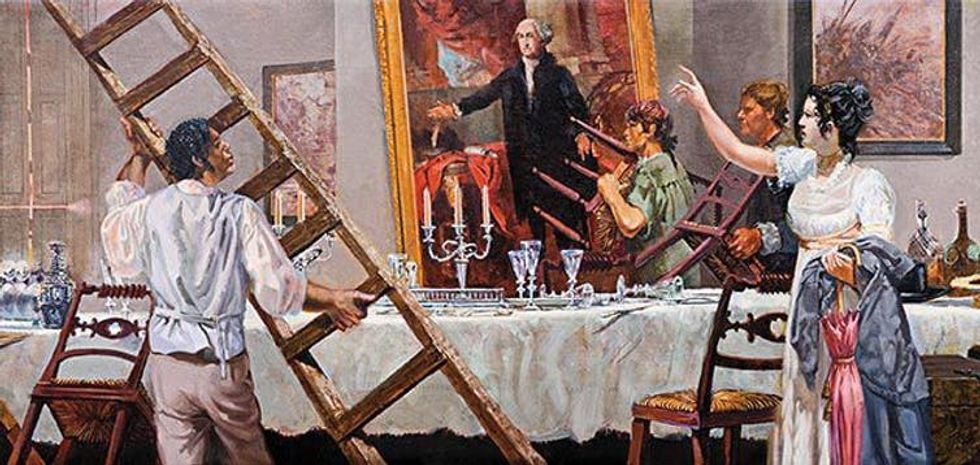
A painting of First Lady Dolley Madison directing the rescue of George Washington portrait as British forces attacked the U.S. capital.
The destruction of Washington provided little tactical advantage to the British, beyond scattering an already divided and bickering group of American politicians. Most officials, including Dolley’s hapless husband James Madison, ran away from the city in a panic as British troops marched toward them.
The pitiful image of bewigged American politicians scrambling away from the city with their coattails flapping is accentuated by the fact that when the British officers and their men arrived at the White House, they found the dining room table set for dinner. The food was prepared and excellent wine waited to be poured. The Americans had apparently been expecting to celebrate a victory that night, but it was instead consumed by their enemies.
However, because the British commanders then ordered the destruction of the White House — a place that, as historian Nicole Eustace reminds us, was not simply a political building but a domestic space — they made it easy for furious Americans to paint the British as disgraceful barbarians.
Within only a few months of the burning of Washington, the Treaty of Ghent was signed on Dec. 24, 1814. The war ended the following February when both governments ratified the treaty.
In the aftermath, Americans did a spectacular job turning a 32-month mess of a war they barely managed to survive (and did not win) into a triumphant victory of manly American prowess.
A war with no winner
While the Americans didn’t win the War of 1812, I’ve never been overly keen to declare Britain/Canada the victor. However, the case can be made: none of the original war aims declared by the Americans were achieved. Canada lost no territory and the treaty ending the war declared everything would be status quo ante bellum. Canada had been effectively defended from the invaders.
When it was all over, the War of 1812 gave Canada and the United States their shared border. The war defined it and marked it on the map in a way that had been fairly easy to ignore before.
It turned former friends and neighbours into enemies. It made Canadian settlers deeply suspicious of American motives on the continent (and it didn’t quell American desire to possess Canadian territory, either).
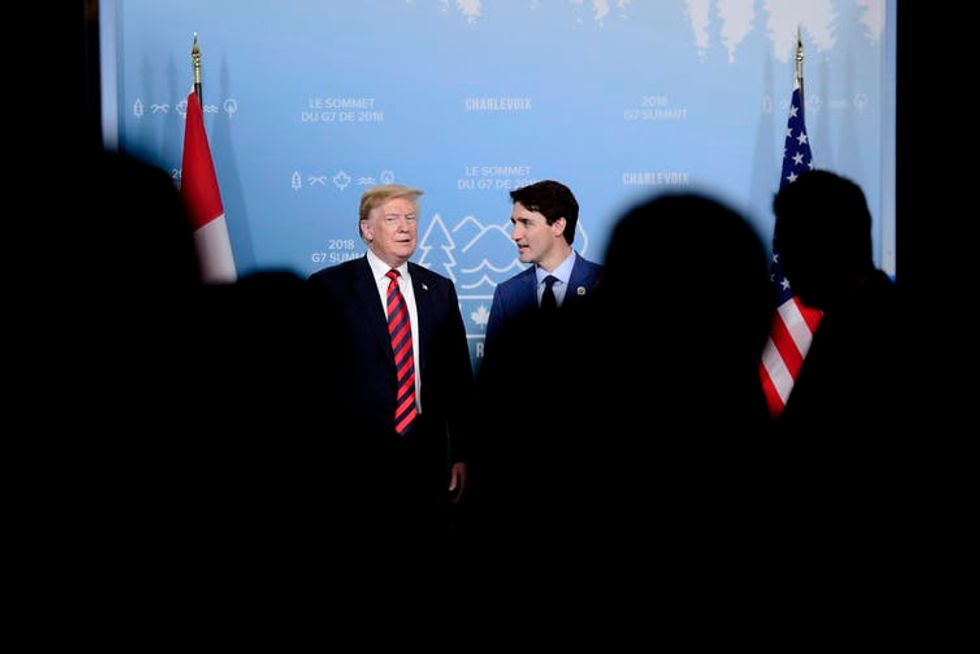
U.S. President Donald Trump and Canadian Prime Minister Justin Trudeau at the G7 Leaders Summit in La Malbaie, Que., on, June 8, 2018. Their discussion about the sacking of the White House in 1814 took part two weeks before the G7 meeting.
THE CANADIAN PRESS/Sean Kilpatrick
After all — a point Trump either didn’t know or blithely ignored — the Americans started the war: they invaded first and, regardless of how morally dubious this kind of international tit-for-tat actually is, they invited retaliation.
While Trump got a few of the facts wrong, he’s not the only one. If there’s one thing this entire, silly episode confirms for me, it’s that our history — our collective, complicated, terrible and rarely triumphant history — needs to trend more often, but with far more thoughtfulness and — dare I suggest it? — reading.
Oscar-winning actor Robert de Niro issued an expletive-laden denunciation of U.S. President Donald Trump during the live television broadcast of the Tony Awards ceremony on Sunday.
De Niro appeared on stage at New York’s Radio City Music Hall to introduce rocker and Tony Awards performer Bruce Springsteen.
“I’m gonna say one thing. Fuck Trump,” De Niro said, without any preamble.
With the audience of theater actors, directors and producers shrieking and rising to their feet in applause, De Niro said: “It’s no longer down with Trump. It’s fuck Trump.”
He did not elaborate on his comment and switched immediately to a prepared introduction of Springsteen.
The expletive, known as the F-bomb, was bleeped by the CBS network for millions of television watchers at home, a CBS spokeswoman said. However, it was heard by those in the audience and journalists covering the awards show, which honors the best of Broadway theater.
De Niro is one of the most respected actors in the United States with two Oscar wins for “Raging Bull” and “The Godfather: Part II.”
The White House did not immediately return a request for comment. CBS also did not return a request for further comment.
De Niro, a noted liberal, has been increasingly critical of Trump, a Republican, at smaller showbusiness events, but none have the high profile and audience of the Tony Awards.
The Tony Awards show was seen by some six million Americans last year.
Reporting by Chris Michaud and Jill Serjeant; Editing by Paul Tait
When the World Cup kicks off in Russia on Thursday Ukrainian film director Oleg Sentsov, who is serving a 20-year prison sentence in Russia, will have spent a month without food.
Sentsov says he is ready to die and the worst effects of his high-profile hunger strike are expected to kick in just as the month-long football extravaganza gets into high gear.
He is demanding Moscow release dozens of Ukrainian political prisoners and timed his protest to exert maximum pressure during Russia's chance to shine on the world stage.
President Vladimir Putin has recently hinted that backdoor talks to exchange prisoners with Kiev were apparently under way, raising hopes for the release of the 41-year-old filmmaker and others languishing in Russian jails.
But details remain scarce and it is still anyone's guess whether Ukraine and Russia will agree on a swap -- and even if they do, whether it will be in time to save Sentsov's life.
"It would be really bad for Putin if these negative things that could become top world news happened during the tournament," said Andrei Kolesnikov of the Carnegie Moscow Center.
Sentsov has carefully prepared for the protest, which he began on May 14, reducing his food intake over several weeks in the high-security prison in Russia's far north.
"I will not back down," he said in a letter published on Saturday.
- True grit -
Doctors have warned him that his kidneys may soon fail as the irreversible consequences of the hunger strike begin.
Sentsov -- who has agreed to be administered a glucose drip -- has already lost around eight kilogrammes (17 pounds).
However doctors have also threatened to start force-feeding him through a stomach tube, a procedure many activists describe as a form of torture.
The director is best known for his film "Gamer", which screened to critical acclaim at the Rotterdam Film Festival in 2012.
A vocal Kremlin critic, Sentsov was detained in Crimea in 2014 after Russia annexed the peninsula from Ukraine.
Sputnik/AFP/File / Alexei DruzhininRussian President Vladimir Putin has recently hinted that backdoor talks to exchange prisoners with Kiev were apparently under way
Supporters say Russia wanted to make an example of him with the stiff sentence on charges of masterminding arson attacks, which the filmmaker denies.
His cousin Natalya Kaplan has urged the West to intervene to save the father of two children, one of whom suffers from autism.
She said Sentsov has struggled with health problems since childhood but has always been a man of true grit.
Supporters have launched a global campaign to secure his release, staging protests in dozens of cities in Europe, the United States and the Middle East.
Several activists fasted in solidarity with him but quickly stopped, admitting they were not strong enough.
In a letter to Putin ahead of the World Cup, dozens of prominent authors including Margaret Atwood and Ian McEwan called for his release "in the spirit of this unifying global event".
But many are sceptical that the Kremlin was ready to release all Ukrainian political prisoners, with one supporter suggesting Sentsov could be just flown out of Russia.
"Such scenario is possible," Russian documentary director Askold Kurov told Ukrainian TV.
- 'Worst rights crisis' -
But whether or not the filmmaker is released, a crackdown on dissenters continues unabated, critics say.
Campaigners have called on FIFA to use its leverage with the Kremlin to address Russia's rights abuses.
With global attention on Russia, Moscow "must decide what they want the legacy of this World Cup to be," said Amnesty International.
Human Rights Watch added: "The FIFA World Cup starting on June 14, 2018, will take place during the worst human rights crisis in Russia since the Soviet era."
In a sign that world football's governing body sought to address at least some of these concerns, FIFA criticised the detention of Oyub Titiyev, head of rights group Memorial's Chechnya office, on drug possession charges.
However last month a court extended Titiyev's detention.
Some have called for a boycott of the World Cup, such as Ukrainian artist Andriy Yermolenko.
To draw Western attention to Moscow's role in the four-year conflict in eastern Ukraine, Yermolenko made a series of graphic drawings that have become popular on Facebook.
One depicts a man playing football in a cemetery; another shows Zabivaka the wolf, the World Cup mascot, about to kick a human skull, clutching a human hand in his teeth.
"They are killing my country but many cannot understand this," Yermolenko told AFP.
"At the same time there is this celebration of football and we are being told that sport is outside politics. These things make me hurt."
“Harry Potter and the Cursed Child” won the Tony for best play on Sunday while “The Band’s Visit” swept the musical categories with 10 wins, including the top award best musical at Broadway’s annual honors for the best in theater.
Glenda Jackson and Andrew Garfield took home acting prizes and rocker Bruce Springsteen received a special Tony, while a revival of the AIDS drama “Angels in America” was named best play revival and “Once On This Island” won best musical revival.
But the biggest surprise of the night came when Robert De Niro, appearing on stage to introduce Springsteen, used the “F-bomb” against U.S. President Donald Trump.
De Niro’s comments brought the cheering crowd at Radio City Music Hall to its feet but were bleeped for U.S. television audiences.
“The Band’s Visit,” about Egyptian musicians stranded in a small Israeli town, also won acting awards for stars Tony Shaloub, Katrina Lenk and Ari’el Stachel, as well as best book, score, director, orchestration, sound design and lighting.
It lost just one category among its 11 nominations, with its 10 wins just two shy of the record for any show set by “The Producers.”
“I avoided so many events with them (his parents) in the past because I pretended that I was not Middle Eastern,” said Stachel, whose father is of Yemeni and Israeli heritage.
He also praised “a cast of actors who never believed they would be able to portray their own races.”
“Harry Potter,” a record-setting $69 million two-part production set 19 years after the last of J.K. Rowling’s best-selling novels about the boy wizard, won a total of six Tonys including best new play and best director.
Garfield won best actor in a play for his acclaimed performance in “Angels in America,” which also won Nathan Lane his third Tony, as closeted conservative lawyer Roy Cohn, who died of AIDS.
Praising playwright Tony Kushner, an emotional Lane said, “Tony wrote one of the greatest plays of the 20th century, and it is still speaking to us as powerfully as ever in the midst of such political insanity.”
Kushner, noting it was 21 weeks until the mid-term congressional elections in the United States, continued the political vein adding, “21 weeks to save our democracy.”
Jackson, 82, returning to Broadway after 30 years and a lengthy term as a British politician, was named best actress for her tour-de-force performance in Edward Albee’s “Three Tall Women.”
Laurie Metcalf won her second Tony, playing a younger version of Jackson’s imperious character in “Three Tall Women.”
Veteran actress Chita Rivera and British musical impresario Andrew Lloyd Webber received lifetime achievement awards, while actor, writer and comedian John Leguizamo was given a special Tony for his one-man show, “Latin History for Morons.”
The Tonys, hosted by singer-songriter-actors Josh Groban and Sara Bareilles, capped another record year on Broadway with $1.7 billion in box office receipts, despite the smallest number of new productions in 20 years.
Reporting by Chris Michaud; Editing by Jill Serjeant and Darren Schuettler
An Ernst & Young survey shows Paris has overtaken London as Europe’s most attractive destination for foreign investors for the first time since EY began such reports 15 years ago.
The change in the continent’s pecking order is a sign of the impact of both Brexit and the “Macron effect”.
The French capital was ranked No. 1 for foreign direct investment by 37 percent of businesses, based on a survey of 502 companies and data from EY and IBM covering 2017.
Britain as a whole remained Europe’s top destination for foreign direct investment in 2017, with 1,205 of the 6,653 new FDI projects in Europe, ahead of Germany’s 1,124 projects and France’s 1,019 projects.
But France’s number was up 31 percent in one year, while the number of investment into Britain was 6 percent higher than in 2016, showing a slowdown in growth.
This was the first time Paris has outdone London since the annual survey started in 2003. Berlin came third and Frankfurt fourth. “The UK is feeling the effect of Brexit,” the report said.
“Investment slowed after the 2008 financial crisis, but France is now in catch-up mode, and a beneficiary of Brexit,” it added, citing President Emmanuel Macron’s reforms to make the labor market more flexible.
For full study, click on: here$FILE/EY-Attractiveness-Survey-Europe-June-2018-Game-changers.pdf
Reporting by Michel Rose; Editing by Angus MacSwan
The largest U.S. actors’ union and the four major television networks on Saturday agreed to limit auditions in private hotel rooms and homes, ratifying a guideline the screen actors’ guild had enacted on its own following the #MeToo uproar, the union said.
SAG-AFTRA, which represents 160,000 actors, and management from ABC, CBS, NBC and Fox reached a tentative agreement on a three-year contract that also includes an array of pay increases, the guild said in a statement. The deal is subject to approval by the guild’s board of directors next month.
The networks and union agreed to language similar to that from the union’s own Guideline No. 1, issued in April, which called for an end to auditions, interviews and similar professional meetings in private hotel rooms or at private residences.
SAG-AFTRA President Gabrielle Carteris said at the time the goal was to eliminate the potential for “predators to exploit performers behind closed doors under the guise of a professional meeting.”
The so-called casting couch has long been used by men seeking sexual favors from actresses in exchange for parts.
The measures followed the industry outrage that resulted from news reports that numerous women accused Hollywood producer Harvey Weinstein of sexual misconduct. Weinstein denied the allegations.
The Weinstein reports led to a wave of accusations against high-profile men in politics, the media and show business, transforming the U.S. conversation about sexual harassment and assault.
Women told stories about how they had been harassed using the #MeToo hashtag on social media.
The scrutiny of Weinstein led to criminal charges against the producer last month. On June 5, Weinstein pleaded not guilty in Manhattan Supreme Court to charges of rape and sexual assault based on allegations from 2004 and 2013.
Reporting by Daniel Trotta; Editing by Nick Zieminski
Mexican Economy Minister Ildefonso Guajardo said on Monday the only way countries re-negotiating the North American Free Trade Agreement (NAFTA) will find a solution is through “sufficient flexibility” to narrow differences.
Guajardo said U.S., Mexican and Canadian negotiators will be “engaging strongly” in July to reach an agreement that is “feasible, workable and benefits the three nations involved.
“The only way we will find that solution is if countries involved have sufficient flexibility to be able to find that narrow strip where we have to land,” he said.
“An agreement that does not give us certainty, does not give us rules that have to be obeyed and mechanisms to settle disputes will not be of help for the business community.”
He said there was a “high chance” there will be an agreement on renegotiating NAFTA, but the timing depends on how flexible each country can be.
The United States, Canada and Mexico have been in months of negotiations to rework NAFTA, which President Donald Trump says harms his country.
White House economic advisor Larry Kudlow has said Trump will seek to replace NAFTA with bilateral deals with Canada and Mexico, something both countries say they oppose.
U.S. trading partners have been furious over Trump’s decision to impose tariffs on steel and aluminum imports from Canada, the European Union and Mexico as part of his “America First” agenda.
Fears of a global trade war come as Trump’s decision to back out of the G7 joint communique torpedoed what appeared to be a fragile consensus on a trade dispute between Washington and its top allies.
Guajardo said public discontent over globalization and open trade was evident even before Trump took office, saying that the current U.S. administration’s position showed the system did indeed need fixing.
“We need to reconstruct our trade policies in order to strengthen them and make them more resilient in new times, where the population has been very clear in expressing their feelings through electoral processes,” Guajardo said.
Reporting by Leika Kihara; Editing by Chang-Ran Kim and Sam Holmes




 It is vitally important that Trump does not shut out his interpreters. Interpreters are much more than conduits for conversations between other individuals, and they are crucial for keeping Trump out of diplomatic trouble. But since the president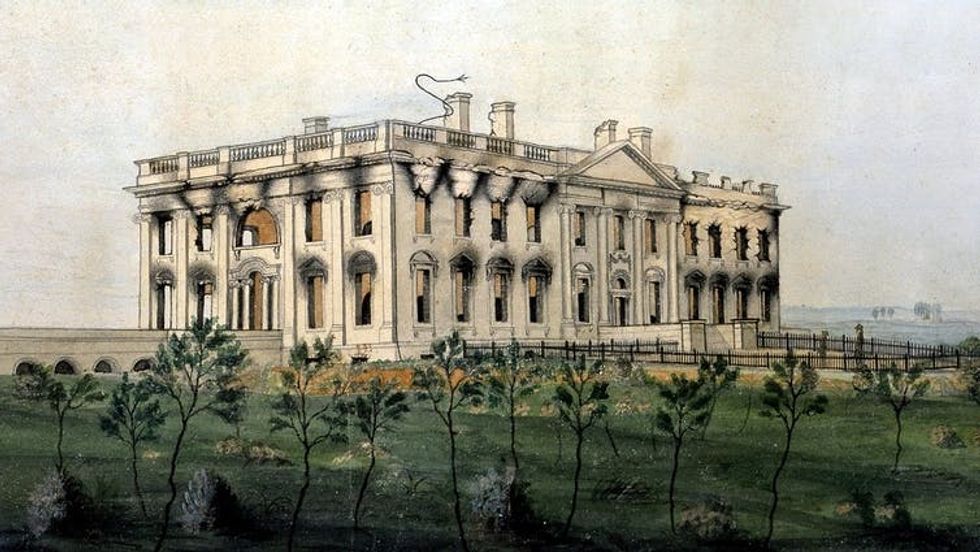

 While Trump got a few of the facts wrong, he’s not the only one. If there’s one thing this entire, silly episode confirms for me, it’s that our history — our collective, complicated, terrible and rarely triumphant history — needs to trend more often, but with far more thoughtfulness and — dare I suggest it? — reading.
 Sputnik/AFP/File / Alexei Druzhinin