President Donald Trump on Friday night urged his 67 million Twitter followers to pay for a monthly subscription to watch Facebook video from a far-right Fox News competitor.
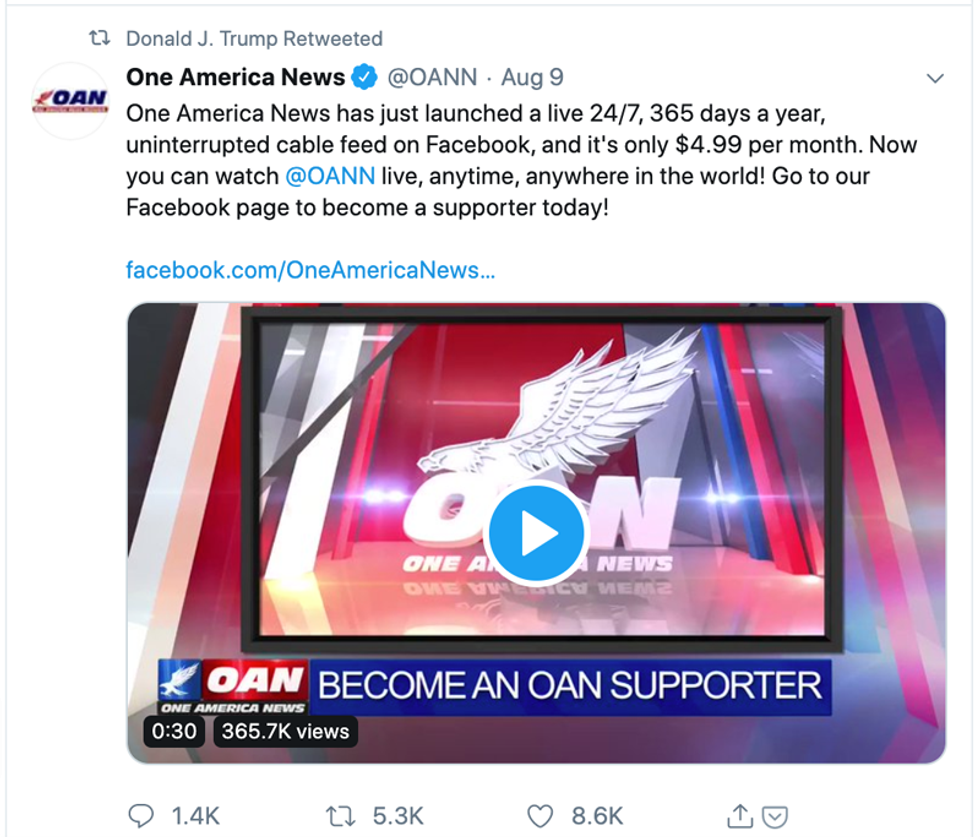
Shortly after 10 p.m. eastern, the commander-in-chief retweeted a solicitation from the One America News network.
[caption id="attachment_1569174" align="aligncenter" width="800"] Screengrab of President Donald Trump's retweet of a One America News solicitation.[/caption]
The network's ad contained urged people to sign up for a $4.99 per month Facebook subscription to One America News.
One America News sent the tweet on August 9th -- almost four months before Trump retweeted their appeal.
This is the same network that accompanied Rudy Giuliani to Ukraine this week as part of his pushing of conspiracy theories that originated from Russian military intelligence.
From its start half a century ago, National Public Radio heralded a new approach to the sound of radio in the United States.
NPR “would speak with many voices and many dialects,” according to “Purposes,” its founding document.
Written in 1970, this blueprint rang with emotional immediacy. NPR would go on the air for the first time a year later, on April 20, 1971.
NPR is sometimes mocked, perhaps most memorably in a 1998 “Saturday Night Live” sketch starring actor Alec Baldwin, for its staid sound production and its hosts’ carefully modulated vocal quality. But the nonprofit network’s commitment to including “many voices” hatched a small sonic revolution on the airwaves.
‘Saturday Night Live’‘s Schweddy Balls sketch spoofed NPR.
This is NPR
One of the first voices to become associated with NPR’s flagship evening news program was Susan Stamberg. Hired in 1971, she soon became the first woman to co-anchor a national nightly newscast on radio or television in U.S. history.
William Siemering, the network’s first program director and the author of “Purposes,” wanted the voice of the network to communicate curiosity rather than authority.
Stamberg, 31 when she was hired, brought youthful exuberance to the job. And, in another departure from newscasting’s baritones, with their supposedly neutral midwestern accents, Stamberg’s voice was “nasal, quizzical, and unashamedly female,” as Lisa Phillips put it. It came she said, “with a hometown – New York – and an ethnicity – Jewish.”
The decision to stick with young and relatively unproven voices came at a cost, according to Jack Mitchell, the original director of the “All Things Considered” evening newscast.
In his account of NPR’s beginnings, “Listener Supported,” Mitchell later recalled how Siemering passed up Ford Foundation funding tied to hiring the proven and respected newscaster Edward P. Morgan, a white man originally from Walla Walla, Washington. Instead, NPR stood by the less “authoritative” and more engaging voices of Stamberg and her peers, even if they sometimes sounded “less than professional.”
“Masculine, commanding” voices were “exactly how we DON’T want to sound,” Siemering told his staff, as Stamberg later recalled in “This Is NPR: The First Forty Years.”
Early feedback on Stamberg from station managers around the country wasn’t encouraging. She sounded too New York, too Jewish, too off-putting, Mitchell wrote.
Siemering hid these negative reviews from Stamberg as she found her own broadcast voice, which helped her win many prestigious awards in broadcast and digital journalism. The network regards her as one of its “founding mothers.”
Women as anchors
NPR has kept speaking with many voices that would sound out of place on the air anywhere else. Many, if not most, have been female. As hosts and anchors, correspondents and reporters, women have played a key role in giving NPR its distinctive sound.
Nina Totenberg, Linda Wertheimer and Cokie Roberts brought hard-nosed journalism and inside-the-Beltway sensibility to the fledgling network in the 1970s. In the process, these white women changed what the news sounded like.
By the time Wertheimer took over as an “All Things Considered” co-anchor in 1989, it was no longer controversial to hear women deliver the news of the day.
But on network television, most of the early stints for the women who were the first to anchor daily news programs were short-lived. Barbara Walters lasted two years in the mid-1970s as an “ABC Evening News” co-anchor. Diane Sawyer co-anchored the “CBS Morning News,” from 1981 to 1984 and Katie Couric spent five years, starting in 2006, as the sole “CBS Evening News” anchor.
Curating distinctive voices “rich with the rhythms and accents of their regions” was another explicit way in which “All Things Considered” initially sought to sonically mark its difference from what had come before, according to Stamberg.
A wider range?
NPR’s commitment to many voices included those who brought regional, as well as gender, diversity to the airwaves.
Occasional commentators Baxter Black, a cowboy poet from Texas; Vertamae Grosvenor, a culinary anthropologist born in the Gullah community of North Carolina; and Kim Williams, a naturalist, checked in during the late 1970s and early 1980s, with field reports from their corners of the country. Andrei Codrescu, a Romanian-American artist living in New Orleans, began to bring his thickly accented English and droll humor to NPR in 1983.
Putting these folks on air seemed to address the network’s vision of speaking in many voices and accents. The intent, Mitchell wrote, was explicitly democratic, to be “representative of the nation. That meant white, black, Hispanic, Asian and as many women as men.”
NPR’s growth led to the opening of foreign bureaus, even as print publications hemorrhaged these expensive positions. International coverage further expanded its vocal range.
Some of the women now working as the network’s anchors got their start as foreign correspondents. Doualy Xaykaothao spent years reporting from Asia and Lulu Garcia-Navarro covered Latin America and the Middle East for NPR.
Other women with nonconventional news voices, including Eleanor Beardsley in Paris, Sylvia Poggioli in Rome and Ofeabia Quist-Arcton in Dakar, are still overseas. Their signature approach to signing off with their name and locale is a sonic pleasure for many NPR fans.
Critics denounced a sense that the voices of NPR’s female journalists sounded “alike in their sober nasal condescension,” as the writer and actor Sarah Vowell put it – hinting at a class-related critique, along with a gendered one.
NPR’s women, some of these naysayers contend, have low-pitched voices that sound too much like men and that NPR voices in general sound more like each other than everyone else. Writer Scott Sherman calls it the “NPR drone.”
Even Stamberg said in a 2010 interview that one price of NPR’s success was that listeners weren’t “hearing great voices anymore.”
Another round of criticism, this one aimed primarily at young women, identified “vocal fry,” a low creaky way of speaking, as an irritating feature of public radio voices. The critique, which came mostly from men and older folks, suggested that despite what the critics were saying, NPR’s sound was not static but evolving.
NPR’s sonic palette and its range of voices has broadened in recent years, especially through its podcasts and on weekends – when Navarro, who is Latina, and Michel Martin, an African American woman, are two of the network’s main three news anchors.
Sam Sanders, an openly gay African American man, hosts a cultural talk show branded with his own name. Programs like “Alt.Latino” and “Radio Ambulante,” which are either in Spanish or in English punctuated with Spanish words, indicate that the network aims to serve new listeners.
As NPR looks forward to the next 50 years, its decisions over whose voices belong on the air will determine how well it lives up to its founding commitment to sound like America. And it is likely that criticism of how those voices sound will reflect dominant attitudes about who gets to speak.
Some people listen to far-right conspiracy theorist/radio host and Infowars founder Alex Jones purely for the entertainment value; many of Jones’ hardcore followers, however, take him quite seriously. Former employee Josh Owens used to be one of them. But in a tell-all article for the New York Times, the Texas-based writer explains why he changed his mind and quit what he once considered a dream job.
Owens recalls that he first went to work for Jones in 2012. The writer explains, “Jones — wanting to expand his website, Infowars, into a full-blown guerrilla news operation and hoping to scout new hires from his growing fan base — held an online contest. At 23, I was vulnerable, angry and searching for direction. So, I decided to give it a shot. Out of what Infowars said were hundreds of submissions, my video — a half-witted, conspiratorial glance at the creation and function of the Federal Reserve — made it to the final round.”
Jones, according to Owens, was “unconvinced” that he could “cut it as a reporter” but gave him a full-time position as a video editor. The writer remembers, “I quit film school and moved nearly 1000 miles to Austin, Texas, fully invested in propagating his world view.”
Owens had been listening to Jones’ radio show long before 2012: Jones, Owens notes, first grabbed his attention during “the last days of George W. Bush’s presidency.” The writer explains that around 2008, he was drawn to Jones because “the American public had been sold a war through outright fabrications. The economy was in free fall thanks to Wall Street greed and the failure of Washington regulators. Most of the mainstream media was caught flat-footed by these developments, but Jones seemed to have an explanation for everything. He railed against government corruption and secrecy, the militarization of police. He confronted those in power.”
When Owens first went to work for Jones, he was delighted to be working for him and “believed that the world was strategically run by a shadowy, organized cabal, and that Jones was a hero for exposing it.” But over time, Owens recalls, he became seriously disenchanted with Jones and came to view him as an extremist.
“Jones often told his employees that working for him would leave a black mark on our records,” Owens remembers. “To him, it was the price that must be paid for boldly confronting those in power — what he called the New World Order or later, the Deep State. Once my beliefs began to shift, I saw the virulent nature of his world, the emptiness and loathing in many of those impassioned claims.”
Owens also grew tired of Jones’ angry outbursts.
“Working for Jones was a balancing act,” Owens explains. “You had to determine where he was emotionally and match his tone quickly. If he was angry, then you had better get angry. If he was joking around, then you could relax, sort of, always looking out of the corner of your eye for his mood to turn at any moment.”
One passage recounts:
Over time, I came to learn that keeping Jones from getting angry was a big part of the job, though it was impossible to predict his outbursts. Stories abounded among my co-workers: The blinds stuck, so he ripped them off the wall. A water cooler had mold in it, so he grabbed a large knife, stabbed the plastic base wildly and smashed it on the ground. Headlines weren’t strong enough; the news wasn’t being covered the way he wanted; reporters didn’t know how to dress properly. Once a co-worker stopped by the office with a pet fish he was taking home to his niece. It swam in circles in a small, transparent bag. When Jones saw the bag balanced upright on a desk in the conference room, he emptied it into a garbage can. On one occasion, he threatened to send out a memo banning laughter in the office. “We’re in a war,” he said, and he wanted people to act accordingly.
He also tells a story suggesting that working for Jones could be downright dangerous:
I remember one trip in particular. It was the summer of 2014, and I rode to the ranch in the back of a co-worker’s truck, surrounded by semiautomatic rifles, boxes of ammunition and Tannerite, an explosive rifle target. A few of us left early in the morning, arriving before Jones to film B-roll and load magazines; he had no patience for preparation. When he came hours later, after eating a few handfuls of jalapeño chips, he picked up an AR-15 and accidentally fired it in my direction.
The bullet hit the ground about 10 feet away from me. One employee, who was already uncomfortable around firearms, lost it, accusing Jones of being careless and flippant. This was one of the few times I saw someone call Jones out and the only time he didn’t get angry in response. He claimed he had intentionally fired the gun as a joke — as if this were any better.
April 7, 2017, was a turning point in Owens’ life: that day, he quit working for Jones — and he ended up taking another job at much lower pay.
Jones, Owens remembers, “offered to double my pay, suggested I work remotely and even proposed funding a feature-length film of my own. I said it wasn’t about money and turned him down. To this day, I still don’t know why he wanted to keep me around. He said it was because he cared about me, but if I had to guess, I would say his main concern was losing control.”
“I should say for the record that I’m totally opposed to these sanctions and I don’t think we should be at war with Russia and I think we should probably take the side of Russia if we have to choose between Russia and Ukraine,” said Carlson.
Rudy Giuliani lashed out at Fox News host Steve Hilton on Monday, after the media personality called on President Donald Trump to dump his personal lawyer over the Ukraine scandal.
“It turns out that the former mayor’s own personal business interests are wrapped up in all this,” Hilton said on Sunday night. “To put it simply, he’s been trying to enrich himself on the back of his relationship with President Trump.”
“It’s time to dump these toxic chumps,” the Fox News host added.
"Fox & Friends" is working extremely hard to ensure as few Americans as possible watch this week's House Judiciary Committee impeachment hearings, perhaps because they are designed to inform the American public about why impeaching this president is important.
Several times Monday morning the "Fox & Friends" co-hosts and contributors told viewers Wednesday's impeachment hearing will be boring, while falsely claiming Americans are not interested in impeachment, and would rather be Christmas shopping.
"It's going to be like a lecture," co-host Brian Kilmeade tells viewers, noting the witnesses will be lawyers and historians. "If you were bored by the last one, you're gonna be really bored by this one."
Later, Fox News Business' Stuart Varney is added to the couch, once again talking about how "boring" the impeachment hearings will be.
"I just want to point out the contrast here. You've got a booming Trump economy, terrific holiday sales, and what've we got in Washington DC? These boring hearings about impeachment, increasingly irrelevant and ignored by people who are getting on with their lives," Varney says. "I mean, don't you find this ridiculous?"
The articles of impeachment against President Donald Trump will likely include charges of bribery, self-dealing, abuse of power, and obstruction – Fox News calls this "boring."
CNN on Sunday aired a photo of Elizabeth Warren beside a photo of Karl Marx. But host Fareed Zakaria later pointed out that Warren "is not really a socialist."
During Zakaria's Sunday CNN program, he teased an upcoming segment about Warren's wealth tax by showing a photo of her next to a photo of Karl Marx, the communist founder of Marxism.
A few complaints surfaced online, but Zakaria quickly pointed out that the comparison was absurd.
Before ending the segment, the CNN host asked billionaire David Rubenstein if he would object to Warren's proposed tax on the richest Americans.
Rubenstein did not object: "Whatever the laws are, I'm going to comply with."
Following a commercial break, Zakaria explained that Warren is, in fact, "not a socialist."
"Little has terrified the titans of Wall Street more in recent years than the prospect of an Elizabeth Warren presidency," he said. "They say she vilifies the rich and they know she plans to levy taxes on their wealth."
"For all the fears about her - and some are legitimate -- Warren is not really a socialist, not in the sense the word is usually used," he added.
In a fairly contentious interview on NBC's "Meet the Press," host Chuck Todd accused Sen. John Kennedy (R-LA) of being "duped" by the Russians and spreading their propaganda about Ukraine in order to help Donald Trump.
According to Kennedy, who has been under fire for pushing the Ukraine 2016 election conspiracy theory, "I think both Russia and Ukraine meddled in the 2016 election. I think it’s been well documented in the Financial Times and Politico and The Economist and the Washington Examiner, even on CBS that the prime minister of Ukraine, the interior minister, the Ukrainian Ambassador to the United States, the head of the Ukrainian anti-corruption league all meddled in the election on social media and otherwise. They worked with the DNC operative against the president.”
Todd pushed back by citing testimony from diplomat Fiona Hill stating, "This entire effort to frame Ukraine for the Russian meddling of 2016, of which you just made this case that they’ve done it, that actually this is an effort of Russia propaganda, that this is a Russian intelligence propaganda campaign in order to get people like you to say these things about Ukraine. Are you at all concerned you are doing Russian intelligence work here?”
With Kennedy offering Hill “is entitled to her opinion,” Todd pressed him again.
“When does opinion become fact?” Todd shot back. “Does 17 intelligence services saying it, does every western intelligence ally saying Russia did this? I’m just sort of confused. At what point is it no longer an opinion for you?”
"You should read the articles, Chuck. They’re very well documented,” Kennedy replied, leading the NBC host to fire back, “You’ve done exactly what the Russian operation is trying to get American politicians to do. Are you at all concerned that you have been duped?”
Dr. Jennifer Gunter, a prominent gynecologist and feminist known for writing about women’s health, has been a vehement critic of Hollywood star Gwyneth Paltrow’s lifestyle brand Goop — and her frequent attacks on Goop have enhanced her online presence. But journalist Emily Shugerman, in an article for the Daily Beast this week, reports that going after Goop has resulted in some fellow feminists, fellow doctors and science writers going after her.
Gunter, Shugerman explains, has “parlayed her skepticism into a highly successful personal brand, amassing more than 267,000 Twitter followers, a TV show and a New York Times column. Fans are drawn to her no-nonsense attitude and quick wit, which she uses to condemn everything from abortion bans to natural tampons.”
Shugerman adds, however, that Gunter now finds herself under attack from critics.
“In recent weeks,” Shugerman reports, “Gunter has taken flak from her fellow physicians and feminists. On Twitter and Facebook — and in the respected journal Scientific American — peers criticized her for ‘bullying’ women and ‘gaslighting’ survivors of sexual abuse. Critics wanted to know why she was so skeptical of alternative medicine and so dismissive of the women who used it. The anti-anti-Goop backlash had begun.”
Shugerman notes that Gunter has been butting heads with the feminist nonprofit Our Bodies, Ourselves, which produced the 1970 book of the same name: Gunter, in interviews promoting her book, “The Vagina Bible,” asserted that Our Bodies, Ourselves had promoted some misinformation on women’s health. Gunter told WBUR, “We (now) know a lot more about the clitoris, and other structures, and about sexually transmitted infections than we did then — and I thought women needed a physician to write a book for them.”
Judy Norsigian, who co-founded Our Bodies Ourselves, told The Daily Beast that she has received an abundance of messages from supporters who took exception to Gunter’s comments — and Norsigian, along with Our Bodies, Ourselves’ Kiki Zeldes, wrote an open letter to Gunter stressing the 1970s book’s credentials.
But Gunter told the Daily Beast that her intention was never to slam or condemn the 49-year-old book but rather, to offer some constructive criticism and show “how there can be misinformation along with good information.”
One of Gunter’s biggest criticisms of Goop has had to do with vaginal eggs. And Shugerman notes that Dr. Jennifer Lang, a California-based OB-GYN, defended the jade egg in an open letter to Gunter in September.
Lang wrote, “I’m a GYN, and when I can remember to do my jade egg practice for more than a few nights in a row, I begin orgasming in my sleep.” And Lang criticized Gunter for showing a “lack of humility,” especially when it comes to alternative medicine.
Jennifer Block, a science writer, wrote an op-ed for Scientific American that was headlined “Doctors Are Not Gods” and was highly critical of Gunter. The op-ed, Shugerman explains, “provided the longest and most in-depth critique of Gunter’s work, drawing on the history of groups like Our Bodies, Ourselves to explain how women taking control of their own health — and occasionally rebuffing their doctors — can be a feminist act.”
Gunter and others have criticized Goop for promoting vaginal steaming, but Block defended the practice — asserting, “There are, anecdotally, many women healing from sexual violence and cancer treatments, who find that steaming helped them regain sensation. Are you really going to argue with them? Isn’t that called gaslighting?”
Debates over Gunter’s work and her criticisms of Goop, Shugerman writes, underscore a larger debate within feminism itself.
“It would be easy to chalk up the criticism of Gunter to a fight between female physicians or even the inevitable milkshake-ducking of any internet celebrity,” Shugerman writes. “But the controversy over Gunter’s work illustrates a larger debate in modern feminism: one about exactly what role the medical system should have in women’s health.”
Fox News host Sean Hannity urged his disgraced former colleague Bill O’Reilly to return to the network he was fired from following multiple allegations of sexual harassment.Hannity interviewed O’Reilly on his radio show to promote his former colleague’s recent interview with President Donald Trump on the former host’s web platform.
This article first appeared in Salon.
O’Reilly told Hannity that he had attempted to make the interview “a little personal.”
“I said you know, you — you're taking more attack and vitriol than any other president, with the exception of Abraham Lincoln,” O’Reilly said. “And I said, ‘I've seen you show emotion to me when I had never seen that before in 30 years.’ His answer to that is really interesting, because I do believe it's taken its toll on President Trump. But if you read ‘The United States of Trump,’ this statement that I wrote in that book remains true: I have never seen a human being able to absorb more punishment than Donald Trump.”
“So true — it's unbelievable,” Hannity agreed.
“You and I, we can identify, because we've been attacked for more than 20 years,” O’Reilly added. “Each of us has.”
“By the way, I keep offering you — go back on Fox,” Hannity said.
“Why do I want to do that?” O’Reilly asked. “So I can have security guards go with me everywhere like I used to?”
“No, so that you take the No. 1 slot,” Hannity pressed. “We'll end the year again No. 1 in all of cable, and with that comes all the crap associated with it.”
“Your listeners should understand there is a price to pay for being a traditional conservative American in this country,” O’Reilly said.
The price O’Reilly could have been referring to was the millions of dollars to settle multiple sexual harassment lawsuits, which ultimately ended his tenure at the network.
O’Reilly was fired amid an advertiser boycott after The New York Times reported that Fox News had paid millions to former female colleagues to settle complaints against him. The Times later reported that O’Reilly had personally spent $45 million to settle harassment at least six claims against him.
Former Fox News host Gretchen Carlson, who left the network after accusing former chief executive Roger Ailes of sexual harassment, called Hannity’s comments “so f’ed up.”
“Every woman and man on this planet should stand up and say WTF is wrong with these people,” she wrote in a statement.
Carlson issued a joint statement with former Fox News contributor Julie Roginsky, who also sued the network after alleging Ailes harassed her, and former Fox reporter Diana Falzone, who accused the network of gender discrimination, slamming Hannity’s comments.
“It is ironic that a man accused of sexual harassment over the course of many years by many different women is being courted to return to Fox News by its most prominent on-air personality, while his victims and other survivors of sexual harassment at that same network continue to be bound by onerous confidentiality provisions that prevent them from disclosing what those harassers said or did to them,” the statement said.
“It is also ironic that many women are bound by no-rehire provisions, which prevent them from getting their jobs back, even as Mr. Hannity is all but begging his network to rehire an accused sexual predator,” they said. “This exchange once again demonstrates how far we have yet to go in ensuring that survivors of sexual assault and harassment are treated with even a modicum of respect and deference that Sean Hannity has shown an alleged sexual predator. We call — again — for Fox News to release all women from their non-disclosure agreements, so that the public can have a much clearer understanding of why Mr. Hannity’s words are so egregious in this respect.”
CNN host Brian Stelter pointed out on Twitter that Trump gave O’Reilly a serious boost by agreeing to be interviewed for his website.
O’Reilly did little to challenge the the repeated false and dubious claims made by the president during the interview.
The host accepted Trump’s claim that he had nothing to do with personal attorney Rudy Giuliani’s efforts to pressure Ukraine to investigate Joe Bidendespite copious evidence. O’Reilly similarly did little to challenge Trump’s unfounded claim that liberals “want to change the name” of Thanksgiving.
When Trump announced that he would designate Mexican cartels as terrorist groups, O’Reilly welcomed the move and lamented that “they’ll attack you for that,” referring to Democrats.
Stelter pointed to a single 90-second clip on which “Trump makes multiple false statements,” and “O’Reilly doesn’t call him on any of it.”
CNN reporter Andrew Kaczynski added, “I keep thinking about between these two men there's close to 30 sexual misconduct allegations.”
Tucker Carlson told viewers that he was rooting for Russia in its conflict with Ukraine during the Monday broadcast of his Fox News primetime program, a remark which he subsequently clarified by claiming that he was “joking.”
The segment in question began with Carlson talking with Richard Goodstein, a former adviser to the Democratic presidential candidate Hillary Clinton, about the impeachment inquiry hearings which were prompted by President Donald Trump’s move to solicit Ukraine to investigate one of the president’s political rivals, former Vice President Joe Biden.
“Isn’t it a little weird that here you have Joe Biden’s ne’er do well son using his father’s position to make a million dollars here in a business he knows nothing about? Trump is being impeached for asking about it. Do you think that’s a little bit weird?” Carlson asked Goodstein.
Goodstein replied by saying that the notes on Trump’s July 25 call to Ukrainian President Volodymyr Zelensky did not mention “corruption” and that Trump had only asked for an announcement rather than an investigation, because he did not care about the substance of the matter.
“We do care about the substance of it. And the substance of it is that Trump, for all of his sins — and I'll concede some of them — has never taken close to a million dollars a year from a Ukrainian energy company to do nothing because his dad is the vice president,” Carlson said. “So Hunter Biden did. Now I know Hunter Biden. I actually like Hunter Biden, but that's totally corrupt — and you know it. Why is it worse to ask about it than do it?”
After Goodstein responded by saying that “people are dying on the front lines” because of the Russia-Ukraine conflict, Carlson asked: “Why do I care? Why do I care what's going on in the conflict between Ukraine and Russia?”
He added, “I'm serious. Like, why do I care? And why shouldn't I root for Russia? Which I am.”
The Fox News host later elaborated, “Why should I root for Ukraine against Russia? I’m totally — I’m sincerely confused. Why shouldn’t I root for Russia against Ukraine or Latvia against Moldova? Why should I care at all?”
At the close of his broadcast, Carlson addressed his earlier remarks by claiming that he was “joking,” was “only rooting for America” and was “mocking the obsession many on the left have. Ha!” He also told Fox News host Sean Hannity in the pair’s handover that “I rooted against Russia when it mattered, by the way.”
Meghan McCain, a co-host of the ABC talk show “The View,” was one of several conservatives who tweeted strong disagreement with Carlson’s remarks.
“‘Why shouldn’t I root for Russia?’ is truly and utterly some next level shit propaganda.... and a totally abhorrent thing to say,” McCain wrote. “Also I’ll make the answer idiot proof. Just google Oleg Sentsov.” (Sentsov is a Ukrainian filmmaker who was arrested by the Russian government after it annexed Crimea on charges which Amnesty International described as fabricated.)
“It’s comments like this from @TuckerCarlson that make me wonder who my friends are and who my enemies are – it makes me wonder whether the world has gone insane,” Frank Luntz tweeted. “I know who I support; Ukraine is an imperfect ally but Russia is a perfect enemy.”
This is not the first time that Carlson has questioned the idea that America should be concerned about Russia. He speculated earlier this month that the underlying reason for the impeachment inquiry was that Democrats and State Department officials had disagreed with the president’s desire for a closer relationship between the U.S. and Russia. During that segment, Carlson made the false claim that “Russia poses no threat to the United States at all,” even though former special counsel Robert Mueller concluded in his report that the Russian government had engaged in “multiple, systematic efforts to interfere in our election."
Ambassador Michael McFaul, who served as President Barack Obama’s representative to Russia from 2012 to 2014, told Salon earlier this year that Russian President Vladimir Putin wants to create an “illiberal international” analogous to the Communist International created by his predecessor Vladimir Lenin a century ago.
“Lenin and his comrades created the Communist International. I do think Putin is leading something akin to an Illiberal International, not only in our country, but trying to find like-minded individuals, and movements and parties first and foremost, in Europe, in the United States and he's investing in those relationships,” McFaul told Salon.
Carlson denied last week to Salon that he intended to play on anti-Semitism in his comments about Vindman. When asked on Tuesday about what Carlson meant when he said that he rooted against Russia "when it mattered," Fox News offered Salon no further comment.
Whether you’re a conservative or a liberal, you have most likely come across a political hashtag in an article, a tweet or a personal story shared on Facebook.
A hashtag is a functional tag widely used in search engines and social networking services that allow people to search for content that falls under the word or phrase, followed by the # sign.
First popularized by Twitter in 2009, the use of hashtags has become widespread. Nearly anything political with the intent of attracting a wide audience is now branded with a catchy hashtag. Take for example, election campaigns (#MAGA), social movements (#FreeHongKong) or calls for supporting or opposing laws (#LoveWins).
Along with activists and politicians, news companies are also using political hashtags to increase readership and to contextualize reporting in short, digestible social media posts. According to Columbia Journalism Review, such practice is a “good way to introduce a story or perspective into the mainstream news cycle” and “a way to figure out what the public wants to discuss and learn more about.”
We tested whether people responded differently to the presence or absence of political hashtags – particularly the most widely used #MeToo and #BlackLivesMatter – in news articles published on Facebook by major news outlets, such as The New York Times and NPR.
We randomly showed each person a news post that either contained or excluded the political hashtag. We then asked them to comment on the article and answer a few questions about it.
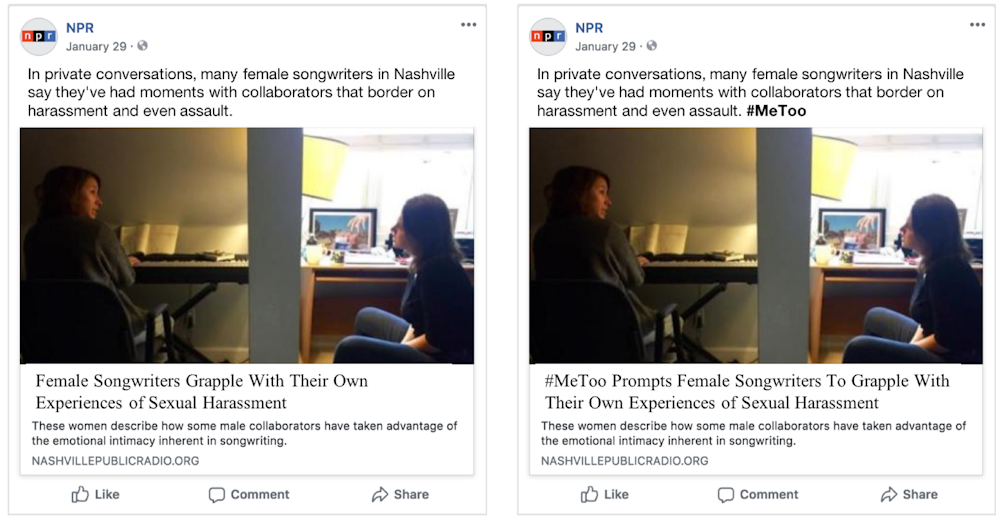
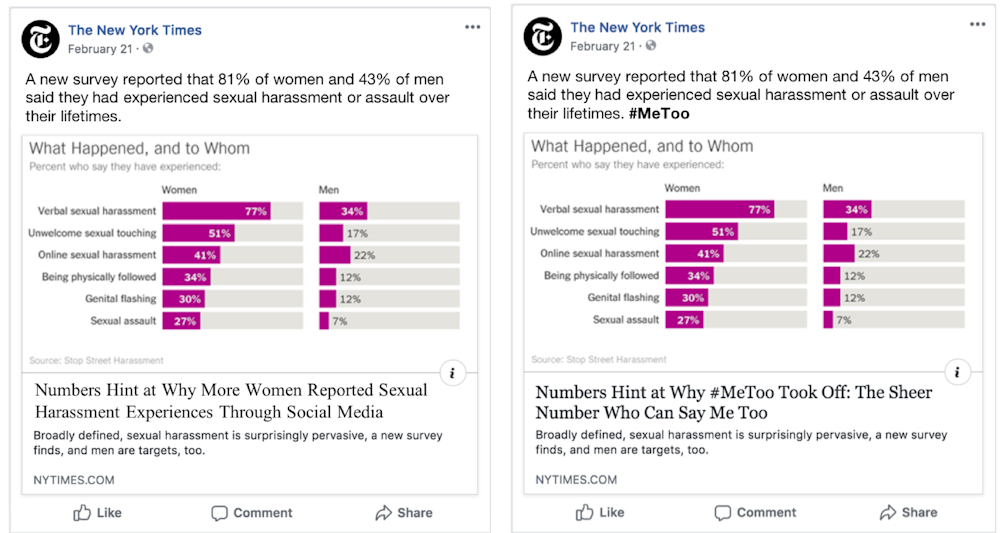
The original news post was identical to the one the right, except for the bolded #MeToo followed by the text description. For the control condition (left), we excluded the hashtag in the post text, as well as the phrase ‘#MeToo Prompts’ in the headline.
Eugenia Ha Rim Rho
We discovered that political hashtags are not a good way for news outlets to engage readers.
In fact, when the story included a hashtag, people perceived the news topic to be less important and were less motivated to know more about related issues.
Some readers were also inclined to view news stories with hashtags as more politically biased. This was especially true for more conservative readers, who were more likely to say a news post was extremely partisan when it included a hashtag.
Similarly, hashtags also negatively affected liberal readers. However, readers who identified themselves as “extremely liberal” did not perceive social media news content about gender and racial issues as partisan, regardless of hashtag presence.
Political moderates
What really interested me was the reaction from people in the middle. People who identified as politically moderate perceived news posts to be significantly more partisan when the posts included hashtags.
In fact, in their comments, politically moderate respondents who saw news posts with hashtags were more suspicious about the credibility of the news and focused more on the politics of the hashtag.
The news post on the right is identical to the original news post published on Facebook, except for the bolded #MeToo hashtag in the post text, which was not included in the original version.
Eugenia Ha Rim Rho
For example in the hashtag group, politically moderate people repeatedly mention the hashtag without substantially engaging with relevant social issues:
“The #MeToo topic is turning into something like the Kardashians. You can’t look at the news without both of them headlining things. It is an important issue, but I am getting tired of seeing it over and over.”
By contrast, when hashtags were absent, readers were more likely to discuss the core ideas and values the hashtag was originally meant to represent.
“Giving a platform and voice to victims via social media is a great way to share one’s experience when one is to uncomfortable to do so publicly. Some people are too afraid to report any harassment or assaults due to being labeled a liar so I’m glad there’s a way to keep track of these instances without them going unheard.”
The language used by participants from the hashtag group in their comments was more emotionally extreme. Even those who seemed to be in favor of the hashtag movement used aggressive language to convey support of the movement and referred to those against it as “You idiots,” claiming, “there’s a reason why [#MeToo] f****-ing exists, dimwits!!”
Fostering better online discourse
These findings show that politicians, activists, news organizations and tech companies cannot take common social media practices for granted.
Even a simple practice, like branding a social topic with a catchy hashtag, can give off the impression to the public that hashtagged content, even news content published by major news companies, is hyper-partisan or untrue.
If we want to build and sustain healthy discussions online, then we need to start questioning how such practices influence the democratic health of the internet.
Using a hashtag can rapidly draw audience attention to pressing social issues. However, as our study shows, such viral momentum may be detrimental to online discussion around pressing social topics in the long run.
White House aide Kellyanne Conway went on a rant about former special counsel Robert Mueller's investigation when she was told that Russia attacked the 2016 U.S. election.
During an interview on CBS, Conway repeated talking points that have been used by Republicans in the past week to defend President Donald Trump against charges that he bribed Ukraine's president with an offer of a White House meeting and military aid.
"[Ambassador Gordon] Sondland, in his prepared remarks, saying he thought there was a quid pro quo for a meeting," Conway complained. "They had the meeting on Sept. 22 in New York and also the aid went to Ukraine earlier than that."
Neither the host or the guest took time to explain that Ukraine President Volodymyr Zelensky never did get his Oval Office meeting and that the military aid was only released after a whistleblower came forward.
Brennan went on to ask Conway about Trump's Russia-backed conspiracy theory that contends Ukraine, not Russia, attacked the 2016 election.
"Why doesn't the president believe his own Justice Department and intelligence experts?" Brennan wondered.
"The president has said that he accepts that," Conway objected, "but that also there are plenty of ways to interfere in an election. And respectfully, if we're doing this, we're back to Mueller."
"And we've already spent two and a half years and 35 million taxpayer dollars for a Mueller report that was produced in March, was a big bomb," she continued. "Mueller testimony in July, a bigger bomb. And if we're going to go back to that, I think it exposes what didn't happen on Capitol Hill this week."
Brennan interrupted to correct Trump's conspiracy theory on Crowd Strike: "That firm that the president keeps bringing up, it's based here in the United States, it's a publicly traded firm. It's, in fact, been hired by Republicans since that time."
Conway, however, ignored the host's point.
"But here's what I was saying," Conway said. "The July 25th call [with Ukraine], the call that the whole world has had access to, the president clearly lays out what's on his mind. It's the day after Mueller testifies and then the president looks at it as his turn. He wants to get to the bottom of what happened in 2016. And certainly to avoid that in the future, look, we have done a great deal in our White House... to secure our elections."
"But I also don't want the impeachment process, I don't want members of the mainstream media -- which don't include you -- to interfere in the 2020 election the way they tried in the 2016 election," the president's aide exclaimed. "That's a different kind of interference and that's dangerous too."
Before allowing Brennan to concluded the interview, Conway noted that polls in swing states have allegedly turned against impeachment.
"These Democrats who are in charge of the hearings don't represent the swing districts," she opined. "They have to look at the polls and say, 'There's no appetite to impeach and remove this president.'"




 Screengrab of President Donald Trump's retweet of a One America News solicitation.[/caption]