In what can only be described as a bizarre admission, a Washington D.C.-based news site boasted that a recently indicted Kremlin operative is one of its top executives, reports The Daily Beast.
According to the report, USA Really, which describes itself as an independent news website, made a point on letting the world know that Elena Khusyaynova is its chief financial officer, thereby linking itself to tehKremlin and Russian President Vladimir Putin.
Khusyaynova was indicted last week for trying to meddle in the 2018 midterm elections, with federal prosecutors alleging that she worked on behalf of “Project Lakhta,” an organization attempting to “to sow discord in the U.S. political system.” She is not currently in U.S. custody.
According to the Beast, USA Really's admission links them to Kremlin-backed new sites like RT and Sputnik, with the Beast clarifying, "It’s not clear what USA Really hoped to gain through the admission. The site is quick to deny that Russia had any involvement in the 2016 election. But its gleeful association with Khusyaynova suggests that USA Really is not the independent, inquisitive news organization that it claims to be, but rather an adjunct of a deep-pocketed propaganda apparatus that federal prosecutors say amounts to a criminal conspiracy against the United States."
USA Really, which trades in conspiracy theories and sensationalized stories, is run by Russian media executive and Kremlin policy adviser Alexander Malkevich, who was the one to proudly announce the Khusyaynova connection.
According to Page Six, the attorney for Megyn Kelly has requested that NBC executives and their lawyers allow former MSNBC host Ronan Farrow sit in on negotiations over how the soon-to-be-released NBC host will be compensated.
“Megyn Kelly’s litigator Bryan Freedman is meeting with NBC execs [Friday] and has requested that Ronan Farrow attend, so he can be a witness,” a source told the tabloid.
According to the report, Farrow is still a sore point for NBC which shot down his reporting on accused sexual predator Harvey Weinstein, forcing him to take it to the New Yorker.
The report notes that Kelly has been critical of NBC's handling of Farrow, with Kelly running a segment in September calling on the network to hire an outside firm to determine why it spiked his reporting on Weinstein.
CNN host John Berman barely controlled his fury on Thursday morning while reporting on a tweet issued by Donald Trump where the president linked the rash of terrorist bombs aimed at his critics to the "fake news" media.
Trump tweeted. “A very big part of the Anger we see today in our society is caused by the purposely false and inaccurate reporting of the Mainstream Media that I refer to as Fake News,” Trump tweeted. “It has gotten so bad and hateful that it is beyond description. Mainstream Media must clean up its act, FAST!”
After reading Trump's tweets on-air --and prior to displaying a map that showed the locations of eight terrorist mail bombs sent by an unidentified terrorist -- Berman snapped at the president, "Well, let me tell you what the mainstream media has been doing this morning."
"We have been reporting on a bomb delivered to the office of Robert De Niro, an eighth bomb delivered somewhere over the last 2 1/2 days, and some of the other targets of these bombs include two former presidents, a former secretary of state, a former attorney general, a member of Congress and a former director of the CIA.," he continued. "Explosives sent to either kill, threaten or scare these people and American society. Traffic was stopped on the West Side Highway today as this bomb was delivered to a safer area, and buildings have been evacuated."
"That is what is going on this morning, and the president is blaming the media," he bluntly concluded.
Authorities in Southern California are responding to the new headquarters of the Los Angeles Times after four suspicious packages were mailed to the building, the newspaper reported Wednesday.
A hazmat team arrived at approximately 2 p.m. local time to examine the four bundled envelopes placed in a box outside the building.
“Contrary to some media reports, we are not being evacuated," noted Hillary Manning, spokesperson for the newspaper.
"Given the reports about the package sent to former CIA chief John Brennan at CNN, and potential explosive devices sent to Obama, Hillary Clinton and former Atty. Gen. Holder, our security and facilities teams are being extra careful with mail and packages, as well as with any visitors to the building," she noted.
Georgia’s Republican Secretary of State Brian Kemp has been sued for suppressing minority votes after an Associated Press investigation revealed a month before November’s midterm election that his office has not approved 53,000 voter registrations – most of them filed by African-Americans.
Kemp, who is running for governor against Democrat Stacey Abrams, says his actions comply with a 2017 state law that requires voter registration information to match exactly with data from the Department of Motor Vehicles or Social Security Administration.
The law disproportionately affects black and Latino voters, say the civil rights groups who brought the lawsuit.
Georgia, like many southern states, has suppressed black voters ever since the 15th Amendment gave African-American men the right to vote in 1870.
The tactics have simply changed over time.
Democrats’ southern strategy
With black populations ranging from 25 percent to nearly 60 percent of southern state populations, black voting power upended politics as usual after the Civil War.
During Reconstruction, well over 1,400 African-Americans were elected to local, state and federal office, 16 of whom served in Congress.
Loyal to President Abraham Lincoln, whose Emancipation Proclamation sounded the death knell for slavery, black Americans flocked to the Republican Party. Back then, it was the more liberal of the United States’ two mainstream political parties.
White paramilitary groups like the Ku Klux Klan and White Leagues threatened black candidates, attacked African-American voters, pushed black leaders out of office and toppled Republican governments.
After establishing single-party control over the South, white Democrats in the late 1800s instituted a poll tax, making voting too expensive for former slaves and their descendants.
These attacks proved effective. Between 1896 and 1904, the number of black men who voted in Louisiana plummeted from 130,000 to 1,342.
After North Carolina U.S. Rep. George White retired, in 1901, the South would send no African-Americans to Congress until the 1972 election.
Voter suppression in Jim Crow Mississippi
In the early 20th century, many black Americans voted with their feet, migrating north and west.
Around the same time, President Franklin Delano Roosevelt’s New Deal – which instituted racial quotas in hiring for federal public work projects and included policies aimed at reducing inequality – was shifting northern black voters’ allegiance to the Democratic Party.
Black voters in northern cities began putting African-American Democrats into congressional office.
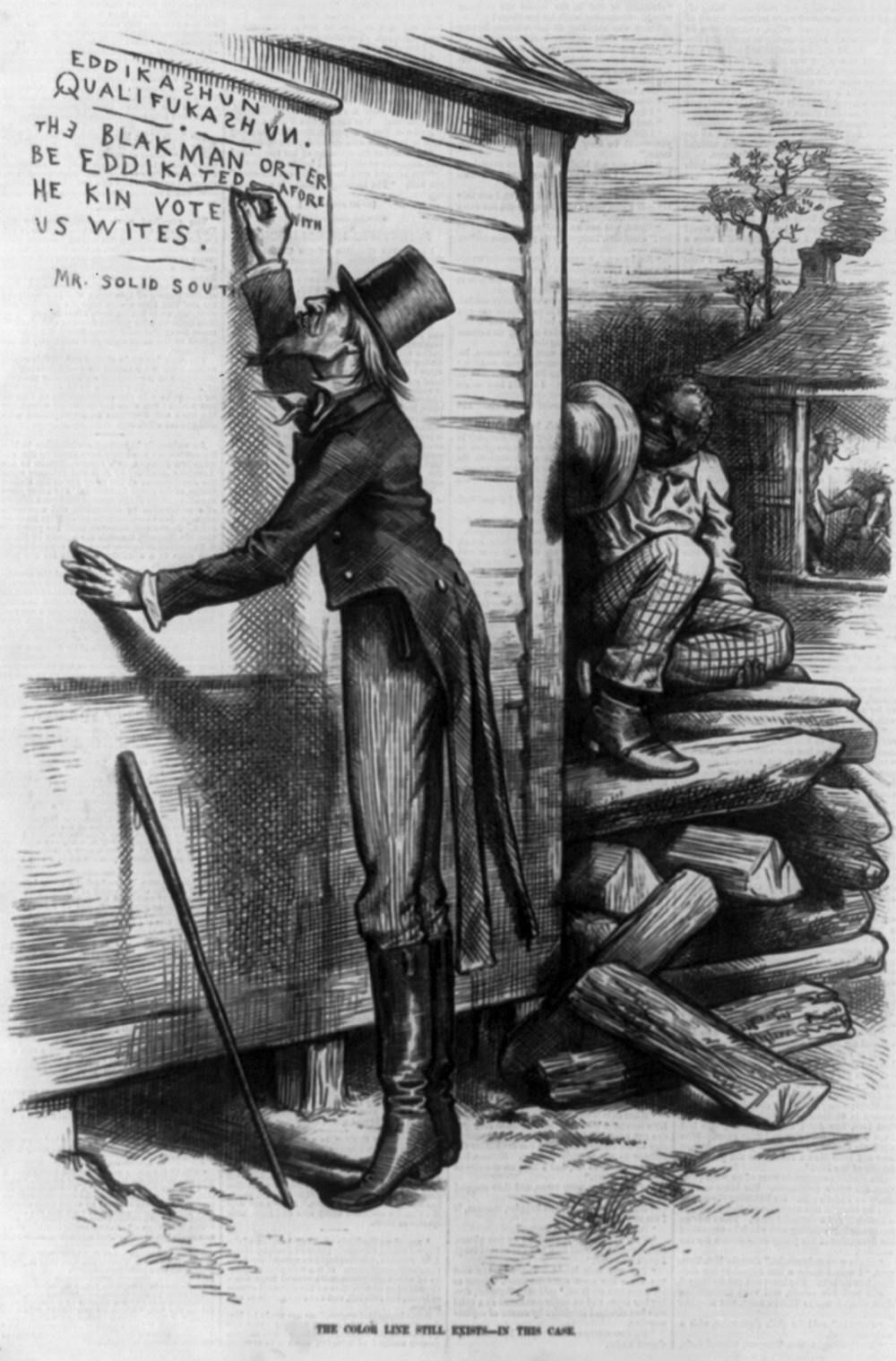
An 1879 cartoon in Harper’s Magazine satirizes the requirement that African-Americans pass a literacy test to vote.
But they did not give up on the South, pressing the Supreme Court to reaffirm voting rights in the 1944 case Smith v. Allwright, which prohibited white-only primaries.
But black voter suppression remained deeply entrenched in the South. Several states required new voters to complete literacy tests before they could cast a ballot. In the 1880s, 76 percent of southern blacks were illiterate, versus 21 percent of whites.
In reaction to Brown v. Board of Education, which in 1954 overturned “separate but equal” segregation laws, Mississippi in the same year modified its poll test. It asked voters to interpret a section of the state’s constitution, authorizing county registrars to determine whether the applicant’s answer was “reasonable.”
Virtually all African-Americans, regardless of education or performance, failed.
Within a year, the number of blacks registered to vote in Mississippi dropped from 22,000 to 12,000 – a mere 2 percent of eligible black voters.
Political violence – including the 1955 attempted assassination of voting rights activist Gus Courts and murder of George W. Lee – accompanied the legal restrictions, showing the cost of black political independence.
Fighting for the vote
Activists were not deterred. The Student Nonviolent Coordinating Committee and the Congress of Racial Equality continued to wage grassroots voter registration campaigns and fight for official representation in the Democratic Party.
In 1964, a new political party, the Mississippi Freedom Democratic Party, was founded to welcome “sharecroppers, farmers and ordinary working people.”
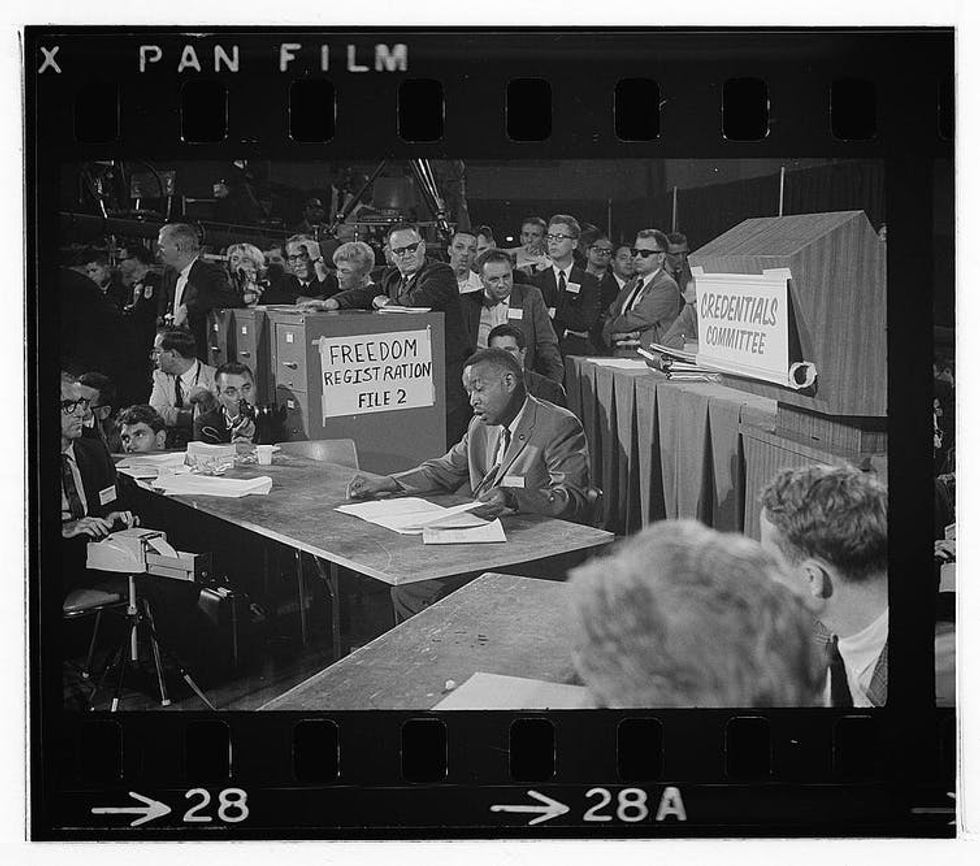
The Freedom Democratic Party elected 68 delegates to attend the 1964 Democratic National Convention in Atlantic City, New Jersey, hoping to transform the all-white Mississippi delegation.
Trying to broker a deal, national Democratic leaders extended Mississippi’s Freedom Democrats two nonvoting at-large seats at the convention – a minor concession that led most white Mississippi party members to walk out in protest.
Freedom Democrats rejected the two seats as tokenism, holding a sit-in on the convention floor in Atlantic City to highlight the lack of black political representation.
Aaron Henry, chair of the Mississippi Freedom Democratic Party delegation, speaks at the Democratic National Convention in 1964.
Over time, the civil rights movement sparked a political shift that dramatically changed the U.S. electorate.
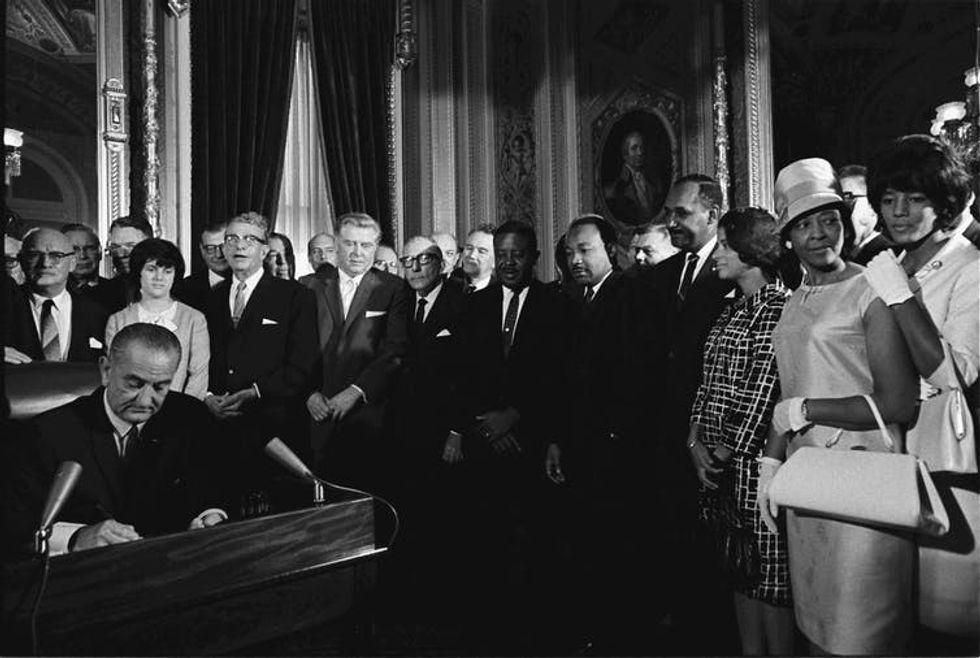
The 24th Amendment outlawed poll taxes in 1964, abolishing a major barrier to black enfranchisement in the South. Literacy tests, too, were restricted, under the 1965 Voting Rights Act.
The Voting Rights Act also established federal oversight of voting laws to ensure equal access to elections, particularly in the South.
By the early 21st century, African-Americans constituted a majority of the registered Democrats in Deep South states from South Carolina to Louisiana. They turn out in high numbers and have been key voters for getting Democrats into office in the conservative-dominated South.
Voter suppression today
Over the past decade, Republican lawmakers have chipped away at the last century’s advances, enacting voter ID laws that make it harder to vote.
Claiming they seek to deter election fraud, some 20 states have restricted early voting or passed laws requiring people to show government ID before voting.
Voter identification laws have hidden costs, research shows.
Getting a government ID means traveling to state agencies, acquiring birth certificates and taking time off work. That puts it out of reach for many, a kind of 21st-century poll tax.
Federal and state courts have overturned such laws in some states, including Georgia, North Carolina and North Dakota, citing their harmful effect on African-American and Native American voters.
But the Supreme Court in 2008 deemed Indiana’s voter ID law a valid deterrent to voter fraud.
Perhaps most damaging to black voters was a 2013 Supreme Court decision that weakened the Voting Rights Act.
The Voting Rights Act of 1965 stopped southern districts from changing laws to exclude black voters – but only temporarily.
Shelby County v. Holder ended 48 years of federal oversight of southern voting laws, concluding that the requirement relied on “40-year-old facts that have no logical relation to the present day.”
Current events show that voter suppression is hardly a thing of the past.
During her Tuesday Today Show program, Kelly asked a panel of white guests to explain why blackface is considered racist.
“What is racist?” Kelly said to her panel. “You do get in trouble if you are a white person who puts on blackface on Halloween, or a black person that puts on whiteface for Halloween. Back when I was a kid, that was okay, as long as you were dressing up as, like, a character.”
Several hours later, outrage on Twitter had turned to talk of a boycott of Kelly's advertisers.
Sponsors like Dell, Chubb North America, Crest, Ameriprise Financial, Salonpas, Allstate, Geico, Liberty Mutual and Progressive Insurance have all been mentioned as targets because they advertise on NBC.
Anticipating a financial backlash, Kelly has apologized for her remarks in an email to colleagues.
Longtime Wall Street Journal columnist Peggy Noonan had very little good to say about Donald Trump in a scathing column, saying he has failed to become presidential in any way, shape or form since assuming office almost two years ago.
Using Trump's defense of the Saudi government involvement in the murder of Washington Post journalist Jamal Khashoggi because the Middle Eastern country is a big purchaser of American military hardware, Noonan said we all should be ashamed.
"Mr. Trump told Lesley Stahl of '60 Minutes': 'I don’t want to hurt jobs. I don’t want to lose an order like that.' Later in the week he told reporters that Saudi Arabia is a 'tremendous purchaser' of U.S. military equipment, and this must be factored in," she wrote. " We used to be ashamed, or at least embarrassed, to be seen as arms merchant to the world. It didn’t quite sit with our vision of ourselves. And American presidents, as representatives of a nation with a certain moral stature, didn’t use to declare that our world stands are heavily influenced by arms contracts."
She went on to explain that the problem is Trump, who manages to stomp all over his achievements by going off-message because he is a narcissist at heart.
"In the end it’s about Mr. Trump, isn’t it?" she suggested. "He is the living context and the constant question: For or against? He has had significant achievements—unemployment down, economy up, the courts, an imperfect tax bill that nonetheless got passed and was slightly better than what it replaced."
Explaining why Trump's popularity numbers stay so low, she blamed it on his penchant for acting "crazy."
"It’s no mystery," Noonan explained. "He obscures his victories with his crazy. And so in the weeks before the election he rants around about 'Horseface,' and compares MBS to Justice Kavanaugh, the victim of unproved allegations. He continues to rag on Attorney General Jeff Sessions: 'I could fire him whenever I want to fire him, but I haven’t said that I was going to.'”
"It is political malpractice on an epic scale and cannot be helped because he lacks self-command and is vain. He thinks nobody communicates like him. Nobody does. He thinks nobody breaks through like him. Nobody does!" she scolded. "He could have opted for a certain stature—the presidential stage, with its flags and salutes, almost leads you by the hand to stature. But he hasn’t."
"His supporters, especially Republican candidates, would love it if he’d put his arguments in the foreground, not his drama and weirdness. It is remarkable that he hasn’t cared about them enough to do this, to give them that kind of cover," the columnist concluded. "He’s lucky the mainstream media hate him so much, and in showing that hatred stiffen his supporters’ loyalty."
As President Donald Trump receives widespread criticism for Saudi Arabia's suspected murder of Washington Post journalist Jamal Khashoggi, the commander-in-chief praised a Republican who assaulted a journalist while campaigning.
On the eve of Montana's 2017 special election, Republican nominee Greg Gianforte "body slammed" reporter Ben Jacobs. Gianforte went on to win the election and was sworn into Congress despite the attack.
Trump claimed Gianforte is "one of the most respected people in Congress" and asked him up on stage.
"Let me just say, on behalf of all of Montana, Mr. President, thank you for giving us hope again," is all Gianforte said.
"He's so smart," Trump claimed.
"And by the way, never wrestle him," Trump warned. "You understand that? Never."
"Any guy that can do a body slam, he's my kind of--" Trump said, while making a motion of throwing a man.
"He's my guy," Trump continued.
"I shouldn't say this, but there's nothing to be embarrassed by," the commander-in-chief claimed.
Trump said, after hearing about the assault, he was worried it would hurt the Gianforte campaign. But then decided it would actually help the Republican.
CNBC host Jim Cramer on Thursday floated a conspiracy theory that Saudi Arabia is secretly lowering the price of oil to "appease" President Donald Trump.
During CNBC's Squawk on the Street program, one CNBC host noted that oil had slipped under $70/barrel even though analysts had been predicting it to be $100 or more.
"There is a subtext that's going on that people are talking about," Cramer said, "which is the murder of the Washington Post journalist [Jamal Khashoggi]. And the way to appease the president, which I think may be not what he's thinking about, but is for the Saudis to flood the world with oil."
"A lot of people don't think they have [the ability], but they absolutely have it," he continued. "They haven't even thought about fracking yet. Can you imagine when they start fracking over there?"
Cramer added: "It is absolutely possible that they are driving the price down in order to be able to appease the president, who has repeatedly for the last two decades said that OPEC is too powerful."
The CNBC host called the move "political."
"I'm not saying that this is a vast conspiracy theory," Cramer insisted. "I'm saying that no one else can figure out where the supply is coming from. We just can't figure out why the supply is suddenly available. And it's not like someone just discovered a big field."
Former Fox News personality Eric Bolling appeared on CNN on Tuesday for his "maiden voyage" with CNN anchor Don Lemon.
The segment focused on "the president's recent media blitz" which included his 36th interview with Fox News -- while he has yet to sit down and answer questions on CNN.
"The president has given more interviews to Fox and Fox Business -- that's not news -- than any other media outlet," Lemon noted. "It is like a megaphone for him."
"There is a feedback loop between the White House and Fox News," noted CNN chief media correspondent Brian Stelter. "We know that Fox is his favorite. He's not trying to communicate to the entire population, he's trying to communicate with his base."
"How important is it for the president that he has the support of Fox and other outlets on the right?" Lemon asked Bolling.
"Of course it is important and it is also not unique to President Trump," Bolling claimed. "It is not unique to Donald Trump to look at where he's going to get his best opportunity to bring out his message and of course he goes to a Fox News and that's smart."
Bolling repeated a bunch of White House talking points, including the claim that, "we're getting respect on the world stage..."
Stelter saw fit to interrupt at that point.
"We all know that's a bunch of bull," Stelter interjected. "We know those are talking points, people see through them Eric, you don't have to do it."
"It's not talking points, it's reality," Bolling argued.
"Respect on the world stage?" Stelter repeated sarcastically.
"You are not at Fox anymore, you don't have to read that stuff anymore," Stelter reminded.
This was the 36th interview President Donald Trump has given to Fox News, which has been mockingly referred to as "state television" for their close relationship with the administration.
Despite the fact her ratings are surging, major advertisers still want nothing to do with Fox News personality Laura Ingraham months after a boycott was called for when she mocked a Florida teen shooting survivor.
According to Politico, Ingraham's show has never recovered from the backlash she brought upon herself when she ridiculed shooting Parkland survivor David Hogg and then created another furor by describing controversial government immigration detention facilities as "summer camps."
Prior to those offensive comments, which are normally de rigueur on the conservative network, the host's "Ingraham Angle" show enjoyed a rotating advertiser roster numbering nearly 229 brands. According to an advertising analyst, that number dropped to 71 after the boycott was announced and only recently rose to 85.
Despite the fact that her show is fourth on the cable news rankings -- following Fox's Sean Hannity, Tucker Carlson and MSNBC's Rachel Maddow -- advertisers still aren't interested in being linked to her in order to reach her almost 2.7 million viewers each night.
“That boycott held firm, regardless of the fact that audience ratings are increasing,” explained Kantar Media chief research officer Jon Swollen. “There are still a number of advertisers that don’t want to be associated with the program.”
He then added, "Brands are skittish about alienating potential customers.”
While Ingraham's show used to feature ads from heavy hitters national brands like Geico, Arby’s, Liberty Mutual and Humira -- nowadays the bulk of her show's deeply discounted ad time is only interesting to what an ad exec called "bottom feeders."
Those advertisers are made up of direct-sales companies who "are less picky about where their ads appear."
According to ad exec Swollen, the hit to Ingraham is costing the Fox network 15 percent to 30 percent of what it previously took in from her show.
“They’re kind of forced off, whether they want to be or not,” Marianne Gambelli, the head of ad sales for Fox said of spooked advertisers, but said she still believes they will return. “They go silent for a while because they don’t want to be part of the controversy either way…They go quiet and come back.”
Donald Trump's never-ending MAGA campaign rallies -- ostensibly to promote GOP candidates -- are getting less and less uninterrupted TV coverage and, according to an MSNBC contributor, the president's waning popularity is not the only reason he is being ignored
With Trump barnstorming the country and holding rallies in deeply conservative communities, the major cable networks have stopped airing them live -- including his favorite network: Fox News.
"What do you think is happening here?" asked AM Joy fill-in host Ali Velshi. "Why is Donald Trump [avoided] after so long being able to manipulate the media into covering his stuff and creating good ratings -- what's happening? "
"I think it is saturation," ShareBlue editor Eric Boehlert explained. "He calls into Fox News at eleven o'clock at night. He calls back the next morning for a 45-minute rambling interview."
"At the end of the interview, the host says, 'Shouldn't you be running the country at this point? " Boehlert added while laughing. "It's not good for business, right? He's not providing anything new. He's producing just redundant programming and for Fox News, for instance, you know, these hour-long rallies are in primetime -- they can't run any ads."
"You do that once or twice as a favor to Trump, that's fine," he elaborated. "You do that six or seven times a month, you're going to lose tens of millions of dollars and he's not producing any bump."
Boehlert then mocked the president for his need for crowd adulation.
"He's in a very needy mode right now, more than usual, and he's not producing anything entertaining so people are cutting the cord," he pronounced.