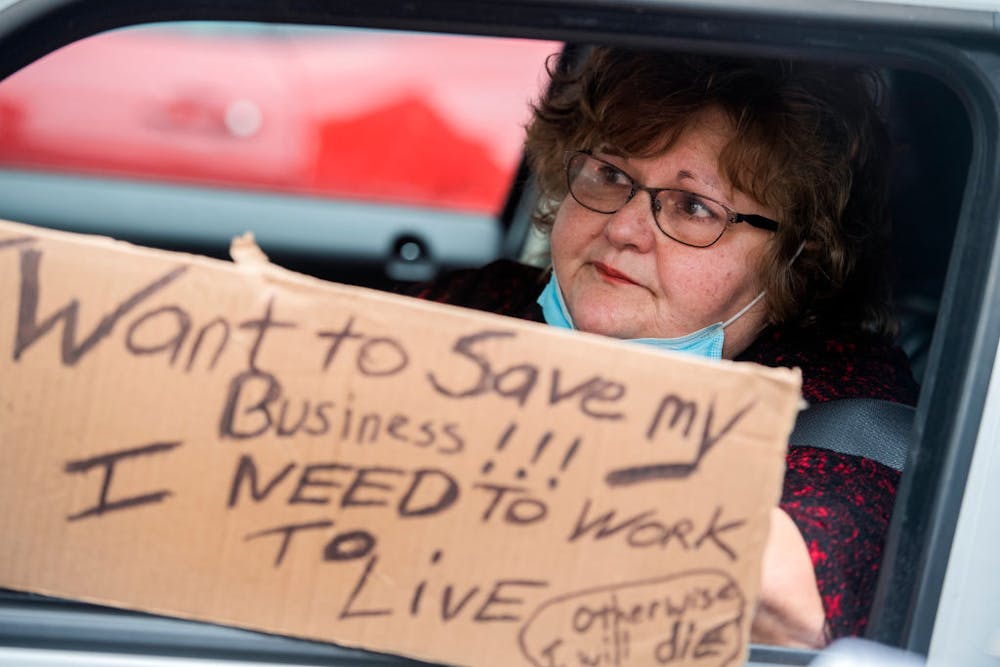
Already, COVID-19 has killed more people than World War I and Vietnam — combined.Coronavirus has pushed the unemployment rate to levels not seen since the Great Depression.A national poll shows historic levels of unhappiness.Six months into the COVID-19 pandemic, there’s little question that the virus many of us hadn’t even heard of in January has upended American life, but just how bad is the damage? A half-dozen experts had a wide range of answers, with several saying that COVID-19 is in the same league as national crises such as the 1918 Spanish flu pandemic, the Great Depression of the 193...
MIAMI — Like many things since the coronavirus pandemic took hold, South Florida houses of worship have had to make dramatic changes. In the Miami Archdiocese, parishioners don’t hold hands as they recite the Lord’s Prayer, pews are emptier and the holy water has been put away.The archdiocese also says that in the earlier days of the pandemic six out of 253 priests tested positive. One of them, Father William Muñiz of St. Henry Catholic Church in Pompano Beach, died of COVID-related complications in late July. He was 85.All but one of the cases, the archdiocese said, occurred after it suspende...
Jerusalem (AFP) - Israel said it will reimpose a national lockdown to battle a coronavirus surge, as the number of daily infections around the world reached a record high.Britain, France, Austria and the Czech Republic also reported spikes, as global cases rapidly approached 29 million with more than 921,000 Covid-19 deaths, according to an AFP tally.The Israel lockdown will last three weeks starting Friday, keeping people to within 500 metres (yards) of their homes. It is the first developed economy to take such drastic steps to contain a second wave of infections."I know these measures will ...
US President Donald Trump on Sunday held his first fully indoor rally in months, outraging officials in the state of Nevada who warned the gathering violated coronavirus restrictions on crowd sizes.
Indoor rallies during the pandemic have proven problematic for Trump, who was heavily criticized after one in June that was later linked to a spike in virus cases.
Trump used Sunday's event, held in the Las Vegas suburb of Henderson, to applaud his own handling of the pandemic, which has killed nearly 195,000 Americans, the world's highest toll.
"We have done an incredible job, we get absolutely no credit for the job we have done," the Republican told the crowd at the Xtreme Manufacturing facility, adding that his leadership had "saved millions of lives."
Governor Steve Sisolak tweeted that "tonight, President Donald Trump is taking reckless and selfish actions that are putting countless lives in danger here in Nevada."
"The President appears to have forgotten that this country is still in the middle of a global pandemic," he said.
Trump called Sisolak, a Democrat, a "political hack" and urged the crowd to "tell your governor to open your state."
Plans for the rally drew a rebuke from local authorities, who noted events with more than 50 people are not allowed due to the coronavirus.
"The City of Henderson has issued a compliance letter and verbal warning to the event organizer that the event as planned would be in direct violation of the governor's COVID-19 emergency directives," city spokeswoman Kathleen Richards said in a statement.
The pandemic has stripped the US presidential campaign of its usual flood of events, but with less than two months to voting Trump and Democratic rival Joe Biden have been making more appearances.
The Trump campaign said temperature checks would be done at the door of the Nevada rally and attendees would be given face masks and encouraged to wear them.
"If you can join tens of thousands of people protesting in the streets, gamble in a casino, or burn down small businesses in riots, you can gather peacefully under the 1st Amendment to hear from the president of the United States," Trump campaign communications director Tim Murtaugh told reporters.
Trump's indoor rally in the Oklahoma city of Tulsa in June proved deeply controversial, with most attendees flouting Trump administration guidelines by refusing to wear masks or engage in social distancing despite being indoors.
Coronavirus cases jumped in Tulsa in the weeks after the June 20 rally, and local health officials said it was "more than likely" that major events were a contributing factor.
President Donald Trump's former Homeland Security official, Miles Taylor, explained that in his department, there were action plans ready to go for the coronavirus pandemic, but the president simply didn't care.
"I would say this: People like to say that this administration is a roller coaster, but I think that's very charitable," Taylor explained. "People get off of a roller coaster, and they are alive. This is a runaway freight train, and the president is the conductor. That's what's happening right now. We have dead Americans because the president is so impulsive and incapable of leading. Again, the dam is starting to break here. People are realizing this isn't just hyperbolic criticism of the president. People who served close to the president are saying this. What Bob [Woodward] got right in that book is he tracked down the key sources from the Jim Mattis to the Tony Faucis, who have seen this man behind the scenes, and he's unable to lead in a crisis."
Taylor went on to say that the true measure of a leader's character is how he behaves during a crisis. Americans have seen "the president behave in such a way that Americans are dying."
Talking about the Henderson, Nevada rally on Sunday, Taylor said people were rushing toward the rally because Trump is incapable of being a responsible leader.
"This is what we saw behind the scenes," Taylor explained. "This impulsivity that the president has, in some cases, had low consequences. Now we're seeing it have the greatest consequences you could possibly imagine. The deaths of hundreds of thousands of Americans."
He said that Trump is the one responsible for presiding over the government, and when he ignored the plans outlined to save Americans in a crisis, he led the country into the disaster.
"Then we have the head of the RNC, Ronna Romney McDaniel, who is blaming Joe Biden for the results. Who is blaming Joe Biden for nationwide violence and unrest and for Americans being dead because of the coronavirus pandemic," said Taylor. "It shows you how desperate the president and his team are becoming in these last few weeks of the campaign and also shows you how damaging they think the last week has been to him reputationally. I will also tell you since the revelations have come out from Bob Woodward, we're hearing from more people behind the scenes from the White House that are thinking about speaking out against the president. So, as I said before, I think the dam is breaking."
ABC White House correspondent Jonathan Karl on Sunday revealed why he finally relented and used the word "lie" to describe how President Donald Trump withheld information about COVID-19 from the American people.
At a press conference on Friday, Karl had confronted Trump about an audio tape in which the president admits that he publicly downplayed the virus even though he knew it was much more serious.
"Why did you lie to the American people and why should we trust what you say now?" Karl asked the president, who responded by calling the reporter a "disgrace."
On Sunday, CNN's Brian Stelter asked Karl why he chose to use the word "lie."
"I've resisted using that word for five years of covering Donald Trump, as a candidate and as president," Karl explained. "But I went in there feeling that there was no other way to put it."
According to the ABC reporter, audio tapes recorded by journalist Bob Woodward make it clear "that the president knew what the truth was and, in fact, explained to Woodward his reason for not telling the truth."
"That is by definition a lie," Karl observed. "So, I just felt I needed to ask the question as directly and plainly as possible."
ABC host George Stephanopoulos grilled Symone Sanders, a surrogate for Democratic nominee Joe Biden, about why the former vice president did not do more to stop the coronavirus pandemic even though he was not in office at the time.
Following an interview in which he gave Trump campaign adviser Jason Miller little pushback, Stephanopoulos told Sanders that Biden did not have a "significantly different response" from President Donald Trump.
"Can you point to statements in January and February where the vice president called for travel bans, social distancing, wearing masks?" Stephanopoulos wondered.
"I can do you one better," Sanders replied. "In October 2019, Vice President Biden warned that we were susceptible and vulnerable to a pandemic. In January of 2020, he wrote an op-ed that warned and cautioned that Donald Trump should take this seriously. On March 12, he put out his plan for a COVID-19 response that spoke of widespread testing, making sure everyone had the proper personal protective equipment, that called for operationalizing the Defense Production Act."
Sanders added: "While Vice President Biden was doing all this public urging and President Trump was speaking privately to at least one reporter saying that he knew the virus was deadly."
At that point, the ABC host interrupted.
"I asked you about January and February," Stephanopoulos said. "You said in March the vice president put out a plan, but he also put out a tweet that day saying a wall will not stop the coronavirus, banning all travel from Europe or any other part of the world will not stop it."
"He didn't explicitly call for travel bans or social distancing or wearing masks," the host pressed.
"Look, George, in January and February, Joe Biden was not being briefed by the national security experts," Sanders pointed out. "In January and February, Joe Biden did not have the knowledge that President Trump did."
"But I will tell you if Joe Biden were president in January or February, he would have taken proper precautions," she continued. "He would have warned the American people. He would have told folks to social distance. He would have modeled good behavior and wearing a mask."
"Donald Trump had information that could have made a difference," Sanders concluded.
On Sunday morning "State of the Union" host Jake Tapper cut short an interview with White House trade advisor Peter Navarro after the Donald Trump appointee insulted CNN's coverage of the COVID-19 health crisis and refused to answer questions about why the president lied to the public about it.
Over a combative nine minutes, the CNN host repeatedly asked Navarro about the taped comments the president made about the coronavirus pandemic in an interview with Bob Woodward and how they conflicted with his public statements.
With Navarro continually calling the president's comments "cherry-picking" and refusing to address direct questions, Tapper finally called an end to the interview and then fact-checked the White House adviser after he was taken off the screen.
"He knew it was deadlier than the flu and he was lying to the American public two weeks later," Tapper accused.
"Jake, you're cherry-picking," Navarro shot back.
"I'm not cherry-picking. He was not honest with the American people. you're not answering the question," the CNN host pressed.
"You're not honest with the American people. CNN is not honest with the American people. You want to go there?" Navarro replied which led Tapper to call the interview off.
"I said you're not answering the question. Thank you, Peter Navarro. We just played tape and you didn't answer the question," Tapper said over the Trump adviser's protestations.
"I appreciate your time today. and I would just like to remind the American people that the United States has less than 5 percent of the world's population, and the United States has more than 20 percent of the world's coronavirus deaths," Tapper explained. "That is a fact. It does not matter how many times he insults CNN."
Trump campaign adviser Steve Cortes on Sunday downplayed the revelations that President Donald Trump misled the American people about the severity of novel coronavirus pandemic.
In an interview with Fox News, Cortes argued that Trump made the admission to journalist Bob Woodward in the "fog of war."
"Why not level with the American people, Steve?" Fox News host Chris Wallace asked.
"This was the fog of war, biological war," Cortes insisted.
"I'm going to interrupt you right there," Wallace interjected. "It wasn't the fog of war. On January 28, the president got his presidential daily brief, the top intelligence in the Oval Office. And at that point, his national security adviser, Robert O'Brien said that this is the biggest challenge you're going to face in your entire presidency."
"So there was no fog of war there," the Fox News host added. "The word that he was getting from his top intelligence and national security people was that this was a deadly pandemic. There was no fog here."
"No, no, there was tremendous fog!" Cortes objected.
There is strong scientific evidence that wearing a mask reduces the risk of transmitting the coronavirus. Both the Centers for Disease Control and Prevention and the World Health Organization recommend wearing them.
Indeed, many people believe it is important to take precautions to reduce the risks we pose to others and wear masks. They conclude that wearing a mask is the right thing to do.
Is it acceptable to comment on others’ apparent irresponsibility when they choose not to wear a mask or try to shame them into wearing one? Is this approach effective?
Moral outrage
There is psychological evidence to show that people express moral righteousness – act from an outraged sense of justice – when they are uncertain and afraid.
When people are anxious, they often try to regain composure by clinging strongly to their moral norms. Some studies also show that such moral outrage may be “self-serving” – a way to bolster one’s own moral status.
But there is also reason to believe that moral outrage, whatever its psychological source, can be an important lever for bringing about positive change – such outrage was, for instance, essential for ending slavery.
The righteous outrage of abolitionists who tried to end slavery in the mid-1800s was justified even if they would not have been so outraged in different circumstances – say, where the country had not been on the brink of civil war.
Martin Luther King’s struggle for civil rights was motivated as much by anger at injustice as by love. For King, anger was part of a process that included forgiveness and led to constructive action.
Refusal to wear masks
To decide whether outrage is an appropriate response to even the most selfishly motivated refusal to wear a mask, consider the consequences of such outrage.
Those who follow 19th-century philosopher John Stuart Mill believe people should act so as to maximize the positive and minimize the negative consequences of their actions, for the benefit of the greatest number of people.
But even those who reject Mill’s views and follow another philosopher, Immanuel Kant, believe that consequences matter. On Kant’s view we need to understand how to help people adhere to the moral law because he thought that what matters most is one’s goodwill or motive.
But this need not be a choice between further polarization and risk reduction.
Epidemiologist Julia Marcus argues that shaming people who do not wear masks will not work to anyone’s advantage. People can better convince others to wear masks if they share the fear, loss and uncertainty that motivates their concern rather than use their outrage to shame others.
As Kant argued, everyone should treat other people with respect. This applies no matter what side of the political fence people occupy. We all share needs for safety, economic security and health. Evidence suggests that shame can undermine, rather than promote, moral motivation.
On the other hand, if people share their feelings and candidly explain their fears and aspirations to others, they might better motivate positive change.
Show empathy
Trying to understand why people might be resistant to wearing a mask might be a good place to start. For example, some people may be worried that a mask may not allow for a free flow of oxygen into their lungs, even though such concerns may not be valid. Some people also find it hard to breathe with a mask on if they are running or exercising in another way. All these concerns can be acknowledged and discussed.
Similarly, everyone should remember that some people have good reasons not to wear a mask. People may have underlying health conditions like autism or anxiety disorders that make wearing a mask difficult.
Even when someone refuses to wear a mask only to make a political statement, it is important to hear why it matters so much to them. As Kant argues, it is important to understand different perspectives.
Are anti-maskers afraid that their businesses wouldn’t be allowed to open any time soon due to the fear of the spread of COVID-19?
Focusing on facts – rules that states, cities or private employers put in place to protect people – rather than blaming others might be a more effective way to convince them.
People on bothsides of the mask debate have found reasons to turn this into a most contentious issue. Perhaps listening carefully and with empathy might help everyone understand that we all really are in this together.
Buckle up for a long ride ahead.Dr. Anthony Fauci, the government’s top infectious disease expert, said Friday that normal times won’t replace America’s long coronavirus nightmare until deep into 2021, explaining that it will take months to widely administer a vaccine.The 79-year-old immunologist said he continues to expect a vaccine to be available by the beginning of 2021.“But by the time you mobilize the distribution of the vaccinations and you get the majority or more of the population vaccinated and protected, that’s likely not going to happen until the mid or end of 2021,” Fauci told MSN...
SAN JOSE, Calif. — New data from medical records in Los Angeles indicate COVID-19 may have been circulating in the United States even before China informed the World Health Organization of the first outbreak of the then-unidentified virus, according to researchers at UCLA and the University of Washington.In a study published Thursday in the Journal of Medical Internet Research, the team of nine researchers compared electronic medical records in the UCLA Health system from this winter to the previous five years and found an excess number of outpatient and emergency room visits with complaints o...
The Trump administration interfered with scientific reports issued by the Centers for Disease Control, according to a bombshell report Politico published Friday evening.
"The health department’s politically appointed communications aides have demanded the right to review and seek changes to the Centers for Disease Control and Prevention’s weekly scientific reports charting the progress of the coronavirus pandemic, in what officials characterized as an attempt to intimidate the reports’ authors and water down their communications to health professionals," Dan Diamond reported. "In some cases, emails from communications aides to CDC Director Robert Redfield and other senior officials openly complained that the agency’s reports would undermine President Donald Trump's optimistic messages about the outbreak, according to emails reviewed by POLITICO and three people familiar with the situation."
"The CDC's Morbidity and Mortality Weekly Reports are authored by career scientists and serve as the main vehicle for the agency to inform doctors, researchers and the general public about how Covid-19 is spreading and who is at risk. Such reports have historically been published with little fanfare and no political interference, said several longtime health department officials, and have been viewed as a cornerstone of the nation's public health work for decades," Politico reported. "But since Michael Caputo, a former Trump campaign official with no medical or scientific background, was installed in April as the health department's new spokesperson, there have been substantial efforts to align the reports with Trump's statements, including the president's claims that fears about the outbreak are overstated, or stop the reports altogether."
"Caputo and his team have attempted to add caveats to the CDC's findings, including an effort to retroactively change agency reports that they said wrongly inflated the risks of Covid-19 and should have made clear that Americans sickened by the virus may have been infected because of their own behavior, according to the individuals familiar with the situation and emails reviewed by POLITICO. Caputo's team also has tried to halt the release of some CDC reports, including delaying a report that addressed how doctors were prescribing hydroxychloroquine, the malaria drug favored by Trump as a coronavirus treatment despite scant evidence," Politico explained. "The report, which was held for about a month after Caputo’s team raised questions about its authors’ political leanings, was finally published last week. It said that "the potential benefits of these drugs do not outweigh their risks."
Political appointee Paul Alexander reportedly demanded that no reports go out that he had not edited to make sure it was "fair and balanced."
“Our intention is to make sure that evidence, science-based data drives policy through this pandemic—not ulterior deep state motives in the bowels of CDC," Caputo told Politico.