Rep. Jamie Raskin (D-MD) on Friday got Dr. Anthony Fauci to shoot down some of the most outlandish claims about the novel coronavirus made by President Donald Trump and other conservatives.
During rapid-fire questioning, Raskin listed off pieces of what he described as "propaganda" about the disease and asked Fauci to answer whether each piece was true.
"Are children almost immune to the disease?" he asked, referring to a false claim about the disease.
"Okay, be a little more precise," Fauci replied. "Do children get infected? Yes, they do."
Fauci then acknowledged that hundreds of thousands of children have been infected by the disease so far, which is a long way from "almost immune."
"Is COVID-19 going to magically disappear, Dr. Fauci?" Raskin asked, referring to Trump's failed prediction from earlier in the year that the virus would disappear by the summer.
"I do not believe it would disappear because it's such a highly transmissible virus," Fauci replied.
"Does wearing a mask give people COVID-19?" he asked, referring to a claim by Rep. Louie Gohmert (R-TX) that he only got infected with the virus after he started wearing a mask more often.
"No, not to my knowledge," Fauci said.
"Should people take hydroxychloroquine as a cure for COVID-19?" Raskin asked.
"The overwhelming cumulative evidence of properly conducted randomized controlled trials indicate no therapeutic efficacy for hydroxychloroquine," Fauci said.
"Can people cure themselves of COVID-19 by injecting themselves with disinfectant or bleach?" he asked.
Rep. Jim Jordan clashed with Dr. Anthony Fauci on Friday during a House hearing about the current status of White House efforts to stem the coronavirus pandemic. The confrontation resulted in the director of the National Institute of Allergy and Infectious Diseases smiling and laughing at the Ohio Republican as he tried to drag the doctor into a political debate about Black Lives Matter protesters.
Jordan came right out of chute ranting about protests and trying to get the doctor to call for the halting of public protests -- something Fauci said was not his call.
"Dr. Fauci, do protests increase the spread of the virus?" Jordan pressed. "Half a million protesters on June 6th alone, I'm asking that number of people, does it increase the spread of the virus?"
"Crowding together particularly when you're not wearing a mask contributes to the spread of the virus," the doctor carefully replied.
"Should we limit the protesting?" Jordan persisted.
"I'm not sure what you mean should -- how do we say limit the protesting? I don't think that's relevant," the doctor replied.
"Well, you just said if it increases the spread of the virus, I'm asking should we limit it?" the Republican asked.
"Well, I'm not in a position what a government can do in a forceful way," Fauci advised,
That was when Jordan went off on a rant, loudly asserting, "You make all kind of recommendations. You made comments on dating and baseball and everything you can imagine. You just said protests increase the spread -- should we try to limit the protest?"
"No, I think I would leave that to people who are more in a position to do that," Fauci replied while beginning to smile and look from side to side as Jordan went off on a rant about churches being forced to close, finally answering the congressman and telling him, "I'm not favoring of anybody over anybody. I'm just making a statement that's a broad statement that avoid crowds of any type no matter where you are because that leads to the acquisition and transmission, and I don't judge one crowd versus another crowd. when you're in a crowd, particularly if you're not wearing a mask."
According to a report from the Fresno Bee, an unidentified Salon owner in Fresno harangued a city health official in the parking lot outside of her business after she was cited for a second time for ignoring pandemic shutdown notices -- and then hit him with her car.
An internal email from a police officer who responded to the incident described what happened when two health officials appeared at the salon last week and what happened afterward.
According to one official, he had returned to his car when a woman started cursing him in the parking lot
“F--- you. F--- Mayor Brand. F--- Newsom. F--- you all. Find something better to do. I hope you all die. Somebody should put a bullet in your brain,” the woman reportedly shouted to which the city employee replied, "Keep it classy."
After she pulled her car behind his, he then took out his cellphone to take a picture of her license plate only to have her back into him, with the report saying he was not injured.
After police arrived she denied driving her car into the man and reportedly apologized "profusely" with the Bee adding she was not arrested.
It was only after the incident that she was recognized as the cited owner of the business.
According to the report, surveillance video of the incident was not conclusive and the case will be sent to the Fresno County District Attorney’s Office for possible assault charges.
President Donald Trump was not happy to see Rep. James Clyburn (D-SC) calling out the American government's failures to contain the novel coronavirus.
After Clyburn displayed a chart showing that cases in the United States had surged even as cases in European countries were under control, the president took to Twitter to attack the congressman, who serves as the Chairman of the Select Subcommittee on the Coronavirus Crisis.
"Somebody please tell Congressman Clyburn, who doesn’t have a clue, that the chart he put up indicating more CASES for the U.S. than Europe, is because we do MUCH MORE testing than any other country in the World," the president wrote. "If we had no testing, or bad testing, we would show very few CASES."
Trump went on to attack Democrats for not doing more to praise his work in containing a pandemic that has left 150,000 Americans dead in just five months.
"Our massive testing capability, rather than being praised, is used by the Lamestream Media and their partner, the Do Nothing Radical Left Democrats, as a point of scorn," the president wrote. "This testing, and what we have so quickly done, is used as a Fake News weapon. Sad!"
Despite the president's claims, however, the rise of COVID cases in the United States is not solely due to increased testing capacity, as the country's positivity rate has also risen alongside test totals.
President Donald Trump’s pivot to a more serious view of the coronavirus pandemic didn’t last long. This week, he was again touting hydroxychloroquine, an antimalarial drug that has not been shown to work against the virus. Meanwhile, on Capitol Hill, Republicans continue to struggle to come up with a proposal for the next round of COVID-19 relief even as earlier bills expire. That’s leaving millions of Americans without the ability to pay rent or meet other necessary expenses, as the economy continues to sink.
Also on the agenda, at least briefly, is the subject of high drug prices. Once considered a leading health issue for the 2020 elections, it has been all but wiped from the headlines by the pandemic. Trump issued a series of executive orders he said would produce an immediate impact, but experts point out they are mostly wish lists of things the president has already said he supports.
This week’s panelists are Julie Rovner of Kaiser Health News, Alice Miranda Ollstein of Politico, Mary Ellen McIntire of CQ Roll Call and Anna Edney of Bloomberg News.
Among the takeaways from this week’s podcast:
Despite much disarray on Capitol Hill about which coronavirus relief economic provisions Republican senators will agree on, there is largely agreement within the party and among Democrats on the health provisions, such as the need for more money for testing and for health care providers.
Senate Majority Leader Mitch McConnell insists the stimulus package must include liability protection for employers to protect businesses struck by a COVID-19 outbreak through no fault of their own. But Democrats are opposed and argue that the promise of liability waivers may keep employers from taking adequate safety precautions.
The Atlantic magazine recently explored the issue of “hygiene theater” in which people take measures they hope will keep the coronavirus at bay — such as excessive scrubbing, temperature checks, etc. — that science suggests have limited or no effect. These measures may give people comfort, but the efforts can also be dangerous in that they give a false sense of security and divert attention and resources from other, more complicated methods to stop the disease.
Much attention in recent weeks has been given to the development of a vaccine. Several options are in advanced stages of testing. But public health advocates fear that the speed of the testing and the administration’s past erroneous statements about the disease may raise fears among consumers about taking the vaccine. Nonetheless, Democrats looking ahead to the election worry that the administration will make a major announcement about vaccine availability as an October surprise.
COVID-19 has basically eclipsed efforts to make progress on several other key health issues that were expected before the election, including drug pricing and surprise medical bills.
With great fanfare this week, Trump announced orders for the administration to move toward new drug pricing policies. But the orders have little or no effect and haven’t created any momentum for advancing legislation in Congress.
The president surprised many people this week when he announced he was loaning Kodak millions of dollars to produce ingredients needed for the generic drug industry. Many of those chemicals have been made overseas, so the effort does follow the administration’s quest to establish more manufacturing in the U.S. But one reason few companies do the work here is that there is not a big profit margin on the drugs.
Also this week, Rovner interviews KHN’s Markian Hawryluk, who reported the July NPR-KHN “Bill of the Month” installment, about a surprise bill from a surprise participant in the operating room: a surgical assistant. If you have an outrageous medical bill you would like to share with us, you can do that here.
Millions of people, including the president of the United States, have seen or shared a video in which a doctor falsely claims there is a cure for the coronavirus, and it’s a medley starring hydroxychloroquine.
The video shows several doctors in white coats giving a press conference outside the Supreme Court in Washington, D.C. It persists on social media despite bans from Facebook, Twitter and YouTube, and it was published by Breitbart, a conservative news site.
The July 27 event was organized by Tea Party Patriots, a conservative group backed by Republican donors, and attended by U.S. Rep. Ralph Norman, R-S.C.
In the video, members of a new group called America’s Frontline Doctors touch on several unproven conspiracy theories about the coronavirus pandemic. One of the most inaccurate claims comes from Dr. Stella Immanuel, a Houston primary care physician and minister with a track record of making bizarre medical claims, such as that DNA from space aliens is being used in medical treatments.
“This virus has a cure. It is called hydroxychloroquine, zinc, and Zithromax,” Immanuel said. “I know you people want to talk about a mask. Hello? You don’t need [a] mask. There is a cure.”
As of July 27, nearly 150,000 Americans had died because of the coronavirus. Could those deaths have been prevented by a drug that’s used to treat lupus and arthritis?
No. Immanuel’s statement is wrong on several points.
‘This Virus Has a Cure’
There is no known cure for COVID-19.
According to the Centers for Disease Control and Prevention, there is no specific antiviral treatment for the virus. Supportive care, such as rest, fluids and fever relievers, can assuage symptoms.
The Cure Is ‘Hydroxychloroquine, Zinc and Zithromax’
In spite of Immanuel’s anecdotal evidence, hydroxychloroquine alone or in combination with other drugs is not a proven treatment (or cure) for COVID-19.
The Food and Drug Administration has not approved hydroxychloroquine for the prevention or treatment of COVID-19. In mid-June, the FDA revoked its emergency authorization for the use of hydroxychloroquine and the related drug chloroquine in treating hospitalized COVID-19 patients.
“It is no longer reasonable to believe that oral formulations of HCQ and CQ may be effective in treating COVID-19, nor is it reasonable to believe that the known and potential benefits of these products outweigh their known and potential risks,” FDA Chief Scientist Denise M. Hinton wrote.
The WHO and the National Institutes of Health have also stopped their hydroxychloroquine studies. Among the safety issues associated with treating COVID-19 patients with hydroxychloroquine include heart rhythm problems, kidney injuries and liver problems.
While some studies have found that the drug could help alleviate symptoms associated with COVID-19, the research is not conclusive. Few studies have been accepted into peer-reviewed journals. And large, randomized trials — the gold standard for clinical trials — are still needed to confirm the findings of studies conducted since the pandemic began.
In the video, Immanuel cited a 2005 study that found chloroquine — not hydroxychloroquine — was “effective in inhibiting the infection and spread of SARS CoV,” the official name for severe acute respiratory syndrome. But the drug was not tested on humans, the authors wrote that more research was needed to make any conclusions, and SARS is different from COVID-19.
‘You Don’t Need a Mask’
Health officials advise everyone to wear a mask in public.
The reason has to do with how the coronavirus spreads. When an infected person coughs or sneezes, they expel respiratory droplets containing the virus. Those droplets can then land in the mouths or noses of people nearby.
Since some people infected with the coronavirus may exhibit no symptoms, public health officials say everyone should cover their face in public — even if they don’t feel sick.
“The spread of COVID-19 can be reduced when cloth face coverings are used along with other preventive measures, including social distancing, frequent handwashing, and cleaning and disinfecting frequently touched surfaces,” according to the CDC.
Our Ruling
In a viral video, Immanuel said there is a cure for COVID-19, hydroxychloroquine can treat it, and people don’t need to wear masks to prevent the spread of the virus.
All of those claims are inaccurate. There is no known cure for COVID-19, hydroxychloroquine is not a proven treatment, and public health officials advise everyone to wear a face mask in public.
As millions of people are recovering from COVID-19, an unanswered question is the extent to which the virus can “hide out” in seemingly recovered individuals. If it does, could this explain some of the lingering symptoms of COVID-19 or pose a risk for transmission of infection to others even after recovery?
A chronic or persistent infection continues for months or even years, during which time virus is being continually produced, albeit in many cases at low levels. Frequently these infections occur in a so-called immune privileged site.
What is an immune privileged site?
There are a few places in the body that are less accessible to the immune system and where it is difficult to eradicate all viral infections. These include the central nervous system, the testes and the eye. It is thought that the evolutionary advantage to having an immune privileged region is that it protects a site like the brain, for example, from being damaged by the inflammation that results when the immune system battles an infection.
An immune privileged site not only is difficult for the immune system to enter, it also limits proteins that increase inflammation. The reason is that while inflammation helps kill a pathogen, it can also damage an organ such as the eye, brain or testes. The result is an uneasy truce where inflammation is limited but infection continues to fester.
A latent infection versus a persistent viral infection
But there is another way that a virus can hide in the body and reemerge later.
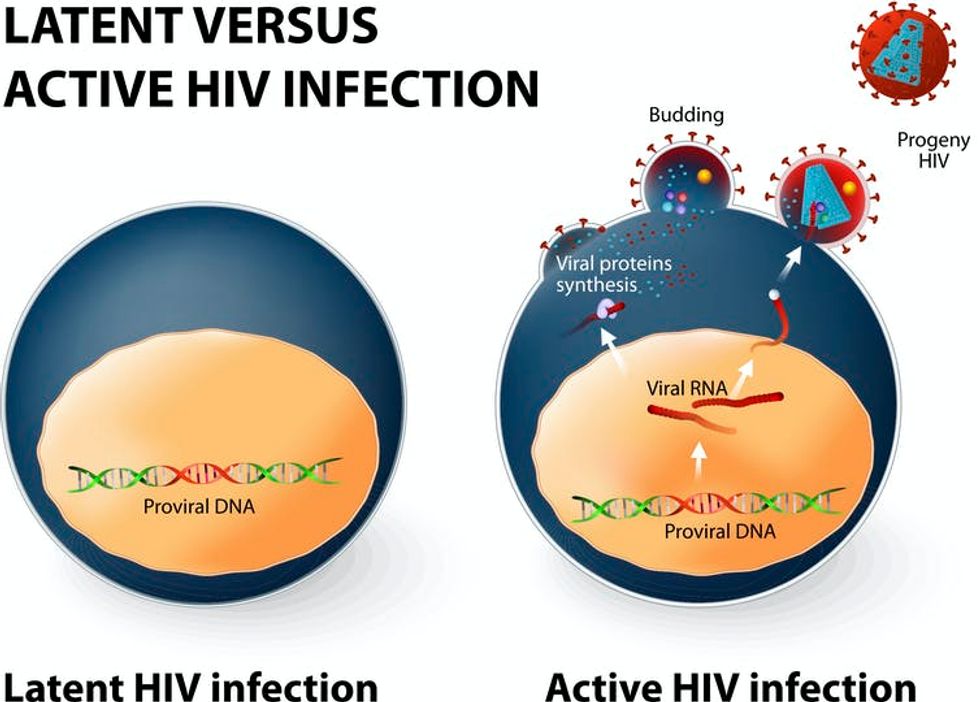
A latent viral infection occurs when the virus is present within an infected cell but dormant and not multiplying. In a latent virus, the entire viral genome is present, and infectious virus can be produced if latency ends and the infections becomes active. The latent virus may integrate into the human genome – as does HIV, for example – or exist in the nucleus as a self-replicating piece of DNA called an episome.
A latent virus can reactivate and produce infectious viruses, and this can occur months to decades after the initial infection. Perhaps the best example of this is chickenpox, which although seemingly eradicated by the immune system can reactivate and cause herpes zoster decades later. Fortunately, chickenpox and zoster are now prevented by vaccination. To be infected with a virus capable of producing a latent infection is to be infected for the rest of your life.
Latent infection (left) is when a cell is infected and the virus has inserted its genetic code into our human DNA. The immune system cannot detect this cell as being infected. An HIV infection can shift from latent to active if the infected cell is producing new viruses.
Herpes viruses are by far the most common viral infections that establish latency.
This is a large family of viruses whose genetic material, or genome, is encoded by DNA (and not RNA such as the new coronavirus). Herpes viruses include not only herpes simplex viruses 1 and 2 – which cause oral and genital herpes – but also chickenpox. Other herpes viruses, such as Epstein Barr virus, the cause of mononucleosis, and cytomegalovirus, which is a particular problem in immunodeficient individuals, can also emerge after latency.
Retroviruses are another common family of viruses that establish latency but by a different mechanism than the herpes viruses. Retroviruses such as HIV, which causes AIDS, can insert a copy of their genome into the human DNA that is part of the human genome. There the virus can exist in a latent state indefinitely in the infected human since the virus genome is copied every time DNA is replicated and a cell divides.
Viruses that establish latency in humans are difficult or impossible for the immune system to eradicate. That is because during latency there can be little or no viral protein production in the infected cell, making the infection invisible to the immune system. Fortunately coronaviruses do not establish a latent infection.
Is it safe for a man to have sex after recovering from COVID-19?
Could you catch SARS-CoV-2 from a male sexual partner who has recovered from COVID-19?
In one small study, the new coronavirus has been detected in semen in a quarter of patients during active infection and in a bit less than 10% of patients who apparently recovered. In this study, viral RNA was what was detected, and it is not yet known if this RNA was from still infectious or dead virus in the semen; and if alive whether the virus can be sexually transmitted. So many important questions remain unanswered.
Ebola is a very different virus from SARS-C0V-2 yet serves as an example of viral persistence in immune privileged sites. In some individuals, Ebola virus survives in immune privileged sites for months after resolution of the acute illness. Survivors of Ebola have been documented with persistent infections in the testes, eyes, placenta and central nervous system.
Could persistent symptoms after COVID-19 be due to viral persistence?
Recovery from COVID-19 is delayed or incomplete in many individuals, with symptoms including cough, shortness of breath and fatigue. It seems unlikely that these constitutional symptoms are due to viral persistence as the symptoms are not coming from immune privileged sites.
Where else could the new coronavirus persist after recovery from COVID-19?
Other sites where coronavirus has been detected include the placenta, intestines, blood and of course the respiratory tract. In women who catch COVID-19 while pregnant, the placenta develops defects in the mother’s blood vessels supplying the placenta. However, the significance of this on fetal health is yet to be determined.
The mounting evidence suggests that SARS-CoV-2 can infect immune privileged sites and, from there, result in chronic persistent – but not latent – infections. It is too early to know the extent to which these persistent infections affect the health of an individual like the pregnant mother, for example, nor the extent to which they contribute to the spread of COVID-19.
Like many things in the pandemic, what is unknown today is known tomorrow, so stay tuned and be cautious so as not to catch the infection or, worse yet, spread it to someone else.
Trump's campaign held the rally in Tulsa in an indoor venue where it did not require face masks or social distancing -- but New York Times reporter Maggie Haberman says the president and his advisers have no regrets about how they held the rally.
During an interview, CNN host Alisyn Camerota wondered if there was any remorse about holding the rally in the middle of the pandemic against the advice of medical professionals.
"Knowing that Herman Cain went to that Tulsa rally -- okay, the Tulsa rally that the medical experts in Tulsa did not want the president to hold because they knew it would be dangerous -- he went as a healthy, 74-year-old man," she said. "He was not sick, he was not positive for coronavirus that day. Then a month later, he is dead. Is there any feeling inside the White House of responsibility, of guilt, of connection to this?"
"This is not how the White House is is handling it," Haberman replied. "The White House continues to have a blinder view of all of this. They do not look at actions they have taken as having an impact on people getting sick, whether that's the Tulsa rally or a lack of sufficient testing across the country."
Hong Kong leader Carrie Lam announced Friday that the government will postpone highly anticipated legislative elections by one year, citing a worsening coronavirus outbreak in the semi-autonomous Chinese city.
The Hong Kong government is invoking an emergency ordinance in delaying the elections. Lam said the government has the support of the Chinese government in making the decision.
“The announcement I have to make today is the most difficult decision I’ve had to make in the past seven months,” Lam said at a news conference.
“We want to ensure fairness and public safety and health, and need to make sure the election is held in an open, fair and impartial manner. This decision is therefore essential,” she said.
The postponement is a setback for the pro-democracy opposition, which was hoping to capitalize on disenchantment with the current pro-Beijing majority to make gains. A group of 22 lawmakers issued a statement ahead of the announcement accusing the government of using the outbreak as an excuse to delay the vote.
“Incumbent pro-democracy legislators, who represent 60% of the public’s opinion, collectively oppose the postponement and emphasize the responsibility of the SAR government to make every effort to arrange adequate anti-epidemic measures to hold elections in September as scheduled,” the statement said, referring to the territory's official name, the Hong Kong Special Administrative Region.
“Otherwise, it is tantamount to uprooting the foundation of the establishment of the SAR.”
The city of 7.5 million people has had a surge in coronavirus infections since the beginning of July. Hong Kong has recorded 3,273 infections as of Friday, more than double the tally on July 1.
Controversial security law
The government has tightened social distancing restrictions, limiting public gatherings to two people, and banned dining-in at restaurants after 6 p.m.
The lead-up to the elections has been closely watched, after a national security law that took effect in late June stipulated that candidates who violated the law would be barred from running.
The new law is seen as Beijing’s attempt to curb dissent in the city, after months of pro-democracy and anti-government protests in Hong Kong last year.
On Thursday, 12 pro-democracy candidates including prominent pro-democracy activist Joshua Wong were disqualified from running for not complying with the city's mini-constitution or pledging allegiance to the local and national governments.
“Beyond any doubt, this is the most scandalous election ever in Hong Kong history,” Wong said at a news conference Friday. “I wish to emphasize that no reasonable man would think that this election ban is not politically driven.”
“Beijing has staged multiple acts to prevent the opposition bloc from taking the majority in the Hong Kong legislature,” he said.
"Tens of millions of Americans on the brink of eviction and food insecurity and the Senate just left for yet another 3-day weekend."
The Republican-controlled U.S. Senate has adjourned for a three-day weekend as enhanced unemployment payments are officially set to lapse on Friday, guaranteeing that tens of millions of Americans will see their incomes drop by 50-75% with another rent payment due in 24 hours.
The Senate's departure followed a long day of jockeying and blame-hurling on the floor Thursday that ultimately failed to produce a solution for the nearly 30 million Americans who for months have relied on the $600-per-week unemployment insurance (UI) boost to meet basic needs as the economy remains in deep recession.
"Mitch McConnell's failure to act already sealed this lapse, and half-measures and gimmicks from the White House cannot undo it."
—Rep. Don Beyer
The chamber is not set to reconvene until 3 pm Monday.
"Just so we're all clear," tweeted economist Robert Reich, "more than 25,000,000 unemployed Americans are about to lose their extra unemployment benefits, and the Senate just left for a three-day weekend. Republicans have lost the right to govern."
On Thursday afternoon, Sen. Ron Johnson (R-Wis.) attempted to pass by unanimous consent legislation that would give states an option to either pay out a federally funded $200-per-week UI boost or implement a formula that would replace two-thirds of a laid-off worker's previous wages. Sen. Ron Wyden (D-Ore.) called Johnson's proposal "so heartless even Cruella de Vil wouldn't endorse it."
Senate Minority Leader Chuck Schumer (D-N.Y.) blocked passage of Johnson's legislation—which would have amounted to a $1,600-per-month drop in benefits for millions of Americans—and subsequently attempted to pass the HEROES Act, a sprawling legislative package approved by the Democrat-controlled House in May that would extend the weekly $600 UI boost through January of next year. Johnson blocked the bill.
Later, Sen. Martha McSally (R-Ariz.) tried to pass a one-week extension of the $600 boost but Schumer objected, dismissing the effort as "clearly a stunt." The Washington Post's Jeff Stein noted on Twitter that it likely would have taken around two weeks for the one-week extension payment to actually reach people.
As Politicoreported Thursday, "tens of millions of laid-off American workers will go weeks without federal jobless aid—because Congress hasn't renewed the benefits in time for overwhelmed state unemployment systems to adjust their computers."
"State offices will need weeks to reprogram their systems to account for an extension of the $600 weekly federal payments that expire on Saturday—or any changes that Congress makes to the benefit amount or eligibility rules," Politico reported. "That comes on top of hardships faced by workers in states like Washington and Nevada, who are already waiting months to get their first payments in the middle of the coronavirus pandemic because their unemployment offices can't handle the historic flood of claims."
Rep. Don Beyer (D-Va.) tweeted late Thursday that Democratic lawmakers have been warning for weeks about the coming lapse in benefits—but Senate Republicans, led by Majority Leader Mitch McConnell (R-Ky.), refused to budge.
"Mitch McConnell's failure to act already sealed this lapse," said Beyer, and half-measures and gimmicks from the White House cannot undo it."
Ryan Thomas, national press secretary for advocacy group Stand Up America, tweeted that "Mitch McConnell is holding our economy and our democracy hostage" by skipping town without passage of Covid-19 relief.
"He's threatening our lives and livelihoods," Thomas wrote. "Indefensible and disgusting."
Schumer and House Speaker Nancy Pelosi (D-Calif.) met once more Thursday night with White House Chief of Staff Mark Meadows and Treasury Secretary Steve Mnuchin, but the two sides emerged apparently without making any progress toward a deal.
"We had a long discussion and we just don't think they understand the gravity of the problem," Schumer said at a press briefing following the meeting. "The bottom line is this is the most serious health problem and economic problem we've had in a very—in a century and in 75 years. And it takes really good, strong, bold action. And they don't quite get that."
The Senate's failure to secure an extension of the UI boost came on the same day the Commerce Department reported that the U.S. economy contracted at a record-shattering 32.9% rate last quarter. The Labor Department also reported Thursday that 1.43 million people filed jobless claims last week.
Heidi Shierholz, senior economist and director of policy at the Economic Policy Institute, noted in a blog post that "last week was the 19th week in a row that unemployment claims have been more than twice the worst week of the Great Recession."
"Republicans in the Senate just allowed the across-the-board $600 increase in weekly UI benefits to expire," Shierholz wrote. "They are proposing to (essentially) replace it with a $200 weekly payment. That $400 cut in benefits is not just cruel, it's terrible economics. These benefits are supporting a huge amount of spending by people who would otherwise have to cut back dramatically. The spending made possible by the $400 that the Senate wants to cut is supporting 3.4 million jobs."
Muslim pilgrims took part Friday in the "stoning of the devil", using sanitized pebbles in the last major ritual of the scaled-down hajj as Saudi authorities seek to prevent a coronavirus outbreak.
Massive crowds in previous years triggered deadly stampedes during the ritual, but this year only up to 10,000 Muslims are taking part after millions of international pilgrims were barred.
In the scorching heat, worshippers made their way across Mina Valley near Mecca in western Saudi Arabia under the watchful eyes of security forces, to symbolically "humiliate" the devil.
Masked pilgrims, clad in white and observing social distancing, threw seven stones each at a pillar symbolizing Satan.
Hajj authorities offered the pilgrims pebbles that were sanitized to protect against the pandemic.
Friday also marks the beginning of Eid al-Adha, the feast of sacrifice.
Muslims traditionally slaughter sheep for the three-day holiday in tribute to the Prophet Abraham's sacrifice of a lamb after God at the last moment spared Ishmael, his son.
Traditionally they consume some of the meat and give the rest to the poor.
- 'Dream come true' -
Last year, Saudi Arabia's King Salman made the trip to Mina and was seen on state-run television observing worshippers from the window of a high-rise.
But it was unclear whether he would visit this year.
The kingdom's 84-year-old ruler left a Riyadh hospital on Thursday, authorities said, after a 10-day stay where he underwent surgery to remove his gall bladder.
The hajj, one of the five pillars of Islam and a must for able-bodied Muslims at least once in their lifetime, is usually one of the world's largest religious gatherings.
But local media said up to 10,000 people already residing in the kingdom are participating in this year's ritual, compared with 2019's gathering of some 2.5 million from around the world.
The hajj ministry had initially said around 1,000 pilgrims will be allowed.
On Thursday, pilgrims scaled Mount Arafat for Koran recitals and prayers to atone for their sins in what is seen as the high point of the hajj.
"I am so happy to be chosen among millions for the hajj this year," Saudi pilgrim Wedyan Alwah said before setting off on the climb.
"My lifetime dream has come true."
They made their way down Mount Arafat to Muzdalifah, another holy site, where they spent the night before the stoning ritual.
In previous years, the ritual was not without risk as millions of pilgrims converge on a tight space and the pebbles often miss their mark.
Riyadh faced strong criticism in 2015 when some 2,300 worshippers were crushed, trampled or suffocated in Mina in the deadliest stampede in the gathering's history.
Authorities have since reinforced safety and security measures.
- Health precautions -
After the stoning ritual, pilgrims will return to the Grand Mosque in Mecca to perform a final "tawaf" or circling of the Kaaba.
The Kaaba, the focal point of Islam, is a cube structure towards which Muslims around the world pray.
It is draped in a black cloth embroidered in gold with Koranic verses and known as the kiswa, which is changed each year during the pilgrimage.
The hajj began on Wednesday when pilgrims were brought inside the mosque in small batches.
They walked along socially distanced paths marked on the floor, in sharp contrast to the normal sea of humanity that swirls around the Kaaba during hajj.
The pilgrims, who have all been tested for the virus, and were required to be quarantined before the hajj and are to be quarantined again afterwards, authorities said.
"Health precautions have been thoroughly and meticulously implemented in all stages" to protect against the pandemic, Hussein al-Sharif, a senior hajj official was quoted as saying by the media ministry.
The hajj typically costs thousands of dollars for pilgrims, who often save for years as well as endure long waiting lists for a chance to attend.
But this year, the Saudi government is covering the expenses of all pilgrims, providing them with meals, hotel accommodation and health care, worshippers said.
The Spanish flu has swept back into public consciousness thanks to Covid-19, ending its status as a “forgotten pandemic”. Experts emphasize that the infamous second wave of this flu from a century ago was a very different disease from Covid-19 – but also say that it provides historical lessons to help face fears of a resurgent coronavirus.
Covid-19 infection rates are soaring in a variety of countries, several months on from the grueling lockdowns that characterized the spring across the globe.
In the US, the average daily number of new confirmed infections has skyrocketed since mid-June – while in Spain, one of the countries the virus hit hardest in the early months of the pandemic, a big rise in cases prompted the UK to impose sudden travel restrictions on Saturday. Several countries previously acclaimed for managing the pandemic deftly – such as Australia and Vietnam – have seen alarming new coronavirus clusters.
The World Health Organization argued on Wednesday that – despite journalists’ and politicians’ frequent use of it – the term “second wave” is inaccurate and that it would be preferable to describe Covid-19 as having “one big wave”, seeing as the virus never went away and does not follow seasonal variations.
‘Lethal’
This puts it in stark juxtaposition to the previous pandemic to take the world by storm. The 1918-20 Spanish flu came in three waves, during which it killed at least 30 million people across the globe, with some historians putting the figure at 100 million – making it more deadly than the Great War that long overshadowed it in the collective memory.
This first wave of the pandemic in spring 1918 was highly contagious and put a gargantuan spanner in the works of both sides’ war efforts. Nevertheless, it was not especially virulent – official death rates were similar to those from the seasonal flu.
But in the autumn the virus re-emerged in a terrifying second wave, the most severe of the three. In the US – where the historical data on the Spanish flu is most complete – the excess mortality rate from September to December 1918 reached 266,000. “Let’s just say that the reconstructed virus continues to be lethal in lab animals,” John Barry, author of The Great Influenza, a study of the Spanish flu, told FRANCE 24.
The tendency of flu to evolve was likely responsible for this increased virulence, explained Erin Sorrell, an assistant professor of microbiology and immunology at Georgetown University: “The increase in lethality is assumed to be in part due to mutations accumulated by the virus in its initial first wave as influenza viruses are prone to point mutations called antigenic drift that allow them to evade existing immunity from previous infections,” she told FRANCE 24
In this respect, the coronavirus seems less menacing: “This virus is much more stable,” Barry noted. “There is no hint anywhere in the world of it becoming more lethal, as happened in 1918.”
There was a range of different responses to the new strain of Spanish flu. In France, where it killed 240,000 people in all three waves collectively, during the second wave the government was still focused on the war effort, with the conflict in its endgame before the November 1918 Armistice. There were bans on some gatherings and a few public places were closed – but nothing on a similar scale to the Covid-19 lockdowns.
However, in the US – a combatant during the last year of the war, but which was spared the carnage seen on the Western Front – some authorities felt free to try and stem the disease’s spread, with several parts of the country shutting down schools, churches and restaurants.
“The initial wave was somewhat glossed over; the war was still very much ongoing, and doctors were focused on keeping soldiers healthy and on the battlefield,” Jim Harris, a historian of science at Ohio State University, told FRANCE 24. “But during the second wave when it became much more virulent, that’s when some policymakers felt forced to react.”
One notorious super-spreader event early in the second wave testifies to the benefits of social distancing measures. On September 28, 1918, more than 200,000 people attended the Philadelphia Liberty Loans Parade to promote the sale of US government war bonds – even though experts had told the city’s health commissioner that the event should not take place.
A historical lesson can be learned by comparing Philadelphia to St. Louis (which cancelled its parade along with other mass gatherings), according to the US Centers for Disease Control and Prevention: “The next month, more than 10,000 people in Philadelphia died from pandemic flu, while the death toll in Saint Louis did not rise above 700. This deadly example shows the benefit of cancelling mass gatherings and employing social distancing measures during pandemics.”
Experts say this contrast between Philadelphia and St. Louis is part of a bigger picture, in which public health measures clearly helped combat the Spanish flu. “We have learned that during the response to the 1918-19 pandemic (particularly in the US) those cities and states that enacted regulations for the use of face masks, banning large gatherings and closing schools fared better than those that did not,” Sorrell noted.
Young adults hit hard
The coronavirus has opened a generational divide over these kinds of measures – notably demonstrated by an episode this week in Brittany, where a cluster of cases among beachgoers in their twenties provoked a furious response from the French government’s top official in the region, who lambasted “irresponsible” young people “ignoring the danger”.
However, during the second wave of the Spanish flu, many young people were in the same position as the elderly today: the pandemic a century ago was especially lethal for previously healthy people aged 25 to 35. Its second wave affected age groups in a W-shaped curve – hitting infants, young adults and the elderly hardest. This was unusual because influenza – including the first wave of the Spanish flu – typically has a U-shaped curve: it is most dangerous for infants and the elderly, without being particularly virulent in young adults.
The question of why it affected this age group so brutally “has still not been answered”, Barry said. “There are only hypotheses,” he continued. “The most likely one is that young people have stronger immune systems, which overreacted, creating cytokine storms in the lungs” – in which the body’s overly active defences cause even more inflammation.
Even amid this bewildering phenomenon, many people from all age groups tired of taking precautions to avoid contagion as the months went on: during both the coronavirus pandemic and the second wave of the Spanish flu, “People think there comes a moment when it’s time for all this to be over”, Naomi Rogers, a professor of the history of medicine at Yale University, told FRANCE 24.
Despite some hubristic behaviour during the current crisis, the huge advances in science and technology since the time of the Spanish flu – when the nature of viruses remained a mystery – are a genuine source of hope, Sorrell added: “We have, on a global scale, scientific skill and expertise, technology, resources and methods for information sharing.”
However, she continued, there remains a crucial task in the fight against the coronavirus – highlighted by the catastrophic results in places like Philadelphia during the second wave of the Spanish flu, where officials refused to heed warnings about the need for social distancing. “Our challenge today," said Sorrell, "is in disseminating the correct information to the public about the pandemic, giving credit and a voice to our scientists to dispel misinformation and encouraging our national leaders to prioritise public health preparedness and response.”
The NBA relaunched its coronavirus-hit season on Thursday, with players taking a knee during the US national anthem in a show of support for the Black Lives Matter movement.
Four months after the league shut down in March due to the COVID-19 pandemic, the NBA is restarting its season with 22 teams based inside a secure "bubble" at Disney World in Orlando, Florida.
The unprecedented NBA experiment began on Thursday with the Utah Jazz defeating the New Orleans Pelicans 106-104 in an empty arena at the resort's ESPN Wide World of Sports Complex.
The first and last points of the game were scored by Utah's Rudy Gobert -- the Frenchman whose COVID-19 case triggered the NBA's shutdown in March.
The Los Angeles Lakers and Los Angeles Clippers were due to play later Thursday in the second game of the day.
Ahead of the opening tip-off, players from the Jazz and Pelicans -- wearing t-shirts emblazoned with "Black Lives Matter" -- kneeled in unison as the "Star-Spangled Banner" played.
The demonstration followed weeks of soul-searching about racism and police brutality in the United States following the death of unarmed black man George Floyd during his arrest by police on May 25 in Minneapolis.
Many NBA players joined protests against the killing which swept across all 50 states in June, and the cause of social justice has loomed large ahead of the league's restart.
Large "Black Lives Matter" slogans have been written on each court, while players are allowed to wear jerseys adorned with messages ranging from "I Can't Breathe" to "Justice Now" and "Education Reform."
Taking a knee has become an emblematic way of showing solidarity with anti-racism campaigners, adopted by athletes around the world in the months since Floyd's death.
Kneeling during the US national anthem was first started by former San Francisco 49ers quarterback Colin Kaepernick in 2016.
Kaepernick used the gesture to draw attention to racial injustice but was widely vilified for his stance and has not played in the NFL since being released by San Francisco in early 2017.
'Unique circumstances'
While the NBA has a long-standing rule requiring players to stand for the national anthem before games, league commissioner Adam Silver said Thursday no players would be sanctioned.
"I respect our teams' unified act of peaceful protest for social justice and under these unique circumstances will not enforce our long-standing rule requiring standing during the playing of our national anthem," Silver said.
Thursday's games marked a resumption of regular season play to determine the final line-up for the NBA playoffs, which start on August 17.
The tightly-controlled "bubble" setting in Orlando is designed to prevent an outbreak of COVID-19 halting play once more.
Florida has emerged as one of the worst-hit COVID-19 hotspots in the United States, with cases and fatalities skyrocketing in recent weeks.
Since Gobert's positive case brought the league to a standstill, the US death toll from COVID 19 has soared from just 40 to more than 150,000.
NBA officials however are confident that the decision to base teams inside a single secure location will allow them to play the remainder of the season in safety.
The latest round of 344 tests of players conducted since July 20 returned zero positive cases.
Players are required to undergo regular COVID-19 testing and the ability to enter and exit the secure zone is subject to stringent regulations.
Team and NBA personnel are staying in three hotels dotted throughout the resort, with a small number of media, sponsors and inactive players also allowed in.