However, Trump administration sources are telling The Daily Beast that Kushner has been notably absent in recent weeks, and they are unsure of what work he's actually doing.
“[Jared] could be in his office just googling ‘coronavirus,’ show the results to the president, and still get a gold sticker from his dad-in-law,” one senior Trump administration official who works with the coronavirus task force tells the publication. “He is solving the coronavirus like he’s bringing peace to the [Middle East].”
Officials say that much of Kushner's time has been spent trying to engage allies in the private sector to help with the administration's response, although the results have "provoked mockery and some internal face-palming."
Additionally, The Daily Beast reports that "several of the projects that Kushner’s team has helmed to help do that are running behind schedule or are causing massive disruptions in the way states are handling their own coronavirus responses."
In particular, state officials are saying that Kushner's efforts at buying up supplies for the national stockpile has actually harmed their ability to secure needed equipment for medical professionals.
After six weeks of being stuck in their homes, a growing number of Parisians appear unable to wait for the May 11 lifting of the nationwide lockdown, venturing out even as officials warn of a new surge in COVID-19 cases if people let down their guard too early.
The city's parks may be closed, but spring sunshine drew throngs of strollers to canals and other promenades over the weekend, despite strict social distancing decrees.
Joggers packed sidewalks and paths of public lawns that could not be blocked off, in particular at the forested Boulogne and Vincennes parks at opposite ends of the city, before the daytime jogging ban came into effect.
And social media was abuzz with a video of a few dozen people dancing in a Montmartre square to the tune of Dalida's "Laissez-moi Danser" (Let me Dance) on Saturday night.
Police showed up nearly immediately to disperse the crowd, and the DJ reportedly promised to no longer blast songs from his window.
But a police source told AFP that no tickets were handed out for breaching the confinement rules, which can see people without a valid reason to be out fined 135 euros ($146).
"Overall, Parisians are being civic-minded," said Pierre-Yves Bournazel, a city council member for the 18th arrondissement where the impromptu disco took place.
"But if we want to avoid new contagions, we're going to have to respect the measures in place," he said.
Overall, police have carried out more than 1.1 million checks in Paris alone since the lockdown was imposed on March 17, issuing around 69,000 fines, officials said Saturday.
But as Prime Minister Edouard Philippe prepares to lay out post-confinement plans Tuesday, more Parisians could be tempted to get out of cramped apartments before May 11, when some stores and schools are set to reopen.
- 'It's not easy' -
Mickael, one of the hundreds of Parisians along the Ourcq canal, told AFP that "from a humane perspective, it's not easy staying cooped up in a house all day long. Humans aren't designed to live like that, isolated like that."
Eric, wearing a bandanna over his mouth and nose, admitted that he had been going out every day "to walk around the block and get some exercise".
"You can put a cross for fitness, so there you go," he said, referring to one of the seven allowed reasons for leaving on the self-signed document everyone must carry when going out.
Emmanuel Latil, one of the dozens of public safety officers deployed across Paris, spent the weekend urging people hanging out in the Bois de Vincennes on the eastern edge of the city.
"The security ribbons forbidding access were torn down, so people didn't realise they weren't allowed in," he said.
He later told two women in the park: "Be careful. I can see you've touched the benches, so wash your hands well before touching your faces."
New York, which has ground to a halt to stop the coronavirus pandemic, may start reopening manufacturing and construction after May 15, Governor Andrew Cuomo said Sunday.
Cuomo, however, said that any easing of measures would take place first in the north of the state and not in the New York City metropolitan region, by far the hardest-hit area in the United States.
"The regions that would be more likely able to open sooner would be the upstate regions," Cuomo told reporters. "Downstate New York is going to be more complicated."
He said that any potential reopening of New York City, the country's most populous city, could need to be coordinated with authorities in the adjacent states of New Jersey and Connecticut.
A lockdown of New York ordered by Cuomo is set to expire on May 15. Under a plan for reopening, the first sectors would be construction and manufacturing.
Cuomo said the state was operating with a caveat -- "don't do anything that's going to bring people in from all across the board."
Cuomo has called for a two-week delay before the next stage of reopenings, which would include most offices, to ensure that the first phase does not trigger a resurgence of the virus.
The governor stressed that any final decision would be conditioned on a downturn in COVID-19 hospitalizations between now and May 15.
The state on Sunday reported 367 fatalities in the previous 24 hours, the lowest number since March 30 when 332 people died.
COVID-19 has now killed 16,966 people in New York state, accounting for around a third of the deaths in the United States.
To reopen, businesses will need to present New York authorities with plans that show they are ensuring sanitation to reduce the risk of virus transmission.
Cuomo said that no full-scale return to normal could come until the reopening of schools, which would allow parents to work outside of home.
New York state has not made a decision on reopening the education system, although Mayor Bill de Blasio has said that he considers the rest of the school year cancelled in the city.
Cuomo said that some school districts were studying whether to hold summer sessions to make up for lost time.
A national security expert told CNN on Monday that President Donald Trump has given Americans no choice but to disregard everything he says about the COVID-19 pandemic.
Juliette Kayyem, the former U.S. Assistant Secretary of Homeland Security for Intergovernmental Affairs for President Barack Obama, told CNN's Alisyn Camerota that Trump's musings about the benefits of injecting people with disinfectant to treat COVID-19 appear to have been the last straw for even many Republicans who are now pushing to have him stop giving regular briefings about the pandemic.
"I've often said from the beginning, if the president can't be useful, make him irrelevant," she said. "It sounds like he's going to get out of the lane that matters the most, which is the protection of lives and the protection of our first responders, and maybe turn into a lane which also matters, which is economics."
While Kayyem didn't exactly endorse whatever solutions Trump would propose to revive the economy, she said that having him focus on economics is "not going to kill people directly right now."
"If people, like governors, begin to isolate the president and his bad information, we will be in a better place," she concluded.
China's ambassador in Australia has warned that demands for a probe into the spread of the coronavirus could lead to a consumer boycott of Aussie wine or trips Down Under.
Australia has joined the United States in calling for a thorough investigation of how the virus transformed from a localised epidemic in central China into a pandemic that has killed more than 200,000 people, forced billions into isolation and torpedoed the global economy.
In a thinly veiled threat, ambassador Cheng Jingye warned the push for an independent inquest into the origins of the outbreak was "dangerous".
"The Chinese public is frustrated, dismayed and disappointed with what Australia is doing now," he claimed in an interview with the Australian Financial Review published on Sunday.
"If the mood is going from bad to worse, people would think 'why should we go to such a country that is not so friendly to China?' The tourists may have second thoughts," he added.
"It is up to the people to decide. Maybe the ordinary people will say 'Why should we drink Australian wine? Eat Australian beef?'"
Cheng also threatened the flow of Chinese students to Australian universities, a key source of revenue that is already under threat from pandemic travel restrictions.
"The parents of the students would also think whether this place which they found is not so friendly, even hostile, whether this is the best place to send their kids here," he said.
The comments mark a significant escalation in tensions between Beijing and Canberra, whose relations are already strained.
They also reflect the willingness of a new generation of Chinese diplomats to aggressively and publicly push Communist Party interests, using Chinese economic might as leverage if necessary.
Experts have said a full investigation into the coronavirus outbreak could prompt scrutiny of China's rulers and their response to the crisis, and open the door for the type of criticism of the Party that is rarely tolerated.
Cheng also accused Australia of echoing talking points from the United States.
"Some guys are attempting to blame China for their problems and deflect the attention," he said.
"It's a kind of pandering to the assertions that are made by some forces in Washington."
Spanish children ventured outside for the first time in weeks on Sunday, and Italy and New York laid out partial reopening plans as marked decreases in deaths from the global coronavirus pandemic stirred hopes.
Even as confirmed virus infections around the world approached three million, governments were increasingly itching to revive shuttered economies -- although there was intense debate on how quickly to move forward.
In one sign of the turnaround, British Prime Minister Boris Johnson returned to his Downing Street official residence, a month after he tested positive for the virus and later went into intensive care.
On the streets of hard-hit Spain, children hopped on bicycles and scooters -- some wearing small masks and gloves -- as the government allowed children outside for the first time since mid-March.
"They are super excited, very, very impatient. They were up at 6:30 am, saying 'We are going out, We are going out!'," Inmaculada Paredes said in Madrid, readying to take her seven- and four-year-old children outdoors.
AFP / Hector RETAMAL A Shanghai bar patron waits for his drink while wearing a mask to guard against the COVID-19 coronavirus
One six-year-old, Ricardo, said it felt "very good" to be able to run around with his younger sister in the city.
"We played hide and seek, we raced. We found a ladybug that was lost," he said.
Under the revised rules, children are allowed out once per day between 9:00 am and 9:00 pm, but cannot venture more than one kilometre (0.6 miles) from home.
With more than 23,000 fatalities, Spain has the third highest death toll in the world after Italy's 26,000. The United States has the highest death toll, which on Sunday neared 55,000.
- 'If you love Italy...'-
AFP / MARCO BERTORELLO Women wait for distribution of bread traditionally considered to be blessed on the Feast of San Giorgio in the northern town of Caresana in virus-hit Italy
Italy, which shut down in March as the disease's devastation became clear, gave the green light for wholesale stores and restaurants to resume business on May 4 and for people once again to stroll in parks and visit relatives.
Other shops will open three weeks later as will Italy's many museums -- just in time for summer, when in ordinary times tourists would swarm the country.
But Prime Minister Giuseppe Conte told Italians that they would still have to wear face masks in public and rigorously observe social distancing.
"If you love Italy, keep your distance from others," Conte said in a national address.
In New York, where the signature bustle has been reduced to an eerie halt, Governor Andrew Cuomo said that a first stage of a reopening would start on May 15 if hospitalizations decrease.
Only construction and manufacturing would resume at first and solely in the north of the state rather than New York City, with a two-week delay and checks for new contagion before office-workers return.
AFP / Simon MALFATTO The global spread of the coronavirus
The pandemic has forced more than half of humanity into lockdown, upending life as we know it and tipping the global economy toward a recession not seen in decades.
More than 205,000 people have died from the virus since it first emerged in China in December -- well over half in Europe -- and more than 2.9 million cases have been recorded, according to an AFP tally.
But Europe's worst-hit countries -- Italy, Spain, France and Britain -- all reported drops in daily fatality rates Sunday, a sign the peak of the weeks-long crisis may have passed.
Britain's daily tally was the lowest since March 31, while Italy and Spain's were the lowest in a month. France's toll was a drop of more than a third on the previous day's figures.
In Switzerland, hairdressers, massage parlours, florists and garden centres were among some businesses allowed to reopen come Monday.
"It's super," said Florian, a barbershop manager in Lausanne who was asking customers to wait their turn outside.
AFP / ANDY BUCHANAN The United Kingdom has resisted calls to ease lockdown restrictions
"We have to start paying the bills," he said.
Millions of Muslims are under restrictions as they begin Ramadan, the month of dusk-to-dawn fasting that in happier times involves large family meals.
Saudi Arabia said it would partially lift its curfew, allowing malls and retailers to open their doors for certain hours, but would maintain a round-the-clock lockdown in the Muslim holy city of Mecca.
AFP / BANDAR ALDANDANI Millions of Muslims are celebrating Ramadan at home
In a reversal, Sri Lanka extended its lock down another week, scrapping reopening plans after a spike in infections.
- How quickly back to normal? -
AFP / TIMOTHY A. CLARY A lone person in mask walks down the steps at the Bethesda Terrace in Central Park in New York City
Rejecting the advice of top disease experts, the US state of Georgia allowed thousands of businesses to resume operations, from hairdressers to bowling alleys.
"How long are we supposed to imprison ourselves?" said bikini-clad Mackenzie Scharf said as she enjoyed the return to the beach.
Oklahoma, another conservative-led state, will let restaurants, movie theatres and other public places reopen from May 1.
"People are still going to get it. But Oklahomans are safe and we're ready for a measured reopening," Governor Kevin Stitt told Fox News.
President Donald Trump, bracing for November elections, has been impatient to resume business.
AFP / CHANDAN KHANNA Beachgoers in the US state of Georgia flocked to the shore after the government lifted lockdown orders
The US leader faced a fresh volley of criticism after suggesting that coronavirus could be treated by shining ultraviolet light inside patients' bodies, or with injections of household disinfectant.
He lashed out Sunday at the media, threatening lawsuits and asking the "Noble Committee" to rescind awards -- a reference to the Nobel Prize, which has no journalism category -- in a tweet he later deleted.
- Immunity warning -
While cases and deaths plateau, the world remains in wait as scientists race to develop treatments and, eventually, a vaccine for the virus.
AFP / LAKRUWAN WANNIARACHCHI A Sri Lankan Navy officer wearing a facemask holds a stop sign at a checkpoint during a government-imposed nationwide lockdown in Colombo
Some governments are studying measures such as "immunity passports" as one way to get people back to work.
The World Health Organization warned that people who survive infection cannot be certain they will not be hit again by the respiratory disease.
Deborah Birx, the doctor who coordinates the White House's coronavirus response, said that the WHO was being "very cautious".
Several countries, including France and Germany, are planning to introduce coronavirus tracing apps to alert users if they are near someone who has tested positive.
The technology has already rolled out in Australia, sparking privacy concerns, and has been widely used in Singapore.
Prime Minister Jacinda Ardern on Monday claimed New Zealand had scored a significant victory against the spread of the coronavirus, as the country began a phased exit from lockdown.
"There is no widespread, undetected community transmission in New Zealand," Ardern declared. "We have won that battle."
After nearly five weeks at the maximum Level Four restrictions -- with only essential services operating -- the country will move to Level Three late on Monday.
That will allow some businesses, takeaway food outlets and schools to reopen.
But Ardern warned there was no certainty about when all transmission can be eliminated, allowing a return to normal life.
Everyone wants to "bring back the social contact that we all miss", she said, "but to do it confidently we need to move slowly and we need to move cautiously."
"I will not risk the gains we've made in the health of New Zealanders. So if we need to remain at Level Three, we will."
The easing of restrictions came as New Zealand, a nation of five million people, reported only one new case of COVID-19 in the past 24 hours, taking the total to 1,122 with 19 deaths.
There has been passionate – and honest – argument about how many people are likely to get sick and die under different circumstances and sets of official rules. It’s not clear how uncertain and evolving scientific findings should affect extraordinary government measures that restrict citizens’ basic freedoms.
CNBC’s Rick Santelli questions a part of the 2009 federal bailout plan.
Seeking authentic feelings
Dissent – and the freedom to do it – is a crucial element of democracy. Political leaders are rightly influenced by public opinion. But it’s important to know when protests are sparked by special-interest groups seeking to manipulate officials’ perception of public sentiment.
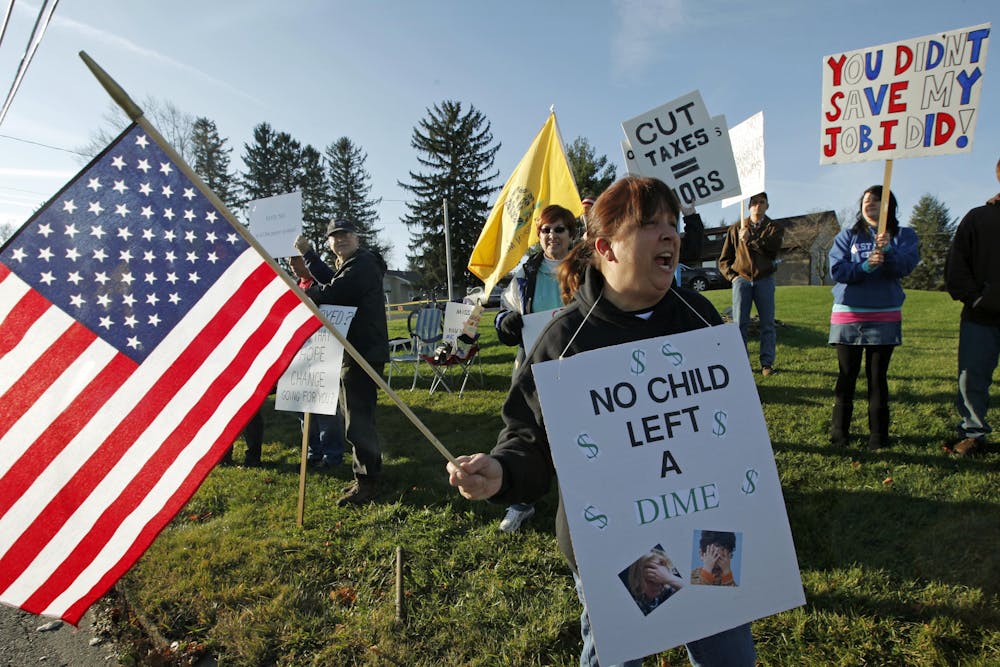
As a journalist who has covered politics for 20 years and now studies how people process uncertainty, I note that the questions about the current protests raise echoes of the Tea Party movement a decade ago.
In February 2009, the Obama administration was grappling with a severe economic crisis caused by a collapse in the mortgage market. A reporter on CNBC, Rick Santelli, began to complain that one part of the federal bailout plan, the Homeowner Affordability and Stability Plan, might let people out of their mortgage obligations even if they should have anticipated they wouldn’t be able to afford them and would face foreclosure.
Santelli made this point on TV while standing on the floor of the Chicago Mercantile Exchange, surrounded by very wealthy traders who egged him on. It was compelling entertainment, and the speech spread rapidly through conservative media. Radio host Rush Limbaugh replayed it on his show; conservative strategists admired it, and millions of conservatives heard it.
Santelli called for a modern-day “tea party” to object to unfair government rules.
Within months, a coalition of anti-immigration reform activists, fiscal hawks, regulation opponents and social conservatives pulled together behind a common set of grievances: Barack Obama’s alleged profligate spending, his willingness to let certain groups get ahead in the economy over other groups – policies that many of them viewed as putting racial minorities at a perceived advantage to white people.
Calling themselves the Tea Party movement, most members were Republicans – but the Republican Party wasn’t speaking for them, so the nation’s two-party structure itself became a common enemy, too. When the Tea Party held its first protests, thousands of people showed up. As the protests spread, motivated partisans who look for opportunities to change attitudes and behaviors, backed by a conservative political funding machine, developed a way to capture the protest energy and channel it effectively.
Authentic protest – like how the Tea Party movement began – is a longstanding American tradition.
Social scientists who study new movements in politics find that the underlying sentiments are as old as civilization itself: Who gets the stuff that the government gives out? What’s fair? Who’s jumped the line?
The movement needs a common enemy – in that case, Obama, his policies and a political structure that permitted them – and the potential for real change, not just politically but socially as well. For those joining the Tea Party, the goal became clear: They could take over the Republican Party.
Fairly quickly, the Tea Party was co-opted by wealthier interests hoping to channel its energy toward slightly different ends – although much of the movement resisted the corporate takeover of its message. Public opinion surveys backed up the intuition that the movement had force.
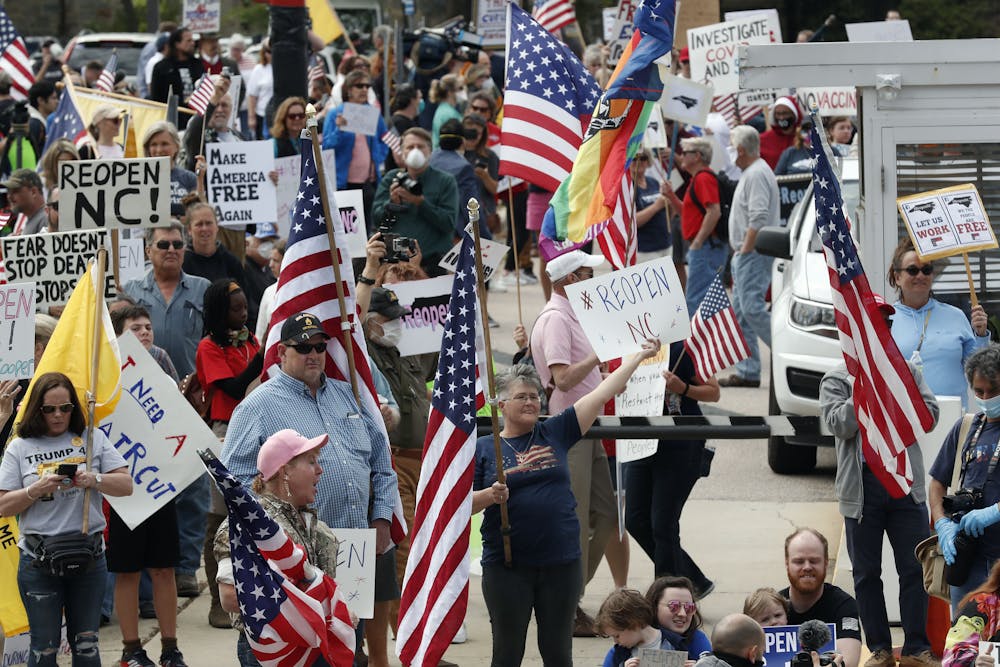
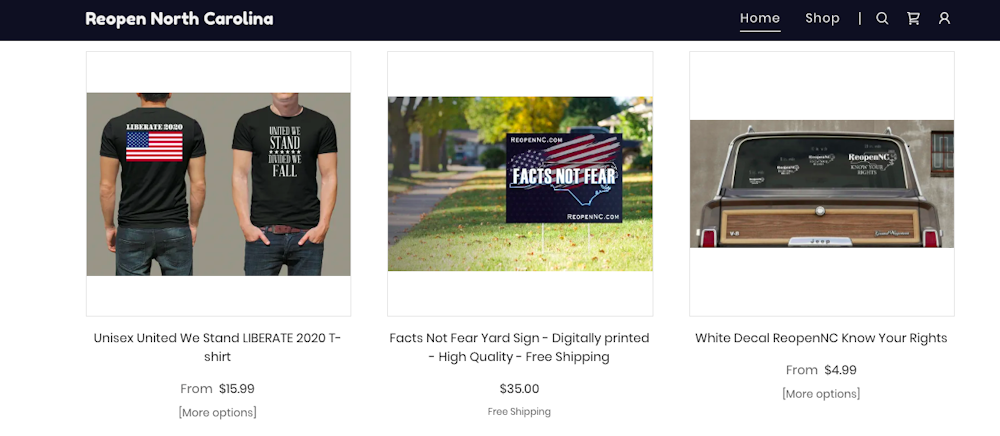
A North Carolina protest was ostensibly coordinated by ReopenNC, whose website was registered by a Florida resident and focuses on selling T-shirts and stickers.
In mid-April 2020, it appeared, a new movement was rising to express frustration with the restrictions and uncertain endpoint to the pandemic, and the economic toll the lockdown has caused.
In the space of several days, there were protests in a dozen states, ranging from a crowd of more than 2,000 who gathered in Olympia, Washington, to several dozen in Annapolis, Maryland.
The available evidence suggests that the demonstrations were organized by paid political operatives using Facebook and new websites to encourage conservatives to protest in specific places against specific governors who had imposed strong public health restrictions on economic activity. This context indicates that one real intention of the protests was to create the illusion of an organic movement that had arisen to object to the restrictions. Evidence is to the contrary: Polling shows that just 12% of Americans think their local restrictions have gone too far – and 26% think they don’t go far enough.
He found that many of these websites, whose registration records you can see yourself at Whois.com, were owned by anti-gun-control groups that are run by the same family of brothers that organized the demonstrations through Facebook groups they run.
Several others of the “reopen” websites were registered with addresses or phone numbers used by longstanding conservative enterprises like Freedom Works. A surprising number belonged to an activist who told Mother Jones that he registered the domains to keep conservatives from using them to counter the recommendation of public health officials.
The ‘Reopen North Carolina’ website focuses on selling merchandise.
But that creates a sense that these protests grew quickly, spontaneously, and organically. The fact that protests happened in different places at different times doesn’t actually mean they’re spreading. When organized by the same small group of political operatives, sequential protests reflect the creators’ skill at mobilizing people – not a naturally rising level of frustration that ultimately pushes people to act.
Many political movements use these tactics. The problem comes from how the media presents the resulting events. On April 21, a labor union organized a protest by nurses at the White House – and media reports noted the event was created by a particular group with a specific purpose. That’s different from how the media treated the “reopen” gatherings.
"It's no use going on to what might have been," said Democratic Speaker of the House on Sunday morning when asked about her legislative strategy against Republicans.
Amid growing criticism from progressives and increased anxiety among the nation's working families, small business owners, and local and state governments that economic relief from the coronavirus pandemic will come too late and be too little, House Speaker Nancy Pelosi on Sunday told television viewers to "just calm down" when asked if she had erred in her legislative strategy with the TrumpWhite House and Senate Majority Leader Mitch McConnell.
Asked by CNN's Jake Tapper on "State of the Union" if she had made a "tactical mistake" by allowing an "interim" piece of coronavirus relief package—known as COVID 3.5—to pass last week without much stronger support for state and local governments, Pelosi deflected on the premise.
"Just calm down," Pelosi said. "We will have state and local and we will have it in a significant way. It's no use going on to what might have been."
Pelosi argued that Democrats "made the most of" the interim package—moving McConnell to a large expansion of the Paycheck Protection Program (PPP) for small businesses—but promised once again that a larger package was on its way.
Pelosi said local and state lawmakers, including New York Gov. Andrew Cuomo, are right to be frustrated in terms of lack of emergency funding for local governments. "They should be impatient," Pelosi said, "and their impatience with help us" get a bigger package and more funding in the Democrats' CARES 2 package, now being drawn up in the House.
On the interim package, widely criticized as a capitulation to McConnell and a forfeiture of key political leverage, Pelosi told the American people, "Judge it for what it does, don't criticize it for what it doesn't—because we have a plan for that."
While McConnell was pilloried last week for suggesting that states should be sent to bankruptcy as opposed to receiving funds, Democrats have said a large aid package to state and local governments will be a key part of their CARES 2 legislation.
As Common Dreamsreported Friday in the wake of the Trump's signing the COVID 3.5. bill into law, progressive advocates said the Democrats' repeated kicking of the can down the road is no longer acceptable.
"'Just wait until the next bill' is not good enough anymore," Morris Pearl, chair of the Patriotic Millionaires, said in a statement. "If these are truly legislative priorities for members of Congress, as they should be, they need to start fighting for them."
In a letter (pdf) to Pelosi and Senate Minority Chuck Schumer at the end of last week, nearly 50 progressive advocacy groups said that as Republicans attempt to exploit the coronavirus crisis to "further enrich their already-wealthy donors, and undermine democracy," Democrats "must put forth and fight for a relief package that puts people first."
"We need Democrats to be bold and fearless in fighting for our families and our communities, advancing solutions that are commensurate with the scale of the crisis we face and helping us build toward a better future for our people, our economy and our democracy," the groups wrote.
Prime Minister Giuseppe Conte promised Italians on Sunday they would soon be allowed to stroll in parks and visit relatives as the country emerges from the world's longest coronavirus lockdown.
The Italian leader also vowed to reopen schools by September and most other businesses over the next three weeks.
But he warned that people would have to wear face masks in public places and rigorously observe social distancing measures when the current restrictions are lifted on May 4.
Hugs and handshakes will still be discouraged and a decision to restart Italy's beloved Serie A football championship has been postponed.
Italy was entering an era "of responsibility and coexistence with the virus", Conte told the nation in a televised address.
"If you love Italy, keep your distance from others."
'Irreversible damage'
Conte's announcement followed a frantic weekend of talks with regional and business leaders aimed at deciding how the nation of 60 million will come out of its most traumatic experience since World War II.
Italy's official coronavirus death toll of 26,664 is Europe's highest and only second globally to the United States.
But the number of cases has been ebbing and Italy believes its contagion rate -- reported at between 0.2 and 0.7 -- is low enough below the key threshold of 1.0 to try and get back to work.
Its 260 new deaths reported on Sunday were the lowest single-day toll since March 14.
"We cannot continue beyond this lockdown -- we risk damaging the country's socioeconomic fabric too much," said Conte.
"The damage could be irreversible," he warned.
Back to school
Italy gradually closed everything over the first half March as it became increasingly clear that an initial crop of cases in northern areas around Milan was spreading.
Scientists now believe that Italy's infections probably began in January -- if not earlier -- and that the virus was running rampant by the time the first official COVID-19 death was recorded on February 21.
But Italy's health care system held the line and Conte now appears to feel safe enough to focus on mending an economy that his team expects to shrink by eight percent this year.
Conte said his government will allow a select group of "strategic" companies to resume operations on Monday.
Restaurants can open for takeout and wholesale stores can resume business on May 4.
All other shops will follow three weeks later -- as will Italy's numerous museums.
Restaurants will be allowed to offer dine-in service and barber shops will return on June 1.
Italy's schools were closed before most other businesses and will now be among the last features of daily life allowed to resume.
Conte said the return to school was filled with peril because many teachers were older and at greater risk of catching the virus.
"Schools are at the center of our attention and will reopen in September," the premier said.
Conte explained that resuming tuition before then would involve "a very high risk of contagion".
50 cent masks
Many Italians appeared most concerned about when they would finally be able to walk in parks and jog without being stopped and fined by the police.
Italy's stay-at-home orders were announced nationally on March 9 and require everyone to stay within about a block of their front door.
Some have turned their roofs into improvised gyms and even tennis courts in a collective effort to avoid going stir crazy.
Conte explained that walks in the park and outdoor exercise will be permitted starting May 4.
Italians will also be allowed to visit their relatives -- but with conditions.
"We will allow people to visit relatives, but only if they respect distance and wear masks," said Conte.
"And there will be no (large) family gatherings," he said.
Conte said his government would cap face mask prices at 50 cents.
Britain's Prime Minister Boris Johnson, back at work after recovering from COVID-19, said on Monday it was still too dangerous to relax a stringent lockdown hammering the economy as that may cause a deadly second outbreak.
Speaking outside his Downing Street residence a month and a day since testing positive for the virus which threatened his life, Johnson compared the disease to a street criminal that the British people had wrestled to the floor.
Stressing it was still a time of maximum risk, he said he understood the concerns of business and would consult with opposition parties - but he made clear that there was to be no swift lifting of the lockdown.
"We simply cannot spell out now how fast or slow or even when those changes will be made, though clearly the government will be saying much more about this in the coming days," Johnson said, looking healthy again.
"If we can show the same spirit of unity and determination as we've all shown in the past six weeks then I have absolutely no doubt that we will beat it."
Johnson's government, party and scientific advisers are divided over how and when the world's fifth largest economy should start returning to work, even in limited form.
"We must also recognise the risk of a second spike, the risk of losing control of that virus and letting the reproduction rate go back over one because that would mean not only a new wave of death and disease but also an economic disaster," he said.
"I ask you to contain your impatience because I believe we are coming now to the end of the first phase of this conflict and in spite of all the suffering we have so nearly succeeded."
The United Kingdom is one of the worst-hit nations, with more than 20,732 hospital deaths reported as of Saturday.
But the most stringent lockdown in peacetime has left the economy facing possibly the deepest recession in three centuries and the biggest debt splurge since World War Two.
Criticism
At the start of the outbreak, Johnson initially resisted imposing a draconian lockdown but then changed course when projections showed a quarter of a million people could die.
Since the lockdown was imposed on March 23, his government has faced criticism from opposition parties and some doctors for initially delaying the lockdown, limited testing capabilities, and lack of protective equipment for health workers.
Opposition Labour Party leader Keir Starmer urged Johnson to set out when and how an economic and social lockdown might be eased - as did some Conservative Party donors.
"Simply acting as if this discussion is not happening is not credible," Starmer wrote in a letter to Johnson.
Johnson is expected to announce plans for how the lockdown could be eased as early as this week, the Daily Telegraph reported.
Latest data on Sunday showed deaths related to COVID-19 in hospitals were up by 413 in the previous 24 hours, the lowest daily rise this month. A total of 29,058 tests were carried out on April 25.
Based on those statistics, the United Kingdom has the fifth worst death toll in the world, after the United States, Italy, Spain and France.
But the full British toll is much higher as statistics for deaths outside hospital - for example in care homes - are slower to be published.
However, Stephen Powis, medical director of the National Health Service in England, said the "very definite" downward trend in coronavirus cases in hospital demonstrated that social distancing was reducing virus transmission and spread.
New White House Press Secretary Kayleigh McEnany spent time during her Sunday to attack the Washington Post for not putting her quote up high enough in an article.
In a Tweet Sunday, McEnany revealed that she took time out of her busy schedule to count the 21 paragraphs that come before her quote in a piece.
She cited the right-wing organization News Busters, claiming that Post headlines about the White House's response to the coronavirus crisis have been "false."
The headlines have read things like "White House's chaotic response evokes Trump's early days." When the headline is googled, it isn't found online anywhere. They also cite the headline: "How the Trump administration squandered its response time," which appeared to be slightly different from the original headline as well. The story details the lost time during February when Trump was attending rallies and saying the coronavirus was nothing more than the flu.
None of the headlines within the News Busters blog post appear to have links or screen captures attached to them, so it's unclear how they're gathering the information or the headlines. It is entirely possible that the headlines came from just the hard copies of the paper, but some of the headlines don't appear to have been used online.
Trump's approval of the coronavirus crisis stands at just 45.7 percent, according to FiveThirtyEight, with 50.1 percent disapproving.
Trump retweeted her, calling the Post "slime balls."
"Our analysts tallied 53 obviously negative headlines during this 100 day period, compared with just two that were clearly positive, a greater than 25-to-1 disparity," wrote News Busters. The deaths of thousands of Americans is generally not seen as a positive.
So far, John's Hopkins reports there are nearly 55,000 deaths in the United States from COVID-19 in just the past few months. The Trump administration frequently compared the COVID crisis to former President Barack Obama's H1N1 crisis, which killed 12,469 people from April 2009 to April 2010. The U.S. is closing in on one million COVID cases, but only 1 percent of the population has been able to be tested.
It is unknown why the Trump White House is focusing on attacking the media instead of focusing on the need for testing and the deaths of so many Americans.
President Donald Trump tweeted Sunday that he was asked by West Point to attend their graduation, which has been postponed due to the coronavirus crisis.
The New York Times reported that the cadets are being forced to come back for an event with Trump, but former senior Trump campaign adviser David Urban attacked it as "fake news."
All of the claims were ones that were disputed by West Point graduate and government relations chief for VoteVets, Will Goodwin.
"I'm a West Point graduate. Mr. President, they did NOT ask you to be there," he tweeted Sunday. "You put your ego ahead of the safety of our future Army Officers. It's just the latest example of you putting your own political interest ahead of our military readiness. You're undeserving of the office."
Many of the graduated cadets have already scattered across the country in an effort to help with the coronavirus crisis, reported the Times.




 AFP / Hector RETAMAL
  AFP / MARCO BERTORELLO
  AFP / Simon MALFATTO
  AFP / ANDY BUCHANAN
  AFP / BANDAR ALDANDANI
  AFP / TIMOTHY A. CLARY
  AFP / CHANDAN KHANNA
  AFP / LAKRUWAN WANNIARACHCHI