New York Gov. Andrew Cuomo on Tuesday delivered a brutal smackdown to President Donald Trump's daily COVID-19 pandemic briefings.
Hours after the president publicly raged at the news media and his political foes while asserting he had total power to force state governments to reopen their economies, MSNBC's Mika Brzezinski asked Cuomo if there was any value in governors tuning into the president's daily press conferences.
"No, a governor should not watch that," he said. "There is no value in it. It is infuriating and offensive, and, frankly, ignorant of the facts. The president stood up and said, 'Forget the constitution of the United States, forget the concept of federalism.' To hear a Republican stand up there, by the way, and argue big government and total authority of the federal government is somewhat amusing. If it wasn't so serious, it could be funny, it could be a comedy skit."
Cuomo then pivoted to say that because it wasn't a literal comedy skit, he found the president's performance to be unnerving.
"It's frightening!" he said. "This is the last place we should be, this crazy politics, this absurd positioning when we're talking about life and death... it's absurd that we have to deal with this!"
Low-income Americans have borne the brunt of the coronavirus pandemic. They may also get left behind in the recovery.
Steep declines in ridership during the crisis have pushed public transit systems across the U.S. into deep financial distress. Though Congress included allocations for transit in the CARES Act, cities said it won’t be nearly enough. Even major systems in large metro areas like New York City and Washington, D.C., have serious concerns about long-term survival without more sustained support.
Failure of transit systems would be a disaster for the large proportion of low income households that depend on buses and trains to get to work and elsewhere – not only in urban areas, but in rural ones too.
I’m currently in the middle of a two-year study of transport inequality in the U.S. One of my early findings is that about 20% of the poorest households don’t own a vehicle. That would make them entirely reliant on public transportation, compared with 6% for all households.
For my study, I looked at the income and vehicle data from 2013 to 2017 for households in the bottom quintile of the income distribution in each of the country’s 709 commuting zones, which represent local economic clusters.
In urban areas, 21% of these low-income households didn’t have a single vehicle. In rural areas, it was slightly lower but still significant at 16%. The share without a car varied widely among states, from over half of the poorest households in New York to just 6.8% in Utah.
Dependence on transit also mirrors the deep racial inequalities in America. Almost a third of low-income African American households didn’t own a vehicle. Even among black households of all income levels the share without a car is very high at 16%.
Even before the present crisis, America’s inadequate transport infrastructure was being seen as a driver of inequality, limiting access to jobs, education and other services for poorer households. Higher unemployment rates and longer duration of joblessness had also been linked to limitations in transit access in certain regions of the country.
If cities and states have to drastically cut back public transportation availability over the long term, it could exacerbate these inequalities. Higher-income households with access to cars will be able to more easily return to their commutes as the crisis eases. And those who, prior to the outbreak, used mass transit might be more weary of returning to the subways and buses, which would worsen the funding problems.
Any long-term disruptions, however, will bring devastating isolation to a large number of low-income households across the country. Their ability to get to work or even look for work once the lockdown ends will be severely hampered if transit systems are not adequately supported to maintain at least pre-crisis service levels.
A key group of allies is missing in the U.S. effort to face the coronavirus pandemic: the American people.
In the wake of World War II and during the Cold War, the U.S. was the world’s best at planning and preparing for mobilizing the citizenry to take action in an emergency. In those days, the anticipated emergency was a nuclear attack on the U.S., likely resulting in a loss of national leadership that required local governments and members of the public to step up.
Every American was asked to help prepare for that possibility, storing extra supplies, planning to communicate with family members and developing survival skills.
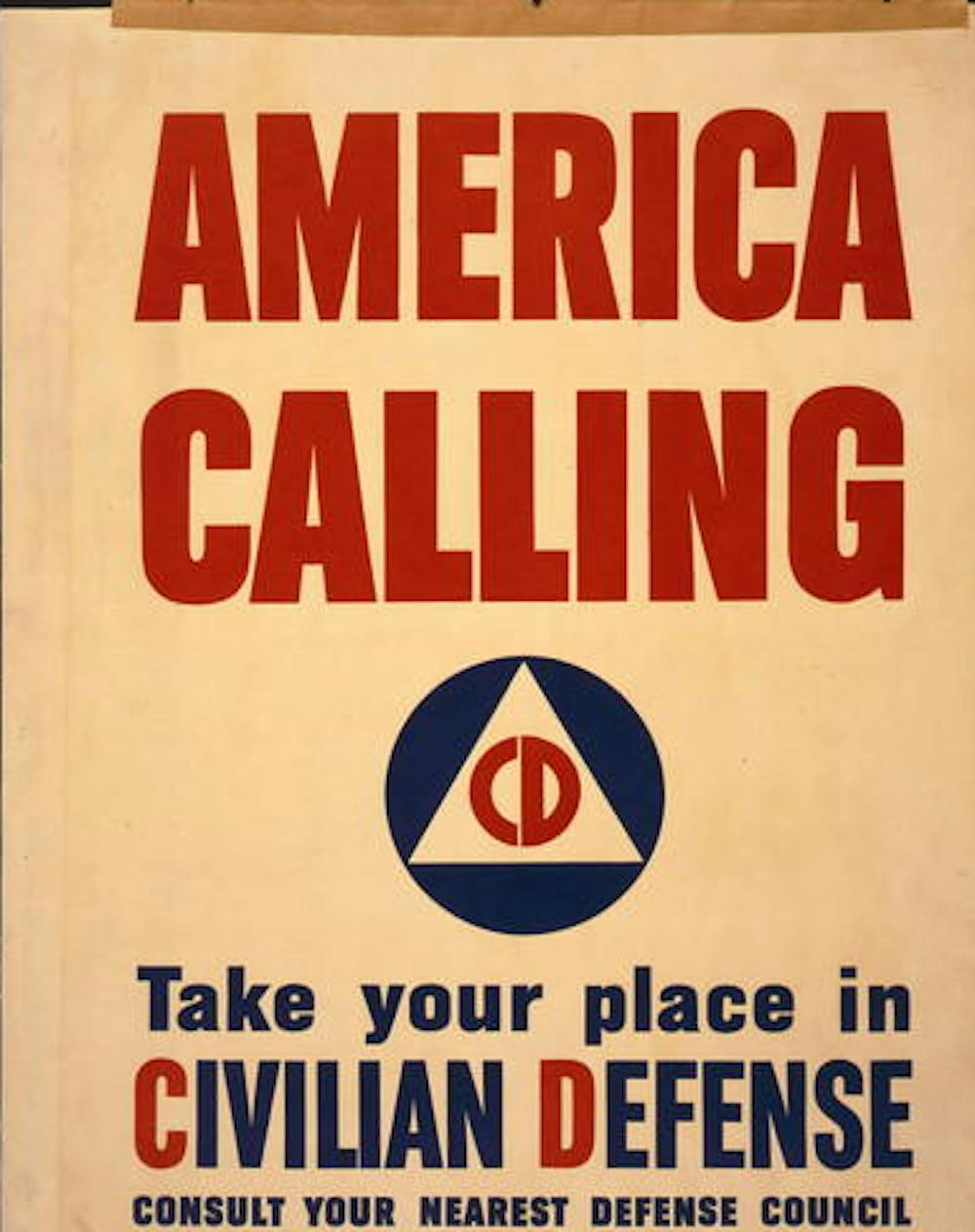
A poster from 1941 urged all Americans to contribute to community preparedness for emergencies.
Over the latter half of the 20th century, the U.S. civil defense effort encouraged all Americans to be prepared to respond actively to a national emergency.
In recent years, however, Americans’ expectations have shifted from being ready to respond to passively waiting for help from a centralized, bureaucratic federal effort – usually led by the Federal Emergency Management Agency.
Bert the Turtle taught Americans to ‘duck and cover’ in the face of danger.
Civilian-led response after World War II
As professors of architecture and urban planning who study extreme events and historical forces shaping communities, we have firsthand experience in disaster response following Hurricanes Katrina and Maria. We have observed that federal emergency responses can often be poorly orchestrated and mismanaged, lacking the nimble effectiveness of local, citizen-organized efforts. That slows aid, and recovery.
But this was not always the case. Civil defense efforts once relied on the active efforts of citizens.
Created in 1947, the National Security Resources Board was charged with overseeing the nation’s civil defense preparations. The agency oversaw a coordinated communications effort that included reserving dedicated radio frequencies for broadcasting emergency information, issuing instructional posters and pamphlets. Its efforts also included producing short films for school-age children such as “Bert the Turtle” and “Duck and Cover,” which taught kids ways they could help keep themselves safe.
The board was also the origin of the once-ubiquitous Emergency Broadcast System, meant to give the public accurate information and instruction in an urgent situation. Its tests, including a script declaring that “this is a test … this is only a test,” would precede an ear-splitting tone interrupting radio and TV broadcasts.
Other civil defense efforts encouraged citizens to practice air raid drills, including training students to shelter under their classroom desks. Volunteers were mobilized to stock and maintain provisions and medical supplies in a decentralized network of fallout shelters in the basements of public buildings. This was common practice until the late 1970s.
As the Cold War subsided, emergency management began to encompass other types of extreme events, which often required specialized equipment and expert training. That required a move to a more professional disaster response.
The lack of civic coordination shifts responsibility away from citizens working collectively – and in fact has left people seemingly less prepared to respond to a crisis.
Schools have closed, and with no real backup plan, most teachers have been forced to learn on the fly about how to provide distance learning and online education.
Without guidance, people are waiting for help to arrive. In the meantime, the uncertainty has fueled panic-buying that has emptied stores, leaving critical care workers – and those too poor to buy in bulk or in advance – without reliable access to key foods and supplies.
These examples demonstrate that small-scale approaches can be effective in producing big results. In contrast, larger organizations are more bureaucratic and slower to respond. These inverse economies of scale mirror civil defense efforts: Many working collectively but independently are sometimes more effective than a larger centralized effort.
When facing an unexpected crisis, some amount of disorganization is probably inevitable. But other countries, such as Estonia, Sweden, Finland, Nigeria and Australia, actively work to engage all citizens in disaster preparedness, first aid training and other efforts that give people clear and productive tasks to accomplish.
Following their example – and indeed the United States’ own history – could help create a system of federal oversight and coordination complemented by prepared and trained local responders. That could better prepare the public to pull together as a collective civic community when disaster next strikes.
MSNBC's "Morning Joe" on Tuesday played back-to-back clips of President Donald Trump and former British Prime Minister Winston Churchill -- and the contrast between the two men in dealing with national crises was stark.
The first clip showed Churchill addressing the United Kingdom during the country's fight with the Nazis in 1941.
"We cannot tell what the course of this fell war will be," Churchill began. "It spreads remorse to ever-wider regions. We know it will be hard, we expect it will be long, we cannot predict or measure its episodes or its tribulation. But one thing is certain, one thing is sure, one thing stands out, stark and undeniable, massive and unassailable for all the world to see: It will not be by German hands that the structure of Europe will be rebuilt or the union of the European family achieved!"
The show then cut immediately to Trump talking about the COVID-19 pandemic last month.
"We're prepared and had we're doing a great job with it," Trump said of the virus. "It will go away. Just stay calm. It will go away. Everybody has to be vigilant and has to be careful. Be calm. It's really working out. A lot of good things are going to happen."
The BBC's Katty Kay then remarked that it was "almost cruel to put the clips of Trump and Churchill back-to-back like that."
Appearing on CNN's "New Day" with host Alisyn Camerota, the former head of the Occupational Safety and Health Administration (OSHA) handed the President an "F" for his handling of the coronavirus pandemic when it comes to worker safety and bluntly called the president a failure.
Less than 24 hours after the president held a confrontational press conference that was long on invective and short on information on efforts made by the government to halt the spread of the COVID-19 virus, David Michaels was asked to grade how things are going for frontline workers since the pandemic gripped the country.
Introduced as the "longest-serving head" of the safety agency, host Camerota asked, "OSHA, as we understand it, is tasked with protecting these workers and making sure they're not in hazardous situations -- what grade do you give to how OSHA has handled this coronavirus pandemic?"
"It's disheartening, he began. "But I would give them an F. They're simply missing in action in handling this epidemic. 12 weeks ago safety and health experts said OSHA should be preparing, should be issuing emergency standards to make sure workers are protected first in health care and then all these other essential workers and OSHA still hasn't done it. OSHA has been invisible in this whole response."
"Well, what should OSHA be doing?" Camerota pressed. "Because you were there for so long, what can they be doing to protect the workers?"
"Well, first it's got to come down from the top," he replied. "It's not just OSHA. President Trump has failed. He's not made the order to employers to protect workers and to tell OSHA to get out there and very prominently say that every employer here are rules that you must follow. and those rules should be in the CDC guidelines. But OSHA is not saying that employers have to follow those rules. OSHA is saying nothing and the CDC is saying employers should follow those rules. and that makes a big difference."
The editors begin by documenting in painstaking detail how DeSantis lagged behind Ohio Republican Gov. Mike DeWine in shutting down key parts of his state's economy, even as the number of infections grew at an exponential pace.
They then accuse him of seeming more interested in buttering up President Donald Trump than in protecting vulnerable Florida residents.
"DeSantis last week played the role of Mini-Me to President Trump, making a pitch for the unproven drug hydroxychloroquine as a potential treatment for COVID-19," the editors write. "DeSantis also gave Florida a meme-worthy moment by wearing a blue glove on one hand while touching his face with other, ungloved hand."
The editors also nail DeSantis for pushing disinformation about the disease that could put people's lives in jeopardy.
"Continuing his dismal week, Florida’s governor also declared that no one in the nation under 25 years old had died from COVID-19," they write. "Fact check: Wrong. His error was in the context of musing about whether to reopen public schools in May given the resistance young people seem to have to coronavirus. News flash for the governor: Many of our public school teachers are not in their 20s and would be at much higher risk for falling ill."
JPMorgan Chase reported a staggering decline in first-quarter earnings Tuesday after setting aside nearly $8.3 billion for loans vulnerable to the economic devastation from coronavirus shutdowns.
The biggest US bank by assets reported profits of $2.9 billion for the quarter ending March 31, down 69 percent from the year-ago period. Revenue dipped three percent to $28.3 billion.
Chief Executive Jamie Dimon described the bank's underlying results as "extremely good" during the first quarter, but said the addition of large credit reserves was needed because of the "likelihood of a fairly severe recession."
The bank said in a press release that the reserve build reflects "deterioration in the macro-environment as a result of the impact of COVID-19 and continued pressure on oil prices."
The provisions included $4.4 billion, primarily in its credit card business, and $2.4 billion across businesses, with the biggest amounts in oil and gas, real estate and retail.
The sums reflect the bank's assessment of clients' ability to pay back loans after suffering a big drop in business due to the shutdown of large parts of the United States to counter the spread of the coronavirus.
Wells Fargo reports results later Tuesday and other large banks will follow on Wednesday.
According to a report from Politico, Texas Republicans are beginning to panic about the upcoming November election as the state reels from a double hit that includes a massive economic downturn due to the reeling oil industry and a bumbling response to the coronavirus pandemic by GOP lawmakers, ranging from President Donald Trump to Gov. Greg Abbott.
According to the report, "The twin economic shock of the coronavirus pandemic and a collapsing oil market has upended the political landscape in Texas — driving Republicans into an unfamiliar defensive crouch and giving restive Democrats an unexpected election-year lift," adding, "Republicans who'd been running on a familiar platform of gangbusters job growth and small government suddenly find themselves without a clear message as unemployment skyrockets and plummeting oil prices ravage the state budget. Their fealty to limited government is under threat with Congress’ massive stimulus spending — and they likely will have to defend even more government spending or slash state spending on core services like education and health care."
One GOP consultant wrapped it the party's problems by admitting, "This pandemic has put Republicans in a tough position."
Noting that the "pandemic is exceedingly unlikely to swing the biggest contests in 2020," Politico reports that multiple Texas lawmakers and strategists claimed "fallout from the virus could hasten the state’s drift away from Republicans spurred by demographic shifts in burgeoning areas repelled by President Donald Trump."
"The economic impact threatens to hurt down-ticket Republicans, who for decades have hitched their fortunes to a robust economy. Democrats are targeting seven U.S. House seats and defending two, mostly in the suburbs of the largest cities: Houston, Dallas, San Antonio, Austin, El Paso and Fort Worth. Winning the state House is not out of the question for Democrats. They need to flip nine seats and are targeting districts that [Beto] O'Rourke carried two years ago to get there," the report states.
Asked what is happening in the state, O'Rourke claimed, "We have yet to feel the full brunt of this pandemic in Texas," before adding, "That’s really going to affect a lot of what you see in November up the ballot — we’ve got 38 Electoral College votes on the line for [Joe] Biden or Trump and down the ballot for these statehouse races. ... People are horrified at Republican leadership right now.”
According to Texas lobbyist Chad Cantella, "We were leaning blue after O’Rourke ran. But people felt like that was the high-water mark,” before admitting that the pandemic crisis has become a major game-changer, stating, "It could really charge up the Democratic base to get over the hump.”
"Democrats are hopeful that many of their social programs now resonate with voters who are used to championing limited government. Nathan Johnson, a Democratic state senator, has called on Abbott to expand Medicaid — Texas is one of 14 states that has opposed doing so and the governor is suing to overturn Obamacare. Advocates, meantime, are also calling on conservatives to drop a lawsuit against Austin and San Antonio’s paid sick leave ordinances," the report notes before adding, "Democrats have also looked to expand vote-by-mail rules to more people to help shape the November vote. Right now, to qualify for a mail-in ballot, Texas voters must either be 65 or older, have a disability or be traveling outside the country during voting."
Battered by grim headlines, horrifying statistics and deep uncertainty over the coronavirus pandemic, many people worldwide are trying to lift their spirits by seeking out "good news."
Sites specializing in upbeat news have seen a surge in growth in recent weeks. And Google searches for "good news" have jumped fivefold since the start of the year.
The Good News Network, created in the late 1990s, has seen traffic triple in the past month with more than 10 million visitors, according to founder and editor Geri Weis-Corbley.
"People are sending us links of positive, inspiring things happening in their neighborhoods, in their cities, in their states, so we have so much good news to pass along," said Weis-Corbley, who also observed spikes in interest after the September 11 attacks and the global financial crisis of a decade ago.
"We think that people now are experiencing a yearning for good news that will continue."
Other websites including The Guardian, Fox News, HuffPost, MSN and Yahoo have their own pages dedicated to uplifting stories.
A CNN newsletter, "The Good Stuff," created last year, has seen a 50 percent jump in subscriptions over the past month, a network spokesperson said.
"Our editorial team saw growing interest in the stories that made our audience smile, with fascinating discoveries, everyday heroes, inspiring movements and great things happening all over the world," the spokesperson said.
Actor John Krasinski joined the effort with his own weekly YouTube video show, "Some Good News," from March 29, which mimics a traditional news broadcast, but focusing on uplifting stories.
Krasinski's videos offer a mix of tributes to pandemic "health heroes" and celebrity appearances including from his actress wife Emily Blunt, and got 15 million views for its first episode.
- Coping with crisis -
Stuart Soroka, a professor at the University of Michigan's Institute for Social Research, said humans are conditioned to pay closer attention to negative news because it could force them to change their behavior.
But in a crisis, Soroka, said people also look for news which is "most outlying, at odds with our expectations," which may account for the public turning to positive stories.
Ashley Muddiman, a professor at the Center for Media Engagement at the University of Kansas, said the positive news is a way of helping people cope.
"There's a good amount of research that suggests that when people are too scared or things are too negative, that they might try to shut down instead of trying to do things or go about their life," Muddiman said.
"I do think that people want to see solutions and want to see people working towards solutions rather than bickering with each other. When news can cover that, I think that that is something to be attractive to audiences."
Some people are showing signs of fatigue with the onslaught of depressing news about the health crisis.
"I think that a lot of us can fall victim to being drawn into constant negative news," said Clarence Edwards, a resident of the US capital city Washington.
"I think the media pay attention to what sells, and mainly that's scary and bad news. "
As the deadly coronavirus spreads across Cuba, with 726 cases recorded by Monday, a growing chorus of voices is calling for an easing of the decades-long US embargo.
During the pandemic, the embargo is "even more cruel" and having a more harmful impact than ever, said Nestor Marimon, head of international relations at the ministry of health.
Marimon and others say that while the blockade may not prevent the delivery of medical supplies, it severely complicates the process.
The government said that a recent shipment of masks, testing kits and ventilators that had been offered by Jack Ma, founder of Chinese e-commerce giant Alibaba, could not make it to the Communist-run island because the US shipping company was worried about US sanctions being imposed.
The embargo was imposed in 1962 to “deny resources to the Castro regime,” resources which could be “used to control & abuse the rights of the Cuban people and interfere in countries around region,” an implicit reference to Venezuela, said Michael Kozak, the Assistant Secretary of State in charge of Latin American affairs.
Since 1992, medicinal supplies have been exempted from the sanctions, as long as they are used exclusively to treat the general population.
The Cuba Democracy Act was adopted when the Cuban economy was in free-fall after the collapse of its main backer, the Soviet Union, and stipulates that the embargo must stay in place until democracy is established in Cuba. The act “permits the export of healthcare products -- medical equipment, medical instruments, medical supplies and pharmaceuticals,” said John Kavulich, president of the US-Cuba Trade and Economic Council.
He cited exports worth $1.1 million in 2019, $3.5 million in 2018 and $5.7 million in 2017, and which included penicillin, insulin, dental surgery equipment and ultrasounds, among other medical items.
But things are not quite that straightforward, including the shipment of medicine and medical equipment from countries other than the United States.
'Fear of sanctions' -
Swiss NGO MediCuba, which backs Cuban projects to treat HIV and cancer, knows all about these complications.
A few months back, its bank Postfinance refused to transfer funds to Cuba, citing fears of sanctions that have been reinforced since Donald Trump became US president.
Since May 2019, Title 3 of the Helms-Burton Act threatens sanctions against anyone doing business with entities that were nationalized during the 1959 revolution, a definition sufficiently fluid to worry Cuba's overseas partners.
MediCuba eventually obtained an exemption from its bank. However, the “strengthening of the embargo by the US government has posed (and continues to pose) difficulties for us in the management of the projects that we support,” said Luisa Sanchez, a coordinator for the NGO.
The bank of one of their suppliers refused their payments and a new regulation forbids exports to Cuba for any medicine whose components are more than 10 percent of US origin.
MediCuba has launched a crowdfunding campaign to support Cuba's fight against the coronavirus to help it “acquire testing material and personal protective equipment for medical staff.”
Jerome Faure, Oxfam's Cuba director confirmed that access to “basic necessity products – hygiene, staff protective equipment, reagents for virus detection – is all made more difficult by the embargo.”
That means that “only certain businesses and suppliers are willing to take the risk of working with Cuba for fear of being hit with sanctions,” he said.
- Internal embargo -
On an island hit by recurrent shortages of food and medicine, Oxfam and eight other organizations that favor the re-opening of Cuba are calling for a lifting of the embargo.
Michelle Bachelet, the UN commissioner for human rights, is also calling for sanctions to be suspended. And the embargo should not inhibit the delivery of humanitarian aid, said EU foreign policy chief Josep Borrell.
But a State Department spokesman told AFP that the Cuban regime “alone is responsible for ongoing medical supply shortages.”
He said the Cuban leadership “has mismanaged Cuba’s economy for decades and proven itself incapable of addressing the Cuban people’s most basic needs.”
That is another way of blaming what Cubans – and even President Miguel Diaz-Canel himself -- refer to as the “internal embargo,” an expression denoting Cuba's excessive red tape, weak local production and corruption that hinder any equitable distribution of goods on the island.
“There’s no question that Cuba’s own economic policies and restrictions are to blame most for Cuba’s precarious economic situation and the prospects of a growing humanitarian crisis,” said Michael Shifter, president of the Inter-American Dialogue think tank.
"But there is also no question that harsh US sanctions are making things worse in the country,” he said. “All this is likely to make it harder for Cuba to confront the coronavirus,” he said.
Perched over the gaping roof of Notre-Dame, a crane stands idle above the silent Paris cathedral, where repair work has ground to a halt one year after the monstrous blaze that nearly destroyed one of the world's most revered monuments.
Millions around the world watched in horror last April 15 as firefighters battled through the night to save the 13th-century masterpiece from the fire, which ravaged its roof and toppled the steeple.
French President Emmanuel Macron promised a herculean effort to have the UNESCO heritage site restored within five years, in time for the Paris Olympics of 2024.
But France's lockdown to combat the coronavirus -- which has forced a full suspension of work at the site -- is making that goal even more unlikely than before.
Work had already been delayed for months by decontamination efforts after more than 300 tonnes of lead from the roof melted in the blaze, covering the site in toxic particles that have proven hard to remove.
And the fragile structure remains at risk despite the massive wooden beams propping up the arches and gables. Authorities had to halt work several times over the winter when winds surpassed 40 kilometres per hour (25 miles per hour).
The 60 to 70 workers normally on site have not even removed the tangled web of metal scaffolding tubes that fused together in the inferno, which erupted during renovation work on the roof.
Until they do, they cannot install a more durable temporary roof to protect the church's priceless artworks from rain.
Although investigators have still not determined the cause of the fire, prosecutors suspect faulty electrical wiring or a poorly extinguished cigarette.
- Monumental tasks -
Jean-Louis Georgelin, the five-star general and fervent Catholic in charge of the renovation, is hoping to resume work soon, perhaps by his "squirrels," who hang by ropes to reach areas where it is too dangerous to walk.
"For these technicians, these tightrope walkers, social distancing is part of the job," Georgelin told AFP.
Much of the debris has been removed from the nave, which allowed Paris Archbishop Michel Aupetit to hold a small Good Friday ceremony in the church last week.
But mounds of debris still have to be cleared above the massive vaulted roof, a more delicate operation that was supposed to be finished this summer.
Notre-Dame's renowned organ must also be removed to have its nearly 8,000 pipes painstakingly cleaned from the layer of lead dust deposited by the melting of the roof and spire.
Countless other cleaning and restoration operations await, and the project's chief architect Philippe Villeneuve has warned that new challenges could arise as the work progresses.
Even the esplanade in front of Notre-Dame remains off limits, surrounded by a tall fence to keep tourists far from the worksite.
Yet Georgelin said he remains confident the five-year goal will be met despite the coronavirus delay, promising that worshippers will hear a "Te Deum" sung in the cathedral in April 2024.
"Lots of people said we'd cut corners to finish in five years. These are malicious comments -- It's a question of carrying out the work assiduously, without any hesitation," he said.
- Tough choices -
Yet officials still have to decide a crucial question: Rebuild the cathedral exactly as it was, using traditional techniques and materials, or incorporate modern equipment and expertise?
Macron has said he is in favour of adding a "contemporary" touch to the spire, which was itself a relatively modern touch, installed by the architect Eugene Viollet-le-Duc in the mid-19th century.
Villeneuve has refused to countenance any glass spire, rooftop garden or any other proposals that have emerged. Opinion polls suggest most French share his more conservative view.
Macron has promised to "consult" the French on any choice for the steeple, and launched an international architectural competition for its reconstruction, though no timeline has been set.
There is also the matter of replacing the lattice of oak beams that supported the roof -- Georgelin raised hackles in January when he dismissed "lobbying" by the wood industry for an exact replica.
Whatever the choices, money should not be a problem -- more than 900 million euros (nearly $1 billion) has been given or pledged by some 340,000 companies and individuals worldwide.
"Everything makes me think we will definitely need that money," Georgelin said.
Yet the funds won't help the restaurants, souvenir shops and other businesses on the island in the heart of Paris, said Patrice Lejeune, president of the Notre-Dame business alliance.
They have seen two-thirds of their revenue evaporate on average over the past year, he told AFP.
"You have people who have worked 50 years, and here they're on the brink after just one year," he added.
No commemorations are planned to mark the anniversary of the fire, in line with the ban on public gatherings during the coronavirus crisis.
Beijing has virtually walled itself off to outsiders with drastic measures to protect China's seat of power against the threat of a second wave of coronavirus infections from other regions.
After largely getting the outbreak under control, China has banned foreigners from entering the country as authorities fret over an increase in cases imported from abroad -- though most have been Chinese citizens.
But Beijing has gone a step further, imposing a strict 14-day quarantine on people arriving from other parts of China, regardless of whether they test negative for COVID-19 -- a measure not required in other cities.
Beijing, of course, is not like any other Chinese city.
The ruling Communist Party postponed its once-a-year congress, known as the "two sessions", in March and experts said it likely wants to make sure the thousands of delegates who participate are not at risk before a new date is set.
"Strengthening management of people returning to Beijing has become the most critical priority, otherwise it is impossible to create the right conditions for the two sessions to start," said Ma Liang, a professor at Renmin University's School of Public Administration and Policy.
The measures are ultimately meant to shield the Communist Party elite from the virus, said Alfred Wu, associate professor at the National University of Singapore's Lee Kwan Yew School of Public Policy.
"In this moment, the central government and core leadership are highly protected, so ordinary people will have to pay the price," he told AFP.
- Wuhan stigma -
Beijing has imposed a mandatory 14-day quarantine on all returning students, who must test negative to attend school. All hotel guests must test negative within seven days prior to their stay.
The measures have already deterred some from going back.
Chen Na, a carer from Anhui province, cannot return to her former employer in Beijing because her area was labelled "high-risk".
"When they see where I'm from, the conversation stops. I can't even get an interview. I've been out of work since February," she said.
But the toughest conditions are reserved for people travelling to Beijing from Wuhan, the central city where the virus first emerged late last year.
Those leaving the city, whose months-long lockdown was lifted April 8, must test negative within seven days before their return date, undergo a 14-day quarantine once they arrive, and test negative again in order to be released.
Other cities only require those from Wuhan and Hubei province to produce a green health code on a special app and a negative nucleic acid test result.
They must first request to return to Beijing through an app when they receive their negative diagnosis.
If approved, they have to submit another request to purchase train tickets to the capital, which are limited to 1,000 seats per day on two services.
"I originally bought tickets for the 12th, but I was told on the evening of the 7th that I needed a negative test result in order to return," said Wuhan resident Liu Shiyi, who arrived in Beijing by train on Sunday.
One day before her train was due to leave, her residential compound said she needed to obtain a paper copy of her negative certificate from the hospital.
"The whole time, my compound received orders from above in a very delayed fashion, making me waste time going back and forth," she said.
- Special lanes -
At two major Wuhan train stations, AFP saw that special lanes for Beijing-bound travellers had been set up and were crewed by several volunteers.
There are an estimated 11,000 Beijing residents stranded in Wuhan, officials said last week, but the city has lately seen a surge in asymptomatic cases which are notoriously difficult to detect.
During a recent visit to the Beijing West Railway Station, AFP saw that arrivals from Hubei were handled in a separate area and boarded designated buses bound for each district.
Between April 8 and April 13, some 1,037 people returned to Beijing from Wuhan. None tested positive for COVID-19.
TALLAHASSEE, Fla. — Gov. Ron DeSantis acknowledged Monday that the scope of the COVID-19 problem in the state’s elder-care facilities is becoming more dire, and he said he wants the Florida National Guard to fortify “strike teams” conducting tests on residents and staffers at nursing homes and assisted-living facilities.DeSantis said teams have already been sent into 93 facilities where residents have tested positive.But a surge of testing is needed, he said Monday, especially to target asymptomatic carriers of the virus among staff. To accomplish that, he is having the National Guard expand i...