The teasing temptation of a sugary treat can often get the better of us. But don’t worry, we’re not the only ones. The saccharine substance that our sweet tooth finds so hard to resist is also powerfully seductive to mosquitoes. And according to new research, in helping to keep the pests away from our blood-rich body parts, sugar may for once be good for our health.
But don’t start mixing up any sugar water just yet – or you might end up doing as much harm as good.
We’ve long understood that sugar is an important energy source for mosquitoes. In fact, it’s actually better than blood in terms of fuelling flight and basic survival processes. Only female mosquitoes feed on blood, as it provides essential nutrients needed to make their eggs.
Of course, this thirst for blood generates a terrible disease burden globally, often in the countries least well equipped to cope. Amid the hundreds of scientists across the world working to reduce the menace of mosquitoes, one promising avenue is investigating how their desires for sugar and blood interact.
The new research, published in Plos Biology, set about investigating exactly this. It focused on the Asian tiger mosquito (Aedes albopictus), an invasive species that has infiltrated every continent, closely associates with humans, and is very difficult to suppress, making it a particularly dangerous transmitter of diseases such as dengue fever, yellow fever, and Zika virus.
The research team found that feeding young tiger mosquitoes sugar solutions caused a physiological response similar to that after feeding on blood. Importantly, it then delayed their search for the red velvet blood of a human host.
Interestingly, the researchers found that feeding on sugar caused levels of a protein called vitellogenin to rise in the mosquitoes. Vitellogenin is an important component in the production of the egg yolk that provides nutrients to unborn mosquito offspring. Normally, vitellogenin is produced when receptors detect specific nutrients that mosquitoes gather from blood meals.
Using gene interference experiments, researchers were able to identify a specific gene associated with vitellogenin that when knocked out, restored the mosquitoes’ attraction to humans. This is exciting, as it highlights potential for this gene to be targeted as a way of reducing host seeking behaviour, and in turn, the transmission of deadly diseases that affect millions.
Work still to do
This research is a significant breakthrough in understanding the physiological mechanisms that influence mosquito feeding behaviour. However, there is still a great deal of work left to do. As the authors themselves are aware of, feeding sugar to mosquitoes cannot alone be used as a control method in the real world.
There are many reasons for this, but the most important is that the effects of sugar on mosquito behaviour can vary significantly, even within just this one species. For example, while the reduction in human attraction held true for young adult mosquitoes, when older females were fed sugar they remained highly attracted to humans, and displayed increased nutrient reserves. This is not a desirable outcome. Physical condition, how well the mosquito fed as larva, whether it has mated, and whether it has previously laid eggs may also influence the effect of sugar on feeding behaviour.
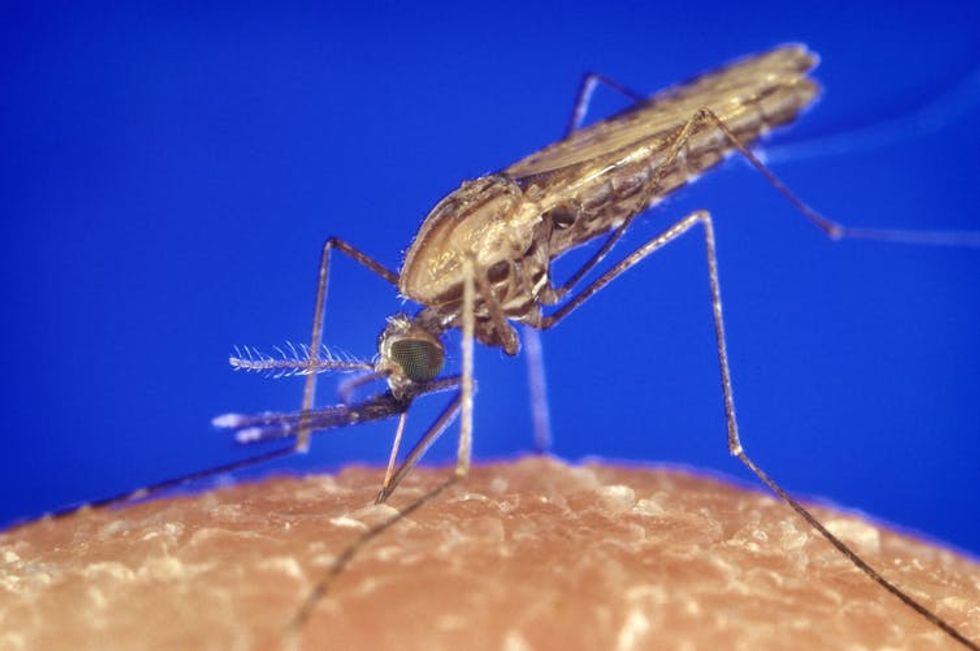
Feeding the Anopheles mosquito sugar isn’t a good idea.
Things get even more complex when other mosquito species are taken into account. For example, high vitellogenin levels weaken the immune system of the African malarial mosquito (Anopheles gambiae), thereby making it more likely to contract and pass on malaria. Raised vitellogenin is therefore clearly not always a good thing.
Leaving sugar out for mosquitoes may put off younger mosquitoes from biting you, but it will make older mosquitoes stronger, and could weaken the defences of other mosquito species. We may, however, be able to genetically modify or treat tiger mosquitoes with hormones that raise vitellogenin levels in the absence of sugar, eliminating this trade off. Given that in most cases mosquitoes pick up disease pathogens during their first meal, such control methods could substantially delay the first blood meal of mosquitos, making them infectious for a shorter period of time.
Of course, at this early stage it is difficult to estimate how effective control measures that alter vitellogenin might be. Importantly, there is still a long way to go before any single answer will be created for mosquitoes, so continue to follow the best current advice when travelling.
MSNBC's Ali Velshi hosted a segment about abortion rights on Tuesday with Breitbart senior editor-at-large Joel Pollak.
Velshi kicked off the interview by asking for "solutions" to abortion.
"Many Americans do not like the idea of abortion, but don't believe in criminalizing the women who have them," Velshi explained. "Let's take a step back from the debates over the laws that are going on in those states and talk about solutions."
At that point, the MSNBC host brought in Pollak, who works for the right-wing publication Breitbart.
Pollak said that he favored persuading women not to have abortion through means other than legislation. He also attacked laws supporting abortion rights in left-leaning states.
"A lot of this was triggered by radical laws in place in New York and Virginia and now under consideration by the governor in Illinois, which basically did away with bans on late-term abortion," the Breitbart editor opined, "and have extended abortion right up to birth."
Pollak did not provide evidence of abortions in the U.S. being performed "right up to birth."
The United States risks losing its measles "elimination status" if current outbreaks continue, US health authorities said Thursday.
The Centers for Disease Control and Prevention (CDC) said Thursday there have been 971 cases of measles reported in the US so far this year, which means more people have caught the disease in the last five months than in any entire calendar year since 1992, which saw 963 reported cases.
Authorities declared measles eliminated in the US in 2000, a goal set in 1966 with the introduction of the vaccine.
Measles is considered eliminated when there is an absence of continuous disease transmission for 12 months or more in a specific geographic area, according to the CDC.
An ongoing outbreak in and around New York City that started last fall is threatening the US's "elimination status" -- if it continues for four more months, the country will no longer be able to say it has eliminated measles.
AFP /Measles
Even though the New York mayor began requiring city residents in heavily affected areas, many with large Orthodox Jewish communities, to be vaccinated starting in April, the city still had 173 cases that month and 60 in May.
The US has never counted zero measles cases. Since 2000, the number has fluctuated between a few dozen and a few hundred cases per year, with 667 cases recorded during a 2014 outbreak in Ohio, especially in Amish communities.
The disease's resurgence can mostly be traced back to un- or under-vaccinated travelers who brought the infection back with them from abroad -- that's what happened last year when cases were reported throughout the country, originating from the Philippines, Israel and Ukraine.
"Measles is preventable and the way to end this outbreak is to ensure that all children and adults who can get vaccinated, do get vaccinated," said CDC director Robert Redfield.
"Again, I want to reassure parents that vaccines are safe, they do not cause autism. The greater danger is the disease that vaccination prevents."
When an unusually large number of puffin carcasses began to wash ashore on Alaska's remote St Paul Island in the fall of 2016, the local tribal population grew alarmed.
At first they suspected the seabirds might have avian flu -- but labs on the mainland soon ruled out any disease, finding that the seabirds known for their brightly-colored beaks and thick tufts had instead starved to death.
In a new study published Wednesday researchers concluded the deaths, which occurred between October 2016 and February 2017, ran into the thousands -- and were part of a growing number of mass die-offs recorded as climate change wreaks havoc on marine ecosystems.
The paper, which appeared in the journal PLOS ONE, found that although locals recovered only 350 carcasses, between 3,150 and 8,500 birds may have succumbed to starvation.
The majority were tufted puffins and the remainder were crested auklets.
The research team, which included scientists from the University of Washington and the Aleut Community of St Paul Island Ecosystem Conservation Office, said that from 2014 increased atmospheric temperatures and decreased winter sea ice led to declines in energy-rich prey species in the Bering Sea.
Tufted puffins breeding in the Bering Sea feed on small fish and marine invertebrates, which in turn eat ocean plankton.
"There was no fat there, the musculature was literally disintegrating," co-author Julia Parrish said of the birds, which washed up on the island, some 300 miles (480 kilometers) east of the mainland.
According to scientists, Alaska as a whole has been warming twice as fast as the global average, with temperatures earlier this year shattering records.
"The puffins are one among several signals recorded that connect the physics of the system -- how cold or warm it is -- to the biology of the system," she told AFP.
"They just happen to be a very visible, graphic signal because it's really hard to avoid hundreds or thousands of birds dying and washing up at your feet."
- 'Ran out of gas' -
The researchers also realized that most of the dead birds had begun molting, the process by which they lose their feathers and gain new plumage. During this time their ability to dive and hunt for food is diminished.
By the time they began molting, the birds should already have migrated to resource-rich waters to the west and south. The energy-intense nature of the transformation appears to have contributed to their starving.
"So all of those things indicated that they did not have enough to eat, they were late in migrating, they literally ran out of gas," said Parrish.
The paper noted "multi-year stanzas of warm conditions," such as those seen from 2001 to 2005 and 2014 to the present, may be particularly detrimental to seabirds, whose future viability will depend on their resilience to these changes.
"I'm tremendously worried," said Parrish. "If I had only seen this puffin die-off I might be a bit more circumspect, but this is one of about six die-offs since about 2014, 15" that collectively account for the deaths of millions of birds.
"Not just the Bering Sea, the whole north Pacific is changing," she added. "I think the ecosystem is screaming at us and we ignore it at our peril."
Five Navy pilots saw unidentified flying objects, or UFOs, in 2014 and 2015 during training maneuvers off the aircraft carrier Theodore Roosevelt, according to a new report.
Described as "objects [that] had no visible engine or infrared exhaust plumes" with "one of them like a spinning top moving against the wind," the Navy pilots did not directly assert a belief that the UFOs were of extraterrestrial origin. However, they also could not identify what they were looking at, according to The New York Times.
The UFOs were later described in the article as "showing up at 30,000 feet, 20,000 feet, even sea level. They could accelerate, slow down and then hit hypersonic speeds." A pilot described one as "a sphere encasing a cube." A video purportedly "showed objects accelerating to hypersonic speed, making sudden stops and instantaneous turns — something beyond the physical limits of a human crew."
The Times' article includes some colorful anecdotes, which summarize the thrust of the story.
"These things would be out there all day,” said Lt. Ryan Graves, an F/A-18 Super Hornet pilot, who has been with the Navy for 10 years and who reported his sightings to the Pentagon and Congress. "Keeping an aircraft in the air requires a significant amount of energy. With the speeds we observed, 12 hours in the air is 11 hours longer than we’d expect.”
It appears the incident did catch the attention of the type of Department of Defense agency one might expect to see in a science fiction movie.
The sightings were reported to the Pentagon’s shadowy, little-known Advanced Aerospace Threat Identification Program, which analyzed the radar data, video footage and accounts provided by senior officers from the Roosevelt. Luis Elizondo, a military intelligence official who ran the program until he resigned in 2017, called the sightings "a striking series of incidents.”
One of the pilots who claims to have seen the UFOs insists he still has not come up with an explanation for what he witnessed.
Lieutenant Graves still cannot explain what he saw. In the summer of 2014, he and Lt. Danny Accoin, another Super Hornet pilot, were part of a squadron, the VFA-11 "Red Rippers” out of Naval Air Station Oceana, Va., that was training for a deployment to the Persian Gulf.
Lieutenants Graves and Accoin spoke on the record to The Times about the objects. Three other pilots in the squadron also spoke to the Times about the objects but declined to be named.
Another Navy officer described his own encounters with the objects.
Lieutenant Accoin said he interacted twice with the objects. The first time, after picking up the object on his radar, he set his plane to merge with it, flying 1,000 feet below it. He said he should have been able to see it with his helmet camera, but could not, even though his radar told him it was there.
A few days later, Lieutenant Accoin said a training missile on his jet locked on the object and his infrared camera picked it up as well. “I knew I had it, I knew it was not a false hit,” he said. But still, “I could not pick it up visually.”
There was even a near-collision between a pilot and one of the UFOs, indicating that at least on one occasion, the pilots had not witnessed some kind of an illusion but rather a tangible object.
Republicans in the Connecticut House of Representatives fought to kill a bill which would require that teachers follow the Next Generation Science Standards on climate change.
During floor debate on Tuesday, Democrats said that they sought to codify what is currently suggested criteria on climate change. It was the second time the bill had been brought up in past week.
Senior Republican Whip John Piscopo argued that the Next Generation Science Standards are wrong about climate change and he said that humans should be thankful for global warming.
"That's what teachers are going to be mandated to teach," the lawmaker complained. "That's just wrong. I mean, it's just glaringly wrong. There is active scientific debate among scientists and others -- politicians, I guess, today."
"It can't be determined how much global warming is caused by human burning of fossil fuels," he continued. "It's just, on the face of it, wrong. If you see something wrong, why tie teachers hands to debate one side of a debate?"
Piscopo accused his Democratic colleagues of "indoctrination" before thanking God for climate change.
"You're indoctrinating the kids to learn one side of a legitimate scientific debate," he remarked. "The climate does change. We have an ice age every hundred thousand years or so. It takes 10,000 years to get out of an ice age -- about 10,000 years -- and we happen to be enjoying a period of global warming."
"If I was talking to you about 10,000 years ago, we'd be under a half mile of ice right night now," Piscopo added. "So, thank God for global warming."
In what environmental experts warned could be President Donald Trump's most dangerous assault on science yet, the White House is reportedly moving to end long-term assessments of the impacts of the climate crisis while pushing a polluter-friendly agenda that is making the planetary emergency worse.
As the New York Timesreported late Monday, "the White House-appointed director of the United States Geological Survey, James Reilly, a former astronaut and petroleum geologist, has ordered that scientific assessments produced by that office use only computer-generated climate models that project the impact of climate change through 2040, rather than through the end of the century, as had been done previously."
"As a result," according to the Times, "parts of the federal government will no longer fulfill what scientists say is one of the most urgent jobs of climate science studies: reporting on the future effects of a rapidly warming planet and presenting a picture of what the earth could look like by the end of the century if the global economy continues to emit heat-trapping carbon dioxide pollution from burning fossil fuels."
The Intergovernmental Panel on Climate Change (IPCC)—the United Nations' leading climate body—warned in a landmark report last October that if carbon emissions are not dramatically and rapidly reduced, catastrophic effects of the climate crisis could be felt across the world as early as 2040.
But, as the Times reported, scientists say that Trump administration's attempt to cut off government climate projections at that year "would give a misleading picture because the biggest effects of current emissions will be felt after 2040."
"Models show that the planet will most likely warm at about the same rate through about 2050," according to the Times. "From that point until the end of the century, however, the rate of warming differs significantly with an increase or decrease in carbon emissions."
Philip Duffy, the president of the Woods Hole Research Center, told the Times that the White House's move to restrict government climate predictions "is a pretty blatant attempt to politicize the science—to push the science in a direction that's consistent with their politics."
Critics also expressed alarm on social media.
"The Trump gang is attacking the scientific process itself," tweeted environmentalist Alex Steffen, "in an attempt to prop up fossil fuel industries, delay inevitable action, and run the carbon bubble as long as it will last."
In addition to attempting to severely limit the government's climate science methodology, the Times reported, the Trump administration is also working "to question its conclusions by creating a new climate review panel" led by physicist William Happer, who once said the "demonization of carbon dioxide is just like the demonization of the poor Jews under Hitler."
Happer was brought on to the National Security Council by John Bolton, Trump's national security adviser.
"Mr. Happer and Mr. Bolton are both beneficiaries of Robert and Rebekah Mercer, the far-right billionaire and his daughter who have funded efforts to debunk climate science," the Times reported. "The Mercers gave money to a super PAC affiliated with Mr. Bolton before he entered government and to an advocacy group headed by Mr. Happer."
The Trump administration's efforts to distort government climate findings in a way that aligns with its fossil fuel agenda began after the release of the second volume of the National Climate Assessment last November, according to the Times.
As Common Dreamsreported, the Trump administration attempted to bury the report—which warned that "Earth's climate is now changing faster than at any point in the history of modern civilization"—by releasing it on the Friday after Thanksgiving.
The assessment's findings directly contradicted the Trump administration's denialism, as environmentalists and climate scientists pointed out at the time.
"This report makes it clear that climate change is not some problem in the distant future," said Brenda Ekwurzel, the director of climate science at the Union of Concerned Scientists (UCS). "It's happening right now in every part of the country."
With millions of dollars missing and officials in prison or fleeing the country, Russia's space sector is at the heart of a staggering embezzlement scheme that has dampened ambitions of recovering its Soviet-era greatness.
For years, Moscow has tried to fix the industry that was a source of immense pride in the USSR. While it has bounced back from its post-Soviet collapse and once again become a major world player, the Russian space sector has recently suffered a series of humiliating failures.
And now, massive corruption scandals at state space agency Roscosmos have eclipsed its plans to launch new rockets and lunar stations.
"Billions (of rubles) are being stolen there, billions," Alexander Bastrykin, the powerful head of Russia's Investigative Committee -- Russia's equivalent of the FBI -- said in mid-May.
Investigations into corruption at Roscosmos have been ongoing "for around five years and there is no end in sight," he added.
In the latest controversy, a senior space official appears to have fled Russia during an audit of the research centre he headed.
Yury Yaskin, the director of the Research Institute of Space Instrumentation, left Russia for a European country in April where he announced his resignation, the Kommersant paper reported.
He feared the discovery of malpractice during an inspection of the institute, according to the newspaper's sources.
Roscosmos confirmed to AFP that Yaskin had resigned but did not clarify why. His Moscow institute is involved in developing the Russian satellite navigation system GLONASS designed to compete with the American GPS system.
- Stopping corruption 'primary goal' -
Corruption has particularly affected Russia's two most important space projects of the decade: GLONASS and the construction of the country's showpiece cosmodrome Vostochny, built to relieve Moscow's dependence on Baikonur in ex-Soviet Kazakhstan.
Almost all major companies in the sector, including rocket builders Khrunichev and Progress, have been hit by financial scandals that have sometimes led to prison sentences for large-scale fraud.
Russia's Audit Chamber, a parliamentary body of financial control, said financial violations at Roscosmos in 2017 stood at 760 billion rubles (around $11.7 billion), accounting for nearly 40 percent of the total irregularities in the entire economy that year.
Roscosmos told AFP that "eradicating corruption" is one of its "primary goals", adding that it regularly cooperates with investigations by the authorities.
In mid-April, President Vladimir Putin stressed the need to "progressively resolve the obvious problems that slow down the development of the rocket-space sector."
"The time and financial frameworks to realise space projects are often unjustified," the Russian leader said.
- More money, more corruption -
Rebooting the space sector is a matter of prestige for the Kremlin. It symbolises its renewed pride and ability to be a major global power, especially in the context of increased tensions with the United States.
Almost destroyed in the 1990s, the sector stayed afloat thanks to foreign commercial contracts.
But independent space expert Vitaly Yegorov told AFP there were still "executives of a very high professional level" at that time and fewer accidents during launches.
The first module of the International Space Station (ISS), Zarya, was manufactured in Russia and launched in 1998 despite a major financial crisis at the time.
Paradoxically, the situation deteriorated in the early 2000s, when the Russian economy was growing. The influx of public funds fuelled fraud, and space research stopped advancing, experts say.
"Today, the space sector works like this: give us money and we will launch something -- one day," Yegorov said.
Only the ISS continues to be "an unshakeable ivory tower", he said, since it plays a "political role" aimed at maintaining international cooperation.
Analysts say Roscosmos chief Dmitry Rogozin, a former deputy prime minister known for his anti-Western statements, is struggling to deal with the industry's problems.
Russia's scientific community has criticised Rogozin, who is a journalism graduate, for his lack of knowledge of the space sector.
"He probably would have made an excellent spokesman for Roscosmos," joked Yegorov, adding: "Even Superman could not handle this avalanche of problems."
All chimpanzees eat animals at least sometimes, including anything from ants and termites to bushpigs and even baboons. Monkeys, in fact, are typically the most frequent item on the menu, and in some cases chimpanzees can eat so many monkeys they threaten to wipe out entire populations. One group in Senegal even hunts tiny, mouse-like primates known as bushbabies by using spear-like tools to first probe the holes the bushbabies hide in during the day, before reaching in to grab their prey.
So chimpanzees are rightly known as resourceful eaters. But until now scientists had never observed them eating reptiles.
That has all changed, thanks to a group of wild chimpanzees in Loango National Park along the Atlantic coast of Gabon in Central Africa. These chimps have recently become used to the presence of humans, which means scientists can now see them act exactly as they would in nature. And, writing in the journal Scientific Reports, a group of researchers say they have already observed behaviour not previously seen in chimpanzees.
These chimpanzees regularly catch, kill and consume tortoises that have been grabbed from the forest floor. For people like us, who also research chimpanzee behaviour, the discovery is particularly exciting because the animals obtain the tortoise meat by pounding the shell repeatedly onto a tree trunk until it cracks.
Thought pistachio nuts were hard to open? Try eating tortoise.
This sort of “percussive foraging” – the pounding of certain food items until a breaking point – has been seen in chimpanzees elsewhere, but never to obtain meat. For instance chimps in Senegal have been observed pounding baobab shells to extract the softer fruit-covered seeds inside. From Sierra Leone to the Ivory Coast, Western chimpanzees use stone and wooden hammers to crack open encased nuts from protective outer shells.
Broadly, this sort of pounding has been suggested as the first step towards more complex tool use that allowed early human ancestors to flourish. The question of why other chimpanzee communities do not do this too, despite the clear benefits of obtaining otherwise protected nuts, seeds – and now meat – remains unanswered.
The reward is a tasty tortoise, helpfully served in a bowl-shaped shell.
This newly discovered percussive behaviour in chimpanzees leaves a significant damage pattern on the tortoise shell and potentially damages the anvil on which it was cracked. The evidence left behind is therefore of interest to us primate archaeologists who use archaeological techniques to understand the physical remains of non-human primates. Our work in this emerging discipline relies on material artefacts – shattered tortoise shells, for instance – to reconstruct contemporary primate behaviour in the same way we do for early hominins.
We have long assumed that reconstructing hominin meat-eating behaviour was dependent on our finding fossilised stone tools and cut marks left on processed animal bones. To this select list we can now add tortoise shell. Previously, scientists had looked at fractured turtle remains and argued the animals may have been an important part of early human diets, but the Loango chimpanzees provide us a glimpse of the role this meat may have played for our early ancestors.
The new findings also reveal something even more remarkable. Among their observations, the researchers describe another novel behaviour, the storage of one of the tortoise shells in the fork of a tree that is later retrieved and consumed by the same male chimpanzee.
Such “future-oriented cognition” has long been considered uniquely human, but experimental evidence suggests other species, including apes and some birds, may possess it as well. If chimpanzees can indeed anticipate a future state (I will be hungry) as being different than their current one (I am not hungry), then a more nuanced interpretation of their cognition is required. Indeed, a careful study of the species may uncover many more examples of this future planning.
It is now clear that with every new wild chimpanzee community that becomes used to humans, scientists observe new and unexpected behaviour – some of which challenges our understanding of evolution and what it means to be human. Furthermore, the difference in behaviour from group to group highlights the extraordinary cultural diversity among our closest living relatives.
The opportunity for comparisons with our own evolution has become a run against time as the human infestation of the planet threatens wild primate populations worldwide. We know that the presence of humans directly destroys not only the habitat and lives of primates but also leads to the loss of behavioural diversity. Conserving the last remaining populations of wild apes has become urgent, otherwise our fellow primates will disappear forever. With their extinction will disappear a part of their own heritage and a window back to our own evolution.
The coffee tasted bad. Acrid and with a sweet, sickly smell. The sort of coffee that results from overfilling the filter machine and then leaving the brew to stew on the hot plate for several hours. The sort of coffee I would drink continually during the day to keep whatever gears left in my head turning.
Odours are powerfully connected to memories. And so it’s the smell of that bad coffee which has become entwined with the memory of my sudden realisation that we are facing utter ruin.
It was the spring of 2011, and I had managed to corner a very senior member of the Intergovernmental Panel on Climate Change (IPCC) during a coffee break at a workshop. The IPCC was established in 1988 as a response to increasing concern that the observed changes in the Earth’s climate are being largely caused by humans.
The IPCC reviews the vast amounts of science being generated around climate change and produces assessment reports every four years. Given the impact the IPPC’s findings can have on policy and industry, great care is made to carefully present and communicate its scientific findings. So I wasn’t expecting much when I straight out asked him how much warming he thought we were going to achieve before we manage to make the required cuts to greenhouse gas emissions.
“Oh, I think we’re heading towards 3°C at least,” he said.
“Ah, yes, but heading towards,” I countered: “We won’t get to 3°C, will we?” (Because whatever you think of the 2°C threshold that separates “safe” from “dangerous” climate change, 3°C is well beyond what much of the world could bear.)
“Not so,” he replied.
That wasn’t his hedge, but his best assessment of where, after all the political, economic, and social wrangling we will end up.
“But what about the many millions of people directly threatened,” I went on. “Those living in low-lying nations, the farmers affected by abrupt changes in weather, kids exposed to new diseases?”
He gave a sigh, paused for a few seconds, and a sad, resigned smile crept over his face. He then simply said: “They will die.”
This article is part of Conversation Insights
The Conversation’s Insights team generates long-form journalism derived from interdisciplinary research. The team is working with academics from different backgrounds who have been engaged in projects aimed at tackling societal and scientific challenges. In generating these narratives we hope to bring areas of interdisciplinary research to a wider audience.
That episode marked a clear boundary between two stages of my academic career. At the time, I was a new lecturer in the area of complex systems and Earth system science. Previously, I had worked as a research scientist on an international astrobiology project based in Germany.
In many ways, that had been my dream job. As a young boy, I had lain on the grass on clear summer evenings and looked up at one of the dots in the night sky and wondered if around that star a planet orbited with beings that could look up from the surface of their world and similarly wonder about the chances of life being found within the unremarkable solar system we call home in the universe. Years later, my research involves thinking about how surface life can affect the atmosphere, oceans and even rocks of the planet it lives on.
That’s certainly the case with life on Earth. At a global scale, the air we all breathe contains oxygen largely as a result of photosynthetic life, while an important part of the UK’s national identity for some – the white cliffs of Dover – are comprised of countless numbers of tiny marine organisms that lived more than 70m years ago.
The chalk is made up of ancient pulverised shells of tiny organisms called coccolithophore.
So it wasn’t a very large step from thinking about how life has radically altered the Earth over billions of years to my new research that considers how a particular species has wrought major changes within the most recent few centuries. Whatever other attributes Homo sapiens may have – and much is made of our opposable thumbs, upright walking and big brains – our capacity to impact the environment far and wide is perhaps unprecedented in all of life’s history. If nothing else, we humans can make an almighty mess.
Change within a lifetime
I was born in the early 1970s. This means in my lifetime the number of people on Earth has doubled, while the size of wild animal populations has been reduced by 60%. Humanity has swung a wrecking ball through the biosphere. We have chopped down over half of the world’s rainforests and by the middle of this century there may not be much more than a quarter left. This has been accompanied by a massive loss in biodiversity, such that the biosphere may be entering one of the great mass extinction events in the history of life on Earth.
What makes this even more disturbing, is that these impacts are as yet largely unaffected by climate change. Climate change is the ghosts of impacts future. It has the potential to ratchet up whatever humans have done to even higher levels. Credible assessments conclude that one in six species are threatened with extinction if climate change continues.
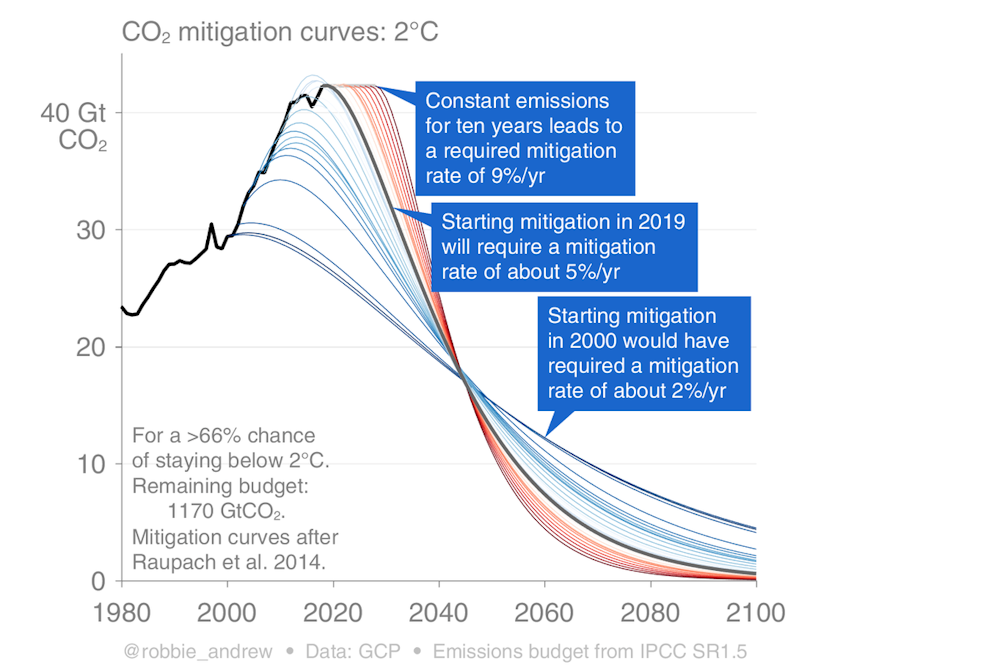
The scientific community has been sounding the alarm over climate change for decades. The political and economic response has been at best sluggish. We know that in order to avoid the worst impacts of climate change, we need to rapidly reduce emissions now.
Required emissions reductions to limit warming to 2°C.
Robbie Andrew
The sudden increase in media coverage of climate change as a result of the actions of Extinction Rebellion and school strike for climate pioneer Greta Thunburg, demonstrates that wider society is waking up to the need for urgent action. Why has it taken the occupation of Parliament Square in London or children across the world walking out of school to get this message heard?
There is another way of looking at how we have been responding to climate change and other environmental challenges. It’s both exhilarating and terrifying. Exhilarating because it offers a new perspective that could cut through inaction. Terrifying as it could, if we are not careful, lead to resignation and paralysis.
Because one explanation for our collective failure on climate change is that such collective action is perhaps impossible. It’s not that we don’t want to change, but that we can’t. We are locked into a planetary-scale system that while built by humans, is largely beyond our control. This system is called the technosphere.
The technosphere
Coined by US geoscientist Peter Haff in 2014, the technosphere is the system that consists of individual humans, human societies – and stuff. In terms of stuff, humans have produced an extraordinary 30 trillion metric tons of things. From skyscrapers to CDs, fountains to fondue sets. A good deal of this is infrastructure, such as roads and railways, which links humanity together.
Along with the physical transport of humans and the goods they consume is the transfer of information between humans and their machines. First through the spoken word, then parchment and paper-based documents, then radio waves converted to sound and pictures, and subsequently digital information sent via the internet. These networks facilitate human communities. From roving bands of hunter-gatherers and small farming tribes, right up to the inhabitants of a megacity that teams with over 10m inhabitants, Homo sapiens is a fundamentally social species.
Just as important, but much less tangible, is society and culture. The realm of ideas and beliefs, of habits and norms. Humans do a great many different things because in important ways they see the world in different ways. These differences are often held to be the root cause of our inability to take effective global action. There is no global government, for a start.
But as different as we all are, the vast majority of humanity is now behaving in fundamentally similar ways. Yes, there are still some nomads who roam tropical rainforests, still some roving sea gypsies. But more than half of the global population now lives in urban environments and nearly all are in some way connected to industrialised activities. Most of humanity is tightly enmeshed into a globalised, industrialised complex system – that of the technosphere.
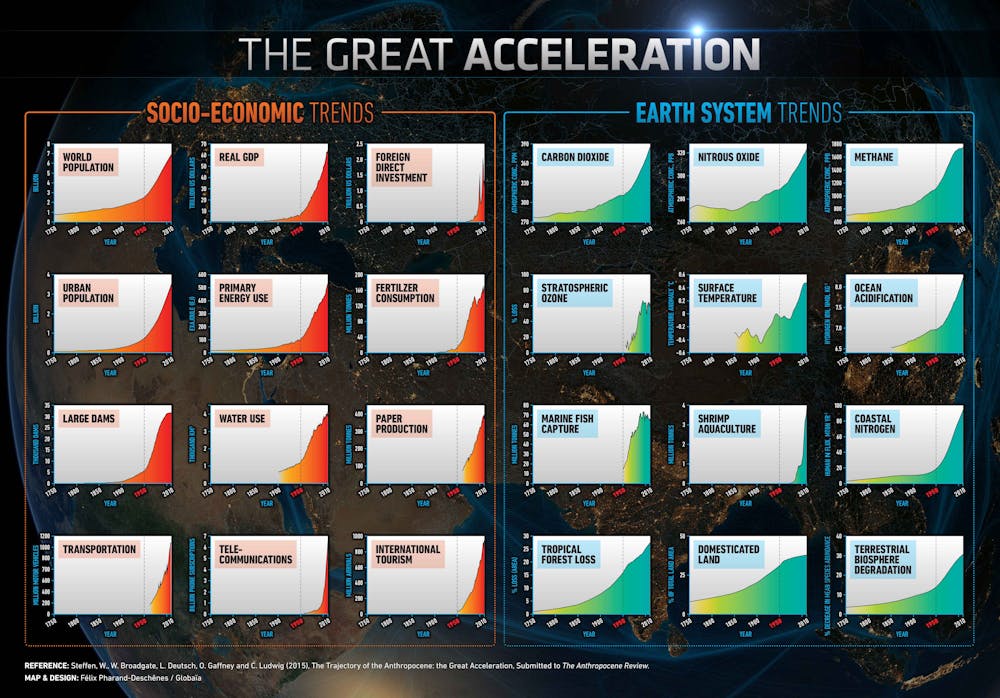
Importantly, the size, scale and power of the technosphere has dramatically grown since World War II. This tremendous increase in the number of humans, their energy and material consumption, food production and environmental impact has been dubbed the Great Acceleration.
The great acceleration of the technosphere.
Felix Pharand-Deschenes Globaia
The tyranny of growth
It seems sensible to assume that the reason products and services are made is so that they can be bought and sold and so the makers can turn a profit. So the drive for innovation – for faster, smaller phones, for example – is driven by being able to make more money by selling more phones. In line with this, the environmental writer George Monbiot argued that the root cause of climate change and other environmental calamities is capitalism and consequently any attempt to reduce greenhouse gas emissions will ultimately fail if we allow capitalism to continue.
But zooming out from the toil of individual manufacturers, and even humanity, allows us to take a fundamentally different perspective, one that transcends critiques of capitalism and other forms of government.
Humans consume. In the first instance, we must eat and drink in order to maintain our metabolism, to stay alive. Beyond that, we need shelter and protection from physical elements.
There are also the things we need to perform our different jobs and activities and to travel to and from our jobs and activities. And beyond that is more discretional consumption: TVs, games consoles, jewellery, fashion.
The purpose of humans in this context is to consume products and services. The more we consume, the more materials will be extracted from the Earth, and the more energy resources consumed, the more factories and infrastructure built. And ultimately, the more the technosphere will grow.
The growth of the economy is based on the growth of consumption.
The emergence and development of capitalism obviously lead to the growth of the technosphere: the application of markets and legal systems allows increased consumption and so growth. But other political systems may serve the same purpose, with varying degrees of success. Recall the industrial output and environmental pollution of the former Soviet Union. In the modern world, all that matters is growth.
The idea that growth is ultimately behind our unsustainable civilisation is not a new concept. Thomas Malthus famously argued there were limits to human population growth, while the Club of Rome’s 1972 book, Limits to Growth, presented simulation results that pointed to a collapse in global civilisation.
Today, alternative narratives to the growth agenda are, perhaps, getting political traction with an All Party Parliamentary Group convening meetings and activities that seriously consider de-growth policies. And curbing growth within environmental limits is central to the idea of a Green New Deal, which is now being discussed seriously in the US, UK, and other nations.
Alexandria Ocasio-Cortez, champion of the US Green New Deal.
If growth is the problem, then we just have to work at that, right? This won’t be easy, as growth is baked into every aspect of politics and economics. But we can at least imagine what a de-growth economy would look like.
My fear, however, is that we will not be able to slow down the growth of the technosphere even if we tried – because we are not actually in control.
Limits to freedom
It may seem nonsense that humans are unable to make important changes to the system they have built. But just how free are we? Rather than being masters of our own destiny, we may be very constrained in how we can act.
Like individual blood cells coursing through capillaries, humans are part of a global-scale system that provides for all their needs and so has led them to rely on it entirely.
Tokyo train commuters travelling to work.
If you jump in your car to get to a particular destination, you can’t travel in a straight line “as the crow flies”. You will use roads that in some instances are older than your car, you, or even your nation. A significant fraction of human effort and endeavour is devoted to maintaining this fabric of the technosphere: fixing roads, railways, and buildings, for example.
In that respect, any change must be incremental because it must use what current and previous generations have built. The channelling of people via road networks seems a trivial way to demonstrate that what happened far in the past can constrain the present, but humanity’s path to decarbonisation isn’t going to be direct. It has to start from here and at least in the beginning use existing routes of development.
This isn’t meant to excuse policymakers for their failure of ambition, or lack of bravery. But it indicates that there may be deeper reasons why carbon emissions are not decreasing even when there appears to be increasingly good news about alternatives to fossil fuels.
Think about it: at the global scale, we have witnessed a phenomenal rate of deployment of solar, wind, and other sources of renewable energy generation. But global greenhouse gas emissions continue to rise. This is because renewables promote growth – they simply represent another method of extracting energy, rather than replacing an existing one.
Renewable energy production has not led to a reduction in fossil fuel use.
The relationship between the size of the global economy and carbon emissions is so robust that US physicist Tim Garret has proposed a very simple formula that links the two with startling accuracy. Using this method, an atmospheric scientist can predict the size of the global economy for the past 60 years with tremendous precision.
But correlation does not necessarily mean causation. That there has been a tight link between economic growth and carbon emissions does not mean that has to continue indefinitely. The tantalisingly simple explanation for this link is that the technosphere can be viewed like an engine: one that works to make cars, roads, clothes, and stuff – even people – using available energy.
The technosphere still has access to abundant supplies of high energy density fossil fuels. And so the absolute decoupling of global carbon emissions from economic growth will not happen until they either run out or the technosphere eventually transitions to alternative energy generation. That may be well beyond the danger zone for humans.
A repugnant conclusion
We have just come to appreciate that our impacts on the Earth system are so large that we have possibly ushered in a new geological epoch: the Anthropocene. The Earth’s rocks will bear witness to humans’ impacts long after we disappear. The technosphere can be seen as the engine of the Anthropocene. But that does not mean we are driving it. We may have created this system, but it is not built for our communal benefit. This runs completely counter to how we view our relationship with the Earth system.
Take the planetary boundaries concept, which has generated much interest scientifically, economically, and politically. This idea frames human development as impacting on nine planetary boundaries, including climate change, biodiversity loss, and ocean acidification. If we push past these boundaries, then the Earth system will change in ways that will make human civilisation very difficult, if not impossible, to maintain. The value of, say, the biosphere here is that it provides goods and services to us. This represents what we can literally get from the system.
The planetary boundaries that are intended to help define a safe operating space for humanity.
Steffen, W., et al, 2015. Planetary boundaries: Guiding human development on a changing planet. Science, 347(6223), p.1
This very human-centric approach should lead to more sustainable development. It should constrain growth. But the technological world system we have built is clever at getting around such constraints. It uses the ingenuity of humans to build new technologies – such as geoengineering – to reduce surface temperatures. That would not halt ocean acidification and so would lead to the potential collapse of ocean ecosystems. No matter. The climate constraint would have been avoided and the technosphere could then get to work overcoming any side effects of biodiversity loss. Fish stocks collapse? Shift to farmed fish or intensively grown algae.
As defined so far, there appears nothing to stop the technosphere liquidating most of the Earth’s biosphere to satisfy its growth. Just as long as goods and services are consumed, the technosphere can continue to grow.
After all, a much smaller and much richer population of the order of hundreds of millions could consume more than the current population of 7.6 billion or the projected population of nine billion by the middle of this century. While there would be widespread disruption, the technosphere may be able to weather climate change beyond 3°C. It does not care, cannot care, that billions of people would have died.
Fewer people would not necessarily mean a smaller technosphere.
And at some point in the future, the technosphere could even function without humans. We worry about robots taking over human’s jobs. Perhaps we should be more concerned with them taking over our role as apex consumers.
Escape plan
The situation, then, may all seem rather hopeless. Whether or not my argument is an accurate representation of our civilisation, there is the risk it produces a self-fulfilling prophecy. Because if we believe we can’t slow down the growth of the technosphere, then why bother?
This goes beyond the question of “what difference could I make?” to “what difference can anyone make?” While flying less, cutting down on eating meat and dairy and cycling to work are all commendable steps to take, they do not constitute living outside the technosphere.
It’s not just that we give tacit consent to the technosphere by using its roads, computers, or intensively farmed food. It’s that by being a productive member of society, by earning and spending, above all by consuming, we further the technosphere’s growth.
Perhaps the way out from fatalism and disaster is an acceptance that humans may not actually be in control of our planet. This would be the vital first step that could lead to a broader outlook that encompasses more than humans.
For example, the mainstream economic attitude about trees, frogs, mountains, and lakes is that these things only have value if they provide something to us. This mindset sets them up as nothing more than resources to exploit and sinks for waste.
What if we thought of them as components or even our companions in the complex Earth system? Questions about sustainable development then become questions about how growth in the technosphere can be accommodated with their concerns, interests, and welfare as well as ours.
This may produce questions that seem absurd. What are the concerns or interests of a mountain? Of a flea? But if we continue to frame the situation in terms of “us against them”, of human well-being trumping everything else in the Earth system, then we may be effectively hacking away the best form of protection against a dangerously rampant technosphere.
And so the most effective guard against climate breakdown may not be technological solutions, but a more fundamental reimagining of what constitutes a good life on this particular planet. We may be critically constrained in our abilities to change and rework the technosphere, but we should be free to envisage alternative futures. So far our response to the challenge of climate change exposes a fundamental failure of our collective imagination.
We must start to see ourselves as a small part of a planetary natural system.
To understand you are in a prison, you must first be able to see the bars. That this prison was created by humans over many generations doesn’t change the conclusion that we are currently tightly bound up within a system that could, if we do not act, lead to the impoverishment, and even death of billions of people.
Eight years ago, I woke up to the real possibility that humanity is facing disaster. I can still smell that bad coffee, I can still recall the memory of scrabbling to make sense of the words I was hearing. Embracing the reality of the technosphere doesn’t mean giving up, of meekly returning to our cells. It means grabbing a vital new piece of the map and planning our escape.
A rare all-white panda has been caught on camera at a nature reserve in southwest China, showing albinism exists among wild pandas in the region, state media reported.
The spotless, red-eyed animal was photographed while trekking through the forest mid-April in southwestern Sichuan province, said official news agency Xinhua on Saturday.
The panda is an albino between one to two years old, said Li Sheng, a researcher specialising in bears at Peking University, who was quoted in Xinhua's report.
The Wolong National Nature Reserve -- where the animal was spotted -- told AFP it had no further details about the albino panda.
More than 80 percent of the world's wild pandas live in Sichuan, with the rest in Shaanxi and Gansu province.
There were about 548 giant pandas in captivity globally as of November, reported Xinhua.
The number living in the wild has dwindled to fewer than 2,000, according to the World Wildlife Fund.
Famed for its "panda diplomacy", in which China dispatches the rare animals to other countries as a symbol of close relations, Beijing has invested in different programmes to protect its furry ambassadors in recent years.
In 2018, China announced plans to create a bastion for giant pandas three times the size of Yellowstone National Park to link up existing wild populations and encourage breeding of the notoriously slow-reproducing animal.
At least 10 billion yuan ($1.45 billion) had been budgeted for the Giant Panda National Park in mountainous southwestern China state-run China Daily reported.
Pandas are currently listed as a vulnerable species, which means that while their survival is still threatened, conservation efforts have helped reduce their danger of extinction.
As Earth grew ever smaller below his spacecraft, Apollo 10 commander Tom Stafford made an unusual request to mission control.
The year was 1969, and his vessel was the first to be equipped with a color camera, which was beaming live images to an awestruck global audience.
"I was feeling real high," recalled Stafford, who is now 88 and the last surviving member of the crew.
"I said: 'Think you could call over to London and tell the president of the Flat Earth Society that he's wrong?'"
It was a light moment during a mission of paramount importance: 50 years ago this week, Apollo 10 set off to finalize the preparations for Apollo 11's lunar landing.
AFP/File / JIM WATSON On the return journey from the Moon, Tom Stafford and the Apollo 10 crew achieved a speed of Mach 37 (about 25,000 mph) as they entered Earth's atmosphere -- a record which still stands
The mission's objectives included an eight-hour orbit in a lunar module that Stafford flew down to within nine miles (14 kilometers) of the Moon's surface.
Apollo 10 paved the way for Neil Armstrong's "giant leap for mankind" two months later -- a historic milestone and a colossal geopolitical win for the United States at the height of the Cold War.
But Stafford, a US Air Force test pilot who was among the first astronauts recruited for the newly formed National Aeronautics and Space Administration (NASA), almost wasn't part of the mission, after a close call a few years earlier.
- Narrow escape -
The US entered the space race well behind the Soviet Union, which put the first artificial satellite, Sputnik 1, into orbit in 1957, and sent up the first human, Yuri Gagarin, four years later.
NASA/AFP / HO In this May 22, 1969, image obtained from NASA, the Apollo 10 command module is seen from the lunar module (LM) after separation in lunar orbit
To catch up, the Gemini program was conceived to devise rendezvous and docking techniques for an eventual mission to the Moon.
"As a boy I'd read about Buck Rogers, Flash Gordon -- you'd see these spaceships flying together. Nobody had ever done it," Stafford said at a Washington event commemorating the anniversary.
The Oklahoma native was chosen for the two-man Gemini 6A mission, which could have ended in tragedy had it not been for the quick thinking of Commander Wally Schirra.
Seconds before lift-off on December 12, 1965, they realized the engines of their Titan II rocket had cut out.
NASA/AFP/File / A photograph taken by Gemini VII piloted by crewmembers Jim Lovell and Frank Borman during a mission in which Gemini VI and VII successfully completed the first rendezvous of two spacecrafts
Mission rules dictated that Schirra should pull a cord and eject them because if the rocket had taken off with partial thrust, it would likely fall back to its launch pad, causing a catastrophic explosion.
But realizing from previous experience that they had not in fact taken off, Schirra decided to wait.
Stafford said it was a decision that probably saved their lives as the cabin had been soaking in pure oxygen for hours.
"We were at 100 percent oxygen, we could have been like two Roman candles going out!" he told AFP.
The mission launched three days later and met its objectives.
- Snoopy to the Moon -
But perhaps Stafford's finest hour would be the Apollo 10 mission from May 18-26, 1969.
NASA/AFP/File / Handout This NASA image shows the Earth as seen from Apollo 8 as it entered lunar orbit on December 24, 1968
It became synonymous with Snoopy and Charlie Brown in the minds of the public, because the three-man crew named their lunar and command modules after the iconic cartoon characters.
"NASA developed a relationship with Charles Schulz, who drew Peanuts," he explained.
The names were said to have caused some consternation among NASA management, which felt they lacked sufficient gravitas -- accordingly, "Eagle" and "Columbia" were chosen for Apollo 11.
The Apollo 10 crew could have been chosen to land on the Moon, but for the fact that NASA had not shaved enough weight off their lander at the time, added Stafford.
Of course, they couldn't actually see it until they were upon it, because it was eclipsed by the Earth on their trajectory.
NASA/AFP / Handout In this May 1969 image obtained from NASA, astronaut Tom Stafford, wearing his spacesuit, is being shown a pennant bearing the Peanuts comic book character Snoopy at the Kennedy Space Center in Florida
"Kind of a buggy feeling -- you're going somewhere you couldn't see," he said with a laugh.
The mission itself was notable for the lunar module's unexpected rolls in its descent stage -- the crew was heard muttering expletives on US television broadcasts.
But they regained control and scoped out the landing site for Apollo 11 on the Sea of Tranquility.
On whether he ever experienced fear during the mission, Stafford said: "No, I was a fighter pilot, a test pilot -- I was used to risk."
But, as their ship set out, he recalls thinking: "Here was the Earth, it was shrinking away.
"I thought, 'Wow, it's going to be a long ride today.'"
- 'Keep things simple' -
Stafford says that he remains struck to this day by the sheer size of the boulders they witnessed in some of the Moon's craters, which he compared to modern-day stadiums like the Superdome in New Orleans.
AFP / -Tom Stafford, 88, is the last surviving member of the Apollo 10 crew
On the return journey, the Apollo 10 crew achieved a speed of Mach 37 (about 25,000 miles per hour) as they entered Earth's atmosphere -- a record which still stands.
Stafford's advice for missions returning to the Moon and heading for Mars are two-fold.
"Number one: keep things as simple as possible" as complexity magnifies the risk, he said.
Secondly, he suggested involving astronauts with the development from the get-go, as was done with the Gemini and Apollo programs -- "not somebody saying, 'Here's a spacecraft, go fly it.' It doesn't work that way."
While the technology involved may have come a long way -- Stafford recalls the Gemini guidance computer designed by IBM carried a total memory of 4,096 words -- other things, like science-deniers, remain familiar.
The day after Stafford made his cheeky request to contact the British Flat Earth Society, he received news from mission control that the group had responded.
They were reading out the day's news items, and told him: "The president of the British Flat Earth society said he appreciated the beautiful color TV images, and yes, the Earth is round but it's a flat disc."
Once again, a Trump project has failed because he did not lay the proper groundwork, made no attempt to get support from Congress, and because he is not, in fact, a great dealmaker.
Since 2017 President Donald Trump has said he wanted to return Americans to the moon. He promised he would make an American astronaut the first woman to walk on the moon. He promised to do it by 2024 – four years ahead of NASA's planned schedule. And he sent Vice President Mike Pence out repeatedly to deliver his message.
“Some will say it’s too hard, it’s too risky, it’s too expensive, but the same was said back in 1962,” Pence, trying to echo President John F. Kennedy, said in March. “Now as then, the United States has a president who is a dreamer, who understands that this is a challenge that once again we are unwilling to postpone and one we intend to win again.”
NASA appropriately christened the project Artemis, named for the Greek goddess of the moon – who is Apollo's twin sister.
Early last week Trump even tweeted about it:
On April 9 NASA Administrator Jim Bridenstine brought in Mark Sirangelo to make it all happen. Thursday, Sirangelo up and quit – six weeks after he was hired.
Reuters chalked it up to "the culmination of internal strife and dwindling congressional support for the lunar initiative."
Once again, a Trump project – this time a rare worthwhile one – has failed because he did not lay the proper groundwork, made no attempt to get support from Congress, and because he is not, in fact, a great dealmaker.
Sirangelo's "departure came after lawmakers rejected NASA’s proposal to create a separate directorate within the space agency to oversee future lunar missions and ultimately develop human exploration of Mars," Reuters' reporter Joey Roulette notes.
“The proposal was not accepted at this time, so we will move forward under our current organizational structure,” Bridenstine said in a statement. “Given NASA is no longer pursuing the new mission directorate, Mark has opted to pursue other opportunities.”
But hours earlier Bridenstine was delivering a speech to students at Florida Tech.
"This is the Artemis generation," he told them, as Roulette tweeted:
One day after Trump's tweet, NASA pinned this tweet to the top of its Twitter page, where it currently remains:






 AFP /
AFP /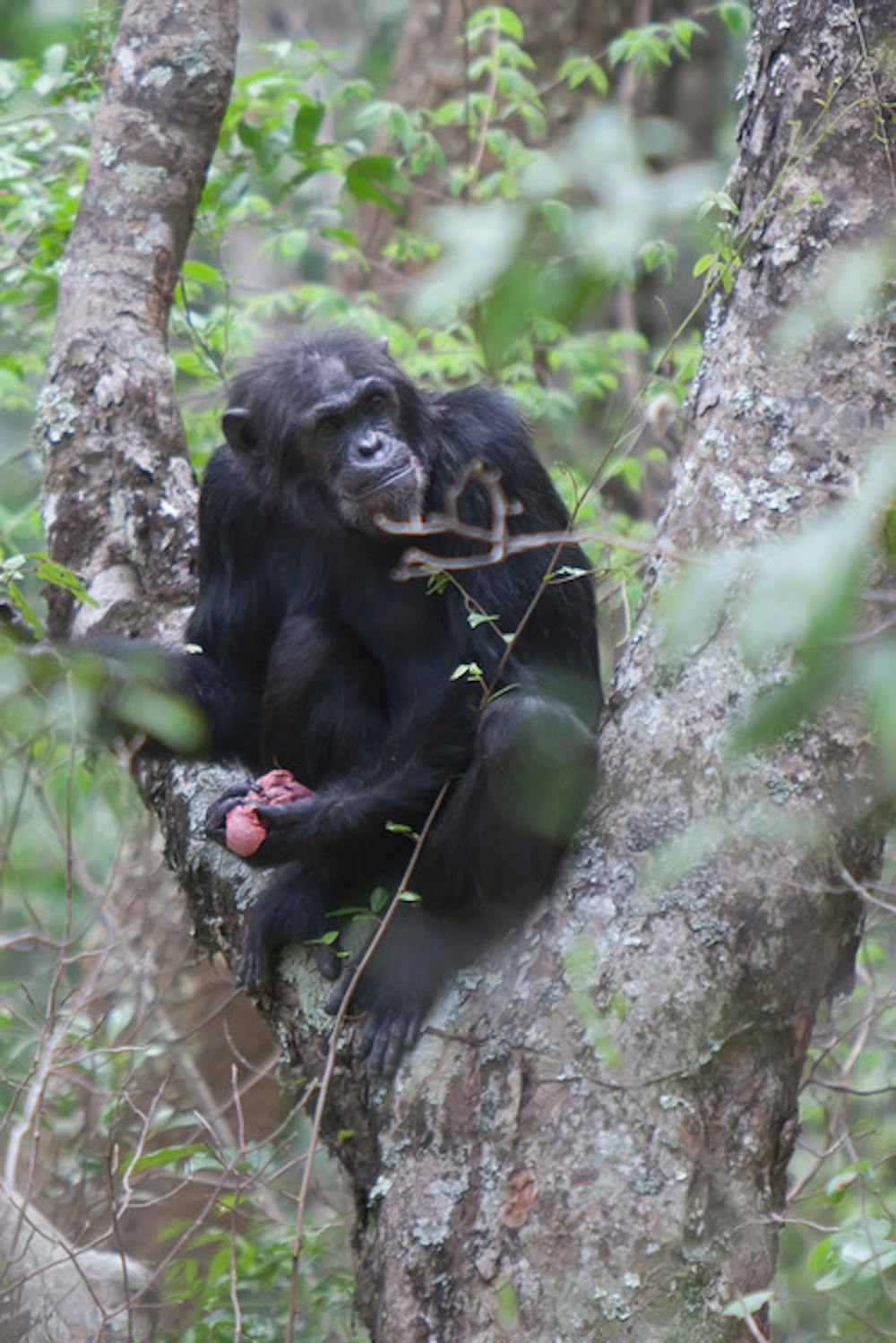





 AFP/File / JIM WATSON
  NASA/AFP / HO
  NASA/AFP/File /
  NASA/AFP/File / Handout
  NASA/AFP / Handout
  AFP / -