Second Amendment activist Jan Morgan on Wednesday suggested that pornography can do more "harm" than guns created on a 3D printer.
During a panel discussion on CNN's New Day program, Las Vegas massacre survivor Brian Claypool said that he was "re-traumatized" when he learned that blueprints for untraceable guns could be downloaded online and printed in anyone's home. This week, a federal judge temporarily blocked the release of the blueprints from Defense Distributed, a Texas-based company.
"I was in despair," Claypool explained. "I was grieving again. I was re-victimized and re-traumatized."
Morgan, who declared her gun store a "Muslim-free zone" in 2014, argued that both the First and Second Amendments protect the right to download plans for 3D-printed plastic guns.
"If we're going to start censoring any information out there on the Internet that might do irreparable harm then we're going to have to take off all the websites that might be out there that teach you how to make explosive devices and bombs," she insisted. "Websites such as pornography, websites that teach people how to poison other people."
"I mean, there's a wealth of information out there that is very dangerous on the Internet," Morgan added. "So this is a First Amendment issue."
According to Morgan, it is easier to build a gun out of parts from a hardware store than it is to print one from downloaded blueprints.
"The 3D-printable firearms are much more complicated to make than just building your own," she said.
Claypool explained that bullets from the gun were "made to destroy" the body by breaking apart once they enter the victim.
Morgan laughed at the notion.
"It's not funny," Claypool complained. "You go dodge bullets."
"United States veterans have gone behind the lines of fire to defend liberty!" Morgan exclaimed.
"This isn't about liberty," Claypool shot back. "It's about public safety."
A U.S. judge on Tuesday blocked the planned release of 3-D printed gun blueprints hours before they were set to hit the internet, siding with states that sued to halt publication of designs to make weapons that security screening may not detect.
U.S. District Judge Robert Lasnik in Seattle said the blueprints’ publication could cause irreparable harm to U.S. citizens. The decision blocked a settlement President Donald Trump’s administration had reached with a Texas-based company, which initially said it planned to put files online on Wednesday.
Gun control proponents are concerned the weapons made from 3-D printers are untraceable, undetectable “ghost” firearms that pose a threat to global security. Some gun rights groups say the technology is expensive, the guns are unreliable and the threat is being overblown.
Josh Blackman, a lawyer for the company Defense Distributed, said during Tuesday’s hearing that blueprints had already been uploaded to the firm’s website on Friday.
The publication of those files is now illegal under federal law, Lasnik said.
“There are 3-D printers in public colleges and public spaces and there is the likelihood of potential irreparable harm,” Lasnik said at the end of a one-hour hearing on the lawsuit.
Defense Distributed and its founder Cody Wilson, a self-declared anarchist, argued that access to the online blueprints is guaranteed under First and Second Amendment rights, respectively to free speech and to bear arms.
Lasnik said First Amendment issues had to be looked at closely and set another hearing in the case for Aug. 10. In a comment apparently directed at Wilson, the judge said breaking the law was something “anarchists do all the time.”
Blackman said in an interview he was disappointed in the court’s ruling and the judge’s comment.
“Mr. Wilson scrupulously obeys all court orders,” Blackman said, adding that he was awaiting the judge’s written order before deciding on further legal action.
Eight states and the District of Columbia on Monday filed a lawsuit against the federal government, arguing it acted arbitrarily in reaching the June settlement.
The states said online blueprints would allow criminals easy access to weapons. They said the Trump administration had failed to explain why it settled the case and that its decision violated their ability to regulate firearms and keep citizens safe.
Eric Soskin, a lawyer for the U.S. State Department, told the judge on Tuesday that the government’s role in the case was that of a bystander.
“As part of this decision, the United States has determined that the kind of guns you can go and buy in any store are not a threat to national security,” Soskin said of the settlement.
Defense Distributed’s files include 3-D printable blueprints for components that would go into the making of a version of the AR-15 semi-automatic assault rifle, a weapon that has been used in many U.S. mass shootings.
Earlier on Tuesday, Trump raised concerns about the sale of plastic guns made with 3-D printers and said on Twitter he had talked with the powerful National Rifle Association lobbying group about the weapons.
“I am looking into 3-D Plastic Guns being sold to the public,” he said. “Already spoke to NRA, doesn’t seem to make much sense.”
White House spokesman Hogan Gidley later told reporters it’s illegal “to own or make a wholly plastic gun of any kind, including those made on a 3-D printer.”
The NRA followed suit.
“Regardless of what a person may be able to publish on the Internet, undetectable plastic guns have been illegal for 30 years,” Chris Cox, executive director of the NRA’s Institute for Legislative Action, said in a statement.
The gun plans were pulled from the internet in 2013 by order of the U.S. State Department under international gun trafficking laws. Wilson sued in 2015, claiming the order infringed on his constitutional rights.
Wilson said in an online video that the blueprints were downloaded more than 400,000 times before they were taken down in 2013.
Reporting by Tina Bellon in New York, Susan Heavey, Susan Cornwell in Washington; Steve Holland; Jon Herskovitz in Austin, Texas; Editing by Grant McCool and Tom Brown
President Donald Trump on Tuesday raised concerns about the sale of plastic guns made with 3-D printers, a day after several U.S. states sued the Trump administration to block the online publication of designs for such printable weapons.
Eight states and Washington, D.C., on Monday filed a lawsuit to fight a June settlement between the federal government and Texas-based Defense Distributed allowing the company to legally publish its designs. Its downloadable plans are set to go online on Wednesday.
The legal wrangling is the latest fight over gun rights in the United States, which has faced a series of mass shooting in recent years that has re-ignited the long-simmering debate over access to firearms.
“I am looking into 3-D Plastic Guns being sold to the public,” Trump said in a Twitter post that referred to the powerful National Rifle Association lobbying group. “Already spoke to NRA, doesn’t seem to make much sense.”
Representatives for the U.S. Department of Justice did not immediately reply to a request for comment.
The states, in their filing on Monday, argued the online plans will give criminals easy access to weapons by circumventing traditional sales and regulations.
Gun rights groups have been largely dismissive of concerns about 3-D printable guns, saying the technology is expensive and the guns unreliable.
The man accused of shooting five people to death last month at a newspaper office in Annapolis, Maryland, entered a plea of not guilty on Monday to all 23 felony charges against him, including five counts of first-degree murder.
The plea was entered on behalf of Jarrod Ramos, 38, by his lawyers in a filing with the Anne Arundel County Circuit Court, along with motions seeking a speedy jury trial and to obtain prosecution evidence through pretrial discovery.
The filing negated the need for Ramos to appear in person for arraignment, as scheduled, and he was not in court. He remains jailed without bond. The proceeding was later removed from the docket, according to Emily Morse, a spokeswoman for prosecutors.
Ramos is charged with opening fire in the Capital Gazette newsroom in Annapolis on June 28 with a barrage of shotgun blasts, killing four journalists and a sales assistant in an attack police said was motivated by a long-standing grudge he held against the newspaper in Maryland’s state capital.
The community newspaper is owned by the Baltimore Sun. The killings rank as one of the deadliest attacks on journalists in U.S. history.
Ramos’ defense raised several procedural objections, including an assertion that identification of the defendant at trial would “be tainted as a result of impermissible suggestive identification procedures undertaken by police.”
Morse said a formal ID of Ramos was established through facial recognition technology. She denied as inaccurate reports that the suspect had mutilated his fingertips to avoid identification. She characterized the defense objections as “pretty standard” in such cases.
Reporting by Steve Gorman in Los Angeles; Editing by Peter Cooney
Five people were shot dead, including the suspected gunman, in a Friday night attack at a Texas nursing home and the home of one of the people slain, city officials said.
Police in Robstown, Texas, outside Corpus Christi, responded to reports of an active shooter at a nursing home about 7 p.m. local time (midnight GMT), where they found two men and a woman dead, said Herman Rodriguez, city secretary, in a video interview with the Caller Times of Corpus Christi.
Officers later found two more bodies at a home connected to one of the people slain at the nursing home, Rodriguez said.
“We do feel the crimes are related,” Rodriguez said.
Officials said the shooter was a male and that it was a murder-suicide.
A U.S. judge on Friday rejected a last-ditch effort by gun control groups to block the Trump administration from allowing the public to download blueprints for 3-D printable guns, declining to intervene just days before the designs are expected to go online.
U.S. District Judge Robert Pitman in Austin, Texas, denied the request for an order by the Brady Center to Prevent Gun Violence, Everytown for Gun Safety and the Giffords Law Center to Prevent Gun Violence at a hearing, saying he would state the reasons for his decision in a written order to follow.
At the hearing, the judge said he was sympathetic to the gun control groups’ concerns but questioned their legal standing to intervene in the case.
The groups sought to intervene following a June settlement between Defense Distributed and the U.S. government allowing the company to legally publish gun blueprints online, something its website says it plans to do by Aug. 1.
The government ordered the blueprints taken down in 2013 and Defense Distributed founder Cody Wilson sued in 2015, claiming his First Amendment and Second Amendment rights had been violated.
The government had until recently argued the blueprints posed a national security risk. Gun control groups said there had been no explanation for the June settlement and the administration’s abrupt reversal on the issue.
Lawyers for the Brady Center declined to comment on Pitman’s ruling after the hearing.
The groups in court filings said not halting the blueprint distribution by a Texas-based company called Defense Distributed would “cause immediate and irreparable harm to the United States national security” and that of individual U.S. citizens.
“The stated goal of Defense Distributed is to sound the death knell for gun control,” David Cabello, a lawyer for the Brady Center, told Pitman during the hearing.
The 3-D files include blueprints for a plastic AR-15 semiautomatic assault rifle, a weapon that has been used in many U.S. mass shootings, as well as other firearms.
Joshua Blackman, a lawyer for Defense Distributed, said he was grateful for the judge’s ruling. During the hearing Blackman said the gun control groups were trying to litigate a political dispute in court.
Wilson, a self-declared Texas anarchist, said in an online video that the blueprints were downloaded more than 400,000 times before they were taken down in 2013.
Lawrence Keane, general counsel for the National Shooting Sports Foundation, a trade association for gun manufacturers, told Reuters concerns over 3-D printable guns were overblown.
“I don’t see it likely at all that criminals will use this clunky and expensive technology,” Keane said. The NSSF is not involved in the case.
Reporting by Jon Herskovitz in Austin; Writing and additional reporting by Tina Bellon in New York; Editing by Susan Thomas and Dan Grebler
On Jan. 24, 2014, police found Josh Boren, a 34-year-old man and former police officer, dead in his home next to the bodies of his wife and their three children. The shots were fired execution-style on Boren’s kneeling victims, before he turned the gun on himself.
On Aug. 8, 2015, 48-year-old David Ray Conley shot and killed his son, former girlfriend and six other children and adults at his former girlfriend’s home. Like Boren, Conley executed the victims at point-blank range.
Both men had histories of domestic violence and criminal behavior. Yet despite the obvious similarities in these two cases and perpetrators, the media, in each case, took a different approach.
When describing Boren, the media focused on his good character and excellent parenting, going as far to call Boren a big “teddy bear” despite a prolonged history of domestic violence. They attributed his crime to “snapping” under the significant stress of his wife’s recent divorce filing.
In Conley’s case, media reports made little attempt to include any redeeming aspects of his personality. Instead, they focused exclusively on Conley’s history of domestic violence and prior drug possession charges. If you were to read articles about Conley, you would likely infer his crime stemmed from his inherently dangerous and controlling personality.
What might explain the differences in media coverage? Could it have something to do with the shooter’s race?
Boren, it turns out, was white; Conley was black.
In a recent study, we explored whether the race of mass shooters influences how the media depict their crime, their motivations and their lives.
We found that the discrepancies in the media coverage of Boren’s and Conley’s crimes were indicative of a broader phenomenon.
Explaining the crime, portraying the criminal
For the study, we randomly selected 433 online and print news articles covering 219 mass shootings from 2013 to 2015. While definitions of a mass shooting can vary, we adhered to the one most commonly used in empirical research: an event in which four or more people are shot, excluding the shooter.
Next, we created a unique data set based on information provided in the articles. We coded each article for a variety of variables associated with the crime and the shooter, including setting of the shooting, number and gender of victims killed and injured and age of the shooter.
After analyzing the data, we found that the shooter’s race could strongly predict whether the media framed him as mentally ill. (Less than 1 percent of the crimes had a female perpetrator.)
In all, about 33 percent of the articles in our study describing the crimes of a white shooter made a mention of mental illness. On the other hand, 26 percent of articles describing a Latino shooter and only two percent of articles describing a black shooter mentioned mental illness.
In fact – holding all aspects of the crime equal – white shooters were nearly 95 percent more likely to have their crimes attributed to mental illness than black shooters. Latino shooters were 92 percent more likely than black shooters to have mental illness mentioned as a factor.
An empathy gap
Furthermore, those articles that did describe a white shooter as mentally ill would often suggest that the shooter had been a generally good person who was a victim of society. The shooting, in other words, was out of character.
For example, in one case, a shooter in a rural trailer park set up a rifle in some bushes and began firing at the family trailer, with his wife, father-in-law and two young children inside. When the police arrived, he turned the rifle on them, hitting two officers before they gunned him down.
Yet subsequent news coverage noted his generally quiet demeanor and his willingness to help family and friends. The man who committed these crimes, one article noted, “wasn’t the same person who loved back-porch cookouts.”
However, such narratives – even within articles that mentioned mental illness – were less common when the shooter was black or Latino.
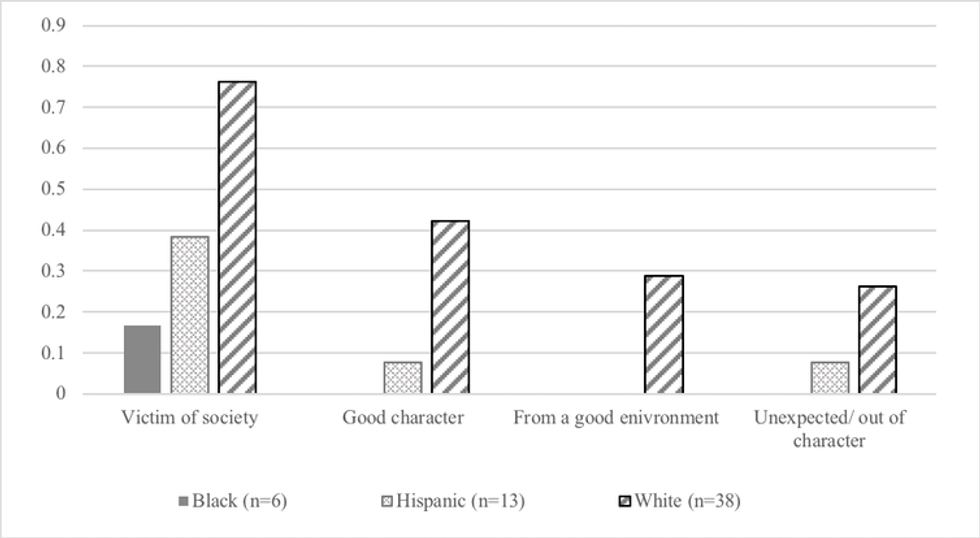
The graph below includes all news articles in our sample that framed a shooting as stemming from mental illness.
The chart shows the proportion of thematic narratives by race within the mental illness subsample.
Nearly 80 percent of articles that described white shooters as mentally ill also described them as a victim of society and circumstance – a tough childhood, a failed relationship or financial struggles.
However only one article that described a black shooter as mentally ill did the same. Furthermore, no article in our sample offered testimony to black shooters’ good character, suggested that the shooter was from a good environment or that the shooting was out of character. Across the board, roughly the same pattern played out with perpetrators who were Latino.
It seems as if media outlets tend to cast the violent acts of white criminals as unfortunate anomalies of circumstance and illness. For black shooters (and, to a lesser extent, Latino shooters) media outlets render their crimes with a brush of inherent criminality.
This isn’t to say that crimes shouldn’t be fully examined and that personal hardships and society don’t play a role. But if the circumstances of one group’s crimes are being explained in an empathetic way, and another group’s crimes aren’t given the same level of care and attention, we wonder whether this can insidiously influence how we perceive huge swaths of the population – criminal or not.
Nearly one year ago, country music star Eric Church watched in horror as dozens of concertgoers were killed at a Las Vegas festival where he'd just played. During a recent interview for the cover of Rolling Stone, Church railed against the NRA for blocking any progress on sensible gun reform.
“There are some things we can’t stop,” Church told the magazine. “Like the disgruntled kid who takes his dad’s shotgun and walks into a high school. But we could have stopped the guy in Vegas. I blame the lobbyists. And the biggest in the gun world is the NRA.”
Church is a gun owner and avid supporter of the Second Amendment, but the Vegas shooting changed him "a little" on the issue. While he owns "about half a dozen" guns, he agreed that no person should be able to own the 13 AR-15 rifles equipped with "bump stocks" that the Las Vegas shooter had. The addition of the "bump stock" gave 64-year-old Stephen Paddock the ability to fire off more than 1,100 bullets into a crowd of 22,000 people, police reported in wake of the event.
"As a gun guy, the number of rounds [the shooter] fired was un-f*cking-believable to me," he said. "I saw a video on YouTube from the police officer’s vest cam, and it sounded like an army was up there. I don’t think our forefathers ever thought the right to bear arms was that."
Church had been the headliner for the event prior to the night of the shooting and many of the victims were members of his fan club.
"I felt like the bait: People come to see you play, then all of a sudden they die? That is not an emotion that I was prepared to deal with. It wrecked me in a lot of ways,” he told the magazine.
“It got dark for me for a while,” he confessed. “I went through a period, a funk, for six months at least. I had anger. I’ve still got anger. Something broke in me that night, and it still hasn’t healed. There’s a part of me that hopes it haunts me forever.”
Manager John Peets noted that the incident was "really hard" for him to come to terms with.
"I think it just opened up an awareness of how fragile all this really is,” he said.
"I don’t care who you are – you shouldn’t have that kind of power over elected officials," he continued. "To me it’s cut-and-dried: The gun-show [loophole] would not exist if it weren’t for the NRA, so at this point in time, if I was an NRA member, I would think I had more of a problem than the solution. I would question myself real hard about what I wanted to be in the next three, four, five years.”
In an epic takedown of the National Rifle Association, late-night comedian Samantha Bee issued her own creepy advertisement mimicking one the gun lobbying group issued.
Bee began with the story of pro-gun activist Maria Butina, who is being labeled by media as a kind of irresistible fem fatal.
"She shot directly to the heart of American conservatism," said a CNN report. "Combining a passion for guns with an irresistible charm rarely associated with the U.S. gun lobby."
The TBS host was horrified all Butina had to do was talk about freedom and the economy and the man next to her looked like he was about to "betray America if she'll brush against his arm."
"With her focus on guns, sex, and big money, Maria Butina caused every Republican she met to grow that tell-tale wet spot on the front of their pants," Bee joked. "And if that sounds gross, it super was."
South Dakota GOP operative Paul Erickson was one who fell into Butina's arms. He was 27 years older than she.
"This is why Russia hates America," Bee surmised. "When their spies go to England, they sleep with Daniel Craig and Pierce Brosnan. When they come here, they have to do collision with Kevin from Dunder Mifflin."
Bee played a CNN report alleging that Butina was trying to establish back-channel communications between President Donald Trump and Russian President Vladimir Putin.
"There's no need for back-channel communications when they're doing front-channel communications!" exclaimed Bee, displaying a photo of Trump and Putin from their joint press conference. "Who cares if Butina fancied herself a half-assed James Bond character? The scary thing is that foreign interests are working with powerful conservative groups like the NRA and it just got even easier."
She then blasted the IRS for the recent decision that the NRA will no longer have to hand over the information of their donors, despite the fact that they're now suspected of being part of an international plot.
"Instead of playing spy, Butina and her cronies can give illegal contributions to the NRA and even the IRS won't know," Bee said. "Butina's arrest and this rule change happening on the same day is a coincidence. I'm sure when she heard about it from prison she was like, 'Wait, I did not even have to sleep with this f*cking jabroni?' Lady, you hit that."
Bee explained that the fact that Butina and shady Russian criminals chose to infiltrate the NRA probably isn't a coincidence, particularly given the new IRS rules. These groups can now spend up to 49 percent of their cash on "social welfare causes" without ever having to report anything to the public.
She noted that this is concerning for any organization, but the NRA has specifically spent years trying to divide Americans in their web ads.
"Usually starring shiny haired panic-button Dana Loesch," Bee said, showing a clip of an ad. The video prompted Bee to say that Loesch made a "bunch of women in p*ssy hats sound like Vietnam."
"You know, I never thought I'd say this to another woman, but maybe calm down and smile more," Bee said. "Dana and the NRA are so eager to call out the scourge of American liberalism, but they've been completely silent about their involvement with Maria Butina and Alexander Torshin."
The man accused of shooting 15 people and killing two on a busy, restaurant-filled Toronto street struggled with severe mental illness, his family said in a statement late on Monday as police sought a motive in the shooting spree.
Less than a day after two young women, ages 10 and 18, were killed and 13 other people were wounded by a gunman, the suspect was identified by the independent Special Investigations Unit (SIU) as Faisal Hussain, a 29-year-old Toronto resident. He was found dead shortly after the shooting, authorities said.
“We do not know why this happened,” Toronto Police Chief Mark Saunders told reporters on Monday, adding that he would not speculate about the gunman’s motive. “It’s way too early to rule out anything.”
The suspect, armed with a handgun, opened fire at 10 p.m. EDT on Sunday (0200 GMT Monday) on a stretch of Danforth Avenue filled with restaurants and family-friendly attractions in the city’s Greektown neighborhood, the SIU said.
“We are utterly devastated by the incomprehensible news that our son was responsible for the senseless violence and loss of life,” Hussain’s family wrote in a statement, adding that he suffered from severe mental illness as well as from “psychosis and depression his entire life.”
“While we did our best to seek help for him throughout his life of struggle and pain, we could never imagine that this would be his devastating and destructive end,” the statement said.
Police did not identify the two young women killed in the shooting spree. A local politician Nathaniel Erskine-Smith confirmed the 18-year-old victim was Reese Fallon, a recent high school graduate who planned to study nursing.
“The family is devastated,” Erskine-Smith said in a statement, adding that they have asked for privacy while they mourn a young woman who was “smart, passionate and full of energy.”
The gunman exchanged fire with police, fled and was later found dead, according to the SIU, which investigates deaths and injuries involving police.
The suspect had a gunshot wound, authorities said, but would not elaborate on the circumstances or cause of his death. An autopsy on the suspect will be conducted on Tuesday, SIU spokeswoman Monica Hudon said.
Hours after the fatal shooting, in an apparently unrelated incident, a man with a knife was arrested during a military ceremony on Parliament Hill in Canada’s capital, Ottawa. The Defense Ministry said no one was injured and gave no further details.
Prime Minister Justin Trudeau wrote on Twitter on Monday: “The people of Toronto are strong, resilient and brave - and we’ll be there to support you through this difficult time.”
Toronto Mayor John Tory told reporters the city has a gun problem, with weapons too readily available to too many people.
“Why does anyone in this city need to have a gun at all?” he asked in an address to city councilors early on Monday.
Bill Blair, Canada’s newly appointed minister of border security and organized crime who has been given the job of tackling gun violence, met with Tory on Monday afternoon.
To own a gun in Canada an individual must apply for a license, pass a background check and pass a firearm safety test. Guns must be kept locked and unloaded and can only be legally carried outside the home with a special permit. Handguns and other restricted firearms require passing an additional course.
Canada’s crime rate rose by 1 percent in 2017, the third consecutive annual increase, according to Statistics Canada. The murder rate jumped by 7 percent, due largely to killings in British Columbia and Quebec, while crime involving guns grew by 7 percent.
Toronto is grappling with a sharp rise in gun violence as gun deaths jumped to 26, up 53 percent so far this year from the same period in 2017. The number of shootings has risen 13 percent.
Toronto has deployed about 200 police officers since July 20 in response to the recent spate in shootings, which city officials have blamed on gang violence.
Saunders said the police presence would be increased in the Danforth area following the shooting.
In April, a driver deliberately plowed his white Ryder rental van into a lunch-hour crowd in Toronto, police said, killing 10 people and injuring 15 along a roughly mile-long (1.6-km) stretch of sidewalk thronged with pedestrians.
Reporting by Anna Mehler Paperny and Danya Hajjaji in Toronto; additional reporting by Denny Thomas in Toronto and David Ljunggren in Ottawa; editing by Paul Tait, Jeffrey Benkoe and Jonathan Oatis
Appearing on MSNBC on Sunday morning, the founder of the pro-gun control group Mom's Demand Action called upon the National Rifle Association to step up and explain their connection to the Kremlin after it was revealed that Russian Maria Butina was taken into custody for funneling millions in foreign cash to them.
Earlier in the week, federal authorities took Butina into custody for conspiring to defraud the United States and acting as an unregistered foreign agent in connection to her work with the NRA, which invested millions in helping Trump get elected in 2016.
With host Joy Reid introducing the segment by noting that NRA spokesperson Dana Loesch was recently revealed to have called Moms Demand Action members "dry-humping wh*res," the MSNBC host asked founder Shannon Watts to weigh in on the NRA's silence since the arrest of Butina.
"Why do you suppose they have been quiet about this unfolding scandal involving them?" Reid asked.
"That's a good one," Watts replied."They specialize in attack and they spent the last year, as an organization and the leadership, saying the Russian investigation was a hoax and that there was no collusion and getting into -- not just the gun rights aspect of it -- but the whole Trump administration aspect of it which was not their specialty."
"Ever since the story broke about Butina, they have been silent," she continued. "Look, we know that the NRA leadership traveled to Moscow. We know they met with Kremlin officials. We know they hosted an alleged Russian agent at their annual meeting. They need to come clean and they need to talk about it and answer questions."
"The walls are closing in on the NRA," she warned. "It's time to be honest with what their relationship is and not not with just with Butina, but with Russia."
On Tuesday, Jack Barsky — author and former sleeper agent of the KGB - appeared on Fox News to lend his expertise to the arrest of Maria Butina Sunday night.
Butina, who posed as a Russian gun enthusiast, is accused of trying to reach high-level GOP lawmakers by way of the National Rifle Association. It appears that the government suspects Butina of trying to establish back-channels with the Russian government.
Barsky has tentatively concluded that Butina is, in fact, an aspiring spy—but that her hijinks are hardly the fodder for an episode of the Americans.
In a detail that stood out to Barsky in the indictment, Butina talked to what appears to be a top Russian operative over Twitter DM—quite the insecure channel of communication.
Harith Augustus was shot and killed Saturday by a Chicago police officer, who stopped Augustus on the South Side. They said that they saw a man who "they thought might be armed." He was, and was shot in the back killing him.
Chicago Police Supt. Eddie Johnson revealed in a press conference that Augustus had a gun license, which contradicted previous claims by the department's spokesperson, Chicago Sun Times reporter Nader Issa tweeted.
In wake of the shooting, protests broke out across the city, which Johnson said he doesn't want to see happen again Sunday evening.
"We can't have another night" like last night, Issa quoted Johnson in a tweet. He went on to ask the community to take a breath a let the investigation continued.
"I know the community is also hurting," Johnson said. He also promised to be as transparent as possible to investigators.
"This police officer has a right to go home also," he continued. He asked citizens to put their guns down and let the court do it's job. In the past, nearly all police officers are acquitted after shooting people of color.
The officer that is responsible for the death of Augustus has been on the force for less than two years and he is still in his probational period. According to Issa, that means he's been out of the police academy for less than a year.




 This isn’t to say that crimes shouldn’t be fully examined and that personal hardships and society don’t play a role. But if the circumstances of one group’s crimes are being explained in an empathetic way, and another group’s crimes aren’t given the same level of care and attention, we wonder whether this can insidiously influence how we perceive huge swaths of the population – criminal or not.