ABC's "This Week " host George Stephanopoulos was forced to cut off Donald Trump's trade adviser Peter Navarro on Sunday morning after the White House official stated the son of presumptive Democratic presidential nominee Joe Biden took a billion dollars from the Chinese.
Speaking to the ABC host from the lawn in front of the White House, Navarro stated, "Joe Biden has forty years of sucking up to the Chinese, including 8 years as vice president. We already know about the billion dollars that his son took from the Chinese."
"That's just not a fact," the ABC host cut in as Navarro shrugged and smirked. "That is not factual. That is just not a fact. He did not take in a billion dollars."
"Went into that hedge fund. But be that as it may, this election is going to be a referendum on China," Navarro soldiered on as Stephanopoulos looked on with a grimace.
Washington (AFP) - President Donald Trump's reelection battle against Joe Biden was always going to be wild -- and then came the coronavirus, killing nearly 90,000 Americans, scuttling the economy and throwing the race into surreal confusion.Less than six months before election day, neither candidate can campaign normally, voters wonder whether they'll be safe, and Trump suddenly faces what amounts to a referendum on his handling of a once-in-a-century crisis."We really don't know how this is going to play out," politics professor Christopher Arterton at George Washington University told AFP.F...
President Donald Trump's son Eric suggested that coronavirus lockdowns were a conspiracy to keep his father from holding 2020 campaign rallies during a Saturday appearance on Fox News with Jeanine Pirro.
With America leading the world in reported coronavirus fatalities, the president's son was focused on the 2020 campaign against former Vice President Joe Biden.
"Listen, Biden loves this," he claimed. "They think they're taking away Donald Trump's greatest tool, which is being able to go into an arena and fill it with 50,000 people every single time."
"So you watch, they will milk it every single day between now and November 3rd,"
"And guess what, after November 3rd, coronavirus will magically all of the sudden go away and disappear and everybody will be able to reopen," he predicted.
"They're trying to deprive him of his greatest asset, which is the fact that the American people love him, the fact that he's relatable, and the fact that he can go out there and draw massive crowds," he argued.
In the segment, his claims about his father's crowd sizes and popularity were both exaggerated.
The president's eldest son lashed out at former Vice Presiden Joe Biden on Saturday.
"President Trump’s eldest son on Saturday posted a social media message suggesting Joseph R. Biden Jr. was a pedophile, an incendiary and baseless charge that illustrates the tactics the president is turning to as he attempts to erase Mr. Biden’s early advantage in key state polls," The New York Timesreported Saturday.
"Donald Trump Jr.’s inflammatory and baseless claim, which he shared with his 2.8 million Instagram followers, comes as his father and the re-election campaign have sought to weaken Mr. Biden with an onslaught of allegations and insinuations rarely seen in modern elections," the newspaper reported.
Congressional Democrats on Saturday launched a probe into President Donald Trump's "politically-motivated" dismissal of a government watchdog believed to have been investigating Secretary of State Mike Pompeo.
The announcement came after Trump told House of Representatives Speaker Nancy Pelosi late Friday that he planned to dismiss State Department Inspector General Steve Linick.
It was Trump's third abrupt dismissal of an official tasked with monitoring governmental misconduct and abuse since April.
"We unalterably oppose the politically-motivated firing of inspectors general and the President's gutting of these critical positions," two senior Democrats -- Senator Bob Menendez and congressman Eliot Engel -- said in a statement.
The lawmakers said Linick had apparently "opened an investigation into wrongdoing by Secretary Pompeo himself."
The IG's dismissal, "transparently designed to protect Secretary Pompeo from personal accountability, would undermine the foundation of our democratic institutions and may be an illegal act of retaliation."
A Democratic congressional aide, speaking on condition of anonymity, said Linick was probing complaints that Pompeo inappropriately used a political appointee to perform personal tasks for himself and his wife Susan.
CNN, citing a senior State Department official, reported that Pompeo himself had recommended the firing and hand-picked Stephen Akard, a former aide to Vice President Mike Pence, to succeed Linick.
By law, the administration must give Congress 30 days' notice of its plans to terminate an inspector general, in theory giving lawmakers time to study the move -- and protest if warranted.
But previous such firings have gone through unimpeded, and those dismissed have been replaced by political allies of the Republican president.
Engel, who heads the House Foreign Affairs Committee, and Menendez, the top Democrat on the Senate Foreign Relations Committee, requested that the White House and State Department turn over records related to Linick's dismissal.
They also asked to see files for IG investigations "involving the Office of the Secretary that were open, pending, or incomplete at the time of Mr. Linick's firing."
Dog-sitting and takeout
Pompeo has raised eyebrows for frequently traveling the world on his government plane with his wife, who has no official role.
CNN reported last year that a whistleblower had complained that the Bureau of Diplomatic Security, which guards US missions overseas as well as the secretary of state, had been assigned questionable tasks for the Pompeos, such as picking up takeout food or tending to the family dog.
The State Department confirmed Linick's firing but did not comment on the reason -- or on whether Pompeo was under investigation.
A State Department spokesperson also confirmed that the new inspector general would be Akard, an attorney who served as a foreign affairs advisor to Pence when the latter was governor of Indiana.
Since last year, Akard has led the State Department's Office of Foreign Missions, which handles relations with diplomats in the United States.
Pelosi said Linick was "punished for honorably performing his duty to protect the Constitution and our national security."
"The president must cease his pattern of reprisal and retaliation against the public servants who are working to keep Americans safe, particularly during this time of global emergency," she said.
Trusted presence for Trump
Pompeo is one of Trump's most trusted aides -- and a rare one never to come publicly into the crosshairs of the mercurial president.
In recent months, Pompeo has moved US foreign policy forcefully to the right -- encouraging a drone strike that killed a top Iranian general and promoting a theory, discounted by mainstream scientists, that the COVID-19 pandemic originated in a Chinese laboratory.
Linick, a longtime prosecutor, was appointed in 2013 by Trump's predecessor Barack Obama to oversee the $70 billion juggernaut of US diplomacy.
He played a small role in Trump's impeachment saga last year, handing to Congress documents by Trump's lawyer Rudy Giuliani with unproven claims about Democratic presidential candidate Joe Biden and Marie Yovanovitch, whom Trump removed as the US ambassador to Ukraine.
Trump repeated the charges to Ukraine's president and pressed him to dig up dirt, while freezing military aid to Kiev, which is battling Russian-backed separatists.
Since his acquittal by the Senate, Trump has fumed against a "Deep State" he sees as out to get him.
He has removed or demoted inspectors general for the Pentagon, the intelligence community and the Department of Health and Human Services, as well as a senior health official who questioned Trump's promotion of unproven drug therapies for COVID-19.
Donald Trump continued his Twitter flurry on Saturday afternoon with an attack on MSNBC's Lawrence O'Donnell -- also getting in a jab at fellow MSNBC host Joe Scarborough -- over an interview O'Donnell did with former Vice President Joe Biden.
Referring to his previous reality show, the president wrote, "Really sad, but even 'sadder', watch flunky @Lawrence CRY when I whipped his mind & he was FORCED to apologize to me over Apprentice fees. Even Psycho Cold Case Joe Scarborough (bad ratings) beat him up, on air, unmercifully. Find tapes & play (5 years back?)."
The president did not explain his beef with O'Donnell over Apprentice fees or what he meant by "whipped his mind."
The loss of 31 million jobs due to coronvirus has an added downside:
27 million have lost job-based health insurance. The worst may still lie ahead. One study estimated that 25 to 43 million people could lose coverage from their employer.
The situation for many Americans feels dramatic. Fortunately, the limited U.S. safety net will be able to cushion some of the fallout for almost 80% through programs like Medicaid, the Children’s Health Insurance Program and the Affordable Care Act marketplaces. And, of course, all preexisting conditions are still required to be covered by all insurers.
Yet millions will be left without coverage. As a professor of public policy, I believe there are four things you need to consider if you’ve been laid off, or if you didn’t have health insurance before the pandemic.
In Plantation, Florida, an aerial view of a deserted Westfield Broward Mall, taken by a drone on May 5.
What do I do if I’ve been laid off and lost coverage?
The good news: For many who have lost their employer-provided coverage, a number of alternatives may exist.
For some, they might now be able to join their spouse’s insurance. Others may be able to maintain their previous coverage through COBRA, albeit without the financial subsidy from their employer. This option can get expensive very quickly. Currently, average premiums in the U.S. for individuals amount to US$7,188. The number increases to $20,576 for a family of four. And COBRA adds an additional 2% of premiums for administration.
Due to the loss of income, people in states that expanded Medicaid under care of the ACA could become eligible for Medicaid coverage. In those states, individuals and their families qualify if their income falls below 138% of the federal poverty line. For a family of four, this currently amounts to roughly $36,000. In states that did not expand Medicaid, eligibility rules vary widely but are often quite restrictive.
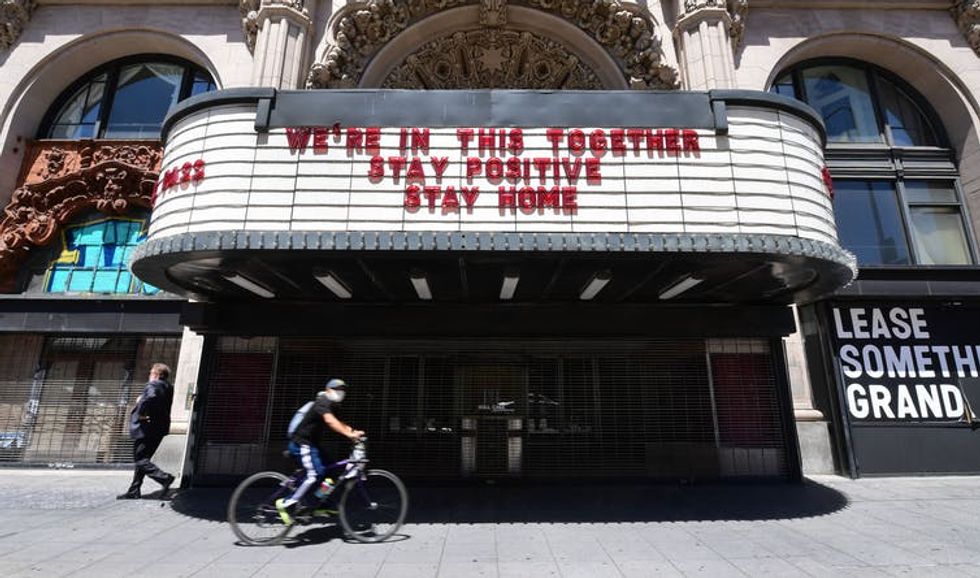
In Los Angeles, California, the Million Dollar Theater, closed due to the pandemic, offers some comforting words on its marquee.
Individuals who do not qualify for their state Medicaid program may find an alternative in coverage purchased on the ACA insurance marketplaces. Here individuals between 100% and 400% of the federal poverty line are eligible for premium support. Those on the low end of the guidelines are also eligible for out-of-pocket support.
Unfortunately, the decision of many states not to expand their Medicaid programs may leave millions of Americans ineligible for public coverage. They fall into the so-called coverage gap. They make less than the 100% of federal poverty line that makes them eligible for ACA marketplace subsidy. Yet they also make too much to qualify for the restrictive state Medicaid program. This situation applies to nonparent adults in 10 states, including Texas, Oklahoma and Mississippi.
Importantly, coverage may be available for the children of those who have lost their previous insurance through the Children’s Health Insurance Program. Eligibility limits, even in nonexpansion states, are significantly higher.
Finally, individuals can purchase short-term limited duration insurance. While premiums for this type of coverage are significantly cheaper than for ACA-compliant products, their coverage comes with significant gaps. That is, most preventive services, treatment for conditions like cancer or even prescription drugs likely will not be covered. They also require medical underwriting.
What if I didn’t have insurance in the first place?
A global pandemic seems like a particularly bad time to go without coverage. Yet we know that millions of Americans are eligible for public coverage but remain unenrolled. For many of them, many of the same options described above may apply, including Medicaid, CHIP, spousal coverage and short-term limited duration health plans.
The situation is more complex for those seeking to purchase insurance on their own. The ACA insurance marketplaces generally require that individuals purchase coverage during their open enrollment period. This occurs generally in November and December. The requirement is intended to keep insurance markets stable and not simply allow individuals to obtain coverage only when they fall sick.
In the wake of the coronavirus pandemic, at least nine states have made an exception and reopened their marketplaces temporarily. These include Colorado and Connecticut.
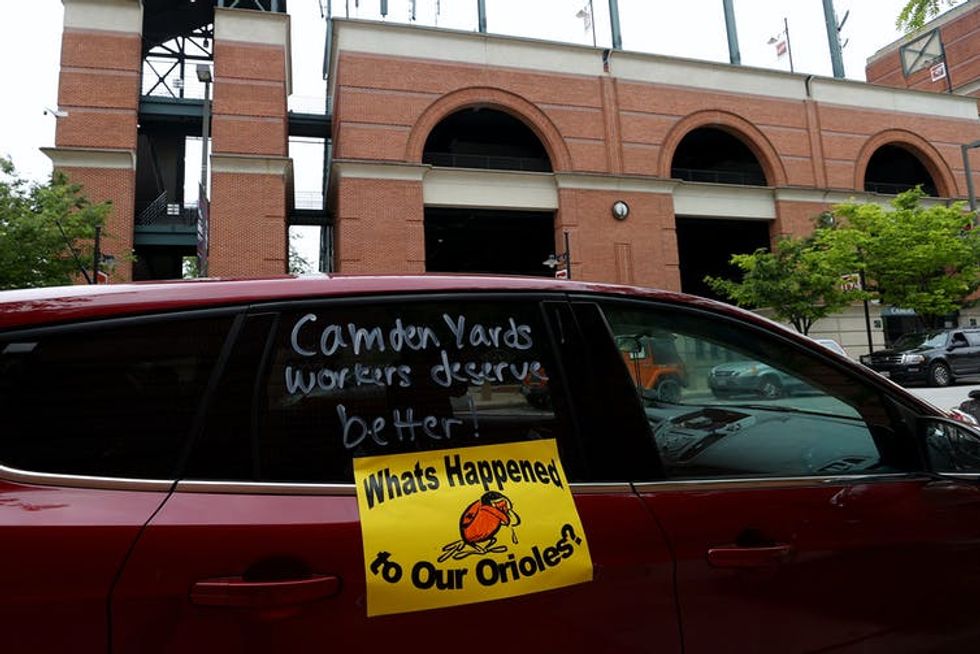
Outside Camden Yards in Baltimore, Maryland, concession workers call for the Baltimore Orioles baseball team to pay the workers unemployment insurance benefits. The start of the baseball season has been delayed due to the COVID-19 pandemic.
If you fall sick and need medical help but are currently uninsured, you should not hesitate to seek care.
Many providers, particularly hospitals and federally qualified health centers, will actively seek to enroll you into public coverage like Medicaid. Importantly, Medicaid coverage in most states can be applied retroactively for three months. However, a few states like Arizona and Iowa have obtained permission to exclude this benefit.
Even then, many states have longstanding protections for uninsured individuals that requires providers to use so-called sliding scales, the adjustment of fees based on income. Others have local programs that may help pay for your care. The CARES Act also provides reimbursement for some COVID-19-related care directly to providers.
Importantly, if you get a bill, try to negotiate with the provider. Legal aid societies across the country are there to help in this process.
How the ACA lawsuit may impact health insurance coverage
From a policy perspective, the coronavirus pandemic starkly highlights the need for a strong safety net. It is also offers a reminder of the benefits that the ACA provides to millions of Americans on a daily basis. Without it, millions more would lose their coverage.
It is important to remember that the ACA’s constitutionality is currently in litigation once more before the Supreme Court. The Trump administration has taken a virtually unprecedented step and refused to defend it. It has also argued that if any of the law is struck down, it should fall in its entirety. Of course, should this occur, the implications for the U.S. could be dramatic. On the other hand, should former Vice President Joe Biden come to office with a large Democratic majority in both chambers, it seems realistic to expect him to move forward with expanding the ACA and seeking the inclusion of the so-called public option.
On Saturday, Politico reported that President Donald Trump's re-election campaign is floundering in its efforts to craft a re-election strategy that can work in the coronavirus pandemic — particularly his planned efforts to woo communities of color.
"Almost a month ago, as the coronavirus exacted an outsized toll on vulnerable groups across America, President Donald Trump turned to an under-the-radar White House council to quickly determine how the federal government 'can best support minority and distressed communities," wrote Gabby Orr. "Little has come of it. The White House Opportunity and Revitalization Council, repurposed by Trump on April 22 to confront the pandemic’s disproportionate damage to communities of color, is still assembling proposals to reduce racial health disparities that have been magnified by the coronavirus outbreak, according to four people familiar with the planning."
"The delay in tackling the disproportionate mortality and infection rates and financial strain in minority communities — some of the most severe of the coronavirus crisis — underscores the challenge administration officials face as they grapple with a dire public health crisis," continued the report.
"The dearth of information about the federal government’s plans to correct failures that have exacerbated the pandemic’s impact on communities of color has not stopped the president — or his campaign — from using the topic to forge ahead in their pursuit of black and Latino supporters," said the report, noting that the president is continuing to trumpet his efforts on "underserved communities." "Nevertheless, minority voters have continued to give the president low marks for his handling of the coronavirus outbreak, which has claimed more than 80,000 American lives since February."
"One campaign official said that in order to survive the November contest, Trump needs to eat into the overwhelming support his likely challenger, former Vice President Joe Biden, enjoys among African Americans, while also strengthening his appeal among non-college educated whites," said the report. "The problem is, Trump’s singular strength with non-white voters — his handling of the U.S. economy — has disappeared as a reliable talking point in the coronavirus era. From campaign rallies in minority communities to speeches in front of conservative black audiences, the president’s most common refrain has been about low unemployment and steady wage growth, two relics of a pre-coronavirus economy."
You know someone's in a real panic when they start running in circles, and that's what Donald Trump has been doing for the past week. He started off last Sunday with an epic tweetstorm, 126 of them in all, the third-highest total for one day in his presidency, according to FactBa.se, which keeps track of Trump's statements. "Obamagate!" he tweeted, following that one with "Because it was Obamagate, and he and Sleepy Joe led the charge. The most corrupt administration in history!"
That presaged by 24 hours his now-famous exchange with Philip Rucker of the Washington Post in the Rose Garden, when Rucker asked him, "What crime, exactly, are you accusing President Obama of committing?"
"Obamagate," Trump replied, refusing to define the "crime" or provide any specific evidence. So Rucker followed up: "What is the crime, exactly, that you're accusing him of?" Trump shot him what passed for an angry look: "You know what the crime is," Trump answered. "The crime is very obvious to everybody."
What was Obamagate, pundits asked each other with puzzled looks on their faces, as the week wore on? They should have known that it would have something to do with Michael Flynn, Trump's former national security adviser, who lasted all of 24 days in the job before being fired for lying to Vice President Mike Pence about his phone call with Russian ambassador Sergey Kislyak in late December of 2016. Flynn was later charged with lying to the FBI, pled guilty twice, and has been awaiting sentencing for more than two years. Trump's Department of Justice, under the direction of Large Lickspittle Bill Barr, moved to drop the charges against Flynn last week, which generated a letter signed by 2,000 former Justice Department officials denouncing the motion filed by Little Lickspittle Timothy Shea, the U.S. attorney for the District of Columbia. The judge in the case will hold hearings on the matter and has not yet issued a ruling.
There is a perfect symmetry to the involvement of Michael Flynn in Trump's latest attempt to deflect attention from his inept handling of the coronavirus crisis, which has caused the infections of more than 1.4 million Americans and the deaths of more than 87,000 nationwide. Flynn enjoyed a singular distinction during the transition between the Obama and Trump administrations, besides his coziness with Russian bankers and ambassadors. Obama gave Trump only one piece of personal advice during their private meeting in the White House after Trump was elected: Whatever you do, don't hire Michael Flynn. For anything. Ever.
But Trump loved Flynn. It had been Flynn who led the delegates at the 2016 Republican National Convention in chanting "lock her up" after mentioning the alleged criminal behavior of Hillary Clinton as secretary of state. As with Trump's use of "Obamagate" as a shorthand for Obama's alleged corruption while in office, Flynn's allegations against Clinton were equally vague and shorn of specificity. Trump had already been encouraging his crowds to chant "lock her up" at his campaign rallies in 2016, and has continued the practice ever since. I don't know of a single rally Trump has held since he's been in office when the crowd didn't break into the "lock her up" chant, with Trump allowing the fascist bellowing to wash over him as he stands at the podium, smiling with approval at the crowd.
I use the words "fascist bellowing" on purpose, because that's what it is: Trump supporters at public events and rallies loudly endorsing official lawlessness. It's not a funny joke or clever verbiage. Trump and his followers have been routinely advocating the jailing of Trump's political opponents without an investigation, criminal charges, trial or conviction by a jury of their peers. This is the way fascist dictators dispose of their political opposition. Putin has jailed opponents of his regime. He has also arrested wealthy businessmen whose enterprises he wanted to seize, and of course he has ordered the murder of Russian citizens who he felt betrayed him.
Trump himself circled back around to calling for the jailing of his political enemies for unspecified crimes on Thursday morning in an interview with Maria Bartiromo on the Fox Business Network. Trump called the "unmasking" of Flynn "the greatest political crime in the history of our country."
He continued: "If I were a Democrat instead of a Republican, I think everybody would have been in jail a long time ago … it is a disgrace what's happened. This is the greatest political scam, hoax in the history of our country." To set the record straight, that's ludicrous and untrue. Flynn's "unmasking" was a routine national security procedure during which officials in the Obama administration were given Flynn's name as the person who was caught on NSA wiretaps talking to Kislyak during the Trump transition, when Flynn was serving as an adviser to Trump on national security and international relations. Included among the Obama officials were Trump's bete noire, former FBI director James Comey, and Vice President Joe Biden.
Another fascist dictator who made use of extrajudicial imprisonment of political enemies was Adolf Hitler. He didn't bother with leading "Lock her up" chants at his rallies. He just locked up his political opponents and racial and ethnic and religious enemies in concentration camps where they were executed or perished from disease and starvation. His followers rewarded him at political rallies by chanting "Heil Hitler." It was the all-purpose approbation of Hitler's leadership of Nazi Germany, a mass public endorsement of everything he did, including locking up his political opponents. That's what "Lock her up" has become for Trump.
Trump's campaign people are already talking about holding rallies as Trump blackmails the states by pushing his "open up" madness. "Lock her up" chant doubles down on hatred for Hillary Clinton, or these days for Nancy Pelosi and Joe Biden, for those in love with Trump, by loudly calling for his political opponents to be imprisoned without trial for unspecified crimes. If you don't believe me, listen to the chant the next time he holds a rally. Trump's followers are both swearing allegiance and saluting him. "Lock her up" is Trump's "Heil Hitler."
It’s wise not to read too much into the implications of these rating movements for the US presidential elections in November. The basic electoral dynamics have not changed since the Republican’s heavy losses in the 2018 midterm elections, and actually not much since Trump’s marginal victory in the 2016 presidential race.
The uptick in approval ratings in late March was neither unprecedented for Trump, nor was it large or long lasting: 49%, up from 44% in early March, and back down to 43% in early May. Trump’s approval went up to 49% in January and February when he was being tried in the Senate. However, since Trump’s inauguration his approval has consistently bumped along in the low 40% range.
Meanwhile, some approval polls, including some taken in mid and late-March when Trump’s rating rose, were not confined to samples of likely voters but rather polled all adults, which also included non-voters, many of whom are not even registered. This distinction is important because only 55%-60% of the US voting age population go out to vote in presidential elections.
Trump’s uptick in approval came in the early stages of the coronavirus outbreak in the US. It was really very small in historical perspective – especially when compared with rallies round the flag during previous international and national crises. Just before 9/11, for example, George W Bush was on 51.5% approval but then soared to 88.4% after.
The basic dynamics of the election remain the same as they have been for the past year or so: Trump might win re-election in November but it’s still more likely that Joe Biden, the former vice-president and expected Democratic party nominee, will become the next president.
The combination of Trump’s marginal 2016 victory, losing the House of Representatives in the 2018 midterm elections, and his unimpressive approval ratings as president in comparison with all his predecessors since Harry Truman have always made Trump electorally vulnerable to any negative developments.
Several factors could have changed the 2020 electoral landscape: disunity in the Democratic Party, a good economy, and an impressive response to the COVID-19 crisis. Either they have not, or are unlikely to change it now.
Rather, each of these factors has now changed in Biden’s favour, at the same time that Trump’s electoral vulnerabilities remain or have increased. Recall that his 2016 Democratic opponent Hillary Clinton lost three battleground states – Michigan, Pennsylvania and Wisconsin – by just 1%. If she had won each those states, she would be president.
An Ipsos poll taken in mid-April showed registered voters in those three states favouring Biden over Trump, 45% to 39%. This was at a time when Biden was sidelined in the COVID-19 crisis while Trump dominated public attention. The poll found that 48% of people living in those states said the coronavirus was the most important problem facing their community, way ahead of other issues. A Fox News poll of voters in the battleground states of Florida, Michigan, and Pennsylvania showed similar results.
While Trump’s electoral vulnerability has increased, Biden’s has decreased. After his opponent Bernie Sanders withdrew from the Democratic primary, he announced his support for Biden, adding to the endorsement of other former Democratic candidates. The widespread fear that the Democrats would be divided in a nasty primary fight disappeared surprisingly quickly – and without Biden being pulled too much to the left of the political centre.
Biden’s message exudes pragmatism and gradual change – on healthcare, climate change, guns and economic inequality, which will likely appeal to many independents and centrist voters. And, come the election, polls show most Sanders Democrats will support Biden against Trump.
For sure, the booming US economy on which Trump relied for his re-election has evaporated. The projected economic effects of the escalating COVID-19 crisis already look horrendous and unprecedented. As much as a third of the economy remains shut down and the possibility of a bounce back by November looks remote.
Given Trump’s prominence and the much greater media attention he receives as president, his numerous missteps and his general handling of the crisis will likely make the November election a referendum on his performance in responding to the coronavirus and its effects on the US economy.
In this context, a sustained “rally round the flag” effect is unlikely to emerge before November. Second-quarter economic growth is always important in an election year in shaping US voters’ opinions of the economy come November, as is an incumbent president’s approval ratings. Given this, Trump appears unlikely to win re-election later this year.
Donald Trump's chance of holding on to the badly needed electoral votes from Rust Belt states is taking a major hit, reports Politico, as the coronavirus spreads from the densely populated urban centers to the suburbs.
Those same states, often labeled as the "battleground states" that could swing the election either way, appear to be leaning towards presumptive Democratic nominee Joe Biden, and the COVID-19 virus is playing a major part in the president's troubles.
"The region is now becoming a new front line for Americans’ lives and livelihoods as coronavirus hot spots proliferate and jobless rates spiral. The confluence of a ferocious pandemic, deepening economic turmoil and rising political tensions is more pronounced here than anywhere else in the country," the report states. "And it sets the stage for a combustible campaign season that is testing President Donald Trump’s efforts to move on and insulate himself from the crisis—and Joe Biden’s ability to blame him for the fallout."
During the president's visit to Pennsylvania on Thursday, he proclaimed, "The fourth quarter is going to do very well. And next year is going to be through the roof,” but Poltico reports that the public is not buying it.
"Numbers and interviews, however, paint a much grimmer picture. The virus has moved from urban centers like Detroit and Chicago into suburbs and more sparsely populated counties, a trend seen from western Pennsylvania to Minnesota and Iowa. In Wisconsin, Michigan and Pennsylvania—Democrats’ so-called “Blue Wall”—19 counties report coronavirus cases doubling in less than 14 days. Trump won all but one of those counties, by an average of 65 percent," the report states. "Democrats are working to ensure that doesn’t happen again by casting his stewardship over the virus and economy as a betrayal."
Adding to fears about the pandemic raging through the communities affecting residents' health, have been the devastating loss of jobs.
"The region has been devastated by job losses amid pandemic-induced economic shutdowns, in some cases far outpacing the national average in terms of the proportion of their workforces that have applied for unemployment benefits since mid-March," the report states.In Michigan, more than 3 in 10 workers have sought aid in the past two months, according to a POLITICO analysis of Labor Department data. Layoffs and furloughs are also piling up in Pennsylvania, where more than one-fourth of the workforce — or 29.6 percent — has filed an unemployment claim."
According to Paul Clark, director of the School of Labor and Employment Relations at Penn State University, the problems Trump was supposed to fix after he was elected in 2016 still remain.
“The way I’ve come to terms with what happened in 2016 in these working-class areas is that the Trump vote was a vote of despair and desperation. And that despair and desperation remain in 2020,” Clark remarked before adding, "The big question is, will people in those areas react in the same way that they reacted in 2016 … or have they had enough?”
According to Sen. Tammy Baldwin (D-WI), the president has a problem with voters in her state over the way he has handled the pandemic.
"They are very clear about what those missteps are and, frankly, they are angry," she told Politico.
According to a column in the conservative Bulwark, Donald Trump's campaign manager Brad Parscale is likely taking advantage of the president's disinterest in details and his inability to understand technology to hang onto his job even though the president is struggling at the polls.
Writing that he is not entirely skeptical of Parscale's boast that he has created a "death star" that will deliver a second term to Trump, Jonathan Last stated he has some questions, and that the campaign manager may be pulling the wool over the president's eyes.
"In 2016, Trump cycled through campaign managers at a rapid clip. The only job security Parscale has comes from convincing Trump that he has built some magical machine which no one else—and especially not Old Man Trump—can understand. Or operate," the columnist wrote. "Creating the impression that the entire Trump campaign will rise or fall with an opaque digital operation is a way to make Parscale un-fireable."
"Unlike the 2016 campaign, which was basically about letting Trump be Trump, there is now a great deal of sunk-cost into an operation which is purpose-built to keep the septuagenarian boss from understanding how it works. Or even, what it really is," Last explained, before adding, "The digital operation is too sprawling, too micro-targeted, and too evanescent for anyone to really have a handle on how effective it is."
What should concern Trump, Last suggested, is the fact that the president is trailing presumed Democratic presidential nominee Joe Biden by considerable margins -- particularly worrisome for an incumbent president.
"All you can really do is look at the polls. And as Harry Enten wrote last weekend, Biden has the largest and steadiest lead any challenger has ever held against an incumbent. As in: Ever," Last noted dryly adding, "I’m sure Big Brad will tell the boss that without his Magical Internet Machine he’d be losing to Biden by even more right now. And for all I know, that’s true. But I kind of suspect it’s not."
Calling the disconnect, "...just one more sign of Trump’s weakness," Last suggested, "In 2016, Trump bet on himself. He saw campaigns as basically superfluous and certainly viewed campaign managers as disposable cogs in the machine that is the cult of Donald J. Trump."
"If Trump keeps Parscale around even as he lags Biden in the polls, it’s a sign that the president no longer believes that he is enough to get his voters out on his own and that he’s hostage to whatever sales pitch he bought from Parscale," he wrote, before dryly adding, "It’s a good reminder that inside every con man is a mark."
Former Vice President Joe Biden participated in an hour-long special on MSNBC on Thursday.
Biden was interviewed, along with Stacey Abrams, by MSNBC's Lawrence O'Donnell and also answered video questions from viewers.
Near the end of the special, Biden was asked whether he would "commit to the American ideal that no one is above the law" by refusing to pardon Donald Trump.
"Yes, I commit," Biden said.
"The Attorney General of the United States is not the president's lawyer," Biden explained. "It's the people's lawyer."
Biden referred to O'Donnell's time working for former Sen. Daniel Patrick Moynihan (D-NY).
"You remember when you were there with Pat Moynihan, we never saw anything like the prostitution of that office like we see it today," Biden continued.
"It is not something the president is entitled to do -- to direct either a prosecution and/or decide to drop a case. That is not the president's role, responsibility, and it's a dereliction of his duty," he added.