In an op-ed for the Washington Post, former federal prosecutor Joyce White Vance explained that the idea of "witness reciprocity" that Republicans seem to think exists, isn't actually a thing.
"Witness 'reciprocity' isn't a thing. So no, there can't be a Biden for every Bolton. Only testimony that bolsters or casts doubt on facts necessary to deciding on the articles of impeachment is relevant at trial," she wrote.
Her comment comes after Sen. Ted Cruz (R-TX) decided that because Democrats want a first-hand witness to testify at the impeachment trial in the Senate. Cruz, wants someone that has nothing to do with President Donald Trump's obstruction of justice or his abuse of power, and instead is part of one of the president's conspiracy theories.
"Leave aside for the moment that no evidence of illegality by Biden has turned up, and Trump’s Justice Department has not charged anyone, which it could presumably do if such evidence existed," wrote Vance. "The implication was that reciprocity might discourage Democrats from pursuing witness testimony. Some commentators took up Cruz’s challenge, however, saying Democrats should be willing to offer up Hunter Biden, or even his father, Joe Biden, Trump’s rival in the 2020 presidential race, to get the testimony of firsthand witnesses such as Bolton, Trump’s former national security adviser, acting White House chief of staff Mick Mulvaney and others during the Senate proceedings."
Vance went on to say that the idea of “witness reciprocity” isn't the way the legal system works. Cruz, who went to Harvard Law School should be aware of that fact.
"It might seem like a good idea at first: Treat each side equally and give them the same number of witnesses," Vance explained. "But in our system, evidence must be relevant to the charges or issues at hand before it can be introduced in a trial. To be relevant, evidence must tend to make the existence of any fact that is necessary to deciding the case more or less likely than it would be if the evidence was unavailable to the decision-maker. The rule of relevance ensures that cases are decided based on evidence, not distraction or trick. It compels focus on the issues in the case being decided, not those in any other matter."
Lev Parnas, the indicted one-time henchman for Trump attorney Rudy Giuliani, has indicated that he is willing to testify under oath about his efforts to shake down the Ukrainian government to help President Donald Trump get reelected.
However, the Wall Street Journal reports that "White House officials would also block any attempt to include testimony from Lev Parnas in the Senate trial," although it's not clear on what legal grounds they could use to block his testimony, as Parnas was never a White House employee.
Parnas last week turned over documents to Congress showing his central role in both pushing out former American ambassador to Ukraine Marie Yovanovitch and also pressuring Ukrainian President Volodymyr Zelensky to publicly announce an investigation that would be damaging to former Vice President Joe Biden.
In followup interviews with the media, Parnas claimed that Trump knew exactly what he and his associates were trying to do by shaking down Ukraine to get the country to investigate his political opponents. Parnas also indicated that he and Giuliani had directly told the Ukrainians that they would not get any more military aid unless Zelensky announced the investigation.
As President Donald Trump’s impeachment trial gets underway, many Republicans are defending the president vigorously. Conservative attorney George Conway, however, has been applauding Trump’s impeachment. And in an op-ed he co-wrote with political consultant Reed Galen for NBC News’ website, Conway describes Trump’s impeachment trial as an event that is “dominated” by “fear.”
“Fear was what Trump used to spin up the Republican base, using stereotypes, lies and hyperbole to dismantle decades of American political discourse,” Conway and Galen assert in their op-ed. “Fear of facing off against former Vice President Joe Biden was what led Trump to demand, as a price for vital military and security aid, that Ukraine help him smear Biden.”
Conway and Galen go on to say, “Fear drives Republican members of the Senate today. Fear is what Senate Majority Leader Mitch McConnell is acting upon as he attempts to limit the length and scope of Trump’s trial. Fear of Trump drives the actions of the spineless GOP caucus, as does fear of the truth and fear of a partisan base to which none dare speak the truth.”
The Trump critics explain how fear is affecting Sen. Susan Collins of Maine and other GOP senators.
“Fear of Trump himself and his minions will keep members like Collins, Cory Gardner of Colorado, Thom Tillis of North Carolina, Martha McSally of Arizona and Joni Ernst of Iowa — all of whom face tough re-election contests in the fall — from doing anything more than playing their part as mute jurors during the trial,” Conway and Galen explain.
Conway and Galen conclude their op-ed on a scathing note, stressing that GOP senators who show cowardice during Trump’s impeachment trial deserve to be judged harshly by history.
“When we look back, many Republican senators will wish they’d been driven not by fear of a bully, but by the courage of their convictions and pride in carrying out their solemn duties,” Conway and Galen assert. “Many of them will have a long retirement to think about it. Because, hopefully, for many, these fears will bring about the very fate that so frightens them — and they’ll deserve it.”
MSNBC's Joe Scarborough busted Rep. Devin Nunes for lying about his own role in President Donald Trump's scheme against Ukraine -- which he then tried to cover up during the impeachment inquiry.
House Democrats have released documents showing Nunes and his staffer Derek Harvey communicating with Lev Parnas, an associate of Trump attorney Rudy Giuliani -- who directed efforts to pressure Ukraine to announce an investigation of Joe Biden.
"Devin Nunes just keeps getting caught in one clumsy lie after another," Scarborough said. "Remember the facade of the press conference on both sides of Pennsylvania Avenue he made a total fool of himself lying about information he claimed to have, but he didn't have until the White House fed it to him."
"Of course, here he's lied about his relationship with Parnas," he added, "and here we see once again this guy lied to the media, lied to other members of Congress, and yet he's still able to run the president's defense for the most part in the Intel Committee. Seems so curious to me that the Republicans there, Kevin McCarthy there, would allow this guy to continue to embarrass themselves."
Editor’s note: Russia’s prime minister, Dmitry A. Medvedev, and cabinet resigned on Jan. 15.
Russian politics are often not what they seem, especially to those in the West. We asked Regina Smyth, a Russia scholar at Indiana University, to help readers understand what’s going on.
1. What just happened?
Russian President Vladimir Putin, who has been in power for 20 years and faces term limits in 2024, has begun his effort to consolidate control and maintain his hold on power after the next elections. The cabinet and prime minister’s resignations are part of that effort.
Putin wants his majority in the parliament – the State Duma – to pass constitutional amendments that will allow him to remain in political control.
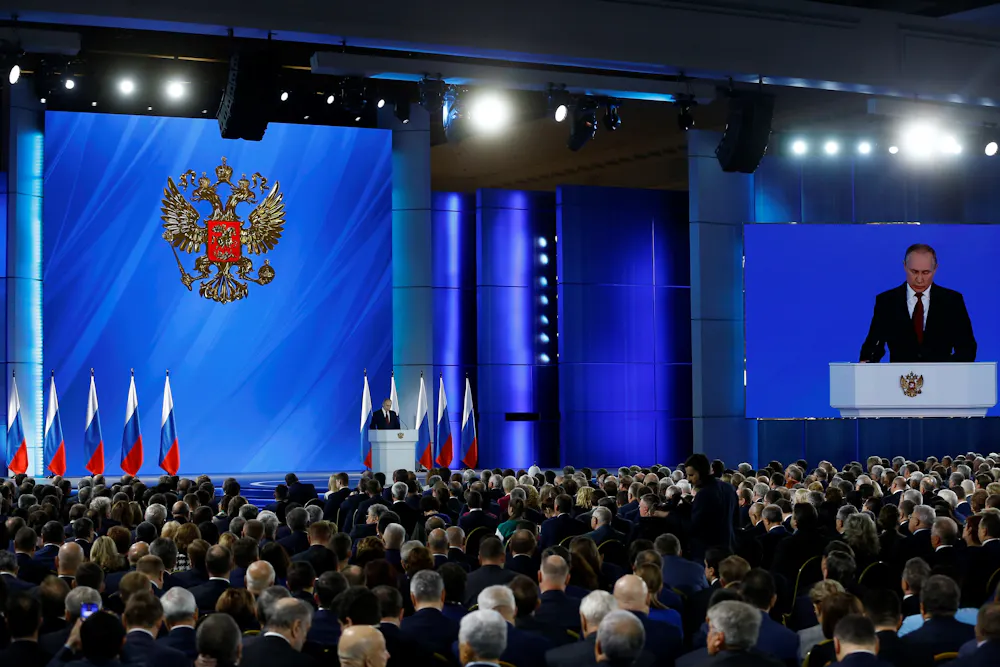
On Jan. 15, Putin gave his annual state of the nation address and unveiled “serious changes to the political system.” In response to the proposed constitutional amendments, which Putin is promoting as “reforms,” Prime Minister Medvedev and his government resigned.
Russian President Vladimir Putin delivers the annual state-of-the-nation address to the Federal Assembly of the Russian Federation in Moscow on Jan. 15, 2020.
Future presidents would retain control of the security forces and the military but must consult the State Council.
The proposal is being touted in leading Russian newspapers as “democratic reform.” In fact, while appearing to redistribute power among the high-level players in the Kremlin, the details that will determine power relations remain vague.
On Monday, Putin’s spokesman stated that specifics will be developed in consultation with the Russian people. Given regime controls over voting and national campaigns, this nod to the people is a form of window dressing.
In making these changes and accepting the government’s resignation, President Putin is laying the groundwork for several paths to retain power, including as prime minister or head of a strengthened State Council, an advisory body to the president.
Putin’s proxies are already arguing that these reforms will prevent political crisis in 2024 and increase living standards.
The second problem is that Putin and his United Russia party need to win large majorities in parliamentary and presidential elections. Russia’s sluggish economy and citizens’ frustration with poor government services will undermine support for regime candidates.
This plan, betting on the regime’s capacity to control elections, is risky. Outright electoral fraud will almost surely provoke protest.
Still, these so-called reforms are timed well before the election to allow Putin and his allies to rebuild support in the wake of any negative reaction. The Kremlin is preserving room to respond and correct course.
In accepting the government’s resignation, Putin blamed it for the country’s economic decline, and placed recovery and improved standards of living at the top of his political agenda.
3. What’s next?
Putin’s regime has successfully sold unpopular reforms to skeptical voters in the past. Earlier government attempts to promote pension and housing program changes provide a model for superficial responsiveness to popular demands.
A rally in Moscow in September 2018 against a retirement age reform proposed by the Russian government.
To channel discontent Putin proposed a national referendum on the changes.
So Duma deputies will hold meetings in their districts. Party leaders will meet with constituents and hear their concerns. Officials will make amendments to the proposed changes that appear to address those concerns, but in ways that don’t fundamentally change their intent. The process will occur quickly to thwart any opposition organization.
The new prime minister will announce economic reforms and an infusion of state funds into the economy. These actions will also create an impression of responsiveness and win voter support.
As elections approach, the Kremlin will warn of potential crisis, offering Putin as the guarantor of stability. The message will be, as it has been in the past, that Putin is the bulwark against crisis.
I believe Putin will continue to meddle in U.S. politics and elections to prolong the country’s democratic crisis. This effort will serve both domestic and international agendas, by destabilizing the U.S. and making democracy look unappealing to ordinary Russians, who associate the dismal economic and political conflicts of the 1990s with Russian attempts at democratic reform.
The trajectory is clear in Russia’s newly revealed hack of the Ukrainian firm Burisma, where Joe Biden’s son Hunter served as a board member. This effort by Russia, presumably to unearth embarrassing information about the Biden family, is likely intended to inflame partisan tensions around the impeachment trial of President Donald Trump.
Distracting the U.S. with domestic strife also limits its capacity to challenge Russia abroad.
Lev Parnas, a longtime associate of Donald Trump’s personal attorney Rudy Giuliani, is causing “concern” among White House officials after he publicly turned on the president and claimed “Trump knew exactly everything that was going on that Rudy Giuliani was doing in Ukraine.”
While some senators, including Sen. John Cornyn (R-TX), have downplayed the relevance of Giuliani and Parnas’ efforts in Ukraine as they pertain to Trump’s impeachment, CBS White House correspondent Weijia Jiang on Sunday said there’s “a recognition among sources who are being honest that even if [Parnas is] not an official witness, he’s already impacting this trial.”
“Unless senators are completely tuned out, they are absorbing what he is saying and they are seeing what he is dropping in these document dumps,” Jiang said on CBS “Face the Nation.”
“So, even though the president insists that he has no idea who Parnas is, the problem is Parnas has receipts,” she said.
“And selfies!” Host Margaret Brennan noted.
“Exactly!” Jiang replied. “Not one, not two, but a whole collection that tell a story of two men that know each other over the course of years. So the president has to add to his defense, he can’t just say, ‘I don’t know who he is.’”
The New York Times on Sunday endorsed Senators Amy Klobuchar and Elizabeth Warren for the Democratic presidential nomination, its first time choosing two candidates.
The liberal newspaper's pick comes just a few weeks before the Iowa caucuses on February 3 which officially begins the presidential primary season.
The Times described Massachusetts senator Warren as the "radical" and Minnesota senator Klobuchar as the "realist" choice.
"An essential debate is underway between two visions that may define the future of the (Democratic) party and perhaps the nation," the editorial board wrote.
"Some in the party view President Trump as an aberration and believe that a return to a more sensible America is possible. Then there are those who believe that President Trump was the product of political and economic systems so rotten that they must be replaced."
"Both the radical and the realist models warrant serious consideration," the board said. "That's why we're endorsing the most effective candidates for each approach. They are Elizabeth Warren and Amy Klobuchar."
Warren has consistently polled at third place, behind former vice president Joe Biden and Vermont Senator Bernie Sanders -- Warren's fellow progressive. She surged during the summer but has seen her support slide since October.
But The Times called her the new "standard-bearer for the Democratic left," praising her plans for structural and social reform.
"Ms. Warren's path to the nomination is challenging, but not hard to envision," the board said.
For Klobuchar, who is more moderate, The Times said her "lengthy tenure in the Senate and bipartisan credentials would make her a deal maker (a real one) and uniter for the wings of the party -- and perhaps the nation."
"May the best woman win," The Times concluded.
For the first time, The Times detailed its decision-making process on its television show "The Weekly".
The episode shows the editorial board's interviews with nine leading Democratic presidential hopefuls.
In addition to Warren and Klobuchar, The Times spoke with Biden, Sanders, billionaire activist Tom Steyer, entrepreneur Andrew Yang, South Bend mayor Pete Buttigieg, former Massachusetts governor Deval Patrick and New Jersey senator Cory Booker, who dropped out of the race in December.
The interviews were conducted on the record. In addition to showing video clips of the interviews in the "Weekly" episode, the Times Opinion section also published interview transcripts.
CNN host Fredricka Whitfield did battle with President Donald Trump's official apologist on the network, Jim Schultz.
Schultz quoted Sen. Ted Cruz (R-TX), who said that if Democrats want witnesses, then all witnesses should be available to be called. The problem is that Republicans want to call people that weren't even involved in Trump's obstructions of Congress. Republicans want to call Vice President Joe Biden and his son, there are likely some Republicans who want to call Hillary Clinton to talk about Benghazi again, and they'll likely search for reasons they can randomly call Democratic officials in Congress, who also had nothing to do with Trump's actions.
"Well, even Adam Schiff, right, how did this investigation begin? How credible was this investigation? All of those things factor into relevancy because it goes to the credibility of the investigation," Schultz claimed.
Republicans have wanted the whistleblower to appear so that they can legally out him and attack his life and his family. Generally, in a court, a witness is not on trial. An example some legal scholars have used is that when a person calls the fire department to report a fire, they are generally not attacked in an arson investigation for making the call to authorities.
Whitfield asked if it was even realistic to propose something like that, which Schultz conceded didn't appear likely.
Schultz then tried Trump's talking point that Democrats couldn't first-hand witnesses and documents for their trial. The reason, of course, is that the president is obstructing Congress. By attacking Democrats for not having the witnesses and documents, Republicans are admitting that the president is obstructing the proceeding.
"But they are claiming obstruction of Congress, which means the White House barred people who were being subpoenaed to show up or documents that were subpoenaed from being handed over. So, hence, the Article of Obstruction of Congress," Whitfield hit back.
"That's a made-up crime, quite frankly," said Schultz.
"That is what happened, though, right? One of them did stop testimony from people who were subpoenaed?" Whitfield hit back.
During an interview with NBC News' "Today" on Saturday, Pam Bondi, the former attorney general of Florida and one of the lawyers representing President Donald Trump in impeachment matters, dismissed the photograph released by House Democrats that shows her with indicted Rudy Giuliani associate Lev Parnas.
"Clearly, Lev Parnas liked to take pictures with a lot of people," said Bondi unconcernedly. "He showed up at events pretty much everywhere where Republicans were."
Asked about Trump's relationship with Parnas, she added, "I don't know what that matters, what they're planning on doing with it. We're going to stick to the facts and stick to the law in this case."
Bondi and Trump's association goes back years. She attracted national attention in 2016 after she dropped her state's investigation into the fraudulent Trump University, right after soliciting a $25,000 campaign donation from the then-presidential candidate.
Parnas is facing charges of campaign finance fraud. He and his business partner Igor Fruman were instrumental in helping Trump and Giuliani in a scheme to pressure the president of Ukraine into announcing an "investigation" into former Vice President Joe Biden's family.
On November 4, 2008, the United States achieved something that many older African-Americans feared they would never live to see: it elected its first black president — and in 2012, President Barack Obama won a second term. But Obama’s presidency was followed by the Donald Trump era, and according to a Washington Post/Ipsos poll conducted earlier this month, most African-Americans have a very low opinion of Obama’s successor in the White House: the poll found that eight out of ten blacks in the U.S. believe that President Trump is a racist.
Nine out of ten African-Americans, according to the poll, disapprove of Trump’s job performance — and 65% of African-Americans believe it is a “bad time” to be black in the United States.
A talking point one often hears in the right-wing media is that African-Americans have fared better under Trump than they did under Obama. But truth be told, the Great Recession ended under Obama; unemployment was down to 4.7% (according to the U.S. Bureau of Labor Statistics) in December 2016, Obama’s last full month in office. And the Post/Ipsos poll found that most African-Americans credit Obama more than Trump for the United States’ economic recovery: 77% of African-Americans, according to the Post and Ipsos, believe Trump deserves “only some” or “hardly any” of the credit for the decrease in black unemployment following the Great Recession.
The poll found most African-Americans to be pessimistic about the future: only 16% believe that black children born in the U.S. today have a “good opportunity to achieve a comfortable standard of living.”
Kenneth Davis, a 48-year-old African-American truck driver who lives in the Detroit suburbs, told the Post that Trump has encouraged racists to come out of the closet. Davis pointed to a white co-worker who is now “waving the Confederate flag on the back of his pickup truck.”
An African-American who responded to the survey asserted that Trump “has created an atmosphere of division and overt racism and fear of immigrants unseen in many years” — and another respondent told the Post that Trump “has taken hatred against people of color in general from the closet to the front porch.”
If any Democrats have doubts about the importance of the black vote to their party, the poll (which was conducted January 2-8) should shatter those doubts: the poll indicated that only about 4% or 5% of respondents are open to the possibility of voting for Trump in November. But African-Americans are more excited about some Democratic presidential candidates than others: the Post reports, “The level of Democratic support depends on who is the party’s nominee, peaking at 82% for former Vice President Joe Biden and falling to 57% for former South Bend, Indiana Mayor Pete Buttigieg.
Disgraced former Baylor University President Kenneth Starr, best known for his role investigating Bill Clinton, has been added to the Trump legal defense team for the impeachment trial, according to media reports.
Starr’s investigation into Clinton’s sexual misconduct, culminating with the Starr Report, led to Clinton's impeachment. Starr also previously served as a federal judge for the District of Columbia Circuit in the 1980s. Under President George H.W. Bush, he served as U.S. solicitor general, arguing cases before the Supreme Court.
Starr was named the 14th president of Baylor University in Waco in 2010 and chancellor in 2013. After the mishandling of campus sexual assault allegations, he was ousted as president in 2016 and resigned as chancellor and law professor shortly after, cutting all ties with the university.
The sexual assault scandal began after a Baylor football player, Sam Ukwuachu, was convicted of rape. (In July, an appeals court reversed the decision and ordered a new trial for the second time in two years.) Testimony during the trial revealed that though Baylor investigated the allegations against Ukwuachu, it failed to take any punitive action. Soon after the conviction, a wave of additional sexual assault allegations were made by female students. An investigation by an outside law firm retained by the university found a pervasive mishandling of sexual assault cases.
During one of many resulting Title IX suits against Baylor, lawyers alleged that Starr and other university officials helped a student they knew to be accused of sexual harassment. The university eventually settled with several of the accusers.
Starr will join Robert Wray, who also served as independent counsel during the Clinton impeachment proceedings, and Harvard Law School professor and defense attorney Alan Dershowitz, who is known for his representation of controversial figures like O.J. Simpson and Jeffrey Epstein.
Also added to the team was former Florida Attorney General Pam Bondi, who was hired by the White House to handle impeachment communications in November. In 2013, a political action committee for Bondi's reelection received a $25,000 donation from the Donald J. Trump Foundation. Shortly after, Bondi announced she wouldn't pursue the dozens of complaints against Trump University.
The team will be headed by White House counsel Pat Cipollone and Trump's personal lawyer, Jay Sekulow.
These appointments come days after House Speaker Nancy Pelosi announced U.S. Rep. Sylvia Garcia of Houston will be one of seven Democrats to prosecute the impeachment case in the Senate.
The House voted largely along party lines in December to impeach Trump over allegations he used his office to pressure the Ukrainian president to investigate a family member of his political rival, former Vice President Joe Biden. Only the Senate has the power to remove a president with a two-thirds majority vote. It's considered unlikely the Republican-controlled Senate would join with Democrats to remove Trump from office.
Trump is the third U.S. president to be impeached by the House. No president has ever been removed from office by the Senate.
The Senate impeachment trial began Thursday with the reading of articles of impeachment. House Democrats will begin presenting the case against Trump next Tuesday.
During a "Women for Trump" event in Iowa this Thursday, President Trump's daughter-in-law, Lara Trump, seemingly mocked Joe Biden's speech impediment and suggested the Democrats are in big trouble having him as a front runner in the 2020 election.
"Every time he comes on stage and they turn to him, I'm like, Joe can you get it out, let's get the words out, Joe," Trump said. "You kinda feel bad for him."
According to Trump, who is the wife of President Trump's son Eric, Biden's frontrunner status is a result of the Democrats being "desperate."
"That is why they have tried since the day he came down the escalator to stop Donald Trump," she said, referencing the 2015 moment when Donald Trump descended the Trump Tower escalator to announce his candidacy.
Biden's struggles with speech are well known, and he's had the issue since he was a child. He described his experiences with having a speech impediment to The Atlantic recently.
Watch Lara Trump make her comments about Biden in the video below:
America's most famous celebrity attorney, Alan Dershowitz, said Friday he would be part of the legal team defending President Donald Trump in his Senate impeachment trial.
According to US media reports, another high-profile member of the team will be Ken Starr, the special prosecutor in the 1988 Bill Clinton impeachment.
Starr is a hero to many on the right, even if Clinton ultimately was acquitted in the Senate.
"Professor Dershowitz will present oral arguments at the Senate trial to address the constitutional arguments against impeachment and removal," said a statement on his personal Twitter account.
"He believes the issues at stake go to the heart of our enduring Constitution."
With past clients including convicted sex offender Jeffrey Epstein, O.J. Simpson, film director Roman Polanski and Mike Tyson, Dershowitz is probably the best known lawyer to the stars in the United States.
He will be part of a team with serious firepower headed by the White House's discreet but uncompromising counsel Pat Cipollone.
Trump, a Republican, is accused of abusing his office by pressuring Ukraine to dig up dirt on a Democratic election rival Joe Biden.
Cipollone is behind the White House's strategy of refusing to cooperate with Democratic investigators throughout the impeachment probe.
The White House has yet to announce the full team but confirms that Cipollone will be the lead lawyer, backed by Trump attorney Jay Sekulow.