President Donald Trump today is living the dream. Actually, living a dream he's had for at least two years: to preside over fireworks at Mt. Rushmore, the iconic 93-year-old national monument to four of America's greatest presidents.
The first item on the President's White House schedule is a 4:45 PM ET departure for what will be more than four hours of travel via Marine One, Air Force One, and presumably some form of government ground transportation to the the Black Hills of Keystone, South Dakota, the home of the Mount Rushmore National Memorial. The First Lady is expected to accompany the President.
The fireworks celebration begins at 8:10 PM Mountain Time, 10:10 PM ET.
At 9:50 MT the President and First Lady will begin their trip back to Washington D.C. They are scheduled to arrive at the White House at 4:25 AM ET.
Environmental experts and former officials who oversaw Mt. Rushmore, a U.S. National Park, have cautioned against holding fireworks in July, citing concerns over brush fires and contamination of drinking water.
“I think it’s insane to explode fireworks over flammable material and ponderosa pine vegetation,” Bill Gabbert, a former National Park Service fire management officer, told The Washington Post. Gabbert oversaw Mount Rushmore and six other national parks for three years.
Cheryl Schreier, superintendent at Mount Rushmore National Park between 2010 and 2019, told the Post it's a "bad idea based on the wildland fire risk, the impact to the water quality of the memorial, the fact that is going to occur during a pandemic without social distancing guidelines and the emergency evacuation issues."
7500 tickets were reportedly given out.
“Fireworks shows,” the Post's report also noted, “had been held at the memorial between 1998 and 2009, until U.S. Geological Survey scientists determined the activities left high levels of a toxic chemical called perchlorate in drinking water used by the 3 million people who visit the memorial annually.”
According to a report from Politico, a White House-endorsed task force run by the Justice Department to go after COVID-19 price gougers and scam artists is running into interference from others in the White House who believe that the free market should be the arbiter of what is fair or not.
Earlier this year, as the country was swamped by the coronavirus pandemic that had the public sheltering at home and hospitals scrambling for enough personal protection equipment (PPE), the White House worked in concert with Attorney General Bill Barr to roll out a task force whose mission was to root out and prosecute individuals and companies indulging in price-gouging the much-needed medical supplies.
However, when it came to time to go after and prosecute perpetrators, some officials at the White House urged caution and a go-slow approach that has hindered the task force members from following through.
"Behind the scenes, according to people familiar with the discussions, some White House officials expressed reservations and concerns about the task force’s approach, and some disagreed with DOJ officials about how to use one particular legal authority," Politico's Betsy Woodruff Swan and Josh Gerstein wrote. "And now, three months after its inception, some advocates say the task force isn’t cracking down hard enough on Covid profiteers. DOJ spokespeople didn’t provide a list of price-gouging cases it has brought, and searches of department news releases reveal only a handful of cases."
According to one source with knowledge of the debate between the White House and Justice, "This was more of a philosophical dispute between people who wanted to go aggressively after those who were hoarding and gouging, and those more partial to letting the market sort it out,” before adding, "The White House folks had no involvement in charging decisions, but there is a degree of overlap with certain actions that need to be taken under the DPA [Defense Production Act], so there had to be some coordination.”
As a result, prosecutions have lagged.
"The resistance from White House staffers materialized shortly after the rollout of the task force, according to the people familiar with the situation. It came from staffers whom one source described as 'free-marketeers,' who felt the massive influx of people wheeling and dealing for PPE was a sign that the free market was working efficiently to move materials where they needed to go," the Politico report states. "Another source described two broad mindsets at play. The first mindset was held by those with prosecutorial sensibilities, who viewed the massive, lightning-fast influx of newcomers into the PPE sector with deep suspicion. The second was held by the free market proponents, who saw it as a sign the invisible hand was doing what it does best: moving goods where they needed to go."
According to Kyle Herrig of government watchdog group Accountable US, not enough is being done.
“The Trump administration has never met a consumer it wanted to protect or a nefarious business it wanted to prosecute. That the DOJ is allowing companies to take advantage of Americans during a global pandemic is as shocking as it is shameful,” he explained. “The lack of price-gouging enforcement has cost Americans millions of dollars and endangered lives — further proof that the administration is not looking out for its citizens in a time of crisis.”
A Black man was stabbed Wednesday during an altercation in a Bowie, Maryland supermarket. The incident allegedly occurred after he was spotted with his white girlfriend and then accused of betraying his race.
"I was just shopping in Giant with my girlfriend," the victim, Avery, told WUSA9.
Another Black man reportedly approached the interracial couple after they bumped grocery carts. The suspect then pulled out a knife and started yelling at them.
"He said I'm a betrayal of my kind for messing with a white girl," Avery said. “If you think there's something wrong with somebody for messing with another race, you're just as bad as the racist people yourself bro. That's racist."
Avery stepped in front of the suspect to protect his partner and began to wrestle with him, police said. At some point during the struggle, Avery was stabbed in his right leg.
Police have detained 26-year-old Marcus Crews as a suspect.
"Hate truly has no place here in Bowie, Maryland, and we stand firm in upholding service with integrity to such a wonderful city," Bowie Police said in a statement.
A 69-year-old man in Houston, Texas, was recently charged with aggravated assault with a deadly weapon after he allegedly shot at two teens after confronting them over a Black Lives Matter shirt, according to ABC 13 Eyewitness News.
Investigators said that the suspect, Santiago Fernandez, questioned two Black teens about the shirt as they were going home from a corner store.
"He asked us if we believed in Black Lives Matter... he kept on harassing us and he told us we don't belong in the neighborhood," one of the victims told ABC 13.
The situation escalated and Fernandez followed two teens home and fired his weapon.
In his column for the Daily Beast, conservative commentator -- and Never-Trumper -- Matt Lewis said Americans are likely to witness GOP lawmakers not only moving away from Donald Trump but also openly criticizing him because his influence is at an all-time low and he can't hurt them with voters as he could in the past.
With the president's poll numbers spiraling downward and the likelihood that he will be re-elected slipping away, Lewis claims that, while he doesn't expect Trump to quit the race, he does expect endangered Republicans to quit the president.
As Lewis, points out, the GOP under Donald Trump has not fared well, with a stunning 48 percent of House Republicans having "retired, resigned, been defeated, or are retiring in 2020.”
While many were replaced by more conservative Trump true believers, a substantial number lost to Democrats in the 2018 "Blue wave" that turned into a referendum on the president.
Using history as their guide, and with the president floundering under a tidal wave of scandals, Republicans running for re-election in 2020 are starting to see criticizing the president -- if not totally flipping on him -- as a winning strategy.
Pointing to a Reuters report that, "Senate Majority Leader Mitch McConnell may have to advise Republican Senate candidates to distance themselves from Trump if needed to win election and keep their majority,” Lewis suggested that where the is smoke, there is fire.
"To mitigate the damage, some Republicans might be forced to throw Trump under the bus. Others, seeing the writing on the wall, might simply feel liberated to do so by choice. Rep. Liz Cheney, a member of the latter group, has already begun speaking out against some of Trump’s actions and suffered no blowback," he wrote. "Once upon a time, this sort of betrayal would have been swiftly punished. But it has become increasingly clear that Trump’s ability to influence and intimidate Republicans has diminished."
Adding, "The danger for Trump is that he reaches a tipping point where he becomes politically a dead man walking—when he becomes a joke. It seems like we are rapidly approaching that point where the levee breaks.," Lewis suggested that Trump attacking a Republican who is critical of him would likely blow up in the party's face.
"Consider how this could play out if Trump reaches his breaking point and decides to seek revenge against his fellow Republicans who, having written him off, try to save their own skin. If he goes after them on Twitter, it would do nothing to attract liberal voters to their cause. But it definitely would depress the votes of Trump’s base. So this would only make their defeats more likely still," Lewis wrote before flatly proclaiming, "It’s looking increasingly like the GOP could be decimated come November."
As for the president's odds of staying in office, the conservative writer doesn't see it happening and admitted he is looking forward to the president's defeat.
"There is mounting evidence that Trump is not only a looming disaster, but also a regrettable mistake. A lot of these people are going to pretend they were never really in bed with Trump—that they didn’t do what everyone saw them do," he wrote before concluding, "Personally, I’m looking forward to watching the walk of shame."
A woman was recently caught on video attacking a Black teenager with her bag on the San Francisco peninsula. The victim says the incident started as he was stretching for his daily jog.
"There's this lady coming behind me, she's getting like really loud and yelling belligerent things at me, telling me to get out of the way,” 17-year-old Steve Johnson Jr. told NBC Bay Area.
The teen started filming the incident after another woman said he should capture the incident on video.
In the video, the woman can be seen hitting Johnson with her bag as she yells "get your f*cking camera off of me."
The police later cited the woman for misdemeanor child abuse.
Johnson told NBC Bay Area he easily could have defended himself, but decided not to.
"As a trained boxer, and ranked no. 6 in the United States, I feel like, if I would have reacted the way a lot of people would have assumed I would have reacted by punching that lady, I would be the one on the news, for hurting an old lady, an old Caucasian lady," he said.
June 2020 will go down in history as a month in which the coronavirus death toll continued to soar in the United States while the country was rocked by double-digit unemployment and huge protests in response to the horrific killing of George Floyd in Minneapolis on May 25. And according to New York Times reporters Maggie Haberman, Jonathan Martin and Alexander Burns, it will also go down in history as a terrible month for President Donald Trump and his reelection campaign.
In an article published on July 2, the Times reporters delve into some of the reasons why Trump’s campaign fared so badly in June — and one of the main reasons is his erratic response to the coronavirus pandemic. In June, the COVID-19 death count passed 100,000 in the U.S.; by July 3, it was up to up to 128,740, according to researchers at Johns Hopkins University in Baltimore. Worldwide, the pandemic has killed more than 521,800 people.
“The disconnect between the surge in coronavirus cases and Mr. Trump’s dismissive stance toward the pandemic has been particularly pronounced, mystifying Democrats and Republicans alike,” Haberman, Martin and Burns explain. “This week, as some states halted their reopening because of a record-setting number of new cases, the president predicted the virus would “just disappear.”
June was also a terrible month for Trump because of his consistently bad poll numbers.
“In addition to public surveys showing him losing decisively to Joseph R. Biden, Jr. in a number of battleground states,” the Times journalists note, “private Republican polls in recent weeks show the president struggling even in conservative states, leading Mr. Biden by less than five points in Montana and trailing him in Georgia and even Kansas, according to GOP officials who have seen the data.”
Haberman, Martin and Burns point out that Trump’s other “missteps” in June range from his “inflammatory response to racial justice protesters” to his “ill-considered rally in Tulsa.” For their article, the Times interviewed more than 45 Republican strategists and officials — some of whom are in the Trump Administration — and they found a mood of despair and frustration.
“Letting Trump be Trump will delight some of his most committed supporters,” the Times reporters note, “but it is likely to dishearten Republicans who are already nervous about losing the Senate and yielding further ground in the House.”
One Republican who has been sounding the alarm, according to the Times, is former New Jersey Gov. Chris Christie — who has warned that Trump will lose to Biden if he continues to campaign like it’s still 2016. And Sen. Mitt Romney is also warning that Trump is dropping the ball.
“What I find hard to understand is that in order for the president to get reelected, he’s going to want to see a really strong economy,” Romney asserted. “So, I would think the president would be on the air hammering his base to get the economy back and win the election.”
Appearing on MSNBC's "Morning Joe" with hosts Joe Scarborough and Mika Brzezinski, the founder of CNBC walked viewers through a scenario where Donald Trump would attempt to remain president even if he is rejected by the voters in November.
According to Rogers, who began by saying his scenario was "not farfetched" he believes Trump has no chance of winning the election and will do anything to remain in office.
"This is how it happens, Biden wins," he began. "I don't just mean the popular vote, he wins the key swing states, he wins the electoral college. President Trump says there's been Chinese interference in the election. He's been talking about Biden's soft on China -- China wanted Biden to win so he says a national emergency; the Chinese have intervened in the election."
"Why do I think that's real?" he continued. "Just ten days ago he tweeted, he actually tweeted, 'rigged 2020 election,' millions of mail-in ballots will be printed by foreign countries it will be the scandal of our times. so he's laying the groundwork for this. So he does an investigation and [Attorney General Bill] Barr backs this up with all kinds of legal opinions about emergency powers that the president has."
"Then what happens is it's all geared towards December 14th. Why December 14th? Well, that's the deadline when the electors of the states have to be chosen," he elaborated. "Why is that key? Because that's what the Supreme Court used in Bush v. Gore to cut off the Florida counting. They keep this national emergency investigation going through December 14th. Biden, of course, challenges this in the courts and says, 'hey, we won these states, I want the electors that favored me named. The Supreme Court doesn't throw the election to the Republicans as it did in 2000, instead it says, 'look, there's a deadline here.' If they can't be certified in these states because of this investigation going on, there's a constitutional process for this."
"What's the constitutional process? It goes to the House of Representatives," Roger continued. "Everybody says, 'that's good. Nancy Pelosi and the Democrats control the House. No. when a presidential election is thrown into the House of Representatives under the Constitution, it's state-by-state vote. Each state gets one vote based on the number of Republicans and Democrats in that delegation. Today Republicans control the House on that kind of vote it 26-23 with on delegation, Pennsylvania split. Even if Pennsylvania was to elect a Democratic delegation, come this new election because it's the new Congress that votes here, it would be 26 to 24 Republicans and Trump retains the presidency."
He then concluded, "It is not so farfetched -- he [Trump] is planning to do this."
As presumptive Democratic presidential nominee Joe Biden gets set to pick his vice presidential candidate, here’s a reality check: Running mates have very little direct effect on voters. When people go to the polls, they are primarily expressing a preference for the presidential candidate, not the second person on the ticket.
In our new book, “Do Running Mates Matter?,” my collaborator Kyle Kopko and I analyze half a century of political science survey data to examine what effect a running mate has on the success of presidential candidates.
In general, voters are very unlikely to choose a presidential ticket simply because they like or dislike the second-in-command.
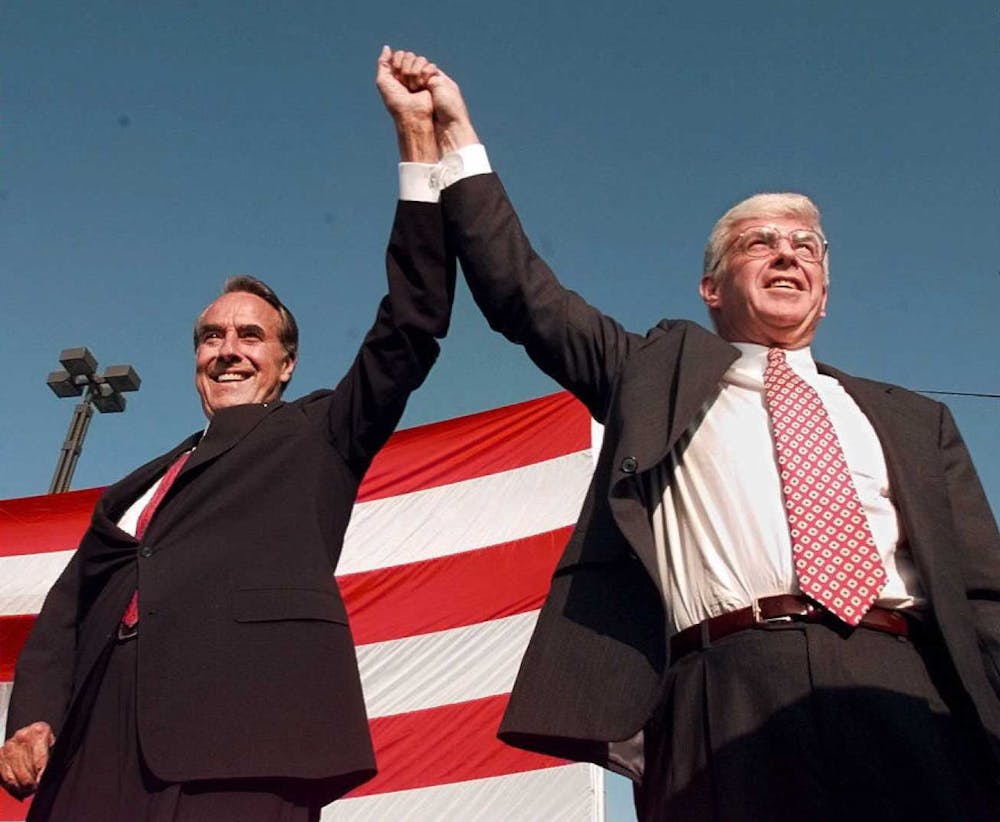
Picking Jack Kemp, right, as his running mate didn’t help 1996 Republican nominee Bob Dole win the election.
On rare occasions, voters can be swayed by running mates who are much more – or less – popular than their party’s main candidate. For instance, John Kerry’s vice presidential candidate in 2004, former North Carolina Sen. John Edwards, was relatively popular with voters early in the campaign. And, as our research shows, Edwards’ popularity made voters more likely to vote for Kerry, at least in the short term.
However, we found that voters view vice presidential choices as new information about the main candidate – and that information can shift voters’ views and change votes. The candidate’s choice gives voters insight into who the candidate really is, what he or she stands for and how the person might operate once in office.
Take the 2008 presidential election, for example, when Democrat Barack Obama ran against Republican John McCain with Joe Biden and Sarah Palin as their respective vice presidential nominees.
In our book, we demonstrate that voters who doubted Palin’s qualifications also were more likely to doubt McCain’s judgment and think he was too old to be president. As a result, they were less likely to vote for McCain.
John McCain, right, picked Sarah Palin, second from left, as his running mate in 2008.
Conversely, our analysis also showed that voters who believed Biden was well qualified for office were more likely to approve of Obama’s judgment – and less likely to think he was too young to be president. As a result, they were more likely to vote for Obama.
In 2020, Joe Biden is already well known as an experienced former vice president, so it’s unlikely his running mate will outshine him on her own. But with this choice, Biden has a valuable opportunity to define himself as a candidate – and a potential president – in his own right.
What does he really stand for? What are his political priorities? And does he have the good judgment to be president?
Biden’s selection will help voters to answer these questions – and to decide whether he deserves their support in November.
Editor’s note: This is an adapted version of an earlier article by Christopher Devine and Kyle Kopko originally published on May 7, 2020.
Appearing on MSNBC's "Morning Joe," regular contributor Donny Deutsch said he would not be surprised at all if Donald Trump dropped out of the 2020 presidential race because he wouldn't be able to face losing to former Vice President Joe Biden in a landslide.
Speaking with hosts Joe Scarborough and Mika Brzezinski, Deutsch -- who has known Trump for years -- said the president is looking at a humiliating defeat and may not stick around and let it happen.
'We've got four months to the election but we're now entering the 57th month out of a 60-month experiment with Donald Trump," he explained. "He is baked at this point, Joe Biden is baked at this point."
"When you look at the 2016 election, you had Donald Trump who was an unknown, Hillary [Clinton] a known. Now we've got two knowns," he continued. "And none of this stuff is going to work. It is just -- it's a pathetic attempt -- people are not stupid, just like they're not stupid about their health. They're just not stupid and, Joe, I want to go back to something you teed up last week that I have been thinking all week."
"I would not be shocked at some point if he doesn't drop the mic," Deutsch admitted. "It's [the election] is not turning around. This is a guy that I cannot see standing up and owning the biggest landslide defeat in U.S. history. I know you have been throwing it out in, a lot of people are saying no, that's not possible. But the more I think about it, the more I'm jumping on your bandwagon. I don't see this guy going the distance."
"Morning Joe" hosts Joe Scarborough and Mika Brzezinski ridiculed Donald Trump on Friday morning after the president took aim at presumptive presidential campaign opponent Joe Biden in a Twitter boast that read: "He cannot pass the test I 'aced'. He should give it a try!!!"
After the two hosts finished giggling at the president's claim, Brzezinski explained what Trump's test was comprised of.
"He's still talking about that test. they show a picture of a lion and say what is this? That's what he's bragging about?" Scarborough smirked.
"Here's in the cognitive test that he claimed he aced," co-host Brzezinski explained. "As the New York Times explained back in 2018, to assess attention and concentration subjects are read a list of five digits and are asked to repeat them in the order they were provided. Other exercises include drawing a clock with the hands pointing to 11, 10 and then identifying a lion, rhino or a camel. A perfect score is 30. A score from 26 to 30 is considered normal."
"And two years later, he is bragging about being able to identify a lion or a rhino or a camel," Scarborough re-emphasized.
With Brzezinski reminding viewers about Trump's claim that he only uses the "best words," the Morning Joe hosts then shared a supercut of the president bumbling and slurring his way through speeches before his fans.
After President Donald Trumpsaid during his June 20 rally in Tulsa Oklahoma, that increased testing was responsible for the surging number of infections, the condemnation of the inaccurate claimwas swift.
Six days later, during a Fox News town hall, Sean Hannity asked Trump about those remarks on increased testing.
“Sometimes I jokingly say, or sarcastically say, if we didn’t do tests we would look great,” he replied.
This seems to be a pattern. Two months earlier, the president had mused about the beneficial effects of injecting disinfectants into the body to combat COVID-19. After many health officials expressed their dismay, Trump repeatedly claimed that he was just being sarcastic.
That same month, after he misspelled “Nobel Prize” in a tweet – writing it out as “Noble Prize” – he deleted the tweet before falling back on on a familiar excuse: sarcasm.
What is it about sarcasm that makes it such a convenient excuse for people who are trying to distance themselves from what they’ve said?
As I describe in my recent book on irony and sarcasm, most cognitive scientists and other language researchers think of sarcasm as a form of verbal irony. Both ways of speaking involve saying the opposite of what you mean. But the goals of irony and sarcasm are actually different.
For example, if someone slowly intones “What beautiful weather!” on a cold and rainy day, it’s clear they’re speaking ironically about a disappointing state of affairs. In general, irony is used to provide commentary on unexpected and negative outcomes.
Sarcasm, on the other hand, is most frequently used to disparage the actions of other people. If someone tells you that you’re a real genius after you forgot to meet them for an important appointment, they clearly don’t mean that you’re mentally gifted. Simply put, irony is commentary, but sarcasm is criticism.
That seems straightforward enough. But in actual practice, the line between irony and sarcasm is blurry and confusing. Many people assert they are being sarcastic when they are in fact being ironic, as in commenting about the weather.
The enlargement of the domain of sarcasm – at irony’s expense – is a linguistic shift that has been going on for some time. In fact, linguist Geoffrey Nunberg called attention to this phenomenon 20 years ago. So it’s hard to fault the president for conflating the two.
Another element that makes sarcasm tricky to grasp has to do with saying the opposite of what is meant. The recipient of such a statement isn’t supposed to take it literally.
For this reason, when we use verbal irony or sarcasm, we might employ cues to signal our nonliteral intent. We may, for example, speak in a tone of voice that’s slower, lower and louder than how we speak normally. Our pitch may swoop up or down. Ironic statements are also frequently accompanied by facial displays, such as a smirk or the rolling of the eyes.
And that’s why, when being sarcastic over text or email, we’ll use emojis to relay nonliteral intent. Of course, even then, there’s no guarantee that the recipient will interpret the message correctly.
President Trump does, at times, clearly make use of sarcasm. For example, at a December 2019 rally in Hershey, Pennsylvania, he said, referring to the House’s imminent decision to initiate impeachment proceedings, that the Democrats “also understand poll numbers, but I’m sure that had nothing to do with it.” He signals sarcasm by using absolute words like “sure” and “nothing” and by gesturing broadly with both hands. He also pauses to give his audience a moment to interpret his remark as the opposite of what he has said – that, in fact, “my high poll numbers have everything to do with impeachment.” The remark is sarcastic because there’s a clear target: the Democrats in Congress.
Trump gets sarcastic during his Dec. 10, 2019 rally in Hershey, Pennsylvania.
But at both the Tulsa rally and his April press conference, the president’s controversial remarks didn’t have such accompanying verbal and nonverbal cues. He wasn’t being critical of anyone; he was simply asserting that testing leads to more infections, or asking what appeared to be sincere questions about the use of disinfectants to combat the virus. Chances are he literally meant what he said.
As the president has repeatedly demonstrated, a claim of intended sarcasm can be used to walk back a remark that has been criticized or otherwise fallen flat. Thanks to our slippery understanding of the term, along with the way sarcasm can be easily missed, it can function like a “Get Out of Jail Free” card: The speaker can take a conversational mulligan and try to make things right.
We’ve all said things that we later regretted and appealed to “just kidding” or “I was being sarcastic.” However, if we habitually reach for such excuses to absolve ourselves of linguistic sins, it becomes, like the little boy who cried wolf, less and less effective.
According to a report from the Daily Beast, Donald Trump is privately fuming that he is getting no credit for rising employment numbers as workers return after being furloughed and businesses begin to reopen after being shut down in the early days of the coronavirus pandemic.
With the past two job reports showing decreases in unemployment numbers, the president and his administration have been touting the bounceback at the same time that the country is still suffering with 11 percent unemployment and an estimated 25 million Americans still out of work.
According to the Beast, based on interviews with three White House insiders, the president is furious about the lack of plaudits and puts a large part of the blame on the media.
"He’s argued that if former Vice President Joe Biden were in the White House during the current moment, the media would be fawning over the strong job gains," the report states before adding, "Trump’s gone so far as to suggest that Democrats would want to build 'statues' honoring Biden, one of the sources said. Elsewhere, he’s griped about how the 'phony' polls conducted by independent organizations aren’t reflecting more voter enthusiasm about economic rejuvenation, another source recounted."
More concerning to White House officials is the fact that he is also not getting a bump in the polls as the economy improves -- something he had been counting on in his bid to be re-elected.
"Trump’s mounting frustrations underscore the degree to which he’s tied his personal political fortunes to the state of the economy. And they come as a major collision with Democrats over the economy’s future emerges on the horizon," the report states before adding that the president is at a crossroads over a new COVID-19 economic stimulus package that could help Democrats if they get what they want while he gets no credit for keeping the economy afloat.
According to one economic adviser close to the president, unless workers flood back to their jobs, he doesn't see a path to re-election.
“If our numbers are accurate, it’s hard to see how Trump can get re-elected with millions and millions of people unemployed,” conservative financial analyst Stephen Moore admitted.
The Beast report adds, "Some of the president’s top advisers working on his reelection effort have grown increasingly concerned that modest economic gains between now and the election in November simply won’t be enough to drag their candidate across the finish line to a second term," with two officials admitting "feeling nervous last month" when they saw the president poor polling numbers stay the same after 2.5 million Americans returned to work in May.